Today in God’s Lavish Mercy, our first reading invites us to a wedding and our Gospel shows us the way to heaven.
The marriage of Tobiah and Sarah is a nail-biter! Seven would-be husbands have already died in the honeymoon chamber! Sarah’s father is so convinced that Tobiah will be the eighth that, after the couple goes to bed, he digs a grave just in case. But Tobiah, like his father Tobit, is a good and just man. His heart is pure. Before they make love, Tobiah and Sarah pray and God hears their prayer, allowing Raphael to dispel the demon that has plagued Sarah’s earlier disastrous marriage attempts.
So what is happening here in terms of scriptural inspiration? Is this just a great beach book for the Jews scattered after the Assyrian captivity? Certainly not. The Book of Tobit offered spiritual stability to the uncertain world of the Jews in exile. In a clever story, the narrator outlines the essential guideposts for the believer to hold fast to their identity and faith – primarily with these concepts:
God is in charge and will remain faithful even if we do not. Imagine that!
Our faithfulness is demonstrated by religious fidelity, humility, prayer, patience and good works.
God’s faithfulness is demonstrated by bringing good even out of chaos and misfortune.
Our modern understandings are not that different from those of Tobit’s ancient author. In some sense, we all live “in exile”, at least from our final heavenly home. And God, of course, is still in charge. But we see God’s power in our lives not as preordained management but rather as a steadfast companionship in our own life’s unfolding drama.
Our life is not a book God has already written. In a mystery we cannot comprehend, our Omnipotent God chooses to live our lives with us, its direction unfolding as we continue to mature in God’s Love.
Our Gospel tells the story of a scribe deepening in that maturing process. He asks Jesus what is most important to live a good life. Jesus says what’s most important is love – love of God and love of neighbor. When the scribe responds in agreement, Jesus tells him that he is not far from the kingdom of God.
Perhaps our prayer today could be this: May deepening Love carry each of us all the way home to God’s heart.
Poetry: Heaven-Haven by Gerard Manley Hopkins
(A nun takes the veil) I have desired to go Where springs not fail, To fields where flies no sharp and sided hail And a few lilies blow. And I have asked to be Where no storms come, Where the green swell is in the havens dumb, And out of the swing of the sea.
Alleluia, alleluia. Mary is taken up to heaven; a chorus of angels exults.
Today, in God’s Lavish Mercy, we honor Mary on the Feast which celebrates her assumption, “that the Immaculate Mother of God, the ever Virgin Mary, having completed the course of her earthly life, was assumed body and soul into heavenly glory.”
The Catholic Church’s teaching on the Assumption of Mary was promulgated in 1950 by Pope Pius XII in an Apostolic Constitution entitled “MUNIFICENTISSIMUS DEUS (the Most Bountiful God). Having experienced the horrors of a world war, and aware of the ensuing evils of the Cold War, Pope Pius XII looked to Mary for healing for himself and the whole world:
We, who have placed our pontificate under the special patronage of the most holy Virgin, to whom we have had recourse so often in times of grave trouble, we who have consecrated the entire human race to her Immaculate Heart in public ceremonies, and who have time and time again experienced her powerful protection, are confident that this solemn proclamation and definition of the Assumption will contribute in no small way to the advantage of human society, since it redounds to the glory of the Most Blessed Trinity, to which the Blessed Mother of God is bound by such singular bonds. It is to be hoped that all the faithful will be stirred up to a stronger piety toward their heavenly Mother, and that the souls of all those who glory in the Christian name may be moved by the desire of sharing in the unity of Jesus Christ’s Mystical Body and of increasing their love for her who shows her motherly heart to all the members of this august body. And so we may hope that those who meditate upon the glorious example Mary offers us may be more and more convinced of the value of a human life entirely devoted to carrying out the heavenly Father’s will and to bringing good to others. Thus, while the illusory teachings of materialism and the corruption of morals that follows from these teachings threaten to extinguish the light of virtue and to ruin the lives of men by exciting discord among them, in this magnificent way all may see clearly to what a lofty goal our bodies and souls are destined. Finally it is our hope that belief in Mary’s bodily Assumption into heaven will make our belief in our own resurrection stronger and render it more effective.
MUNIFICENTISSIMUS DEUS (42)
Maybe, like me, the fact of the Assumption doesn’t matter a whole lot to you. I love Mary whether she was “assumed” or not. But in its time, the declaration of this dogma was important in order to turn the world’s focus toward Mary, a figure of goodness, courage, love, mercy and justice – virtues desperately necessary for healing in the aftermath of war.
Our own world could surely benefit from a prayerful, loving contemplation of Mary.
Mary was a woman so open to God that she enfleshed God’s Spirit in the person of Jesus. She was a vessel of love – for God and for all Creation. By living her ordinary life with extraordinary love and holy courage, she became blessed.
Mary, the Blessed Mother of all of us, can teach us to love, reverence, strengthen and support one another when we pray with her as we meet her in the Gospel.
Elizabeth said:
“Blessed are you who believed that what was spoken to you by the Lord would be fulfilled.”
And Mary said: “My soul proclaims the greatness of the Lord; my spirit rejoices in God my Savior for God has looked on my simplicity with favor . From this day all generations will call me blessed: the Almighty has done great things for me and holy is God’s Name. In every generation, God has mercy on those with holy reverence and awe.
Poetry: The Blessed Virgin compared to the air we breathe… by Gerard Manley Hopkins, SJ
( I know this is a really long poem, and Hopkins can seem a little convoluted. But the images in this poem are spectacular … even if you just read a bit at a time. It’s so worth it.)
Wild air, world-mothering air, Nestling me everywhere, That each eyelash or hair Girdles; goes home betwixt The fleeciest, frailest-flixed Snowflake; that’s fairly mixed With, riddles, and is rife In every least thing’s life; This needful, never spent, And nursing element; My more than meat and drink, My meal at every wink; This air, which, by life’s law, My lung must draw and draw Now but to breathe its praise, Minds me in many ways Of her who not only Gave God’s infinity Dwindled to infancy Welcome in womb and breast, Birth, milk, and all the rest But mothers each new grace That does now reach our race— Mary Immaculate, Merely a woman, yet Whose presence, power is Great as no goddess’s Was deemèd, dreamèd; who This one work has to do— Let all God’s glory through, God’s glory which would go Through her and from her flow Off, and no way but so.
I say that we are wound With mercy round and round As if with air: the same Is Mary, more by name. She, wild web, wondrous robe, Mantles the guilty globe, Since God has let dispense Her prayers his providence: Nay, more than almoner, The sweet alms’ self is her And men are meant to share Her life as life does air. If I have understood, She holds high motherhood Towards all our ghostly good And plays in grace her part About man’s beating heart, Laying, like air’s fine flood, The deathdance in his blood; Yet no part but what will Be Christ our Saviour still. Of her flesh he took flesh: He does take fresh and fresh, Though much the mystery how, Not flesh but spirit now And makes, O marvellous! New Nazareths in us, Where she shall yet conceive Him, morning, noon, and eve; New Bethlems, and he born There, evening, noon, and morn Bethlem or Nazareth, Men here may draw like breath More Christ and baffle death; Who, born so, comes to be New self and nobler me In each one and each one More makes, when all is done, Both God’s and Mary’s Son. Again, look overhead How air is azurèd; O how! nay do but stand Where you can lift your hand Skywards: rich, rich it laps Round the four fingergaps. Yet such a sapphire-shot, Charged, steepèd sky will not Stain light. Yea, mark you this: It does no prejudice. The glass-blue days are those When every colour glows, Each shape and shadow shows. Blue be it: this blue heaven The seven or seven times seven Hued sunbeam will transmit Perfect, not alter it. Or if there does some soft, On things aloof, aloft, Bloom breathe, that one breath more Earth is the fairer for. Whereas did air not make This bath of blue and slake His fire, the sun would shake, A blear and blinding ball With blackness bound, and all The thick stars round him roll Flashing like flecks of coal, Quartz-fret, or sparks of salt, In grimy vasty vault. So God was god of old: A mother came to mould Those limbs like ours which are What must make our daystar Much dearer to mankind; Whose glory bare would blind Or less would win man’s mind. Through her we may see him Made sweeter, not made dim, And her hand leaves his light Sifted to suit our sight. Be thou then, thou dear Mother, my atmosphere; To wend and meet no sin; Above me, round me lie Fronting my froward eye With sweet and scarless sky; Stir in my ears, speak there Of God’s love, O live air, Of patience, penance, prayer: World-mothering air, air wild, Wound with thee, in thee isled, Fold home, fast fold thy child.
Music: Magnificat – Mina
Magnificat anima mea Magnificat Dominum et exsultavit spiritus meus In Deo salutari meo Magnificat, Magnificat Quia respexit humilitatem ancillae suae Ecce enim ex hoc beatam me dicent omnes generationes Magnificat anima mea Magnificat Dominum et exsultavit spiritus meus In Deo salutari meo Magnificat, Magnificat Quia fecit mihi magna qui potens est Et sanctum nomen ejus Magnificat, Magnificat Dominum et exsultavit spiritus meus In Deo Magnificat, Magnificat
Lyrics translation
My soul magnifies the The lord and my spirit rejoices In God my saviour Magnificat, Magnificat For he has looked on his servant in her lowliness Behold this blessed shall call me blessed all generations The Magnificat my soul Magnifies the The lord and my spirit rejoices In God my saviour Magnificat, Magnificat Because I made a big who is able And holy is his name Magnificat, Magnificat The lord and my spirit rejoices In God Magnificat, Magnificat
Today, in God’s Lavish Mercy, we have the beautiful letter from Paul to Timothy, filled with tenderness, encouragement, hope and the sweet suggestion of loving memories.
Paul, an Apostle of Christ Jesus by the will of God for the promise of life in Christ Jesus, to Timothy, my dear child: grace, mercy, and peace from God the Father and Christ Jesus our Lord.
2 Tim 1:1
On life’s road, what an indescribable blessing to have even one companion who loves us the way Paul loved Timothy — to care for our whole life, our whole soul, and our whole “forever”.
Timothy and His Mother, Eunice – Henry Lejeune
In his letter, Paul reveals that Timothy has been immensely blessed with such love throughout his life. Timothy’s mother and grandmother, Eunice and Lois have already – for many years – tendered Timothy in the faith.
I think gratefully of my own mother today, on the 34th anniversary of her death. How indescribably blessed I have been by her love and faith!
In this heartfelt epistle, Paul notes that he prays for Timothy daily. Perhaps as you read his words you may, like me, think of those who have nurtured and cared for you in a way similar to Paul’s love for Timothy; to Eunice’s and Lois’s love for him.
Do we pray for those who have blessed us and loved us in our lives? Do we tell them so, if they are living? Do we thank and remember them if they have gone home to God?
Paul closes this part of his letter with such a powerful charge to Timothy:
For this reason, I remind you to stir into flame the gift of God that you have through the laying on of my hands.
In other words, it is not enough just to be grateful for such gifts. We must use them to light and warm a next generation of believers and faith-filled lovers.
Many people have rested the hands of blessing on our spirits, our hearts. May we be filled with generous gratitude today and everyday.
For those who have done otherwise, may we forgive them and, as best we can, release them to God’s Mercy. Perhaps they, by the grace of God, have left us with another kind of “gift” — as Mary Oliver has written:
Someone I loved once gave me
a box full of darkness.
It took me years to understand
that this, too, was a gift.
Poetry: God’s Grandeur – Gerard Manley Hopkins
The world is charged with the grandeur of God.
    It will flame out, like shining from shook foil;
    It gathers to a greatness, like the ooze of oil
Crushed. Why do men then now not reck his rod?
Generations have trod, have trod, have trod;
    And all is seared with trade; bleared, smeared with toil;
    And wears man's smudge and shares man's smell: the soil
Is bare now, nor can foot feel, being shod.

And for all this, nature is never spent;
    There lives the dearest freshness deep down things;
And though the last lights off the black West went
    Oh, morning, at the brown brink eastward, springs —
Because the Holy Ghost over the bent
    World broods with warm breast and with ah! bright wings.
Music: for your remembering prayer: James Last – Coulin
Today, in God’s Lavish Mercy, we pray with Psalm 9 and its beautiful verse which is echoed in several other Psalms:
I will give thanks to you, O LORD, with all my heart; I will declare all your wondrous deeds. I will be glad and exult in you; I will sing praise to your name, Most High.
Psalm 9: 2-3
Like so many of our readings lately, today’s point us toward a consideration of the “afterlife” or the “end times”. I know you may have had enough of such considerations, but the Church isn’t giving up quite yet!
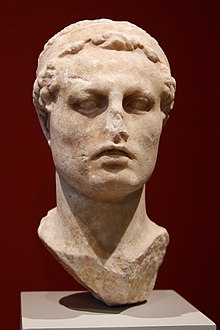
Antiochus IV, wikipedia
Maccabees gives us a colorful account of the defeat, dismay and ultimate death of Antiochus IV, persecutor of the Jews. The account, like most of the Books of Maccabees, is primarily historical, not spiritual or theological. But threaded through the books, of course, is the underlying biblical orientation that God-Yahweh is present and active in all life’s circumstances.
Today’s passage has even pagan Antiochus considering how God/Fate has brought him to judgement- to “payback” time:
But I now recall the evils I did in Jerusalem, when I carried away all the vessels of gold and silver that were in it, and for no cause gave orders that the inhabitants of Judah be destroyed. I know that this is why these evils have overtaken me; and now I am dying, in bitter grief, in a foreign land.
1 Maccabees 6:11-13
In our Gospel account, some Sadducees question Jesus about marriage laws and the afterlife. Their questioning reminds me of modern songwriter Eric Clapton’s musings in his song:
Tears in Heaven – Eric Clapton
Jesus doesn’t sing to the Sadducees, as far as I know. Rather, he answers them this way:
Those who are deemed worthy to attain to the coming age and to the resurrection of the dead neither marry nor are given in marriage. They can no longer die, for they are like angels; and they are the children of God because they are the ones who will rise.
Luke 20:35-36
So for us today, the questions and concerns of both Antiochus and the Sadducees might lead us to consider how we feel about the “afterlife”.
Do you ever wonder what heaven will be like? Will we see our beloveds once again? Will we see our “unbeloveds” too and what will that be like!! Do you calculate whether or not you’ll even make the cut through the Pearly Gates?
When I think about heaven these two promises of Jesus sustain, comfort and animate me. Maybe you’ll consider their power too as you pray today.
I have come that you may have life, and have it to the full.
John 10:10
Eternal life is this, that they know you, the only true God, and Jesus Christ, whom you have sent.
I have desired to go
Where springs not fail,
To fields where flies no sharp and sided hail,
And a few lilies blow.

And I have asked to be
Where no storms come,
Where the green swell is in the havens dumb,
And out of the swing of the sea.
Music: Here’s a beautiful piece of music to accompany you in your “considerations”.
Nocturne No.20 in C-Sharp Minor – Frédéric Chopin, played by Joshua Bell
Today, in God’s Lavish Mercy, we pray with Psalm 34, thought to be a young David’s thanksgiving prayer after God saved him from one of his many dangerous escapades.
In telling his deliverance story, David invites his friends to celebrate with him and to learn the faith-lesson he has learned:
Glorify the LORD with me, let us together extol his name. I sought the LORD, and he answered me and delivered me from all my fears.
I picture myself sitting in David’s audience, absorbing the words of his prayer. This line strikes me:
The LORD has eyes for the just, and ears for their cry.
Ah, the Lord has eyes for me….for ME! It conjures up sounds of The Flamingos, doesn’t it? (Sorry for the transcriber’s misspelling 😀)
Most of us want to think that we are individually special to God. This desire is at the core of the Protestant Evangelical model, “a personal relationship with Jesus Christ”. But for some, this model has become confused with a prosperity gospel that is quite misleading.
The only prosperity we should seek from God is the gift of grace because:
Yahweh’s peculiar inclinations are with the broken-hearted and the ones with crushed spirit. That is, Yahweh’s solidarity is not with the ones who go from success to success, but the ones denied success.
Walter Brueggemann The Message of the Psalms A Theological Commentary Ausberg Publishing House 1984
Still, such a personal relationship is not alien to a full and complete faith:
Faith is above all a personal, intimate encounter with Jesus, and to experience his closeness, his friendship, his love; only in this way does one learn to know him ever more, and to love and follow him ever more. May this happen to each one of us.
Pope Benedict XVI, General Audience, 2009
(Look for an extra prayer about “The Eye of God” in another post today.)
However, our psalm alerts us that this deeply personal dimension is only part of relationship with God.
When the just cry out, the LORD hears them, and from all their distress he rescues them. The LORD is close to the brokenhearted; and those who are crushed in spirit he saves.
To be seen and heard by God, one must be part of the just community. To be close to God, one must feel the brokenheartedness of the poor. We come to the psalmist’s exuberant praise only by walking with suffering, either in our own lives, or beside others who bear distress.
From all their distress God rescues the just.
Psalm 34 teaches us that our personal relationship with God is interdependent with our relationship with the whole community. David calls his community to share in his praise-song because they- together -recognize God’s mercy and share it in concern for one another.
The LORD has eyes for the just, and ears for their cry.
Our Gospel today confirms that a personal love for God thrives only within a communal love. The prayer Jesus shares is not “My Father”. It is “Our Father”. We come to the depths of God’s merciful heart with our sisters and brothers.
Poetry: An Inclusive Lord’s Prayer – Author unknown
Loving God,
in whom is heaven,
may Your name be honored everywhere.
May Your Mercy reign.
May the desire of Your heart for the world
be done,
in us, by us and through us.
Give us each and all
the bread we need for the day.
Forgive us.
Free us to forgive others.
Keep us from all anxiety, fear, and selfishness.
For You reign in the power that comes from love
which is Your glory
forever and ever.
Amen.
Today, in God’s Lavish Mercy, we pray with Psalm 17, a confident prayer calling on God’s intervention.
The psalmist tenders a plea:
Hear, O LORD, a just suit; attend to my outcry; hearken to my prayer from lips without deceit.
Psalm 17:1
But before reiterating that plea, the pray-er convinces God that she is worthy of an answer:
You have tested my heart, searched it in the night. You have tried me by fire, but find no malice in me. My mouth has not transgressed as others often do. As your lips have instructed me, I have kept from the way of the lawless.
Psalm 17: 3-4
It sounds a little boastful but it really isn’t. The one who prays this psalm is very familiar with God and God with her. There are no secrets between them. She knows that she is infinitely loved and protected, not despite her vulnerability but because of it.
The psalmist, from long experience, is confident asking for help, as we would be asking a friend to turn and listen to us:
I call upon you; answer me, O God. Turn your ear to me; hear my speech.
Psalm 17: 7
Have you ever been asked for prayers because you are “a good prayer”? It happens to nuns all the time.
But no prayer is more powerful than another. We say “Of course” to such requests because it is our intention to join our prayer with that of the requester.
Show your wonderful mercy, you who deliver with your right arm those who seek refuge from their foes. Keep me as the apple of your eye; hide me in the shadow of your wings
Psalm 17: 8-9
Each of us is God’s “eye-apple”. Each of us, when we give ourselves to a long familiarity with God, will be wrapped in the confidence of one who is always answered.
( In a second posting, I’ll be sending on an extra meditation on The Eye of God by Macrina Wiederkehr – beautifully profound.)
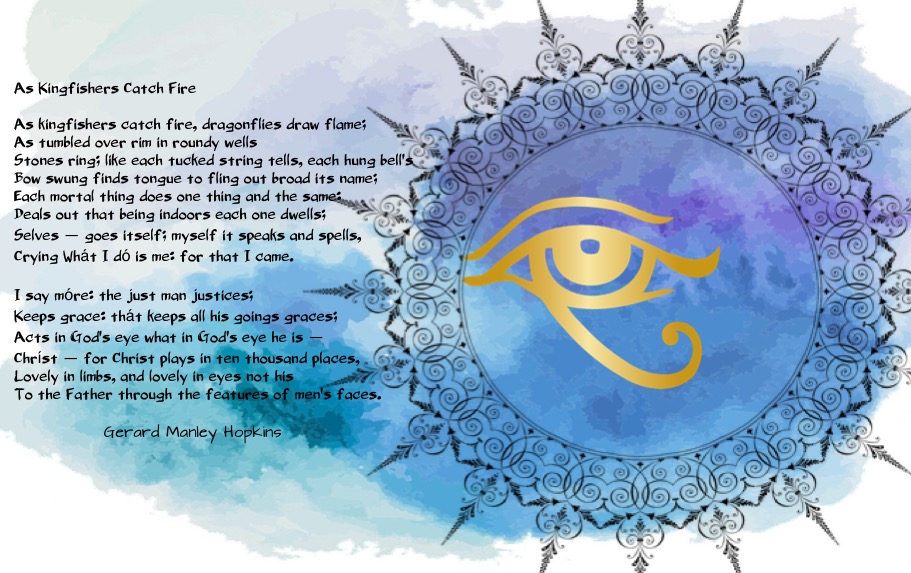
Poetry: As Kingfishers Catch Fire – Gerard Manley Hopkins
by Alcedo Atthis
As kingfishers catch fire, dragonflies draw flame; As tumbled over rim in roundy wells Stones ring; like each tucked string tells, each hung bell’s Bow swung finds tongue to fling out broad its name; Each mortal thing does one thing and the same: Deals out that being indoors each one dwells; Selves — goes itself; myself it speaks and spells, Crying Whát I dó is me: for that I came.
I say móre: the just man justices; Keeps grace: thát keeps all his goings graces; Acts in God’s eye what in God’s eye he is — Chríst — for Christ plays in ten thousand places, Lovely in limbs, and lovely in eyes not his To the Father through the features of men’s faces.
Music: The Apple of My Eye by Umb-5 and Sam Carter
Sometimes a non-spiritual song captures a spiritual meaning in a beautiful way. Let God sing to you with this lovely song.









 Lavish Mercy