Be Impartial, or Not?

Thursday of the Sixth Week in Ordinary Time

February 20, 2020

Click here for readings

Today, in Mercy, two Apostles of Jesus are our teachers. James advises us on what to do. Beloved Peter, as so often is the case, shows us what not to do.

James tells us to show no partiality. He makes clear that he is talking about impartiality toward those who are materially poor. It’s a maxim that Jesus gave us time and again in the Gospel.

James2_1 partiality

James reminds us that Jesus is not just impartial toward the poor, he actually has a preferential love for them. So Jesus was partial to the poor, right? Hmm!

Yes, I think that’s right. In order to balance our human inclination to the richest, best, strongest, etc., Jesus teaches us to go all out in the other direction.

It’s like this great cartoon that’s popped up on Facebook recently:

equity


Our Gospel picks up the theme.

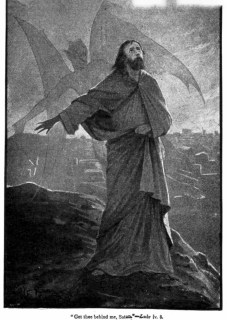
Because of his great love for the poor and his passion for mercy, Jesus tells his followers that suffering is coming. Peter doesn’t like hearing that. Can you see Peter take Jesus aside and say, “Listen, Jesus, negative talk is going to hurt you campaign. You’re God! You can just zap suffering out of your life!


behind me satan

Jesus responds to Peter definitively: “Get thee behind me, Satan!

Wow! That must have stung! But that’s how important it was to Jesus that his followers understood his mission: to preach Mercy to the poor, sick, and broken by sharing and transforming their experience.

Jesus wants us to understand that too.


Music: Beauty for Brokenness – Graham Kendrick

Like Trees Walking

Wednesday of the Sixth Week in Ordinary Time

February 19, 2020

Click here for readings

Today, in Mercy, our readings are around the theme of our spiritual senses.

James1_22 doers

James tells us to listen, look, see, and act on the Word planted within our hearts. Once again, he gives us great images to help our understanding.

mirror

For if anyone is a hearer of the word and not a doer,
he is like a man who looks at his own face in a mirror.
He sees himself, then goes off and promptly forgets
what he looked like.


horse


If anyone thinks he is religious
and does not bridle his tongue

but deceives his heart, his religion is vain.


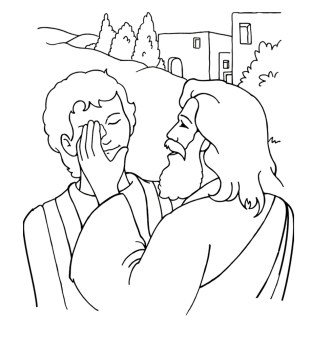
In our Gospel, once again our dear, earthy Jesus heals someone in a deeply human way. Jesus takes the blind man aside, holding his hand to lead him. As he did in a passage recently, Jesus spits on his fingers and massages the blind man’s eyes.

blind man

The man tries to work with Jesus, exclaiming that he sees “people like trees walking”. 

I’ve always loved that line because it makes me feel like I’m right there, listening to the man’s amazement!

As we pray this morning, we might wonder what Jesus said back to that overwhelmed man as they sat together. What might he say to us as he lifts one of our many blindnesses from our hearts?

Music:  I See Men As Trees Walking – Johnny Cash (lyrics below)

No Shadow of Turning

Tuesday of the Sixth Week in Ordinary Time

February 18, 2020

Click here for readings

Today, in Mercy, James continues with his spiritual encouragements. 

For one thing, he makes it clear that God doesn’t tempt us. Some of us make the mistake of thinking that, saying things like, “God is testing me.”

James, outlining a perfect way to examine one’s conscience, says this:

No one experiencing temptation should say,
“I am being tempted by God”;
for God is not subject to temptation to evil,
and God himself tempts no one.
Rather, each person is tempted when lured and enticed by his own desire.
Then desire conceives and brings forth sin,
and when sin reaches maturity it gives birth to death.


I don’t really like to talk about sins; I’d probably much rather commit them!!!! So if we have some little labyrinths of temptation and sinful habits ensnaring us, we should listen to James. He encourages us to examine and check our own concupiscent  desires as they are the seeds of our spiritual undoing. 

In my experience, these desires are usually disguised, pretending to be beneficial for us at first sight. But underneath, they are rooted in selfishness and excess, deviating us from our center in God. Just think how some of the famous ones have masqueraded into our lives: Pride, Envy, Gluttony, Sloth, Lust, Greed, Wrath (Vengeful Anger).


In the second part of this passage, James takes the tone up a notch. He reminds us that, once centered on God, we realize that only good things come from God.

All good giving and every perfect gift is from above,
coming down from the Father of lights,
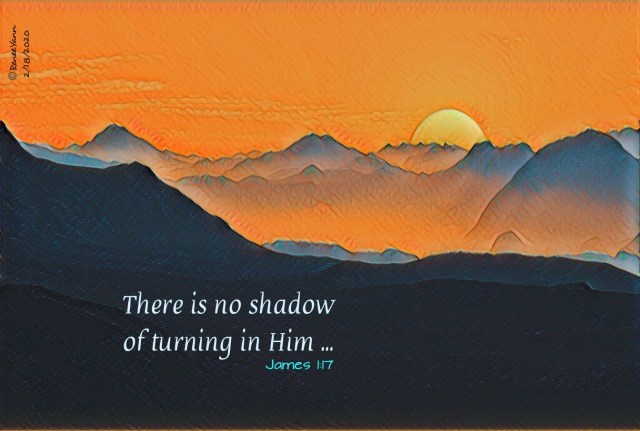
with whom there is no alteration or shadow caused by change.

I particularly love that last phrase, rendered in our hymn today like this:
James1_17 no shadow

It’s beautiful to see how James, as a real spiritual leader, is so aware of his flock’s human struggles. No doubt, he shares them. What a blessing that his wise and loving guidance has come down through the ages to us!

Music: Great Is Thy Faithfulness- Chris Rice

Count It All Joy!

Monday of the Sixth Week in Ordinary Time

February 17, 2020

Click here for readings

Today, in Mercy, in this week and a half before Ash Wednesday, we begin the Epistle of James.

800px-Epistle_of_James_Chapter_1-2_(Bible_Illustrations_by_Sweet_Media)
The Epistle of James- Chapter 1: Illustration provided to Wikimedia Commons by Distant Shores Media/Sweet Publishing as part of a cooperation project. Sweet Publishing released these images, which are taken from now-out-of-print Read’n Grow Picture Bible Illustrations (Biblical illustrations by Jim Padgett, courtesy of Sweet Publishing, Ft. Worth, TX, and Gospel Light, Ventura, CA. Copyright 1984.), under new license, CC-BY-SA 3.0

This letter is one of the very earliest of the New Testament. Scholars are mixed about exactly which “James” wrote it, but agree that it was one of several who were very close to Jesus – perhaps one of “the brothers of Jesus” mentioned in several New Testament passages:

  • Matthew 12:46-50
  • Mark 3:31
  • Luke 8:19
  • John 2:12
  • Acts 1:14
  • 1 Corinthians 9:5
  • and specifically “the Lord’s brother James” in Galatians 1:19

James writes in the style of Wisdom Literature, those Old Testament books that give advice, proverbs, and insights for living a holy life. His immediate audience was a community of dispersed Christian Jews whose world was filled with increasing upheaval and persecution.

When I read the following description I thought how germane James’s letter could be for our world today. His themes echo the teachings of Pope Francis for our chaotic time:


The epistle is renowned for exhortions on fighting poverty and caring for the poor in practical ways (1:26–27; 2:1-4; 2:14-19; 5:1-6), standing up for the oppressed (2:1-4; 5:1-6) and not being “like the world” in the way one responds to evil in the world (1:26-27; 2:11; 3:13-18; 4:1-10). Worldly wisdom is rejected and people are exhorted to embrace heavenly wisdom, which includes peacemaking and pursuing righteousness and justice (3:13-18).
(Jim Reiher, “Violent Language – a clue to the Historical Occasion of James.”Evangelical Quarterly. Vol. LXXXV No. 3. July 2013)


  • Be joyful in trials. (Wait! What!)
  • Let trials increase your perseverance not discourage you.
  • Doing this is a sign of wisdom.
  • When your wisdom is depleted, ask God for more with an open and trusting heart.
  • Honor all people, high or low in circumstances
  • Don’t be fooled by riches. They fade away.

In our Gospel, Jesus is frustrated with the Pharisees who insincerely demand a magical sign from him. They demonstrate none of the spiritual wisdom and openness to grace that James describes.

scale

When we think about our own faith, where does it fall on the scale of sincerity, on the spectrum of counter-culturalism?

Music: Count It All Joy – Scripture Memory Songs

Gaudete! Rejoice!

Third Sunday of Advent

December 15, 2019

Click here for readings

Gaudete 2019

Today, in Mercy, we celebrate Gaudete Sunday, a name which comes from the first word of the Introit of today’s Mass:

Gaudete in Domino semper: iterum dico, gaudete.
Rejoice in the Lord always; again I say, rejoice.

Our readings, too, counsel us to rejoice, and to do so with patience and honesty before God.


REJOICE:
Those whom the LORD has ransomed
…. will meet with joy and gladness (Isaiah 35:10)


BE PATIENT:
You too must be patient.
Make your hearts firm,
because the coming of the Lord is at hand. (James 5:8)


SPEAK HONESTLY WITH GOD:
When John the Baptist heard in prison of the works of the Christ,
he sent his disciples to Jesus with this question,
“Are you the one who is to come,
or should we look for another?” (Matthew 11:2)


As we pray with these verses, we might ask, similarly to John the Baptist:

  • Is the coming of the Lord really at hand?
  • Is our long wait to be complete in God really over?
  • Hasn’t this gone on for 2000 years with no Second Coming? 

Well, it all depends on how we look at it.

time


With our feet and our experiences firmly planted in a time-bound world, it is hard for us to enter God’s timeless view of our salvation.


With God there is no waiting. We already live in the fullness of God’s eternal life.

Our time-bound life is our chance to open ourselves to that Fullness by allowing our experiences to fashion us in the image of Christ.

Every moment, every encounter, every experience carries the invitation to this Complete Love. Continually answering this invitation brings us into an ever deeper transparency with God.

transparent


When we see and live our lives this way, joy captures us. Circumstances may not always leave us happy or satisfied (I mean, look at John, he was imprisoned). But they cannot claim our joy, because we see patiently through time’s veil to the eternity already within us.

This sacred insight is the gift of our Baptism in Christ.

Today, we draw closer to the celebration of his presence with us in history by his birth on Christmas. But the deeper celebration is Christ’s continual rebirth in our lives of joy, patience and honest relationship with God.

Music: Patience People – John Foley, SJ (Lyrics below)

Patience, people, till the Lord is come.
See the farmer await the yield of the soil.
He watches it in winter and in spring rain.

Patience, people,
for the Lord is coming. Patience, people, till the Lord is come.
You have seen the purpose of the Lord.
You know of His compassion and His mercy.

Patience, people,
for the Lord is coming. Patience, people, till the Lord is come.
Steady your hearts for the Lord is close at hand.
And do not grumble, one against the other.
Patience, people, for the Lord is coming.

Mrs. Zebedee, Again

Feast of Saint James, Apostle

July 25, 2019

Click here for readings

( I am republishing last year’s post for this feast. I think it is worth another read. But to make up for my little bit of laziness, I will send another post today with a few profound quotes from Henri Nouwen’s book Can You Drink the Cup? – Ave Maria Press; 10th Anniversary edition (October 1, 2012))


Today, in Mercy, we learn a lesson in humble leadership, thanks to “Mrs. Zebedee”. Our Gospel recounts the story of the mother of James and John interceding for her sons with Jesus. Like many overprotective mothers, she intervenes in their adult lives. She wants to make sure they get the best deal for their investment with Jesus.

Veronese-Le-Christ-rencontrant-la-femme-et-les-fils-de-zebedee_-_Grenoble
Veronese-Le-Christ-Rencontrant La Femme Et Les Fils de Zebedee By Paolo Veronese

Unfortunately, “Mrs. Zebedee” has missed the whole point of Christian discipleship. Her boys have decided to follow a man who says things like this:

  • The last shall be first and the first, last.
  • Unless you lay down your life, you cannot follow me.
  • Whoever takes the lowly position of a child is the greatest in the Kingdom of Heaven.

The seats at Christ’s right and left, which she requests for her sons, will bring them rewards only through humility and sacrificial service.

Jesus is gentle with “Mrs. Zebedee”. He understands how hard it is for any of us to comprehend the hidden glory of a deeply Christian life. We are surrounded by a world that screams the opposite to us:

  • Me first!
  • Stand your ground!
  • Good guys finish last!

Mk 10_38 cup

So Jesus turns to James and John. One can imagine the bemused look on his face. He knows the hearts of these two men. He knows they have already given themselves to him. So he asks them for a confession of faith, “Can you drink the cup that I will drink?”

Their humble, faith-filled answer no doubt stuns their mother. She is left in wonder at the holy men her sons have become. Perhaps it is the beginning of her own deep conversion to Christ.

As we pray with this passage on the feast of St. James the Apostle, where do find ourselves in this scene? How immediate, sincere, and complete is our response to Jesus’ question: “Can you drink the cup….?”

Music: Can You Drink the Cup? (Be patient. The song has a slightly delayed start. You may have to click the white arrowhead in the orange circle- upper left. Lyrics below.😀)

Can You Drink The Cup?

Lyrics by Pamela Martin, Music by Craig Courtney
Copyright 2001, Beckenhorst Press, Inc.

Can you dring the cup,
embrace it in your hands?
Can you look inside
and face what it demands?
In the wine you see
reflections of your soul.
No one else can drink
this cup that you must hold.

Can you drink the cup?
Then you must lift it high
though this cup of joy
holds pain and sacrifice.
When you lift your cup,
raise it unafraid.
Lift it up, this cup
of life, and celebrate.

Can you drink the cup
until there is no more?
When the wine is gone,
Christ Himself will pour.
Though you drink it all
the cup is never dry,
God keeps filling it
with everlasting life.