Alleluia: Full of Grace

Memorial of the Immaculate Heart of the Blessed Virgin Mary
June 25, 2022

Today’s Readings:

https://bible.usccb.org/bible/readings/062522.cfm

Today, in God’s Lavish Mercy, we pray with Mary, blessed mother of Jesus, and thus of us all who have been born anew in him.

Alleluia, alleluia.
Blessed is the Virgin Mary
who kept the word of God
and pondered it in her heart.

What can this beautiful mother teach us, she who kept and pondered the very Word of God?

In order to grow fully in to God’s heart and will, this holy woman held the Word – the way the dough holds yeast to allow its own transformation.

So that she might blossom into the fullness of her own beauty, she caressed faith’s slow-forming bud in the dark protection of her prayer.


Like all of us, Mary was not divine. She was not supernatural. She was an ordinary, good woman who loved God with extraordinary passion.

She spent her days clearing her heart-space of any clutter that would keep her from God. And slowly, that Divine Presence ripened and revealed itself in the flash of an angel wing and the soundless message that would transform all time.


We too, in our particular ways, are asked to allow God the space to imagine Divinity into flesh through our human experience.

Mary believed that God could and would do such a miracle for love of us. She let the Truth of Jesus live, not only in Him, but in her own mother’s life.

This generous mother then became the first disciple, keeping company with Jesus through his Passion, Death and Resurrection

Indeed, we have much to learn from her.


Poetry: Annunciation – Denise Levertov

We know the scene: the room, variously furnished,

almost always a lectern, a book; always
the tall lily.
Arrived on solemn grandeur of great wings,
the angelic ambassador, standing or hovering,
whom she acknowledges, a guest.

But we are told of meek obedience. No one mentions
courage.
The engendering Spirit
did not enter her without consent.
God waited.

She was free
to accept or to refuse, choice
integral to humanness.

____________________________

Aren’t there annunciations
of one sort or another
in most lives?
Some unwillingly
undertake great destinies,
enact them in sullen pride,
uncomprehending.
More often
those moments
when roads of light and storm
open from darkness in a man or woman,
are turned away from
in dread, in a wave of weakness, in despair
and with relief.
Ordinary lives continue.
God does not smite them.
But the gates close, the pathway vanishes.

______________________________

She had been a child who played, ate, slept
like any other child – but unlike others,
wept only for pity, laughed
in joy not triumph.
Compassion and intelligence
fused in her, indivisible.

Called to a destiny more momentous
than any in all of Time,
she did not quail,
only asked
a simple, ‘How can this be?’
and gravely, courteously,
took to heart the angel’s reply,
perceiving instantly
the astounding ministry she was offered:

to bear in her womb
Infinite weight and lightness; to carry
in hidden, finite inwardness,
nine months of Eternity; to contain
in slender vase of being,
the sum of power –
in narrow flesh,
the sum of light.
Then bring to birth,
push out into air, a Man-child
needing, like any other,
milk and love –

but who was God.

This was the moment no one speaks of,
when she could still refuse.

A breath unbreathed,
                                Spirit,
                                          suspended,
                                                            waiting.

______________________________

She did not cry, ‘I cannot. I am not worthy,’
Nor, ‘I have not the strength.’
She did not submit with gritted teeth,
                                                       raging, coerced.
Bravest of all humans,
                                  consent illumined her.
The room filled with its light,
the lily glowed in it,
                               and the iridescent wings.
Consent,
              courage unparalleled,
opened her utterly.


Music: Two versions of the magnificent “Ave Maria”.

Ave Maria – Franz Schubert – sung by Ms. Jessye Norman, in German as written by Schubert.

( I had the immense privilege and pleasure of meeting and working with the great Jessye Norman when I chaired a UNCF event in Philadelphia many years ago. She, in her own way, was a bit “divine”!)

Ave Maria – Charles Gounod – sung by Ms. Jessye Norman in Latin, as written

O, How We Are Loved!

December 16, 2021
Thursday of the Third week in Advent

Today, in God’s Lavish Mercy, we stand on the edge of the magnificent “O Antiphons”!

Tomorrow, December 17th, we will enter one of the loveliest times of the Liturgical Year – the proclamation of these powerfully beautiful verses leading us to Christmas.

The great O Antiphons are Magnificat verses used at Vespers on the last seven days of Advent. They are also used as the Alleluia verse on the same days. The importance of the O Antiphons is twofold.

  • First, each one is a title for the Messiah.
  • Second, each one refers to Isaiah’s prophecy of the coming of the Messiah.

Each year, as I prepare for this sacred interval,
I am reminded of an old family story.
I have written about it before,
and I hope those of you who have heard it
won’t mind hearing it again.


Aunt Peg on Her Wedding Day to Uncle Frank – 1929

I so loved my great-aunt Peg. She was that perfect mix of elegance and earthiness that both comforted and inspired.

Her husband, Uncle Frank, loved her totally. And to boot, he was a romantic which led him to proclaim that love often. One summer, in the 1950s, he surprised her with a second honeymoon trip to Niagara Falls.

Upon return, they visited us and Uncle Frank brought a movie of their trip.


camera

Now, taking a movie and eventually showing it was quite an accomplishment in the ‘50s. Not only were the camera and lights cumbersome, so was the screening equipment.

But that effort on my Uncle Frank’s part yielded a long-lasting blessing for me. It came in a brief scene still indelibly etched on my mind.


Aunt Peg, dressed in her Sunday best, stood looking over the rail at the majestic falls, her back to the camera. There was no sound on the film, but you could tell Uncle Frank had called to her to turn around. Knowing him, my guess was that he said something like, “Peg, you are as beautiful as the falls!”.

Aunt Peg turns and clearly, despite the silent film, mouths a bashful response,

“O, Frank!”.

Those two words, given with a slight blush and demure smile, carried the whole story of their very special love. They were, in a sense, my Aunt Peg’s “O Antiphon”. And they left me, even at a young age, with such a profound message.


Every time I have thought of that short phrase over these nearly 70 years, this is what I hear:

O, Frank!

  • how blessed am I to be so loved
  • how good you are to show that love so clearly
  • how grateful I am that you share your life with me
  • please know how much I love you in return

As we prepare for this beautiful and sacred time, I once again think of my dear Aunt Peg standing in the glory of both the magnificent Falls and my Uncle Frank’s tremendous love.

We, dear friends, are standing in awe at the passage of time into eternity. Our God calls to us to turn around and look into God’s loving face. As we pause in silent, grateful adoration, the roaring thunder of life silenced behind us, we respond with awe:

  • 17 December: O Sapientia (O Wisdom)
  • 18 December: O Adonai (O Lord)
  • 19 December: O Radix Jesse (O Root of Jesse)
  • 20 December: O Clavis David (O Key of David)
  • 21 December: O Oriens (O Dayspring)
  • 22 December: O Rex Gentium (O King of the Nations)
  • 23 December: O Emmanuel (O God With Us)

As we approach the opening of these profound prayers, let’s prepare our hearts to experience God’s tremendous love.

O Beloved God

  • how blessed am I to be so loved
  • how good you are to show that love so clearly
  • how grateful I am that you share your life with me
  • please know how much I love you in return

Poetry: O Emmanuel – Malcolm Guite

O come, O come, and be our God-with-us
O long-sought With-ness for a world without,
O secret seed, O hidden spring of light.
Come to us Wisdom, come unspoken Name
Come Root, and Key, and King, and holy Flame,
O quickened little wick so tightly curled,
Be folded with us into time and place,
Unfold for us the mystery of grace
And make a womb of all this wounded world.
O heart of heaven beating in the earth,
O tiny hope within our hopelessness
Come to be born, to bear us to our birth,
To touch a dying world with new-made hands
And make these rags of time our swaddling bands.

Music: O Divine Redeemer – Charles Gounod, sung by Jessye Norman

I have included the English lyrics below, although they are a little heavy for my purposes today. It is the beautiful imploring voice of Ms. Norman that I hope you will focus on as you play this music. The lyrics are really immaterial.

Ah, turn me not away, receive me though unworthy.
Hear Thou my cry, hear Thou my cry,
Behold, Lord, my distress!
Answer me from Thy throne,
Haste Thee, Lord, to mine aid!
Thy pity show in my deep anguish, Thy pity show in my deep anguish.
Let not the sword of vengeance smite me,
Though righteous Thine anger, O Lord!

Shield me in danger, O regard me!
On Thee, Lord, alone will I call!

O divine Redeemer, O divine Redeemer!
I pray thee grant me pardon, And remember not
Remember not my sins!
Forgive me!

O divine Redeemer! I pray Thee, grant me pardon
And remember not, remember not, O Lord, my sins!

Night gathers round my soul
Fearful, I cry to Thee,
Come to mine aid, O Lord!
Haste Thee, Lord, haste to help me!

Hear my cry, hear my cry
Save me, Lord in Thy mercy;
Hear my cry, hear my cry!
Come and save me, O Lord!

O divine Redeemer! O divine Redeemer!
I pray Thee, grant me pardon, and remember not
Remember not, O Lord, my sins!

Save in the day of retribution
From death shield Thou me, O my God!
O divine Redeemer, have mercy!
Help me Savior! 

Tuesday of the Fourth Week of Easter

April 27, 2021

Today, in God’s Lavish Mercy, we pray with Psalm 87 which is both a celebration of and a longing for God’s Presence as symbolized for the psalmist in Jerusalem, Zion, the Temple.

His foundation upon the holy mountains
    the LORD loves:
The gates of Zion,
    more than any dwelling of Jacob.
Glorious things are said of you,
    O city of God!

Psalm 87: 1-3

For the psalmist, who is in exile, Zion was the visible expression of God’s exclusive relationship with Israel – the longed-for Kingdom.


In our reading from Acts, the concept of God’s Kingdom takes a larger shape. Jewish Christians, scattered in persecution, began to share the Good News with Gentiles. Barnabas blesses this sharing. He and Paul spend a year in Antioch teaching these new Christians who will not have the same devotion to “Zion”.


So where is “the Kingdom” now?

Our Gospel shows us Jesus, walking in the Temple portico one winter morning. He stands amidst the very symbols extolled in Psalm 87. He points his listeners, who are still resistant, toward the only true “kingdom”, one he has described before:

Now when He was asked by the Pharisees when the kingdom of God would come, He answered them and said, “The kingdom of God does not come with observation; nor will they say, ‘See here!’ or ‘See there!’ For indeed, the kingdom of God is within you.”

Luke 17: 20-21

We know from the Beatitudes that the “kingdom of God” belongs to the poor and the persecuted:

Blessed are the poor in spirit,
    for theirs is the Kingdom of Heaven…..
……Blessed are those who are persecuted because of righteousness,
    for theirs is the Kingdom of Heaven.


Perhaps there is a touch of biblical irony in the fact that our poor and persecuted psalmist, exiled from beautiful Zion, already possessed the “kingdom” within! But, without the benefit of Jesus’s teaching, it seems he didn’t realize it.

Do we realize it? 


Prose: from Hans Küng

(For my spiritual reading recently , I returned to an old favorite Hans Küng, a revered Catholic priest and Vatican II theologian who died earlier this month. Word of his death took me back to my 1960s heady theology days.🙏😇)

Here are two relevant quotes to our thoughts on “the Kingdom” today:

The meaning of the church does not reside in what it is but in what it is moving towards. It is the reign of God which the church hopes for, bears witness to and proclaims.

Hans Küng: The Church

The kingdom of God is creation healed.

Hans Küng: On Being a Christian

Music: The Holy City, Jerusalem sung by Jessye Norman

Holy Thursday

Evening Mass of the Lord’s Supper

April 1, 2021

Today, in God’s Lavish Mercy, we pray with Psalm 116 which Walter Bruggemann calls an example of “the performance of thanks”. 

How shall I make a return to the LORD
    for all the good he has done for me?
The cup of salvation I will take up,
    and I will call upon the name of the LORD.

Psalm 116: 12-13

There is a tone of solemn ritual woven through the psalm, just as there is throughout the Holy Thursday liturgies.

The time of waiting and wondering is over. Jesus chooses the Passover meal to formalize his understanding that the time has come to offer his life in an ultimate sacrifice of praise.

Before the feast of Passover, Jesus knew that his hour had come
to pass from this world to the Father.
He loved his own in the world and he loved them to the end.

John 13:1

The Last Supper by the nun Plautilla Nelli (1524–1588) of Florence
Inscribed: Suor Plautilla · Orate Pro Pictora (Pray for the Paintress)

It is likely that, during his Last Supper, Jesus would have prayed, and possibly sung, Psalm 116 as part of the ancient Hallel,  six thanksgiving prayers included in the Passover rites. 

On our behalf, Jesus is about to enflesh in his own life the redemptive promise awaited through the ages. He is about to enact the Great Deliverance — far greater than that achieved in the Passover. By the power of his Paschal sacrifice, we are redeemed from death itself:

Return, my soul, to your rest;
the LORD has been very good to you.
For my soul has been freed from death,
my eyes from tears, my feet from stumbling.
I shall walk before the LORD
in the land of the living

Psalm 116: 7-9

For me, Holy Thursday is the most solemnly beautiful and meaningful day of the Liturgical Year. There is so much to be found in the readings, especially as we peel back single phrases to hear their living power and love. There is so much to be learned at the side of Jesus as we pray with Him.

May we place ourselves beside Jesus at the holy table of his life. Feel him lay the gathering tensions down as he gathers his beloveds in the truth of this moment. It is time for him to give everything over in love. This is the moment of Holy Acquiescence, this is the moment of Eucharist.

With Jesus, let us pray for the loosening of any bonds which prevent us from giving our lives lovingly into God’s Will for us, from allowing Eucharist to be offered through our lives.

Dear to the eyes of the LORD
    is the death of his faithful ones.
I am your servant, the child of your handmaid;
    you have loosed my bonds.
To you will I offer sacrifice of thanksgiving,
    and I will call upon the name of the LORD.
My vows to the LORD I will pay
    in the presence of all his people.

Psalm 116: 15-18

Prose: from Mass on the World, by Pierre Teilhard de Chardin

Since once again Lord 
I have neither bread nor wine nor altar,
I will raise myself beyond these symbols 
up to the pure majesty of the real itself.
 
I, your priest, will make the whole earth my altar, 
and on it I will offer you 
all the labors and the sufferings of the world.
 
I will place on my paten Lord God 
all the harvest to be won from your renewal. 

Into my chalice, I shall pour all the sap 
which is to be pressed out this day 
from the earth’s fruits and from its sufferings.
 
All the things in the world 
to which this day will bring increase; 
all those that will diminish; 
all those, too, that will die: 
all of them, Lord, I try to gather into my arms 
so as to hold them out to you in offering.
 
This is the material of my sacrifice, 
the only material you desire.
The restless multitude, confused or orderly, 
the immensity of which terrifies us, 
this ocean of humanity, 
the slow, monotonous wave-flows which trouble the hearts 
of even those whose faith is most firm.
 
My paten and my chalice are 
the depths of a soul laid widely open 
to all the forces which in a moment will rise up 
from every corner of the earth 
and converge upon the Spirit. 

Grant me the remembrance and the mystic presence 
of all those whom the light is now awakening to the new day.
Receive, O Lord, this all-embracing Host
which your whole creation, moved by your magnetism, 
offers you at this dawn of a new day.
 
Sanctus, Sanctus, Sanctus
Dominus Deus Sabaoth.
Pleni sunt cæli et terra gloria tua.
Hosanna in excelsis.

Music: Sanctus – Jessie Norman

(Get someplace where you can turn the sound up for this and let it blow you away. There are some exquisite soft notes, beginning and end, that you don’t want to miss. Wait for them.)

Praying with Jesus

Thursday of the Seventh Week of Easter 

June 6, 2019

Click here for readings

Today, in Mercy, Jesus continues to pray. What a blessing it is to be able to place ourselves next to Jesus and listen to his prayer!

The flow of this prayer shows clearly that it is part of an ongoing and continual conversation. Jesus is always in a relationship of presence with the Father. He just allows us to listen in John 17.

John17_11 One

By our listening, we may grow in the depth of our own prayer. Jesus prays:

  • for God to be glorified
  • for all to be one in God
  • for the wholeness and perfection of all Creation
  • for eternal, Trinitarian life for his followers
  • for God’s love to live in our hearts

These requests are the same things the Father wants. These are the reasons the Father sent Jesus into the world. So, in his prayer, Jesus is praying for God’s Will of love and wholeness in the world. He is praying for oneness with the Father.

We can grow in this kind of prayer by opening our minds and spirits to God’s heartbeat in our lives. St. Teresa of Avila said it like this:

“Through a truth glimpsed fleetingly in a state of prayer he calls to us.
No matter how halfhearted such insights may be, God rejoices
whenever we learn what he is trying to teach us.”
– The Interior Castle

and

“Let the truth be in your hearts, as it will be if you practice meditation,
and you will see clearly what love we are bound to have for our neighbors.”
– The Way of Perfection

Through intention and practice, and responsive to grace, there comes a point in our spiritual life when we are never unaware of the Presence of God. The intensity of this awareness will vary, like the volume in a beautiful piece of music, but the Divine music is still always there, even in its necessary rests.

( Rests are intervals of silence in pieces of music, marked by symbols indicating the length of the pause. Each rest symbol and name corresponds with a particular note value, indicating how long the silence should last.)

Whether we are in a “rest” or a full, resounding note, let us become aware of God’s Presence in us and our presence in God.

Music:   My TOP favorite piece of music. ( P.S. Whoever is in charge, please play this at my funeral.)

Messe solennelle en l’honneur de sainte Cécile: Sanctus – Jessye Norman

https://www.youtube.com/watch?v=YYmaznpLMz8&feature=youtu.be

The New Jerusalem

The Sixth Sunday of Easter

May 26, 2019

Click here for reading

(I know you’re having a holiday weekend but, if nothing else, listen to today’s glorious song)

Today, in Mercy,  in our readings, we definitely get the sense of a young Church growing in its self-understanding.

The early Church leaders, most of whom are Jews, grapple with the question of whether new Gentile followers must first be circumcised in order to be baptized.

Over twenty centuries later, the answer seems obvious. But the question nagging the disciples shows us how they experienced their Christianity as emerging from Judaism. They had no concept of the call to Christianity coming in any other way.

It seems it was a huge shift for some of them to realize that God is not Jewish, that God is the God of all peoples – just as some of us today have trouble understanding that God is not Catholic, Protestant, Muslim, male, white, born again or any other human limitation we attach to the Divine.

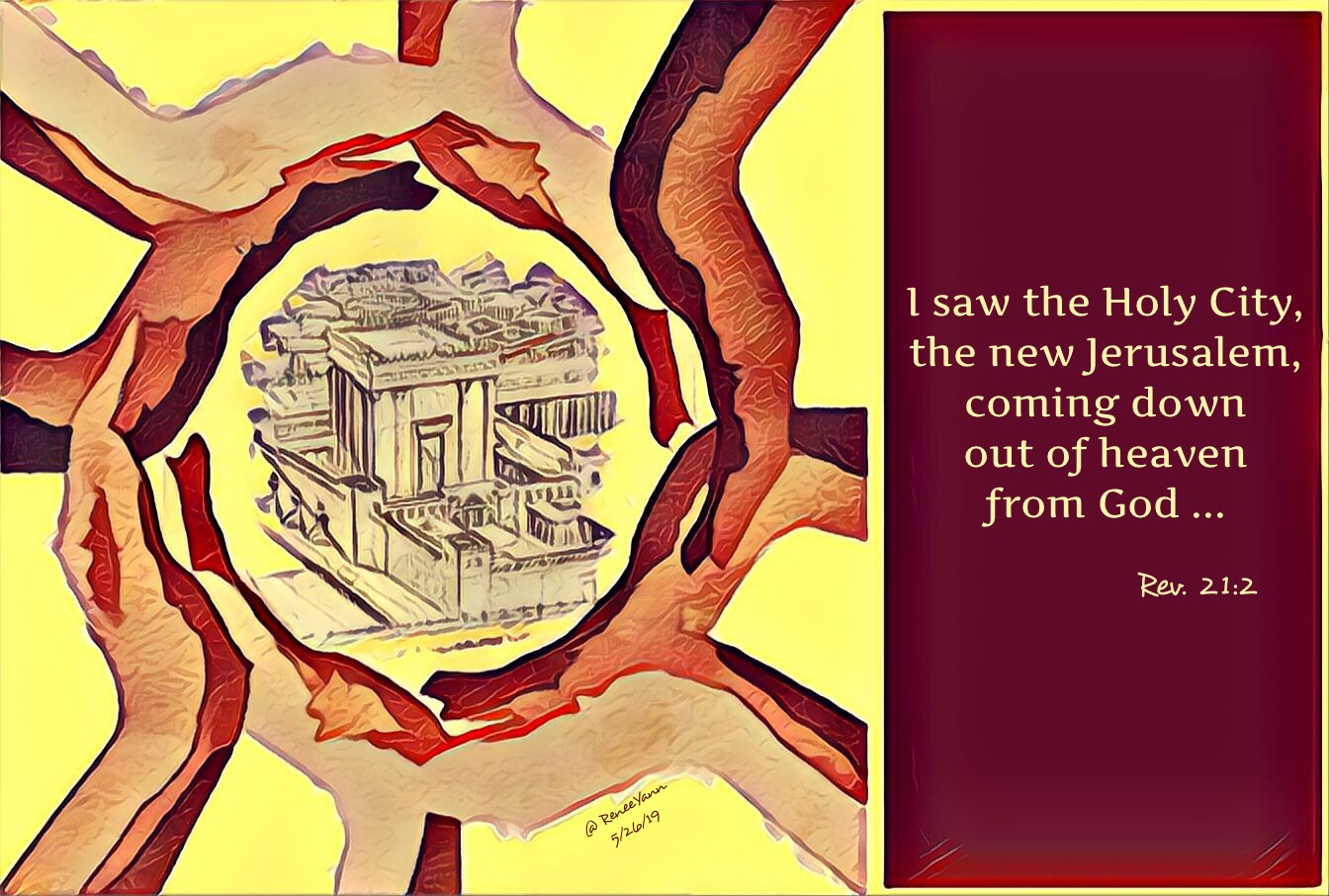
Rev21_2 Jerusalem

Our second reading reveals how John dealt with navigating this shift. Still cemented in his Jewish symbols, he sees “Jerusalem” coming down out of heaven from God. But it was a new Jerusalem – one without the central symbol of Judaism, the Temple:

I saw no temple in the city
for its temple is the Lord God almighty and the Lamb.
The city had no need of sun or moon to shine on it,
for the glory of God gave it light,
and its lamp was the Lamb.

For John, the New Creation in Christ included, but exceeded the Jewish narrative.

In our Gospel, Jesus prepares his disciples for life without his physical presence. They, too, need to learn to let go. He encourages them to open their hearts to even greater graces:

The Advocate, the Holy Spirit,
whom the Father will send in my name,
will teach you everything
and remind you of all that I told you.

Jesus is reminding his disciples, and us, that the graces and learnings of the New Creation are infinite. If we can learn when to let go of our old practices, our material symbols, our impregnable sureties, the Holy Spirit will astound us, and re-shape our understanding of God, just as She did for Mary, Peter, Paul, John and all the many enlightened saints through the ages.

As Pentecost approaches, let us pray for such Enlightenment in ourselves and especially in our Church. For the world grows ever more resistant to the Holy Spirit Whose Gifts are wisdom, understanding, counsel, fortitude, knowledge, piety, and awe of God.

Let us pray for a New Jerusalem where all are one in God.

Music: If you do nothing else with this reflection, please allow yourselves the thrill of listening to the celestial voice of Miss Jessye Norman. (Always gives me goosebumps!)