Outside the Lines

Memorial of Saint John Vianney, Priest
Friday of the Seventeenth Week in Ordinary Time
August 4, 2023

Today’s Readings:

https://bible.usccb.org/bible/readings/080423.cfm


Today, in God’s Lavish Mercy, we dip our toes into the Book of Leviticus which is basically a set of instructions on how to live a good life.

Leviticus 23 establishes five holy times of prayer, reflection, and action for the people to grow in friendship with God.

  • the Sabbath (vv. 1–3)
  • the Feast of the Unleavened Bread, or Passover (vv. 4–14)
  • the Feast of Weeks, or Pentecost (vv. 15–23);
  • on the Day of Atonement (vv. 26-32)
  • the Feast of the Tabernacles (vv.33-44)

As Christians, we may be more familiar with Sabbath and Passover because their patterns are embodied in our Sunday and Easter celebrations. In the other less familiar feasts, we might recognize harvest sharing (Weeks), repentance (Atonement), reflection and recommitment (Tabernacles).


The Book of Leviticus is a formation manual for Israel’s spiritual life. Realizing that fact this morning, I thought about my Novitiate and early formation experiences in religious life. Readers who are religious sisters or brothers might share my experience, and those who are lay can probably think of their own comparisons. What were our earliest steps in our journey into God?

I wasn’t completely clueless when I came to the convent at 18 years of age. I did have a vigorous spiritual life and a deep desire to grow in relationship with God. What I needed was spiritual discipline and a quiet reverence in my whole being. And, in those early years, I received abundant amounts of both from multiple sources. It was my “Leviticus Time”.

But our “Leviticus Time” is only a launchpad. If we refuse to leave it, we will never fly. What we must move on to is a personal relationship with God, grounded in loving faith and Gospel commitment. While enhanced by exterior resources, the power of that relationship springs from an interior intimacy with God, as realized so clearly by our saint for today, John Vianney.


Today’s Gospel shows us a group of people unable to take that next step – beyond rules and practices into committed relationship. (“beyond” not “without” rules and practices – more on that in tomorrow’s reflection)

Jesus came to his native place and taught the people in their synagogue.
They were astonished and said,
“Where did this man get such wisdom and mighty deeds?
Is he not the carpenter’s son?
Is not his mother named Mary
and his brothers James, Joseph, Simon, and Judas?
Are not his sisters all with us?
Where did this man get all this?”
And they took offense at him.
But Jesus said to them,
“A prophet is not without honor except in his native place
and in his own house.”
And he did not work many mighty deeds there
because of their lack of faith.

Matthew 13:54-58

This is such a sad Gospel! Here God was right in the midst of these people! They could see him and hear him. He personally invited them to believe. But they refused to see God in Jesus. All they could see was their stagnated prejudgments and inert definitions.

These were probably good people. They more than likely kept all the Leviticus regulations. They colored within the lines, so to speak. Then Jesus came and asked them to step outside the lines. He asked them to believe that the poor are blessed and the persecuted happy. He asked them to cast their nets again into a sea that had denied them all night. He asked them to walk to him across the water. He asked them to sell everything they had and follow. He asked them to fall into the ground and die, as he would.

Only a courageous few set their safe scroll of Leviticus aside to give Jesus a wholehearted “Yes”.

What might we have done — what are we doing — when Jesus invites us outside the lines?


Poetry: Of Being – Denise Levertov

I know this happiness
is provisional:

the looming presences --
great suffering, great fear --

withdraw only
into peripheral vision:
but ineluctable this shimmering
of wind in the blue leaves:
this flood of stillness
widening the lake of sky:
this need to dance,
this need to kneel:
this mystery:

Music: Only You

Something a little different this morning – a picture to contemplate while you listen to a beautiful song. Just click the little white arrowhead in the grey bar below. Let the song take you where it will in your own spiritual landscape.

image by David Mark from Pixabay
Lent: On God’s Good Side?

March 7, 2022
Monday of the First week of Lent

Today, in God’s Lavish Mercy, we are invited to be like God:

The LORD said to Moses,
“Speak to the whole assembly of the children of Israel
and tell them:
Be holy, for I, the LORD, your God, am holy.

Leviticus 19:1

Our first reading goes on to tell us how to be a decent person.

Don’t steal, lie, or cheat
Pay just wages
Respect and help those physically burdened
Be impartial and just
Defend life
Don’t slander, hate, take revenge, or hold a grudge

Basically, the message is about kindness …
deep kindness,
the type that comes from realizing
how infinitely kind God is to us.

Leviticus, after a long list of practical examples, sums it up:

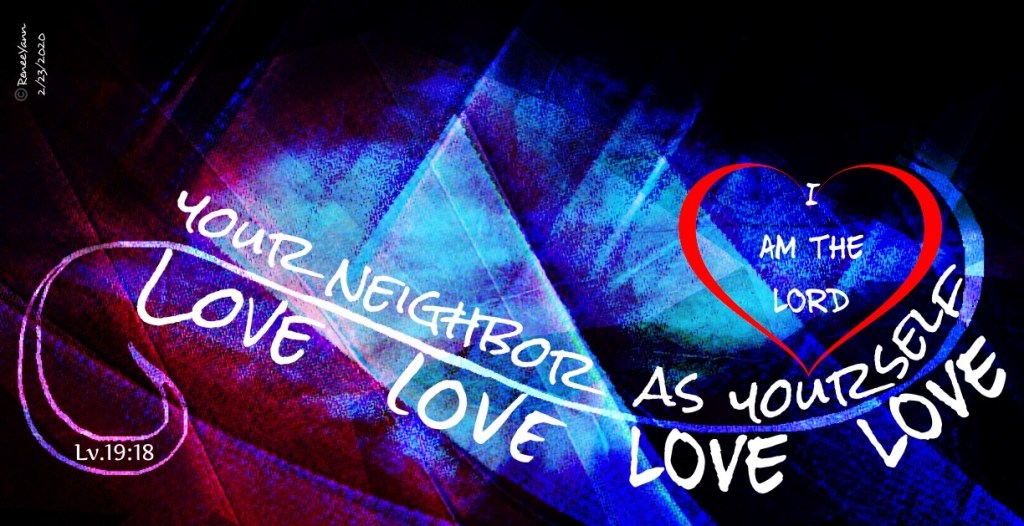
You shall love your neighbor as yourself.
I am the LORD.

Leviticus 19:18

Our Gospel tells us what happens when we make the choice to take the Old Testament advice — or not.

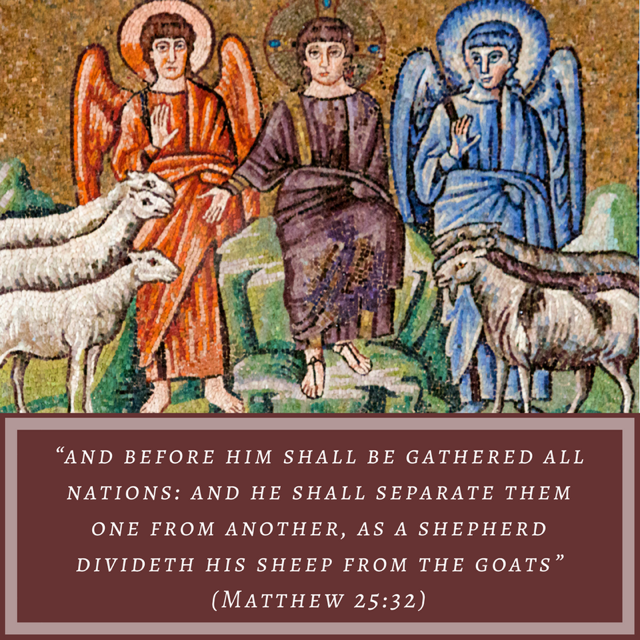
We are all familiar with the parable of the sheep and the goats. And we all hope our scorecard gets us into the right herd “When the Son of Man comes in his glory, and all the angels with him …”

In this parable, Jesus puts the advice of Leviticus into practical form for his followers. But he adds one dynamic element that not only invites but impels our wholehearted response:

Amen, I say to you,
what you did not do for one of these least ones,
you did not do for me.

Matthew 25:40

Leviticus invites us to become holy as God is holy. But Jesus reveals the secret that this Holy God lives in the poor, hungry, homeless, imprisoned and sick. By embracing these most beloved of God, we find the path to holiness.


Poetry: When Did I See You – Renee Yann, RSM

When Did I See You …
(Woman Who Is Homeless)

In the bitter rain of February
I sat inside a sunlit room,
and offered You warm prayer.

Then, she passed outside my window
dressed too lightly for the wind,
steadied on a cane, though she was young.

She seemed searching for
a comfort, unavailable and undefined.
The wound of that impossibility

fell over her the way it falls
on every tender thing that cries
but is not gathered to a caring breast.

Suddenly she was a single
anguished seed of You,
fallen into all created things.

Gathering my fallen prayer,
I wear the thought of her
like cracked earth wears fresh rain.

I’ve misconstrued You,
Holy One, to whom
I spread my heart

as if it were a yearning field…
Holy One, already ripe within
her barest, leanest yearning.

Music: The Least of These – Karl Kohlhase

Sheep or Goat?

Monday of the First Week of Lent

March 2, 2020

Click here for readings

sheep mosaic

Today, in Mercy, we are invited to be like God:

The LORD said to Moses,
“Speak to the whole assembly of the children of Israel
and tell them:
Be holy, for I, the LORD, your God, am holy.

Our first reading goes on to tell us how: be a decent person.

  • Don’t steal, lie, or cheat
  • Pay just wages
  • Respect and help those physically burdened
  • Be impartial and just
  • Defend life
  • Don’t slander, hate, take revenge, or hold a grudge

Basically, the message is about kindness … deep kindness, the type that comes from realizing how infinitely kind God is to us.

Leviticus, after a long list of practical examples, sums it up:

You shall love your neighbor as yourself.
I am the LORD.


Our Gospel tells us what happens when we make the choice to take the Old Testament advice — or not.

little lamb

We are all familiar with the parable of the sheep and the goats. And we all hope our scorecard gets us in the right herd “When the Son of Man comes in his glory, and all the angels with him …”


Basically, in this parable, Jesus puts the advice of Leviticus into practical form for his followers. But he adds one dynamic element that not only invites but impels our wholehearted response:

Amen, I say to you,
what you did not do for one of these least ones,
you did not do for me.

Leviticus invites us to become holy as God is holy. But Jesus reveals the secret that this Holy God lives in the poor, hungry, homeless, imprisoned and sick. By embracing these most beloved of God, we find the pattern of Holiness.

Music: The Least of These – Karl Kohlhase

Simple Not Easy

Seventh Sunday in Ordinary Time

February 23, 2020

Click here for readings

Today, in Mercy, our readings focus us on how to live a good,honest, holy life.

Leviticus makes it simple:

Lv19_18 neighbor

But “simple” does not mean easy. Jesus makes that clear in the Gospel. He tells us that we may thinks it’s enough to love our neighbor by:

  • an “eye for an eye” justice
  • accepting that one slap on the cheek
  • giving over some of our possessions
  • serving them for the time they ask

But Jesus says, “No. Not enough!” We must go all in for love:

  • take no “eye”, no legal repayment 
  • turn the other cheek
  • give both shirt AND jacket off your back
  • work twice as long and hard as demanded

kidding


Guess what? He’s not kidding. He goes on to double down on his words:

  • Don’t just love your neighbor as yourself, as Leviticus requires. Love your enemy that way too.
  • Do it because your Creator loves you, and all of us, that way — with Lavish Mercy.
  • Be that Mercy in the world.

Paul gives us an added incentive for living this challenge. He acknowledges that to live in Christian love and mercy seems foolish in the eyes of the world … BUT:

Let no one deceive himself.
If any one among you considers himself wise in this age,
let him become a fool, so as to become wise.
For the wisdom of this world is foolishness in the eyes of God,
for it is written:
God catches the wise in their own ruses,
and again:

The Lord knows the thoughts of the wise,
that they are vain.


As I said at the outset, it’s simple, but it’s not easy. So much in our culture promotes the opposite approach to life – me first, exclude others, win at all costs, money matters over everything, use people and things then discard them, and on and on…..

Using our beautiful Responsorial Psalm, let us pray for the insight to see through to God’s Truth and Love, and for the courage to live them. 

Music: The Lord Is Kind and Merciful – Jean Cotter 

Refrain
The Lord is kind and merciful;
The Lord is kind and merciful.
Slow to anger, rich in kindness,
The Lord is kind and merciful.

Bless the Lord, O my soul;
All my being bless God’s name.
Bless the Lord, O my soul;
Forget not all God’s blessings.

The Lord is gracious and merciful,
Slow to anger, full of kindness.
God is good to all creation,
Full of compassion.

The goodness of God is from age to age,
Blessing those who choose to love.
And justice toward God’s children;
On all who keep the covenant.

Sabbath and Jubilee

Saturday of the Seventeenth Week in Ordinary Time

August 3, 2019

Click here for readings

Sabbath-Should-We


Today, in Mercy, our reading from Leviticus may seem pastoral and peaceful in tone as it describes the days and years of rest and jubilee. Don’t let that tone fool you. This is perhaps one of the most radical, transformative passages in Scripture!

These verses from Leviticus describe and mandate an economic system based on respect and care for neighbor and earth. They require the community to take significant, reflective pauses in what might be an otherwise relentless drive to personal prosperity.

These commands are rooted in the understanding that God is the Creator, and therefore “owner” of all – people, animals, the land and its produce. We are to use these resources with reverent mutuality. If we do not, we become caught in an economy that inflates some at the expense of others – that is, an extractive economy.

Lv25_17_extraction

In an extractive economy, those with power and money siphon resources from the weak and vulnerable. This cycle grows ever more greedy because the “haves” can never have enough. Eventually, both human and natural resources are exhausted and the faulty, actually sinful, economy fails.

Sabbath and Jubilee are meant to restore balance by causing us to reflect on and reverse the pitfalls of a greedy, extractive system.

The parallels to present day realities are stunning! We live in a world where everything is a commodity at the disposal of those who control money. Walter Brueggemann calls this “the oligarchy of concentrated wealth…the network of the wealthy and powerful in the U.S. and around the world who basically outflank or control governmental structures.”

This unmitigated imbalance eventually creates impoverished nations whose citizens are plagued by violence, who must flee their homeland simply to survive. It spawns a culture of “disposability” where even human beings are bought and sold into exploitation. It creates a system where you may be sold anything, even if it kills you like tobacco, opioids and carcinogenic products. You may buy anything, even if it kills the people who provided it, even if it kills the earth for future generations.

So we simply cannot read Leviticus today as an ancient writing meant to organize a long-ago agrarian society. This scripture is speaking to us, demanding that we pause to consider how we contribute to or stand against such systems.

The reading is asking us to develop a deep, sacred awareness of all human beings as “neighbor”, and to live, unflinchingly, out of that awareness.

Music: The Workingman’s Hymn – Joshua Davis (Lyrics below)

Some people hunger for the greenback bill
Some folks hunger for the top of the hill
Some people just tryin’ to get a decent meal
Well I know that we can turn it around

Some people sleepin’ in a fine feather bed
Some folks are dreamin’ of an old homestead
Some just need a place to lay their head
Well I know that we can turn it around

[Chorus]
I know that we can turn it around
There’s one thing that I’ve found
If there’s a force in the dim singin’ a workingman’s hymn
I know that we can turn it around

River bottom up to home on high
In the light of the endless sky
Jetsettin’ or just gettin’ by
I know that we can turn it around

[Chorus]   [Bridge]

From the 9th Ward up to Patoka Lake
One man’s joy’s been another man’s pain
But the sun keeps shinin’ through the drivin’ rain
And I know that we can turn it around

Marking the Hours

Friday of the Seventeenth Week in Ordinary Time

August 2, 2019

Click here for readings

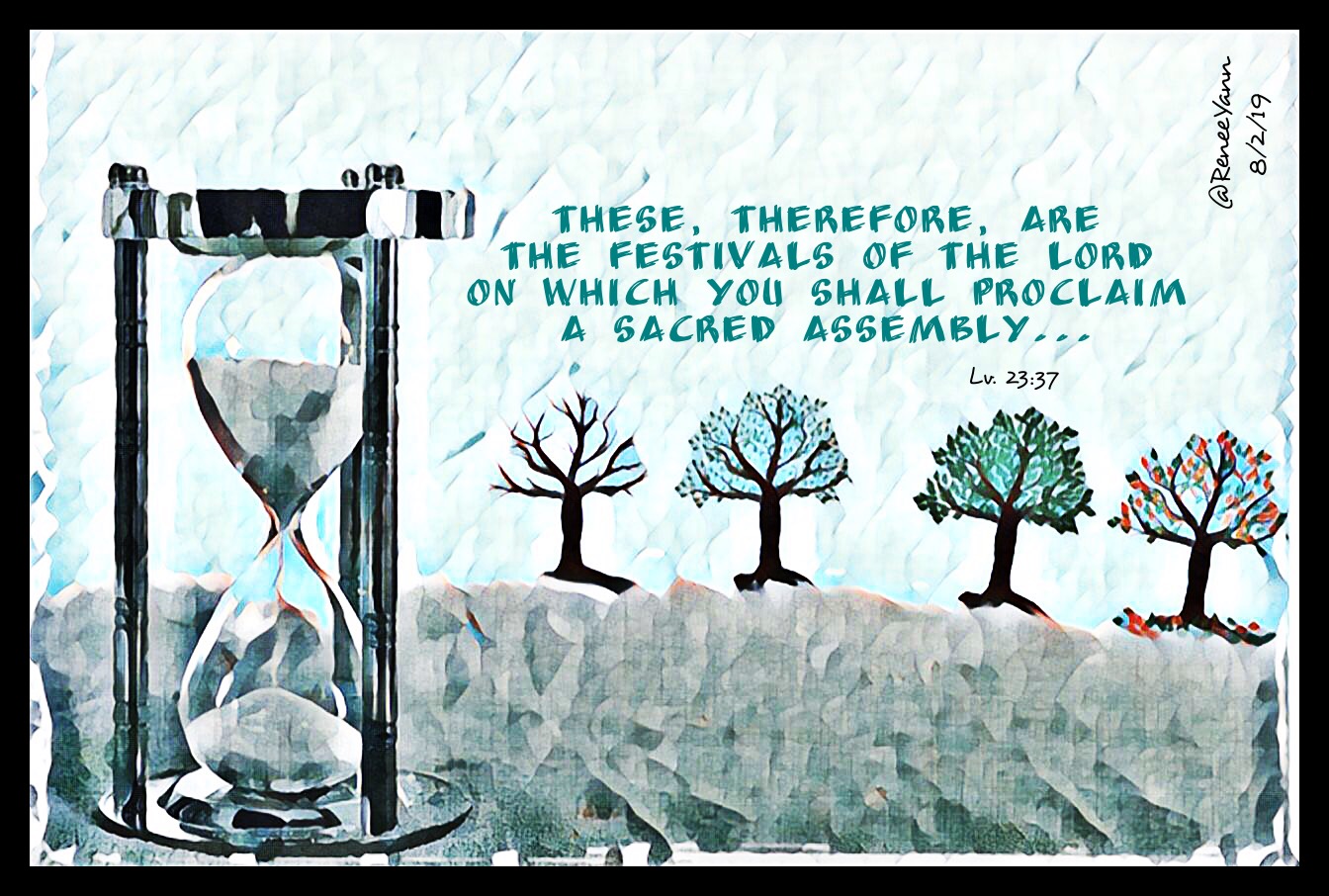
Today, in Mercy, we begin a few days of reading Leviticus. The reading today provides a long list of when and how the community should gather to worship. It is a lexicon on how to honor the sacred presence in their lives. Such honoring includes aspects of celebration, decoration, sharing, remembering and hoping together.

Lv23_37 hoursJPG

While the particular enjoinments detailed in Leviticus might not pertain to us, their spirit does. It is a spirit that encourages us to cherish the gift of time – moments, days, years – as precious opportunities to encounter God.

Down through the ages, people seeking holiness have used various, ritualized practices to remember and honor God’s omnipresence in their lives. They include morning and nighttime prayers, Grace before Meals, the Blessing of the Hour, the Angelus at noontime, the great liturgical practices of Advent and Lent, and the Divine Office. Each of these spiritual practices helps us to be more intentional about the true meaning and purpose of our daily life. 

Macrina Wiederkehr, a Benedictan monastic, has published a beautiful book to help people mark the hours of their day. She says this in Seven Sacred Pauses:


When I speak of “the hours” I am referring to those times of the day that the earth’s turning offers us: midnight, dawn, midmorning, noon, midafternoon, evening, and night. Although every hour is sacred, these special times have been hallowed by centuries of devotion and prayer…..

The daily and nightly dance of the hours is a universal way of honoring the earth’s turning as well as the sacred mysteries that flow out of our Christian heritage.


I think this is exactly what our Leviticus passage is doing as well. Our time is so precious and it flows so quickly! What a tragedy if we fail to stop and realize that it is the holy river on which we are meant to float to God!

robson-hatsukami-morgan-454S_xB0ReA-unsplash
Photo by Robson Hatsukami Morgan on Unsplash

Music: Teach Us to Number Our Days – Marty Goetz