Easy-Peasy?

Tuesday of the Twelfth Week in Ordinary Time
June 27, 2023

Today’s Readings:

https://bible.usccb.org/bible/readings/062723.cfm


Today, in God’s Lavish Mercy, both our readings express a desire for equanimity and reasonableness in our dealings with fellow human beings.

Rich old Abraham and rich young Lot can’t seem to get there unless they move away from each other. As we know from life, that’s sometimes the only and best route to peace (even though Lot ended up in a pretty bad neighborhood!)

Thus they separated from each other;
Abram stayed in the land of Canaan,
while Lot settled among the cities of the Plain,
pitching his tents near Sodom (uh oh!).

Genesis 13:11-12

In our Gospel, Jesus gives us some snippets of common sense and mutuality too:

Do not give what is holy to dogs, or throw your pearls before swine,
lest they trample them underfoot, and turn and tear you to pieces.

Do to others whatever you would have them do to you.
This is the Law and the Prophets.

Matthew 7: 6;12

However, the even-steven tone of these passages is countered by the Gospel’s closing verse:

Enter through the narrow gate;
for the gate is wide and the road broad that leads to destruction,
and those who enter through it are many.
How narrow the gate and constricted the road that leads to life.
And those who find it are few.

Matthew 7:13-14

Jesus seems to be telling us that “even-steven” is not so “easy-peasy”!

It is a huge challenge to live in sacred balance with our sisters and brothers, and with all Creation. That Balance was lost in Eden but redeemed on Calvary. For us to allow its redemption in our own lives, we must live in the pattern of Christ’s sacrificial love. That pattern is “the narrow gate”. May we be among the few who find it!


Poem: The Narrow Way – Anne Brontë, one of the noted three sisters in a famous literary family. Their stories attracted attention for their passion and originality immediately following their publication. Charlotte’s Jane Eyre was the first to know success, while Emily’s Wuthering Heights, Anne’s The Tenant of Wildfell Hall and other works were accepted as masterpieces of literature later. Anne’s famous poem The Narrow Way, while seeped in the weighty tones of Victorian literature, makes a powerful point for any generation. (ref:Wikipedia)


The Narrow Way

Believe not those who say
The upward path is smooth,
Lest thou shouldst stumble in the way,
And faint before the truth.
It is the only road
Unto the realms of joy;
But he who seeks that blest abode
Must all his powers employ.
Bright hopes and pure delights
Upon his course may beam,
And there, amid the sternest heights
The sweetest flowerets gleam.
On all her breezes borne,
Earth yields no scents like those;
But he that dares not grasp the thorn
Should never crave the rose.
Arm—arm thee for the fight!
Cast useless loads away;
Watch through the darkest hours of night,
Toil through the hottest day.
Crush pride into the dust,
Or thou must needs be slack;
And trample down rebellious lust,
Or it will hold thee back.
Seek not thy honor here;
Waive pleasure and renown;
The world’s dread scoff undaunted bear,
And face its deadliest frown.
To labor and to love,
To pardon and endure,
To lift thy heart to God above,
And keep thy conscience pure;
Be this thy constant aim,
Thy hope, thy chief delight;
What matter who should whisper blame,
Or who should scorn or slight?
What matter, if thy God approve,
And if, within thy breast,
Thou feel the comfort of His love,
The earnest of His rest?

Music: Narrow Road – Josh Baldwin
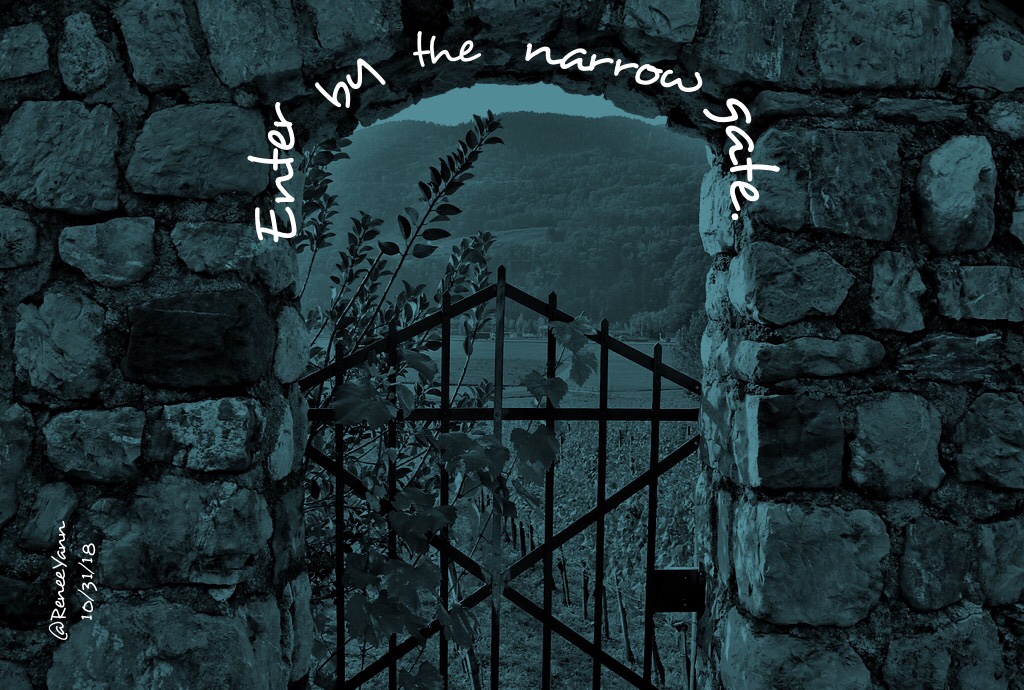

The Only Road

Wednesday of the Thirtieth Week in Ordinary Time
October 26, 2022

Today, in God’s Lavish Mercy, Jesus sets out a stringent formula for entrance into the Kingdom of Heaven.

Strive to enter through the narrow gate,
for many, I tell you, will attempt to enter
but will not be strong enough.

Jesus goes on to say that some will get to the threshold of the kingdom and be denied entrance because they are not recognized. These petitioners will be shocked, saying, “But we ate and drank in your company and you taught in our streets.


The passage teaches us that there is more to faith than religion, more to prayer than words, more to relationship than ritual. We may be the most observant Catholic, Lutheran, or Jew. We may stay praying in church longer than anyone else. We may know the catechism by heart. But if our deep heart hasn’t touched God’s, we will not be recognized at the narrow gate.


Where will we find God’s heart? The Gospel seems to suggest that we would do best to look among those who are considered “last” – those who are poor, humble, suffering, marginalized. At “the gate”, they will be “first” – so they must have the secret to that stringent formula.

There is little or nothing between these blessed ones and the touch of God – no power, pride or wealth. Their strength lies in their utter dependence on God – God knows them in that dependence.


It is hard for us to reach that place of trust and unity with God. Our possessions and accomplishments get in the way. Our independence and self-reliance get in the way. Our pride and penchant for control get in the way. It is a very narrow gate through these things that lets us find God – our God Who is not far … Who waits in the spaces between our self-importance.


Poetry: The Narrow Way – Anne Bradstreet

Believe not those who say
     The upward path is smooth,
Lest thou shouldst stumble in the way,
     And faint before the truth.
It is the only road
     Unto the realms of joy;
But he who seeks that blest abode
     Must all his powers employ.
Bright hopes and pure delights
     Upon his course may beam,
And there, amid the sternest heights
     The sweetest flowerets gleam.
On all her breezes borne,
     Earth yields no scents like those;
But he that dares not grasp the thorn
     Should never crave the rose.
Arm—arm thee for the fight!
     Cast useless loads away;
Watch through the darkest hours of night,
     Toil through the hottest day.
Crush pride into the dust,
     Or thou must needs be slack;
And trample down rebellious lust,
     Or it will hold thee back.
Seek not thy honor here;
     Waive pleasure and renown;
The world’s dread scoff undaunted bear,
     And face its deadliest frown.
To labor and to love,
     To pardon and endure,
To lift thy heart to God above,
     And keep thy conscience pure;
Be this thy constant aim,
     Thy hope, thy chief delight;
What matter who should whisper blame,
     Or who should scorn or slight?
What matter, if thy God approve,
     And if, within thy breast,
Thou feel the comfort of His love,
     The earnest of His rest?

Music: Enter the Narrow Gate! – John Michael Talbot


Enter the narrow gate
The gate that leads to life
His yoke is easy and His burden is light.
Pray for your enemies Those who abuse you
Love them and do not hate And love will follow you.
Enter the narrow gate
The gate that leads to life
His yoke is easy and His burden is light.
Forgive those who offend And seek their forgiveness And when you bring your gift You will be forgiven.
Enter the narrow gate
The gate that leads to life
His yoke is easy and His burden is light.

Walk in Mercy and Hope

Twenty-first Sunday in Ordinary Time

August 25, 2019

Click here for readings

Is66_18 great lightJPG

Today, in Mercy, our first reading gives us the conclusion of the magnificent Book of Isaiah. Most biblical scholars today attribute this book to at least three different authors writing over the period of two centuries. The book is thus divided into three sections: First, Second, and Third Isaiah – each reflecting a particular time and circumstance in the history of the Jewish people.

Despite its multi-authorship, the Book holds an essential integrity throughout. As a whole, it is the story of the displacement and restoration of Israel. That dynamic is poetically articulated through the themes of loss, grief, hope, and responsiveness to hope. These themes are so fundamentally human and universal that Isaiah stands as one of the most influential scriptures, both spiritually and culturally.

Today’s passage from Isaiah, combined with the Lukan symbol of the narrow gate, strike a powerful message for us – as individuals, as Church, as global citizens. 

There is one Kingdom in God and we ALL are invited to it.

I come to gather nations of every language;
they shall come and see my glory.

But we will find our way to this Kingdom by the twists of suffering and compassion, living on one side or the other of that reciprocal throughout our lives. 

faith reciprocal

How we support, include, love and minister with one another in our “displacement” determines our “restoration”:

And people will come from the east and the west
and from the north and the south
and will recline at table in the kingdom of God.
For behold, some are last who will be first,
and some are first who will be last

We know the works of mercy and our call to live them. Let’s pray for the strength to do so fully and joyfully.

Let’s pray for all nations, especially our own, to respond in mercy and hope to the displaced people of our time, knowing that it is only with them that we shall find the narrow gate.

Music: The People That Walked in Darkness (Is. 9:2) from Handel’s Messiah

Sung by James Milligan with Royal Liverpool Philharmonic Orchestra

Pearls, Gates and Mercy

Tuesday, June 26, 2018

Readings: http://www.usccb.org/bible/readings/062618.cfm

Today, in Mercy, Matthew begins to wrap up the long series of instructions related to the Sermon on the Mount. Three familiar, and very direct, closing points punctuate today’s reading:

  • Pearls before swine
  • Do unto others
  • Enter by the narrow gate

best gate1 copy

They sound a bit like what a wise parent might say to a child as he or she goes off to the wide worlds of college, business or marriage. But the core of their message works for us at any age:

Be wise.
Be merciful.
Be focused on God.

Music: Be Thou My Vision