At that time Jesus exclaimed: “I give praise to you, Father, Lord of heaven and earth, for although you have hidden these things from the wise and the learned you have revealed them to the childlike. Matthew 11:25
What really is praise? Is it song and dance and lifting up the reputation of the other in glory?
Or is it when Love moves fully from the heart into the heart of the one esteemed? And does its light come not from within us but from the One to Whom it is given?
There is a total selflessness in praise. The Other is the full focus of our awe and gratitude.
Today, in God’s Lavish Mercy:
For many of us, our prayer may be full of petitions with little room for much else. Today, we think about how Jesus loved and praised the Father. We ask for deeper praise and gratitude in our own prayer.
Poetry: Gitanjali 11 – Rabindranath Tagore
Leave this chanting and singing and telling of beads! Whom dost thou worship in this lonely dark corner of a temple with doors all shut? Open thine eyes and see thy God is not before thee!

He is there where the tiller is tilling the hard ground and where the path-maker is breaking stones. He is with them in sun and in shower, and his garment is covered with dust. Put off thy holy mantle and even like him come down on the dusty soil!

Deliverance? Where is this deliverance to be found? Our master himself has joyfully taken upon him the bonds of creation; he is bound with us all for ever.

Come out of thy meditations and leave aside thy flowers and incense! What harm is there if thy clothes become tattered and stained? Meet him and stand by him in toil and in sweat of thy brow.
Music: Love Divine – Jan Mulder with the London Symphony Orchestra
Today we stand at the threshold of a sacred time. In a few days, we will begin our Lenten journey for the Year of our Lord, 2024. I reflected this morning on the purpose of Lent and on how I want to prepare in these three days leading up to Ash Wednesday.
Often Lent is interpreted only in the light of sacrifice and renunciation. We think about what we will give up, or what difficult practice we will assume. We might even introduce mixed purposes to our renunciations – thinking that fasting is a good way to lose weight, or that purging our excessive possessions is a path to feng shui in our environment. I know I have been guilty of these hidden agendas. Realizing this, I want to make the effort to live a more sincere Lent. I want to focus my spiritual awareness on Lent’s true purpose which is to align my life with the life of Christ.
To help me more truly engage this Lenten time, I have considered some proven elements from our long Christian tradition. I know that many of my readers already live a spiritual life deeply enriched by their own chosen practices. Still, I thought some of you might like to think about these few simple elements as well. These three elements are: • Practice • Time • Reflection
Today, let’s think about “Lenten Practice”. Tomorrow, “ Lenten Time”. On Tuesday, “Lenten Reflection”
Lenten Practice What practice might I introduce or deepen in my life that would turn my attention to God? The choice of a Lenten practice can be very simple: • to take a daily morning or evening walk in a spirit of prayer • to read a spiritual rather than secular book throughout Lent • to write a note or make a phone call to someone who would be blessed by your voice • to not choose a new practice, but to choose a new attitude about some circumstance in my life, an attitude of hope or generosity
What is essential is to focus our attention on God as we engage this simple practice, to make our actions a prayer. More tomorrow.
Today, in God’s Lavish Mercy, we have the belovedly familiar story of the Miracle at Cana.
There was a wedding at Cana in Galilee, and the mother of Jesus was there. Jesus and his disciples were also invited to the wedding. When the wine ran short, the mother of Jesus said to him, “They have no wine.”
John 2: 1-3
Like all good stories, this one is engaging on so many levels:
We see Mary and Jesus enjoying a social event in the same way we would.
We see Mary extending her solicitude and influence for the sake of the hosting family.
We see Jesus needing a swift nudge from his mother to do the right thing!
We see the Apostolic tipsters slowly waking up to the fact that Jesus is not just the guy next door!
We can pray with this Gospel passage by entering it from any one of these, or other, perspectives. We can easily sit right down at one of the wedding tables and watch the slow, human revelation of God in the world. But I think our first reading makes a strong case for us to pray the Cana story as a perfect example of how we should make our prayers of petition.
If you’re like me, you ask God for a lot of things every single day. Some of them are big deal things like “Please move hearts to stop the war on Ukraine.” And some of them are little deals like, “Please don’t let it rain on my picnic!”
In our first reading, John tells us how to pray our needs to God – with the utter confidence that, within God’s Will, we are heard.
Beloved: We have this confidence in God, that if we ask anything according to God’s will, we are heard. And if we know that God hears us in regard to whatever we ask, we know that what we have asked for is ours.
1 John 5: 14-15
This is the way Mary offers her petition in our Gospel story. She knows that Jesus will hear her and do the right thing. She doesn’t niggle him to death to get it done. She knows that by her “prayer”, she is now present to God’s infinite awareness of our needs.
His mother said to the servers, “Do whatever he tells you.”
John 2:5
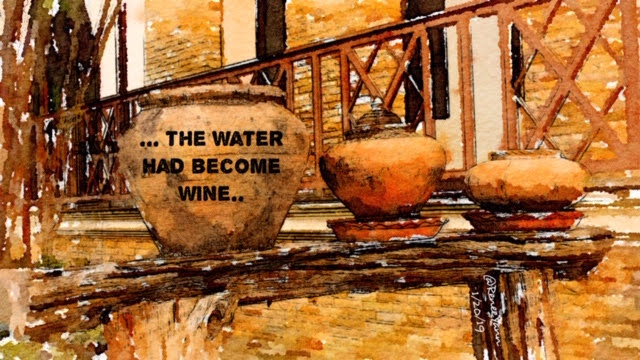
In this case, that “right thing” was to turn huge vats of water into delicious wine. A very satisfying outcome! But what about when our prayer doesn’t result in a deluge of wine? What about when it seems like God paid no attention to our request? Can we still have the unyielding confidence which John encourages and Mary exemplifies?
Our faith calls us to believe that God is present with us in all things. Our prayer opens us to seek that Presence and to respond in faith to our circumstances knowing that even when the vessels seem empty, God abides. Ours is a life in God not limited to one petition, or one prayer. It is an incremental immersion into an Eternal Truth which transcends any particular circumstance. God is always with us and that alone is the source of our confident prayer.
We also know that the Son of God has come and has given us discernment to know the one who is true. And we are in the one who is true, in God’s Son Jesus Christ. He is the true God and eternal life.
1 John 5:20
Poetry: Cana Wine – Irene Zimmerman, OSF
“The weather’s so hot
and no more wine’s to be bought
in all of Cana!
It’s just what I feared—
just why I begged my husband
to keep the wedding small.”

“Does he know?” Mary asked.

“Not yet. Oh, the shame!
Look at my son and his beautiful bride!
They’ll never be able
to raise their heads again,
not in this small town.”
“Then don’t tell him yet.”
Mary greeted the guests
as she made her way
through crowded reception rooms.
“I must talk to you, Son,”
she said unobtrusively.

Moments later he moved
toward the back serving rooms.
They hadn’t seen each other
since the morning he’d left her—
before the baptism
and the desert time.

There was so much to tell her,
so much to ask.
But this was not the time!
They could talk tomorrow
on the way to Capernaum.
She spoke urgently, her words
both request and command to him:
“They have no wine.”
But he hadn’t been called yet!
He hadn’t felt it yet.
Would she send him so soon
to the hounds and jackals?
For wine?

Was wine so important then?

“Woman, what concern is that
to you and me?
My hour has not yet come.”

Her unflinching eyes reflected to him
his twelve-year-old self
telling her with no contrition:
“Why were you searching for me?
Did you not know I must be
in my Father’s house?”

She left him standing there—
vine from her stock,
ready for fruit bearing—
and went to the servants.
“Do whatever he tells you,” she said.

From across the room
she watched them fill water jars,
watched the chief steward
drink from the dripping cup,
saw his eyes open in wide surprise.

She watched her grown son
toast the young couple,
watched the groom’s parents
and the guests raise their cups.

She saw it all clearly:
saw the Best Wine
pouring out for them all.


 Lavish Mercy