Good Ground for Hope

Sixteenth Sunday in Ordinary Time
July 23, 2023

Today’s Readings:

https://bible.usccb.org/bible/readings/072323.cfm


Today, in God’s Lavish Mercy, our readings revolve around the dynamic of hope – God’s hope planted in our spirits and our hope entrusted to God’s Mercy.

As we pray with these passages, it helps to remind ourselves of the true definition of “hope”. It is a word that many of us use carelessly to the point that we may have lost the power of its meaning – as in when we say things like, “I hope it doesn’t rain”. What we really mean is that we wish it wouldn’t rain.

Hope is not the same as wishing. Wishing is a mental activity that has no power to make its object come true. Hope, on the other hand, is a resident condition of our spirits that frees us to live with enthusiasm and gratitude despite whatever outcome may arise.

Wishing dissapates when conclusions pass. Hope is eternal because it draws its energy from faith in God’s Infinite Mercy and the promise of eternal life.

The Book of Wisdom’s author understood the Source from which hope springs:

Though you are master of might, you judge with clemency,
and with much lenience you govern us;
for power, whenever you will, attends you.
And you taught your people, by your deeds,
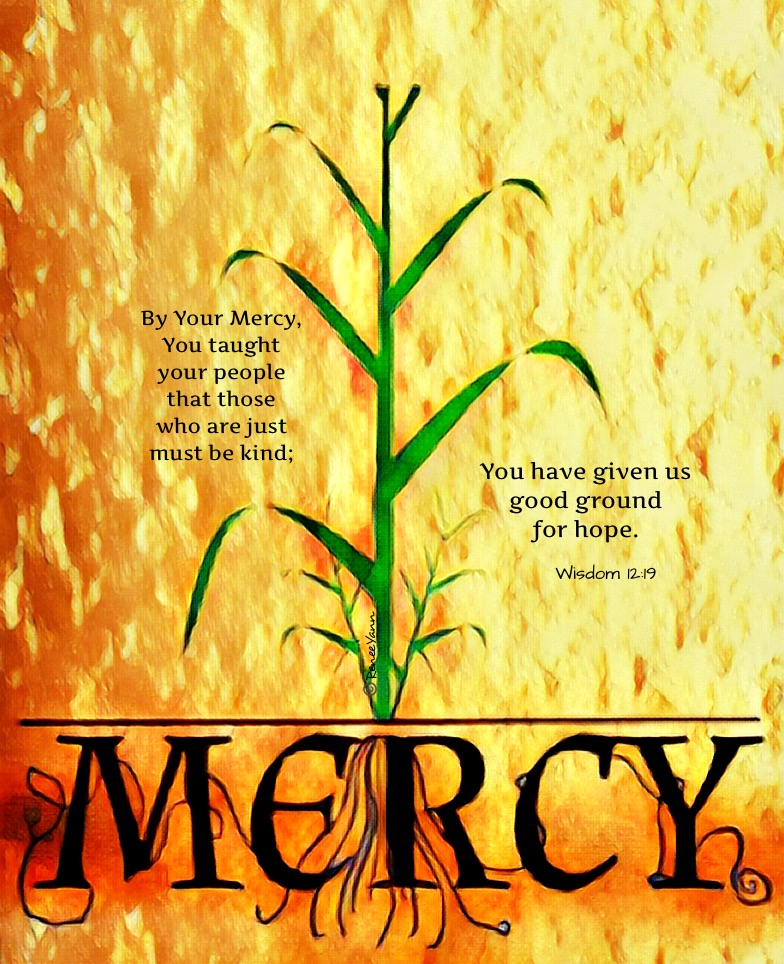
that those who are just must be kind;
and you gave your children good ground for hope
that you would permit repentance for their sins.

Wisdom 12:18-19

Paul, in another passage from magnificent Romans 8, acknowledges that we can sustain hopeful hearts only by the power of the Holy Spirit who lifts us up and prays within us when we are too overwhelmed to do so ourselves.

The Spirit comes to the aid of our weakness;
for we do not know how to pray as we ought,
but the Spirit intercedes with inexpressible groanings. 
And the one who searches hearts
knows what is the intention of the Spirit,
because Spirit intercedes for the holy ones
according to God’s will.

Romans 8:26-27

Jesus gives us a great parable for understanding hope. How discouraged might that farmer have been when the enemy tried to ruin his crop! But instead, the farmer realized that his field, like life, can sustain both the wheat and the weeds. If we live hopefully and faithfully, the wheat can be gathered from the harvest, and the weeds ultimately cast aside.


How many times in our own lives have we nearly been overwhelmed by the weeds! There is no life which passes without its hurts, disappointments, confusions, and dashed wishes! Some experience a sparse scattering of these weeds, and some lives are thick with difficulty. How surprising that it is often in the latter circumstance that hope rises up and sustains hearts.


As our Responsorial Psalm reminds us, those who live simply and sincerely are most able to tap deeply into the mysterious power of hope.

Blessed are you, Father, Lord of heaven and earth;
you have revealed to little ones the mysteries of the kingdom.


Poetry: From “Odes” – George Santayana was a Spanish-American philosopher known more for his aphorisms than his poetry. He came up with lines like, ‘Those who cannot remember the past are doomed to repeat it”, and “Fanaticism consists in redoubling your effort when you have forgotten your aim.”

IV

Slowly the black earth gains upon the yellow,
And the caked hill-side is ribbed soft with furrows.
Turn now again, with voice and staff, my ploughman,
Guiding thy oxen.
Lift the great ploughshare, clear the stones and brambles,
Plant it the deeper, with thy foot upon it,
Uprooting all the flowering weeds that bring not
Food to thy children.
Patience is good for man and beast, and labour
Hardens to sorrow and the frost of winter.
Turn then again, in the brave hope of harvest,
Singing to heaven.

Music: Weed and Wheat – Silayio Kirisua is a Maasi woman who represented Kenya in the Voice of Holland singing competition. After winning the competition, she has become an international sensation.

The Word Takes Root

Fifteenth Sunday in Ordinary Time
July 16, 2023

Today’s Readings:

https://bible.usccb.org/bible/readings/071623.cfm


Today, in God’s Lavish Mercy, we have three iconic readings from the rich store of Scripture. Any one of them, taken in itself, offers depths for study and prayer. As on all Sundays in the Liturgical Year, there is a theme that ties the readings together and helps us find entrance into their infinite wisdom.

Isaiah, in rich imagery, describes the generative power of God’s Word planted in us and in all Creation:

Thus says the LORD:
Just as from the heavens
the rain and snow come down
and do not return there
till they have watered the earth,
making it fertile and fruitful,
giving seed to the one who sows
and bread to the one who eats,
so shall my word be
that goes forth from my mouth;

Isaiah 55:10-11

For our second reading, Paul inspires us with one of his most magnificent passages – Romans 8:

All commentators agree that Romans 8 is something special. If Romans is a breathtaking landscape, this chapter is a majestic peak towering above its surroundings. …
… Paul’s focus in this chapter is threefold: the divine work of the Spirit, the divine gift of sonship, and the divine purpose of suffering, each in relation to the practical realities of Christian living.

Scott W. Hahn – Romans (Catholic commentary on Sacred Scripture

In today’s verses, Paul describes Creation being transformed by the omnipotent Word foretold in Isaiah. As we read this passage, we must be mindful that we, our experiences, and our material world are the “creation” to which Paul refers:

For creation awaits with eager expectation
the revelation of the children of God;
for creation was made subject to futility,
not of its own accord but because of the one who subjected it,
in hope that creation itself
would be set free from slavery to corruption
and share in the glorious freedom of the children of God. 

Romans 8:9-21

Indeed, we experience that worldly “futility” every day in our own bodies and in the body of the universe. Life, both within and around us, may sometimes feel like an barren field longing for tillage and rain. We yearn for the healing, wholeness, and fulfillment that Paul calls “the glorious freedom of the children of God”.


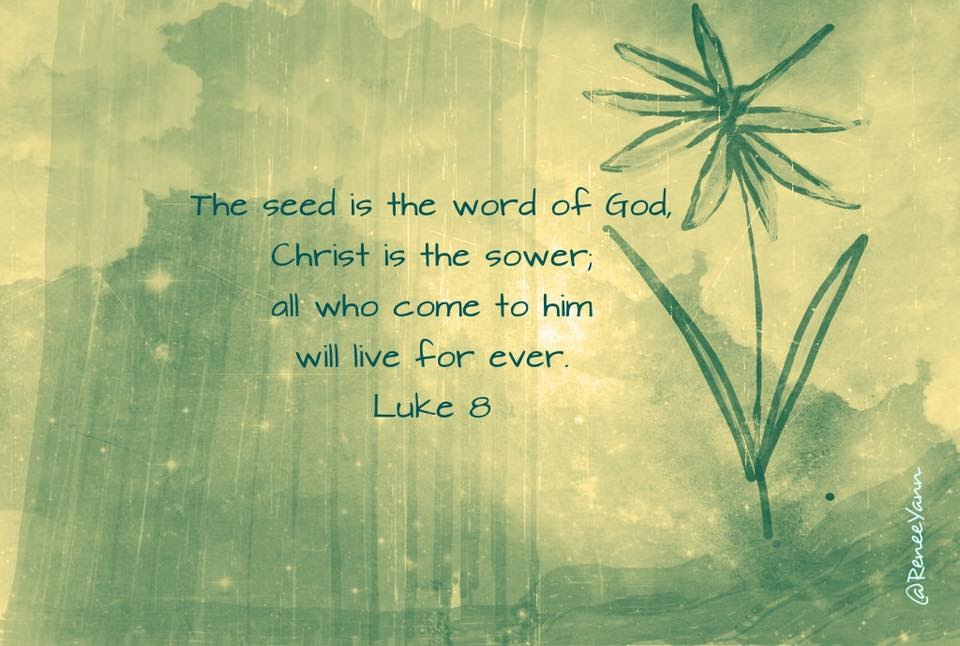
In our Gospel, Jesus tells us that this fulfillment will come only through a spiritual patience and discipline like that of the sower sowing his seed. In this detailed parable, Jesus clearly equates effective “seeding” to receptive hearing of the Word.

For God’s harvest to be accomplished in us, we must hear the Word as described in Isaiah, and act in hope as described in Paul. We can do this in two ways:

  • by our prayerful, informed study of the Scriptures
  • our merciful action for the healing of suffering Creation.

But the seed sown on rich soil
is the one who hears the word and understands it,
who indeed bears fruit and yields a hundred or sixty or thirtyfold.

Matthew 13:9

Poetry: God Speaks to Each of Us – Rainer Maria Rilke

God speaks to each of us as he makes us,
then walks with us silently out of the night.
These are the words we dimly hear:
You, sent out beyond your recall,
go to the limits of your longing.
Embody me.
Flare up like a flame
and make big shadows I can move in.
Let everything happen to you: beauty and terror.
Just keep going. No feeling is final.
Don’t let yourself lose me.
Nearby is the country they call life.
You will know it by its seriousness.
Give me your hand.

Music: Spirit of the Living God – Daniel Iverson


Love or Hate, hmm?

November 3, 2021
Wednesday of the Thirty-first Week in Ordinary Time

Today, in God’s Lavish Mercy, we pray with Psalm 112, a hymn to the human generosity which mirrors God’s own:

Happy are they who fear the Lord
and have great delight in the divine commandments! 

Light shines in the darkness for the upright;
the righteous are merciful and full of compassion. 

For they will never be shaken;
their righteousness will be kept in everlasting remembrance.

Psalm 112: 1-6

Paul and Jesus seem to give us contradictory messages about how to achieve this “righteousness”. Paul talks about love, and Jesus tells us what we must “hate” – a bit of a challenge to untangle the core message.

Here’s one way.

We probably don’t like Jesus telling us to hate anything, as in:

If anyone comes to me without hating his father and mother,
wife and children, brothers and sisters,

and even his own life,
he cannot be my disciple.

Come on, Jesus! You don’t mean that do you – my sweet mom, my precious kids???


No, the scholars say, Jesus doesn’t mean “hate” the way we interpret it in modern English. He is using the common, hyperbolic language of the ancient East which, in this circumstance, would mean “love less”.

So what is Jesus really saying? 

This, I think.

We love many people and things in our lives. But we must love God, and God’s dream for all people, above and within all things. 


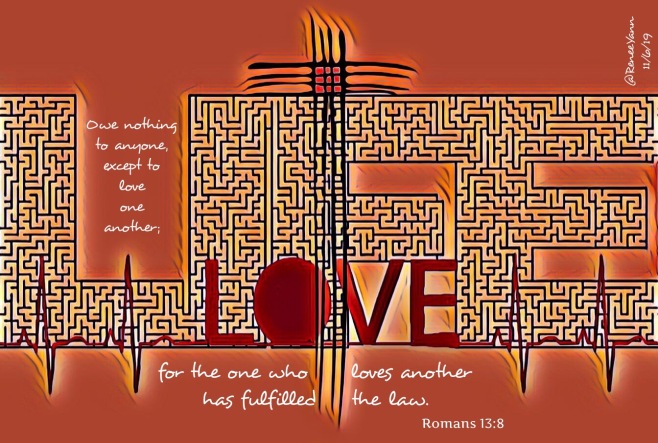
And that’s not easy! Life is a maze of relationships and situations that can get us very confused about what is most important. That’s why Jesus uses such strong language to remind us that there is only one way through the maze: to love as God loves. This is the heartbeat of our life in God!


Paul says this too, indicating how to negotiate the maze by keeping Love’s commandments.

Brothers and sisters:
Owe nothing to anyone, except to love one another;
for the one who loves another has fulfilled the law.

Romans 13:8

If we love with God’s love, of course we will love those we cherish. But we will love them selflessly, with an infinite generosity that always chooses their eternal good. And we will try always to love all Creatures in the same way. This is the kind of love Jesus taught us on the Cross. May God give us the courage to learn.


Poetry: Prayer of Mother Teresa and Brother Roger of Taize 

Oh God, the Creator of all,
you ask every one of us to spread
Love where the poor are humiliated,
Joy where the Church is brought low,
And reconciliation where people are divided. . . 
Father against son, mother against daughter,
Husband against wife,
Believers against those who cannot believe,
Christians against their unloved fellow Christians.

Music: Ubi Caritas performed by Stockholm University Choir (texts below)

Latin Text

Ubi caritas et amor, Deus ibi est.
Congregavit nos in unum Christi amor.
Exsultemus, et in ipso jucundemur.
Timeamus, et amemus Deum vivum.
Et ex corde diligamus nos sincero.
Ubi caritas et amor, Deus ibi est.
Simul ergo cum in unum congregamur:
Ne nos mente dividamur, caveamus.
Cessent iurgia maligna, cessent lites.
Et in medio nostri sit Christus Deus.
Ubi caritas et amor, Deus ibi est.
Simul quoque cum beatis videamus,
Glorianter vultum tuum, Christe Deus:
Gaudium quod est immensum, atque probum,
Saecula per infinita saeculorum. Amen.

English Translation
Where charity and love are, God is there.
Love of Christ has gathered us into one.
Let us rejoice in Him and be glad.
Let us fear, and let us love the living God.
And from a sincere heart let us love one.
Where charity and love are, God is there.
At the same time, therefore, are gathered into one:
Lest we be divided in mind, let us beware.
Let evil impulses stop, let controversy cease.
And in the midst of us be Christ our God.
Where charity and love are, God is there.
At the same time we see that with the saints also,
Thy face in glory, O Christ our God:
The joy that is immense and good,
Unto the World without end. Amen.

How Long, O Lord?!

October 27, 2021
Wednesday of the Thirtieth Week in Ordinary Time

Today, in God’s Lavish Mercy, we pray with Psalm 13, a powerful lesson in prayer.

The psalm is one of my favorites because it feels so “real”. The one who prays, presumably David, needs an answer to his prayer- and is not perceiving one. (emphasis on “perceiving”)

So the psalmist sounds a bit like someone desperately calling customer service to see why a life-saving order has not arrived😉:

How long, LORD? Will you utterly forget me?
How long will you hide your face from me?
..
Look, answer me, O LORD, my God!
Give light to my eyes that I may not sleep in death

Psalm 13: 2, 4

But as the psalmist continues to pray, an evolution of grace and understanding occurs. There is a realization that the kind of answer expected is one according to human measurement … one that will make the pray-er look triumphant in the eyes of his enemies:

Answer me, Lord my God …
Lest my enemy say, “I have prevailed,”
lest my foes rejoice at my downfall.

Psalm 13: 4-5

But the depth of our relationship with God is not determined by what our enemies think … or even our friends. That sacred relationship is rooted in our grateful recognition and trusting immersion in God’s ever-present mercy and love for us:

But I trust in your mercy.
Grant my heart joy in your salvation,
I will sing to the LORD,
Who has dealt bountifully with me!

Psalm 13: 6-7

God always answers us. We may not have the capacity to perceive the answer because it is not the one we expected or wished for. But the truth is that through whatever “answer” unfolds to our prayer, God is leading us deeper into God’s heart.

Can we trust that? Can we yield to it? That is the “salvation” the psalmist ultimately prays for:


Sometimes we might hear a person say that they don’t know how to get started talking with God in prayer. They seem to feel it’s kind of like a blind date where you end up realizing you have nothing in common with each other.

Paul – in our reading from Romans says – no, wait a minute. God is already within you simply by the nature of your creaturehood. You are made of the very stuff of God. In fact, the Spirit of God deep within our souls is like the fiery magma from a volcano. It erupts from our love and prays for us to the Creator – if we will only let it.


Poetry: Praying by Mary Oliver

It doesn’t have to be
the blue iris, it could be
weeds in a vacant lot, or a few
small stones; just
pay attention, then patch
a few words together and don’t try
to make them elaborate, this isn’t
a contest but the doorway
into thanks, and a silence in which
another voice may speak.

Music: Spirit Seeking Light and Beauty – by Janet Erskine Stuart, interpreted here by the Daughters of St. Paul (Lyrics below)

Spirit seeking light and beauty,
Heart still longing for your rest
In your search for understanding,
Only thus can you be blest,

Through the vastness of creation,
Though your restless thought may roam,
God is all that you can long for,
God is all creation’s home.

Taste and see God, feel and hear God,
Hope and grasp the unseen hand;
Though the darkness seem to hide you,
Faith and love can understand.

Loving Wisdom, guiding Spirit,
All our hearts are made anew.
Lead us through the land of shadows
‘Til we come to rest in you.

That Little Seed

Tuesday of the Thirtieth Week in Ordinary Time
October 26, 2021

Today, in God’s Lavish Mercy, we pray once again with Psalm 126, a song of hope fulfilled:

When the LORD brought back the captives of Zion,
    we were like men dreaming.
Then our mouth was filled with laughter,
    and our tongue with rejoicing.

Then they said among the nations,
    “The LORD has done great things for them.”
The LORD has done great things for us;
    we are glad indeed.

Psalm 126: 1-3

In our readings, we are called to be people of hope – to live in gratitude for hopes fulfilled, and to live in confidence of future blessing.


Paul blesses us with some of his most powerful words:

I consider that the sufferings of this present time are as nothing
compared with the glory to be revealed for us.

Romans 8:18

How often, over the ensuing centuries, have these words uplifted and embravened a struggling heart! Paul reminds us of what he so passionately believed – that we are not here for this world alone; that we, with all Creation, are being transformed for eternal life in God.


Jesus too reminds us that our life in faith is so much bigger than we perceive. We see a tiny mustard seed, but God sees the whole tree of eternal life blossoming in us.  We see a fingertip of yeast, but God sees the whole Bread of Life rising in us.

Paul tells us to be People of Hope who do not yet expect to see the object of their hope but who, nonetheless, believe and love with all their hearts.

May we pray this today for ourselves, and for anyone burdened by suffering or hopelessness at this time in their lives.


Poetry: Hope – Czeslaw Milosz

Hope is with you when you believe
The earth is not a dream but living flesh,
that sight, touch, and hearing do not lie,
That all thing you have ever seen here
Are like a garden looked at from a gate.
You cannot enter. But you're sure it's there.
Could we but look more clearly and wisely
We might discover somewhere in the garden
A strange new flower and an unnamed star.
Some people say that we should not trust our eyes,
That there is nothing, just a seeming,
There are the ones who have no hope.
They think the moment we turn away,
The world, behind our backs, ceases to exist,
As if snatched up by the hand of thieves.

Music:  Living Hope – Phil Wickham

Inseparable

Thursday of the Thirtieth Week in Ordinary Time

October 31, 2019

Click here for readings

Today, in Mercy, Paul exults in God’s love and Jesus suffers the full burden of his impending passion. And the two are tied tightly together.

Romans8_

Let me tell you a story that symbolizes that tight knot.

It was in the late 1960s. A group of us had traveled to Atlantic City for the National Catholic Education Convention. Weather forecasting was not so advanced in those days, or at least, we were not so attuned to it. We went to our various sessions early one morning, only to come out of them a few hours later into a hurricane!

I remember walking, obliviously, up to the boardwalk, on my way to the next session in another hotel. The wind became so heavy that I was blown, motionless, against the boardwalk railing. A plexiglass window pane blew by me, cutting me just below the eye. For a short while, that seemed very long, I feared for my life. A strong, young man actually pulled me into a nearby lobby where I tried to calm my fears.

rowboat

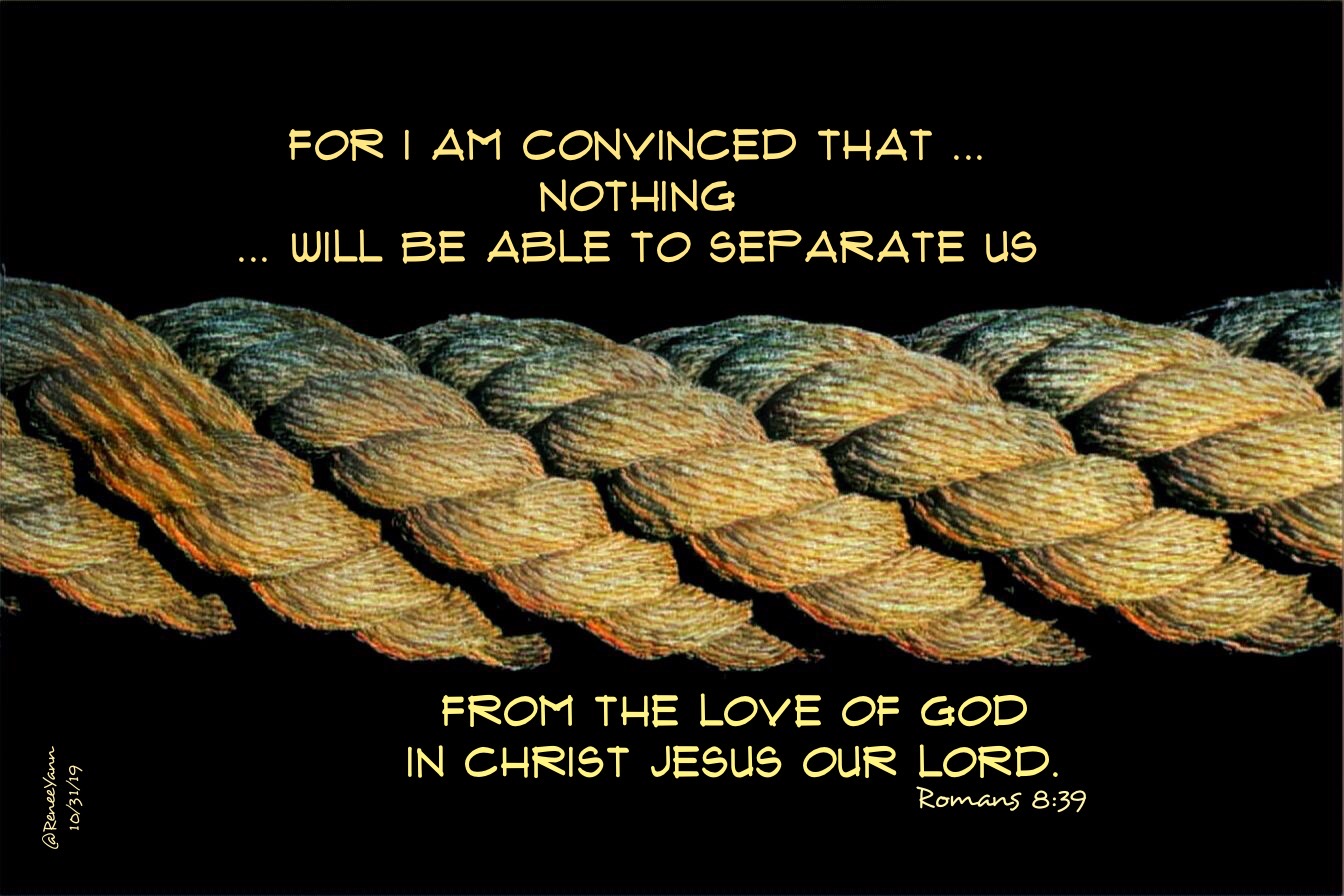
But the next morning, there was a beautiful rainbow and a brilliant, calm sky. I walked back to the bay to survey the previous day’s damage. It was significant. But one image remains in my mind these fifty years later: the front quarter of a battered boat still attached to a half-sunken dock by a thick, sodden rope that wouldn’t let go in the storm.

I think that, in today’s Gospel, Jesus might have felt a little bit like that boat. He has been battered by the resistance of his enemies. He knows it is an ill wind for his message.

Jerusalem, Jerusalem,
you who kill the prophets and stone those sent to you,
how many times I yearned to gather your children together
as a hen gathers her brood under her wings,
but you were unwilling!

Still, like that strong, unrelenting rope, he is held sure by the love of God:

But I tell you, you will not see me until the time comes when you say,
“Blessed is he who comes in the name of the Lord.”

Paul, through his baptism, inherited that faith, hope and love purchased for us all by the Passion, Death and Resurrection of Christ.

Whenever a storm rises up around your soul, whether expected or not, remember that knot which ties you to the steady and enduring love of God:

No, in all these things we conquer overwhelmingly
through him who loved us.
For I am convinced that neither death, nor life,
nor angels, nor principalities,
nor present things, nor future things,
nor any other creature will be able to separate us
from the love of God in Christ Jesus our Lord.

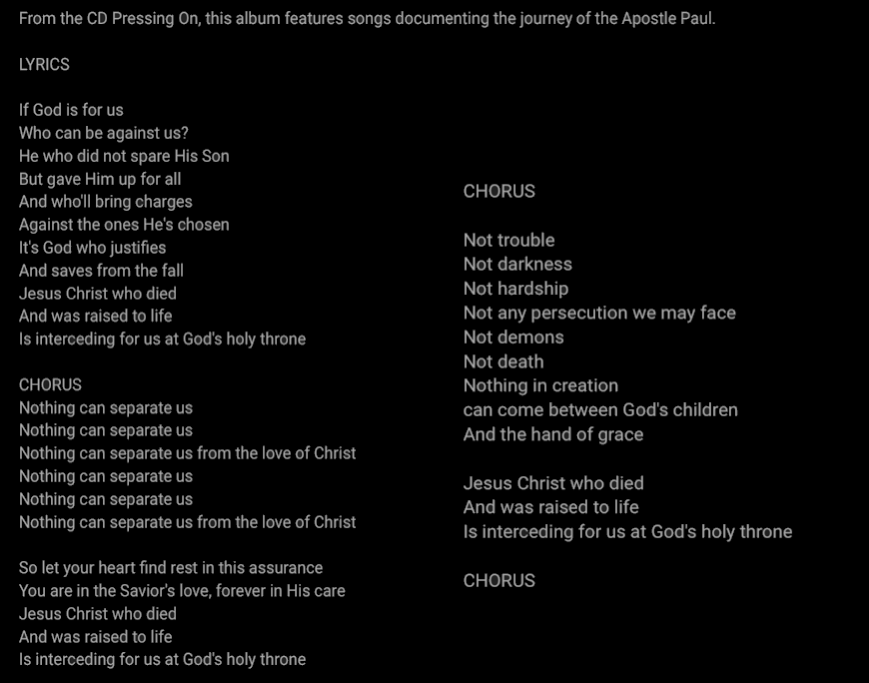
Music: Nothing Can Separate Us – First Call (Lyrics below)


lyrics