But God Does Notice

Sunday, November 11, 2018

 Click here for readings.

Today, in Mercy, we learn lessons from widows – those whose place in biblical times was uncertain and frightening. Without a husband, a woman experienced diminished standing in the legal, financial and political life of the community. 
Mk12_44 miteJPG

She was often dependent on charity, and was deemed fortunate to capture a bit of good will from those in better circumstances. 

There are several examples of widows being blessed by miracles, because they were among those most in need of them.

In today’s first reading and in the Gospel, we meet two widows displaying amazing charity and character strength.  The widow of Zarephath steadfastly prepares for death because she has nothing left to live on. When Elijah asks to share in her last few cornmeal cakes, she does not hesitate to feed him.

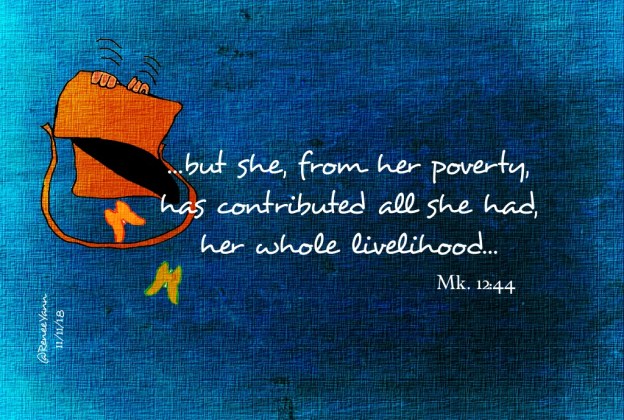
In our Gospel, it is significant that, just across the road from the well-stocked treasury, a nearly penniless widow gives her last coins to the poor.

In Elijah’s account, we learn the outcome of the widow’s generosity.  She reaps an abundant reward in perpetual flour and oil to sustain her.

We never learn what happens to Jesus’s widow. We are left to imagine that, in some way, her selflessness is rewarded.

It is so hard to give it all to God, especially if we feel we have little left for ourselves.  It is hard to give our love when we feel empty-hearted.  It is hard to give care when we feel unappreciated.  It is hard to assist others when we ourselves are exhausted. It is hard to do good if no one, not even God, seems to notice.

But God does notice.  Like Jesus on that long-ago afternoon, God is watching as we empty our coffers in service and care for the poor, sick, troubled and lost.

What we have to give may be small — a single corn cake or two little coins. It is the act of giving it that is large — and will make our hearts large by the choice.

One this date in 1841, Catherine McAuley, the first Sister of Mercy, died. She had given everything she had — a fortune actually.. and a life — for God’s poor and needy.  Let’s call on her to inspire us to greater charity and mercy. God knows we need to do something for this aching world!

Music:: Matthew West – Do Something

God Knows Our Hearts

Saturday, November 10, 2018

Click here for readings

Lk 16_45 knows heart

Today, in Mercy, we celebrate the Memorial of Pope St. Leo the Great.  He was a remarkable 5th century leader who consolidated essential elements of theology and administration for the yet emerging Church.

Our first reading today reflects Paul doing the same thing in the very early days of Christianity.  His ministry throughout the Mediterranean basin guided early Christians as the Church planted its first harvest.

Paul lets us know that this ministry of leadership is not easy – that he relies on the good will of the communities he serves:

You were, of course, concerned about me but lacked an opportunity.
Not that I say this because of need,
for I have learned, in whatever situation I find myself,
to be self-sufficient.

Paul seems to refer specifically to material help,  but certainly he values even more the spiritual and moral loyalty of his followers.

In our Gospel, Jesus offers us a sermonette that can, at first, seem a little confusing. His tone, as he speaks to a group of Pharisees, is somewhat ironic. But his bottomline message is this: loyalty to God, not to material things.

The thread running through all these passages?  The work of the Church needs both our spiritual and material loyalty to thrive  – whether in Paul’s time, or Christ’s, or our own.

The Pharisees pretended such loyalty, but Jesus challenged them:

You justify yourselves in the sight of others,
but God knows your hearts …

A sobering challenge against which to measure ourselves!

Music: Thank You for Giving to the Lord _ Ray Boltz

We Are God’s Temple

Friday, November 9, 2018

Readings: http://www.usccb.org/bible/readings/110918.cfm

psalm46 stream

Today, in Mercy, we celebrate the Feast of the Dedication of the Lateran Basilica in Rome.  It’s a big deal feast and, as a young religious, I never really understood why. I thought to myself, “It’s a building, right? Why are we celebrating a building.” As I matured, I learned. 

Perhaps some of you are familiar with Ken Follett’s book “The Pillars of the Earth”. Or perhaps others of you have visited the Sagrada Familia Cathedral in Barcelona, Spain. You may have been, as I was, overwhelmed at the sheer enormity and span of these cathedral-building endeavors which reflect our desire to enshrine God.

What is it in us, as human beings, that will move us to give lifetimes and centuries to capturing God? What is it in us that will try to concretize our awe at the Almighty?

It was just such an inner drive that motivated the builders of the Lateran, the oldest and highest ranking of the four major basilicas in Rome.  This “temple of stones” was understood by its builders to represent the living Church – you and me, who together are built up by Christ into his own Body.

What kind of  temple are we, sisters and brothers – we who are all too aware now of the cracks in our structure? 

We are, as Ezekiel visions and the psalmist confirms in today’s readings, a temple fed by the life waters of God.

Our Gospel shows that Jesus knew and believed this. He cleansed the temple in Jerusalem of its weaknesses. He then compared it to his own body, which is the true dwelling place of grace among us. He asked us to imitate him in the way we treasure and live our lives in this world because we too are Temples of God’s Grace.

A living fountain of grace flows through this living temple. God is in our midst as we build, and rebuild, the Church – brick by human brick.

May this feast renew our hope for our Church, cause us to call upon God for deeper courage, and witness to all the enduring power of faith.

Music:  We Are God’s People – Fred Bock

This is a recently written hymn with an old time kind of sound. 

English hymn text writer, Bryan Jeffery Leech, took the primary theme from Johannes Brahms’ 1st Symphony, 4th movement and wrote lyrics which have become a hymn standard. We Are God’s People is a majestic statement befitting Brahm’s regal theme. Allan Robert Petker has created an anthem setting and has intertwined many of the other themes that Brahms utilized in his 1st symphony.

The Sweet Scent of God

Thursday, November 8, 2018

Click here for readings

Lk15_5 lost lamb

Today, in Mercy, we meet the Shepherd bringing the lost lamb home.  Haven’t we all, at sometime in our lives, been carried on those sacred shoulders?

Whether by our own prayers, or the prayers of those who love us, have we not been rescued from sorrow, foolishness, isolation or fear?

This beautiful Gospel assures us of the one thing we most deeply need – we are cherished, irrevocably, by God.

This morning, if we need to ride those shoulders, let us trust ourselves to them in prayer. 

If, by grace, we are already home, let us pray for those feeling most lost or abandoned – those most beset by a hostile world. May our merciful action help lift them to peace and the sweet scent of God so close beside them.

Music: I Will Carry You – Sean Clive

I will carry you when you are weak.
I will carry you when you can’t speak.
I will carry you when you can’t pray.
I will carry you each night and day.

I will carry you when times are hard.
I will carry you both near & far.
I’ll be there with you whenever you fall.
I will carry you through it all.

My arms are wider than the sky,
softer than a little child,
stronger than the raging,
calming like a gentle breeze.
Trust in me to hold on tight because 

I will carry you when you can’t stand.
I’ll be there for you to hold your hand.
And I will show you that you’re never alone.
I will carry you and bring you back home.

Not pain, not fear, not death, no nothing at all
can separate you from my love.
My arms and hands will hold you close.
Just reach out and take them in your own.
Trust in me to hold on tight.
I will carry you.

One Thing I Ask

Wednesday, November 7, 2018

Click here for readings

Today, in Mercy, both Jesus and Paul continue to instruct us on the Christian life. Paul, writing from a distance to his beloved Philippians, encourages them to hold fast to the teachings he gave them when he was with them. We can sense, in Paul’s tone, an awareness of his impending death. There is a “last advice” urgency in his words.

Ps27_one thing

The same is true of Jesus’s teaching in the Gospel. He is driving home the point that, with God, it must be all or nothing. We can’t be half-hearted, “sometimes” disciples.

His words fall hard on our sensibilities.

If anyone comes to me
without hating his father and mother,
wife and children, brothers and sisters,
and even his own life,
he cannot be my disciple.

Really? Hate? In a Gospel which is always Love, from a man who is himself Love, what can this really mean? 

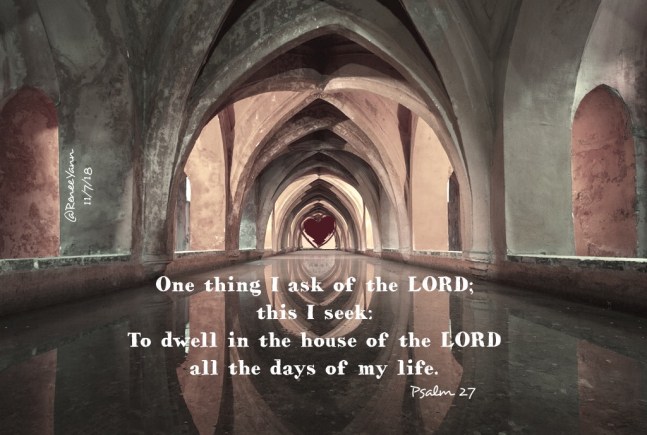
For me, the passage says that we can let nothing hold us that would turn us from God – even if that might be as dear as beloved family. It means that our one core desire must be that of the Psalmist:

One thing I ask of the LORD;
this I seek:
To dwell in the house of the LORD
all the days of my life,
That I may gaze
on the loveliness of the LORD
and contemplate his temple.

What we love, cherish and choose should reveal God’s heart to us, not obscure it. If that’s not the case, we have some tough choices to make, just like Jesus’s listeners in today’s Gospel.

Music: One Thing I Ask, One Thing I Seek

Come to the Feast!

Tuesday, November 6, 2018

Click here for readings

Today, in Mercy, we are back at “the banquet” – that divine communion where we are all one in God – even the poor, crippled, lame and blind from yesterday’s reading.

Lk14_15 dine kingdom

But there’s a little different twist to this story.  This time, we are the ones invited, but we fail to attend due to multiple bogus excuses:

  • we’ve gotten married
  • we bought a cow
  • we bought a field
  • we bought not one, but FIVE yoke of oxen

You get the gist… all those preoccupying duties that keep us bound. Not to make a pun, but, Holy Cow, given all my responsibilities, how could I ever make it to “the banquet”!

The truth is that what keeps us from “the banquet” is fear:

  • fear that we might be associated with Jesus
  • fear to sit at the same table with his motley companions 
  • fear that some loyalty might be demanded of us

and the basis of all fears –

  • that we aren’t good enough, holy enough,
    strong enough to be what Jesus desires.

Oh, Friends, let us not be deterred by fear or any other preoccupation from the invitation of a lifetime! Let us approach the table of God with a humble and open heart. God has the banquet garment ready for us. The celebration is ready. All we have to do is sit down and listen to the Divine Music. The rest will come. We will learn how to dance with God.

Music: Dancing with God – sung by Briege O’Hare, OSC,  based on the writings of Mechthild of Magdeburg, a Beguine and Christian medieval mystic whose book Das fließende Licht der Gottheit (The Flowing Light of Divinity) described her visions of God.

I cannot dance, O Lord, unless you lead me
And if you want me to leap for joy,
Then you must be the first to dance and to sing
And I will follow you; in their echo I will ring.

Then, only then,
Then, only then,
Then, only then, will I leap for joy!

I cannot sing, O Lord, unless you lead me
And if you want me to sing for joy,
Then you must be the first to sing out your song
And I will follow you and sing right along.

Then, only then,
Then, only then,
Then, only then, will I sing for joy!

Lead me Lord in your joyful dancing.
I will follow in your dance of life.
Then all my living will be true to you,
My loving God.

(Repeat Verse 1)
Leap for joy!
Will I leap for joy!

The Grace at Our Border

Monday, November 5, 2018

Readings: http://www.usccb.org/bible/readings/110518.cfm

Today, in Mercy,  we continue our readings from Paul’s inspiring letter to the Philippians. Paul sincerely loves this community and wants them to be perfected in Christ. 

This is what Jesus wants for us too.  Today’s Gospel is just one example of Jesus showing his followers the way to holiness. He uses the opportunity of a dinner to remind those gathered that they are very fortunate. Their lives are like a banquet compared with the lives of those who are poor and burdened.

He suggests that his followers do what God would do:

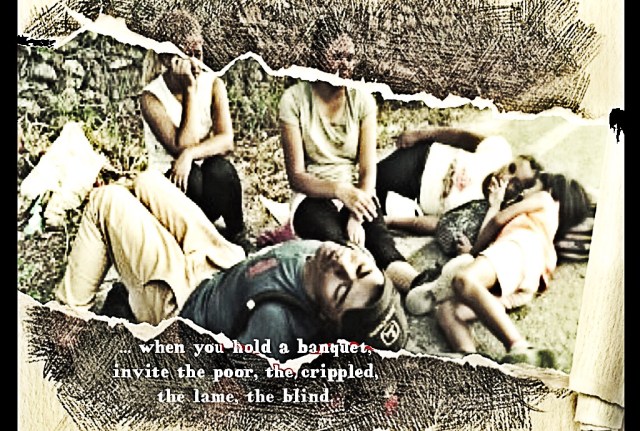
When you hold a banquet,
invite the poor, the crippled, the lame, the blind;
blessed indeed will you be
because of their inability to repay you….

Just such an opportunity to be blessed awaits us, in the USA, at our southern border. A wave of God’s beloved poor and besieged washes toward us. Will we meet them with true mercy and justice born out of Christian charity? Or will we confront them with a brutal show of power born of fear and alienation?

Lk14_14 banquet

Of course, there are legitimate concerns with such a large migration. But these concerns must be met with wisdom and prudence, not prejudice and vilification. This is not a horde of animals attacking us. These are human beings desperately seeking a better life.

Jesus thought that his table companions, gifted as they were by God, had the moral capacity to respond to his challenge. Can he expect the same of us?

Let’s hope so, because our Gospel closes with a very compelling reason:

“For you will be repaid
(one way or the other, I might add)
at the resurrection of the righteous.”

Music: God of the Poor – Graham Kendrick

Wholehearted

Sunday, November 4, 2018

Readings: http://www.usccb.org/bible/readings/110418.cfm

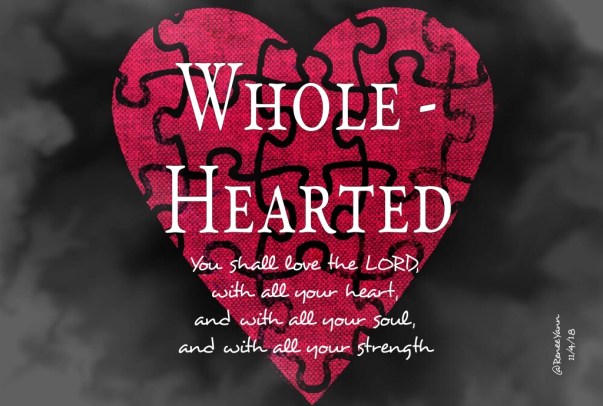
Today, in Mercy, both Deuteronomy and Mark proclaim the call to love God wholeheartedly.

woleheartedJPG

In Mark, it is one of the scribes who initiates this proclamation by asking Jesus which is the first – most important – of the commandments. Unlike many of Jesus’ encounters with the scribes and Pharisees, this one does not seem hostile. The man, as one might expect of an expert in the Law, wants to know if Jesus continues the priorities of the Torah. 

He is pleased with Jesus’ answer. And Jesus is pleased with him. We can almost see Christ’s smile at the scribe’s sincere and lived response. 

This man sees through the Pharisaical confusions which have been heaped upon this most important law. He understands that love of God and neighbor mean infinitely more than burnt offerings and public sacrifices.

How do we reach this wholehearted love in our complex lives? We’re not busy with burnt offerings, but we are distracted by so many forces that lay claim to our attention and devotion. 

We love many worthy and unworthy things in our lives. We often confuse real love with one of its masquerading forms – “loves” that are self-serving rather than other-serving.

Today’s Alleluia verse is an answer to our, “How?”.

Whoever loves me
will keep my word, says the Lord;
and my father will love him
and we will come to him.

Real love is proved by action. It’s that simple. What do my actions say about where my heart is? Let me just flip back through my last 24 hours to see if God would have smiled at my choices, words, and actions. And let me change what I need to change for tomorrow.

Music: V’Ahavta- Marty Goetz

V’Ahavta is part of the Shema Yisrael (שְׁמַע יִשְׂרָאֵל)- a prayer that serves as a centerpiece of the morning and evening Jewish prayer services.

Seesaws

Saturday, November 3, 2018

Click here for readings

Lk14_11 seesaw

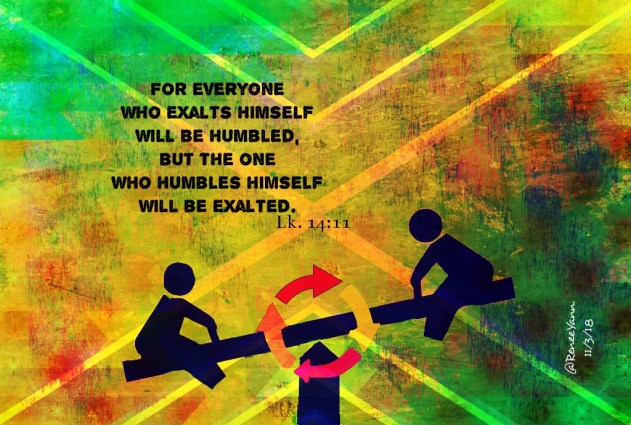
Today, in Mercy, Jesus gives us one of the many “seesaw“ choices of the Gospel:

  • with Me or against Me
  • sheep or goats
  • God or money 
  • being first or last
  • being humble or exalted

These phrases are both hard and kind. They’re hard because they leave us no middle ground. It’s either-or, not both-and. I don’t know about you but I like both-and. I like to have my cake and eat it too. But it doesn’t work, does it?

The phrases are kind because, if we trust them, they make our choices clear.

Today’s Gospel tells us the secret to true spiritual greatness – humility. In worldly terms, that’s a contradiction. Just observe the pompous, dishonest posturing of some of our politicians to see how the world rejects humility as a path to greatness!

But Jesus turns the world upside-down. In Christ’s world, the seesaws go backward. They dip to power by service; to love by sacrifice; to wealth by compassion. They are rides in contradiction to the world.

Our spiritual life is the constant challenge of balancing these seesaws toward God and God’s beloved poor, wounded, and marginalized. That’s how Jesus rode them. That’s how He’s asking us to do it.

Music: Humble – Audrey Assad

In Prayer, Memory, and Light

Friday, November 2, 2018

Click here for Readings

Today, in Mercy, we remember the beloved Holy Souls who have gone before us. They are never far from us. Some of us may visit cemeteries today. Some will place a list of names upon the altar. But all of us will whisper their names: grandparents, parents, spouses, children, brothers, sisters and beloved friends — meeting each name in a sacred memory.

Romans6_8 All Souls

May those memories, whatever they contain, be transformed by our loving prayers. May whatever grief remains in us be blessed by the grace of faith and thanksgiving. And may the Holy Ones we honor today brighten us with some of their overwhelming Eternal Light in God.

Music: Lux Aeterna- Eternal Light – Michael Hoppé

Lux aeterna
Lux aeterna luceat eis, Domine,
cum sanctis tuis in aeternum,
quia pius es.

Requiem aeternam
dona eis, Domine,
et lux perpetua luceat eis.

May light eternal shine upon them, O Lord,
with Your saints forever,
for You are Mercy.

Eternal rest
give to them, O Lord,
and let perpetual light shine upon them.