Valley of Decision

Saturday of the Twenty-seventh Week in Ordinary Time

October 12, 2019

Click here for today’s readings

Today, in Mercy, we have our second passage from Joel. It’s a awe-filled reading which describes Yahweh calling together the nations for final judgement. The gathering is to take place in the valley between the Temple Mount and the Mount of Olives.

Joe4_14 valley

From his poetic imagination, Joel describes the apocalyptic scene:

Apply the sickle,
for the harvest is ripe;
Come and tread,
for the wine press is full;
The vats overflow,
for great is their malice.
Crowd upon crowd
in the valley of decision;
For near is the day of the LORD
in the valley of decision.

It is a place where the Lord decides who, by their decisions, belongs to God and who does not. Those who have suffered, even shed blood to remain faithful – these are God’s holy ones. They will receive the reward.

What can we learn from this reading which grew out of Israel’s experience so long ago? How can we relate to a “valley” on the other side of the world?

That awesome valley runs right down the middle of our heart. It is the place within every moment where we decide for God or for self. On one side, its high ridges call us to greed, irresponsible self-interest, manipulative relationship, indifference to others’ suffering.

On the other side, the heights of love, mercy, and justice stretch before us. 

We will stand in that valley innumerable times in our lives. Which way we have chosen to climb makes all the difference when the final trumpet sounds.

Music today is a stretch. But I think Joel’s vivid prophesying was a stretch for his people too. The song is “Valley of Decision”, a reggae worship sung. It is sung by Christafari, a Christian convert from Rastafarianism. We all come to God in different ways. I was fascinated and inspired by this singer’s own choice from his “Valley of Decision”. (Words below)

VALLEY OF DECISION
Joel 3:14-21
(Chorus):
Run come and fall people take heed to His call,
Valley of Decision. Valley of Decision.
This is no game, people have to die in His name
Valley of Decision. Valley of Decision.

Darkness it looms all around us, I find it hard to see.
I don’t know, I don’t know, I don’t know, I don’t know, I don’t know
whether I should stay or whether I should flee.
People all around me seem, they seem to be so sad.
I see them cry I hear them bawl I see their backs against the wall,
I wish I could wipe away their tears.

(Pre Chorus):

There’s a Holy, a Holy hill, Holy Mount Zion,
Holy, Holy Mount Zion (Heb 12:22).
Just know that He’s the Lord your God
in this Valley of Decision, Valley of Decision.

Chat Chorus):

Even though I run through enough Hills and Valleys
I fear no evil cause God is with me.
Even though I run through enough Hills and Valleys
Thy rod and staff they will comfort me (Psalm 23:4). (2x)

(Chorus)
(Pre Chorus)
(Chat Chorus)

Jah (Yahweh) Great and dreadful day will soon come (Joel 2:11).
Jah will pour out His mighty, mighty, mighty Spirit to all mankind (Acts 2:17).
Through Him all creation, all creation was made (John 1:3).
Those who call upon His name, Call on His name and you will be saved (Rom 10:13).

(Pre Chorus)
(Chorus)
(Chat Chorus repeated)

Sound the Alarm!

Friday of the Twenty-seventh Week in Ordinary Time

October 11, 2019

Click here for readings

Today, in Mercy, we have the first of two readings from the imaginative poet-prophet Joel. Joel lived at the time of a massive locust infestation in Israel. He compares that devastation to the conquest of an invading army which can be expected if the people do not repent.

Joel2_1

If you have the time, I suggest you read the whole brief book of Joel at one time. Doing so gives a clearer picture of the prophetic cadence Joel employs. It is repeated by most prophets and it goes like this:

  • Hey folks, things are a mess!
  • Guess what, they’re gonna’ get worse.
  • Besides that, it’s your own fault.
  • So wake up and repent.
  • But don’t worry because God still loves us.
  • God wants to and will make things better.
  • Motivate yourself by that hope.
  • And anyway, we’re all just waiting for that great and final day.
  • So praise God by your righteous life.

Oh, but gloriously literate Joel delivers this message with such passionate turns of phrase! Let yourself relish one of two of these startlers from today’s passage.

Listen for how they speak to your heart in the current circumstances of our world:

  • Gird yourself in sorrow
  • Spend the night in scratchy haircloth
  • The Day of the Lord comes as ruin from the Almighty
  • a day of darkness and of gloom,
  • a day of clouds and somberness
  • The enemy is numerous and mighty
  • Their like has never been seen before

You might say, “Gee, I’m not really feeling all that bad, and the sun’s out where I live!” 

Well, try reading the phrase as if you lived in Kurdish Syria, or war-torn Yemen. Hear the prophet’s warning as an immigrant fleeing your country, or a democracy-seeker in Hong Kong. Listen to this word of God as a person without a home, or food, or healthcare might hear it.

In many ways, things are a mess! What are we called to by today’s reading? What is the warning and the hope within it to impel us toward a more just and merciful life?

Music: Deep Within – David Haas

Eyes on the Prize

Thursday of the Twenty-seventh Week in Ordinary Time

October 10, 2019

Click here for readings

Today, in Mercy, Malachi (chronologically last of the Twelve minor prophets) lays it all out.  He is writing for the Jewish community after the Restoration of the Second Temple. It is a community whose faith and practice have become “institutionalized”, having lost much of the raw vigor and intention of its first charismatic restorers.

Mal3_20 sun_justice

I think we can all understand how that happens. It’s hard to maintain the passion of an early vision over the long years of its testing. This Jewish community has been visibly successful. They are home from captivity. The Temple has been rebuilt. Life is good. What’s the problem? So God tells them:

You have defied me in word, says the LORD,
yet you ask, “What have we spoken against you?”
You have said, “It is vain to serve God,
and what do we profit by keeping his command,
And going about in penitential dress
in awe of the LORD of hosts?

The community has forgotten the heart of their life! In the imposing shadow of their Temple achievement, they have lost the memory of the God it honors.


Rabbi Gunther W. Plaut says this:
Malachi describes a priesthood that is forgetful of its duties, a Temple that is underfunded because the people have lost interest in it, and a society in which Jewish men divorce their Jewish wives to marry out of the faith. The Prophet lived probably sometime after the year 500, perhaps as late as 450 (B.C.E.). It was an era of spiritual disillusionment, for the glorious age that earlier prophets had foreseen had not materialized. 

Click here to to link to the Rabbi’s blog. Good stuff.


It’s not a big leap to see ourselves foreshadowed in Malachi’s prophecy. We live on a devastated planet and a war-pocked world. We agonize over corrupted political, economic and justice systems. We worship in a scarred and struggling Church. We live in a culture that has forgotten. Indeed, in our materialistic world, it appears that:

… evildoers prosper,
and even tempt God with impunity.

But Malachi tells the faithful people that the day of their reconciliation is coming. He tells them to remain steadfast, to keep their eyes on the prize.

… you shall be mine, says the LORD of hosts,
my own special possession, on the day I arise.
And I will have compassion on you,
as a parent has compassion on a devoted child.

Our Gospel echoes this promise. If we but ask, God will give us the strength to remain merciful, faithful, and just – not to forget the heart of our life, not to be blind to it in our suffering brothers and sisters.

Music: Keep Your Eyes on the Prize– a folk song, a genre that carries a lot in common with prophetic poetry. This ballad became influential during the Civil Rights Movement of the 1950s and 1960s. It is based on the traditional song, “Gospel Plow” also known as “Hold On” or “Keep Your Hand on the Plow”.

This version is written by Pete Seeger sung by The Boss, Bruce Springsteen 

Paul and Silas bound in jail
Had no money for to go their bail
Keep your eyes on the prize, hold on

Paul and Silas thought they was lost
Dungeon shook and the chains come off
Keep your eyes on the prize, hold on

Freedom’s name is mighty sweet
And soon we’re gonna meet
Keep your eyes on the prize, hold on

I got my hand on the gospel plow
Won’t take nothing for my journey now
Keep your eyes on the prize, hold on

Hold on, hold on
Keep your eyes on the prize, hold on

Only chain that a man can stand
Is that chain o’ hand on hand
Keep your eyes on the prize, hold on

I’m gonna board that big greyhound
Carry the love from town to town
Keep your eyes on the prize, hold on
Hold on, hold on
Keep your eyes on the prize, hold on

Now only thing I did was wrong
Stayin’ in the wilderness too long
Keep your eyes on the prize, hold on

The only thing we did was right
Was the day we started to fight
Keep your eyes on the prize, hold on
Hold on, hold on

(Jamming interlude)

Ain’t been to heaven but I been told
Streets up there are paved with gold
Keep your eyes on the prize, hold on

The Lord’s Prayer

Wednesday of the Twenty-seventh Week in Ordinary Time

October 9, 2019

Click here for today’s reading

(Some of you may recognize this reflection as a “recycle”, but I think it may be worth another read.)

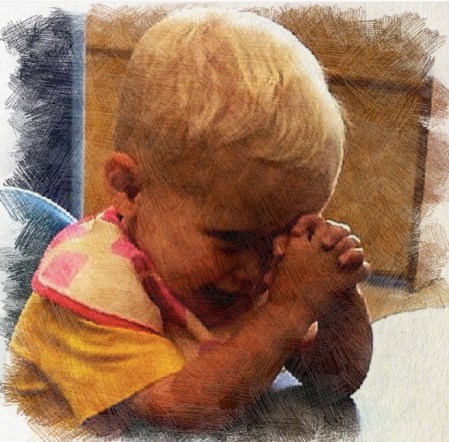
Ollie praying

Today, in Mercy,  Jesus teaches his disciples how to pray. His prayer is simple and direct, like talking to your Dad over a morning cup of coffee.

What about us? How do we pray?

Our first learned prayers are a lot like Jesus’s simple Our Father. We praise God, giving thanks, and asking for what we need.

Then we grow up and get sophisticated. We may begin to “say” or read prayers rather than use our own words. While such a practice can deepen our understanding of prayer, it places a layer between us and our conversation with God.

Sometimes others lead our prayer in the community of faith. This too can enrich us as we are inspired by a shared faith. But it is a little like trying to have a private conversation in an elevator.

Just as Jesus often went off in solitude to pray, this kind of prayer is our most intimate time with God – a time when God allows us to know God and ourselves in a deeper way. This sacred time alone with God may be spent in words, song, or the silence that speaks beyond words.

It is a time to be with the Beloved as we would our dearest, most faithful companion. We rest in the field of our experiences, letting them flow over God’s heart in tenderness. We listen with the ear of absolute trust to the secrets God tells us in the quiet.

Pray Always

Tuesday of the Twenty-seventh Week in Ordinary Time

October 8, 2019

Click here for today’s readings

Today, in Mercy, our readings suggest that there are many different ways to pray – to acknowledge and respond to God’s Presence in our lives, to deepen in relationship with God.

png-divider-lines--1400

Jonah has just finished his prayer of thanksgiving for deliverance from the chaos. This prayer is transformative. Jonah is different – open to God’s call – after it. The Ninivites, after hearing only one day of Jonah’s preaching, respond by acts of fasting and mortification . Their king, when he hears of their actions, himself formalizes a drastic national atonement. The repentant prayer of the Ninivite Kingdom is also transformative. They turn from their evil ways and open their hearts to God’s sovereignty.

png-divider-lines--1400

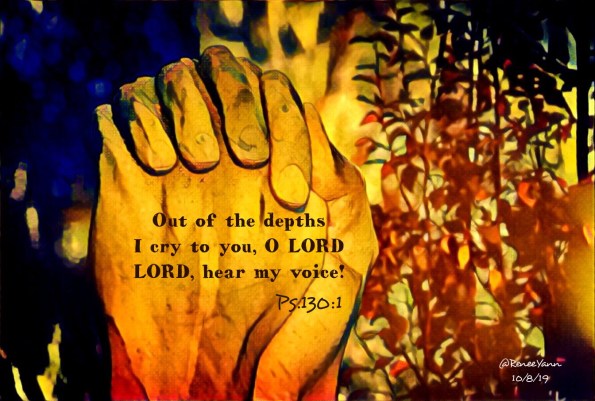
ps130_1 lament

Our Responsorial Psalm 130, a treasured and classic song of lament, shows us the transformative power of this kind of prayer. The one praying from the depths of her heart:

  • names her suffering
  • weeps with God because of it
  • begs deliverance
  • in the begging, relinquishes the outcome to God
  • receives peace in the relinquishment
  • is transformed by that peace and offers praise

png-divider-lines--1400

Our Gospel offers us another classic example of types of prayer, that of contemplation and that of service. In the story, Mary is affirmed for her singular attention to the presence of Christ – her contemplative prayer. Martha, on the other hand, pays attention to Christ by her service. Some have interpreted Martha’s as a lesser form of prayer. However, Macrina Weirdekehr, in her new book “The Flowing Grace of Now”, gives us this powerful insight into Martha’s prayer:

“Mary’s listening annoys Martha, who is busy serving. Yet if the full truth be known, Martha was also sitting at the feet of the teacher. She is sitting at the feet of service. Later, after dinner was served, with Jesus gone and Mary retired for the evening, I envision Martha finally sitting down by herself, and listening to the experience of the evening. As she reviewed the evening and her lament in the midst of her service, perhaps she began to realize that all of this was part of the wisdom offered by the school of life. We learn by contemplating our daily struggles.”


(I so highly recommend this deeply beautiful book available from:

Click here to go to Ave Maria Press or

Click here to go to Amazon


Today, we might consider our many ways to talk with and be with God, to give time and awareness to this all-encompassing relationship in our lives.

Music: Lord, I Need You – Matt Maher 


Transparent Prayer

Memorial of Our Lady of the Rosary

Monday, October 7, 2019

Click here for today’s readings

Today, in Mercy, our first reading is from the Book of Jonah, a drama with which we are all familiar.  Because of the fantastical nature of the tale, we may tend to read it simply on the level of allegory – the way we might read Aesop’s fables. But there is much spiritual depth to be found in this well-known story.

As I pray with the Jonah passages for these three days, I am using an article by Walter Bruggemann to inform my prayer.

You can access Bruggemann’s article here

Since today is the feast of the Holy Rosary, a prayer which has blessed the Church for centuries, Bruggemann’s consideration of Jonah’s prayer caught my attention:

The complexity of (Jonah’s) prayer is reflective of the complexity of all prayer.  Prayer purports to be single-minded in its communication with Yahweh.  Everyone who prays is complex, given to deception, distortion, and willfulness; our prayers are most often thick with mixed motives, distortions, and exhibits, even if only to the self.  There are “saints” who are more mature and more disciplined than this in their prayer.  But evidently Jonah is not among those mature, disciplined saints.  For that reason his compromising and manipulative maneuvers are highly visible in the prayer.  We may spot such maneuvers in his prayer and be driven to reflect on our own acts of seduction in prayer whereby we deceive ourselves, even if God is not deceived.

The Rosary, intended as a contemplation not a recitation, allows us the silence and time to sort out the complexities of our own prayer. It is a prayer not to be rushed. Praying it well requires us to lay aside our busy existence and excuses, and to place ourselves in the stillness of Divine Transparency.

rosary

The Rosary invites us to enter more deeply into the truth of Christ’s life, but also into our own. Seen in the light of Mary’s and Jesus’s lives, what is our own life teaching us?

So many of us have a Rosary in our drawer or purse that we haven’t touched for a while. Many of these beads were given to us by, or belonged to, someone who loved us – who wished us the blessings that come from its devotion. Perhaps we might like to rekindle our love for the Rosary today while remembering that beloved person. In the drawer beside my bed, my Dad’s well worn rosary is waiting for me.

Music: Ave Maria – Bach, sung by Jessye Norman

Write It Down with Your Life!

Twenty-seventh Sunday in Ordinary Time

October 6, 2019

Click here for readings

Today, in Mercy,  our readings combine to offer us a powerful message: we are the translators of God’s Word for our time. Our choices and actions for justice and mercy make the vision “readable” – visible for our sisters and brothers.

Hab2_2 vision

Habakkuk starts our challenge. He is in a bit of a struggle with God, asking repeatedly how long God is going to allow the people to suffer. ( I have had similar conversations with God, especially during these charged political times).

In so many words, God tells Habakkuk to look to his faith – his vision through God’s eyes. God sees that “the just one, because of his faith, shall live.” God tells him to “write the vision down”, to make it apparent in his own choices and actions for justice and mercy. In other words, Habakkuk, I’ve done what I am going to do. The rest is up to you, Buddy!

In a similar way, Paul reminds Timothy to “stir up the flame” – the gift of God given at his profession of faith. Paul reminds Timothy that, by grace, he knows what is right and just. He must not be chicken about living and speaking that Truth – to write the vision down by his choices and actions for justice and mercy.

In our Gospel, the disciples seem to want their faith increased because the commitment to witness is scary. They think they might feel a little better about it all if their faith consoled them more. But “writing the vision with our lives” takes guts, and the disciples seem a little lacking in today’s reading.

Jesus tells them to buck up. They are blessed to serve the Word of God by the witness of their lives. It won’t always feel good, safe or successful. Still they, and we, must unfailingly write the vision down by our choices and actions for justice and mercy, because even …

When you have done all you have been commanded,
say, ‘We are unprofitable servants;
we have done what we were obliged to do.

Jesus calls it like it is today. We are blessed to be God’s translators. We have an undeniable call to live God’s just and merciful vision. No excuses. Get it together. Keep the pencil sharp. No asking God when He’s going to make things better. The legible  (just and merciful) translation depends on us!

Music: The Vision – Patrick Love

Advice to a Prophet – Richard Wilbur

Speaking of prophets, a beautiful poem, Advice to a Prophet, came across my email today thanks to Joe Riley at Panhala. The poem is fitting as we close this Season of Creation. I have included it in a second post in case you’d like to read it.

deer


Advice to a Prophet

When you come, as you soon must, to the streets of our city,
Mad-eyed from stating the obvious,
Not proclaiming our fall but begging us
In God’s name to have self-pity,

Spare us all word of the weapons, their force and range,
The long numbers that rocket the mind;
Our slow, unreckoning hearts will be left behind,
Unable to fear what is too strange.

Nor shall you scare us with talk of the death of the race.
How should we dream of this place without us?–
The sun mere fire, the leaves untroubled about us,
A stone look on the stone’s face?

Speak of the world’s own change. Though we cannot conceive
Of an undreamt thing, we know to our cost
How the dreamt cloud crumbles, the vines are blackened by frost,
How the view alters. We could believe,

If you told us so, that the white-tailed deer will slip
Into perfect shade, grown perfectly shy,
The lark avoid the reaches of our eye,
The jack-pine lose its knuckled grip

On the cold ledge, and every torrent burn
As Xanthus once, its gliding trout
Stunned in a twinkling. What should we be without
The dolphin’s arc, the dove’s return,

These things in which we have seen ourselves and spoken?
Ask us, prophet, how we shall call
Our natures forth when that live tongue is all
Dispelled, that glass obscured or broken

In which we have said the rose of our love and the clean
Horse of our courage, in which beheld
The singing locust of the soul unshelled,
And all we mean or wish to mean.

Ask us, ask us whether with the worldless rose
Our hearts shall fail us; come demanding
Whether there shall be lofty or long standing
When the bronze annals of the oak-tree close.


(If you would like to receive a wonderful poem daily, you can subscribe to Panhala. Send a blank email to Panhala-subscribe@yahoogroups.com)


Names Written in Heaven

Saturday of the Twenty-sixth Week in Ordinary Time

October 5, 2019

Click here for readings

Today, in Mercy, we read from the Book of Baruch, a little book with a big punch. Baruch authored “scribal literature”, that which completed the message of another writer. Baruch was Jeremiah’s scribe, working to finish the edges of this most complex of the prophets.

Our reading today reflects this complexity. The Israelites have a history of intertwined faith and faithlessness. They also have current overwhelming sufferings. How does the prophet employ these two realities to impel hearts toward God?

Baruch characterizes God as angry and vengeful, punishing the people for their idolatry. It’s a model that works for Baruch’s time and purposes. But it’s not the God I know and love. So how can the passage speak to me?

The core of Baruch’s message is that things can be really bad sometimes in life, but that God is with us even in those times. Our turning to God in trust and patience will allow us to remain faithful and to deepen spiritually even in suffering. That fidelity brings joy and peace.

It’s hard to have that kind of faith. We want to manage our lives, and even manage God, in order to make sense of the chaos of life – to provide sensible, rectifiable reasons for suffering and evil.

We want to control demons like the early disciples did.

lk10_20 name_heaven

In our Gospel, these disciples return from their missionary trips all puffed up with their powers over evil. Jesus cautions them saying that’s not at all what it’s all about. Any miraculous power they have in a given moment is only a sign of a Greatness beyond them. 

Instead, their names a written in Heaven by the long, unshakeable fidelity that comes with keeping their eyes on God; by giving themselves to the mysterious, sometimes hidden, presence of God in every reality; by allowing that Presence to transform them and their circumstances.

(Speaking of prophets, a beautiful poem, Advice to a Prophet, came across my email today thanks to Joe Riley at Panhala. The poem is fitting as we close this Season of Creation. I will include it in a second post in case you’d like to read it.)

Music:  a little revival music today, New Name Written Down in Glory. Picture the disciples singing this after Jesus instructs them in today’s Gospel.

Celebrating Francis and his Followers

Memorial of Saint Francis of Assisi

October 4, 2019

Click here for readings

Francis
Francis of Assisi in Ecstasy- Caravaggio https://creativecommons.org/publicdomain/mark/1.0/deed.en

Today, in Mercy, in lieu of my usual reflection, I choose on this feast of St. Francis, to share with you my thoughts on our beloved Sisters of St. Francis of Philadelphia, and to give a well-deserved shout out to their Spiritual Center in Aston, PA.

I have been so enriched by their spirituality, their passion for justice, their unbounded hospitality, their love of the Gospel, and their witness for Christ.

Please join me in praying today for their community .. for its vigor, strength, holiness, witness and joy.

I commend to all my readers the Franciscan Spiritual Center at Aston, PA. If you are serious about your soul-life, consider their desire to assist you. I have found my relationship with these Sisters so beneficial for my spiritual life:

Click here for info on Franciscan Spiritual Center

I particularly send blessings to these beloved women who have blessed my life by their deep Franciscan spirituality. I have been brought into the world by them (Click to read about Old St. Mary’s Hospital – Kensington), taught by them, worked with them, prayed with them, laughed with them, mourned with them, been arrested for civil disobedience with them, and been edified by their gentle, hospitable goodness:

Sister Clare Immaculate
Sister Irma Catherine
Sister Jean Margaret McDevitt
Sister Marge Sullivan
Sister Marie Lucey
Sister Miriam Eileen Murray
Sister Kate O’Donnell
Sister Angela Presenza
Sister Annemarie Slavin
Sister Clare D’Auria
Sister Julia Keegan
and their devoted SSJ buddy, Sister Pat Hamill

Happy Feastday to all Franciscans and their co-ministers worldwide!

Music: Be Praised, My Lord – Andrea Likovich, OSF