Today, in God’s Lavish Mercy, we pray with Psalm 146, a call to praise God. The call is supported by the particular verses of today’s reading. We should praise God, the psalmist says, because God:
secures justice for the oppressed
gives food to the hungry
sets captives free
gives sight to the blind
raises up the humble
loves the just
protects strangers
sustains fatherless and the widow
thwarts the way of the wicked
Reading this elaborate hymn of praise makes one think the Lord was pretty busy in ancient Israel. Were all these good things happening for otherwise unfortunate people?
For me, this psalm, rather than being a retrospective list of God’s generous accomplishments, is a call to realize the way God wants things to be. Within that call is another deeper call – to become an agent for God’s Will for good. In other words, God acts through us to make God’s mercy real in the world through the ways the psalm describes.
The loving will of God is always turning the world toward good. But sometimes our lack of faith inhibits our insight into that holy turning. Sometimes we see only the surface of life and get caught in its tangles.
Prayer is the ointment that releases our inner vision to find God in all things, either calling us to foster good or to thwart evil, as our psalm describes. As we cooperate with this call, God’s everlasting creative action opens before us and we see the world, and our role in it, with new eyes.
Ode: Intimations of Immortality from Recollections of Early Childhood
BY WILLIAM WORDSWORTH


   The child is father of the man;
And I could wish my days to be
   Bound each to each by natural piety.
          (Wordsworth, "My Heart Leaps Up")

There was a time when meadow, grove, and stream,
       The earth, and every common sight,
                          To me did seem
                      Apparelled in celestial light,
            The glory and the freshness of a dream.

It is not now as it hath been of yore;—
                      Turn wheresoe'er I may,
                          By night or day.
The things which I have seen I now can see no more.


                      The Rainbow comes and goes,
                      And lovely is the Rose,
                      The Moon doth with delight
       Look round her when the heavens are bare,
                      Waters on a starry night
                      Are beautiful and fair;
       The sunshine is a glorious birth;
       But yet I know, where'er I go,
That there hath past away a glory from the earth.


Now, while the birds thus sing a joyous song,
       And while the young lambs bound
                      As to the tabor's sound,
To me alone there came a thought of grief:
A timely utterance gave that thought relief,
                      And I again am strong:
The cataracts blow their trumpets from the steep;
No more shall grief of mine the season wrong;
I hear the Echoes through the mountains throng,
       The Winds come to me from the fields of sleep,
                      And all the earth is gay;
                           Land and sea
                Give themselves up to jollity,
                      And with the heart of May
                 Doth every Beast keep holiday;—
                      Thou Child of Joy,
Shout round me, let me hear thy shouts, thou happy Shepherd-boy.


Ye blessèd creatures, I have heard the call
      Ye to each other make; I see
The heavens laugh with you in your jubilee;
      My heart is at your festival,
            My head hath its coronal,
The fulness of your bliss, I feel—I feel it all.
                      Oh evil day! if I were sullen
                      While Earth herself is adorning,
                         This sweet May-morning,
                      And the Children are culling
                         On every side,
In a thousand valleys far and wide,
                      Fresh flowers; while the sun shines warm,
And the Babe leaps up on his Mother's arm:—
                      I hear, I hear, with joy I hear!
                      —But there's a Tree, of many, one,
A single field which I have looked upon,
Both of them speak of something that is gone;
                      The Pansy at my feet
                      Doth the same tale repeat:
Whither is fled the visionary gleam?
Where is it now, the glory and the dream?


Our birth is but a sleep and a forgetting:
The Soul that rises with us, our life's Star,
                      Hath had elsewhere its setting,
                         And cometh from afar:
                      Not in entire forgetfulness,
                      And not in utter nakedness,
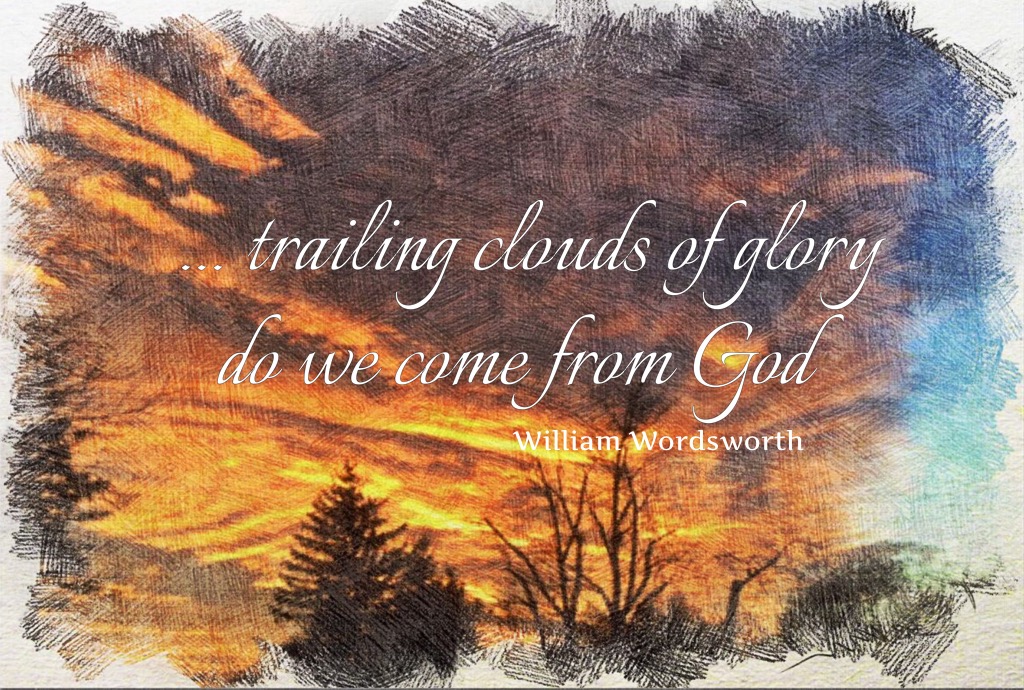
But trailing clouds of glory do we come
                      From God, who is our home:
Heaven lies about us in our infancy!
Shades of the prison-house begin to close
                      Upon the growing Boy,
But he beholds the light, and whence it flows,
                      He sees it in his joy;
The Youth, who daily farther from the east
                      Must travel, still is Nature's Priest,
                      And by the vision splendid
                      Is on his way attended;
At length the Man perceives it die away,
And fade into the light of common day.


Earth fills her lap with pleasures of her own;
Yearnings she hath in her own natural kind,
                      And, even with something of a Mother's mind,
                      And no unworthy aim,
The homely Nurse doth all she can
To make her Foster-child, her Inmate Man,
                      Forget the glories he hath known,
And that imperial palace whence he came.


Behold the Child among his new-born blisses,
A six years' Darling of a pigmy size!
See, where 'mid work of his own hand he lies,
Fretted by sallies of his mother's kisses,
With light upon him from his father's eyes!
See, at his feet, some little plan or chart,
Some fragment from his dream of human life,
Shaped by himself with newly-learn{e}d art
                     A wedding or a festival,
                      A mourning or a funeral;
                         And this hath now his heart,
                      And unto this he frames his song:
                         Then will he fit his tongue
To dialogues of business, love, or strife;
                      But it will not be long
                      Ere this be thrown aside,
                      And with new joy and pride
The little Actor cons another part;
Filling from time to time his "humorous stage"
With all the Persons, down to palsied Age,
That Life brings with her in her equipage;
                      As if his whole vocation
                      Were endless imitation.


Thou, whose exterior semblance doth belie
                      Thy Soul's immensity;
Thou best Philosopher, who yet dost keep
Thy heritage, thou Eye among the blind,
That, deaf and silent, read'st the eternal deep,
Haunted for ever by the eternal mind,—
                      Mighty Prophet! Seer blest!
                      On whom those truths do rest,
Which we are toiling all our lives to find,
In darkness lost, the darkness of the grave;
Thou, over whom thy Immortality
Broods like the Day, a Master o'er a Slave,
A Presence which is not to be put by;
Thou little Child, yet glorious in the might
Of heaven-born freedom on thy being's height,
Why with such earnest pains dost thou provoke
The years to bring the inevitable yoke,
Thus blindly with thy blessedness at strife?
Full soon thy Soul shall have her earthly freight,
And custom lie upon thee with a weight,
Heavy as frost, and deep almost as life!


                      O joy! that in our embers
                      Is something that doth live,
                      That Nature yet remembers
What was so fugitive!
The thought of our past years in me doth breed
Perpetual benediction: not indeed
For that which is most worthy to be blest;
Delight and liberty, the simple creed
Of Childhood, whether busy or at rest,
With new-fledged hope still fluttering in his breast:—
                      Not for these I raise
                      The song of thanks and praise
                But for those obstinate questionings
                Of sense and outward things,
                Fallings from us, vanishings;
                Blank misgivings of a Creature
Moving about in worlds not realised,
High instincts before which our mortal Nature
Did tremble like a guilty thing surprised:
                      But for those first affections,
                      Those shadowy recollections,
                Which, be they what they may
Are yet the fountain-light of all our day,
Are yet a master-light of all our seeing;
                Uphold us, cherish, and have power to make
Our noisy years seem moments in the being
Of the eternal Silence: truths that wake,
                To perish never;
Which neither listlessness, nor mad endeavour,
                      Nor Man nor Boy,
Nor all that is at enmity with joy,
Can utterly abolish or destroy!
                Hence in a season of calm weather
                      Though inland far we be,
Our Souls have sight of that immortal sea
                      Which brought us hither,
                Can in a moment travel thither,
And see the Children sport upon the shore,
And hear the mighty waters rolling evermore.


Then sing, ye Birds, sing, sing a joyous song!
                      And let the young Lambs bound
                      As to the tabor's sound!
We in thought will join your throng,
                      Ye that pipe and ye that play,
                      Ye that through your hearts to-day
                      Feel the gladness of the May!
What though the radiance which was once so bright
Be now for ever taken from my sight,
                Though nothing can bring back the hour
Of splendour in the grass, of glory in the flower;
                      We will grieve not, rather find
                      Strength in what remains behind;
                      In the primal sympathy
                      Which having been must ever be;
                      In the soothing thoughts that spring
                      Out of human suffering;
                      In the faith that looks through death,
In years that bring the philosophic mind.
And O, ye Fountains, Meadows, Hills, and Groves,
Forebode not any severing of our loves!
Yet in my heart of hearts I feel your might;
I only have relinquished one delight
To live beneath your more habitual sway.
I love the Brooks which down their channels fret,
Even more than when I tripped lightly as they;
The innocent brightness of a new-born Day
                      Is lovely yet;
The Clouds that gather round the setting sun
Do take a sober colouring from an eye
That hath kept watch o'er man's mortality;
Another race hath been, and other palms are won.
Thanks to the human heart by which we live,
Thanks to its tenderness, its joys, and fears,
To me the meanest flower that blows can give
Thoughts that do often lie too deep for tears.
from November 11, 2018: As I write today, I think of the humble servant Catherine McAuley who died on this date in 1841. On this Veterans’ Day, I think of all who have died in war. I think of our Sister-veterans, Sister Bernard Mary Buggelein and Sister Dorothy Hillenbrand who served in WWII and now rest in our community cemetery. All of their lives have been called into the great embrace of our Eternal God. May all our lives inspire one another to humble service and praise.
Today, in God’s Lavish Mercy, we pray with Psalm 23, that confident string of affirmations that God abides with us in all of life’s seasons, even the winter of death.
Only goodness and kindness follow me all the days of my life; And I shall dwell in the house of the LORD for years to come.
Psalm 23
I pray with the psalm from two perspectives today.
November 11th is the anniversary of Catherine McAuley’s death, the beloved Foundress of the Sisters of Mercy.
November 11th is observed in many countries commemorating the end of World War I:
Armistice Day (New Zealand, France, Belgium and Serbia)
Remembrance Day (United Kingdom and the Commonwealth of Nations including Australia and Canada)
Veterans Day called Armistice Day until 1954, when it was rededicated to honor American military (Army, Navy, Marine, and Air Force) veterans. (United States)
In all instances, we are reminded that, whether in peace or in war, our lives end in death, a sobering admission for our prayer today.
Most of us don’t choose to spend a lot of time thinking about our own death. Our human tendency is to think of death as loss rather than as the gain many saints, especially Paul, suggest to us, as in today’s first reading:
But when the kindness and generous love of God our savior appeared, not because of any righteous deeds we had done but because of his mercy, he saved us through the bath of rebirth and renewal by the Holy Spirit, whom he richly poured out on us through Jesus Christ our savior, so that we might be justified by his grace and become heirs in hope of eternal life.
Titus 3: 4-7
However, despite a natural tendency to deny it, the reality of death becomes more intrusive as one grows older.
The vaulting English poet William Wordsworth struggled with the intrusion throughout his life. When commenting on his masterpiece, Ode on Intimations of Immortality from Recollections of Early Childhood, Wordsworth wrote:
Nothing was more difficult for me in childhood than to admit the notion of death as a state applicable to my own being.
William Wordsworth
Wordsworth’s Ode, even for those unfamiliar with it, offers beautiful lines we might recognize immediately:
our birth is but a sleep and a forgetting;
trailing clouds of glory do we come from God
Heaven lies about us in our infancy!
though nothing can bring back the hour of splendor in the grass
Over many readings, this magnificent poem has always offered me both new insights and old comforts about life, death, nature, hope, peace and God – very much like Psalm 23. To prayerfully read one, then the other, is like a long, lovely hike into the heart of God.
Since I suggest it for our prayer today, I looked for a summary for those unfamiliar with it. Sparks Notes offers this:
It remains a powerful poetic meditation on death, the loss of childhood innocence, and the way we tend to get further away from ourselves – our true roots and our beliefs – as we grow older. But it is not merely elegiac: indeed, it becomes celebratory as Wordsworth comes to realise that the advancing years can still provide opportunities to catch some glimmers of that first encounter with nature as a child.
The complete poem is in a second post today, to give it all the prominence it deserves. I hope it blesses you as it does me.
Today, in God’s Lavish Mercy, we pray with Psalm 37, a song of promise and encouragement to live a good life. Although I don’t usually choose to write a subjective reflection, a life-shaping memory keeps rising up from this psalm today.
I was nineteen years old, kneeling on an antique prie-dieu in front of the Superior General. She was about to rename me “Sister Something” for the rest of my life. You know, something like this picture – except that novice couldn’t sing quite as well as I did! 🙂
We postulants had been able to submit three suggestions, so I was expecting a name in honor of my mother or father, or my own baptismal name. How stunned was I when Mother intoned, “God bless you, Sister Mary Nathaniel”- a name I had heard maybe once in American Lit class! (You remember Hawthorne, right?)
But my shock is not the point of the story. Later, Mother took me aside and told me that she gave me the name because I reminded her of Nathaniel in the Gospel – the guileless one. Being guileless I guess, I told her I didn’t know what “guileless” meant. She said, “It means whole hearted. Be wholehearted, without pretense.”
The LORD watches over the lives of the wholehearted; their inheritance lasts forever. By the LORD are your steps made firm, as the Lord blesses your way.
Psalm 37 gave me the gift of that word, and that memory, again today. I realized that it is still taking me a lifetime to live into Mother’s long-ago challenge.
Trust in the LORD and do good, that you may dwell in the land and be fed in security. Take delight in the LORD, and God will grant you your heart’s requests.
Even though, after Vatican II, I eventually returned to my baptismal name, my heart has remained “Nathaniel”. Like the disciple under the fig tree, I am still trying to weave a true and loving life out of life’s tangled threads – still trying to do so wholeheartedly and without guile.
Gratefully and humbly, I thank God for watching over me. But God is not the only one. Mother Bernard came once more this morning, borne on memory’s beloved wing, to bless me with renewed hope and challenge.
As we pray this psalm today, let us call on the memory of those who have blessed us by their confidence and hope in us. Let us call on the God who watches over our desire to be truly wholehearted disciples.
Poem: Desiderata by Max Ehrmann (1927) – a writing I loved in my youth and have often passed on to those just beginning the glorious journey.
GO PLACIDLY amid the noise and the haste,
and remember what peace there may be in silence.
As far as possible, without surrender,
be on good terms with all persons.
Speak your truth quietly and clearly; and listen to others,
even to the dull and the ignorant; they too have their story.

Avoid loud and aggressive persons; they are vexatious to the spirit.
If you compare yourself with others, you may become vain or bitter,
for always there will be greater and lesser persons than yourself.
Enjoy your achievements as well as your plans.

Keep interested in your own career, however humble;
it is a real possession in the changing fortunes of time.
Exercise caution in your business affairs,
for the world is full of trickery.
But let this not blind you to what virtue there is;
many persons strive for high ideals,
and everywhere life is full of heroism.

Be yourself. Especially do not feign affection.
Neither be cynical about love;
for in the face of all aridity and disenchantment,
it is as perennial as the grass.

Take kindly the counsel of the years,
gracefully surrendering the things of youth.
Nurture strength of spirit to shield you in sudden misfortune.
But do not distress yourself with dark imaginings.
Many fears are born of fatigue and loneliness.
Beyond a wholesome discipline, be gentle with yourself.

You are a child of the universe no less than the trees and the stars;
you have a right to be here.
And whether or not it is clear to you,
no doubt the universe is unfolding as it should.

Therefore be at peace with God, whatever you conceive God to be.
And whatever your labors and aspirations,
in the noisy confusion of life, keep peace in your soul.

With all its sham, drudgery and broken dreams,
it is still a beautiful world.
Be cheerful. Strive to be happy.
Today, in God’s Lavish Mercy, we pray with Psalm 46, a song of confidence, celebration, and joy.
The waters of the river gladden the city of God, the holy dwelling of the Most High!
A city gladdened! We know what it looks like. Just this week, we’ve seen it right here in my city, beloved Philadelphia – people dancing in the streets with those who are no longer strangers.
Perhaps people danced in the Roman plaza in 324 AD when Pope Sylvester dedicated the church. Not sure. But it is the power of a civic act, to give people a “place” wherein to claim renewed identity. ( The word “civic” comes from a Latin phrase describing an award given for a noble public deed.)
The dedication of St. John Lateran was such an act. The glorious building shouted out in its massive stones, “God lives among us, the Foundation of our lives.”
Or, as our psalmist puts it:
God is our refuge and our strength, an ever-present help in distress. Therefore, we fear not, though the earth be shaken and mountains plunge into the depths of the sea.
Our faith, and the morality it sustains, live deep under the surface of our lives, like the unseen roots of a magnificent tree. The power of those hidden roots is attested to by generations of leaves and branches unfurling in the cycle of life.
Those acts of faith, be they in the construction of sacred buildings or the washing of a beggar’s feet, shout out our conviction that, “God lives among us, the Foundation of our lives.”
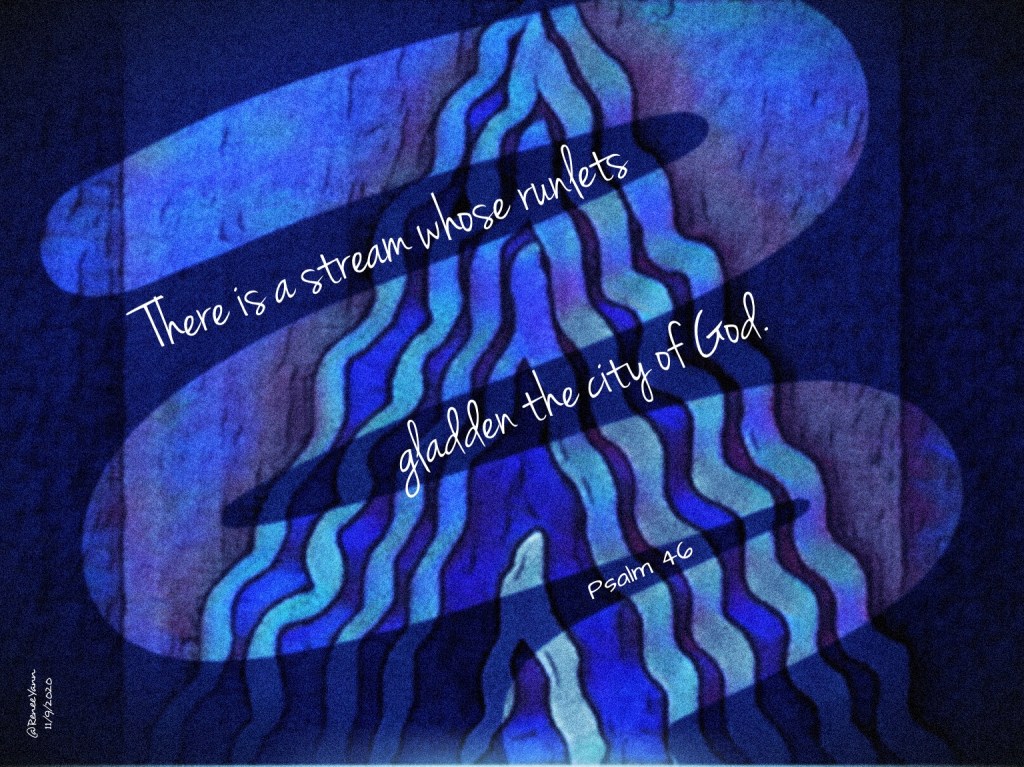
There is a stream whose runlets gladden the city of God, the holy dwelling of the Most High. God is in its midst; it shall not be disturbed; God will help it at the break of dawn.
I began thinking about this reflection last night after President-Elect Biden’s acceptance speech. To me, the world felt lighter than it had in four years. It had begun to breathe again. Hope was returning to its perch in our hearts. This after the terrible fear that it might have died or gotten lost in a long migration into darkness.
I think it is the greatest of sins to kill hope, especially for those who have only hope to cling to. Because, indeed, as Joe Biden assured us last night, when we share hope, we can do anything in the God who strengthens us.
Hope is its own great “basilica”, built from the stones of mutual charity, reverence, and trust which God fires in our hearts:
The LORD of hosts is with us; our stronghold is the God of Jacob. Come! behold the deeds of the LORD, the astounding things God has wrought on earth.
As we pray Psalm 42 today, let us ask for the continuing grace to exercise hope for and with one another.
Poetry: Hope Restored by Craig A. Roberts, a New Zealand poet. I thought this was a beautiful poem-prayer. His book of poetry can be found here.
Discouraging events,
entangling thoughts,
melancholic tsunamis form
in quick time, devastating my soul,
destroying the joyful breath of life.
Surges of futility, rejection
and self pity breach the dykes.
I churn and tumble in dark sucking swells.

I call to Him who loves me in abundance.
Swiftly He comes,
plucks me out of dark waters.
He is here now.
He whispers of promises never broken,
reminds me of my calling,
my inward journey,
my vocation.

He reassures my heart,
He restores my poise.
He sends me to wander by the waters edge,
immersed in His creative wonder
Christ breathes afresh into my created being.

O what joy. Bathed in His steadfast love
I trust all to Christ,
false illusions destroyed,
hope restored,
possibilities unfold,
His kingdom comes.
( A bit late today in publishing as I was distracted by the breaking U.S. election results! I would like to say one word on that before the reflection. Here is that word:
Today, in God’s Lavish Mercy, we pray with Psalm 63, a prayer of deep longing and faithful intimacy.
The psalm is complemented by the lyrical passage from the Book of Wisdom which immediately reminded me of my favorite verse for the Christmas season:
For while gentle silence enveloped all things, and night had now run half its swift course, Wisdom’s all-powerful Word leapt down from heaven, from the royal throne, into the midst of the shadowed land.
Wisdom 18: 14-15
Using delicate feminine images, our first reading from Wisdom describes the God for whom we long – a God who longs for us as eagerly:
Resplendent and unfading is Wisdom, and she is readily perceived by those who love her, and found by those who seek her. She hastens to make herself known in anticipation of their desire –
This reading forms a sort of dance with our Psalm – the first describing God’s desire, the second describing ours:
O God, you are my God whom I seek; for you my flesh pines and my soul thirsts like the earth, parched, lifeless and without water.
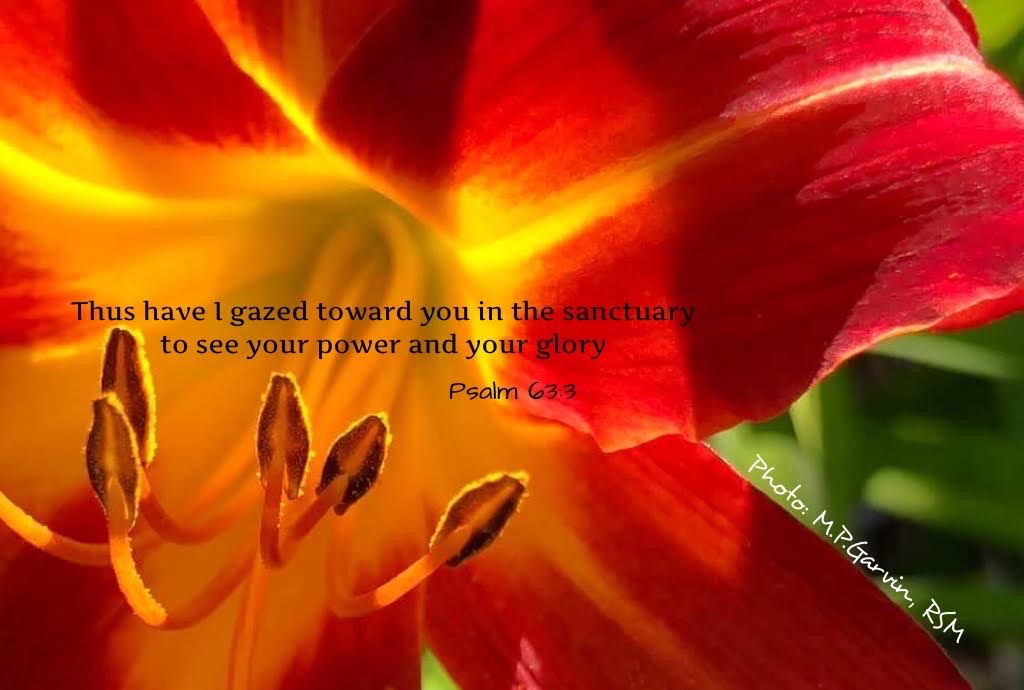
Thus have I gazed toward you in the sanctuary to see your power and your glory, For your kindness is a greater good than life; my lips shall glorify you.
Our reading assures us that God readily meets our gaze:
Whoever watches for Wisdom at dawn shall not be disappointed, for they shall find her sitting by their heart’s gate. For taking thought of wisdom is the perfection of prudence, and whoever for her sake keeps vigil shall quickly be free from care; because she makes her own rounds, seeking those worthy of her, and graciously appears to them in the ways, and meets them with all solicitude.
In our prayer today, let us open our deepest hearts to this Wisdom God who seeks us. Let our thirsty souls be satisfied in that loving Sacred Bliss.
Thus will I bless you while I live; lifting up my hands, I will call upon your name. As with the riches of a banquet shall my soul be satisfied, and with exultant lips my mouth shall praise you.
Music: I Long for You, O Lord – The Dameans
I long for you, O Lord With all my soul, I thirst for You.
God, my God, you I seek for You my soul is thirsting, Like a dry and weary land, my spirit longs for You.
I have sought for Presence, Lord to see your power and your glory. Lord, your love means more than life. I shall sing your praise.
Thus will I bless you while I live, and I will call your name, O Lord. As with the riches of a feast shall my soul be satisfied.
Through the night, I remember You for You have been my Savior. In the shadow of your wings, I will shout for joy.
Today, in God’s Lavish Mercy, we pray again with Psalm 112, placed between two interestingly complementary readings.
Psalm 112 is basically a guide to what constitutes a happy life. The psalm tells us this:
Blessed and happy is the one:
who fears the LORD,
who greatly delights in God’s commands.
who is gracious and lends
who conducts affairs with justice
who gives to the poor
The psalmist tells us that this kind of humble, grateful generosity is its own reward.
Such a person
shall have a posterity which is mighty upon the earth
shall never be moved;
shall be in everlasting remembrance
shall be steadfast; shall not fear.
shall be remembered for enduring generosity
shall have a “horn” exalted in glory. ( “horn” = strength and power)
If we translate the biblical language here, what is Psalm 112 telling us.
This. True happiness comes from:
loving God
living within the law of love
being just, merciful, and generous
taking care of the vulnerable
Such happiness looks like this:
others can look up to you, especially the young
you stay faithful to goodness and righteousness
your faithfulness nourishes those who come after you
you are strong and courageous
your generosity inspires generosity in others
you are respected and loved for your goodness, even long after you’re gone
These are the kind of people Paul is depending on in our first reading to keep his ministry afloat. It sounds like he didn’t find too many of them, except finally in his Philippian community! Actually, under his eloquence, I think Paul sounds a little ticked off!😉
Jesus was looking for this kind of people too, but he certainly didn’t find them in the Pharisees of today’s Gospel. And Jesus let’s them have it in a dose of their own medicine.
What does Jesus, who “knows our hearts”, find when he looks at us? Let’s pray Psalm 112 today asking for the grace to grow in true, generous, faith so we can look back at Jesus with deep peace and HAPPINESS!
Poem: The Work of Happiness by May Sarton
I thought of happiness, how it is woven Out of the silence in the empty house each day And how it is not sudden and it is not given But is creation itself like the growth of a tree. No one has seen it happen, but inside the bark Another circle is growing in the expanding ring. No one has heard the root go deeper in the dark, But the tree is lifted by this inward work And its plumes shine, and its leaves are glittering.
So happiness is woven out of the peace of hours And strikes its roots deep in the house alone: The old chest in the corner, cool waxed floors, White curtains softly and continually blown As the free air moves quietly about the room; A shelf of books, a table, and the white-washed wall— These are the dear familiar gods of home, And here the work of faith can best be done, The growing tree is green and musical.
For what is happiness but growth in peace, The timeless sense of time when furniture Has stood a life’s span in a single place, And as the air moves, so the old dreams stir The shining leaves of present happiness? No one has heard thought or listened to a mind, But where people have lived in inwardness The air is charged with blessing and does bless; Windows look out on mountains and the walls are kind.
Music: Psalm 112 – 4Him
We only get so many times
To ride around this sun
And so many times to see a full moon shine
When day is done if anything's worth doing
Then it's worth doing right

So I looked for wisdom on how to
Best live this brief life I have found
Blessed is he who fears the Lord
Who finds delight in His commands
Blessed is he who fears the Lord

Who finds delight in His commands
I guess that we all gamble on some
Truth to guide our days
And we trust that it will bring us joy and meaning
On the way

I've got friends who feel betrayed by all the things
They once believed
So with everything I've seen I've gotta say
It seems to me

Blessed is he who fears the Lord
Who finds delight in His commands
Blessed is he who fears the Lord
Who finds delight in His commands
Please hear this from a humble heart

But I feel like Exhibit A
In the evidence that God is good to those
Who live by faith, that's why I believe

Blessed is he who fears the Lord
Who finds delight in His commands
Blessed is he who fears the Lord
Who finds delight in His commands
He will not be shaken
He will have no fear
He will then remember
Today, in God’s Lavish Mercy, we pray with Psalm 122, one of the Psalms of Ascent prayed as the community of Israel prepared to worship.
Let us go rejoicing to the house of the Lord.
The community was happy to be able to gather at the Temple/Jerusalem which was more than a physical place of worship. The Temple/Jerusalem was a stable symbol of God’s power and faithful presence to Israel. It was so significant a symbol that, even when destroyed, its power sustained the community of believers.
The “Temple” became much more than a building; Jerusalem much more than a city. The very concepts grew into living realities with which the believer formed a dynamic relationship. Within that relationship, the believer could meet and explore the mystery of God.
“Temple/Jerusalem” became an icon of one’s faith relationship with God.
As the psalm indicates, the believer must go out of oneself to dwell within this icon, to grow in this relationship. It is a place of full spiritual integration achieved through a lifting of the spirit into the joyful discipline of grace.
Jerusalem, built as a city with compact unity. To it the tribes go up, the tribes of the LORD.
Psalm 22:3-4
The essence of this graceful transformation is to respond with profound gratitude to God’s invitation to love and mercy. Such a response raises our hearts to a new understanding of God’s Presence in every aspect of our lives.
According to the decree for Israel, to give thanks to the name of the LORD. In it are set up judgment seats, seats for the house of David.
Psalm 22:4-5
The psalm verses not included in today’s reading tell us that once we begin to live this sacred relationship, we become a force for peace and justice among our sisters and brothers.
For the peace of Jerusalem pray: “May those who love you prosper! May peace be within your ramparts, prosperity within your towers.” For the sake of my brothers and friends I say, “Peace be with you.” For the sake of the house of the LORD, our God, I pray for your good.
Psalm 22: 6-9
These verses seem like such a good prayer today.
Poem: from Rumi
Remember, the entrance door to the sanctuary is inside you.
Music: Fill This Temple Once Again – Don Moen and Benny Hinn
( Good morning, friends, as the world awaits the final result of the U.S. Presidential election. It is an unsettling morning for many of us, and a difficult one for me to create new inspiration! Maybe that’s because I slept so little! Today, I find myself relying on some of my older reflections to bring myself a measure of equanimity. I was glad to see this one from two years ago. It comforted me as I hope it does you.)
Today, in Mercy, we meet the Shepherd bringing the lost lamb home. Haven’t we all, at some time in our lives, been carried on those sacred shoulders?
Whether by our own prayers, or the prayers of those who love us, have we not been rescued from sorrow, foolishness, isolation or fear?
This beautiful Gospel assures us of the one thing we most deeply need – we are cherished, irrevocably, by God.
This morning, if we need to ride those shoulders, let us trust ourselves to them in prayer.
If, by grace, we are already home, let us pray for those feeling most lost or abandoned – those most beset by a hostile world. May our merciful action help lift them to peace and the sweet scent of God so close beside them.
Poetry: from Kahlil Gibran
We live only to discover beauty. All else is a form of waiting.
Music: I Will Carry You – Sean Clive
I will carry you when you are weak. I will carry you when you can’t speak. I will carry you when you can’t pray. I will carry you each night and day.
I will carry you when times are hard. I will carry you both near & far. I’ll be there with you whenever you fall. I will carry you through it all.
My arms are wider than the sky, softer than a little child, stronger than the raging, calming like a gentle breeze. Trust in me to hold on tight because
I will carry you when you can’t stand. I’ll be there for you to hold your hand. And I will show you that you’re never alone. I will carry you and bring you back home.
Not pain, not fear, not death, no nothing at all can separate you from my love. My arms and hands will hold you close. Just reach out and take them in your own. Trust in me to hold on tight. I will carry you.
Today, in God’s Lavish Mercy, we pray with Psalm 27, a brilliant testimony of faith and trust.
As you know, I write each day’s reflection on the preceding morning. As I write today, most polls have not opened. The political fate of the US remains hidden in a future yet unfolded. And yet you will be praying with this reflection on a morning when at least some of that fate will be known.
What to say then that will hold meaning no matter how the chips fall? The question was causing me some consternation until I opened to our psalm.
God has an infinitely bigger view of reality than any one of us! And our psalm invites us to live in that “blessed assurance” despite the shifting exigencies of our lives.
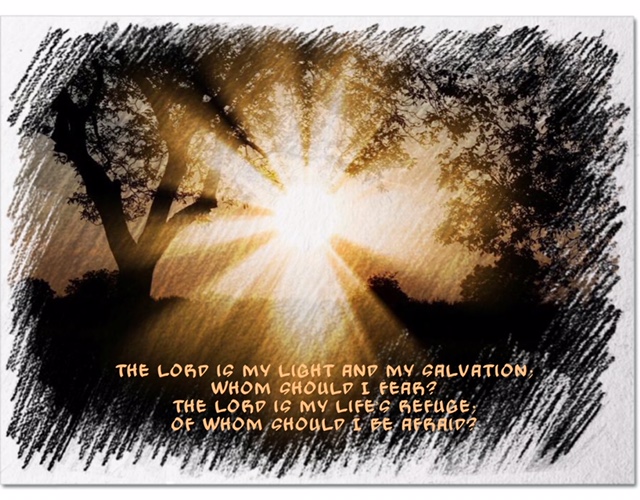
The LORD is my light and my salvation; whom should I fear? The LORD is my life’s refuge; of whom should I be afraid?
Will the election outcome matter to me tomorrow when I wake up to pray? You’re darn right it will! But there is a foundational truth that matters far beyond the day’s circumstances:
One thing I ask of the LORD; this I seek: To dwell in the house of the LORD all the days of my life, That I may gaze on the loveliness of the LORD and contemplate God’s eternal Presence.
Indeed, it is toward that hope that all our life’s energy must be directed. No matter who emerges victorious from the election, we must continue to work for a world where every person enjoys the bounty of the Lord.
Today I hope and pray for leaders who work with us, not against us, in that pursuit. In any case though, let us pray for courage to continue, with God’s grace, to build a “land of the living” for all God’s people.
I believe that I shall see the bounty of the LORD in the land of the living. Wait for the LORD with courage; be stouthearted, and wait for the LORD.
Poem: Trust by Thomas R. Smith
It’s like so many other things in life
to which you must say no or yes.
So you take your car to the new mechanic.
Sometimes the best thing to do is trust.
The package left with the disreputable-looking
clerk, the check gulped by the night deposit,
the envelope passed by dozens of strangers—
all show up at their intended destinations.
The theft that could have happened doesn’t.
Wind finally gets where it was going
through the snowy trees, and the river, even
when frozen, arrives at the right place.
And sometimes you sense how faithfully your life
is delivered, even though you can’t read the address.
Music: Blessed Assurance sung by James Ingram
“Blessed Assurance” is a well-known Christian hymn.The lyrics were written in 1873 by writer Fanny Crosby who was blind. The melody was composed by Fanny’s friend Phoebe Knapp.
Blessed assurance, Jesus is mine!
Oh, what a foretaste of glory divine!
Heir of salvation, purchase of God,
Born of His Spirit, washed in His blood

Chorus:
This is my story, this is my song,
Praising my Savior all the day long;
This is my story, this is my song,
Praising my Savior all the day long.

Perfect submission, perfect delight,
Visions of rapture now burst on my sight;
Angels, descending, bring from above
Echoes of mercy, whispers of love.

Perfect submission, all is at rest,
I in my Savior am happy and blest,
Watching and waiting, looking above,
Filled with His goodness, lost in His love.















 Lavish Mercy