Today, in God’s Lavish Mercy, our beautiful reading from Wisdom requires no further words from me. I highly recommend that we savor each of its elegant phrases, turning them over in our hearts and souls – like the rich colors of a vibrant Autumn or Spring day.
In Wisdom is a spirit intelligent, holy, unique, Manifold, subtle, agile, clear, unstained, certain, Not baneful, loving the good, keen, unhampered, beneficent, kindly, Firm, secure, tranquil, all-powerful, all-seeing, And pervading all spirits, though they be intelligent, pure and very subtle.
For Wisdom is mobile beyond all motion, and she penetrates and pervades all things by reason of her purity. For she is an aura of the might of God and a pure effusion of the glory of the Almighty; therefore nought that is sullied enters into her.
For she is the refulgence of eternal light, the spotless mirror of the power of God, the image of his goodness. And she, who is one, can do all things, and renews everything while herself perduring; And passing into holy souls from age to age, she produces friends of God and prophets.
For there is nought God loves, be it not one who dwells with Wisdom. For she is fairer than the sun and surpasses every constellation of the stars. Compared to light, she takes precedence; for that, indeed, night supplants, but wickedness prevails not over Wisdom. Indeed, she reaches from end to end mightily and governs all things well.
Instrumental Music: Poéme by Secret Garden
As we listen, let us carry to the arms of Wisdom and Mercy any bright hope or shadowed care we have in our hearts.
On this special anniversary of the death of the foundress of the Sisters of Mercy, Catherine McAuley, you may be interested in this beautiful article and prayer service from Mercy International Association:
November 10, 2021 Memorial of Saint Leo the Great, Pope and Doctor of the Church
Today, in God’s Lavish Mercy, we pray with Psalm 82 considered, by at least one Biblical scholar, to be:
“the single most important text in the entire Christian Bible.”
John Domenic Crossan, an Irish-American New Testament scholar, historian of early Christianity, and former Catholic priest
Council of the Gods by Raphael, (Public domain, via Wikimedia Commons)
Psalm 82 best summarizes for me the character of (the early Biblical) God. It imagines a scene in which God sits among the gods and goddesses in divine council. Those pagan gods and goddesses are dethroned not just because they are pagan, nor because they are other, nor because they are competition. They are dethroned for injustice, for divine malpractice, for transcendental malfeasance. They are rejected because they do not demand and effect justice among the peoples of the earth. And that justice is spelled out as protecting the poor from the rich, protecting the systemically weak from the systemically powerful.
excerpts from Crossan: The Birth of Christianity
Rise up, O God, bring judgment to the earth. Defend the lowly and the fatherless; render justice to the afflicted and the destitute. Rescue the lowly and the poor; from the hand of the wicked deliver them. Psalm 82: 3-4
In today’s Gospel, we encounter this just and supreme God in the person of Jesus when we witness the cure of the ten lepers.
You know, it would be startling enough to run into one leper on your daily walk, right? But TEN! That must have been an astounding situation. And to see those sad, disfigured people restored to wholeness must have been nearly overwhelming for the entourage accompanying Jesus.
Can you imagine that the recipients of such a miracle wouldn’t have clung in gratitude to Jesus for the rest of their days??? But, wow, only one even bothered to say “Thank you”.
What might have kept the other nine away, locked in their blind ingratitude?
Perhaps it’s not such a mystery if we allow ourselves to examine our own often ungrateful hearts. We don’t necessarily mean to be boorish in the face of God’s kindness and the generosity of others, but we sometimes suffer from …
Distraction: our lives are filled with frenetic activity which causes our blessings to flit by us into dizzying forgetfulness
Entitlement: we think we deserve or have earned those blessings
Self-absorption: we are so wrapped up in ourselves that we don’t even notice that our whole life is a gift
Laziness: we might say thanks if we get around to it. But we never get around to it.
Unresolved anger: we’re mad that we even needed help
Non-intentionality: we fail to live with intention and reflection, thus missing the opportunities for gratitude
Pride: we are too proud to acknowledge that we need anything
Fear: we are afraid something will be required of us in return for the gift
Spiritual blindness: we just don’t see the nurturing power of God and others in our life
It’s likely that our nine ungrateful lepers had these human frailties. But don’t be thinking about them, or your acquaintances who share their failings.
Let’s think about ourselves and how we want to be more grateful. Let’s think about our omnipotent God who is always Justice and Mercy.
The story is a powerful wake-up call to do better than the poor lepers did by living this prayer:
May I live humbly and gratefully today.
Poetry: The Ten Lepers – by Rosanna Eleanor (Mullins) Leprohon who was both a poet and novelist. Born in Montreal in 1829, Rosanna Mullins was educated at the convent of the Congregation of Notre Dame.
’Neath the olives of Samaria, in far-famed Galilee, Where dark green vines are mirrored in a placid silver sea, ’Mid scenes of tranquil beauty, glowing sun-sets, rosy dawn, The Master and disciples to the city journeyed on.
And, as they neared a valley where a sheltered hamlet lay, A strange, portentous wailing made them pause upon their way— Voices fraught with anguish, telling of aching heart and brow, Which kept moaning: “Jesus, Master, have mercy on us now!”
Softly raised the gentle Saviour His eyes like midnight star, And His mournful gaze soon rested on ten lepers, who, afar, Stood motionless and suppliant, in sackcloth rudely clothed, Poor Pariahs! by their nearest, their dearest, shunned and loathed.
Not unto Him prayed vainly those sore afflicted ten, No! He yearned too fondly over the erring sons of men, Even sharing in their sorrows, though He joined not in their feasts,— So He kindly told the Lepers: “Show yourselves unto the priests.”
When, miracle of mercy! as they turned them to obey, And towards the Holy Temple quickly took their hopeful way, Lo! the hideous scales fell off them, health’s fountains were unsealed, Their skin grew soft as infant’s—their leprosy was healed.
O man! so oft an ingrate, to thy thankless nature true, Thyself see in those Lepers, who did as thou dost do; Nine went their way rejoicing, healed in body—glad in soul— Nor once thought of returning thanks to Him who made them whole.
One only, a Samaritan, a stranger to God’s word, Felt his joyous, panting bosom, with gratitude deep stirred, And without delay he hastened, in the dust, at Jesus’ feet, To cast himself in worship, in thanksgiving, warm and meet.
Slowly questioned him the Saviour, with majesty divine:— “Ten were cleansed from their leprosy—where are the other nine? Is there none but this one stranger—unlearned in Gods ways, His name and mighty power, to give word of thanks or praise?”
The sunbeams’ quivering glories softly touched that God-like head, The olives blooming round Him sweet shade and fragrance shed, While o’er His sacred features a tender sadness stole: “Rise, go thy way,” He murmured, “thy faith hath made thee whole!”
Music: Hymn of Grateful Praise – Folliott S. Pierpoint
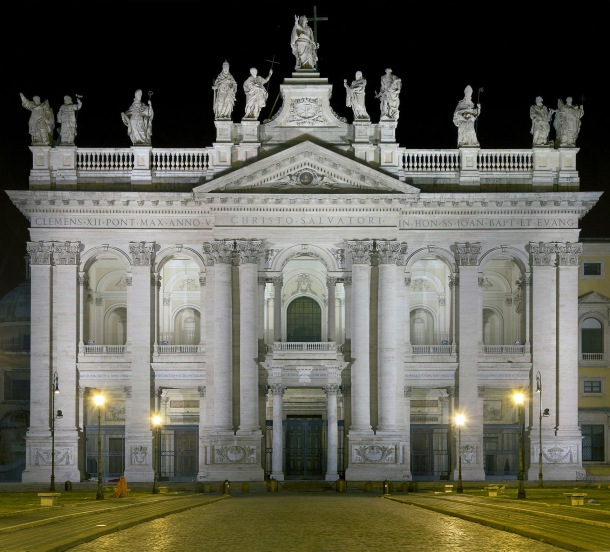
November 9, 2021 Feast of the Dedication of the Lateran Basilica in Rome
Today, in God’s Lavish Mercy, we celebrate a rare type of feast day – one that marks the dedication of a church building. For many, that seems a little odd. We are accustomed to celebrating Mary, Joseph and other saints and feasts of Our Lord.
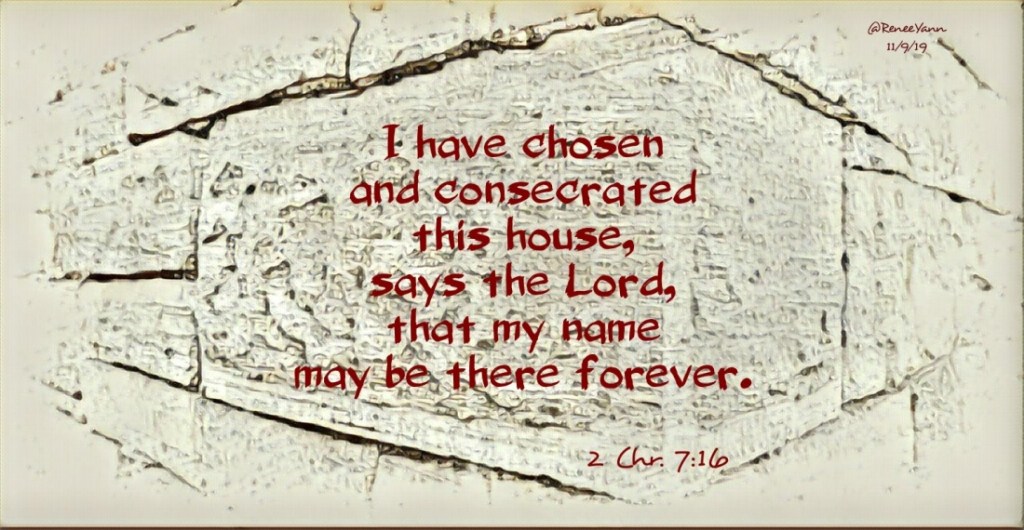
Here’s the thing: we are not actually celebrating a building. We are celebrating what the building represents – the Body of Christ, the Church, made of living stones – us.
St. John Lateran Basilica in Rome
But sometimes it helps to have visible symbols of the things we venerate and celebrate. That’s why we have medals, rosary beads and candles – so that we can SEE something as we try to conceptualize a spiritual reality.
St. John Lateran is the Pope’s parish church. Since he is the Bishop of the whole People of God, his physical church has come to symbolize the universal Body of Christ, the world Church.
Pope Benedict XVI in his Angelus Address, on November 9, 2008 said this:
Dear friends, today’s feast celebrates a mystery that is always relevant: God’s desire to build a spiritual temple in the world, a community that worships him in spirit and truth (cf. John 4:23-24). But this observance also reminds us of the importance of the material buildings in which the community gathers to celebrate the praises of God. Every community therefore has the duty to take special care of its own sacred buildings, which are a precious religious and historical patrimony. For this we call upon the intercession of Mary Most Holy, that she help us to become, like her, the “house of God,” living temple of his love.
As we pray today, we might want to consider the gift of faith on which our own lives are built – a faith whose cornerstone is Jesus Christ. In our second reading, Paul says this:
Brothers and sisters: You are God’s building….. Do you not know that you are the temple of God, and that the Spirit of God dwells in you?
1 Corinthians 3:16
And in our Gospel, Jesus speaks of his own body as a temple which, though apparently destroyed by his enemies, will be raised up in three days.
By our Baptism, that same spiritual temple lives in us and in all the community of faith. That same power of Resurrection is alive in us! So in a very real sense, what we celebrate today is ourselves – the Living Church – raised up and visible as a sign of God’s Life in the world.
Happy Feast Day, Church!
Poetry: A Perfect Church – the Roseville Bulletin. A light-hearted but honest look at ourselves as Church 🙂
I think that I will never see A church that’s all it ought to be A church that has no empty pews A church where people never get the blues A church whose music is always great A church where people are never late
Such perfect churches there may be But none of them are known to me If you could find the perfect church Without one fault or smear For goodness sake, don’t join that church You’ll spoil the atmosphere
If you should find the perfect church Then don’t you even dare To tread upon such holy ground You wouldn’t fit in there But since no perfect church exists Where people never sin Then let’s stop looking for that church And love the one we’re in
Today, in God’s Lavish Mercy, we pray with the comforting yet challenging Psalm 139, a prayer of awareness, intimacy, and trust.
O LORD, you have probed me and you know me; you know when I sit and when I stand; you understand my thoughts from afar. My journeys and my rest you scrutinize, with all my ways you are familiar.
Psalm 139:1-3
The thought that God knows us so intimately might be both assuring and/or scary — depending on how we know and understand ourselves. The psalmist describes an overwhelming wonder at the thought of God’s closeness:
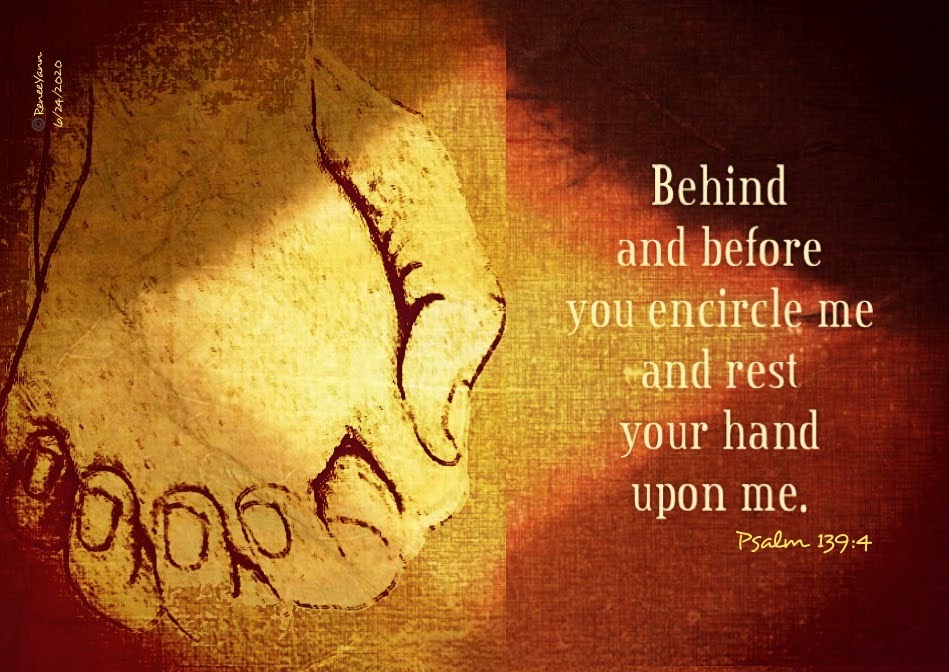
Even before a word is on my tongue, behold, O LORD, you know the whole of it. Behind me and before, you hem me in and rest your hand upon me. Such knowledge is too wonderful for me; too lofty for me to attain.
Psalm 139:4-6
As we pray Psalm 139, the awe settles into a deep awareness that God’s penetrating Presence in our spirits is ever beneficent and merciful. We pray to yield to its Love and seek its Wisdom.
Where can I go from your spirit? From your presence where can I flee? If I go up to the heavens, you are there; if I sink to the nether world, you are present there. If I take the wings of the dawn, if I settle at the farthest limits of the sea, Even there your hand shall guide me, and your right hand hold me fast.
Psalm 139:7-10
On this 32nd Monday, we begin a week of readings from the Book of Wisdom. Written in the century surrounding the birth of Christ, Wisdom is the work of a poet, theologian, philosopher, and moralist.
Today’s passage alerts us, as does our Gospel, that holding God’s Presence within us, we must live lives that bear it witness:
For wisdom is a kindly spirit, yet she acquits not blasphemers of their guilty lips; Because God is the witness of the inmost self and the sure observer of the heart and the listener to the tongue. For the Spirit of the Lord fills the world, is all-embracing, and knows what the person truly bespeaks by their lives.
Wisdom 1:6-7
A millstone at someone’s feet …
For as our Gospel tells us today:
Jesus said to his disciples, “Things that cause sin will inevitably occur, but woe to the one through whom they occur. It would be better to have a millstone hung around the neck and be thrown into the sea than to cause one of these little ones to sin.”
Luke 17:1-2
Poetry: Wisdom – Tagore
The small wisdom
is like water in a glass:
clear, transparent, pure.

The great wisdom
is like the water in the sea:
dark, mysterious, impenetrable.
Today, in God’s Lavish Mercy, we pray with Psalm 146 which tells us just how very much God loves those whom no-one else appears to love.
Hallelujah! Praise the Lord, O my soul! I will praise the Lord as long as I live; I will sing praise to my God while I have my being. Put not your trust in rulers, nor in any child of earth, for there is no help in them. When they breathe their last, they return to earth, and in that day their thoughts perish. Happy are they who have the God of Jacob for their help! For their hope is in the Lord their God, who made heaven and earth, the seas, and all that is in them; who keeps promises for ever; who gives justice to those who are oppressed, food to those who hunger and sets the prisoners free. The Lord opens the eyes of the blind! The Lord lifts up those who are bowed down and loves the righteous. The Lord cares for the stranger and sustains the orphan and widow, but frustrates the way of the wicked. The Lord shall reign for ever, your God, O Zion, throughout all generations. Hallelujah!
In our readings this Sunday, we learn lessons from widows – those whose place in biblical times was uncertain and frightening. Without a husband, a woman experienced diminished standing in the legal, financial and political life of the community.
She was often dependent on charity, and was deemed fortunate to capture a bit of good will from those in better circumstances.
There are several examples of widows being blessed by miracles, because they were among those most in need of them.
In today’s first reading and in the Gospel, we meet two widows displaying amazing charity and character strength. The widow of Zarephath steadfastly prepares for death because she has nothing left to live on. When Elijah asks to share in her last few cornmeal cakes, she does not hesitate to feed him.
In our Gospel, it is significant that, just across the road from the well-stocked treasury, a nearly penniless widow gives her last coins to the poor.
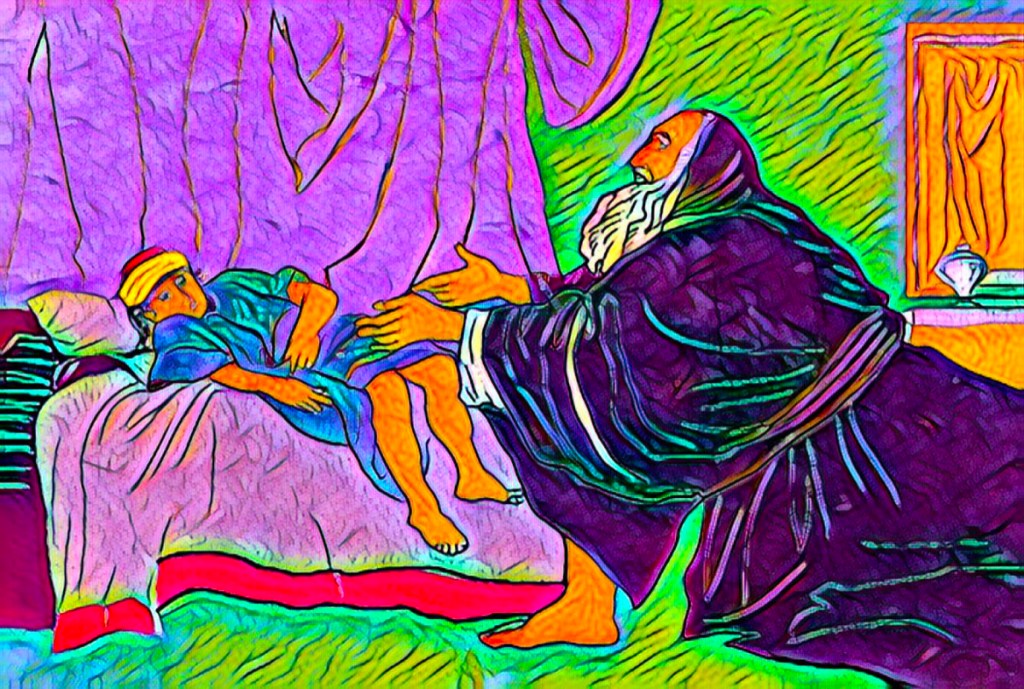
Elijah and the Widow’s Boy
In Elijah’s account, we learn the outcome of the widow’s generosity. She reaps an abundant reward in perpetual flour and oil to sustain her and her son.
We never learn what happens to Jesus’s widow. We are left to imagine that, in some way, her selflessness is rewarded.
It is so hard to give it all to God, especially if we feel we have little left for ourselves. It is hard to give our love when we feel empty-hearted. It is hard to give care when we feel unappreciated. It is hard to assist others when we ourselves are exhausted. It is hard to do good if no one, not even God, seems to notice.
But God does notice. Like Jesus on that long-ago afternoon, God is watching as we empty our coffers in service and care for the poor, sick, troubled and lost.
What we have to give may be small — a single corn cake or two little coins. It is the act of givingit that is large — and will make our hearts large by the choice.
Poetry: The Widow of Zarephath by Sister Lou Ella Hickman, I.W.B.S, a member of the Sisters of the Incarnate Word and Blessed Sacrament of Corpus Christi, Texas. Her most recent collection of poetry is titled “she: robed and wordless“, available through press53
Today, in God’s Lavish Mercy, we pray with Psalm 145, the only psalm to be designated as “praise” in its superscription: A psalm of praise. Of David.
This is an intriguing psalm to be chosen for today’s readings which, at first glance, have little to do with “praise”.
Our reading from Romans is the closing chapter of Paul’s letter in which is listed a catalogue of early Christians movers and shakers. The names are of influential and generous people who joined Paul and used their resources to foster the Gospel. They were the stewards of our nascent faith and are accorded a timeless memorial in the epistle’s final chapter.(Notably, many of them are women who obviously played significant roles in the blossoming of the early Church.)
In our Gospel, Jesus explains the parable about the dishonest steward. The steward has been accused of squandering his master’s goods and is about to be fired. In order to rectify accounts, the steward rewrites customer receipts, balancing with his own commissions. That way, his master doesn’t prosecute him and his customers like him enough to consider him for the job he now needs.
The parable is about how to use our wealth of blessings in order to respond to God’s goodness to us. By our generosity for others, we also serve God.
So how does Psalm 145 fit in? When the core attitude of our life is one of thanksgiving and praise:
we have the insight to recognize our true wealth, the blessings God has given us
Every day will I bless you, and I will praise your name forever and ever. Great is the LORD and highly to be praised; Whose greatness is unsearchable.
2. we look to our ancestors in faith as inspiration for generosity (people like those of
Romans 16)
Generation after generation praises your works and proclaims your might. They speak of the splendor of your glorious majesty and tell of your wondrous works.
3. we draw grace from their example and from the eternal beauty of Creation
Let all your works give you thanks, O LORD, and let your faithful ones bless you. Let them discourse of the glory of your Reign and speak of your power.
Poetry: Hymns for the Amusement of Children – Hymn 21. Generosity by Christopher Smart, 1722 – 1771) a talented and controversial English religious poet.
That vast communicative Mind,
That form'd the world and human kind,
And saw that all was right;
Or was Thyself, or came from Thee,
Stupendous Generosity,
Above all lustre bright.

" Not for themselves the bees prepare
" Their honey, and the fleecy care,
" Not for themselves are shorn:
" Not for themselves the warblers build,
" Not for themselves the lands are till'd,
" By them that tread the corn."

The Lord shed on the Holy Rood
His infinitely gen'rous blood,
Not for himself, but all;
Yea e'en for them that pierc'd his side,
In patient agony he died,
To remedy the Fall.

O highly rais'd above the ranks
Of Angels — he cou'd e'en give thanks
Self-rais'd, and self-renew'd —
Then who can praise, and love, and fear
Enough? — since he himself, 'tis clear,
Is also Gratitude.
November 5, 2021 Friday of the Thirty-first Week in Ordinary Time
Today, in God’s Lavish Mercy, we pray with Psalm 98, a beautiful hymn celebrating God’s munificence.
Our readings are about spiritual wealth, stewardship and Godly generosity.
Paul starts us off by proclaiming that the wealth/riches of salvation belong to ALL humanity. He presents himself as a unique “steward “ of those riches to the Gentiles.
Thus I aspire to proclaim the Gospel not where Christ has already been named, so that I do not build on another’s foundation, but as it is written:
Those who have never been told of him shall see, and those who have never heard of him shall understand.
Romans 15:21
Our Gospel gives us a second interpretation of “stewardship” in the parable the wily steward. This fella’ gets called on the carpet for squandering his employer’s resources. Pink slip time!
So the steward calls in some of the debtors and reduces their debt by the amount of his own commission. By doing this, he hopes to make some friends to support him in his impending unemployment.
Many years ago, there was a Talbot’s outlet in the Franklin Mills Mall in Northeast Philly (I know. Heaven, right?) You could get an amazing deal on the clearance items. But you got an even better deal if you went to a certain cashier for your checkout.
He was a tall, flamboyant and loudly funny guy. If a price tag was missing on an item, you got it virtually for free. He would make outlandish comments like, “Oh, honey, this isn’t your color so let’s discount it 50%.” If you bought two of the same item, he might announce,”Two for one today”, charging for only one. He was a living example of the Biblical steward! Over time, he developed a devoted buying community – those who had learned the secret of why people waited in his long line!
In today’s parable, Jesus isn’t advocating that we cheat our employers. The parable isn’t really about that at all. It is about the way he wants his disciples to be profligate in preaching the mercy of God.
Remember that this parable comes in between two blockbusters about Mercy – the Prodigal Son and Lazarus and the Rich Man. In a way, you might say Jesus is on a tear about the unbounded generosity of God in forgiveness and hope for us. Jesus makes clear that the wealth of Divine Love is delivered to us by our unbounded Christian love for one another.
So today, maybe we can think about the Talbot’s guy. We have been abundantly blessed by God’s love for us. Let’s pay it forward over and over today… and every day. Let’s generously share the infinite discount of Mercy.
Poetry: Mercy – by Charles Mackay, (1814 – 1889), a Scottish poet, journalist, author, anthologist, novelist, and songwriter.
A little stream had lost its way Amid the grass and fern; A passing stranger scooped a well, Where weary men might turn; He walled it in and hung with care A ladle at the brink; He thought not of the deed he did, But judged that all might drink. He passed again, and lo! the well, By summer never dried, Had cooled ten thousand parching tongues, And saved a life beside.
A nameless man, amid a crowd That thronged the daily mart, Let fall a word of hope and love, Unstudied, from the heart; A whisper on the tumult thrown, A transitory breath– It raised a brother from the dust, It saved a soul from death. O germ! O fount! O word of love! O thought at random cast! Ye were but little at the first, But mighty at the last.
Music: Jesus Paid It All – Elvira M. Hall (1865) This rendition of the hymn by Kristian Stanfill (born 1983) is so interesting. Offered here with modern instrumentation, the words date back to the era of the US Civil War. Past and present meld in the ever eternal love God has for us. An original version is below in case you’d like to compare the music. i think both are beautiful.
Wednesday, November 4, 2021 Memorial of St. Charles Borromeo
Today, in God’s Lavish Mercy, we pray with Psalm 27:
Our scripture passages are all about confidence in our salvation.
Do you have that confidence? Do you ever wonder if you’re going to get to heaven? Maybe even worry about it a little?
If so, today’s readings are for you.
Paul tells the faithful:
For if we live, we live for the Lord, and if we die, we die for the Lord; so then, whether we live or die, we are the Lord’s.
And Jesus, using the symbol of a lost sheep, counsels the critical Pharisees:
I tell you, in just the same way there will be more joy in heaven over one sinner who repents than over ninety-nine righteous people who have no need of repentance.
Key to both readings is the call to a repentant, Christian life.
Our beautiful Responsorial Psalm captures the joy of the repentant sinner, the very ones for whom Christ died. It’s a beautiful psalm. We might want to just slowly relish it in our prayer today.
R. I believe that I shall see the good things of the Lord in the land of the living.
The LORD is my light and my salvation; whom should I fear? The LORD is my life’s refuge; of whom should I be afraid?
R. I believe that I shall see the good things of the Lord in the land of the living.
One thing I ask of the LORD; this I seek: To dwell in the house of the LORD all the days of my life, That I may gaze on the loveliness of the LORD and contemplate his temple.
R. I believe that I shall see the good things of the Lord in the land of the living.
I believe that I shall see the bounty of the LORD
in the land of the living.
Wait for the LORD with courage;
be stouthearted, and wait for the LORD.
R. I believe that I shall see the good things of the Lord in the land of the living.
We might want to turn toward the searching Shepherd of today’s Gospel while praying this Psalm of repentance and faith.
Poetry: The Shepherd Boy Sings in the Valley of Humiliation– John Bunyan (1628–1688), a Christian writer and preacher, most famous for The Pilgrim’s Progress.
He that is down needs fear no fall, He that is low, no pride; He that is humble ever shall Have God to be his guide.
I am content with what I have, Little be it or much: And, Lord, contentment still I crave, Because Thou savest such.
Fullness to such a burden is That go on pilgrimage: Here little, and hereafter bliss, Is best from age to age.
Today, in God’s Lavish Mercy, we pray with Psalm 112, a hymn to the human generosity which mirrors God’s own:
Happy are they who fear the Lord and have great delight in the divine commandments!
Light shines in the darkness for the upright; the righteous are merciful and full of compassion.
For they will never be shaken; their righteousness will be kept in everlasting remembrance.
Psalm 112: 1-6
Paul and Jesus seem to give us contradictory messages about how to achieve this “righteousness”. Paul talks about love, and Jesus tells us what we must “hate” – a bit of a challenge to untangle the core message.
Here’s one way.
We probably don’t like Jesus telling us to hate anything, as in:
If anyone comes to me without hating his father and mother, wife and children, brothers and sisters, and even his own life, he cannot be my disciple.
Come on, Jesus! You don’t mean that do you – my sweet mom, my precious kids???
No, the scholars say, Jesus doesn’t mean “hate” the way we interpret it in modern English. He is using the common, hyperbolic language of the ancient East which, in this circumstance, would mean “love less”.
So what is Jesus really saying?
This, I think.
We love many people and things in our lives. But we must love God, and God’s dream for all people, above and within all things.
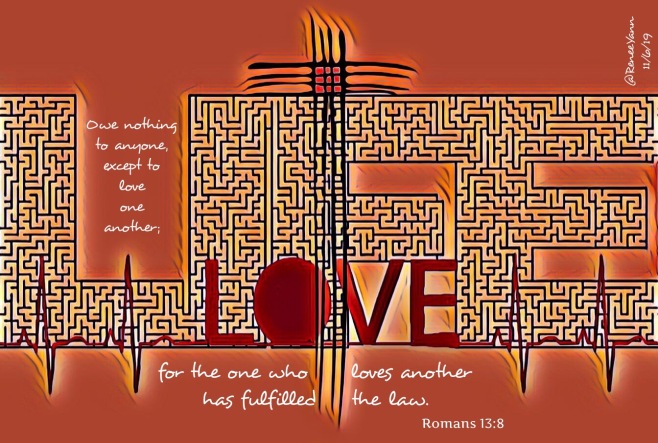
And that’s not easy! Life is a maze of relationships and situations that can get us very confused about what is most important. That’s why Jesus uses such strong language to remind us that there is only one way through the maze: to love as God loves. This is the heartbeat of our life in God!
Paul says this too, indicating how to negotiate the maze by keeping Love’s commandments.
Brothers and sisters: Owe nothing to anyone, except to love one another; for the one who loves another has fulfilled the law.
Romans 13:8
If we love with God’s love, of course we will love those we cherish. But we will love them selflessly, with an infinite generosity that always chooses their eternal good. And we will try always to love all Creatures in the same way. This is the kind of love Jesus taught us on the Cross. May God give us the courage to learn.
Poetry: Prayer of Mother Teresa and Brother Roger of Taize
Oh God, the Creator of all,
you ask every one of us to spread
Love where the poor are humiliated,
Joy where the Church is brought low,
And reconciliation where people are divided. . .
Father against son, mother against daughter,
Husband against wife,
Believers against those who cannot believe,
Christians against their unloved fellow Christians.
Music: Ubi Caritas performed by Stockholm University Choir (texts below)
Latin Text
Ubi caritas et amor, Deus ibi est. Congregavit nos in unum Christi amor. Exsultemus, et in ipso jucundemur. Timeamus, et amemus Deum vivum. Et ex corde diligamus nos sincero. Ubi caritas et amor, Deus ibi est. Simul ergo cum in unum congregamur: Ne nos mente dividamur, caveamus. Cessent iurgia maligna, cessent lites. Et in medio nostri sit Christus Deus. Ubi caritas et amor, Deus ibi est. Simul quoque cum beatis videamus, Glorianter vultum tuum, Christe Deus: Gaudium quod est immensum, atque probum, Saecula per infinita saeculorum. Amen.
English Translation Where charity and love are, God is there. Love of Christ has gathered us into one. Let us rejoice in Him and be glad. Let us fear, and let us love the living God. And from a sincere heart let us love one. Where charity and love are, God is there. At the same time, therefore, are gathered into one: Lest we be divided in mind, let us beware. Let evil impulses stop, let controversy cease. And in the midst of us be Christ our God. Where charity and love are, God is there. At the same time we see that with the saints also, Thy face in glory, O Christ our God: The joy that is immense and good, Unto the World without end. Amen.
Today, in God’s Lavish Mercy, we pray with Psalm 23, that familiar pastoral which, for millennia, has comforted our griefs and fears.
The Lord is my shepherd; I shall not want. You make me lie down in green pastures and lead me beside still waters. You revive my soul and guide me along right pathways for your name’s sake.
Psalm 23: 1-3
But even for us who believe, it’s a somber day.
Because we just don’t know, do we? We believe. We hope. We trust. But we just don’t know
how life can seem to end so finally
why love’s cord seems to break, or at least to tangle
where they go when they leave us
when we will see them again
That’s why I think that, in many ways, All Souls Day is for us, the living. The act of corporate remembrance lets us hold up before one another these profound “unanswerables” while saying, “Still, I believe; I hope; I love.”
We give one another strength on All Souls Day to choose eternal life in a world that often casts only a deadly shadow.
Even though I walk through the valley of the shadow of death, I will fear no evil, for you are with me; your rod and your staff comfort me.
Psalm 23: 4
Today, we participate in a treasured spiritual exercise for us – those who remain:
We remember.
By our holy remembering:
We bless in our departed beloveds what – in life – we might have taken for granted.
We cherish their goodness and acknowledge their weaknesses.
We consider that our love and longing for them is but a pale reflection of God’s own.
We release our dear family and friends into that Immense Love.
As part of the great Communion of Saints, we release even those who have no one holding on to them. By our prayer for them, we attest our love to a heavenly family we have yet to meet.
Our dear Catherine McAuley said this, even in a time when she was faced with constant loss and bereavement:
Shall we all meet in Heaven? Oh what joy even to think of it!
Venerable Catherine McAuley
On All Souls Day, we do think of it – and are consoled by a quiet, indescribable joy.
You spread a table before me despite anything that troubles me; you have anointed my head with oil; Indeed, my cup is running over. Surely this goodness and mercy follows us always and we will dwell in your house for ever.
Psalm 23: 5-6
Poetry: Hildegard of Bingen (1098–1179) – O Shepherd of Souls
O Shepherd of souls
and O, First Voice
through whom all creation was summoned,
now to you,
to you may it give pleasure and dignity
to liberate us
from our miseries and languishing.
Music: Stand in the Light – Jordan Smith
As we remember all our faithful departed today, we pray that we may all stand in the Light.













 Lavish Mercy