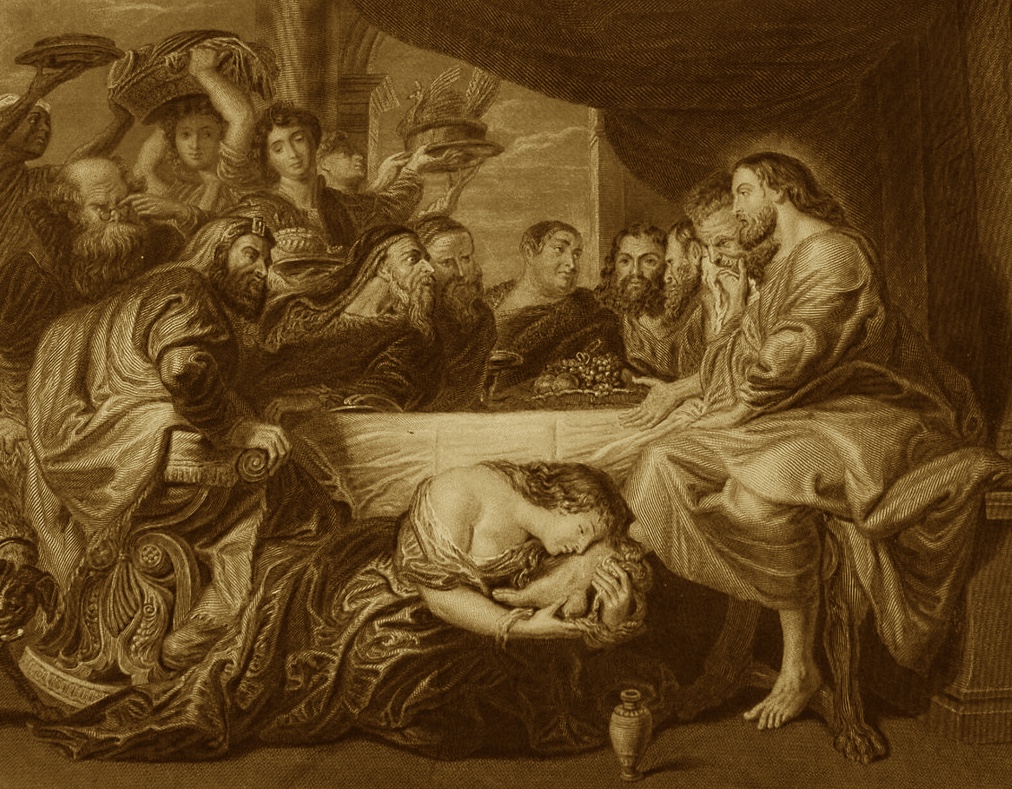
Today, in God’s Lavish Mercy, our Gospel places a fundamental question before us. How should the precious oil be used – tenderly poured out or reasonably saved? It is a question that challenges us to balance justice with mercy, reality with hope, law with passion. How are we being asked to open our alabaster jar?
This poem by Malcolm Guite may offer inspiration for our prayer:
Come close with Mary, Martha, Lazarus so close the candles stir with their soft breath and kindle heart and soul to flame within us, lit by these mysteries of life and death. For beauty now begins the final movement in quietness and intimate encounter. The alabaster jar of precious ointment is broken open for the world’s true Lover.
The whole room richly fills to feast the senses with all the yearning such a fragrance brings. The heart is mourning but the spirit dances, here at the very center of all things, here at the meeting place of love and loss, we all foresee, and see beyond the cross.
(Malcolm Guite: The Anointing at Bethany)
Jesus, give us courage to accompany you in your final journey. May your passion, death and resurrection bring us new life.
As we make this Holy Week journey, may we prove our love by our actions. May we live generously, hopefully, and gratefully in the Mercy of God.
Music: Pour My Love on You by Craig and Dean Phillips
Today, in God’s Lavish Mercy, we begin a familiar journey.
In a warring, dystopian world, the rites of Holy Week offer us a reassuring pattern for our prayer. As we begin these rituals, we already know where we will joyfully finish. It is a feeling so opposite from our current global concerns which leave us questioning how peace and joy can be restored to the human family.
Through the solemnities of Holy Week, we are reminded that there is nothing we experience not already patterned in the Paschal Mystery. There is nothing we suffer or hope for not already etched on the heart of Jesus Christ.
These liturgies are an invitation to enter into that Sacred Heart, to place our experiences beside those of Jesus. No matter where we find ourselves on the journey, Jesus is with us:
In the confusion of Palm Sunday, tossed between loyalty and betrayal
In the suggestive silence of Holy Monday and Tuesday, when plotters whisper and friends weaken
In the discomfort of Spy Wednesday, when we realize suffering is inevitable
In the profound communion of Holy Thursday
In the loneliness of a decisive Garden and the angst of a resisted outcome
In the inexorable solitude of dying and death
In the other-worldly contemplation of a silent Saturday
In the sunrise of a promise, longed for and believed in
These are profound sacred mysteries which invite us to sink into their depths and be renewed. Let’s be intentional about the time and practices we will give to this invitation.
We are invited into the Life and Passion of Jesus Who, in turn, wants to be with us in our experience of this journey. Each day, let us listen – let us become “obedient” (which means “listening”) – for the very personal whisper of grace in our souls. And even though we may pray alone, let us pray for the whole world suffering and rising with our beloved Savior.
I think today’s reading from Philippians is the most beautiful and pregnant passage in all of scripture. May it guide our prayer during this Holy Week when we all so hunger for God’s presence and healing.
Music: Philippians Hymn – John Michael Talbot (Lyrics below)
And if there be therefore any consolation And if there be therefore any comfort in his love And if there be therefore any fellowship in spirit If any tender mercies and compassion
We will fulfill His joy And we will be like-minded We will fulfill His joy We can dwell in one accord And nothing will be done Through striving or vainglory We will esteem all others better than ourselves
This is the mind of Jesus This is the mind of Our Lord And if we follow Him Then we must be like-minded In all humility We will offer up our love
Though in the form of God He required no reputation Though in the form of God He required nothing but to serve And in the form of God He required only to be human And worthy to receive Required only to give
This is the mind of Jesus This is the mind of Our Lord And if we follow Him Then we must be like-minded In all humility We will offer up our love In all humility We will offer up our love
Today, in God’s Lavish Mercy, worlds are splitting apart, but the Word of God comes to heal them.
In our first reading, we share in the experience of the prophet Ezekiel.
Ezekiel and his wife lived during the Babylonian Captivity on banks of the Chenab River which is in modern day Iraq. He lived during the siege of Jerusalem in 589 BC. In Ezekiel’s day the northern kingdom had been conquered and destroyed 150 years earlier.
In other words, Ezekiel, like his contemporary Jeremiah, had his heart torn apart along with the homeland they cherished as God’s promise to them.
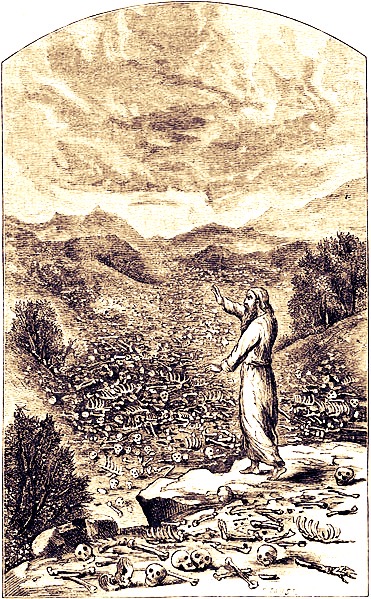
The Valley of the Dry Bones – artist unknown
In today’s reading, which comes immediately after his vision of the Dry Bones, Ezekiel prophesies a message of hope and restoration to a fragmented and devastated nation.
In our Gospel, Jesus is the new Ezekiel. He stands in the midst of the bigger “nation” of all God’s Creation which has been fragmented by the failure to love. Like Ezekiel, Jesus offers a message of hope and restoration to sinners.
In this Gospel, Jesus himself is the “Temple” about to destroyed. The prophecy of its destruction is unwittingly delivered by the high priest Caiaphas:
Caiaphas, who was high priest that year, said to the Pharisees and Sanhedrin, “You know nothing, nor do you consider that it is better for you that one man should die instead of the people, so that the whole nation may not perish.” He did not say this on his own, but since he was high priest for that year, he prophesied that Jesus was going to die for the nation, and not only for the nation, but also to gather into one the dispersed children of God.
John 11: 49-52
Within Christ’s new law of love, these “children of God” go far beyond the Jewish nation. They are you and me, and every other creature with whom we share this time and universe. The fragmentations which separate and alienate us are dissolved in the Passion, Death and Resurrection of Jesus Christ.
Holy Week will begin tomorrow when all believers will intensify their desire to join Christ in his final journey to Resurrection, to understand our own lives anew in the power of Paschal Grace.
Let’s pray for one another, dear friends, for the grace we need to be deepened in the life of Jesus, and for that deepening to bless and heal our suffering world.
Poetry: The New Ezekiel – Emma Lazarus
What, can these dead bones live, whose sap is dried By twenty scorching centuries of wrong? Is this the House of Israel, whose pride Is as a tale that’s told, an ancient song? Are these ignoble relics all that live Of psalmist, priest, and prophet? Can the breath Of very heaven bid these bones revive, Open the graves and clothe the ribs of death?
Yea, Prophesy, the Lord hath said. Again Say to the wind, Come forth and breathe afresh, Even that they may live upon these slain, And bone to bone shall leap, and flesh to flesh. The Spirit is not dead, proclaim the word, Where lay dead bones, a host of armed men stand! I ope your graves, my people, saith the Lord, And I shall place you living in your land.
Music: Make Us One – featuring James Loynes. Written by Sally DeFord (Lyrics below)
Lyrics
How shall we stand amid uncertainty? Where is our comfort in travail? How shall we walk amid infirmity, When feeble limbs are worn and frail? And as we pass through mortal sorrow, How shall our hearts abide the day? Where is the strength the soul may borrow? Teach us thy way.
Chorus: Make us one, that our burdens may be light Make us one as we seek eternal life Unite our hands to serve thy children well Unite us in obedience to thy will. Make us one! teach us, Lord, to be Of one faith, of one heart One in thee. Then shall our souls be filled with charity, Then shall all hate and anger cease And though we strive amid adversity, Yet shall we find thy perfect peace So shall we stand despite our weakness, So shall our strength be strength enough We bring our hearts to thee in meekness; Lord, wilt thou bind them in thy love?
(Repeat chorus)
Take from me this heart of stone, And make it flesh even as thine own Take from me unfeeling pride; Teach me compassion; cast my fear aside. Give us one heart, give us one mind Lord, make us thine Oh, make us thine! (Repeat chorus)
Today, in God’s Lavish Mercy, as we inch closer to Holy Week, we meet both a very troubled Jeremiah and Jesus.
The Prophet Jeremiah Weeping Alone on a Hill (from the Wellcome Trust)
Jeremiah, the Old Testament mirror of Jesus’s sufferings, bewails the treachery even of his friends:
I hear the whisperings of many: “Terror on every side! Denounce! let us denounce him!” All those who were my friends are on the watch for any misstep of mine.
Jeremiah 20:10
That’s really raw, because you can get through almost anything in the company of true friends.
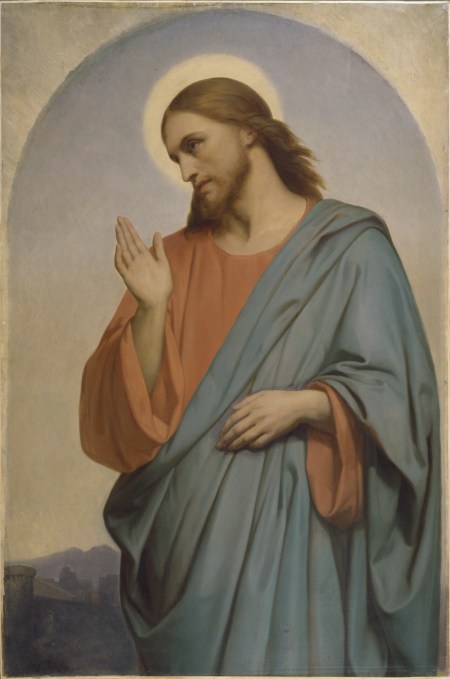
Jesus Weeping Over Jerusalem by Ary Scheffer (1795-1858)
Jesus came as a Friend and hoped to find Friends of God by his ministry. And he did find many. But not all.
It takes some work to be a true friend of Jesus. Some didn’t have the courage, or generosity, or passion, or hopeful imagination to reach past their self-protective boundaries – to step into eternal life even as they walked the time-bound earth.
In today’s Gospel this band of resisters project their fears and doubts to the crowds around them. The evil sparks inflame the ready tinder of human selfishness. The mob turns on Jesus, spiritual misers scoffing at the generous challenge to believe.
Jesus pleads with them to realize what they are doing:
If I do not perform my Father’s works, do not believe me; but if I perform them, even if you do not believe me, believe the works, so that you may realize and understand that the Father is in me and I am in the Father.
John 10:37-38
But Jesus and Jeremiah, though troubled, are grounded in God. Our Responsorial Psalm captures what might have been their silent prayer:
Poetry: The following transliteration of Psalm 18, composed by Christine Robinson, might help us to be with Jesus in his moment, and in our own moments of fear, anxiety, or doubt.
I open my heart to you, O God for you are my strength, my fortress, the rock on whom I build my life. I have been lost in my fears and my angers caught up in falseness, fearful, and furious I cried to you in my anguish. You have brought me to an open space. You saved me because you took delight in me. I try to be good, to be just, to be generous to walk in your ways. I fail, but you are my lamp. You make my darkness bright With your help, I continue to scale the walls and break down the barriers that fragment me. I would be whole, and happy, and wise and know your love Always.
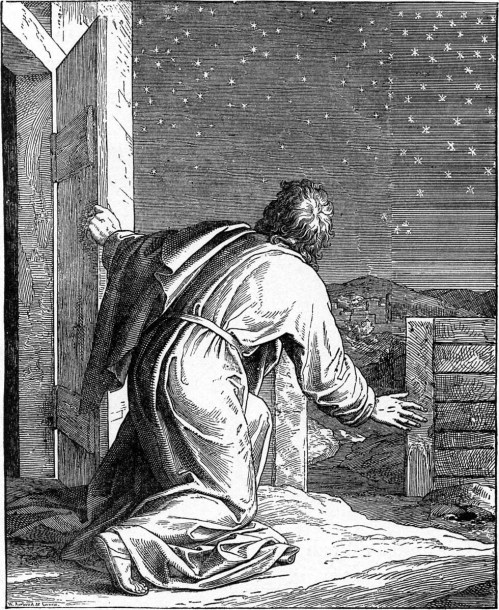
Abraham Looks to the Heavens from Bible Pictures by Charles Foster (1897)
Today, in God’s Lavish Mercy, Yahweh is very clear with Abram that he is now in a life-changing situation:
My covenant with you is this: you are to become the father of a host of nations. No longer shall you be called Abram; your name shall be Abraham, for I am making you the father of a host of nations.
Genesis 17: 3-4
Having witnessed how young fathers are upended by the news of impending fatherhood, I can’t even imagine what Abraham felt like when he heard this:
I will render you exceedingly fertile; I will make nations of you; kings shall stem from you.
But aside from the practical ramifications of God’s promise, what Abraham is invited to is a whole new outlook on the world. God lays out before him a vision of the ages, infinitely beyond the confines of Abraham’s current understanding.
It is an existence beyond time and human definition. It is the infinite place of God’s timelessness, where we all exist, but forget when we are born. Our lifetime is a spiritual journey back to remembrance.
In our Gospel, Jesus uses a rather cryptic phrase as he challenges his listeners to look beyond their circumscribed perspectives:
Amen, amen, I say to you, whoever keeps my word will never see death…. Abraham your father rejoiced to see my day; he saw it and was glad.
John 8:51
By fully embracing his covenant with God, Abraham saw beyond death. The vision of heaven was opened to him and he lived his life by its power. He lived then within the Day of the Lord, not within any small confined perspective.
Jesus offers us the same invitation. We can choose to see with God’s eyes, or with only our own. We can choose to live within God’s infinity, or in only our own earthbound borders.
In our current global situation, where some humans have lost the sense of anything beyond themselves, it may be a good time to remember the eternal character of our heart. It may be time to have a sit-down with God about our covenant, like the conversation God had with Abraham.
Poetry: The Unwavering Nomad – Jessica Powers
I love Abraham, that old weather-beaten
unwavering nomad; when God called to him
no tender hand wedged time into his stay.
His faith erupted him into a way
far-off and strange. How many miles are there
from Ur to Haran? Where does Canaan lie,
or slow mysterious Egypt sit and wait?
How could he think his ancient thigh would bear
nations, or how consent that Isaac die,
with never an outcry nor an anguished prayer?
I think, alas, how I manipulate
dates and decisions, pull apart the dark
dally with doubts here and with counsel there,
take out old maps and stare.
Was there a call after all, my fears remark.
I cry out: Abraham, old nomad you,
are you my father? Come to me in pity.
Mine is a far and lonely journey, too.
Music: In the Day of the Lord – M.D. Ridge
Refrain: In the day of the Lord, the sun will shine like the dawn of eternal day. All creation will rise to dance and sing the glory of the Lord!
1. “And on that day will justice triumph, on that day will all be free: free from want, free from fear, free to live! Refrain
2. Then shall the nations throng together to the mountain of the Lord: they shall walk in the light of the Lord! Refrain
3. And they shall beat their swords to plowshares; there will be an end to war: one in peace, one in love, one in God! Refrain
4. For Israel shall be delivered, and the desert lands will bloom. Say to all, “Do not fear. Here is your God!” Refrain
5. And on that day of Christ in glory, God will wipe away our tears, and the dead shall rise up from their graves! Refrain
6. O give us eyes to see your glory, give us hearts to understand. Let our ears hear your voice ’til you come! Refrain
Today, in God’s Lavish Mercy, we see faith tested by fire.
In our first reading, three young men stand convinced of God. Even the threat of a fiery death cannot shake them from that conviction.
And their faith is not a quid pro quo – a case where they say to God, “I’ll believe if you do ‘X’ for me.” No, their commitment is unqualified and complete:
If our God, whom we serve, can save us from the white-hot furnace and from your hands, O king, may he save us! But even if he will not, know, O king, that we will not serve your god or worship the golden statue.
Daniel 3: 17-18
When Shadrach, Meshach, and Abednego are cast into the furnace, a fourth figure appears with them, an angel of God who delivers them safely through their trial.
In our Gospel, even “the Jews who believed” in Jesus begin to quibble with him. They stand with him at the threshold of his Passion and Death, the great fire that will test them all. Like the three young men at the furnace, they face the ultimate choice:
Who do you really believe in? What God will you give your life to?
Jesus challenges them to follow him into the fire that faces him:
Jesus answered them, “Amen, amen, I say to you … … if the Son frees you, then you will truly be free. I know that you are descendants of Abraham. But you are trying to kill me, because my word has no room among you. I tell you what I have seen in the Father’s presence; then do what you have heard from the Father.
John 8: 34-36
Throughout our lives, our faith will be tested many times. That’s why it’s called “faith” and not “certainty ”. Our life circumstances will ask us, again and again, if our faith is strong enough to stand in the fire, to walk the Calvary road with Jesus.
Let the testimony of the ages inspire us with courage. From our scriptural heritage, we know the fire hid an angel. We know the road continued past the bloody hill and on to the Resurrection. We know that every storm will pass and leave us washed anew in grace if we make that ultimate choice to be faithful.
Poetry: Touched by an Angel – Maya Angelou
We, unaccustomed to courage exiles from delight live coiled in shells of loneliness until love leaves its high holy temple and comes into our sight to liberate us into life.
Love arrives and in its train come ecstasies old memories of pleasure ancient histories of pain. Yet if we are bold, love strikes away the chains of fear from our souls.
We are weaned from our timidity In the flush of love’s light we dare be brave And suddenly we see that love costs all we are and will ever be. Yet it is only love which sets us free.
Today, in God’s Lavish Mercy, there are some common threads running through our readings.
In the passage from Numbers, we have a restless crowd, confused and hungry, feeling directionless in a vast wilderness. They demand an answer from Moses:
Why have you brought us up from Egypt to die in this desert, where there is no food or water? We are disgusted with this wretched food!”
To make things worse, God, annoyed at their complaints, sends a bunch of snakes to hassle them.
In John’s Gospel, a disgruntled gathering of Pharisees pesters Jesus for a resolution to their questions. Even after all Jesus’ signs and preaching, they ask Him, “Who are you?”
In both instances, it is impossible for the questioners to receive the answer they seek because they lack faith.
In both instances, they are told that a sign will be lifted up before them and that then they will understand.
We’re on a life’s journey, at times confused and disgruntled, just like those ancient Hebrews.
We may be locked in faithless expectations of God, just like those debating Pharisees.
In our difficulties and challenges, will we be able to see the sign that God offers us? Not the one we design or demand – but the unexpected one rising up out of the depths of our faith?
Poetry: The Crosse – George Herbert
What is this strange and uncouth thing?

To make me sigh, and seek, and faint, and die,

Untill I had some place, where I might sing,

          And serve thee; and not onely I,

But all my wealth and familie might combine

To set thy honour up, as our designe.

          And then when after much delay,

Much wrastling, many a combate, this deare end,

So much desir’d, is giv’n, to take away

          My power to serve thee; to unbend

All my abilities, my designes confound,

And lay my threatnings bleeding on the ground.

          One ague dwelleth in my bones,

Another in my soul (the memorie

What I would do for thee, if once my grones

          Could be allow’d for harmonie):

I am in all a weak disabled thing,

Save in the sight thereof, where strength doth sting.

          Besides, things sort not to my will,

Ev’n when my will doth studie thy renown:

Thou turnest th’ edge of all things on me still,

          Taking me up to throw me down:

So that, ev’n when my hopes seem to be sped,

I am to grief alive, to them as dead.

          To have my aim, and yet to be

Further from it then when I bent my bow;

To make my hopes my torture, and the fee

          Of all my woes another wo,

Is in the midst of delicates to need,

And ev’n in Paradise to be a weed.

          Ah my deare Father, ease my smart!

These contrarieties crush me: these crosse actions

Doe winde a rope about, and cut my heart:

          And yet since these thy contradictions

Are properly a crosse felt by the Sonne,

With but foure words, my words, Thy will be done.
( George Herbert (3 April 1593 – 1 March 1633) was a Welsh poet, orator, and priest of the Church of England. His poetry is associated with the writings of the metaphysical poets, and he is recognized as “one of the foremost British devotional lyricists.” He was born into an artistic and wealthy family and largely raised in England. He received a good education that led to his admission to Trinity College, Cambridge, in 1609. He went there with the intention of becoming a priest, but he became the University’s Public Orator and attracted the attention of King James I. He served in the Parliament of England in 1624 and briefly in 1625.
After the death of King James, Herbert renewed his interest in ordination. He gave up his secular ambitions in his mid-thirties and took holy orders in the Church of England, spending the rest of his life as the rector of the rural parish of Fugglestone St Peter, just outside Salisbury. He was noted for unfailing care for his parishioners, bringing the sacraments to them when they were ill and providing food and clothing for those in need. Henry Vaughan called him “a most glorious saint and seer”.[4] He was never a healthy man and died of consumption at age 39. ~ from Wikipedia)
Today, in God’s Lavish Mercy, our first reading offers us one of the most captivating, and perhaps infuriating, stories of the Bible – the story of Susanna. This is a tale that can offer us many points of reflection. Rather than offer you my own, I would like to refer you to this excellent article by Dr. Malka Zeiger Simkovich is a the Crown-Ryan Chair of Jewish Studies at Catholic Theological Union in Chicago, and the director of their Catholic-Jewish Studies program.
Our Gospel for today picks of the themes of knowledge, truth and judgement we have found in Daniel.
Jesus in facing mounting harassment and criticism from those threatened by his message. In today’s passage, a group of Pharisees engages in a verbal duel with Jesus:
The Pharisees said to him, “You testify on your own behalf, so your testimony cannot be verified.” Jesus answered and said to them, “Even if I do testify on my own behalf, my testimony can be verified, because I know where I came from and where I am going. But you do not know where I come from or where I am going. You judge by appearances, but I do not judge anyone.
Jesus makes it clear that such mental gymnastics, devoid of heart and spirit, are nothing but a journey in darkness:
Jesus spoke to them again, saying, “I am the light of the world. Whoever follows me will not walk in darkness, but will have the light of life.”
We’ve all met people who want to make faith into a mental Rubik’s cube. But deep faith will never fit into blocks and clever twists. Deep faith releases us from the need to have everything fit – from the futile imagination that we are in control of anything but our power to love.
As we pray with the little pieces of Susanna, Pharisees, and wicked elders we might discover in our own lives, let’s ask for the courage and grace to relax into the Light that Jesus offers us today.
Poetry: Peter Quince at the Clavier – Wallace Stevens
I
Just as my fingers on these keys
Make music, so the selfsame sounds
On my spirit make a music, too.
Music is feeling, then, not sound;
And thus it is that what I feel,
Here in this room, desiring you,
Thinking of your blue-shadowed silk,
Is music. It is like the strain
Waked in the elders by Susanna:
Of a green evening, clear and warm,
She bathed in her still garden, while
The red-eyed elders, watching, felt
The basses of their beings throb
In witching chords, and their thin blood
Pulse pizzicati of Hosanna.
II
In the green water, clear and warm,
Susanna lay.
She searched
The touch of springs,
And found
Concealed imaginings.
She sighed,
For so much melody.
Upon the bank, she stood
In the cool
Of spent emotions.
She felt, among the leaves,
The dew
Of old devotions.
She walked upon the grass,
Still quavering.
The winds were like her maids,
On timid feet,
Fetching her woven scarves,
Yet wavering.
A breath upon her hand
Muted the night.
She turned—
A cymbal crashed,
And roaring horns.
III
Soon, with a noise like tambourines,
Came her attendant Byzantines.
They wondered why Susanna cried
Against the elders by her side;
And as they whispered, the refrain
Was like a willow swept by rain.
Anon, their lamps’ uplifted flame
Revealed Susanna and her shame.
And then, the simpering Byzantines
Fled, with a noise like tambourines.
IV
Beauty is momentary in the mind—
The fitful tracing of a portal;
But in the flesh it is immortal.
The body dies; the body’s beauty lives.
So evenings die, in their green going,
A wave, interminably flowing.
So gardens die, their meek breath scenting
The cowl of winter, done repenting.
So maidens die, to the auroral
Celebration of a maiden’s choral.
Susanna’s music touched the bawdy strings
Of those white elders; but, escaping,
Left only Death’s ironic scraping.
Now, in its immortality, it plays
On the clear viol of her memory,
And makes a constant sacrament of praise.
Music: Bach: Prelude in C Major, BWV 846, The Well-Tempered Clavier
Today, in God’s Lavish Mercy, Jesus writes new rules for life in the venerable Jerusalem dust.
Jesus enjoys an early morning walk from the Mount of Olives to the Temple. The weather, no doubt, was typically beautiful since others easily gathered and sat around Jesus to hear his teaching.
But the Pharisees, vigilant for an opportunity to condemn Jesus, executed a mean-hearted plot.
Dragging a woman “caught in the act of adultery” before the encircled men, they demanded Jesus’s judgment of the distraught woman.
Woman Taken in Adultery – Rembrandt, National Gallery London
Imagine the woman’s terror. Her poverty and loneliness have already forced her into an ignoble commerce. Had she the chance, she surely would have chosen an easier life.
Now, her meager quarters have been broken into, her privacy invaded in the most intimate of circumstances. Her adulterous accomplice has either turned her in, or absconded in cowardice. She is surrounded by brutal accusers, many of whom are likely her former customers.
But Jesus sees the woman, not her sin. He responds to her heart not her actions. He also sees these evil, plotting men and responds to their veiled motivations.
Wouldn’t we love to know what Jesus scribbled in the Temple dirt as these blood-thirsty hypocrites hung over him?
Might it have been the names of those who also visited the woman on earlier nights?
Might it have been some of their hidden sins?
Challenged to cast the first stone if they were sinless, the plotters slowly slink away. Jesus is left to forgive and heal this suffering woman.
Jesus tells her to go and sin no more, to -as the first reading says – “remember not the things of the past”. Jesus has made her into a new person by the power of his mercy.
May that renewing Mercy touch us, and our world, where we sorely need it.
May it flow through our renewed hearts to everyone we encounter, no matter the circumstances.
Poetry: Two beautiful poems today. The first refers specifically to Rembrandt’s painting above:
Rembrandt, “The Woman Taken in Adultery,” National Gallery, Trafalgar Square, London by Peter Cooley, Senior Mellon Professor in the Humanities and Director of Creative Writing at Tulane University and lives in New Orleans.
Just as I came out of the Gallery,
I saw a gull among hoards of tourists
encircling the statue of Lord Nelson,
crazed while I prayed he'd make it out, resume
flight I attribute to all birds, boundless.
But my dying: I try to keep it lined
around the edges of the ordinary
so I can—shall I say—appreciate?

Drawn to that picture by the glowing dark
around the woman, kneeling, Christ standing,
the Scribes and Pharisees shrouded in black,
I saw she, too, has just discovered light,
knowing, moments ago, she escaped stoning.
She just this instant came to where I'm going.
The second poem is by the beautiful Franciscan poet, Irene Zimmerman, OSF.
From the angry crunch of their sandaled feet as they left the courtyard, Jesus knew, without looking up from his writing on the ground, that the Pharisees and scribes still carried their stones.
The woman stood where they’d shoved her, her hair hanging loose over neck and face, her hands still shielding her head from the stones she awaited.
“Woman,” he asked, “has no one condemned you?”
The heap of woman shuddered, unfolded. She viewed the courtyard — empty now — with wild, glazed eyes and turned back to him. “No one, Sir,” she said, unsurely.
Compassion flooded him like a wadi after rain. He thought of his own mother — had she known such fear? — and of the gentle man whom he had called Abba. Only when Joseph lay dying had he confided his secret anguish on seeing his betrothed swelling up with seed not his own.
“Neither do I condemn you,” Jesus said. “Go your way and sin no more.”
Black eyes looked out from an ashen face, empty, uncomprehending. Then life rushed back. She stood before him like a blossoming tree.
“Go in peace and sin no more,” Jesus called again as she left the courtyard.
He had bought her at a price, he knew. The stony hearts of her judges would soon hurl their hatred at him. His own death was a mere stone’s throw away.
Music: Remember Not the Things of the Past – Bob Hurd
Today, in God’s Lavish Mercy, danger continues to escalate for Jesus.
Our first reading from Jeremiah foreshadows Jesus’s situation. Some powerful people didn’t want to hear what Jeremiah preached. And we can understand why: Jeremiah prophesied the destruction of Jerusalem because of Israel’s unfaithfulness. It’s a message that was hard to swallow.
The core of Jeremiah’s teaching was this: You people have to change. This is not the way God created the world to be.
But the people couldn’t listen. They had let the skewed reality of their lives become normal and needed. They couldn’t accept the world of mutual love and justice that God imagined for them.
Jesus meets the same kind of stonewalling.
In today’s passage, the hard-hearted rationalize their resistance:
“The Christ will not come from Galilee, will he? Does not Scripture say that the Christ will be of David’s family and come from Bethlehem, the village where David lived?”
But their antagonism isn’t really about geography and lineage. It’s about blind comfort in a world balanced toward their advantage. It’s about the fear of grace-inspired change.
Isn’t it the truth that we’ll use almost any argument to resist what demands our conversion? I understand why these guys “each went to his own house”, as the Gospel says in closing. They took refuge from grace in the little roofed pretense of their own control.
They didn’t have the courage to open their hearts to Jesus. Do we?
Poetry: LOVE IS THE MASTER – RUMI
Love is the One who masters all things;
I am mastered totally by Love.
By my passion of love for Love
I have ground sweet as sugar.
O furious Wind, I am only a straw before you;
How could I know where I will be blown next?
Whoever claims to have made a pact with Destiny
Reveals himself a liar and a fool;
What is any of us but a straw in a storm?
How could anyone make a pact with a hurricane?
God is working everywhere his massive Resurrection;
How can we pretend to act on our own?
In the hand of Love I am like a cat in a sack;
Sometimes Love hoists me into the air,
Sometimes Love flings me into the air,
Love swings me round and round His head;
I have no peace, in this world or any other.
The lovers of God have fallen in a furious river;
They have surrendered themselves to Love’s commands.
Like mill wheels they turn, day and night, day and night,
Constantly turning and turning, and crying out.









 Lavish Mercy