Longing for God

Thirty-second Sunday in Ordinary Time
November 12, 2023

Today’s Readings:

https://bible.usccb.org/bible/readings/111223.cfm


Today, in God’s Lavish Mercy, we pray with Psalm 63, a prayer of deep longing and faithful intimacy. 

The psalm is complemented by the lyrical passage from the Book of Wisdom which immediately reminded me of my favorite verse for the Christmas season:

For while gentle silence enveloped all things,
and night had now run half its swift course,
Wisdom’s all-powerful Word leapt down from heaven, 
from the royal throne,
into the midst of the shadowed land.
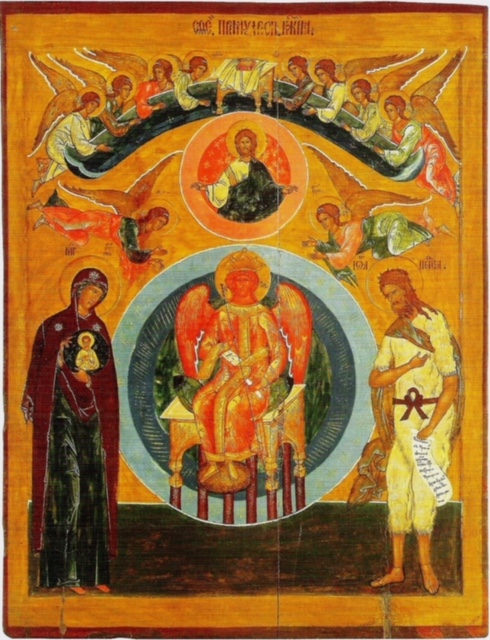
Wisdom 18: 14-15

Using delicate feminine images, our first reading from Wisdom describes the God for whom we long – a God who longs for us with infinite eagerness:

Resplendent and unfading is Wisdom,
and she is readily perceived by those who love her,
and found by those who seek her.
She hastens to make herself known in anticipation of their desire –

Wisdom 6: 12-13

This reading forms a sort of dance with our Psalm – the first describing God’s desire, the second describing ours:

O God, you are my God whom I seek;
for you my flesh pines and my soul thirsts
like the earth, parched, lifeless and without water.

Thus have I gazed toward you in the sanctuary
to see your power and your glory,
For your kindness is a greater good than life;
my lips shall glorify you.
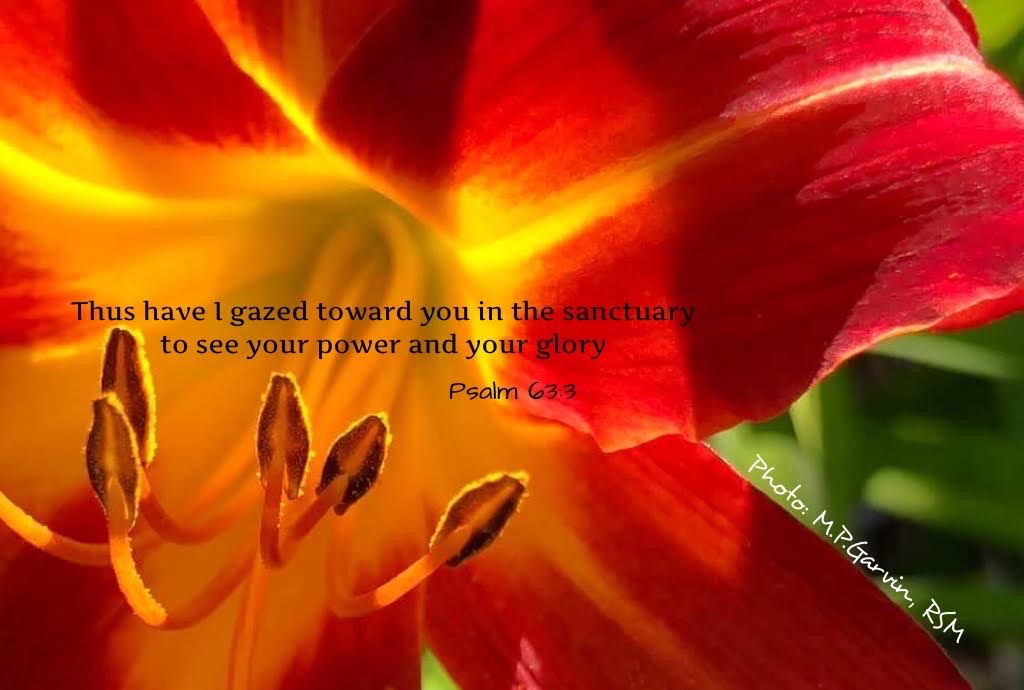
Psalm 63: 2-4

Our reading assures us that God readily meets our gaze:

Whoever watches for Wisdom at dawn shall not be disappointed,
for they shall find her sitting by their heart’s gate.
For taking thought of wisdom is the perfection of prudence,
and whoever for her sake keeps vigil
shall quickly be free from care;
because she makes her own rounds, seeking those worthy of her,
and graciously appears to them in the ways,
and meets them with all solicitude.

Wisdom 6:14-16

In our prayer today, let us open our deepest hearts to this Wisdom God who seeks us. Let our thirsty souls be satisfied in that loving Sacred Bliss.

Thus will I bless you while I live;
lifting up my hands, I will call upon your name.
As with the riches of a banquet shall my soul be satisfied,
and with exultant lips my mouth shall praise you.

Psalm 63: 5-6

Poetry: Our beautiful Psalm 63 for today is a poem beyond comparison. You might enjoy Rev. Christine Robinson‘s interpretation:

My soul thirsts for you, O God
As my dehydrated body craves water.
But I can’t see you.
I often lose touch with your loving kindness
My longing for you is the only real evidence I have
that you are really here.
Still, I will seek You
Still, I will do Your work
Still, I will remember You from my bed,
when I meditate before I sleep
and when I wake in the night.
You have been my helper
I have taken refuge in the shadow of your wings.
Dispatch my fears, O God
help me find my center in You.
And I will rejoice.

Music: I Long for You, O Lord – The Dameans

I long for you, O Lord
With all my soul, I thirst for You.

God, my God, you I seek 
for You my soul is thirsting,
Like a dry and weary land,
my spirit longs for You.

I have sought for Presence, Lord
to see your power and your glory.
Lord, your love means more than life.
I shall sing your praise.

Thus will I bless you while I live,
and I will call your name, O Lord.
As with the riches of a feast
shall my soul be satisfied.

Through the night, I remember You
for You have been my Savior.
In the shadow of your wings,
I will shout for joy.

Beyond Fear

Memorial of Saint Martin of Tours, Bishop
November 11, 2023

Today’s Readings:

https://bible.usccb.org/bible/readings/111123.cfm


Today, in God’s Lavish Mercy, there is a graceful coincidence of several themes calling me to prayer. I share them with you:

  • On November 11th, Sisters of Mercy throughout the world commemorate the death of our beloved founder Catherine McAuley.
  • This year that commemoration falls on the feast of the beautiful St. Martin of Tours.
  • Our readings for the day prompt us to consider our beloved companions on our spiritual journey who provide a harbor of blessings in a fearsome world.

Not just today, but often, I think about what Catherine would be like if she lived among us today. In her day, she was ever practical, focusing on healing the greatest unmet needs around her.

Her “un-technologized” world was smaller than ours. She encountered need simply by a walk through Dublin’s neighborhoods. Were she here today, need would pour into her awareness from every corner of the earth via technological means. How would she focus the power of her merciful heart for our times?


Our readings prompt me to think that Catherine would do the same three things she did almost two hundred years ago:

  • She would gather her companions on the journey
  • Together, they would empty their spirits of anything that was not of God
  • In that profound spiritual clarity, they would see where God called them to be Mercy for the world.

In our first reading, Paul names a number of his companions, those who strengthened and assisted him in life and ministry. Catherine too had beloved companions without whom she could not have met the challenges of her call.


In our Gospel, Jesus affirms that our hearts must be emptied of the undue love of anything that distracts us from God and God’s Way:

No servant can serve two masters.
He will either hate one and love the other,
or be devoted to one and despise the other.
You cannot serve God and mammon.”
The Pharisees, who loved money,
heard all these things and sneered at him.And he said to them,
“You justify yourselves in the sight of others,
but God knows your hearts;
for what is of human esteem is an abomination in the sight of God.”

Luke 16: 12-15

While in her times, Catherine encountered the ravages of material poverty, I think that something much less tangible, but exponentially more destructive, would capture her ministerial awareness today.

Our world suffers from an intrinsic and debilitating fear which inclines us to amass power and possessions to the impoverishment of those around us. The fear of not being or having enough drives the systemic predation of the rich upon the poor, and the powerful over the weak. It is a fear that grows in a heart emptied of God.

While Catherine would continue to address the needs of those suffering from poverty and disenfranchisement, I think she would reach out in a new way to the healing of those underlying fears. These fears fester in a culture of spiritual ignorance endemic to our modern society. The naming and healing of that ignorance is deeply congruous with Catherine’s charism and calls to us urgently today.


About St. Martin de Porres, Pope John XXIII said this:

“He loved his neighbors with the benevolence
of the heroes of the Christian faith.”

So did Catherine McAuley. So must we.


Poetry: Where the Mind is Without Fear – Rabindranath Tagore

Where the mind is without fear and the head is held high
Where knowledge is free
Where the world has not been broken up into fragments
By narrow domestic walls
Where words come out from the depth of truth
Where tireless striving stretches its arms towards perfection
Where the clear stream of reason has not lost its way
Into the dreary desert sand of dead habit
Where the mind is led forward by thee
Into ever-widening thought and action
Into that heaven of freedom, my Father, let us awake.


Music: There is No Fear in Love – The Bible Project

Magna Misericordia

Memorial of Saint Leo the Great, Pope and Doctor of the Church
Friday of the Thirty-first Week in Ordinary Time
November 10, 2023

Today’s Readings:

https://bible.usccb.org/bible/readings/111023.cfm


already paid

Today, in God’s Lavish Mercy, our readings are about spiritual wealth, stewardship, and Godly generosity.

Paul starts us off by proclaiming that the wealth/riches of salvation belong to ALL humanity. He presents himself as a unique “steward “ of those riches to the Gentiles.

But I have written to you rather boldly in some respects to remind you,
because of the grace given me by God
to be a minister of Christ Jesus to the Gentiles
in performing the priestly service of the Gospel of God,
so that the offering up of the Gentiles may be acceptable,
sanctified by the Holy Spirit.

Romans 15:15-16

Our Gospel gives us a second interpretation of “stewardship” in the parable the wily steward. This fella’ gets called on the carpet for squandering his employer’s resources. Pink slip time! 

So the steward calls in some of the debtors and reduces their debt by the amount of his own commission. By doing this, he hopes to make some friends to support him in his impending unemployment.

Talbots

Many years ago, there was a Talbot’s outlet in the Franklin Mills Mall in Northeast Philly. You could get an amazing deal on the clearance items. But you got an even better deal if you went to a certain cashier for your checkout.

He was a tall, flamboyant and loudly funny guy. If a price tag was missing on an item, you got it virtually for free. He would make outlandish comments like, “Oh, honey, this isn’t your color so let’s discount it 50%.” If you bought two of the same item, he might announce,”Two for one today”, charging for only one. He was a living example of the Biblical steward! Over time, he developed a devoted buying community – those who had learned the secret of why people waited in his long line!


In today’s parable, Jesus isn’t advocating that we cheat our employers. The parable isn’t really about that at all. It is about the way Jesus wants his disciples to be profligate in preaching the mercy of God.

Remember that this parable comes in between two blockbusters about Mercy- the Prodigal Son and Lazarus and the Rich Man. In a way, you might say Jesus is on a tear about the unbounded generosity of God in forgiveness and hope for us. He makes clear that the wealth of Divine Love is delivered to us by our unbounded Christian love for one another.


So today, maybe we can think about the Talbot’s guy. We have been abundantly blessed by God’s love for us. Let’s pay it forward over and over today… and every day. Let’s generously share the infinite discount of Mercy.


Poetry: from Day of a Stranger by Thomas Merton

I am out of bed at two-fifteen in the morning, 
when the night is darkest and most silent. . .. 
I find myself in the primordial lostness of night,
solitude, forest, peace, a mind awake in the dark,
looking for a light,
not totally reconciled to being out of bed. 
A light appears, and in the light an ikon. 
There is now in the large darkness 
a small room of radiance with psalms in it. 
The psalms grow up silently by themselves 
without effort like plants
in this light which is favorable to them.
The plants hold themselves up on stems 
that have a single consistency,
that of mercy, or rather great mercy. 
Magna misericordia. 
In the formlessness of night and silence
a word then pronounces itself: Mercy.

Music: Jesus Paid It All – Elvira M. Hall (1865)
This rendition of the hymn by Kristian Stanfill (born 1983) is so interesting. Offered here with modern instrumentation, the words date back to the era of the US Civil War. Past and present meld in the ever eternal love God has for us.

A Syllabus of Faith

Feast of the Dedication of the Lateran Basilica in Rome
November 9, 2023

Today’s Readings:

https://bible.usccb.org/bible/readings/110923.cfm


Today, in God’s Lavish Mercy, we celebrate a rare type of feast day – one that marks the dedication of a church building.  For many, that seems a little odd. We are accustomed to celebrating Mary, Joseph, and other saints and feasts of Our Lord.

Here’s the thing: we are not actually celebrating a building.  We are celebrating what the building represents – the Body of Christ, the Church, made of living stones – us.

The Lateran Basilica, founded in 324, is the oldest public church in the city of Rome, and the oldest basilica in the Western world. Standing before it, one can sense the entire drama of our 2000-year-old Church whispering its secrets to us. We hear the echoes of human courage, hope, perseverance, and fidelity which, over centuries, have transmitted the faith to us. We can hear the now stilled voices of those who loved the faith enough to give it visible and glorious expression for all who would follow them.


Today’s feast reminds us that sometimes it helps to have visible symbols of the things we venerate and celebrate. That’s why we have medals, rosary beads, and candles – so that we can SEE something as we try to conceptualize a spiritual reality. Can you imagine the awe and joy of the early Christians when, after centuries of hiding from persecution, they were able to gather and worship in this magnificent edifice!

john lateran

St. John Lateran is the Pope’s parish church. Since he is the Bishop of the whole People of God, his physical church has come to symbolize the universal Body of Christ, the world Church.


Pope Benedict XVI in his Angelus Address, on November 9, 2008 said this:

Dear friends, today’s feast celebrates a mystery that is always relevant: God’s desire to build a spiritual temple in the world, a community that worships him in spirit and truth (cf. John 4:23-24).
But this observance also reminds us of the importance of the material buildings in which the community gathers to celebrate the praises of God.
Every community therefore has the duty to take special care of its own sacred buildings, which are a precious religious and historical patrimony. For this we call upon the intercession of Mary Most Holy, that she help us to become, like her, the “house of God,” living temple of his love.

st j lateran

As we pray today, we might want to consider the gift of faith on which our own lives are built – a faith whose cornerstone is Jesus Christ. In our second reading, Paul says this:

Brothers and sisters:
You are God’s building…..
Do you not know that you are the temple of God,
and that the Spirit of God dwells in you?


And in our Gospel, Jesus speaks of his own body as a temple which, though apparently destroyed by his enemies, will be raised up in three days.

By our Baptism, that same spiritual temple lives in us and in all the community of faith. That same power of Resurrection is alive in us! So in a very real sense, what we celebrate today is ourselves – the Living Church – raised up and visible as a sign of God’s Life in the world.

Happy Feast Day, Church (and I’m talking to YOU, dear reader!)


Research: For the Church History buffs among us, this Wikipedia article on St. John Lateran Basilica can serve as a syllabus on the annals of the Roman Catholic Church.

https://en.wikipedia.org/wiki/Archbasilica_of_Saint_John_Lateran


Music: Cornerstone – Hillsong

“Hate” Enough to Love Completely

Wednesday of the Thirty-first Week in Ordinary Time
November 8, 2023

Today’s Readings:

https://bible.usccb.org/bible/readings/110823.cfm


Roman13_8 owe nothing

Today, in God’s Lavish Mercy, Paul and Jesus seem to give us contradictory messages. Paul talks about love, and Jesus tells us what we must “hate” – a bit of a challenge to untangle the core message.

Here’s one way.

We don’t like Jesus telling us to “hate” anything, as in:

If anyone comes to me without hating his father and mother,
wife and children, brothers and sisters,

and even his own life,
he cannot be my disciple.

Luke 14:26

Come on, Jesus! You don’t mean that do you – my sweet mom, my precious kids???

No, the scholars say, Jesus doesn’t mean “hate” the way we interpret it in modern English. He is using the common, hyperbolic language of the ancient East which, in this circumstance, would mean “love less or without bias”.

So what is Jesus really saying? 

This.

We love many people and things in our lives. But we must love God, and God’s dream for all people, above and within all things. 


And that’s not easy! Life is a maze of relationships and situations that can get us very confused about what is most important. That’s why Jesus uses such strong language to remind us that there is only one way through the maze: to love as God loves. This is the heartbeat of our life in God!

Paul says this too, indicating as well how to negotiate the maze by keeping Love’s commandments.


We have such a critical example of this love-hate dynamic in our world just now. The terrible situation in the Holy Land has brought out radical feelings in people all over the world. People who love Israel and abhor violence are disgusted and furious over the attack against the Israeli people. People who love and pity the Palestinians, who have been suppressed into human desperation for decades, are equally disgusted and furious over the mass revenge being wrought upon innocents in Gaza and the West Bank.


I think Jesus would say this to us: You must “hate” those human relationships enough to make you not take sides in this horror. You must look past blood ties and religious ties. You must look to the human person, God’s creature like you who is the innocent victim of political forces. You must add to the voice for justice, mercy, and humane solutions.

No matter how far we may feel from the wars in Ukraine and the Middle East, each one of us is at a point of moral discernment regarding them. As massive funding is poured into weapons of war, how do we respond to the ongoing massacre of innocent people? I ask myself what is required of me as a citizen of the world to make my voice heard in this unspeakable tragedy.


If we love with God’s love, of course we will love those we cherish. But we will love them selflessly, with an infinite generosity that always chooses their eternal good. And we will try always to love all Creatures in the same way, seeking to the degree that is possible their well-being and peace. This is the kind of love Jesus taught us on the Cross. May God give us the courage to learn.


Prose: Remarks of Pope Francis at the Angelus on October 15, 2023

Dear brothers and sisters, I continue to follow with great sorrow what is happening in Israel and Palestine. I think again of the many people … in particular of the children and the elderly. I renew my appeal for the release of the hostages, and I strongly ask that children, the sick, the elderly, women, and all civilians not be made victims of the conflict. May Humanitarian Law be respected, especially in Gaza, where it is urgent and necessary to ensure humanitarian corridors and to come to the aid of the entire population. Brothers and sisters, many have already died. Please, let no more innocent blood be shed, neither in the Holy Land nor in Ukraine, nor in any other place! Enough! Wars are always a defeat, always!

Prayer is the meek and holy force to oppose the diabolical force of hatred, terrorism and war.


Music: Ubi Caritas performed by Stockholm University Choir (texts below)

Latin Text

Ubi caritas et amor, Deus ibi est.
Congregavit nos in unum Christi amor.
Exsultemus, et in ipso jucundemur.
Timeamus, et amemus Deum vivum.
Et ex corde diligamus nos sincero.
Ubi caritas et amor, Deus ibi est.
Simul ergo cum in unum congregamur:
Ne nos mente dividamur, caveamus.
Cessent iurgia maligna, cessent lites.
Et in medio nostri sit Christus Deus.
Ubi caritas et amor, Deus ibi est.
Simul quoque cum beatis videamus,
Glorianter vultum tuum, Christe Deus:
Gaudium quod est immensum, atque probum,
Saecula per infinita saeculorum. Amen.

English Translation
Where charity and love are, God is there.
Love of Christ has gathered us into one.
Let us rejoice in Him and be glad.
Let us fear, and let us love the living God.
And from a sincere heart let us love one.
Where charity and love are, God is there.
At the same time, therefore, are gathered into one:
Lest we be divided in mind, let us beware.
Let evil impulses stop, let controversy cease.
And in the midst of us be Christ our God.
Where charity and love are, God is there.
At the same time we see that with the saints also,
Thy face in glory, O Christ our God:
The joy that is immense and good,
Unto the World without end. Amen.

Preventing One Another

Tuesday of the Thirty-first Week in Ordinary Time
November 7, 2023

Today’s Readings:

https://bible.usccb.org/bible/readings/110723.cfm


Today, in God’s Lavish Mercy, Paul gives us one of his most heartfelt and beautiful passages, and Jesus offers us a puzzling parable about the kingdom.

Rms12_10 honor

Paul’s exhortation to sincere holiness is a passage that warrants frequent reading. At any given point in our lives, one or another of its encouragements will seem to ring profoundly true with our circumstances.

One of the lines that I particularly cherish goes like this in the old Douay-Rheims version, which is where I first encountered it as a young girl:

Love one another with fraternal charity:
with honor preventing one another.

The bolded phrase fascinated me. I didn’t understand what it meant. From what were we to prevent one another?

It was not until I came to the convent that I begin to discern the power of this verse. At the time (during the Dark Ages, of course), the Sisters lived under the 1952 Constitutions of the Sisters of Mercy, an adaptation of the ancient Rule of St. Augustine. As postulants, we each received a 4×6, 128 page copy of the Rule. In direct and intentional language, it set the frame for our whole lives.

I nearly memorized it, especially Chapter 14 on Union and Charity. Right in the middle of the Chapter, I found this precious line:

They (the Sisters) shall sincerely respect one another. The young shall reverence the old and all shall unceasingly try in true humility to promote constant mutual cordiality and deference, “with honor preventing one another”.

Sister Inez, our dear early instructor, explained that this meant to anticipate the needs of our beloved sisters, especially the elderly; to do for them what might be difficult for them before they had to ask. In other words, to prevent their need. She said that this anticipatory charity should mark our service toward everyone, especially the poor, sick and ignorant whom we would vow to serve.


The more all of us can live together with this mutual love and respect, the closer we come to the kingdom of God, to the banquet table described in today’s Gospel. Jesus came to gather us all around this table. Pity on those who resist his invitation because their lives are entangled in self-interested endeavors. Their places are taken by “the poor, the crippled, the blind and the lame” and all those on the margins of society.

As we join our sisters and brothers at the banquet of life, may we love and serve one another sincerely, always with honor preventing one another.


Poetry: Emily Dickinson

If I can stop one heart from breaking,
I shall not live in vain;
If I can ease one life the aching,
Or cool one pain,
Or help one fainting robin
Unto his nest again,
I shall not live in vain.

Music: a little motion mantra this morning. Maybe you might want to get up outta’ that chair and join in🤗

The Inscrutable Plan

Monday of the Thirty-first Week in Ordinary Time
November 6, 2023

Today’s Readings:

https://bible.usccb.org/bible/readings/110623.cfm


Today, in God’s Lavish Mercy, to understand our first reading from Romans, we have to put ourselves back in time to sit beside Paul as he writes.

Paul was a devout Jew. Remember how, before his conversion, he felt called to persecute Jews who had become Christians? Now here he is writing and preaching the Christian message himself. Still he believes in his deepest heart that God has a particular affection for the Jews and wills their salvation. So Paul tries to explain how this will happen.

The explanation can sort of leave your head spinning. But essentially, Paul believes that salvation will be accomplished when all people, Gentile and Jew, repent from whatever is their unfaithfulness and receive God’s Mercy – that from all eternity, God’s “inscrutable” plan was to redeem us all, not just Israel. Paul still seems a little amazed by this revelation and tries to pound it home to his listeners:

Just as you once disobeyed God 
but have now received mercy
because of their disobedience,
so they have now disobeyed in order that,
by virtue of the mercy shown to you,
they too may now receive mercy.
For God delivered all to disobedience,
that he might have mercy upon all.

Romans 11:30-32

Paul’s apologia meant more to the listeners of his time than it probably does to us. But it is in the final verses of the passage that Paul captures an eternal truth that rings as true today as it did in early Christian times:

Oh, the depth of the riches and wisdom and knowledge of God!
How inscrutable are his judgments and how unsearchable his ways!

For who has known the mind of the Lord
or who has been his counselor?
Or who has given him anything
that he may be repaid?

For from him and through him and for him are all things.
To God be glory forever. Amen.

Romans 11: 33-36

These magnificent lines remind all of us – Jew or Gentile, ancient or contemporary believer – that God is accomplishing the work of salvation in a depth of love beyond our understanding. Perhaps we spend moments of our lives wondering “why God lets things happen”, or “why God doesn’t intervene”.

Paul says we cannot answer those questions. God’s ways are infinitely beyond us, but nevertheless faithful and abiding. In our fidelity and hope, we see the unsearchable ways of God slowly unfold, moment by moment, in our lives and in our world.


The young, fiery Paul we first meet in Acts never expected his faith to be fulfilled outside the borders of Judaism. But our expectations and God’s inscrutable plan rarely align. That’s the wonder and mystery of the spiritual life! God will always surprise us, just as God surprised the deeply Judaic Paul into Christianity, even to the role of “Apostle to the Gentiles”!


I bet almost every one of us finds ourselves trying to “become holy” in a way we had not at first imagined. The challenges, opportunities, choices, responsibilities, and obstructions life presents take us down roads we did not envision. When Paul was thrown from his horse on the way to Damascus, his whole life plan was overthrown with him. And from that tailspin, the path to True Life opened up before him.

I’m going to spend some time in prayer thinking about my own life summersaults and how God has used them to lead me according to that “inscrutable plan”. Maybe you’d want to do the same.


Poetry: Light Shining Out of Darkness – William Cowper (1731-1800)

God moves in a mysterious way
His wonders to perform;
He plants His footsteps in the sea
And rides upon the storm.

Deep in unfathomable mines
Of never failing skill
He treasures up His bright designs
And works His sov’reign will.
Ye fearful saints, fresh courage take;
The clouds ye so much dread
Are big with mercy and shall break
In blessings on your head.
Judge not the Lord by feeble sense,
But trust Him for His grace;
Behind a frowning providence
He hides a smiling face.

His purposes will ripen fast,
Unfolding every hour;
The bud may have a bitter taste,
But sweet will be the flow’r.

Blind unbelief is sure to err
And scan His work in vain;
God is His own interpreter,
And He will make it plain.


Music: Who Has Known – John Foley, SJ

Oh, the depth of the riches of God
And the breadth of the wisdom and knowledge of God
For who has known the mind of God
To Him be glory forever

A virgin will carry a child and give birth
And His name shall be called Emmanuel
For who has known the mind of God
To Him be glory forever

The people in darkness have seen a great light
For a child has been born, His dominion is wide
For who has known the mind of God
To Him be glory forever

Phat Phylacteries!

Thirty-first Sunday in Ordinary Time
November 5, 2023


Today’s Readings:

https://bible.usccb.org/bible/readings/110523.cfm


Today, in God’s Lavish Mercy, our readings perfectly complement one another delivering a clear message: all leadership, including spiritual leadership, requires the disciplines of humility, honesty, justice, mercy, and love.

These disciplines are so easy to lose in the euphoria of power and the delusions of superiority. Malachi, prophet of the 5th century before Christ, vehemently points this out. Speaking for God, the prophet states:

O priests, … I will send a curse upon you
and of your blessing I will make a curse.
You have turned aside from the way,
and have caused many to falter by your instruction;
you have made void the covenant of Levi,
says the LORD of hosts.
I, therefore, have made you contemptible
and base before all the people,
since you do not keep my ways,
but show partiality in your decisions.

Malachi 2:2

Five hundred years later, Jesus echoes the rebuke to his own generation:

Do not follow the example of the scribes and Pharisees.
For they preach but they do not practice.
They tie up heavy burdens hard to carry
and lay them on people’s shoulders,
but they will not lift a finger to move them.
All their works are performed to be seen.
They widen their phylacteries and lengthen their tassels.
They love places of honor at banquets, seats of honor in synagogues,
greetings in marketplaces, and the salutation ‘Rabbi.’

Matthew 23: 3-7

What are phylacteries anyway, and what is Jesus talking about when he describes them as widened?


The wearing of phylacteries in Jewish practice is similar to Christians wearing crosses or being signed with ashes on Ash Wednesday, All of these devotional acts are intended to demonstrate one’s faith and invite others to faithful practice. But when exaggerated, such practices draw attention to oneself rather than to the faith. It is often an attempt to proclaim the superiority of one’s faith perhaps because, in our hearts, we are unsure of it.


Jesus says that such exaggerated devotion is unnecessary when our lives speak for themselves, demonstrating faith through our works of mercy.

You have but one teacher, and you are all brothers.
Call no one on earth your father;
you have but one Father in heaven.
Do not be called ‘Master’;
you have but one master, the Christ.
The greatest among you must be your servant.
Whoever exalts himself will be humbled;
but whoever humbles himself will be exalted.

Matthew 23: 8-12

We are all leaders at some level in our lives — parents, teachers, supervisors, politicians, clinicians, and everyone who has influence over another’s life. In each of these roles, our soul’s lens can be turned toward ourselves, or it can be turned in merciful care toward the other. The way we effectively turn the lens is to continually deepen ourselves in the greatest commandment: Love God above all things and your neighbor as yourself.


Poetry: Some keep the Sabbath going to Church – Emily Dickinson

Some keep the Sabbath going to Church –
I keep it, staying at Home –
With a Bobolink for a Chorister –
And an Orchard, for a Dome –
Some keep the Sabbath in Surplice –
I, just wear my Wings –
And instead of tolling the Bell, for Church,
Our little Sexton – sings.
God preaches, a noted Clergyman –
And the sermon is never long,
So instead of getting to Heaven, at last –
I’m going, all along.

Music: Where I Find God – Larry Fleet

The night I hit rock bottom, sittin’ on an old barstool
He paid my tab and put me in a cab, but he didn’t have to
But he could see I was hurtin’, oh, I wish I’d got his name
‘Cause I didn’t feel worth savin’, but he saved me just the same

That day out on the water, when the fish just wouldn’t bite
I put my pole down, I floated around, was just so quiet
And I could hear my old man sayin’ “Son, just be still
‘Cause you can’t find peace like this in a bottle or a pill”

From a bar stool to that Evinrude
Sunday mornin’ in a church pew
In a deer stand or a hay field
An interstate back to Nashville
A Chevrolet with the windows down
Me and him just ridin’ around
Sometimes, whether I’m lookin’ for Him or not
That’s where I find God

Sometimes late at night, I lie there and listen
To the sound of her heart beatin’
And the song the crickets are singin’
And I don’t know what they’re sayin’
But it sounds like a hymn to me
Naw, I ain’t too good at prayin’
But thanks for everything

From a bar stool, to that Evinrude
Sunday mornin’ in a church pew
In a deer stand or a hay field
An interstate back to Nashville
A Chevrolet with the windows down
Me and him just ridin’ around
Sometimes, whether I’m lookin’ for Him or not
That’s where I find God

From a bar stool, to that Evinrude
Sunday mornin’ in a church pew
In a deer stand or a hay field
An interstate back to Nashville
A Chevrolet with the windows down
Me and him just ridin’ around
Talkin’, well I do that a lot
Well, I do that a lot
That’s where I find God

Humble Desire

Memorial of Saint Charles Borromeo, Bishop
Saturday of the Thirtieth Week in Ordinary Time
November 4, 2023

Today’s Readings:

https://bible.usccb.org/bible/readings/110423.cfm


Today, in God’s Lavish Mercy, the message of the readings seems to be that we can miss out on grace if we don’t humbly pay attention to its call.


It’s tough to miss out on something when you really want it. I’ve told the story here before of the elderly gentleman at the supermarket ice cream freezer. He was having trouble locating his favorite pineapple ice cream among the oceans of mint chocolate chip and moosetracks. Reaching into the freezer to help him, I found the last pineapple carton. He was delighted but instead of taking it, he said, “Won’t you please try it, I think you will love it. It would make me happy if you did.” In a sense, he missed out on something he really wanted, but he gained something immensely more important.


Paul wants his fellow Israelites to do something similar. He tells them that because they hesitated to embrace Christ’s message, they missed out for a while. In their place, the Gentiles have received the Gospel. But now Paul is asking his fellow Israelites to complete the Gospel community by joining and welcoming the larger Church.

But through their transgression
salvation has come to the Gentiles,
so as to make them jealous.
Now if their transgression is enrichment for the world,
and if their diminished number is enrichment for the Gentiles,
how much more their full number.

Romans 11: 11-12

Our Gospel offers a slightly different approach. Yes, it’s tough to miss out on something you really want. But it’s even worse to miss out because you’re too dense, dumb, or distracted to know what’s good for you.

The invitees to the wedding banquet are so self-absorbed that they don’t even consider the comfort of their fellow guests. Their pride merits them the lowest seat at the table while the humble guests are brought up closer to the host.


“When you are invited by someone to a wedding banquet,
do not recline at table in the place of honor.
A more distinguished guest than you may have been invited by him,
and the host who invited both of you may approach you and say,
‘Give your place to this man,’
and then you would proceed with embarrassment
to take the lowest place.
Rather, when you are invited,
go and take the lowest place
so that when the host comes to you he may say,
‘My friend, move up to a higher position.’
Then you will enjoy the esteem of your companions at the table.
For everyone who exalts himself will be humbled,
but the one who humbles himself will be exalted.”

Luke 14: 8-11

The proud guests in the Gospel really wanted the prestigious seats. But these were seats that only the host (God) could give. Grappling to land the best chair, they got in their own way and missed the sacred invitation which only the humble can hear.


Song Poem: I Don’t Want to be a Pharisee – for your fine listening pleasure and sophisticated spiritual enrichment: 😉

I don’t want to be a pharisee
Or anyone like that.
It’s stupid swallowing camels
Whilst straining out a gnat.
To keep the letter of the law,
They forgot the people it was for.
So I don’t want to be a Pharisee,
I don’t want to be a Pharisee,
I don’t want to be a Pharisee
Or anyone like that.

But They Kept Silent

Friday of the Thirtieth Week in Ordinary Time
November 3, 2023

Today’s Readings:

https://bible.usccb.org/bible/readings/110323.cfm


Today, in God’s Lavish Mercy, as we read our scriptures for the day, we sense that both Jesus and Paul suffer heartbreak for those who resist the Gospel.

Brothers and sisters:
I speak the truth in Christ, I do not lie;
my conscience joins with the Holy Spirit in bearing me witness
that I have great sorrow and constant anguish in my heart.
For I could wish that I myself were accursed and cut off from Christ
for the sake of my own people,
my kindred according to the flesh.

Romans 9:1-3

Paul expresses his deep regret that his own people, the Israelites, resist the Messiah who is God’s final gift to them in a long line of unique blessings:

They are children of Israel;
theirs the adoption, the glory, the covenants,
the giving of the law, the worship, and the promises;
theirs the patriarchs, and from them,
according to the flesh, is the Christ,
who is over all, God blessed forever. Amen.

Romans 9:4-5

In our Gospel, Jesus encounters a man with a withered hand. From the get-go, Jesus plans to heal the suffering man, but he decides to use the occasion to teach the Pharisees a lesson.

Jesus invites the scholars and Pharisees to move beyond the written Law and into the true practice of its spirit:

Jesus spoke to the scholars of the law and Pharisees in reply, asking,
“Is it lawful to cure on the sabbath or not?”
But they kept silent; so he took the man and,
after he had healed him, dismissed him.
Then he said to them
“Who among you, if your son or ox falls into a cistern,
would not immediately pull him out on the sabbath day?”
But they were unable to answer his question.

Luke 14: 5-6

What Jesus asked was apparently too much for them. They were so encrusted in the worldly benefits the Law had brought them that they couldn’t challenge themselves to hear Jesus’s message. So they were silent – they gave no response to the divine invitation to life-giving change.

And to be fair to the Pharisees, Jesus’s invitation was a huge challenge. Their lives had become entirely dependent on a system that had lost its true meaning. The Law no longer led them to God but to themselves. They had lost the way through the woods, as you will see in Kipling’s poem below.


There are many levels on which we can pray with this passage. We are surely aware of the same kind of resistant silences in ourselves and in our world.

We may be caught in a sort of personal woods where we can’t make our way through to a life-giving choice or, like the Pharisees, to an inclusive, merciful understanding.

Or we may see this kind of entrapment happening in a beloved’s life.

Or we may see the atrophic effects of dead, unreviewed laws in our country, world, and Church. Failing to adapt laws that have lost their true spirit allows us to normalize outrageous behaviors based on manufactured”legality”. The image of a 16-year-old carrying an AK-47 down a neighborhood street, “legally” shooting unarmed protesters, comes to my mind!

All of these situations arise when we are entwined in a system that no longer gives life. The spirit and energy of the Gospel is the key to our un-entwining. Let’s pray for it in ourselves and in our very knotted world.


Poetry: The Way Through the Woods – Rudyard Kipling

They shut the road through the woods
Seventy years ago.
Weather and rain have undone it again,
And now you would never know
There was once a road through the woods
Before they planted the trees.
It is underneath the coppice and heath,
And the thin anemones.
Only the keeper sees
That, where the ring-dove broods,
And the badgers roll at ease,
There was once a road through the woods.

Yet, if you enter the woods
Of a summer evening late,
When the night-air cools on the trout-ringed pools
Where the otter whistles his mate,
(They fear not men in the woods,
Because they see so few.)
You will hear the beat of a horse’s feet,
And the swish of a skirt in the dew,
Steadily cantering through
The misty solitudes,
As though they perfectly knew
The old lost road through the woods.
But there is no road through the woods.

Music: Dave Eggar – Fallen Leaves