Alleluia: Be Light!

June 7, 2022
Tuesday of the Tenth Week in Ordinary Time
Today, in God’s Lavish Mercy, we come back to the shore of Ordinary Time. Fresh off the glorious voyage with Jesus through Lent, Holy Week, Eastertide and Pentecost, we arrive grace-filled for the ordinary days of our lives.

( During this next Liturgical Season, I would like to focus us on our Alleluia Verse each day.  This short snippet of scripture serves like a doorman opening the way into our Gospel for the day. It helps us to focus on a truth that might be most meaningful in the sacred Word awaiting us. It alerts us that Jesus wants to speak to us, and it gives us a hint of what He might want to say.

Of course, we do not read the Alleluia Verse in isolation, but rather in the context of the lessons of our first reading and the reinforcements of our daily psalm. But it still might help us to take the small gem of the Alleluia Verse and hold it up to a longer, more reflective light.

For those who wish to meditate further on the readings or Psalm, I will try each day to give you links to earlier reflections on these readings, as you see with the buttons above.)
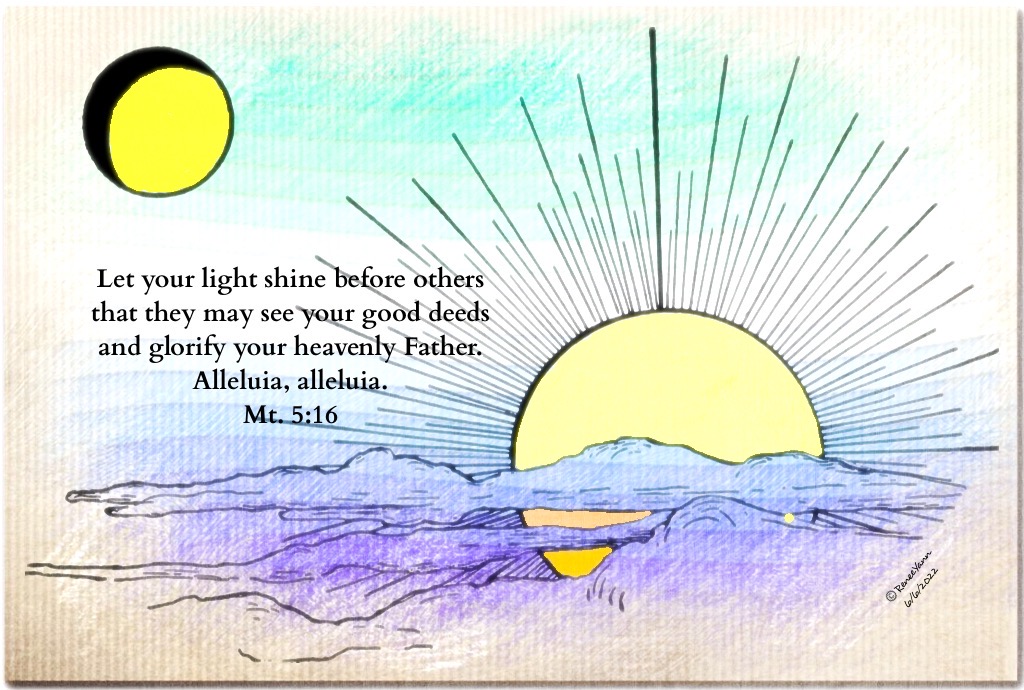

Today’s verse is an invitation to the light and energy of the Holy Spirit.
It is a call to be like suns and stars in the world’s shadows.
It is a reminder that we are satellites circling God’s Brillance …
that the brightness we reflect is a sprinkling of Divinity…
that no shadow can withstand our “Alleluia ”.

So if we are brave, let’s look in the mirror each morning,
maybe after a cold splash and a sip of coffee
and let’s tell ourselves the amazing truth:
“You are called to be Light in the darkness.”

That darkness takes the form of the obvious evils of our times:
war, violence, hatred, rampant militarism
and all other forms of contempt for another’s life.

But it comes in subtler patterns as well
that may be harder to discern in ourselves.

To name just a few – the infamous “ins” such as:

  • Intemperance
  • Ingratitude
  • Insincerity
  • Injustice
  • inaction
  • and I think, worst of all, Indifference

May we invite and welcome the
“Alleluia Light”
into our every darkness.
Amen.

Poetry: Bearing the Light – Denise Levertov

Rain-diamonds, this winter morning, 
embellish the tangle of unpruned pear-tree twigs; 
each solitaire, placed, it appears, with considered judgement, 
bears the light beneath the rifted clouds - 
the indivisible shared out in endless abundance.

Music: Be a Light – Thomas Rhett
Mary, Mother of the Church

June 6, 2022

Today, in God’s Lavish Mercy, we celebrate the Memorial of the Blessed Virgin Mary, Mother of the Church.


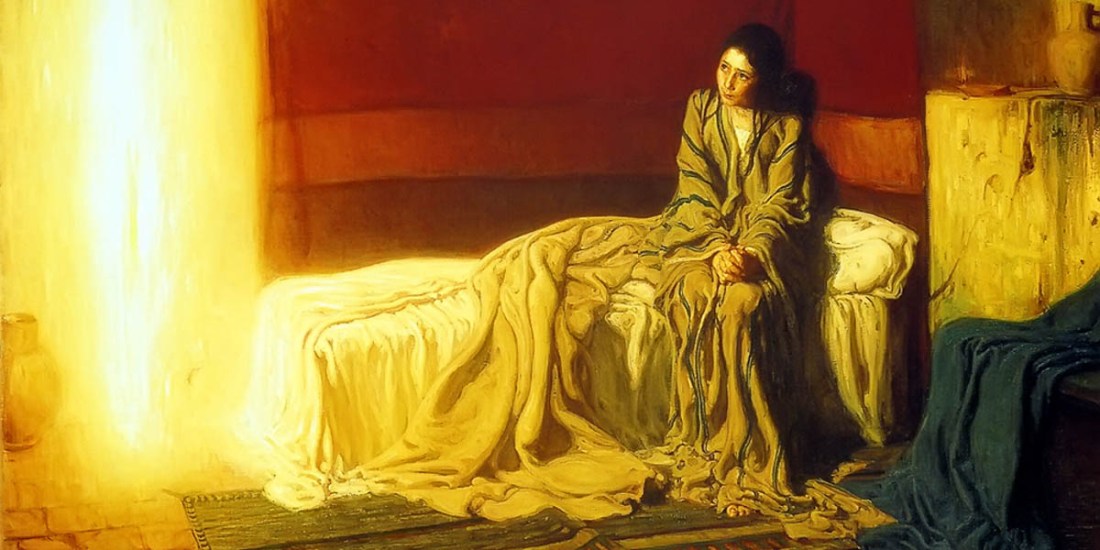
web3-the-annunciation-by-henry-ossawa-tanner
Annunciation by Henry Ossawa Tanner

It is a day to honor Mary for giving life to Jesus
for the sake of all humanity.

It is day to beg her intercession
for a world so desperately in need of
Christ’s continued revelation.

door of Mercy

Mary is the Door through which
Heaven visited earth
to heal it from sinful fragmentation.


Ave

May Mary continue to carry her beautiful grace
to broken hearts and even
to the twisted souls who broke them. 

Through her, may we all find healing.

Mary, Mother of Mercy, intercede for all Creation
that we may embrace the Love your Son taught us.


Poetry: How Do I See Her – by Judith Evans

How do I see her?
Blessed Mother, Queen of Heaven, Virgin Mary:
these are names that people have given her.
But who is she?

When I see the mother of our Savior,
I see the courage of women:

She said “yes” and stepped into the never-before,
the great unknown,
unfairly judged by neighbors,
nearly losing her betrothed at a time when “unmarried” and “pregnant” meant banishment or death by stoning.

I see the strength of women:

A pregnant teenage girl,
she rode 100 miles on a donkey,
sleeping on the ground,
surrounded by Roman oppression.

I see the wisdom of women:

It was time.
She knew that her son was ready before he knew it.
“Do as he tells you,” she told the servants at the wedding. And then there was wine,
and the greatest ministry of all time began.

I see the anguish of women:

She visualized her son’s destiny as she nursed him,
cleaned him,
baked bread for him.
Her heart nearly stopped when she couldn’t find him,
and then rejoiced when he turned up
discussing theology with scholars:
a prelude to a future loss,
that horrific afternoon at the foot of the cross.

I see women celebrating:

Beyond all human-sized hope,
her son conquered death.
She had dared to believe in hope,
and when hope’s light seemed extinguished,
she hoped one more time.

Who is she?
She is each and every one of us.
Whole, messy, wounded, blessed.

Bewildered by the mystery of it all,
yet willing to try one more time
to comprehend God’s purpose.

Learning to receive God’s mercy and grace,
realizing that we are seen and loved
beyond our understanding.


Music: Ave Maria – Michael Hoppé

Pentecost Sunday

June 5, 2022

Today, in God’s Lavish Mercy, we celebrate the great Feast of Pentecost when the Holy Spirit descended to eternally enliven the Church.

We are that Church, living today in a world that sorely needs God’s renewing breath of life!


For today’s Responsorial Psalm, we pray with Psalm 104 – a fitting plea for this glorious Feast of Pentecost.

Lord, send out your Spirit, 
and renew the face of the earth.

It is a bold prayer, an extravagant request. It asks for everything – a Fire of Love so complete that the whole earth is remade in its Divine Power.

It is a prayer based in mutual invitation as, in the Sequence, we invite the Holy Spirit to renew us:

Come, Holy Spirit, come!
And from your celestial home
Shed a ray of light divine!

Pentecost Sequence

And, as in any true relationship, the Spirit invites us too – to open our hearts to the infinite grace of this feast. The Book of Revelation describes this reciprocity in this profound passage:

“ I, Jesus, have sent my angel to give you this testimony for the churches. I am the Root and the Offspring of David, and the bright Morning Star.”

The Spirit and the bride say, “Come!” And let the one who hears say, “Come!” Let the one who is thirsty come; and let the one who wishes take the free gift of the water of life.

Revelation 22: 16-17

On this Birthday of the Church, we pray not only for our own soul’s kindling, but for the whole People of God. May the Grace of Pentecost ignite a new fire of charity over all the earth. May that fire clear the way for the Spirit’s gifts to flower, for Her fruits to blossom, for Her power to surprise us as it bursts forth in our hearts!


Poetry: The Golden Sequence

Veni Sancte Spiritus, sometimes called the Golden Sequence, is a sequence prescribed in the Roman Liturgy for the Masses of Pentecost and its octave. It is usually attributed to either the thirteenth-century Pope Innocent III or to the Archbishop of Canterbury, Cardinal Stephen Langton, although it has been attributed to others as well.

“Veni Sancte Spiritus” is one of only four medieval Sequences which were preserved in the Roman Missal published in 1570 following the Council of Trent (1545–63).

The other three occasions when we hear these beautiful ancient hymns are Easter Sunday (“Victimae Paschali Laudes”), Corpus Christi (“Lauda Sion Salvatorem”) and Our Lady of Sorrows (“Stabat Mater Dolorosa”). On Easter Sunday and Pentecost, the sequence must be sung, whereas on Corpus Christi and Our Lady of Sorrows, the sequence is optional.

Wikipedia

Come, Holy Spirit, come!
And from your celestial home
    Shed a ray of light divine!

Come, Father of the poor!
Come, source of all our store!
    Come, within our bosoms shine.

You, of comforters the best;
You, the soul’s most welcome guest;
    Sweet refreshment here below;

In our labor, rest most sweet;
Grateful coolness in the heat;
    Solace in the midst of woe.

O most blessed Light divine,
Shine within these hearts of yours,
    And our inmost being fill!

Where you are not, we have naught,
Nothing good in deed or thought,
    Nothing free from taint of ill.

Heal our wounds, our strength renew;
On our dryness pour your dew;
    Wash the stains of guilt away:

Bend the stubborn heart and will;
Melt the frozen, warm the chill;
    Guide the steps that go astray.

On the faithful, who adore
And confess you, evermore
    In your sevenfold gift descend;

Give them virtue’s sure reward;
Give them your salvation, Lord;
    Give them joys that never end. Amen.
    Alleluia.

Music: Veni Santé Spiritus – Chant of the Mystics

Saturday of the Seventh Week of Easter Mass in the Morning

June 4, 2022

Today, in God’s Lavish Mercy, on this day before Pentecost, we close the book on both Acts and John’s Gospel, companions we have been praying with since mid-April.


When I read a really great book, I hate it to end. The characters and their story linger in my mind. The places where I’ve pictured them seem real – as if I’ve visited there myself. And the core of their stories becomes part of me, a reference point for my own experience.

Hopefully, the same thing happens when we read and pray with scripture. 

bible

apostles

As we leave Acts today, we should feel like we know the early disciples better, especially Peter, Paul, Barnabas, Stephen, Lydia and others whose story might have touched us. We should better understand the ups and downs of the early Church, the passion for mission, and the evolution of faith – and how these speak to our own times.


Finishing John, we have a slightly different picture of Jesus from that of the Synoptic Gospels of Matthew, Mark, and Luke. We see a Jesus full of Light, his human existence described through the lens of his Divinity. Johannine scholar Raymond E. Brown describes the difference like this:

That Jesus is the center of John’s message is confirmed by even a hasty reading of the Gospel itself. The emphasis on the Kingdom of God, so prominent in the Synoptic Gospels, has yielded in John to an emphasis on Jesus as the embodiment of life, truth, and light. No more is the parabolic language introduced by “The kingdom of God is like,..”; rather we hear the majestic “I am ” Whereas it is the Kingdom that the Synoptic Gospels describe in terms of vineyard, wheat, shepherd and sheep, in John it is Jesus who is the vine, the bread, the shepherd, and the sheepgate.


shepherd
eucharist

Today, in our prayer, we might want to glance back through these books, reminding ourselves of the words, phrases and stories that touched our own experience most deeply. 

John_I

Sketching such phrases – perhaps in a daily prayer journal –  is a good way to let our minds turn them over and over again in prayer, discovering new depths with each turn.


Poetry: As we wait for the dawning of Pentecost, let us pray with William Blake’s powerful poem:

Unless the eye catch fire,
The God will not be seen.
Unless the ear catch fire
The God will not be heard.
Unless the tongue catch fire
The God will not be named.
Unless the heart catch fire,
The God will not be loved.
Unless the mind catch fire,
The God will not be known.

William Blake (1757-1827) from Pentecost


Music:  Cavalleria Rusticana: Easter Hymn – Pietro Mascagni, featuring Australian soprano Kiandra Howarth

I thought we’d close these two wonderful books, and the Easter Season, with a bang.
(Lyrics below)

Lyrics:
LATIN AND ENGLISH:
CHORUS (within the church)
Regina coeli, laetare—Alleluia!
Quia, quem meruisti portare—Alleluia!
Resurrexit sicut dixit—Alleluia!

CHORUS (in the square)
We rejoice that our Saviour is living!
He all-glorious arose from the dead;
Joys of heaven the Lord to us giving,
All the sorrows of darkness are fled!
(The chorus goes out slowly)


ITALIAN:
CORO INTERNO (dalla Chiesa.)
Regina coeli, laetare—Alleluja!
Quia, quem meruisti portare—Alleluja!
Resurrexit sicut dixit—Alleluja!

CORO ESTERNO (sulla piazza.)
Inneggiamo, il Signor non è morto.
Ei fulgente ha dischiuso l’avel,
inneggiamo al Signore risorto
oggi asceso alla gloria del Ciel!
(il Coro esce lentamente)

Holding Hands with God

Picture two people, who love each other deeply, walking along a quiet beach. They may be a child and parent, committed spouses or devoted friends. They are walking, fully in each other’s presence. But at times, one or the other may wander off to study a shell or watch a sandpiper while the other continues slowly walking. Still, they are completely with each other and will often reconnect to share snatches of thought and imagination. In many ways, this image captures the meaning of the epistolary admonition, “Pray always.” On the beach of our lives, we are walking with God always.


But there are times in that walk when, for some reason, we will reach for the other’s hand. We will intensify and focus our attention to each other. The reason may be an awareness of something beautiful, poignant, frightening, joyful or overwhelming. We will remember these moments as specific experiences such as:

  • • “It was the time we saw the magnificent sunrise.”
  • • “It was the time we were frightened by the unexpected storm.”

In our lifelong walk with God, this reaching for and holding each other’s hands is a good image for the act of prayer. It may be initiated by God or by us, or perhaps by both at once. It may be vocal or silent. It is an experience which has a beginning and an end. Like the shared moments on the beach, these acts of prayer are definite moments, for example:

  • • “It was the time I was overwhelmed with gratitude for God’s gift of my family and prayed that gratitude as I watched them around our family table.”
  • • “It was the time I became aware of the call to greater generosity and service and prayed aloud for God’s guidance and support.”

These acts of prayer change us. They open us to greater depth in our journey with God. They deepen the sense of God’s presence within our total experience. They thin the veil which separates us from the Divine.

To become pray-ers like this, we must first become constant listeners. God is whispering to us in every moment and experience of our lives. As we learn to hear God in our own lives, we become better at hearing God in other’s hearts. Our prayers become a response to that Voice which first and constantly speaks to us.

Some music for you all:

Tony O’Connor – Whispering Sea

Friday of the Seventh Week of Easter

Memorial of Saint Charles Lwanga and Companions, Martyrs

June 3, 2022

festus
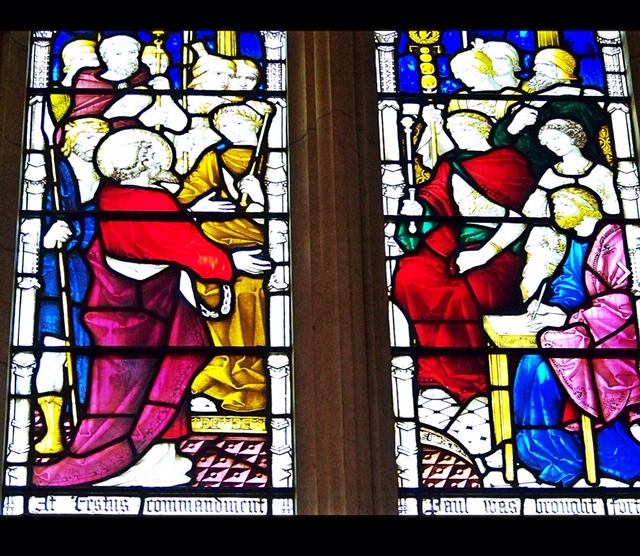
Window in St. Paul’s Cathedral, Melbourne – Paul Pleads His Case (Festus in yellow)

Today, in God’s Lavish Mercy, Paul’s case goes before Festus and King Herod Agrippa. Just in case you are confused, like I was, about just who this particular Herod is, this family tree from Wikipedia helped:

chart

This King Agrippa was Marcus Julius Agrippa II (A.D. 27-100), son of Agrippa I (Acts 12:1-25) and great-grandson of Herod the Great (Mt 2:1-23). 

I offer these facts for no real spiritual reason, but they remind me that these biblical characters were real people, like us, engaging (or not) a real life of faith. (Also, I thought it was fun to see how uncreative they were in naming their babies )


In our Gospel, Jesus once again prepares Peter for his tremendous responsibility in the building of that faith. Jesus asks Peter three times, “Do you love Me?”. By the third interrogation, Peter’s answer sounds a little intense:

“Lord, you know everything; you know that I love you.”

Hearing this response, Jesus lays the full burden of Peter’s life upon his shoulders. Not only must Peter “feed” the faith of Jesus’s followers, he must do so by giving over all control to God:

“Amen, amen, I say to you, when you were younger,
you used to dress yourself and go where you wanted;
but when you grow old, you will stretch out your hands,
and someone else will dress you
and lead you where you do not want to go.”

hand

Like Peter,
we too are given the gift and responsibility
of living a faithful life.
Like Peter, we all learn through the years,
that life comes to us in unexpected ways.
In reality, life often chooses us
rather than the other way around.


As we pray with these passages, we might want to look back over our lives for those points where life challenged or unbalanced us. What unexpected blessings came from those surprises/shocks? When God’s plan contradicted our own, how were we eventually blessed with courage, hope, gratitude, and insight?

We are the person we are today because of how we responded to God’s mysterious plan for our lives. Did we reach out our hand and let God lead us? Do we still need to do some letting go in order to enjoy that kind of freedom?


Rather than a poem today, I will be offering second post. It is a reflection I wrote many years ago for healthcare ministers and other chaplains. I think you might enjoy it. Watch for it later today – “Holding Hands with God”


Music:  Precious Lord, Take My Hand – written by Thomas A. Dorsey, sung here by the Great Mahalia Jackson

When my way groweth drear

Precious Lord, linger near-ear

When my li-ight is almost gone

Hear my cry, hear my call

Hold my ha-and lest I fa-all

Take my hand, precious Lor-ord

Lead me on

Precious Lord, take my hand

Lead me on, let me sta-and

I am tired, I’m weak, I am worn

Through the storm, through the night

Lead me on to the li-ight

Take my ha-and, precious Lor-ord

Lead me home

When my work is all done

And my race here is are you-un

Let me see-ee by the light

Thou hast shown

That fair city so bright

Where the lantern is the li-ight

Take my ha-and, precious Lor-ord

Lead me on

Precious Lord, take my hand

Lead me on, let me sta-and

I am tired, I’m weak, I am worn

Through the storm, through the night

Lead me on to the li-ight

Take my ha-and, precious Lor-ord

Lead me home

Thursday of the Seventh Week of Easter

June 2, 2022

Today, in God’s Lavish Mercy, as we continue to read Jesus’s loving dialogue with his Father, we become the silent listener to an intimate conversation.

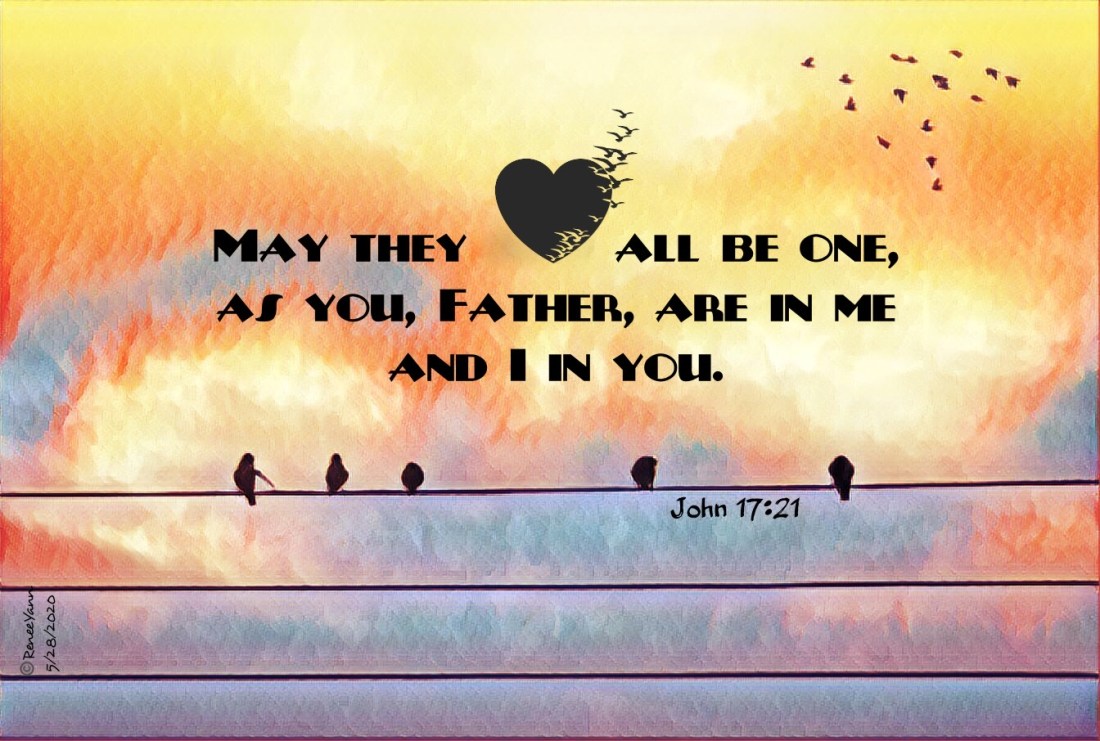
Jn17_21 all one

As I prayed with this passage, the memory of my own conversations with my mother came back to me. Many of these exchanges took place in person, but what I remembered today was our daily evening phone calls late in her life.

The calls were brief, but unflinchingly regular – 7PM every night. The exchanges were  very simple and almost formulaic: were we both OK, slept well, had a good day, had what for dinner, endured whatever weather….did we need anything?

But the real conversation was deep under any formula. It was the silent language of love, comfort, hope, trust, fidelity, and presence.  It was the unspoken assurance that we were, and would always be, FOR each other.


In John 17, we find the same kind of conversation between Jesus and his Father.

  • You and I are one
  • You have gifted me with your essence
  • You have empowered me in your Name
  • You have always loved me
  • I know your heart 
  • and I am grateful

What a privilege to listen to God’s conversation! In our prayer today, we may just want to witness silently the infinite love between Jesus and the Father. As Jesus prays for us to be incorporated into that love, may our hearts overflow in gratitude.


Poetry: Presence – by Rumi

Your grief for what you’ve lost holds a mirror up
To where you’ve been bravely working.
Expecting the worst, you look and instead,
Here’s the joyful face you’ve been wanting to see.
Your hand opens and closes
And opens and closes.
If it were always a fist
Or always stretched open,
You would be paralyzed.
Your deepest presence is in every small
Contracting and expanding—
The two as beautifully balanced and coordinated
As bird wings.

Music: I Just Called fo Say I Love You – Stevie Wonder

Mom and I loved this song because it so clearly described our relationship. I still sing it to her sometimes… loooong distance for sure now! I think it’s a song we could easily share with God in our prayer.

Wednesday of the Seventh Week of Easter

Memorial of St. Justin, Martyr
June 1, 2022

Today, in God’s Lavish Mercy, Jesus and Paul continue their heart-wrenching farewell addresses.

We’ve become accustomed to the passages and may read them without much emotional investment, but honestly they are real “weepers” – like movies where you have to bite the edge of your popcorn cup to keep from sobbing out loud.


paul-s-farewell-to-ephesian-elders-sacred-biblical-history-old-new-testament-two-hundred-forty-images-ed-st-69560609
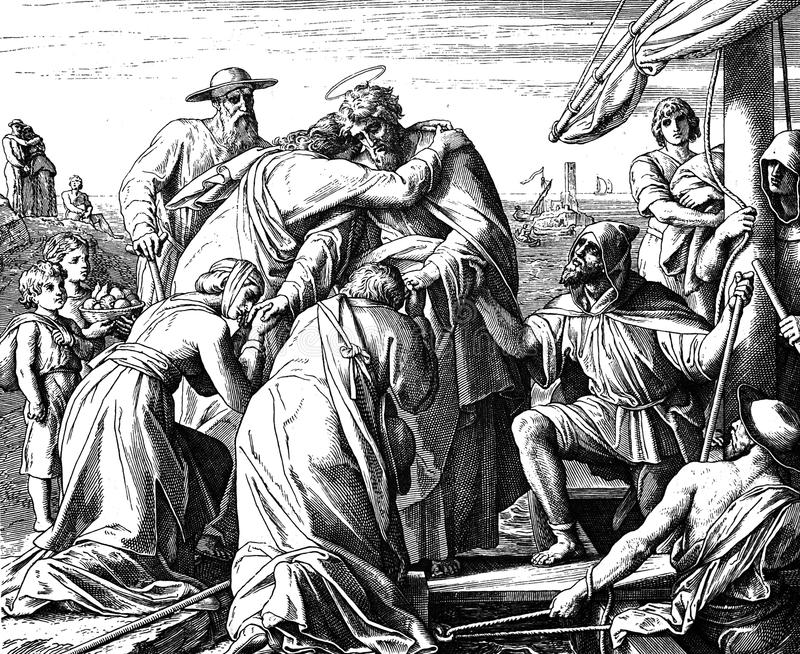
St. Paul Bids Farewell to the Ephesians

Look at Acts, for example, and put yourself in the scene:

When Paul had finished speaking
he knelt down and prayed with them all.
They were all weeping loudly
as they threw their arms around Paul and kissed him,
for they were deeply distressed that he had said
that they would never see his face again.
Then they escorted him to the ship.

Acts 20: 36-38

blessing

The verses from John are not quite so emotional, but picture yourself being prayed over like this. You sense that this is really a final blessing. You know these may be some of Christ’s last words you will ever hear.

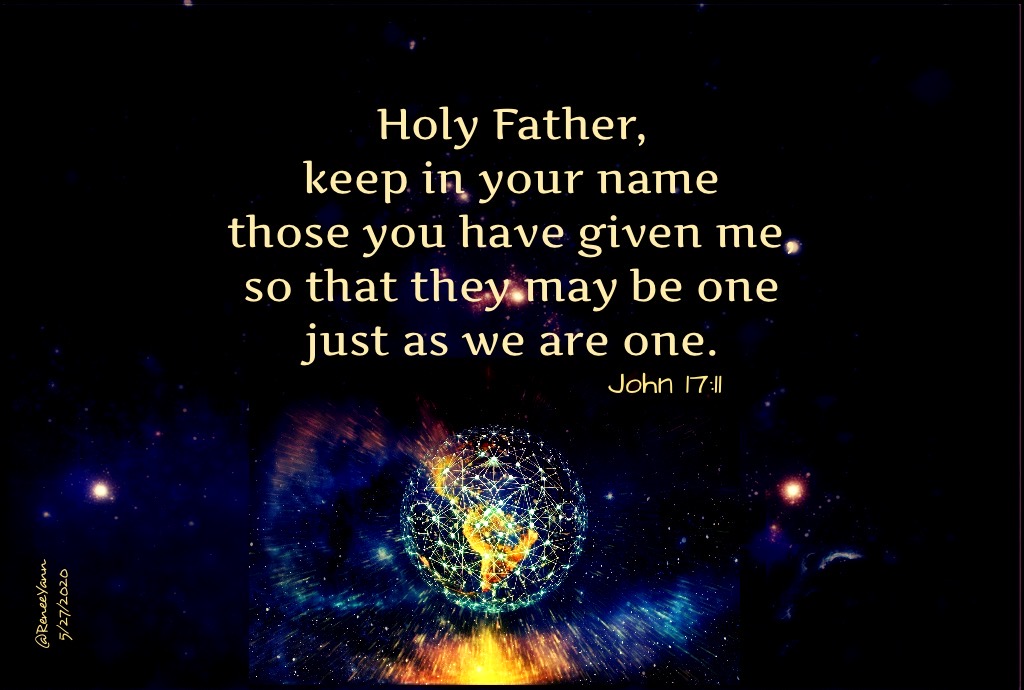
Holy Father, keep them in your name
that you have given me,
so that they may be one just as we are one.

John 17: 11

As we pray with today’s scriptures,
we are reminded that
goodbyes are awfully hard.
We need to mourn them
within a community of faith
lest our hearts break
from their weight. 


So many of us, in these sorrowful times, feel the deep pain of those suffering senseless violence and unprovoked war. We can only imagine the loss of bereaved families in Buffalo, NY and devastated parents and children in Uvalde, TX. We feel anger and horror at the suffering of the Ukrainian people.

In the throes of such pain, we need to tell one another the stories of our loved ones, to sing together our belief in eternal life, to prove that we can still find joy in kept memories, to cry at the sight of one another’s tears, and to act for justice in the name of one another’s suffering. This is what Jesus did.

Jn17_11 keep

Let us find courage and sustaining hope in the core of Jesus’s message today:

Father, now I am coming to you.
I speak this in the world

so that those you have given me
may share my joy completely.

All that we love, and may seem to have lost, is preserved and transformed – complete and joyful – in the infinite love of God. 

We too can be there in our prayer. We may be shaken by loss, but we are confident in faith. We know and believe that we are all kept in God’s Name. That faith gives us the power to transform our wounded world.


Poetry: Hymn for the Hurting – By Amanda Gorman
Ms. Gorman is a poet and the author of “The Hill We Climb,” “Call Us What We Carry” and “Change Sings.”


Everything hurts,
Our hearts shadowed and strange,
Minds made muddied and mute.
We carry tragedy, terrifying and true.
And yet none of it is new;
We knew it as home,
As horror,
As heritage.
Even our children
Cannot be children,
Cannot be.

Everything hurts.
It’s a hard time to be alive,
And even harder to stay that way.
We’re burdened to live out these days,
While at the same time, blessed to outlive them.

This alarm is how we know
We must be altered —
That we must differ or die,
That we must triumph or try.
Thus while hate cannot be terminated,
It can be transformed
Into a love that lets us live.

May we not just grieve, but give:
May we not just ache, but act;
May our signed right to bear arms
Never blind our sight from shared harm;
May we choose our children over chaos.
May another innocent never be lost.

Maybe everything hurts,
Our hearts shadowed & strange.
But only when everything hurts
May everything change.


Music: Aaronic Benediction – Misha and Marty Goetz

Feast of the Visitation

May 31, 2022

A “Women’s Feast”?

Today, in God’s Lavish Mercy, we celebrate the Feast of the Visitation, when a newly-pregnant Mary travels to be with her shockingly pregnant older cousin, Elizabeth. Although a universal feast, it is certainly a feast for women to treasure.

The Carmignano Visitation, a unique masterpiece by one of sixteenth-century Italy’s greatest painters, Jacopo da Pontormo (1494-1557)

The Gospel is replete with the quiet but powerful understandings women share with one another:

  • the haste to support one another
  • the blessing and bolstering of each other’s faith
  • the shared joy to cause a baby’s leap in the womb
  • the desire for mercy and justice for the suffering
  • the “staying with” until need’s end

Of course, men too experience many of these holy sensibilities, but today most certainly invites women to celebrate the gifts of God within their bodies, minds and spirits.

Perhaps we might pray on these things while watching this movie clip of the imagined scene:


Poetry: Two poems to honor the two blessed women of this scene

The Visitation by Joyce Kilmer
(For Louise Imogen Guiney)

There is a wall of flesh before the eyes
Of John, who yet perceives and hails his King.
It is Our Lady’s painful bliss to bring
Before mankind the Glory of the skies.
Her cousin feels her womb’s sweet burden rise
And leap with joy, and she comes forth to sing,
With trembling mouth, her words of welcoming.
She knows her hidden God, and prophesies.
Saint John, pray for us, weary souls that tarry
Where life is withered by sin’s deadly breath.
Pray for us, whom the dogs of Satan harry,
Saint John, Saint Anne, and Saint Elizabeth.
And, Mother Mary, give us Christ to carry
Within our hearts, that we may conquer death.

Visitation Villanelle by Sarah O’Brien

She came to me, the mother of my Lord,
and grinned with amazement at the sight.
All creation with me seemed to roar.
Grey haired, belly swollen like a gourd,
I stood to kiss her in the morning light.
She came to me, the mother of my Lord.
Her voice, as she crossed the threshold of my door,
rang through my womb –  from a great height,
all creation with me seemed to roar.
The baby leapt – tethered only by the cord.
The joy coursing through us! I shouted outright.
She came to me, the mother of my Lord.
Already she faced her share of the sword
She who believed all God said would be, might –
All creation with me seemed to roar.
Blessed one! With your yes you moved us toward
the home we long for, and all things made right.
She came to me, the mother of my Lord.
All creation with me seemed to roar.

Music: Also two selections for this wonderful Feastday:

Ave Maria (Schubert) sung in German, as Schubert wrote it, by the incomparable Marian Anderson


Magnificat (Bach) 
Imagine composing this powerful first movement based on only a single word: “Magnificat

Monday of the Seventh Week of Easter

May 30, 2022

Today , in God’s Lavish Mercy, we read in Acts about Baptism in the Spirit and the powers it bestows. When Paul encounters some believers who have received the Baptist’s rite of repentance, he asks if they had received the Holy Spirit.

Their simple answer kind of amuses me:

We’ve never even heard of him!

Paul remedies the situation with a few quick sacramental steps and:

… they were baptized in the name of the Lord Jesus.
And when Paul laid his hands on them,
the Holy Spirit came upon them,
and they spoke in tongues and prophesied.


When I read passages like this, I sometimes wonder what has happened in the millennia since those early Spirit-filled Baptisms… since the days when the Holy Spirit seems to have burst out all over in flames, wonders and eloquence.

battery

Has the Holy Spirit changed? Diminished? Is Her battery running low? Or have we changed … the Church and we members who comprise it?

I guess we all know the answer, given our faith in a changeless God.


So why doesn’t the Holy Spirit blaze for us as She did for those twelve Ephesians in today’s reading?

I think it’s a matter of how we see, and listen. 

Sir John Lubbock, a 19th century scientist and polymath wrote this:
“What we see depends mainly on what we look for. … In the same field the farmer will notice the crop, the geologists the fossils, botanists the flowers, artists the colouring, sportmen the cover for the game. Though we may all look at the same things, it does not all follow that we should see them.”

John Lubbock, The Beauties of Nature and the Wonders of the World We Live In

Might not this wisdom apply as well to how we perceive the Spirit in our lives?

If in our daily experiences and interactions, we remain on a superficial, distracted relationship with what is sacred in all Creation, then we – like the fellows in our reading – may “never even hear” of the Holy Spirit.

But if, by prayer and contemplation, we open ourselves to what is holy in everything around us, then what we see and hear, what we feel and respond to begins to change — to catch fire.

Hopkins_wings


During this week leading up to Pentecost, we might try this practice: let’s look more intensely for the Spirit in our daily lives by noticing the presence (or absence) of the Spirit’s gifts.

  • How are our choices, conversations, judgements, reactions reflective of these gifts?
  • In my experiences each day, what persons or circumstances have mirrored these gifts? What has overshadowed or eradicated them?

The Holy Spirit’s heart beats alive and well within all Creation. I might just need to dust off my stethoscope a bit to hear it! Maybe this beautiful poem will help.

God’s Grandeur- Gerard Manley Hopkins, SJ

The world is charged with the grandeur of God.
It will flame out, like shining from shook foil;
It gathers to a greatness, like the ooze of oil
Crushed. Why do men then now not reck his rod?
Generations have trod, have trod, have trod;
And all is seared with trade; bleared, smeared with toil;
And wears man’s smudge and shares man’s smell: the soil
Is bare now, nor can foot feel, being shod.
And for all this, nature is never spent;
There lives the dearest freshness deep down things;
And though the last lights off the black West went
Oh, morning, at the brown brink eastward, springs —
Because the Holy Ghost over the bent
World broods with warm breast and with ah! bright wings.

Meditation: God’s Grandeur- read so beautifully by Samuel West