Sister Renee Yann, RSM, D.Min, is a writer and speaker on topics of spirituality, mission, and ethical business practice. After twenty years in teaching and social justice ministry, she served for over thirty years in various mission-related roles in Mercy Health System of Southeastern Pennsylvania.
… people brought to Jesus a paralytic lying on a stretcher. When Jesus saw their faith, he said to the paralytic, “Courage, child, your sins are forgiven.”
This passage describes a situation found in just a few of Jesus’s miracles. The miracle occurs because of the intervention of others, not the one in need. When Jesus sees the faith of those who carried this young man, his Infinite Mercy was moved.
It seems that perhaps the afflicted person had lost hope. It was his friends who hoped – his friends who carried him. What a gift it is to have friends who will stand by you in life’s sometimes crippling circumstances. What a blessing to have companions who see your salvation when you have lost the vision!
Acting on the faith of these steadfast friends, Jesus tells the paralytic to reach down into his soul and recover the courage that will make him whole.
Today, in God’s Lavish Mercy: We pray to be faithful friends like the ones described in this passage. We pray in gratitude for those who are such friends to us.
Thought:
There is nothing on earth more to be prized than true friendship.
So the other disciples said to him, “We have seen the Lord.” But Thomas said to them, “Unless I see the mark of the nails in his hands and put my finger into the nailmarks and put my hand into his side, I will not believe.” John 20:25
There’s that tiny word for which, despite a magnanimously holy life, Thomas remains famous:
Unless …
At that particular moment in his life, Thomas’s faith was conditional. He would not believe Jesus was alive unless he saw and touched him.
I doubt that Thomas was alone in his “conditionality”. The faith of many of those scared disciples was probably a bit shaky. Thomas was just more forthcoming in his doubts and hadn’t, like some of them, already seen the Risen Lord.
Today, in God’s Lavish Mercy:
We all know what it’s like to have doubts – about big things, like our faith, and about little things like our appearance. It feels like we’re being dropped into a safety net that might have a hole in it. Will it hold, or will it fall through? And what happens to us in either case!
Decades ago, when I taught eighth grade, one of my brightest students asked me this: “Sister, you’ve dedicated your whole life for the faith. What if, in the end, there is no God or heaven?”
I’m not going to tell you my answer. I’m going to suggest that you consider what your own answer would be. Is your faith conditional or unconditional?
Poetry: St. Thomas the Apostle – Bishop Edward Henry Bickersteth (1825-1906)
The Paschal feast was ended. Multitudes,
Unweeting what was done, that day had left
The gates of Zion for their far-off homes;
And there was silence, where but yesterday
Had been the hum of thousands. Olivet
Slept calmly underneath the waning moon,
And darkening shadows fell across the steeps
And hollows of Jerusalem. Deep night
Had drench'd the eyes of thousands. But, behold,
Within the upper room where Jesus broke
The bread of life, and pour'd the mystic wine
The night before He suffer'd, once again
The little band of those who loved Him most
Were gather'd. On the morrow morn they thought
To leave the holy city, holier now
Than ever in their eyes, and go to meet
Their Lord upon the Galilean hill.

All bosoms swell'd with gladness, all save one;
One heart amid that group of light and love
Was desolate and dark: nine weary days
Of doubt, which shadow'd all eternity,
Had written years of suffering on his brow.
The worst he fear'd to him was realized,
Life quench'd, for ever quench'd, and death supreme.
Jesus was dead. And vainly others told,
How they had seen and heard their risen Lord;
Himself had seen the lifeless body hang
Upon the cross; and, till he saw like them
And like them touch'd the prints in hands and side,
He would not, for he could not, hope again.

But there has been enough of sorrow now
For that true mourner, sorely tried but true:
And as they communed of an absent Lord
Jesus was there, though doors were shut and barr'd,
There in the midst of them; and from His lips,
Who is Himself our Peace, the words of peace
Fell as of old like dew on every heart,
But surely sweetest, calmest, tenderest
On one most torn and tost. The waves were still;
Day broke; the shadows fled: nor this alone,
Love offer'd all which bitterest grief had ask'd,
And laying bare the inly bleeding wound
Heal'd it, which haply else had bled afresh
In after years, till faith adoring claim'd
In One, whom sense no longer sought to touch,
The Lord of life, the everlasting God.

O Master, though our eyes have never look'd
Upon Thy blessèd face and glorious form,
Grant us to trust Thee with a perfect trust,
And love Thee and rejoice in Thee unseen,
And prove the heaven of Thy beatitude
On those who, though they see Thee not, believe.
Music: When I Survey The Wondrous Cross – Keith & Kristyn Getty
Sometimes a reading will be repeated rather quickly in the Liturgy. Such is the case with today’s Gospel which we read on June 23. So, I may be being a little lazy, but I too have repeated the reflection. I think it might be worth a second glance. 😉
A violent squall came up and waves were breaking over the boat, so that it was already filling up. Jesus was in the stern, asleep on a cushion. They woke him and said to him, “Teacher, do you not care that we are perishing?” He woke up, rebuked the wind, and said to the sea, “Quiet! Be still!” The wind ceased and there was great calm. Then he asked them, “Why are you terrified? Do you not yet have faith?” Mark 4:37-40
Many years ago, at a particularly critical crossroad in my life, a revered mentor rescued me. She did it with a simple phrase, “Do not go down under this wave.”
Her counsel challenged me stand up and reach for my faith, despite having been knocked down by gross misjudgment. Her confidence led me to realize that with faith we can find God within our circumstances, releasing a power we may not have recognized before.
In today’s passage, Jesus urges his disciples to live this kind of faith. God is with them, even when seemingly asleep. Fully trusting that Presence will allow their lives to unfold in peace, despite any passing storm. And yes, all storms are passing. 🙂
Poetry: I Go Down to the Shore – Mary Oliver
I go down to the shore in the morning
and depending on the hour the waves
are rolling in or moving out,
and I say, oh, I am miserable,
what shall—
what should I do? And the sea says
in its lovely voice:
Excuse me, I have work to do.
A scribe approached and said to him, “Teacher, I will follow you wherever you go.” Jesus answered him, “Foxes have dens and birds of the sky have nests, but the Son of Man has nowhere to rest his head.” Another of his disciples said to him, “Lord, let me go first and bury my father.” But Jesus answered him, “Follow me, and let the dead bury their dead.” Matthew 8: 19-22
The scribe. What was Jesus driving home to this learned interpreter of the Law who now bursts with enthusiasm for discipleship? Perhaps Jesus looked up to a small nest in a nearby tree. Maybe he pointed to it and told the scribe, ” You have to spread your wings and fly with God if you follow me!”
Basically, I think Jesus is saying this:
Think about it. It’s a way very different from your present comfortable life.
We are itinerant preachers, going out to the whole world. We are not intrenched in the Law, commanding people to come to us.
Even the core responsibilities to which you are devoted will be secondary to your Gospel ministry.
The whole foundation of your life will be turned upside-down.
Today, in God’s Lavish Mercy:
We want to serve God by living the Gospel with a steadfast and enthusiastic heart. We pray for the grace and courage to do so, understanding clearly where our first responsibilities lie as a committed Christian.
Prose from: The Wisdom of the Carpenter by Ron Miller
Jesus walked the earth as a homeless vagrant and identified his disciples by their concern for the most marginalized people in the community. It’s such a simple criterion and yet one so easily forgotten. Daily Prayer: Help me to be especially attentive to You today in those who have so little of the world’s wealth.
Music: He Had Not Where To Lay His Head Score: Alison Willis Text:Frances Ellen Watkins Harper (1825 – 1911)
There was a woman afflicted with hemorrhages for twelve years. She had suffered greatly at the hands of many doctors and had spent all that she had. Yet she was not helped but only grew worse. She had heard about Jesus and came up behind him in the crowd and touched his cloak. She said, “If I but touch his clothes, I shall be cured.” Immediately her flow of blood dried up. She felt in her body that she was healed of her affliction. Matthew 5:25-29
After praying with this passage from Mark, I wrote this homily almost a decade ago. I liked it very much. And even though it is long, I thought some of you might like to read it or to pray with it this Sunday.
One of my favorite voices from the 50s and 60s, Sam Cooke is considered one among the greatest R&B artists of all time. Some of you may recall his pop hits like “You Send Me” and “Twisting’ the Night Away”.
Early in his career, he sang with a Gospel group, the Soul Stirrers.
In 1950, Cooke replaced gospel tenor R. H. Harris as lead singer of his gospel group The Soul Stirrer. Their first recording under Cooke’s leadership was the song “Jesus Gave Me Water” in 1950. They also recorded the gospel songs “Peace in the Valley”, “How Far Am I from Canaan?”, “Jesus Paid the Debt” and “One More River”, among many others, some of which he wrote. Cooke was often credited for bringing gospel music to the attention of a younger crowd of listeners, mainly girls who would rush to the stage when the Soul Stirrers hit the stage just to get a glimpse of him. (Wikipedia)
I, Paul, am already being poured out like a libation, and the time of my departure is at hand. I have competed well; I have finished the race; I have kept the faith. From now on the crown of righteousness awaits me, which the Lord, the just judge, will award to me on that day, and not only to me, but to all who have longed for his appearance. 2 Timothy 4:6-8
Jesus said to his disciples, “But who do you say that I am?” Simon Peter said in reply, “You are the Christ, the Son of the living God.” Jesus said to him in reply, “Blessed are you, Simon son of Jonah. For flesh and blood has not revealed this to you, but my heavenly Father. And so I say to you, you are Peter, and upon this rock I will build my Church, and the gates of the netherworld shall not prevail against it. Matthew 16:15-18
We remember and celebrate these two great pillars of the Church. In some ways, the long passage of the years has turned each of them into figures bigger than life. Their memory is enthroned throughout the world in sculptures and cathedrals.
Our readings today remind us that they were simple people, like you and me – a fisherman and a tent maker. Their faith, while unshakeable, was tested beyond human strength. But by their believing, God’s strength became theirs.
Today, in God’s Lavish Mercy: We pray to have a simple, resolute faith like Peter and Paul. Like them, we will see God work miracles by the power of such faith.
Two Poems today.
St. Peter – Malcolm Guite Impulsive master of misunderstanding You comfort me with all your big mistakes; Jumping the ship before you make the landing, Placing the bet before you know the stakes. I love the way you step out without knowing, The way you sometimes speak before you think, The way your broken faith is always growing, The way he holds you even when you sink. Born to a world that always tried to shame you, Your shaky ego vulnerable to shame, I love the way that Jesus chose to name you, Before you knew how to deserve that name. And in the end your Saviour let you prove That each denial is undone by love.
Apostle – Malcolm Guite An enemy whom God has made a friend, A righteous man discounting righteousness, Last to believe and first for God to send, He found the fountain in the wilderness. Thrown to the ground and raised at the same moment, A prisoner who set his captors free, A naked man with love his only garment, A blinded man who helped the world to see, A Jew who had been perfect in the law, Blesses the flesh of every other race And helps them see what the apostles saw; The glory of the lord in Jesus’ face. Strong in his weakness, joyful in his pains, And bound by love, who freed him from his chains.
Music: Solve Jubente Deo – William Byrd (1607)
Loosen by God’s command, Peter, the chains of the earth: thou who makest open the kingdom of heaven to the blessed, Alleluia.
When Jesus came down from the mountain, great crowds followed him. And then a leper approached, did him homage, and said, “Lord, if you wish, you can make me clean.” He stretched out his hand, touched him, and said, “Of course I will do it. Be made clean.” Matthew 8:1-3
This leper, this beautiful soul, trusts that Jesus’s wish is the same as his own. He wants to be clean, to be free of all that may tarnish a life as one passes through the years. And Jesus does share the leper’s wish. He transforms that “wish” into a “will” — “of course, I will do it!”.
Today, in God’s Lavish Mercy: As we look over our lives, perhaps we too carry a few unhealed pockmarks or scars. These may be past grudges, unforgivenesses, or harbored hurts. They may be a current resistance of heart, an indifference to need, an unexamined selfishness.
Like the leper, we may long to be free of any canker that we have carried too long. Jesus wills that for us too. Believing in, learning from, and imitating him is the path to healing.
Poetry: The Leper – John Newton (1725-1807)
Oft as the leper's case I read,
My own described I feel;
Sin is a leprosy indeed,
Which none but Christ can heal.
Awhile I would have passed for well,
And strove my spots to hide;
Till it broke out incurable,
Too plain to be denied.
Then from the saints I sought to flee,
And dreaded to be seen;
I thought they all would point at me,
And cry, Unclean, unclean!
What anguish did my soul endure,
Till hope and patience ceased?
The more I strove myself to cure,
The more the plague increased.
While thus I lay distressed, I saw
The Savior passing by;
To him, though filled with shame and awe,
I raised my mournful cry.
Lord, thou canst heal me if thou wilt,
For thou canst all things do;
O cleanse my leprous soul from guilt,
My filthy heart renew!
He heard, and with a gracious look,
Pronounced the healing word;
I will, be clean - and while he spoke
I felt my health restored.
Come lepers, seize the present hour,
The Saviour's grace to prove;
He can relieve, for he is pow'r,
He will, for he is love.
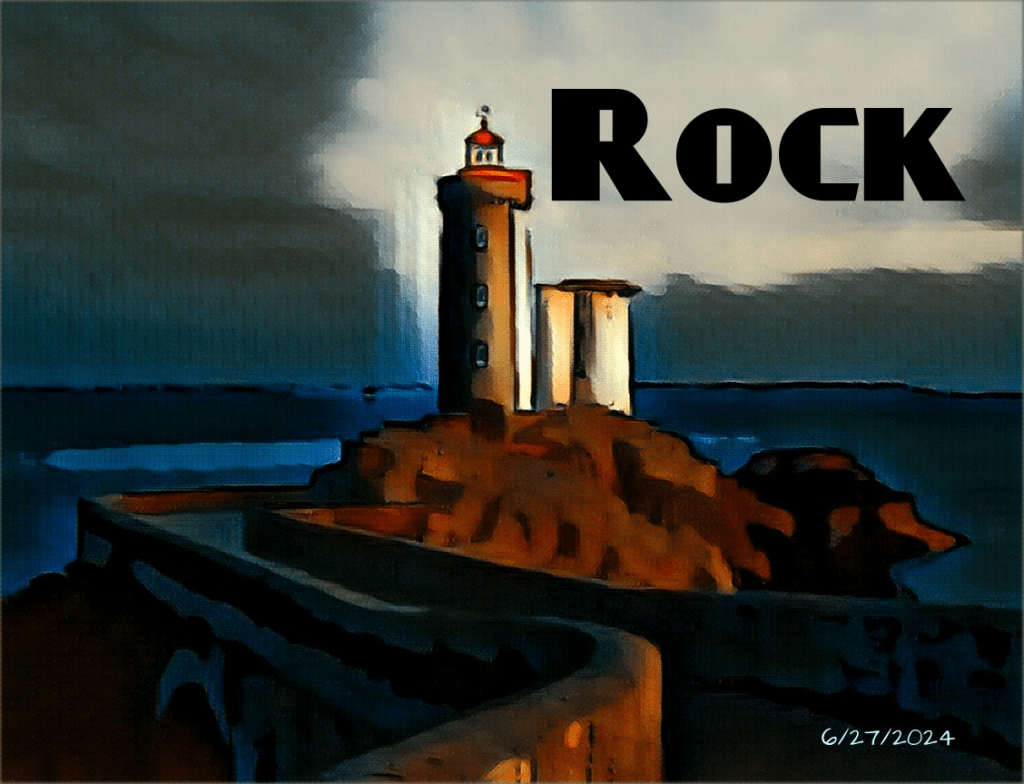
Everyone who listens to these words of mine and acts on them will be like a wise man who built his house on rock. The rain fell, the floods came, and the winds blew and buffeted the house. But it did not collapse; it had been set solidly on rock. Matthew 7:24-25
When the storm comes, who doesn’t want their house to be built on rock – steady, constant, imperturbable ROCK! But take a good look at the picture above. How hard do you think it was for the builders to:
penetrate that rock for a new foundation
transport and maintain building materials on to that precipice
Jesus recognizes that such commitment is not easy, but the rewards are incomparable. He teaches the people that empty proclamations will not sustain a spiritual life. Such stability is achieved only by committed “building” – by opening ourselves to God’s word and acting on it.
Today, in God’s Lavish Mercy:
We pray for the courage and vision to sincerely engage God’s word by our actions for mercy and justice.
Poetry: Psalm 18 – interpreted by Christine Robinson
I open my heart to you, O God for you are my strength, my fortress, the rock on whom I build my life. I have been lost in my fears and my angers caught up in falseness, fearful, and furious I cried to you in my anguish. You have brought me to an open space. You saved me because you took delight in me.
I try to be good, to be just, to be generous
to walk in your ways.
I fail, but you are my lamp.
You make my darkness bright
With your help, I continue to scale the walls
and break down the barriers that fragment me.
I would be whole, and happy, and wise
and know your love
Always.
Music: O Lord, My Rock and My Redeemer – Prayers of the Saints Alive
A good tree cannot bear bad fruit, nor can a rotten tree bear good fruit. Every tree that does not bear good fruit will be cut down and thrown into the fire. So by their fruits you will know them. Matthew 7: 18-20
Jesus speaks these words to warn his followers about false prophets. These charlatans may be clothed in a gentle sheep’s skin, but inside they are voracious wolves consuming everything for their own gain. They are liars, thieves, cheats, and pretenders.
Yet many people trust and believe them. How can that be? Are we just too naive to see them for what they are? Maybe. But I think it’s more likely that we want to believe their lies because we think we will benefit from them. We excuse their cheating and veiled thievery because it hasn’t hurt us, just the “other guy”. We espouse their pretenses because we mistakenly believe they will advance us as well as the “wolves”.
Jesus knows we’re not stupid. He says there is one clear and sure-fired way to identify a false prophet. By their fruits you shall know them – and those “fruits” should be the fruits of the Holy Spirit. If, despite the rotten fruit they have produced, we follow them then we will end up in the fire just like they will.
An image today instead of a poem
Music: Ubi Caritas – Where Love and Charity Abide, There is God




 Lavish Mercy