Have you ever been told not to get your hopes too high? The kind admonisher is trying to protect you. But you, like all human beings, still hope for everything, no matter the odds!
What would it be like if someone told us instead, “Hope for everything! The fulfillment of your hope is guaranteed!”
This is the jubilant assurance carried to us by the Word of God in the fourth week of Advent. • Luke tells us that God has indeed remembered his promise of mercy. • The eloquent Song of Songs guarantees us that the winter is past; that the rains are over and gone. • The psalmist encourages us to lift up our heads and see. Our salvation is near at hand.
After our prayerful Advent, we now stand at the threshold of the sacred, transforming Nativity. As we lift our eyes to behold this glorious God, what shall we see – a miracle, a change in the world around us?
Marianne Williamson, spiritual teacher and author, says this: “A miracle is just a shift in perception from fear to love.” The transformative change is within us, not around us.
As we open our hearts for the coming of Jesus, might we be surprised to see that nothing, yet everything is changed? Will we see Him now in the beggar we bypassed just a month ago? Will we sit gratefully beside Him now in the church where we had ignored our neighbors? Will we recognize Him fully now in an aging parent, a distressed spouse, a demanding child? Will we meet him now in our own peaceful silence where before we had obliterated him in a flurry of distractions?
“Behold your God!” is clearly an invitation to bask – awestruck – in Christ, the fulfillment of our hope. It is also a profound invitation to free ourselves of any graceless complacency which hides the ever-incarnate God from our daily sight.
Music: O Come – The Porter’s Gate
[Verse 1] For those who walk in darkness The sun is rising… rising, rising The shadow dies Our anguish flies From dawn on high Oh, Lord Jesus, come!
Oh, come! Oh, come!
[Verse 2] The yoke upon our shoulders Is finally breaking… breaking, breaking Our burdens gone In that bright dawn When He has come Oh, Lord Jesus, come!
Oh, come! Oh, come! Oh, come!
[Verse 3] The Son to us is given And we are waiting… waiting, waiting Emmanuel Oh Wonderful! Your peace to tell Oh, Lord Jesus, come!
For Your Reflection
What feelings or reactions do I have after reading this reflection?
Do my feelings or reactions remind me of any passage or event in scripture, especially in the life of Christ?
What actions might I take today because of my response to these readings?
Is there a difference between happiness and joy? Walking through the Med-Surge ward, the chaplain juggled that question. He had just left Betty whose test results had proven benign. Her reaction still echoed in his mind. Like someone awaking from a bad dream, she had said, “I am almost afraid to be happy!” But John, just across the corridor, was beyond happiness. In the slow diminishment of a terminal illness, John had told the chaplain, “It seems strange, but I have never been so joyful. In the busyness of my life before this, I had never realized how much I was loved.”
Coming to joy, even in the midst of challenge, is the perfection of the spiritual life. This week’s readings offer a syllabus for that journey. We find two great biblical figures visited by angels. Mary welcomes her angel somewhere within the humble routine of her day. She seems almost to be expecting the visit, already to have prepared a place for the Surprise of God. Presented with astonishing news, she simply asks God’s methods before bowing in graceful accord. Zechariah, on the other hand, receives his angel in the reserved sanctuary of the Temple. This angel disrupts the practiced rituals stabilizing Zechariah’s faith. Zechariah is startled, skeptical – afraid to be happy.
During this week, as we listen to scripture’s angels, may we hear their call to joyous freedom. May we delight in the prophet Zephaniah’s image of God Who, replete with divine joy, sings over us with gladness. Each day, we are visited by angels. Will they find in us the advent-heart of Mary, open to the wonder of the Holy Spirit? Or will they find us petrified in practices and protocols born of fear? The core of all deep healing lies in this: can we help people find their joy? Can we find our own? The answer begins in the recognition that, despite any contradiction of circumstance, we are infinitely loved.
Music: Handel: The Triumph of Time and Truth, HWV 71: “Guardian Angels, Oh, Protect me”
Guardian angels, oh, protect me, And in Virtue’s path direct me, While resign’d to Heav’n above. Let no more this world deceive me, Nor let idle passions grieve me, Strong in faith, in hope, in love. Guardian angels. . .
For Your Reflection
What feelings or reactions do I have after reading this reflection?
Do my feelings or reactions remind me of any passage or event in scripture, especially in the life of Christ?
What actions might I take today because of my response to these readings?
Blessed are you, holy Virgin Mary, deserving of all praise; from you rose the sun of justice, Christ our God. Alleluia Verse: Feast of Our Lady of Guadalupe
There are a few places where nature offers a darkness so absolute that it can be terrifying. Assateague Island lies along the barrier coast of Virginia. On a winter night, darkness there feels complete, enveloping. As evening lengthens, night pulls its velvet canopy from the black ocean, covering the beach in silence.
The whisper of rustling sea oats along invisible dunes is the only link to a land left behind. But slowly, like sparks rolling through dry tinder, stars burn one by one through heaven’s blanket. By midnight, their incomparable brilliance convinces the soul that it has never been and can never be alone.
During this second week of Advent, which includes the feasts both of the Immaculate Conception and Our Lady of Guadalupe, we are continually assured that we are not alone. Mary, First Among the Redeemed, rises like an evening star in the long story of salvation history. She begins a motherhood for Jesus and, in so doing, becomes our Mother too.
Like all maternities, Mary’s was a gradual awakening to the Life she bore within her. In this week’s readings, we see her absorb the angel’s stunning announcement into the immensity of her faith. We see her begin to prepare, in the confines of her humble life, a dwelling for Infinity. We see her labor to introduce God’s extraordinary secret into the ordinary dimensions of her life. We see her carry Incarnate Grace into the disrupted world of her cousins Elizabeth and Zechariah, anointing them with the blessing of her faith-filled Magnificat.
Boticelli: Madonna of the Magnificat
As we pray with Mary this week, let us hold all mothers in our hearts. Certainly, we hold our own mothers, whether in presence or in memory. May our prayer embrace all single mothers, unwilling mothers, refugee mothers, mothers so overburdened by poverty that they cannot enjoy the blessing of their children. We include all mothers, sick with any form of illness in body, mind or spirit. May any darkness these mothers face be lifted by the gracious hand of Mary who intimately knows their hearts and circumstances.
Mary visits each of us with the same unbounded joy she brought Elizabeth in that ancient Advent. She teaches us the profound yet simple secret of her holiness: that she understood her life to be a sacred channel for God. As we prayerfully wait with our blessed Mother for Christ to be born, may we listen in the darkness for her maternal lessons.
Music: Magnificat – Johann Pachelbel
For Your Reflection
What feelings or reactions do I have after reading this reflection?
Do my feelings or reactions remind me of any passage or event in scripture, especially in the life of Christ?
What actions might I take today because of my response to these readings?
On that day, the Lord will bind up the wounds of His People. Isaiah 30:26
Today, we will begin the sacred season of Advent. It is a time of miracles, and we do not want to miss them because of our Yuletide distractions. Let me tell you a story about someone who longs for such miracles.
Christine is a beautiful woman, inside and out. She is as vital as fresh air or summer sun. She is successful, strong, sincere and faith-filled. But her heart is a fragile hidden glass, ready to break at any moment, because her beloved son is a heroine addict. Johnny lives in a tidal darkness beyond the shore of her sustaining light. Like spilled ink, that darkness regularly invades her joy and conspires to steal her hope.
Spiritual darkness holds a profound contradiction. It is the place where we may be deeply lost but even more deeply found. It is an interior tunnel through which every person walks at least once in her life, the deep chasm from which Isaiah pointed to the distant mountaintop.
During the thrilling season of Advent, we step out into the land of promises and prophets. The language of hope unfurls in a galaxy across the heavens, calling us out of darkness toward an Infinite and Incarnate Light. In this first week’s glorious readings, the prophet Isaiah points to our salvation, star by prophetic star: • There is a Day coming, he tells us, and on that Day, the Lord will bind up the wounds of his people. • In a very little while, he tells us, Lebanon will be changed. A shoot shall sprout from the tree we had thought to be withered. • On this very mountain, he tells us, we will behold our God.
For all of us who, like Christine, carry human sorrow in the shadowed valleys of our spirits, there is healing on the near horizon. The Daystar of Jesus Christ is about to dawn through the darkness. God is about to put on the very humanness that is our burden and transform it into glory. Let us begin, with an eager faith, to enter the divine mystery being sung among the stars.
Music: Darkness and Light – Harald Hauser
For Your Reflection:
What feelings or reactions do I have after reading this reflection?
Do my feelings or reactions remind me of any passage or event in scripture, especially in the life of Christ?
What actions might I take today because of my response to these readings?
Suggested Scripture:Readings for the First Sunday of Advent
As we draw close to the Holy Season that will close our year, let’s welcome each final day as an extraordinary gift, grateful for the faith, hope, and love that sustain our lives.
Music: “Your Love” from “Once Upon A Time in the West” ” – by Ennio Morricone – performed by Hauser
For Your Reflection:
What feelings or reactions do I have after reading this reflection?
Do my feelings or reactions remind me of any passage or event in scripture, especially in the life of Christ?
What actions might I take today because of my response to these readings?
Today, in God’s Lavish Mercy, on this Christmas Eve and Fourth Sunday of Advent, we are blessed with the iconic reading from Luke:
The moment of Annunciation …. where history pivots on a woman’s willingness for God
The angel Gabriel was sent from God to a town of Galilee called Nazareth, to a virgin betrothed to a man named Joseph, of the house of David, and the virgin’s name was Mary. And coming to her, he said, “Hail, full of grace! The Lord is with you.” But she was greatly troubled at what was said and pondered what sort of greeting this might be. Then the angel said to her, “Do not be afraid, Mary, for you have found favor with God.
“Behold, you will conceive in your womb and bear a son, and you shall name him Jesus. He will be great and will be called Son of the Most High, and the Lord God will give him the throne of David his father, and he will rule over the house of Jacob forever, and of his kingdom there will be no end.” But Mary said to the angel, “How can this be, since I have no relations with a man?” And the angel said to her in reply, “The Holy Spirit will come upon you, and the power of the Most High will overshadow you. Therefore the child to be born will be called holy, the Son of God. And behold, Elizabeth, your relative, has also conceived a son in her old age, and this is the sixth month for her who was called barren; for nothing will be impossible for God.” Mary said, “Behold, I am the handmaid of the Lord. May it be done to me according to your word.” Then the angel departed from her.
Luke 1:26-38
Poetry: The Blessed Virgin Compared to the Air We Breathe – Gerard Manley Hopkins
Wild air, world-mothering air,
Nestling me everywhere,…
Minds me in many ways
Of her who not only
Gave God’s infinity
Dwindled to infancy
Welcome in womb and breast,
Birth, milk, and all the rest
But mothers each new grace
That does now reach our race…
And makes, O marvellous!
New Nazareth in us,
Where she shall yet conceive
Him, morning, noon, and eve;
New Bethlems, and he born
There, evening, noon, and morn…
Be thou then, O thou dear
Mother, my atmosphere;
My happier world, wherein
To wend and meet no sin…
Stir in my ears, speak there
Of God’s love, O live air,
Of patience, penance, prayer:
World-mothering air, air wild,
Wound with thee, in thee isled,
Fold home, fast fold thy child.
(Today, the Church repeats the King O Antiphon. But I love the concept of Christ as Radiant Dawn. It also fits so clearly with the sacred purifications alluded to in today’s readings.)
Today, in God’s Lavish Mercy, we have finally reached the “delivery” stage of Advent. Just like those Amazon packages that keep showing up on doorsteps in the days preceding Christmas, other important arrivals are popping up in our readings.
Malachi announces that a prophet is coming who will purify the people, particularly concerning their worship practices which have corrupted:
Thus says the Lord GOD: Lo, I am sending my messenger to prepare the way before me; And suddenly there will come to the temple the LORD whom you seek, And the messenger of the covenant whom you desire. Yes, he is coming, says the LORD of hosts.
It seems that Malachi and his friends, perhaps like some of us, haven’t had the discipline and devotion to safeguard the Temple rituals. Maybe like Mal and the gang, we start to take things for granted, to become cavalier about liturgical intention, to cut corners, to program our own agendas into the sacred rituals of common prayer. — to forget that God is the center of worship, not us.
Becoming that “forgetful” hardens the heart to grace. The One Who longs to encounter us in prayer and worship is stymied by our distracted negligence.
Our Gospel, too, is reminiscent of a sanctuary scene, for it was there that Zechariah learned that a prophet was actually going to be his son! Zechariah encountered God’s Word purifying his life and directing it in a totally unexpected manner. Surely, in the ensuing nine months of silence, the essence of Zechariah’s worship was transformed.
In today’s reading, the incredulous neighbors at John’s bris question Elizabeth’s assignment of such an unfamiliar name. But Zechariah confirms Elizabeth’s declaration. Zechariah’s purification and graceful evolution are complete. His tongue is loosened to proclaim the Word God has spoken in his silent heart.
“There is no one among your relatives who has this name.” So they made signs, asking his father what he wished him to be called. He asked for a tablet and wrote, “John is his name,” and all were amazed. Immediately his mouth was opened, his tongue freed, and he spoke blessing God.
Luke 1: 61-64
(I often wonder why the neighbors “made signs” to Zechariah. Why didn’t they just speak to him? He wasn’t struck deaf, just mute.:)
Poetry: Zechariah by Andy Sabaka, Pastor of Grace Fellowship Church in Louisville, KY
Day one of his nine months of silence
Began as Zechariah entered God’s presence.
When he walked past the curtain to behold
Gabriel standing by the incense altar of gold,
Zechariah did what all who are not regularly
In the presence of such shining authority
Do: he fell to his knees, filled full with dread,
Assuming in moments he would be struck dead.
Yet Gabriel’s words were frightfully comforting,
Ringing off the walls like heavenly trumpeting.
“Zechariah, my friend, do not be afraid,
For the prayers you and Elizabeth have prayed,
Have been heard by our God, the All-powerful One,
And I tell you, soon your bride will bear a son.
His name will be John, a man set apart,
Filled with God’s Spirit, calling the hearts
Of all who will listen to make room and repent
Because the coming Messiah is soon to be sent.”
The announcement of who the promised child would be,
Never reached Zechariah’s ears, for all he could see
Was Elizabeth’s barrenness and how old they both were.
He was stung that the promise had come so long after
They had given up hope of any offspring.
The guarantee of a child brought back an old sting.
His fear of the angel faded, now replaced by disbelief,
Combined with renewed disappointment and grief.
He said to the angel, “How shall I know this is true?
Can’t you see we are old; our youth long ago flew?
So I hear your authoritative proclamation
But from the little I know about procreation…”
“Silence,” the angel said, and Zechariah obeyed the command.
“Gabriel is my name; before God in heaven I stand.
I was sent from there to give you this good news.
But since you have rejected these wonderful truths,
You will be silent until you see their fulfillment.”
And at the exit of Gabriel, Zechariah’s voice also went.
The crowd outside had been worried at Zechariah’s delay,
So when he finally emerged, they demanded right away
An explanation for all that had happened inside,
But Zechariah’s mouth could give none, no matter how he tried.
It was obvious to all that a vision had been sent
And those who heard of his muteness responded with wonderment.
Yet the response to Zechariah’s silence was nothing compared
To the way that everyone would stop and then stare
At Elizabeth’s pregnant stomach. How could it be
That a woman her age could possibly conceive?
So it was that dumbfounded silence was the reply
To Gabriel’s message that could no longer be denied.
Elizabeth named her child John the day he was born,
But everyone received the name with great scorn,
Insisting the name Zechariah was the right one,
But his father wrote clearly: “His name shall be John.”
It was in that moment of faith, when Zechariah obeyed,
When he showed he believed all the angel had said,
God reached down and touched the lips of the man,
Releasing his tongue to speak once again.
And when his voice first spoke after being dead for so long,
It rang out clearly in the words of this song:
Praise the Lord, the God of Israel, who has come to save
And redeem his people – a horn of salvation he will raise
And he will come from the house of David, his servant,
The one who the prophets said would be sent,
Bringing salvation from our enemies and great mercy
To our fathers before and to all who now see
The promise of Abraham fulfilled in our days.
We are free now to serve with no fear in the way
To walk in righteousness before the rising sun,
And in holiness from this blessed day on.
And you, John, my son, will be a prophet of the Most High,
Preparing the way for him – in the desert you will cry,
Giving the knowledge of salvation through the forgiveness of sins
That the tender mercy of God has come here to win.
He will rise like the sun from heaven and shine bright
On those living in darkness, giving them sight,
Calling them out of the shadow of death to release
Their feet to walk in the path paved with peace.”
Our first advent candle tells us to recall
The miracle of Christmas and the wonder of all
It took for our God to prepare and then send
His Son to bring sin and death to an end.
Let us silently wait in this season pregnant with meaning
Until God loosens our lips to break forth with loud singing
About the rising sun from heaven who has risen again
And brings forgiveness and life to each of us when
We repent and believe that God can do
Any miraculous thing that he wants to,
Including save doubting sinners like you and like me,
Shutting our mouths, making us able to see.
Today, in God’s Lavish Mercy, we pray a heartfelt antiphon beseeching God to transform our world.
Our readings strengthen our prayer because they vibrate with luminous faith deepened by a palpable humanness like our own. We pray with these spiritually powerful women:
Mary and Hannah courageous mothers shining believers agents of worship prophets in common disguise.
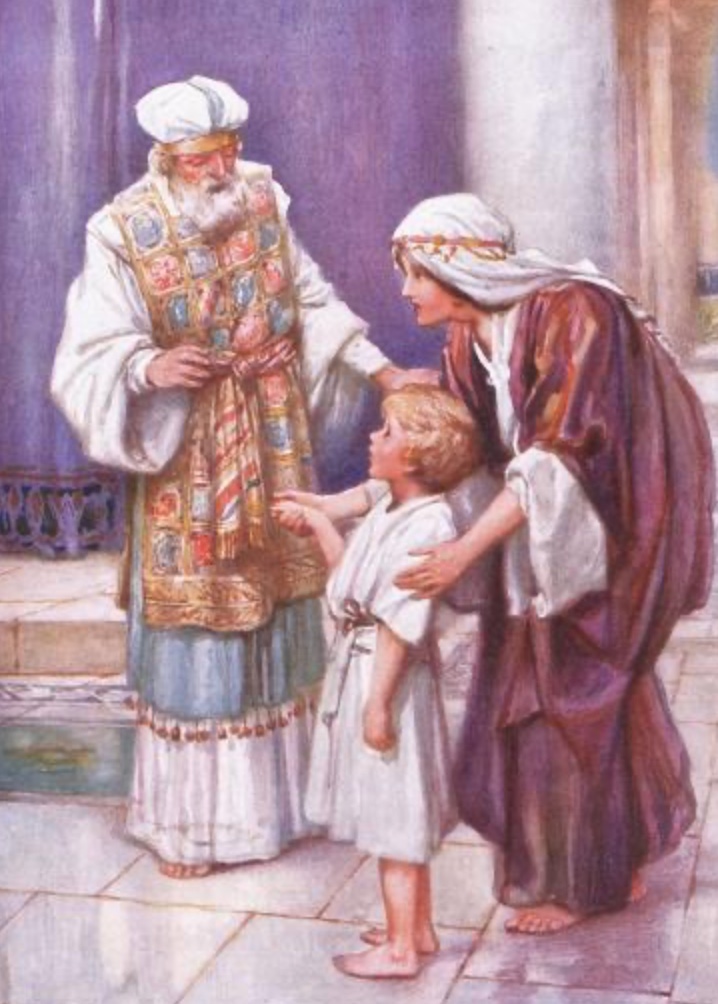
Our first reading once again foreshadows Christ’s life. Hannah, a mother like Mary, gives her only son fully to God’s work. Notice that Hannah, not her husband, brings Samuel to the Temple and initiates the ritual of his dedication. It is Hannah who, claiming her womanhood, utters the simple canon that dedicates Samuel’s life.
Hannah brought Samuel with her, along with a three-year-old bull, an ephah of flour, and a skin of wine, and presented him at the temple of the LORD in Shiloh……
I am the woman who stood near you here, praying to the LORD. I prayed for this child, and the LORD granted my request. Now I, in turn, give him to the LORD; as long as he lives, he shall be dedicated to the LORD.” She left Samuel there.
1 Samuel 1:24-28
Hannah Leaves Samson at the Temple
But how poignantly the reading ends! Do not miss the human emptiness that filled her heart as she returned to her childless home.
She left Samuel there.
1 Samuel 1:28
In our Gospel, Mary offers us her Liturgy of the Word as she proclaims the liberated dimensions of a redeemed world.
My soul proclaims your greatness, O God!
My heart rejoices in you, my Savior,
because you have showered your servant with blessing!
From now to the end of time,
all generations will know the great things you have done for me.
Mighty One! Your name is holy!
In every age, your compassion flows to those who reverence you!
But all who seek to exalt themselves in arrogance
will be leveled by your power.
You have deposed the mighty from their seats of power,
and have raised the lowly to high places.
Those who suffer hunger, you have filled with good things.
Those who are privileged, you have turned away empty-handed.
You have come to the aid of your people,
in fulfillment of the promise you made to our ancestors
when you spoke blessing to Sarah and Hagar
and all their descendants, to the utmost generation!
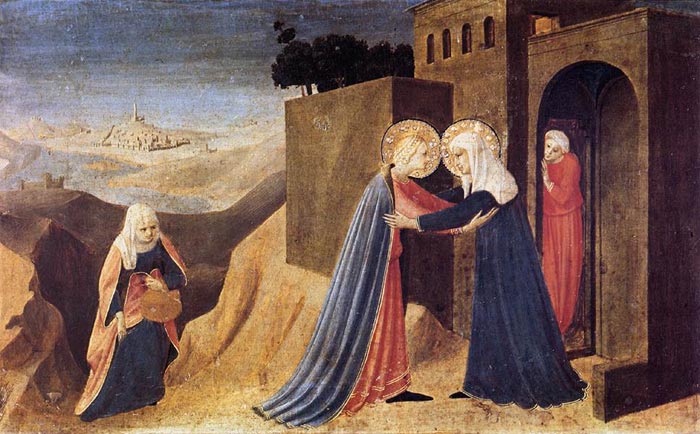
from the Cortona Altarpiece by Fra Angelico
After her courageous declaration, Mary spends three months with Elizabeth in a mutually-directed matriarchal retreat. She then goes back, alone but not alone, to the life she has yet to shape for the coming God. Once again, the striking solitude of this young mother as she travels home:
Mary remained with Elizabeth about three months and then returned to her home.
Luke 1:56
What can we learn from these women today as we make a place for God in our hearts and in our world? Like Hannah, to what liturgies of giving am I called? Like Mary, does my life proclaim my faith in God’s transformative intention for Creation?
Poetry: The Eternal Feminine by Pierre de Chardin
When the world was born, I came into being.
Before the centuries were made, I issued from the hand of God. . .
God instilled me into the initial multiple
as a force of condensation and concentration.
In me is seen that side of beings by which they are joined as one,
in me the fragrance that makes them hasten together and leads them,
freely and passionately, along their road to unity.

Through me, all things have their movement and are made to work as one.
I am the beauty running through the world,
to make it associate in ordered groups;
the ideal held up before the world to make it ascend.
I am the Eternal Feminine.
I was the bond that held together the foundations of the universe. . .
I extend my being into the soul of the world. . .
I am the magnetic force of the universal presence
and the ceaseless ripple of its smile.
I open the door to the whole heart of creation:
I, the Gateway of the Earth, the Initiation. . .

In me, the soul is at work to sublimate the body —
Grace to divinize the soul.
Those who wish to continue to possess me
must change as I change. . .
It is God who awaits you in me!. . .
If, God, then, was able to emerge from himself,
he had first to lay a pathway of desire before his feet,
he had to spread before him a sweet savor of beauty.
It was then that he caused me to rise up,
a luminous mist hanging over the abyss—
between the earth and himself—
that, in me, he might dwell among you. . .

Lying between God and the earth,
as a zone of mutual attraction,
I draw them both together in a passionate union.
. . . I am the Eternal Feminine.
Music – Magnificat – Carl Philipp Emmanuel Bach
Carl Philipp Emanuel Bach (8 March 1714 – 14 December 1788), commonly abbreviated C. P. E. Bach, was a German Classical period composer and musician, the fifth child and second surviving son of Johann Sebastian Bach and Maria Barbara Bach. Throughout his lifetime, Bach worked on the Magnificat in D, Wq. 215. J. S. Bach was alive to hear it in 1749, and C. P. E. continued to revise and perform it as late as 1786. The work clearly shows the influence of J.S. Bach’s own Magnificat, including the striking resemblance of the Deposuit movements in both works.
This is the track list for the album Magnificat, taking the various phrases of the Latin prayer and expressing them in melody. If you don’t have time to listen to the whole thing, you might like to take a portion or two at a time.
Tracklist: 00:00:00 Symphony in G Major, Wq 173: I. Allegro assai 00:02:59 Symphony in G Major, Wq 173: II. Andante 00:05:34 Symphony in G Major, Wq 173: III. Allegretto
00:08:38 Symphony in G Major, Wq 180: I. Allegro di molto 00:12:50 Symphony in G Major, Wq 180: II. Largo 00:17:12 Symphony in G Major, Wq 180: III. Allegro assai
00:20:26 Magnificat in D Major, Wq 215: I. Magnificat (Chorus) 00:23:18 Magnificat in D Major, Wq 215: II. Aria. Quia respexit (Soprano) 00:29:35 Magnificat in D Major, Wq 215: III. Aria. Quia fecit (Tenor) 00:33:40 Magnificat in D Major, Wq 215: IV. Et misericordia eius (Chorus) 00:41:28 Magnificat in D Major, Wq 215: V. Aria. Fecit potentiam (Bass) 00:45:14 Magnificat in D Major, Wq 215: VI. Duet. Deposuit potentes (Contralto, Tenor) 00:51:00 Magnificat in D Major, Wq 215: VII. Aria. Suscepit Israel (Contralto) 00:56:31 Magnificat in D Major, Wq 215: VIII. Gloria (Chorus) 00:58:17 Magnificat in D Major, Wq 215: IX. Sicut erat (Chorus)
Today, in God’s Lavish Mercy, the Church sings out to God the warm, familiar Advent invitation:
Our first reading from the Song of Songs vibrates with anticipation of God’s arrival:
Hark! my lover–here he comes springing across the mountains, leaping across the hills. My lover is like a gazelle or a young stag. Here he stands behind our wall, gazing through the windows, peering through the lattices.
Song of Songs 2: 8-9
When the Divine Lover arrives, the one who waits must be awakened from frost, flood, or barrenness that has drowsed them.
“Arise, my beloved, my dove, my beautiful one, and come! “For see, the winter is past, the rains are over and gone. The flowers appear on the earth, the time of pruning the vines has come, and the song of the dove is heard in our land. The fig tree puts forth its figs, and the vines, in bloom, give forth fragrance. Arise, my beloved, my beautiful one, and come!
Song of Songs 2: 10-12
As we pray with the Song of Songs, we are reminded that relationship with God exceeds our comprehension and expression. We have only our human descriptions to help us explore the infinite dimensions of Grace and Mercy. We image the Holy One as Father, Mother, Sister, Brother, Child, Light, Wisdom, Love, Lover, or Beloved – each aspect offering a necessarily limited metaphor for the Incomprehensible One.
As we consider places in our world, and in our own hearts, which are frozen, flooded, or barren of life, let us invite the Passion of God to rescue and reinvigorate us.
As we reflect on today’s Gospel, we can imagine both Mary and Elizabeth filled with that Holy Vigor which changes and restores everything to God’s original hope for Creation. It was into such ready openness that God’s Word leapt in one moment 2000 years ago. May it leap again into our hearts.
Poetry: Love Gaze – Renee Yann, RSM
Caught in the ferocious wind
of my own inadequacies,
I cling by finest web
to the energy You are,
fixing my soul on yours
in that precarious holding.

You are the magnet, gathering
all my emptiness beyond itself.
As if my fears were only stones
to tread upon, You come into the marshes
of my life as stillness, paused
and vibrating like a deer
among the reeds in dusklight.

I cannot word what it is
to swim in the deep pool of your Eyes.
All the universe, and all my understanding
turn reverently aside to offer privacy
for such profound combining.
Music: Veni, Dilecte Mi – Orlande de Lassus (1532-1594), one of the leading composers of the later Renaissance
Latin: Prima pars 7:11 Veni dilecte mi, egrediamur in agrum, commoremur in villis, 7:12 Mane surgamus ad vineas. Videamus si floruit vinea, si flores fructus parturiunt, si floruerunt mala punica. Ibi dabo tibi ubera mea.
Secunda pars 4:11a Favus distillans labia tua, [dilecte mi], mel et lac sub lingua tua. 8:6a Pone me ut signaculum super cor tuum, quia fortis est ut mors dilectio, dura sicut infernus aemulatio.
English: Prima pars 7:11 Come, my beloved, let us go forth into the field, let us abide in the villages. 7:12 Let us get up early to the vineyards, let us see if the vineyard flourish, if the flowers be ready to bring forth fruits, if the pomegranates flourish: there will I give thee my breasts.
Secunda pars 4:11a Thy lips, my spouse, are as a dropping honeycomb, [my beloved] honey and milk are under thy tongue; 8:6a Put me as a seal upon thy heart, as a seal upon thy arm, for love is strong as death, jealousy as hard as hell. (Douai-Rheims)
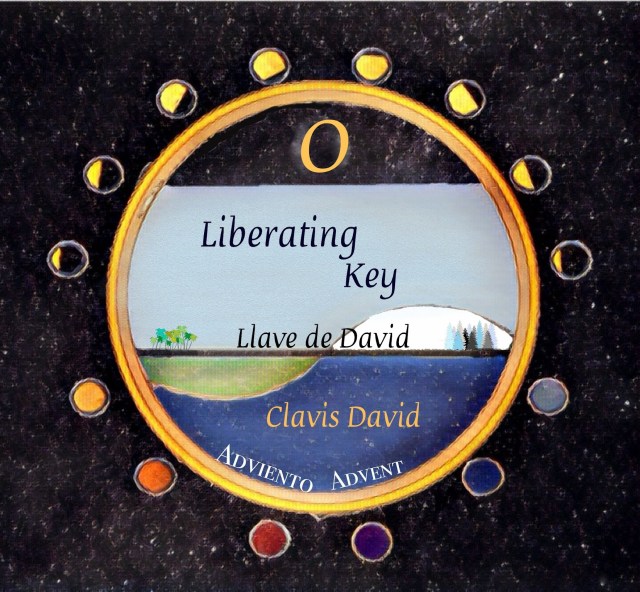
Today, in God’s Lavish Mercy, Isaiah foretells the conception and birth of the Messiah.
Therefore the Lord himself will give you this sign: the virgin shall conceive and bear a son, and shall name him Emmanuel.
Isaiah 7:14
Isaiah offered the prophecy to one of the bad guys of the Hebrew Scriptures – King Ahaz (who was, nevertheless, the 16th great-grandfather of Jesus in the long David line). But Ahaz refused to believe, subsequently pursuing his own agenda rather than God’s. Ahaz’s choice ended up in disaster for both the religious and social framework of Israel.
Isaiah had handed Ahaz the Key to believe and to act in union with God’s Will, but Ahaz remained closed to the grace.
About 700 years later, when an angel offers her the Key, a young girl opens her heart to the miracle Isaiah once prophesied.
In the sixth month, the angel Gabriel was sent from God to a town of Galilee called Nazareth, to a virgin betrothed to a man named Joseph, of the house of David, and the virgin’s name was Mary. And coming to her, he said, “Hail, full of grace! The Lord is with you.” But she was greatly troubled at what was said and pondered what sort of greeting this might be. Then the angel said to her, “Do not be afraid, Mary, for you have found favor with God. Behold, you will conceive in your womb and bear a son, and you shall name him Jesus. He will be great and will be called Son of the Most High, and the Lord God will give him the throne of David his father, and he will rule over the house of Jacob forever, and of his Kingdom there will be no end.”
Luke 1:26-33
The stark contrast between Ahaz’s and Mary’s responses encourages us to consider our own openness to God’s interventions in our lives. We live a series of experiences, learnings, mistakes, reminiscences, hopes, disappointments, and a thousand other turnings of circumstance and relationship. Each holds the potential to draw us closer to God if, by prayer and reverence, we can find the key hidden under human appearances.
We can hear Mary searching for that key in her question to the angel:
But Mary said to the angel, “How can this be, since I have no relations with a man?”
Luke 1: 34
The angel assures Mary that there is a world transcending our perceptions where God’s power holds sway beyond all human calculation.
And the angel said to her in reply, “The Holy Spirit will come upon you, and the power of the Most High will overshadow you.
Luke 1: 35
Expressing her profound faith and trust in God, Mary was able to suspend the limits of expectation and definition. Ahaz didn’t even try.
Mary said, “Behold, I am the handmaid of the Lord. May it be done to me according to your word.”
Luke 1: 38
Poetry: Annunciation – Marie Howe
Even if I don't see it again—nor ever feel it
I know it is—and that if once it hailed me
it ever does—
And so it is myself I want to turn in that direction
not as towards a place, but it was a tilting
within myself,
as one turns a mirror to flash the light to where
it isn't—I was blinded like that—and swam
in what shone at me
only able to endure it by being no one and so
specifically myself I thought I'd die
from being loved like that.
Music: The Annunciation from Rosary Sonata – Heinrich Biber











 Lavish Mercy