Today, in Mercy, we continue to pray the O Antiphons – beseeching the Savior to come to us.
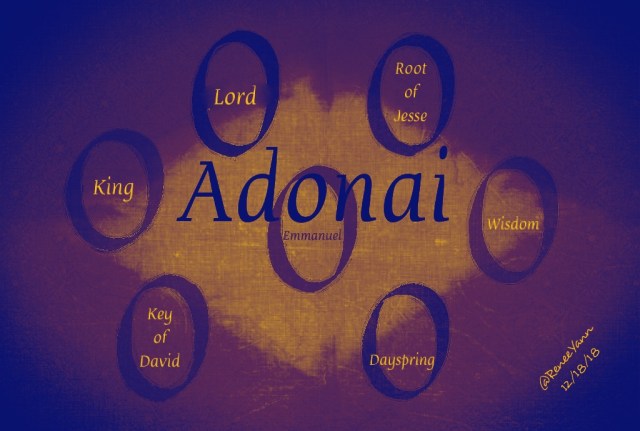
O Adonai calls on God to come lead us out of darkness. Let us pray today for all who live in any form of darkness – war, fear, poverty, exile, addiction, depression, illness, ignorance or indifference.
Let us pray for God’s light for any of these situations in ourselves or our families … in our world.
As the year grows toward its greatest darkness, we seek You, Greatest Light! O Adonai, lead us out of darkness!
O Leader of the House of Israel,
giver of the Law to Moses on Sinai:
come to rescue us with your mighty power!
R. Alleluia, alleluia.
Today, in Mercy, we begin the recitation of the O Antiphons.
The O Antiphons are Magnificat antiphonies used at Vespers of the last seven days of Advent. They are also used as the Alleluia Verse during the daily Mass.
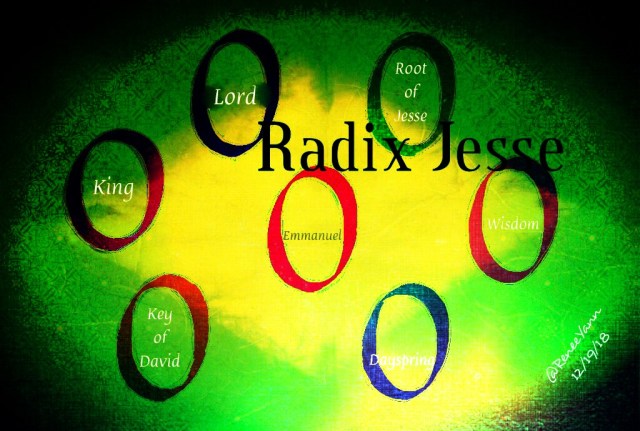
Each antiphon is a name of Christ, one of his attributes mentioned in Scripture. They are:
Advent was originally, like Lent, a time of fasting. Midway in the fast, the Church took a break from the fast and rejoiced prematurely for the coming Christmas.
Pink vestments worn for the liturgy indicate joy, as do the uplifting readings.
In our first reading, Zephania tells us that “the Lord will rejoice over us with gladness!”
Paul tells us to “Rejoice in the Lord always!”
Even serious John the Baptist seems to tingle with expectation of the coming Savior. He’s just a little more taciturn in his proclamations.
In our terribly commercialized holiday world, let us stop and remember the true cause of our hope and celebration.
What gives your heart true joy as we approach the sacred celebration of Christmas?
Let’s make a deeper effort this week, which will require so much bustle of us, to settle our hearts for a moment with God – remembering that his presence with us is what this whole season is about.
Music: Gaudete in Domino sung by the Schola of St. Meinrad Abbey (Latin and English lyrics below)
Gaudete in Domino semper iterum dico gaudete.
Modestia vestra nota sit omnibus hominibus. Dominus prope est.
Nihil solliciti sitis sed in omni oratione et obsecratione cum gratiarum actione petitiones vestrae innotescant apud Deum.
Et pax Dei quae exsuperat omnem sensum custodiat corda vestra et intellegentias vestras in Christo Iesu [Domino nostro].
Rejoice in the Lord always: and again I say, rejoice. Let your moderation be known unto all men. The Lord is at hand. Be careful for nothing; but in every thing by prayer and supplication with thanksgiving let your requests be made known unto God. And the peace of God, which passeth all understanding, shall keep your hearts and minds through Christ Jesus [our Lord].
Today, in Mercy, our Gospel places us with Jesus, as he descends the mountain after the Transfiguration.
He speaks about two great prophets – Elijah and John the Baptist:
Elijah – the fiery reformer who “turned back hearts” to the day of the Lord
John – who cried out in the desert, “Prepare the way of the Lord!”
These prophets open the door to our final approach to Christmas – our last few days to heed their advice and ready our hearts for the awesome, yet humble, coming of Christ.
Is there anything in my heart that needs to be turned back to God — any energy, dedication or insight that has shifted from God’s Way to my own selfish way?
Is there anything I must prepare so that my life is ready to receive Christ?
These are the questions Elijah and John offer us today..
Music: Prepare the Way, O Zion – Fernando Ortega (Lyrics below)
Prepare the way O Zion
Your Christ is drawing near
Let every hill and valley
A level way appear
Greet One who comes in glory
Foretold in sacred story
Chorus:
O blest is Christ that came
In God’s most holy name
Christ brings God’s rule O Zion
He comes from heaven above
His rule is peace and freedom
And justice truth and love
Lift high your praise resounding
For grace and joy abounding
Fling wide your gates, O Zion
Your Savior’s rule embrace
And tidings of salvation
Proclaim in every place
All lands will bow rejoicing
Their adoration voicing
Today, in Mercy, we celebrate the feast of St. John of the Cross, a great mystic of the 16th century, one of the 36 Doctors of the Church, and an influential Spanish writer.
John, with Teresa of Ávila, founded the Discalced Carmelites. His poetry and prose recount the journey of the soul as it grows more deeply into God.
Much of his poetic writing can surprise, perhaps even shock, with its passionate tone. But John’s love for God is so profound that he uses the symbols of deepest human intimacy to convey his passion.These are the most beautiful images he has to express his total gift of self to the Divine.
Through the darkness of profound personal suffering, John found Light by nurturing this extraordinary spiritual intimacy with God.
John is a perfect inspiration for the Advent journey as we move through darkness to the Light of Christmas.
Many of us will have favorite passages from this prolific and passionate writer.Mine is this:
“In the evening of our lives,
we will judged on love.
Learn, therefore, to love God
as God wishes to be loved.”
Music: John Michael Talbot tries to capture the mysticism of John’s writings.
Today, in Mercy, we celebrate the feast of St. Lucy, patroness of the blind. Lucy was a brave young woman, martyred during the persecutions.
Her name meaning “Light”, she has been venerated for millennia as one who can bring clarity and insight to places of darkness.
Today’s first reading shows us what our Radiant God can do for those who live in darkness, destitution and fear.
As the year moves closer to its time of deepest darkness, may we know God’s brightness in our hearts. May we sense God lighting, once again, the dark places in our lives and in our world.
We all have painful situations, unanswered hopes, lingering fears.Let us bring them out of the shadows today with the help of St. Lucy and our Brilliant God who made the stars to give us hope.
Music:Hail, Gladdening Light – Etcetera: the Civil Service Choir
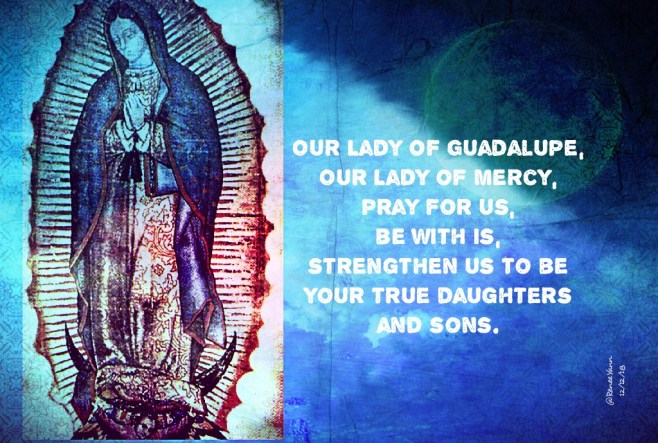
Today, in Mercy, we celebrate the Feast of Our Lady of Guadalupe, commemorating the apparitions of Mary to the Mexican peasant Juan Diego in 1531.
It is also on this date, 300 years later, that Catherine McAuley founded the Sisters of Mercy in Dublin, Ireland.
Both Mary and Catherine found their joy in total commitment to God’s will and presence in their lives. May they inspire and helpto make God the center of our lives. May that discovery fill us with joy.
Perhapsby increasing our spiritual simplicity, trust and humility like Juan Diego, we can grow closer to Mary and to her Son.
Today’s beautiful readings can lead us closer into Mary’s arms.Zecharia, even without knowing her, named Mary the Holy Dwelling from whom Christ would come forth.
Revelation captures multiple images from the Hebrew scriptures, fashioning a glorious picture of Mary’s significance in salvation history.
And our treasured passage from Luke — can we not read it like a beloved family story that gives us roots and wings?
Mary is not so far away from us.She chose to enter Juan Diego’s life, looking like a queen he would recognize in his own culture. She has chosen to do the same thing in many other struggling cultures.
How is Mary present to us today? How was she present to Catherine McAuley? A homeless woman? An immigrant mother? An incarcerated young woman/? A sickly neighbor? An annoying, lonely grandmother?
What language is Mary speaking to us?
Music: Tota Pulchra Es Maria – Latin words and translation below. This lovely hymn reflects our responsorial psalm for today.
Tota pulchra es, Maria,
et macula originalis non est in te.
Vestimentum tuum candidum quasi nix, et facies tua sicut sol.
Tota pulchra es, Maria,
et macula originalis non est in te.
Tu gloria Jerusalem, tu laetitia Israel, tu honorificentia populi nostri.
Tota pulchra es, Maria.
You are all beautiful, Mary,
and the original stain [of sin] is not in you.
Your clothing is white as snow, and your face is like the sun.
You are all beautiful, Mary,
and the original stain [of sin] is not in you.
You are the glory of Jerusalem, you are the joy of Israel, you give honour to our people.
You are all beautiful, Mary.
Today, in Mercy, we once again hear that powerful passage from Isaiah, “Comfort Ye, My People”.
Our Gospel gives us the gentle parable of the Good Shepherd who finds and comfortshis lost sheep.
As we listen to today’s tender music, let us slowly name in our prayer those who most need God’s comfort.
We may pray for ourselves, for someone we love, for those we know by name, or for those dear to God though nameless to us – all who suffer throughout the world.
Music: Comfort My People -Created by: Michelle Sherliza, OP; Music by: Monica Brown
Today, in Mercy, our Advent readings increase in joyously expectant tone:
Isaiah’s exultant description of the Peaceful Kingdom
the Psamist’s confidence in God’s intervention
Jesus’s miracle, and probable delight, for the paralyzed man lowered through the roof!
We have seen incredible things.. Luke 5:26
These passages are filled with an exuberant expectation, much like children feel as they discover an amazing gift. May we open our hearts with innocent hope toward God’s promise.
If you can, take the time today to read these passages slowly, listening for the particular word that will fall upon your heart like a blossom of hope.
Music: O Come, Divine Messiah – Jennie Lee Riddle and Robbie Seay








 Lavish Mercy