The Peaceable Kingdom

November 29, 2021
Monday of the First Week of Advent

Today, in God’s Lavish Mercy, we pray with Isaiah, Matthew and Psalm 122.

Our first reading sets us out on nearly two weeks of passages from Isaiah. The passionate hope of Isaiah’s writing, as well as its literary elegance, can reach into our hearts and powerfully renew us.

For these reasons, “Isaiah’s Vision” is among the most beloved and influential books of the Bible. The book has so influenced Christianity that it often is referred to as “The Fifth Gospel”.

They shall beat their swords into plowshares
    and their spears into pruning hooks;
One nation shall not raise the sword against another,
    nor shall they train for war again.

Isaiah 2:4

Isaiah’s images, written to fire the souls of the ancient Hebrews, still have the power to enkindle ours today as we await the quickening grace of our Prince of Peace. We still have little and big wars all around us, and some within us. Still there are swords and spears between us that cry for a peaceable bending.

Isaiah asks us to acknowledge them and offer them for transformation so that we may, with our psalmist, “go rejoicing to the house of the Lord.”


In our Gospel, Jesus paints a picture of the sacred house, an inclusive table where all are fed with Eternal Life.

I say to you, many will come from the east and the west,
and will recline with Abraham, Isaac, and Jacob
at the banquet in the Kingdom of heaven

Matthew 8:11

Today’s centurion
– by virtue of his humble, resolute faith –
already has partaken of that peaceable feast.
The early invitation is open to us as well.🤗


Poetry: An Appendix to the Vision of Peace by Yehuda Amichai

Yehuda Amichai is recognized as one of Israel’s finest poets. His poems, written in Hebrew, have been translated into 40 languages, and entire volumes of his work have been published in English, French, German, Swedish, Spanish, and Catalan. “Yehuda Amichai, it has been remarked with some justice,” according to translator Robert Alter, “is the most widely translated Hebrew poet since King David.”

  • from Poetry Foundation

    Don’t stop after beating the swords
    into plowshares, don’t stop! Go on beating
    and make musical instruments out of them.
    Whoever wants to make war again
    will have to turn them into plowshares first.


Music: Lo Yisa Goy – Utah Philharmonic

Lo Yisa Goy is a Jewish folk song based on Isaiah 2. Translation below.

Lo yisa goy
El goy cherev
Lo yil’medu
Od milchamah.

A nation shall not raise
A sword against a nation
And they shall not learn 
Any more war.

Promise Fulfilled

First Sunday of Advent
November 28, 2021

Today, in God’s Lavish Mercy, we begin our Advent journey remembering a promise:

The days are coming, says the LORD, 
    when I will fulfill the promise 
    I made to the house of Israel and Judah.

Jeremiah 33:14

“Promise” is a powerfully dynamic concept whose meaning we sometimes constrict. 

We might say something like, “I promise to pay you back someday” – thereby limiting “promise” to some future event that may or may not happen.

But “promise”, in its richer meaning, is an inward turning toward a journey, each step a necessary component of the ultimate fulfillment. 

In this sense, “promise” is more akin to “vow” or “covenant”. It unfolds as life unfolds. It grows through stages, like a fruit tree from a tiny seed. Its meaning, at first indistinctly seen, blossoms as it is fed with faith, hope, and enduring love.

This is the nature of God’s promise to us. It is not only some salvific event in our future. It is the flowering of grace, again and again, in our life choices for God. 

It is the classic example of that insightful phrase, “The journey is the destination.” In other words, Jesus cannot be born for us on Christmas if He is not born in us every day.


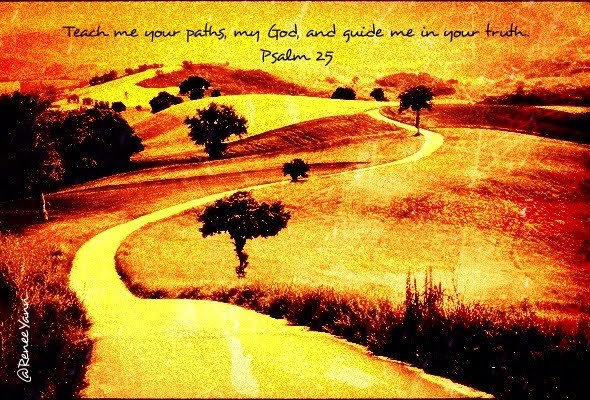
Thus, Psalm 25 is the perfect prayer as we reflect on our journey during Advent.

To you, O Lord, I lift my soul.

Your ways, O LORD, make known to me;
   teach me your paths,
Guide me in your truth and teach me,
   for you are God my savior,
   and for you I wait all the day. 

All Your paths are kindness and constancy
   toward those who keep Your covenant and decrees.
Your friendship is with those 

who hold themselves in awe before You,
   and Your covenant is for their daily instruction.

Psalm 25: 4-5; 10,14

As we begin this Advent,
let us ask God to show us
the promise longing for fulfillment
in each moment and
in every event of our daily lives.
Let us give our hearts to it.

Poetry: Advent Credo from Walking on Thorns by Allan Boesak

It is not true that creation and the human family are doomed to destruction and loss—
This is true: For God so loved the world that He gave his only begotten Son, that whoever believes in Him shall not perish but have everlasting life;

It is not true that we must accept inhumanity and discrimination, hunger and poverty, death and destruction—
This is true: I have come that they may have life, and that abundantly.

It is not true that violence and hatred should have the last word, and that war and destruction rule forever—
This is true: Unto us a child is born, unto us a Son is given, and the government shall be upon his shoulder, his name shall be called wonderful councilor, mighty God, the Everlasting, the Prince of peace.

It is not true that we are simply victims of the powers of evil who seek to rule the world—
This is true: To me is given authority in heaven and on earth, and lo I am with you, even until the end of the world.

It is not true that we have to wait for those who are specially gifted, who are the prophets of the Church before we can be peacemakers—
This is true: I will pour out my spirit on all flesh and your sons and daughters shall prophesy, your young men shall see visions and your old men shall have dreams.

It is not true that our hopes for liberation of humankind, of justice, of human dignity of peace are not meant for this earth and for this history—
This is true: The hour comes, and it is now, that the true worshipers shall worship God in spirit and in truth.

So let us enter Advent in hope, even hope against hope. Let us see visions of love and peace and justice. Let us affirm with humility, with joy, with faith, with courage: Jesus Christ—the life of the world.


Music: Psalm 26 – Kendrick and Redman

The Last Day

November 27, 2021
Saturday of the Thirty-fourth Week in Ordinary Time

Today, in God’s Lavish Mercy, we come – FINALLY – to the last day in Ordinary Time. And, believe me, the readings are as daunting as their predecessors suggested they would be.

They are so daunting that I will leave you to them if you wish, but I choose to close the Liturgical Year with another story I wrote years ago.

May the story inspire you as we stand on beautiful Advent’s doorstep. Within it, may you find love, hope, tenderness, mercy and gratitude to carry with you into the new Church Year.

The Earring

Young Emma, skewered by indecision, had stared into her mother’s jewelry box. She had always loved those bejeweled earrings, a gift to her mother from her grandmother—an heirloom now, a treasure beyond price. She wanted so to wear them on this special date, but they were “hands off” and she knew it. Still, her mother at work and unaware of her desire, Emma had succumbed to temptation.


The dance had been wonderful, a whirlwind of such delight that Emma had not noticed when her left earring had brushed against her partner’s shoulder, tumbling hopelessly under the dancers’ trampling feet. Only at evening’s end, approaching her front door exhausted and dreamy, had she reached up to unclip the precious gems.


Her mother sat waiting for her in the soft lamplight, having already noticed the earrings missing from her dresser. Awaiting retribution, Emma knelt beside her mother and confessed the further sacrilege of loss. But her mother simply cupped Emma’s tearful face in her hands, whispering, “You are my jewel. Of course I forgive you.”  Though accustomed to her mother’s kindness, this act of compassion astonished Emma, filling her with an indescribable, transformative gratitude.


Like Emma, we may be astonished at the graciousness that has been given to us. We may respond by pouring out our thanks to God in a silent act of prayer.

May we also have the courage to become like our merciful God, anticipating the other’s need for our forgiveness and compassion. May we seek the strength not to harbor injury, but too release it to make room for further grace in our hearts.


Advent 2021

I am so excited about Advent – my favorite time of the Church Year! The readings are magnificent — especially lyrical, prophetic Isaiah!

Advent offers us the wonderful call “to relish expectation” – to believe in, to hope for, and to love what we cannot yet see. It is a time of blind but unshakeable trust which teaches us to live within our deep, invisible spirit.

Looking forward to being with all of you tomorrow as we begin the journey through this season of profound hope.


Poetry: I Hear the Oriole’s Always-Grieving Voice – Anna Akhmatova

I chose this poem because it captures a spirit of hope – yet unrealized, but nevertheless convinced.

I hear the oriole’s always-grieving voice,
And the rich summer’s welcome loss I hear
In the sickle’s serpentine hiss
Cutting the corn’s ear tightly pressed to ear.
And the short skirts of the slim reapers
Fly in the wind like holiday pennants,
The clash of joyful cymbals, and creeping
From under dusty lashes, the long glance.

I don’t expect love’s tender flatteries,
In premonition of some dark event,
But come, come and see this paradise
Where together we were blessed and innocent.


Music: Gracias a la Vida – Mercedes Sosa and Joan Baez ( English lyrics below.) Thanks to my friend Beth who shared this lovely song on Facebook today.

Thanks to life, which has given me so much.
It gave me two beams of light, that when opened,
Can perfectly distinguish black from white
And in the sky above, her starry backdrop,
And from within the multitude The one that I love.

Thanks to life, which has given me so much.
It gave me an ear that, in all of its width
Records— night and day—crickets and canaries,
Hammers and turbines and bricks and storms,
And the tender voice of my beloved.

Thanks to life, which has given me so much.
It gave me sound and the alphabet.
With them the words that I think and declare:
“Mother,” “Friend,” “Brother” and the light shining.
The route of the soul from which comes love.

Thanks to life, which has given me so much.
It gave me the ability to walk with my tired feet.
With them I have traversed cities and puddles
Valleys and deserts, mountains and plains.
And your house, your street and your patio.

Thanks to life, which has given me so much.
It gave me a heart, that causes my frame to shudder,
When I see the fruit of the human mind,
When I see good so far from bad,
When I see within the clarity of your eyes…

Thanks to life, which has given me so much.
It gave me laughter and it gave me longing.
With them I distinguish happiness and pain—
The two materials from which my songs are formed,
And your song, as well, which is the same song.
And everyone’s song, which is my very song.
Thanks to life

Thanks to life
Thanks to life
Thanks to life

Antiphon: O Radiant Dawn

Christmas Eve – 2020


Today, God’s Lavish Mercy, we pray a prayer full of beautiful, hopeful images. Let us savor them slowly as we make our way to the waiting manger:

O Morning Star,
splendor of Light Eternal
and Sun of Righteousness:
Come and enlighten those
who dwell in darkness
and the shadow of death.


O Radiant Dawn,
it is Christmas Eve.
We see the hint of your dawning
along the dark horizon
of our limitations.


How we long for You
to fracture time,
our fragile eggshell,
Eternal Love flowing
across our weary hearts.

O Dayspring,
let us see beyond the darkness,
beyond fear,
and selfish calculations,
beyond doubt, despair, hatred,
even death…
…to know that, in You,
everything is Light
for those who trust
Your Rising.


We await your
Christmas Morning
in our world.
Maranatha!  Come, Lord, Jesus!

Antiphon: O Wisdom

December 17, 2020
Thursday of the Third Week of Advent


Today, in Mercy, we begin the recitation of the O Antiphons.

The O Antiphons are Magnificat antiphonies used at Vespers of the last seven days of Advent. They are also used as the Alleluia Verse during the daily Mass.

Each antiphon is a name of Christ, one of his attributes mentioned in Scripture. They are:

  • 17 December: O Sapientia (O Wisdom
  • 18 December: O Adonai (O Beautiful Lord)
  • 19 December: O Radix Jesse (O Root of Jesse)
  • 20 December: O Clavis David (O Key of David)
  • 21 December: O Oriens (O Dayspring)
  • 22 December: O Rex Gentium (O King of the Nations)
  • 23 December: O Emmanuel (O God With Us)

We begin today
with a heartfelt plea to God
to fill our world with a Wisdom
that orders all things
and teaches us prudence.

Oh, how our world needs this prayer to be answered!  How we need to discover a Wisdom rooted in truth, justice and mutual love!

Let us pray this prayer together today, dear friends, and wrap the whisper of longing around our whole aching world:

O Wisdom of our God Most High,
guiding creation with power and love:
come to teach us the path of knowledge!


As we begin this final week before Christmas, may each one of you feel a dawning of new grace and courage in your hearts. This will certainly be a very different, and perhaps difficult time for many. But let Wisdom teach us that there may be a new and unexpected grace even in this strange season.

Poetry:

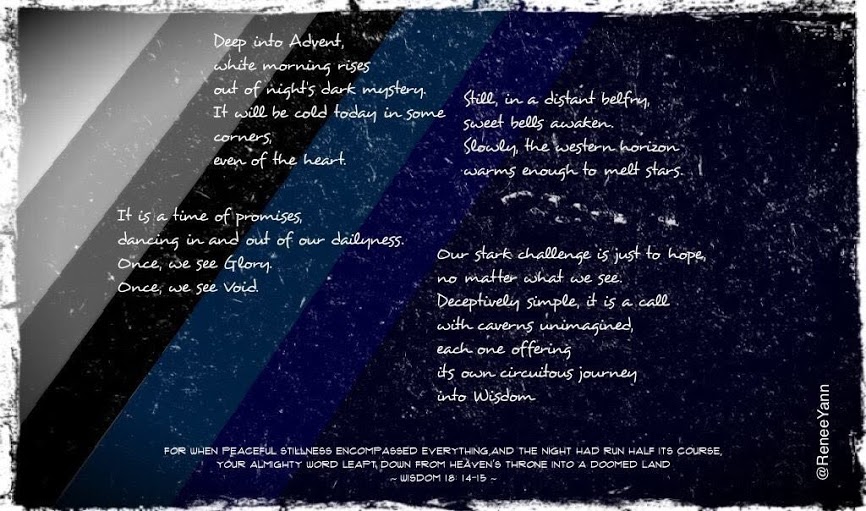
Deep into Advent
white morning rises
out of night’s dark mystery.
It will be cold today in some corners
even of the heart.

Still, in a distant belfry
sweet bells awaken
Slowly, the western horizon
warms enough to melt stars.

It is a time of promises
dancing in and out of hope.
Once, we see Glory.
Once, we see Void.
Our stark challenge is just to hope,
no matter what we see.

Deceptively simple, it is a call
with caverns unimagined,
each one offering
its own circuitous journey
into Wisdom.

For when peaceful stillness encompassed everything and night had run half its course,
your Almighty Word leapt down from heavens throne into a doomed land.
Wisdom 18:14-15


Music: O Wisdom – Michael G. Hegeman, Performed by: The Lauda! Chamber Singers

Psalm 85: Rain Down, O Lord!

Wednesday of the Third Week of Advent

December 16, 2020


Today, in God’s Lavish Mercy, we pray with Psalm 85 – a song filled with urgency and expectation!

When we pray this psalm:

We are desperately thirsty nomads who hear promise in the hint of thunder.
We are the parched leaves stretching up to catch the first rain.
We are the foundered boat lifted on the gathering flume.

Tomorrow, we begin the exclamations of our answered hopes — the great O Antiphons.

But for today, let us relax into the certainty that, indeed, the Savior is coming – just as sure as the clouds turn silver with the weight of rain.

What is it in your heart today
that reaches for the cloudburst of grace?

Poetry: Last Night, the Rain Spoke to Me – Mary Oliver

Last night
the rain
spoke to me
slowly, saying,
what joy
to come falling
out of the brisk cloud,
to be happy again
in a new way
on the earth!
That’s what it said
as it dropped,
smelling of iron,
and vanished
like a dream of the ocean
into the branches
and the grass below.
Then it was over.
The sky cleared.
I was standing
under a tree.
The tree was a tree
with happy leaves,
and I was myself,
and there were stars in the sky
that were also themselves
at the moment,
at which moment
my right hand
was holding my left hand
which was holding the tree
which was filled with stars
and the soft rain—
imagine! imagine!
the wild and wondrous journeys
still to be ours.

Music: Spirit of God, Rain Down – Nelson Jose

Psalm 34: The Reason

Tuesday of the Third Week of Advent

December 15, 2020


Today, in God’s Lavish Mercy, we pray with Psalm 34.

When I read its refrain, my mind was triggered into a kind of “Jeopardy-like” exchange with God:

Answer: This is the reason God sent his Son,
and continues to redeem the world in us.

Question : What is “The Lord hears the cry of the poor”.

Psalm 34 reiterates a fundamental fact so often overshadowed by our highly secularized “Christmas unconsciousness”. The psalm refocuses us by consistently using words like this:

  • Let my soul glory in the LORD;
    the lowly will hear me and be glad.
  • When the poor one called out, the LORD heard,
    and from all his distress he saved him.
  • When the just cry out, the LORD hears them,
    and from all their distress he rescues them.
  • The LORD is close to the brokenhearted;
    and those who are crushed in spirit he saves.

Christmas is God’s response to the unrelenting cry of the poor. If we want to truly honor and celebrate Christmas, we must allow that merciful and healing response to flow through us.

How and where do I hear the cry of the poor?
How do I respond?

Poetry: Blessed Are the Poor in Spirit Alice Walker (born February 9, 1944) is an American novelist, story writer, poet and social activist. In 1982, she wrote the novel The Color Purple for which she won the National Book Award hardcover fiction, and the Pulitzer Prize for Fiction.

Did you ever understand this? 
If my spirit was poor, how could I enter heaven? 
Was I depressed? 
Understanding editing,
I see how a comma, removed or inserted
with careful plan,
can change everything.
I was reminded of this
when a poor young man
in Tunisia
desperate to live
and humiliated for trying
set himself ablaze; 
I felt uncomfortably warm
as if scalded by his shame.
I do not have to sell vegetables from a cart as he did
or live in narrow rooms too small for spacious thought; 
and, at this late date,
I do not worry that someone will
remove every single opportunity
for me to thrive.
Still, I am connected to, inseparable from,
this young man.
Blessed are the poor, in spirit, for theirs is the kingdom of heaven.
Jesus. (Commas restored) .
Jesus was as usual talking about solidarity: about how we join with others
and, in spirit, feel the world, and suffering, the same as them.
This is the kingdom of owning the other as self, the self as other; 
that transforms grief into
peace and delight.
I, and you, might enter the heaven
of right here
through this door.
In this spirit, knowing we are blessed,
we might remain poor 

Music: The Lord Hears the Cry of the Poor – John Foley, SJ

Psalm 25: Praying with John of the Cross

Memorial of Saint John of the Cross, priest and doctor of the Church

December 14, 2020


Today, in God’s Lavish Mercy, we pray with Psalm 25, the prayer of someone who is in love with God – as was John of the Cross:

Your ways, O LORD, make known to me;
teach me your paths,
Guide me in your truth and teach me,
for you are God my savior.

Psalm 25: 4-5
St. John of the Cross

When we truly love someone, we see God’s face in them. Who doesn’t love that beautiful line from Les Miserables:

Take my hand
I'll lead you to salvation
Take my love
For love is everlasting
And remember
The truth that once was spoken
To love another person
Is to see the face of God

( Just in case you’re longing to listen to it now🤗)


John of the Cross saw God’s Face in all Creation, and found God deep within his own contemplative soul:

What more do you want, O soul!
And what else do you search for outside, when
within yourself you possess your riches, delights,
satisfactions, fullness, and kingdom
– your Beloved whom you desire and seek?

Be joyful and gladdened
in your interior recollection with Him,
for you have Him so close to you.
Desire Him there, adore Him there.

Do not go in pursuit of Him outside yourself.
You will only become distracted and wearied thereby,
and you shall not find Him,
nor enjoy Him more securely,
nor sooner,
nor more intimately
than by seeking him within you.

Spiritual Canticle 1.8

John was in love with God in a way described by the blessed Jesuit Pedro Arrupe:

Nothing is more practical than
finding God, than
falling in Love
in a quite absolute, final way.
What you are in love with,
what seizes your imagination, will affect everything.
It will decide
what will get you out of bed in the morning,
what you do with your evenings,
how you spend your weekends,
what you read, whom you know,
what breaks your heart,
and what amazes you with joy and gratitude.
Fall in Love, stay in love,
and it will decide everything.

As we pray today with St. John of the Cross, we ask our God to deepen us in love. We thank God for the promise and gift of Unconditional Love:

Remember that your compassion, O LORD,
and your kindness are from of old.
In your kindness remember me,
because of your goodness, O LORD.

Music: One Dark Night – John Michael Talbot

Gaudete Sunday: Rejoice!

Third Sunday of Advent

December 13, 2020

The day takes its name from the Latin word Gaudete (“Rejoice”),
the first word of the Introit prayer for this day’s Mass taken from Philippians 4:
Gaudete in Domino semper: iterum dico, gaudete.
Rejoice in the Lord always; again I say, rejoice. 


Today, in God’s Lavish Mercy, we prayerfully rejoice with Mary’s courageous and hopeful song:

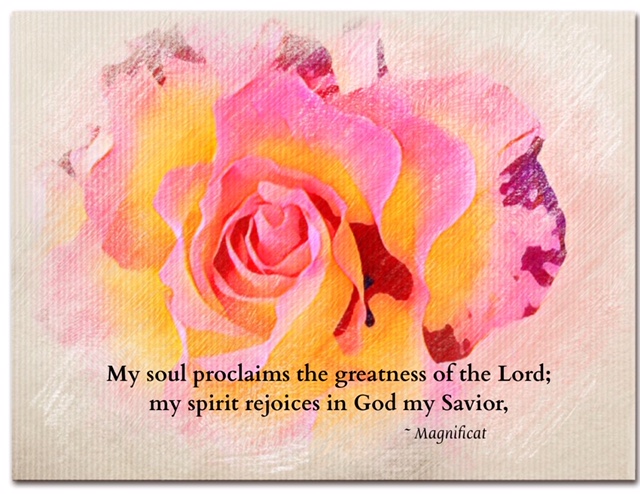
My soul proclaims the greatness of the Lord;
my spirit rejoices in God my Savior,
for he has looked upon his lowly servant.
From this day all generations will call me blessed.

Today is a break day midway through a season which is otherwise of a penitential character, and signifies the nearness of the Lord’s coming. On Gaudete Sunday, the Church is no longer inviting us to adore merely “The Lord who is to come”, but calling upon us to worship and hail with joy “The Lord who is now nigh and close at hand“.


While the whole Church is called this Sunday to rejoice in the approach of the Christ-event,  Mary’s Magnificat calls us to celebrate a specific “nearness” – God’s preferential affinity for those who are poor:

The Lord has filled the hungry with good things,
and sent the rich away empty.
He has come to the help of his servant Israel
remembering the promise of mercy.

The Gaudete message is not about a cheap and frenzied Christmas celebration. It is a profound reminder that Divine Joy seeks its home in a holy emptiness – in a heart space that has been reflectively cleared of spiritual arrogance.

His mercy is from age to age
to those who bow in awe.
He has shown might with his arm,
dispersed the arrogant of mind and heart.

Luke 150-51

How do we become, like Mary,
poor and humble before our God,
open to the Awesome Joy who is Christ?

We can pray according to Paul’s blessing to the Thessalonians in our second reading:

May the God of peace make us perfectly holy
and may we entirely, spirit, soul, and body,
be preserved blameless for the coming of our Lord Jesus Christ.
The One who calls us is faithful,
and will also accomplish it.


Poem: Heart Cave – Geoffrey Brown

I must remember to go down to the heart cave
And sweep it clean, make it warm, with fire on the hearth
And candles in their niches
The pictures on the walls glowing with quiet lights
I must remember to go down to the heart cave
And make the bed with the quilt from home
Strew rushes on the floor
And hang lavender and sage from the corners
I must remember to go down to the heart cave
And be there when you come.

Music: Gaudete – Steeleye Span 

This British folk rock group had a hit in 1973 (No. 14, UK singles chart) with an a cappella recording of the song. Guitarist Bob Johnson heard the song when he attended a folk-carol service with his father-in-law. 
This single is one of only three top 50 British hits to be sung fully in Latin (the others were both recordings of “Pie Jesu” from Andrew Lloyd Webber’s
Requiem)

Guadalupe: The Largesse of Mercy

Feast of Our Lady of Guadalupe

December 12, 2020


Today, in God’s Lavish Mercy, we pray in praise of Mary, with a passage from the Book of Judith as our Responsorial Psalm:

Blessed are you, daughter, by the Most High God,
above all the women on earth;
and blessed be the LORD God, 
the creator of heaven and earth.

Judith 13:18

Judith rescues her people’s future by an act of heroism against the enemy. That “deed of hope” saves the whole community from deadly oppression.

You are the highest honor of our human race.
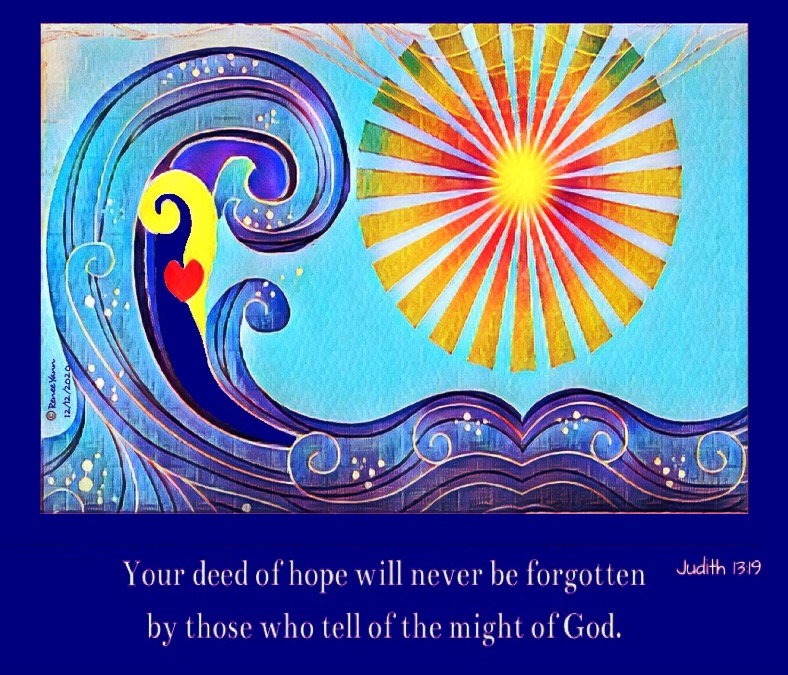
Your deed of hope will never be forgotten
by those who tell of the might of God.

Judith 13:19

Judith’s deeds foreshadow Mary’s sublime obedience to the power of God. Her dynamic faith and trust free Mary to respond to God’s outrageous willingness to become flesh for our salvation.

Mary said,
“Behold, I am the handmaid of the Lord.
May it be done to me according to your word.”

Luke 1:38

Down through history, Mary continues to inspire that kind of faith in God’s People. Today, we remember two such inspired individuals:

Saint Juan Diego who, in receiving graces from Our Lady of Guadalupe, offered a “deed of hope” for the Mexican people.


Venerable Catherine McAuley who, in responding to her founder’s call, released the “deed of hope” ever afterward known as “the Sisters of Mercy”.


What “deed of hope” wants firing
in your heart today?

Let’s look to Mary and the Saints she has inspired, to encourage us.

Poetry: from Hafiz

Light
Will someday split you open
Even if your life is now a cage,

For a divine seed, the crown of destiny,
Is hidden and sown in an ancient fertile plain
You hold the title to.

Love will surely burst you wide open
Into an unfettered, blooming new galaxy…
A life–giving radiance will come,
The Beloved’s gratuity will come…..


Music: Sub Tuum Praesidium- “Beneath Thy Protection” – is the oldest preserved extant hymn to the the Blessed Virgin Mary. (mid 3rd century)

Sub tuum praesidium
confugimus,
Sancta Dei Genetrix.
Nostras deprecationes ne despicias
in necessitatibus nostris,
sed a periculis cunctis
libera nos semper,
Virgo gloriosa et benedicta.

We fly to Thy protection,
O Holy Mother of God;
Do not despise our petitions
in our necessities,
but deliver us always
from all dangers,
O Glorious and Blessed Virgin.