Jesus said to his disciples: “Suppose one of you has a friend to whom he goes at midnight and says, ‘Friend, lend me three loaves of bread, for a friend of mine has arrived at my house from a journey and I have nothing to offer him,’ and he says in reply from within, ‘Do not bother me; the door has already been locked and my children and I are already in bed. I cannot get up to give you anything.’ I tell you, if he does not get up to give him the loaves because of their friendship, he will get up to give him whatever he needs because of his persistence.
“And I tell you, ask and you will receive; seek and you will find; knock and the door will be opened to you. For everyone who asks, receives; and the one who seeks, finds; and to the one who knocks, the door will be opened. Luke 11:5-11
In our Gospel today, Jesus describes the meaning of friendship and invites his disciples to receive that gift from God.
Today, in God’s Lavish Mercy: We ask God to show us the profound beauty of Divine Friendship. We are grateful and humbled to be offered such a gift.
William Barry, SJ – one of my top ten spiritual writers – has written an inspiring book about friendship with God. Barry believes, as I do, that the concept of friendship best describes one’s deepening relationship with God.
What does God want in creating us? My stand is that what God wants is friendship. To forestall immediate objections, let me say that I do not mean that God is lonely and therefore needs our friendship. This is a romantic and quite unorthodox notion that makes God ultimately unbelievable. No, I maintain that God—out of the abundance of divine relational life, not any need for us—desires humans into existence for the sake of friendship.
Music: I’ve Found a Friend – J. G. Small (1866)
Although this hymn echoes some revival tones of the 19th century, I think is still a beautiful and unexpectedtribute to Divine Friendship.
Today, in God’s Lavish Mercy, we read one of the saddest lines in Scripture.
You have followed the story in these daily passages. Absalom rebels, designing to usurp his father’s throne. A massive battle rises between them. David, as commander-in-chief, remains behind, but gives instructions to his generals to spare Absalom’s life. Joab ignores the command, killing Absalom in a moment of vulnerability.
David is devastated.
David Mourning Absalom’s Death – Jean Colombe
I think there is no more wrenching human emotion than regret. When I ministered for nearly a decade as hospice chaplain, and later in the hospital emergency room, I saw so much regret.
People who had waited too long to say “I’m sorry”, “I forgive you”, “Let’s start over”, ” It was my fault too..”, “Thank you for all you did for me”, “I love you”…..
Instead, these people stood at lifeless bedsides saying things like, “I should have”, “I wish…”, “If only…”
Life is complex and sometimes difficult. We get hurt, and we hurt others — sometimes so hurt that we walk away from relationship, or stay but wall ourselves off.
We might think that what is missing in such times is love. But I think it is more likely truth. In times of painful conflict, if we can hear and speak our truth to ourselves and one another, we open the path to healing.
If you want the truth, I’ll tell you the truth. Listen to the secret sound, the real sound, which is inside you. ~ Kabir
That healing may demand adjustments, agreements, even a willingness to step apart in mutual respect. But if the changes emerge from shared truth, restoration and wholeness are possible.
David and Absalom never found that path because they were so absorbed in their own self-interests. Theirs was the perfect formula for regret – that fruitless stump that perpetually sticks in the heart.
I remember a trauma surgeon leaving the hospital late one night after an unsuccessful effort to save a young boy who had been shot. The doctor carried the loss so heavily as he walked into the night saying to me, “I’m just going to go home and hug my kids.”
As we pray over David and Absalom today, let us examine our lives for the still healable fractures and act on them. Let us “hug” the life we have. Regret is a useless substitute.
Poetry: The Eyes of My Regret – Angelina Weld Grimké
Angelina Weld Grimké was born in Boston on February 27, 1880. She was the daughter of Archibald Grimké, who had been born a slave in Charleston, South Carolina, and Sarah Stanley Grimké, a white woman and the daughter of an abolitionist. Named after her great-aunt, the abolitionist and suffragist, Angelina Grimké Weld, Grimké grew up in liberal, aristocratic Boston society. She attended the best preparatory schools in Massachusetts, including Cushing Academy and the now defunct Carleton School.
My readers might be interested in Sue Monk Kidd’s excellent historical novel “The Invention of Wings” which tells the story of the poet’s abolitionist great-aunts, the Grimké sisters.
The Eyes of My Regret
Always at dusk, the same tearless experience,
The same dragging of feet up the same well-worn path
To the same well-worn rock;
The same crimson or gold dropping away of the sun
The same tints—rose, saffron, violet, lavender, grey
Meeting, mingling, mixing mistily;
Before me the same blue black cedar rising jaggedly to a point;
Over it, the same slow unlidding of twin stars,
Two eyes, unfathomable, soul-searing,
Watching, watching—watching me;
The same two eyes that draw me forth, against my will dusk after dusk;
The same two eyes that keep me sitting late into the night, chin on knees
Keep me there lonely, rigid, tearless, numbly miserable,
—The eyes of my Regret.
Music: When David Heard – Eric Whitaker (The piece builds. Be patient. Lyrics below)
When David heard that Absalom was slain, he went up into his chamber over the gate and wept, and thus he said;
My son, my son, O Absalom my son, would God I had died for thee!
When David heard that Absalom was slain, he went up into his chamber over the gate and wept, and thus he said;
Today, in God’s Lavish Mercy, we resume our journey through “Ordinary Time”. Advent and Christmastide of 2023 seem to have passed very swiftly! Just a week or so beyond the New Year, life resumes the “everyday-ness” that can be either comforting or humdrum.
The Church calls this “everyday-ness” Ordinary Time. It is a time during which we are invited to recognize the extraordinary gift of each day by praying with the ordinary lives of ancient Israel and early Christianity. Key to their lives, and to ours, is this: God abides with us. Praying with the Scriptures helps us to recognize and deepen within that Presence.
Now and for several weeks, we will read from the Books of Samuel. These Books present a point of profound change in the character of ancient Israel. Before 1 Samuel, Israel is a disorganized group of tribes with an amorphous societal infrastructure. After II Samuel, Israel is characterized by a power and theology centralized around a king and kingly political power.
We could read these books simply as history, or as a fictionalized narrative, but that would be unfortunate. Praying with the Books of Samuel, and all scripture, allows us to witness God’s intervention in the human heart. We can learn from and compare our challenges to those of these ancient believers. Samuel – and his mother Hannah – is an engaging place to begin.
As 1 Samuel opens in our reading today, Israel is a mess. Externally, they are mortally threatened by the Philistines. Internally, they have devolved into a brutal, amoral, rudderless gaggle. They ache for the Leader who will restore their safety and prosperity.
The Prayer of Hannah – Julius Schnorr von Carolsfeld
Samuel’s mother, Hannah, is the first inkling of that restoration. Frustrated with her barrenness, she turns in desperation to God. She makes the ultimate promise of returning the child God might give her. Her desolation is met with mercy. With the conception of Samuel, Hannah sets in motion the dynamic line that will lead through David to Jesus, the Messiah.
Hannah rose after a meal at Shiloh, and presented herself before the LORD; at the time, Eli the priest was sitting on a chair near the doorpost of the LORD’s temple. In her bitterness she prayed to the LORD, weeping copiously, and she made a vow, promising: “O LORD of hosts, if you look with pity on the misery of your handmaid, if you remember me and do not forget me, if you give your handmaid a male child, I will give him to the LORD for as long as he lives;
This passage is a pre-figuring of Mary and the Son she will give back to God. It offers us so many ways to pray as we live to gratefully return our lives to the Creator.
As we consider Hannah as an expression of Israel’s journey, where do we stand on our journey into God’s grace?
How do we respond to frustration in our lives, especially when our prayers seem unanswered?
How do we place our frustrations before God? How do we wait for an answer?
How do we live out and fulfill our promises, vows, and covenants with God and neighbor?
Are we aware, and reverent of, the influence of our salvation journey on the journeys of those around us?
It matters how we live our ordinary time. We are not just place markers in history. Like Hannah, how we live, pray, and love affects the whole flow of Creation. Like Hannah, by our faithful relationship with God, we influence a future we do not yet see.
Poetry and Music: MARBLE FLOOR – (A song in Hannah’s voice) by Alicia Jo Rabins
The composer writes that this is a song about Hannah – and what it means to ask for what you need. The story of Hannah appears in I Samuel 1-2. Hannah (Chana in Hebrew) prayed so hard her lips moved, but no sound came out; the priest threw her out of the temple, thinking she was drunk. But not only was Hannah’s prayer answered, she also became the model for the Amidah, one of the most important moments in the Jewish prayer service. The chorus is inspired by the Chassidic story of the holiest prayer being that of the illiterate man who only knew the alphabet but recited it with perfect intention.
I opened my mouth but no words came I lay down to sleep but I did not dream I looked up at the stars but the sky was dark like a mirror held up to my heart A B C, D E F
Take away this alphabet it’s heavy on my tongue
You can want a thing so bad it seems That you lose yourself and everybody else So I got down on my knees on the marble floor And I cried until my throat was sore A B C D, E F G
Tell me what you want from me I’ll do it all I swear I was not drunk, I was awake I could not open so I had to break to let the light come in A B C D, E F G Take away this alphabet from me it’s heavy on my tongue
Today, in God’s Lavish Mercy, we are presented with a summary version the Ten Commandments.
But the daily readings have skipped over a dramatic passage. In between today’s reading and yesterday’s, Mount Sinai has exploded with the thunderous voice of God.
On the morning of the third day there were peals of thunder and lightning, and a heavy cloud over the mountain, and a very loud blast of the shofar,* so that all the people in the camp trembled. But Moses led the people out of the camp to meet God, and they stationed themselves at the foot of the mountain. Now Mount Sinai was completely enveloped in smoke, because the LORD had come down upon it in fire. The smoke rose from it as though from a kiln, and the whole mountain trembled violently. The blast of the shofar grew louder and louder, while Moses was speaking and God was answering him with thunder.
Exodus 19:16-19
The writer of Exodus wants us to know that God was serious when delivering the Commandments:
With appropriate ritual preparation on the part of Israel (19:1–15), YHWH comes storming into the presence of Israel (19:16–25). This divine arrival, technically characterized as a theophany, a showing of God, is a disturbing upheaval of the mountain. This description of divine arrival is highly stylized and may reflect something of a repeatable liturgical performance. YHWH, shrouded in mystery, is accompanied by fire, smoke, the violent shaking of the mountain, a blast of trumpets, and thunder. The mountain, occupied by this assertive deity, is now saturated with dangerous holiness, so dangerous that YHWH might “break out against them” (19:22).
Walter Brueggemann – Delivered into Covenant (Pivotal Moments in the Old Testament)
These commandments, delivered clearly and deliberately in today’s passage, form the immutable groundwork for relationship with God. God makes it clear from the beginning that friends of God honor both God and neighbor, and in so doing honor themselves. While many of the Commandments are stated as prohibitions, they are really guides toward wholeness and balance in spiritual and communal life.
I remember, as a youngster, using the Commandments as a guide when preparing my list for weekly confession. It was hard to generate that list because, most of the time, I was a fairly good kid. I was pretty sure I hadn’t coveted my neighbor’s wife or anything like that.
I had not yet learned to capture the spirit of the Commandments which is just and humble relationship with God and God’s Creation. This relationship is rooted in awareness of and reverence for God’s Presence in all things.
In the Beatitudes, Jesus teaches us the perfection of the Ten Commandments. A magnificent book that helped me learn this is The Spirituality of the Beatitudes by Michael Crosby – another life-changing book.
But the seed sown on rich soil is the one who hears the word and understands it, who indeed bears fruit and yields a hundred or sixty or thirtyfold.
Matthew 13:23
Like the seed variously scattered in today’s Gospel reading, our daily choices and actions may or may not fall short of the fertile ground. Of course, we have the spirit of the Commandments as a guide for that assessment. But the surer guide is the new Law of Love poured out for us on the still and silent Mount Calvary, and codified for us in the Gospel.
Poetry: The Garden of Love – William Blake, the famous mystical poet of late 18th and early 19th century England, was a deeply committed Christian. But he loathed organized religion because he felt that it destroyed the spirit of true faith. I chose this poem because it might reflect what happens when we see the Commandments only as spiritless rules.
I went to the Garden of Love,
And saw what I never had seen:
A Chapel was built in the midst,
Where I used to play on the green.
And the gates of this Chapel were shut,
And 'Thou shalt not' writ over the door;
So I turn'd to the Garden of Love,
That so many sweet flowers bore.
And I saw it was filled with graves,
And tomb-stones where flowers should be:
And Priests in black gowns, were walking their rounds,
And binding with briars, my joys & desires.
Music: The Ten Commandments – Johnny Cash – A delightful song that suggests we can find theologians anywhere if we just look for them! 😉
Today, in God’s Lavish Mercy, we celebrate Mary, our beautiful human kinswoman who allowed God to take flesh within her. In so doing, Mary taught us how to enflesh God in our own lives. Over a lifetime of prayer with her, we will continually learn her lesson.
Concepts of Mary, and her role in Salvation History, abound in theology and culture.
Madonna della Seggiola ~ Raphael
While many of these images introduce us to a particular understanding of Mary, some can also limit her to deficient descriptions as sweet, passive, and limited in her role as young mother and wife.
The hope is that Christians today will look beyond any limited definition to find the Prophet who voices a strong, faithful witness to Christ and to his Gospel for the poor and disenfranchised – a Mary whose life offers inspiration for the challenges we face in our own lives.
The Annunciation ~ Henry Ossawa Tanner
Dr. Elizabeth Johnson, CSJ is distinguished Professor Emerita at Fordham University. In her ground-breaking book on Mary, Truly Our Sister, she says:
“Remembering Mary as a friend of God and prophet in the communion of saints, a woman who is truly sister to our strivings, allows the power of her life to play in the religious consciousness of the church, encouraging ever-deeper relationship with the living God in whom our spirits rejoice, and allying us with God’s redemptive designs for the hungry, the lowly, and all those who suffer, including in an unforgettable way women with their children in situations of poverty, prejudice, and violence.”
Today, in our prayer, let’s invite ourselves to an ever deeper understanding and relationship with Mary who, with her Immaculate Heart, is nevertheless truly our sister.
Windsock Visitation ~ Michael O’Neil McGrath, OSFS
Poetry: Women Weaving – from Incarnation by Irene Zimmerman, SSSF
Afterwards, Mary moved from fear (Will they drag me to the stoning place?) to pain (Will Joseph doubt my faithfulness?) to trust (I fear no evil—Thou art with me.) and back again to fear. “I must go to my cousin,” she said, and set out in haste for Judea.
As her feet unraveled the warp and woof of valleys and hills, darkness and days from Nazareth to Elizabeth, Mary wove the heart of her Son.
When her newly-womaned cousin came, Elizabeth, wise old weaver herself for several months by then, instantly saw the signs and heavily ran to meet her.
‘Who am I,” she called, “that the mother of my Lord should come to visit me?” and helplessly held her sides as laughter shuttled back and forth inside her.
Then Mary sang the seamless song she’d woven on the way.
Music: Behold ( A modern Magnificat) ~ David Kauffmann ( Lyrics Below)
Behold, Behold The mighty one has done great things for me Behold, Behold The mighty one has done great things for me And Holy is your name And Holy is your name
My soul exalts you Behold my Lord whose mercy lies on me My soul magnifies the Lord My spirit rejoices in my savior He looks at me with kindness As with holy eyes of blindness and all will call me blessed Refrain
My soul exalts you Behold my Lord whose mercy lies on me Compassion inhabits those who fear him He has done great deeds with his arms Scattered the proud. Rulers are brought down, and he has lifted the humble Refrain
My soul exalts you Behold my Lord whose mercy lies on me He has filled the hungry with good things and sent away the selfish empty handed He has sent his servant, in remembrance of his mercy and he has kept his promise Refrain
My soul exalts you Behold my Lord whose mercy lies on me Whose mercy lies on me.
Today, in God’s Lavish Mercy, we begin a series of readings from the Book of Tobit. This fascinating scripture is actually a biblical novel written by an unknown author about 200 years before Jesus was born. It tells the story of a character who lived 800 years before that. It is not an autobiography or history. It is a combination of fiction, poetry, allegory and wisdom. Probably a “best seller” in its own time, it is actually really fun to read – and it gives us a good dose of spiritual wisdom!
In a nutshell, the book of Tobit relates how two suicidal characters, one blind (Tobit) and one haunted by a husband-killing demon (Sarah) are healed with medicinal fish organs by Tobit’s son Tobiah with the guidance of the angel Raphael. Tobiah marries Sarah and acquires wealth and property into the bargain. In addition to being entertaining, the book of Tobit maintains that one can withstand temporary misfortune and ultimately enjoy a happy life if one performs righteous deeds.
Delicious Prose: Reading the Tale of Tobit with Food and Drink, by Naomi S.S. Jacobs
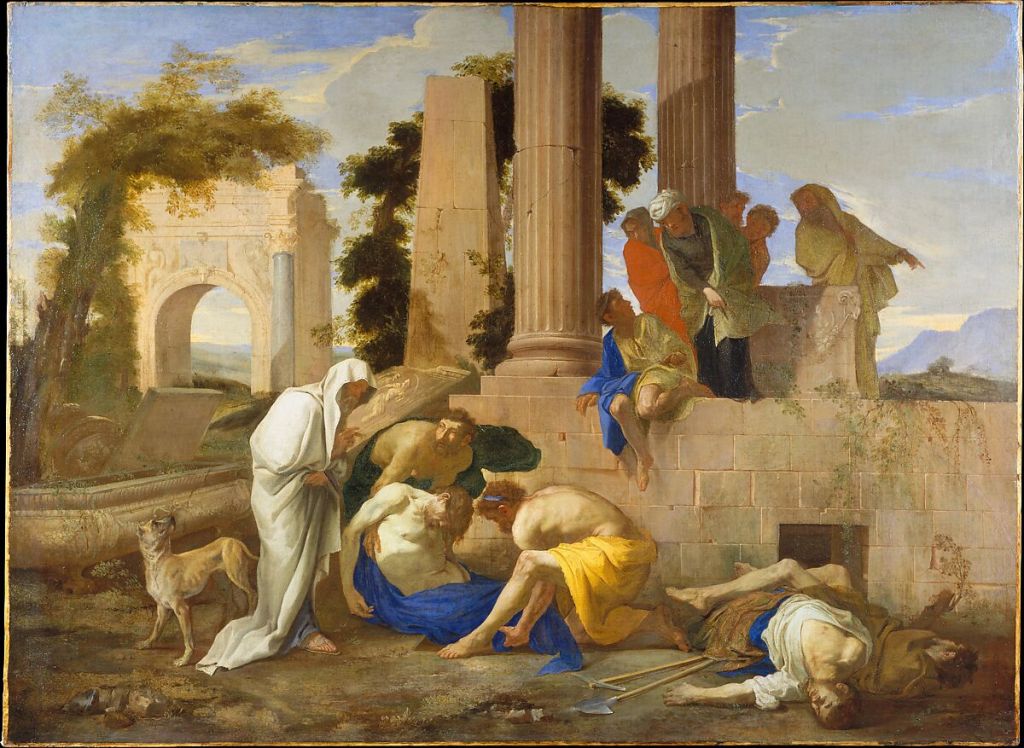
In today’s passage, Tobit introduces himself as a good man who wants to share his blessings with someone less fortunate. He sends his son Tobiah on the noble errand to find such a person. On his way, Tobiah discovers a murdered kinsman left unburied where he died. Upon hearing of it, Tobit “springs” into action, doing the right thing for this unfortunate victim. As a result of his righteous response, Tobit incurs the wrath not only of the Assyrian overlords, but also of his wimpy Israelite neighbors who are too afraid (or lazy) to keep the Mosaic Law while in exile.
Tobit Burying the Dead – Andrea DiLeone
Big lessons from this reading? Remember, the author of Tobit was writing for a community that had been ripped from their spiritual and material home. They knew the waning hope of one in exile. They needed to be reminded of and supported by stories of covenantal fidelity – both God’s and humanity’s.
By the rivers of Babylon we sat and wept when we remembered Zion.(Ps.137)
But even if our lives are not quite so dramatic as theirs, the reading holds quite a few lessons for us as well.
Circumstances may cause one to feel “exiled” from the comfort of their faith, but it is essential to retain a stabilizing religious devotion and practice.
It is important to invite and include others, especially the young, in the faithful practice of charity and justice.
It is normal and healthy to grieve the spiritual losses or emptiness we may experience. Such recognition is a first step to healing, and can give us the release to move on to what we need to do:
Returning to my own quarters, I washed myself and ate my food in sorrow. I was reminded of the oracle pronounced by the prophet Amos against Bethel: “All your festivals shall be turned into mourning, and all your songs into lamentation. And I wept. Then at sunset I went out, dug a grave, and buried him.
Tobit 2:5-7
Prose: How to Be Hopeful by Barbara Kingsolver, from her commencement address at Duke University, May 11, 2008
HOPE: AN OWNER’S MANUAL
Look, you might as well know, this thing
is going to take endless repair: rubber bands, crazy glue, tapioca, the square of the hypotenuse. Nineteenth century novels. Heartstrings, sunrise: all of these are useful. Also, feathers.

To keep it humming, sometimes you have to stand on an incline, where everything looks possible;
on the line you drew yourself. Or in
the grocery line, making faces at a toddler secretly, over his mother's shoulder.

You might have to pop the clutch and run
past all the evidence. Past everyone who is laughing or praying for you. Definitely you don't want to go directly to jail, but still, here you go, passing time, passing strange. Don't pass this up.

In the worst of times, you will have to pass it off.
Park it and fly by the seat of your pants. With nothing in the bank, you'll still want to take the express.
Tiptoe past the dogs of the apocalypse that are sleeping in the shade of your future. Pay at the window.
Pass your hope like a bad check.
You might still have just enough time. To make a deposit.
Today, in God’s Lavish Mercy, Isaiah greets us once again with the inspiring phrase, “On that day …”
That day … the one whose dawning we are all awaiting, when all shall be complete and well in God:
There shall be no harm or ruin on all my holy mountain; for the earth shall be filled with knowledge of the LORD, as water covers the sea.
Isaiah 11:9
How will we know when that day has come? Will it be dramatically different from today or yesterday? Will time have paused and the world be turned upside down?
Or will it simply be that in my heart – right here and now – a “new day” has dawned?
Isaiah indicates that the “new day” is potentially present in the day we have, that when we see experience through God’s eyes, the stagnated stump of our lives blossoms in sacred possibility.
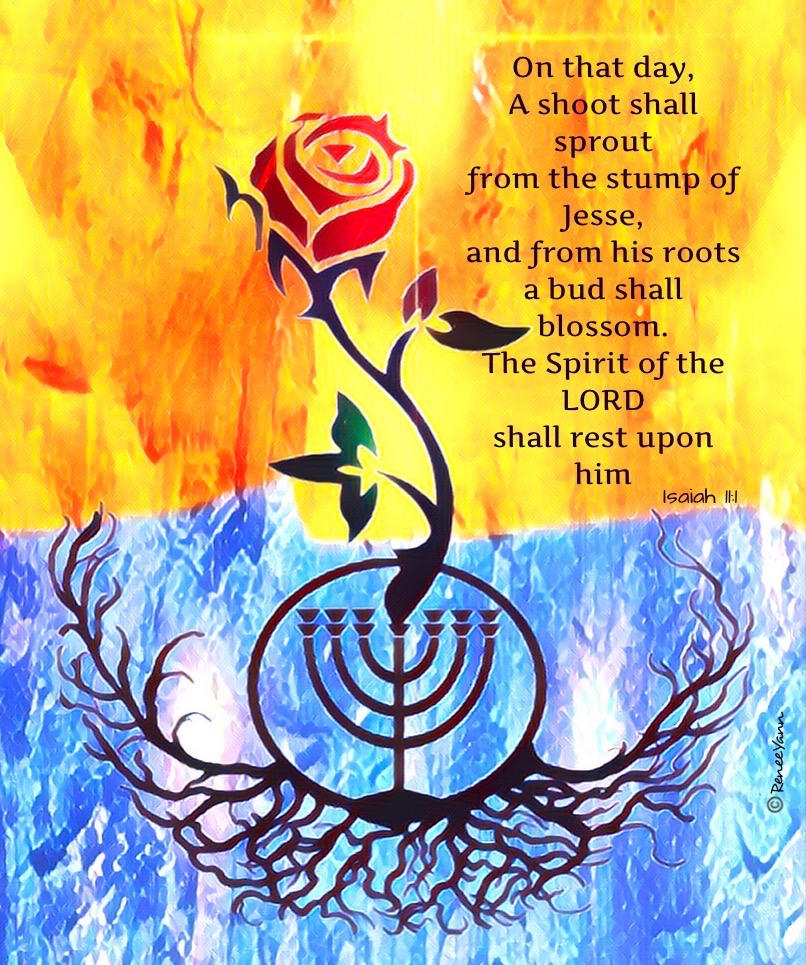
On that day, A shoot shall sprout from the stump of Jesse, and from his roots a bud shall blossom.
Isaiah 11: 1
What a glorious description Isaiah offers us of the world transformed by the longed-for Messiah, that shoot which shall sprout from the stump of Jesse:
The Spirit of the LORD shall rest upon him: a Spirit of wisdom and of understanding, A Spirit of counsel and of strength, a Spirit of knowledge and of fear of the LORD, and his delight shall be the fear of the LORD. Not by appearance shall he judge, nor by hearsay shall he decide, But he shall judge the poor with justice, and decide aright for the land’s afflicted. He shall strike the ruthless with the rod of his mouth, and with the breath of his lips he shall slay the wicked. Justice shall be the band around his waist, and faithfulness a belt upon his hips.
Isaiah 11:2-5
As we pray these magnificent words this morning, we should let them thrill us with the truth that the “new day” has come! Indeed, since Christ has transformed us through his Incarnation, that “new day” dawns through us when we choose to live our lives impelled by its graces.
In our Gospel, Jesus says we can live in that divine possibility simply by trusting God the way a child trusts.
Jesus rejoiced in the Holy Spirit and said, “I give you praise, Father, Lord of heaven and earth, for although you have hidden these things from the wise and the learned you have revealed them to the childlike. Yes, Father, such has been your gracious will. All things have been handed over to me by my Father. No one knows who the Son is except the Father, and who the Father is except the Son and anyone to whom the Son wishes to reveal him.”
Luke 10:21-22
Let’s know and believe that Jesus turns to us as well as we pray today’s Gospel:
Turning to the disciples in private he said, “Blessed are the eyes that see what you see. For I say to you, many prophets and kings desired to see what you see, but did not see it, and to hear what you hear, but did not hear it.”
Luke 10:23-24
Poetry: Advent Good Wishes – David Grieve
I found this poem in a book by one of my favorite poets, Malcolm Guite. It’s a great book for Advent if you are interested.
Give you joy, wolf,
when Messiah makes you meek
and turns your roar into a cry that
justice has been done for the poor.
Give you joy, lamb,
when Messiah saves you from jeopardy
and all fear is overwhelmed
by his converting grace.
Give you joy, wolf and lamb together,
as Messiah brings worldwide peace
and, side by side, you shelter
under Jesse’s spreading shoot.
Music: Memory – Trevor Nunn / Thomas Stearns Eliot / Andrew Lloyd-webber / Otto Eckelmann
In this beautiful song from Cats, the writers tap some of the same feelings Isaiah calls up – acknowledgement of the night, hope for the morning, and trust that “that new day” can begin.
Today, in God’s Lavish Mercy, we earnestly begin the Book of Revelation. These twelve days of passages will close out the liturgical year before Advent.
The Book of Revelation, also commonly known as the Apocalypse, is one of the most controversial in the Bible. Scholars disagree as to its author, its meaning, its literary genre and even its place in the biblical canon.
Wherever we might fall in this spectrum of interpretations, the book still can inspire us to prayer and reflection.
In today’s passage, the author addresses the first of seven churches to whom he will write – the church at Ephesus. He praises them and says that God is pleased with their work, their endurance and their fidelity. That must have made them feel pretty good, right?
But then, the heart-breaking line:
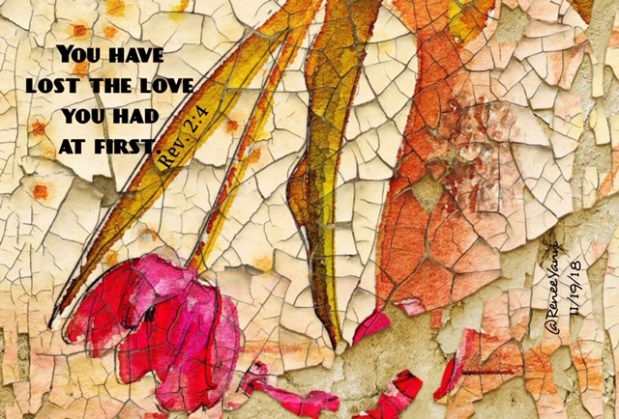
Yet I hold this against you: you have lost the love you had at first.
We might easily find ourselves in this passage. We’re trying hard to be faithful Christians. But, depending on where we are in our lives, have we lost that first fervor?
The continual grind of work, ministry, family and community responsibility can dim that first fire. Maybe the fresh flower has been choked in the daily weeds. Just the accumulation of years may obscure it. Just the unnoticed indifference within and around us can smother the love that once propelled us to choose God as our Everything.
Perhaps with the blind person in our Gospel, we might beg God to let us see where our faith has become dim or even blinded:
The people walking in front rebuked the blind man, telling him to be silent, but he kept calling out all the more, “Son of David, have pity on me!” Then Jesus stopped and ordered that he be brought to him; and when he came near, Jesus asked him, “What do you want me to do for you?” He replied, “Lord, please let me see.” Jesus told him, “Have sight; your faith has saved you.”
Luke 18:39-42
Today, let’s try to remember that first love which turned our hearts to God and to God’s work in the world. Let’s ask our generous God, Who longs for our love, to renew our passion and energy for the Divine Adventure.
Poetry: Consumed in Grace – Catherine of Siena
This poem is from a wonderful book which I highly recommend to you:
I first saw God when I was a child, six years of age.
The cheeks of the sun were pale before Him,
and the earth acted as a shy
girl, like me.

Divine light entered my heart from His love
that did never fully wane,

though indeed, dear, I can understand how a person’s
faith can at times flicker,

for what is the mind to do
with something that becomes the mind’s ruin:
a God that consumes us
in His grace.

I have seen what you want;
it is there,
a Beloved of infinite
tenderness.
Today, in God’s Lavish Mercy, we celebrate all those canonized and uncanonized sisters and brothers who lived their lives in Christ with gusto and fidelity.
The feast of All Saints, on its current date, is traced to the foundation by Pope Gregory III by (731–741) of an oratory in St. Peter’s for the relics “of the holy apostles and of all saints, martyrs and confessors, of all the just made perfect who are at rest throughout the world”. (Wikipedia)
I’ve personally known many of these saints, whether I fully recognized their sanctity or not. They have lived in my family, school, neighborhood, parish, ministries, and workplaces. Some were clothed as nuns and some as beggars. Some taught me by words and some by silence. I knew some by name, others by grace. Now they have all joined the eternal family watching over us and cheering for us.
There they have formed communion with my more recognized and favorite holy friends like Mary, Joseph, Teresa of Avila, Catherine of Siena, Kateri Tekawitha, Anna the Prophet, John XXIII, and of course Catherine McAuley.
What a wonderful day to know that these beloveds of God are our sisters and brothers, who pray with and for us that we may one day rejoice with them in eternal light.
Who are the saints that speak especially to your heart? Take time to have a nice conversation with them on this glorious feastday!
If you are interested in learning more about the saints, this is a wonderful book by Father James Martin, SJ.
Poetry: All Saints Day – Ada Cambridge, (1844 – 1926), later known as Ada Cross, was an English-born Australian writer. She wrote more than 25 works of fiction, three volumes of poetry and two autobiographical works. Many of her novels were serialized in Australian newspapers but never published in book form.
“But they are at peace.”
Never to weary more, nor suffer sorrow,— Their strife all over, and their work all done: At peace—and only waiting for the morrow; Heaven’s rest and rapture even now begun.
So tired once! long fetter’d, sorely burden’d, Ye struggled hard and well for your release; Ye fought in faith and love—and ye are guerdon’d, O happy souls! for now ye are at peace.
No more of pain, no more of bitter weeping! For us a darkness and an empty place, Somewhere a little dust—in angels’ keeping— A blessèd memory of a vanish’d face.
For us the lonely path, the daily toiling, The din and strife of battle, never still’d; For us the wounds, the hunger, and the soiling,— The utter, speechless longing, unfulfill’d.
For us the army camp’d upon the mountains, Unseen, yet fighting with our Syrian foes,— The heaven-sent manna and the wayside fountains, The hope and promise, sweetening our woes.
For them the joyous spirit, freely ranging Green hills and fields where never mortal trod; For them the light unfading and unchanging, The perfect quietness—the peace of God.
For both, a dim, mysterious, distant greeting; For both, at Jesus’ cross, a drawing near; At Eucharistic gate a blessed meeting, When angels and archangels worship here.
For both, God grant, an everlasting union, When sin shall pass away and tears shall cease; For both the deep and full and true communion, For both the happy life that is “at peace.”
Music: All Saints Day – featuring “Lifesong” by Casting Crowns (lyrics below)
Empty hands held high Such small sacrifice Now joined with my life I sing in vain tonight
May the words I say And the things I do Make my lifesong sing Bring a smile to you
Let my lifesong sing to you Let my lifesong sing to you I want to sign your name To the end of this day
Lord led my heart was true Let my lifesong sing to you Lord I give my life A living sacrifice To reach a world in need To be your hands and feet
So may the words I say And the things I do Make my lifesong sing Bring a smile to you
Let my lifesong sing to you Let my lifesong sing to you I want to sign your name To the end of this day
Knowing that my heart was true Let my lifesong sing to you Hallelujah, Hallelujah let my lifesong sing to you Hallelujah, Hallelujah let my lifesong sing to you
Hallelujah,… Let my lifesong sing to you Let my lifesong sing to you I want to sign your name To the end of this day
Knowing that my heart was true Let my lifesong sing to you Let my lifesong sing to you Let my lifesong sing to you I want to sign your name To the end of this day Lord led my heart was true Let my lifesong sing to you
Today, in God’s Lavish Mercy, we have the option of celebrating the Memorial of Our Lady of Mount Carmel in place of the 15th Saturday in Ordinary Time. And since it is Saturday, traditionally Mary’s day, I have chosen to pray with those readings.
Our Alleluia Verse captures in a short sentence exactly why Mary is the perfect model for a Christian life: she heard and acted on God’s word.
Alleluia, alleluia. Blessed are those who hear the word of God and observe it.
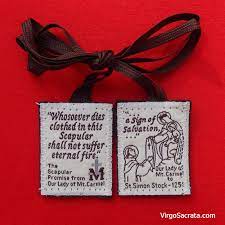
Many of you will have been introduced to Our Lady of Mt Carmel as young children. Perhaps you, as I did, received a brown scapular when you made your First Communion. My second grade teacher convinced me that, by wearing that scapular, I had become a very dedicated Christian and friend of Jesus and the Blessed Mother.
According to the Vatican’s Congregation for Divine Worship, the Brown Scapular is “an external sign of the filial relationship established between the Blessed Virgin Mary, Mother and Queen of Mount Carmel, and the faithful who entrust themselves totally to her protection, who have recourse to her maternal intercession, who are mindful of the primacy of the spiritual life and the need for prayer.
Wikipedia
My little brown scapular is long gone, set aside perhaps when my maturing fashions were inhibited by it in seventh of eighth grade. But the devotion to Mary which it initiated has never left me. It has grown, changed and deepened over these seventy years, but its roots are still entwined with that sepia necklace Sister Grace Loretta once placed in my little hand.
When I entered the Sisters of Mercy in the early 60s, I was so delighted that Our Lady of Mt. Carmel was honored as one of our patron saints. We did it up big back then by wearing our church cloaks and special habit sleeves to Mass on her feastday.
As I pray the Magnificat in today’s Responsorial Psalm, I reflect that Mary has become not only a trusted friend and model for my spiritual life. Her profound faith and poverty of spirit challenge and inspire my deeper understanding of the Gospel in today’s world.
The Mary I love today is a very different woman from the one I idealized in my youth. This change in perception has come about through reflection on the works of modern theologians such as those referred to below. Some of these books are out of print and/or expensive but reviews and excerpts are available online and can be helpful to one’s prayerful study.
For today’s prayer, let us open our hearts to the deep inspiration of Mary of Nazareth. I have referred readers to this excellent article by Elizabeth Johnson — and I do so again — as a great place to start:










 Lavish Mercy