Law or Love?

Tuesday, April 2, 2019

Click here for readings

Today, in Mercy, our readings bring to mind the role of religion in our spiritual life.

take up mat 2

The dictionary defines religion as a particular system of faith and worship. The origin of the word “religion” is from the Latin “religare”: to bind.

In the magnificent passage from Ezekiel, we are given a metaphorical description of grace flowing from the Temple, the locus of faith for Israel. Ezekiel is led by a radiant vision to this source of abundant life symbolized by water. Slowly and incrementally, this abundance deepens for Ezekiel, until he is swimming in its grace. 

Ezekiel’s vision demonstrates what happens in us when religion, ritual and law enhance grace. The beauty, power and architectural symmetry of the Temple symbolize the great benefits of religious practice.

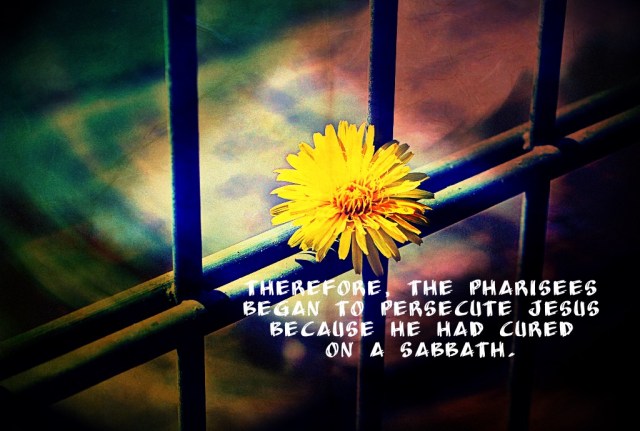
Our Gospel, on the other hand, shows us a Pharisaical religion built on empty practice and bereft of heart. When Jesus cures on the Sabbath, he moves beyond these skeletal boundaries to mercy, which is the reason for all religious practices.

take up mat
Jesus Cures on the Sabbath

Jesus shows us that when religion – and its ensuing ritual and law – bind grace, it needs to be set aside. His whole life was predicated on a faith which generated mercy, not sacrifice. The alleviation of suffering and need always supersede observance – even on the Sabbath.

When we see any so-called faith or religion which places law over mercy, we see an empty temple where the river of grace has run dry. Our culture is filled with fake holiness that measures, condemns and ostracizes others. We see religion distorted into political bullying. We see it redefined as an excuse for excessive wealth. We even see it used as legitimization for nationalism, violence, racism, and war.

Today’s readings tell us to be on guard. The forces which twist religion are very subtle and pervasive in our culture. They dress themselves in impressive words and practices, just like the Pharisees did, but their costumes hide an ugly hate and fear.

To the fearful and weak, these forces preach power – but it is a power over not for others.

Jesus has shown us what faithful practice looks like: mercy and love. It is vulnerable, courageous, inclusive, and humble. It sees the suffering of others and responds. It waters the Temple of our hearts to make them verdant with hope, joy and generosity.

Music: Come to the Water – John Foley, SJ and Matt Maher

To See As God Sees

Tuesday, March 26, 2019

Click here for readings

Today, in Mercy, our readings describe God’s lavish mercy and the expectation for our reciprocity.

love one another

The passage from the Book of Daniel, written in lilting prose, quotes the prayer of Azariah. It gives us several phrases to savor in our own prayer, depending on the particular disposition of our heart on any given day:

To whom you promised …. like the stars of heaven, or the sand on the shore of the sea.
What has God promised you to give you hope in your life? Can you call on those promises today in your prayer?

For we are reduced, O Lord, beyond any other nation…
Are you feeling sad, disconnected, humiliated or depressed? Can you give these feelings to God and open your heart to healing?

We have in our day no prince, prophet, or leader,
no burnt offering, sacrifice, oblation, or incense,
no place to offer first fruits, to find favor with you.
Do you ever feel abandoned by the institutions we all once depended on, whether Church, government, law etc.? Can we pray for the courage to depend only on God in all things?

Now we follow you with our whole heart…
Have our life circumstances brought us to the point of placing ourselves totally in God’s care? Can we pray with that peaceful and holy abandonment?

Deliver us by your wonders, and bring glory to your name, O Lord.Can our prayer be one of giving glory to God for all the blessings in our lives?

God has been so good to us! Our Gospel enjoins us to be reciprocally good to others.

Music: Give Me Your Eyes – An interesting song by rock singer Brian Heath. As his plane is landing one night, he receives a grace to pray for new eyes — eyes that see and love  all humanity as God does.

A Warning Sign

Thursday, March 21, 2019

Click here for readings

generous impulse

Today, in Mercy, our Gospel gives us the disturbing parable of the rich man, sometimes called Dives, and Lazarus, a very poor man.

The story is disturbing because 

  • Lazarus suffers so desperately 
  • Dives is impervious to that suffering 
  • God won’t give Dives a break after his death
  • We fear being in either of these guys’ situations 

Probably, like most people, we’d rather be rich than poor. But would we rather be generous with that wealth or selfish? Do we ever find ourselves thinking thoughts like this, deciding we’re not responsible for the gap between rich and poor:

“I worked hard for what I have. Let everybody else do the same!”

That wealth gap cannot be mended simply by giving a dollar to a corner beggar nor by donating our wornout clothes to Goodwill. This kind of re-balancing requires a conversion of heart which touches our economic, political and moral understanding.

I was struck this morning by this headline from The Economist, a British weekly magazine.

economist

How can today’s Gospel inspire and encourage us in a global culture that infcreasingly marginalizes persons who are poor, resourceless, and politically oppressed?

May the story of Lazarus and Dives influence us to use the powers we have to make just and generous decisions.

  • We can vote for just, generous and moral leaders. 
  • We can advocate for universally just policies. 
  • We can donate to compassionate causes. 
  • We can confront hateful speech and stereotyping. 
  • We can speak and act for justice, peace, inclusivity and mercy.

We just have to be courageous before, like Dives, it is too late for us.

Music:  Act Justly

Can You Drink the Cup?

Wednesday, March 20, 2019

Click here for readings

Mt20_22 cup

Today, in Mercy, our Gospel tells the story of Mrs. Zebedee, who sought a prejudiced advantage for her two disciple sons.

Jesus said to her, “What do you wish?”
She answered him,
“Command that these two sons of mine sit,
one at your right and the other at your left, in your kingdom.”

Sounds a little like something ripped from today’s headlines, doesn’t it.

headline

There is a natural inclination to advantage those we love. But when we do so to the unjust disadvantage of others, that’s a problem.

We know from experience that people use various points of leverage to gain advantage in life. We see people use money, power, political connections, and other influences to get a job, choose a school, land an important invitation, get a traffic ticket written off, etc., etc. Maybe, on occasion, we are one of those people.

Today’s Gospel teaches us a lesson. In gaining such advantage, we may, as Jesus says, “not know what we are asking for”. Can we actually DO the job, succeed in the school, … become a better person by what we have maniputively gained?

The Gospel also brings before us the “other people” who lost the right to what we unjustly claimed. How do they begin to see us? What do we lose in respect and mutuality within our community? How do we begin to see ourselves in relationship to justice, honesty, sincerity and truth?

Jesus hopes that we will love every person to the extent that we want her/his just advantage as much as we want our own? That is the “cup” He drinks through his Passion and Death.

Let us ponder Jesus’s question to us: Can you drink the cup that I will drink?

Music:  The More I Seek You ~ Gateway Worship

This One’s Pretty Difficult!

Monday, March 18, 2019

Click here for readings

Today, in Mercy, Jesus tells us to be merciful, as God is merciful.

I think that’s really hard.

Lk6_36 be merciful

Being merciful is not too hard with poor, unfortunate souls for whom life is one tragedy after another.

It’s not too hard when someone innocent is suffering unjustly.

But, gosh, it’s difficult to be merciful in the face of meanness, stupidity, selfishness and arrogance.

Yet God is merciful to me when I’m like that.

The Gospel’s message is painfully straightforward. It calls me to examine all my judgmental thoughts and actions and to reverse them.

I don’t know about you, but I’m going to be busy for a while working on this one.

Music: The Mercy Song – Paul Alexander

Take It Up a Notch

Friday, March 15, 2019

Click here for readings


Mt5_24 brother
Today, in Mercy, Jesus tells us to take it up a notch. It’s not good enough, he says, not to kill people.

You have heard that it was said to your ancestors,
You shall not kill; and whoever kills will be liable to judgment.
But I say to you …

When we first read this, we might think we’re pretty safe. After all, how many of us actually kill people?!?! 

But let’s check that, Jesus says:

  • Don’t remain angry with your sister/brother
  • Don’t call them  “empty head” (raqa)
  • Don’t call them fools 

Jesus seems to be telling us that there are many ways to kill!

  • We can kill the possibility of relationship by our unresolved angers, grudges, sustained hatred of people.
  • We can kill hope in someone by labeling them stupid or foolish.
  • We can easily kill someone’s reputation by a false or injudicious word.
  • We can kill joy by our indifference.
  • We can kill love with ingratitude.
  • We can kill innocence with any of the seven deadly sins

It takes vigorous spiritual attention to live at the level Jesus is asking of us. Let’s give our souls that particular attention, especially during our Lenten journey.

Music: The Servant Song – Maranatha

God’s Beloved Least Ones

Monday, March 11, 2019

Click here for readings.

Today, in Mercy, the voice of the Lord, in both Leviticus and Matthew, makes one thing abundantly clear: God lives in the “least ones”, and this is where we must love and serve God.

Mt25_45 least

In our first reading, God tells the people to be holy – not by offering God sacrifice and praise, but like this:

  • Don’t steal.
  • Don’t lie.
  • Don’t make an empty vow.
  • Don’t cheat.
  • Don’t hurt those already hurting.
  • Don’t make false judgments.
  • Don’t be prejudiced.
  • Don’t do nasty gossip.
  • Don’t ignore your neighbor’s need.
  • Don’t hate, take revenge on, or begrudge others.

In other words, 

You shall love your neighbor as yourself.
I am the LORD.

We are so accustomed to this passage that we may miss how startling it is! God asks nothing of us for himself! God asks only that we love God through our neighbor.

In Matthew’s Gospel, Jesus reiterates this command in the form of positive actions, adding how we will be judged by it. Jesus says:

  • Feed the hungry.
  • Hydrate the thirsty.
  • Welcome the stranger.
  • Clothe the naked.
  • Care for the sick.
  • Visit the imprisoned.

We are called to these works of mercy on many levels. Certainly the call is first to the physically suffering – the homeless, the refugee, the uncared for, the abused.

But we also know from our own experience that there are all kinds of hungers and thirsts in the human heart. There is a loneliness that persists even in a crowd. There is naked fear, depression and isolation even among those otherwise warmly dressed. There are sicknesses that come from selfishness and others that come from abandonment. There are prisons without bars.

We do not have to look far to find the “least ones” whom God wishes us to love and serve.

We do not have to look far to find God. We just have to look deep.

Music: The Circle of Mercy – Jeannette Goglia, RSM

What Return Can I Make?

Tuesday, March 5, 2019

Click here for Readings

Today, in Mercy, our readings challenge us to consider what we might offer to God in return for all the good we have received.

Ps50_praise

When I was young, and on a stressful occasion still, I have been known to bargain with God.  It goes something like this:
“Dear God, please, if You will only do X, I promise to do Y.”

The process reminds me of a game my Uncle Joe played with me when I was a toddler. He would give me some pennies to buy candy from him that he had just purchased at the corner store. He intended to teach me simple math. But I also learned what is was like to have resources, to possess buying power.

The glitch in the process was this: none of the resources really belonged to me. Everything belonged to Uncle Joe who allowed me to use his resources to learn and grow.

When we think about what we can offer God, it’s sort of a similar model. We have nothing that doesn’t first and already belong to God. We can give God nothing to “buy” God’s love and grace. God gives these freely and without restriction.

All that we really have to offer God is our love, demonstrated by our charitable actions. That’s what Sirach is talking about today.

In our Gospel, Peter – ever a guileless and simple soul – wants to make sure Jesus knows how much Peter has given up for God. Jesus affirms Peter’s offering, but says that God’s generosity exceeds it a hundredfold.

We live in loving relationship with an infinitely generous God. Our only currency in this relationship is the return of love, praise and thanksgiving.

When I regress to my bargaining stance with God, I think God smiles at me the way Jesus probably smiled at Peter. The smile says, “I am already giving you everything you need. Let yourself rest in Me.”

Music: To God Be the Glory ~ Andrae Crouch

Let the Children Come to Me

Saturday, March 2, 2019

 Click here for readings

Mk10_14

Today, in Mercy, let this picture carry home the message of today’s Gospel for our time. Let us consider our moral and civic responsibilities to this child and the thousands like him throughout the world.  Let us pray in the spirit of Jesus to understand what Mercy requires of us.

Enough said.

If you would like to help our Sister Anne Connolly working directly at our southern border with refugee families:

Gifts may be sent to:
Sisters of Mercy
(Please mark “Border Aid”)
c/o Sisters of Mercy-Border Aid
Development Office
515 Montgomery Avenue
Merion, PA.  19066

If you would like to connect directly with  Sister Anne:
(215) 539 7393
annecbba@yahoo.com

Music: Take All the Lost Home 


A Covenant of Love

Sunday, February 24, 2019

Click here for readings

Today, in Mercy, our reading from 1 Samuel tells the intriguing tale of David’s magnanimity toward Saul. Saul is enraged and jealous of David whom Samuel has anointed as king to replace Saul. David is continually in Saul’s crosshairs.

But one night, David stealthily enters Saul’s camp. Even though he has a chance to kill Saul, David spares his life out of respect for his kingship.

While it’s not exactly “love for his enemies”, David does demonstrate a largeness of spirit that foretells today’s Gospel. This gracious spirit demonstrates that David is in right relationship (covenant) with God.

Our Gospel is part of Jesus’s Great Sermon in which he restates and renews the covenant of right relationship. If our spirits are true to God, we will love as God loves. We are to be merciful as God is merciful.

Lk6_38 measure

This Law of Love is the essence of life in Christ. It is a profoundly challenging call.

How hard it must have been for David as he stood, spear in hand, over his sleeping enemy – over the one trying to kill him!

How hard it is for us not to be vengeful, retaliatory, and parsimonious when we feel threatened or exploited.

But we are called, in Christ, to the New Covenant of love. By that call, we are endowed with a right spirit.

Today, Jesus asks us to love, forgive, and judge all others as we ourselves would want to be treated. He asks us to live with a divinely magnanimous heart.

Let us pray for the strength to respond.

Music: O Mercy – Stu Garrard, Matt Maher and Audrey Assad