Unless…

Feast of Saint Lawrence, Deacon and Martyr

August 10, 2019
Click here for readings

St. Lawrence
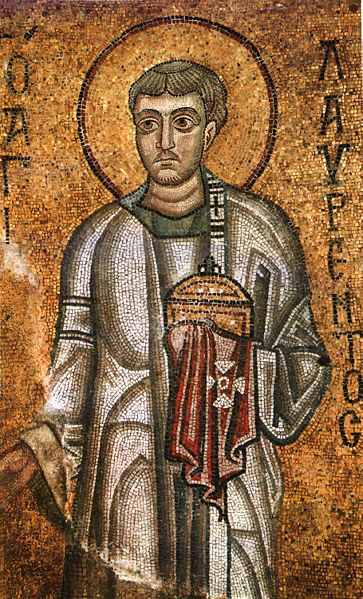
Saint Lawrence. Mosaic from the Saint Sophia Cathedral in Kiev.

Today, in Mercy, we celebrate the feast of St. Lawrence who is noted for his love for those who were poor. Legend has it that Lawrence was demanded, before his martyrdom, to turn over the Church’s riches to the emperor Valerian. Instead, he distributed all the resources among the poor. Lawrence then gathered all these people, presenting them before Valerian with these words:

Behold in these poor persons
the treasures which I promised to show you –
these are the true treasures of the Church.

Lawrence was likely inspired by readings like today’s. In Corinthians, Paul encourages us to be cheerful givers. He says this delights God, the Giver of Divine Abundance, whom we are imitating.
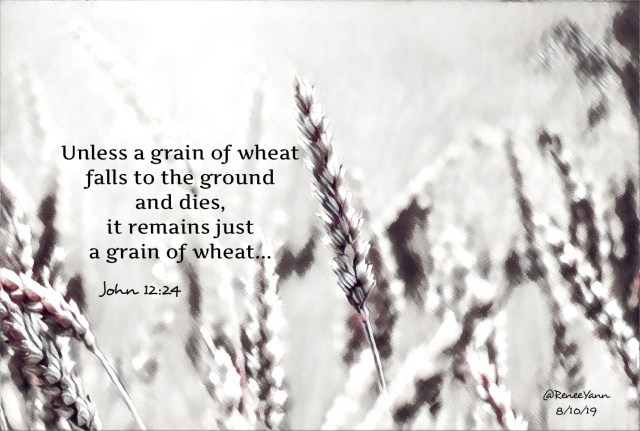
John12_24 grain wheat

In our reading from John, Jesus says that only in dying to ourselves do we live – the ultimate generosity. He says that only by doing this can we truly follow him.

While these readings are clear and simple, they are so profound that we can hardly take in their message. What they ask of us is daunting! The encouragement Jesus gives us to respond to his challenge is this:

The Father will honor whoever serves me.

St. Lawrence believed and lived this promise. What about us?

Music: Before the Bread – Elizabeth Alexander

We all want our lives to be full and complete – to be “bread”. But there are many steps before the grain of wheat becomes bread, as captured in this elegant acapella canon.

Honor Those Who Bore You Life

Memorial of Saints Joachim and Anne, Parents of the Blessed Virgin Mary

July 26, 2019

Click here for readings

Today, in Mercy, our Exodus reading coincides perfectly with today’s Memorial Feast for Anne and Joachim, grandparents of Jesus.

Exodus20_5

In the passage, we have one of many Old Testament formulations of the Ten Commandments. We learned these codes as children, and perhaps have always interpreted them as laws which, when broken, marked us as sinners.

While this is one approach, a more mature and life-giving one is offered by the Biblical scholar Terence E. Fretheim:

The focus (of these directives) is on
protecting the health of the community,

to which end the individual plays such an important role.
Exodus: Interpretation: A Biblical Commentary for Teaching and Preaching

The command to honor one’s father and mother clearly demonstrates this approach. It is a command not only for children to be docile and obedient. Rather it denotes a life-long responsibility to care for parents and other  nurturers of our lives. The command also suggests the responsibility of these nurturers to live honorably so that their children may respond to their example with equal honor.

Today is a day to pray for our own families and for all families, for the young and the elderly, and for those walking the tenuous bridge in between.  It is a day to assess how well we carry our responsibilities to honor, obey, bless and foster life for one another.

It is a day to be deeply grateful for the love of family which we are blessed to experience; a day to pray for healing for those not equally blessed. Let us pray for families distressed by the necessity to migrate, and further burdened by nations’ failures to keep the commandment of neighborly love.

Like Mary, may we embrace the elders in our lives who love and need us, be these parents, mentors, community members, or neighbors. Scripture promises us that, in doing so, we shall have “mercy bestowed on us down to the thousandth generation.”

Music: Love Remains – Hillary Scott

Fount of Love and Mercy

Solemnity of Most Sacred Heart of Jesus 

Friday, June 28, 2019

Clcik here for readings

Today, in Mercy, we celebrate the feast of the Sacred Heart, a day of deep devotion and gratitude for God’s lavish mercy to us.

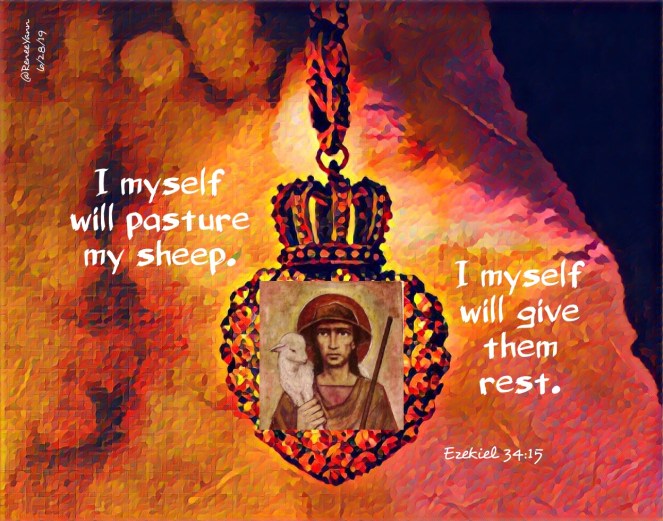
All of our readings today suggest the image of a good shepherd caring for his sheep. This metaphor, perhaps more meaningful for the agrarian society in which these scriptures were written, still retains for us the imagery of tenderness, attentive responsibility, strength, protection, and vigilant presence.

Ez34_15 shepherd

Our first reading comes from Ezekiel whose ministry occurred in Babylon during the second captivity there. God calls Ezekiel to prophesy against Israel’s leaders who have forgotten their defenseless sheep, who have fed themselves instead of their flock. Today’s particular verses have God speaking, taking over the shepherding duties, because the human “shepherds” (kings and priests) have so badly failed their sheep. 

The Lord makes clear who will be the beneficiaries of his tenderness:

The lost I will seek out,
the strayed I will bring back,
the injured I will bind up,
the sick I will heal,
but the sleek and the strong I will destroy,
shepherding them rightly.

As I prayed with this passage, I was struck by the awareness of how some things never change. The parallels to our Church and society are painfully evident. Immorally self-indulgent “pastors” and self-serving, indifferent leaders still plague their “flocks”. The poor and weak are still abandoned by those they had depended on.

Our reading from Romans and Matthew raise before us the model of Jesus Christ, the Good Shepherd who both renders us infinite compassion, and teaches us how to dispense it as his disciples. We are invited to become one with the sacred, compassionate Heart of Jesus, being healed ourselves to become healers.

Take my yoke upon you, says the Lord,
and learn from me,
for I am meek and humble of heart.

Our world aches for this healing. Let us pray together today for God to inspire and energize us to be Mercy for our world.

Music: Sweet Heart of Jesus – sung by the Irish soprano Maureen Hegarty

(I know this hymn is tinged with a bit of the old, sentimental spirituality. Still, I have loved it from my long-ago youth and it touches me deeply. I hope it will touch you as well.❤️ Lyrics below.)

Sweet Heart of Jesus!
Fount of love and mercy,
Today we come,
thy blessings to implore;
Oh touch our hearts, so
cold and so ungrateful,
And make them Lord,
Thine own for evermore.

Sweet Heart of Jesus!
We implore
Oh, make us love Thee
more and more.

Sweet Heart of Jesus!
Make us know and love thee.
Unfold to us
the treasures of thy grace.
That so our hearts, from
things of earth uplifted,
May long alone
to gaze upon Thy face.

Will We Live Our Faith Out Loud?

Tuesday of the Twelfth Week in Ordinary Time

June 25, 2019

Click here for readings

Today, in Mercy, we begin several weeks of readings from the Book of Genesis. 

Some people think of Genesis as a literal history. Others think of it more as a myth. Was there a real Adam and Eve? A real apple? A real snake?

When we get caught up in these ambivalences about Genesis, we are likely to miss the whole point. And the whole point, according to Hebrew Scripture scholar Walter Brueggemann is this:

… these texts should be taken neither as history nor as myth.
Rather, we insist that the text is a proclamation
of God’s decisive dealings with his creation. 


“God’s decisive dealings with God’s Creation…”

What a powerful phrase! So over the next few weeks, here is our opportunity:

How does God want to be with us,
to love us,
and to share the ongoing Creation with us?


Today’s reading, according to Brueggemann, is the second part of a four-part drama:

Genesis 11: 30—25: 18 “The Embraced Call of God”
Will Abraham live by faith? 

This second segment poses a profound question to us, and to our Church:
Have we embraced God’s call in our lives and will we live our faith OUT LOUD!

Jesus asks us the same question in today’s Gospel: Will we live our faith OUT LOUD?


Will we:
“Do to others whatever you would have them do to you.”

cage

How to help children at the border and in inhuman detention centers:

Click here.


Music: By Faith -Keith and Kristyn Getty

What is “Mammon” Anyway?

Saturday of the Eleventh Week in Ordinary Time

June 22, 2019

Click here for readings

Life’s dilemmas confound some of us:

Dickens


Today, in Mercy,  Jesus addresses the confounding problem of spiritual schizophrenia.

No one can serve two masters.
He will either hate one and love the other,
or be devoted to one and despise the other.
You cannot serve God and mammon.

Mammon (μαμωνᾷ), a concept that is rather simplistically translated as “money”, actually connotes a much more complex meaning. Strong’s Concordance of the Bible offers related words that help enrich our understanding of the word “mammon”:

  • Excess
  • Dis-ease
  • Unrighteousness 
  • Imbalance

This is the dissonance Jesus speaks to in today’s Gospel. “Money”, or possessions, – like good wine – in excess can dehumanize us. We can become entangled, addicted and covetous of it. We can forget who we truly are when we allow ourselves to drown in it. We can lose connection to the community in which we exist.

But we need “money”, don’t we? Very few people desire real material poverty. How does Jesus guide us to face this internal dichotomy?

Mt6_33 FIRST

Jesus says that our FIRST concern must be the Kingdom of God. Motivated by that core intention, the rest of our concerns will fall into proper place.  Pope Francis reiterates this truth for our times in the encyclical “Laudato Sì”. Let’s pray with it today:

Christian spirituality proposes an alternative understanding of the quality of life, and encourages a prophetic and contemplative lifestyle, one capable of deep enjoyment free of the obsession with consumption. We need to take up an ancient lesson, found in different religious traditions and also in the Bible. It is the conviction that “less is more”. A constant flood of new consumer goods can baffle the heart and prevent us from cherishing each thing and each moment. To be serenely present to each reality, however small it may be, opens us to much greater horizons of understanding and personal fulfilment. Christian spirituality proposes a growth marked by moderation and the capacity to be happy with little. It is a return to that simplicity which allows us to stop and appreciate the small things, to be grateful for the opportunities which life affords us, to be spiritually detached from what we possess, and not to succumb to sadness for what we lack. This implies avoiding the dynamic of dominion and the mere accumulation of pleasures. (223)

Music: Seek Ye First – Maranatha Singers

Is Scrooge My Hero?

Memorial of Saint Aloysius Gonzaga, Religious

June 21, 2019

Click here for readings

Today, in Mercy, Jesus puts the whole spiritual life in a nutshell:

Luke heart treasure

When I was a kid (and maybe even now), one of my favorite cartoon characters was Uncle Scrooge McDuck.

Scrooge

I was amazed to think that someone could accumulate all that money, and fascinated to see that all he wanted to do was sit on it!

Both Uncle Scrooge and Jesus pose some deep questions to us today.

  • How much do we really need to make us happy?
  • Will having it actually make us happy in the long run?
  • Where does our happiness come from, if we have happiness at all?

We have seen the theme in a hundred books and movies – poor little rich boy or girl starving for love. We all seem to realize that true wealth comes from love. But do we live and choose by that understanding?

Possessions can distract us from what is truly essential for our soul. Greed and selfishness can kill the Spirit within us.

Our coöptation by materialism and greediness doesn’t have to rise to the level of Scrooge’s mounted millions. So often a miserly heart is crippled by things much more complex than money. We can be sinfully stingy with:

  • our attention to those deemed unimportant
  • our kindness to those struggling with life
  • our forgiveness to the unappreciative 
  • our presuppositions about what belongs to whom

The following parable has always shaken me down at the root of my assumed entitlements:

A young woman was waiting to catch a flight in the boarding area of the airport. Given that her wait was going to be several hours she decided to buy a book to read along with a packet of cookies to enjoy. She sat down in an armchair in the VIP room of the airport to relax and read her book in peace. 

Beside the armchair where the packet of cookies lay, a man was seated next to her reading his magazine.  When the woman reached into the packet of cookies to take the first cookie, the man next to her also took one. She was irritated but said nothing. “What nerve this man has!” she thought.  For each cookie she took the man also took a cookie. 

She was infuriated but didn’t want to cause a scene. When only one cookie remained she thought to herself, “what will this horrible man do now?” The man reached down and broke the cookie into even halves and handed one half to her. It was more than she could handle!  She grabbed her things in a huff, refused the half, and stormed off to the boarding area.  

When she got onto her seat on the plane she reached into her purse to get her reading glasses and, to her surprise, her packet of cookies was sitting there untouched and unopened.

We might wish to spend some prayer time considering the application of this story to our own attitudes.

Music: Where Your Treasure Is – Marty Haugen

Be Perfected in Mercy

Tuesday of the Eleventh Week in Ordinary Time

June 18, 2019

Click here for readings

Today, in Mercy, both Jesus and Paul teach us about the true meaning of charity and community.

Mt5_43_48 PerfectJPG

Throughout his journey among the Gentile Christians, Paul conducts a collection for the poor of the Jerusalem Church.


Galatians 2:9-10

James, Cephas, and John, those esteemed as pillars, gave me and Barnabas the right hand of fellowship when they recognized the grace given to me. They agreed that we should go to the Gentiles, and they to the circumcised. All they asked was that we should continue to remember the poor, the very thing I had been eager to do all along.


Romans 15:25-26

Now, however, I am on my way to Jerusalem in the service of the Lord’s people there. For Macedonia and Achaia were pleased to make a contribution for the poor among the Lord’s people in Jerusalem.


In today’s passage, Paul encourages the Corinthians to contribute by holding up to them the generosity of the churches of Macedonia. Great strategy, eh?

In our Gospel, Jesus shows how deep our generosity, hospitality, mercy, forgiveness,  and love should be: boundless. He gives such a reasonable argument:

For if you love those who love you,
what recompense will you have?
Do not the tax collectors do the same?

Jesus tells us that we must far exceed the tax collectors, that we must be “perfect as our Heavenly Father is perfect” – perfected, whole, and completed by Mercy and Love.

For Paul, this meant embracing both the Jewish and Gentile Christians as one community.

For Jesus, it means loving all Creation as God Loves.

Beloved friends, what does it mean for us?

Music: In Perfect Charity – Randall deBruyn (Lyrics below)

Verse 1

O most high and glorious God,
Cast your light into the darkness of my heart.
Give me right faith, and certain hope,
And perfect, perfect charity.
Give me true insight, Lord, and wisdom,
That I may always live within your ever holy will,
Lord may your light within me burn,
Shining out in perfect charity.

Verse 2

O most high and glorious God,
Open wide the door that leads me to your love.
Give me your firm, yet gentle strength;
May I live that perfect charity.
Lord, may your peace be ever in me,
That I may always seek to serve your children here on earth;
That I may find my home in you,
And live in perfect charity.

Verse 3

Then most high and thankful praise
I will sing unto the glory of your name:
To Father, Son, and Spirit bright,
Living Presence, Perfect Charity.
Praise to the Love that shines in splendour,
That lights the pathways of my heart,
And brings me close to you. O Holy One,
Invite me in, where you live in perfect charity.

If … then. Uh oh!

Saturday of the Fifth Week of Easter 

May 25, 2019

Click here for readings

Today, in Mercy, our readings challenge us.

Jn15_20JPG

Jesus talks about the kind of blowback his disciples can expect for living their faith in  an inimical world. He gives us some “if … then” statements:

  • If the world hates you, realize that it hated me first.
  • If you belonged to the world, the world would love its own; but because you do not belong to the world, and I have chosen you out of the world, the world hates you.
  • If they persecuted me, they will also persecute you.

Reading these verses makes me wonder if I am really living the Gospel, because I don’t feel all that persecuted.

And then I think that this is because I really live in two worlds. I live in first world comfort and security. But there is also a part of me that agonizes daily over the injustice rampant in our shared world. Today’s Gospel challenges me to live more intentionally in that second world.

Walter Brueggemann says this:

Faith is both the conviction
that justice can be accomplished
and the refusal to accept injustice.”
Interrupting Silence: God’s Command to Speak Out

Jesus was not persecuted simply because he did miracles and preached love. This loving, life-giving ministry confronted the dominant, government-generated culture which relied on the subjugation and despair of those they dominated.

Jesus, just like other prophets, was killed because he gave hope to a people whose freedom threatened the status quo comfort of the dominators. Just like  Martin Luther King, Gandhi, Oscar Romero , Deitrich Bonhoeffer, Wang Zhiming , the Blessed Martyrs of Nowogrodek  (All names are clickable to find more information.)

I don’t aspire to martyrdom. But I do want to be a true disciple of Jesus. The way available to us is to live and act with mercy and compassion for the poor, marginalized people Jesus so loves. We can do this by voting, advocating for, and sponsoring programs and agendas for social justice.  This link from the Sisters of Mercy is a help on how to do that:

Click here for Sisters of Mercy Advocacy page

Brueggemann also says this:

Compassion constitutes a radical form of criticism, for it announces that the hurt is to be taken seriously, that the hurt is not to be accepted as normal and natural but is an abnormal and unacceptable condition for humanness. In the arrangement of “lawfulness” in Jesus’ time, as in the ancient empire of Pharaoh, the one unpermitted quality of relation was compassion. Empires are never built or maintained on the basis of compassion.” (Prophetic Imagination)

May our hearts be moved by grace to the depth of compassion we have learned from Jesus.

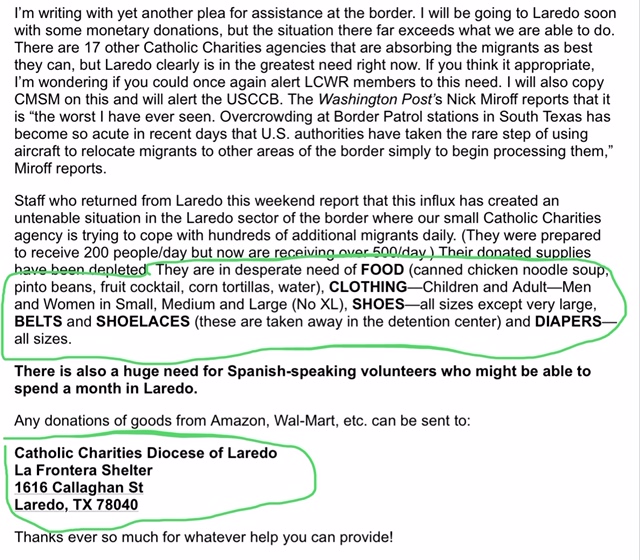
P.S. I know that many of you have responded to this request I placed on Facebook. Thank you. For those who don’t do Facebook, this is an urgent request for help for refugees at our southern border. It’s an easy way to do some good things.It was received from Sisters of Mercy Leadership Team in D.C.

Music for today is below this request. 


appeal


Music: Compassion- The Gettys 

Open to the Light

Wednesday of the Fourth Week of Easter

Click here for readings

May 15, 2019

Today, in Mercy, Jesus calls himself the Light.

Jn12_46_Light

Surely he came to bring us out of darkness which is light’s polar opposite. Most of us receive that deliverance with gratitude, understanding it to be our redemption from sin and separation from God.

As we grow deeper in our spiritual life, we may realize that there are many degrees of opposition to the Light. We may not find ourselves in the deep darkness of habitual sin, but rather on those tantalizing edges of spiritual laziness that can halt our soul’s growth:

  • the fog of faithless religious practice
  • the clouds of unresolved hurts and failures in forgiveness
  • the shadows of our religious prejudices
  • the dusk of our early energy for charity and community
  • the eclipse of hope and confidence in God

May God give us the grace to see that Light, too, comes in many forms, beaming through the smallest openings in our spirit. Every act, every choice, every silent prayer made for the sake of Love allows that Light to grow. You may like to pray with that thought while appreciating this poem of Denise Levertov:

Bearing the Light

Rain-diamonds, this winter morning, 
embellish the tangle of unpruned pear-tree twigs; 
each solitaire, placed, it appears, with considered judgement, 
bears the light beneath the rifted clouds – 
the indivisible shared out in endless abundance.

Music: some beautiful instrumental music from Kathryn Kaye for your prayer time.

Do You Love Me?

Third Sunday of Easter

May 5, 2019

Click here for readings

Today, in Mercy, Jesus asks Peter an open-ended question, the kind that leaves us very vulnerable to the answer:

Do you love me?

Jn21_17

Wow! What if Peter says “No”, or “Sort of” or worse yet, just stares off into the distance in silence?

And the question is kind of scary for Peter too. Maybe he’s thinking, “OK, this is it. Jesus wants me to lay it all on the line. Am I ready?”.

The Gospel poses questions to each of us today as well:

  • Who and what do I really love?
  • How does my primary love drive my life choices?
  • Are there places in my life that lack love – places where prejudice, blindness, selfishness or hate have filled in the emptiness?
  • Where is God in my loves?

St. John of the Cross wrote this:

At the end of our lives we will be judged on love.
Learn therefore to love God as God wishes to be loved.

More than enough to pray on today.❤️

Music: Where Charity and Love Prevail – a lovely English translation of Ubi Caritas, written in Gregorian chant.