Today, in God’s Lavish Mercy, our reading from the Book of Numbers reveals a very human moment between Joshua and Moses.
Moses Blesses Joshua – James Tissot
Moses is getting older. He realizes that the time is approaching for him to hand over the leadership of his people. God seems to realize that too.
The LORD came down in the cloud and spoke to Moses. Taking some of the spirit that was on Moses, the LORD bestowed it on the seventy elders; and as the spirit came to rest on them, they prophesied.
Joshua, ever since his youth, has been aide to Moses. Moses is his hero – the one, who having spoken with God, led the People out of Egypt. Now Joshua sees other ordinary guys assuming some of Moses’s roles. Joshua feels his own security and comfort shifting beneath him – hints of a spiritual earthquake.
An outraged Joshua alerts Moses, begging him to stop these supposed imposters. But Moses assures Joshua with words no hero-worshipper ever wants to hear:
Are you jealous for my sake? Would that all the people of the LORD were prophets! Would that the LORD might bestow his spirit on them all!
What a powerful question Moses poses. It searches Joshua’s heart:
Are you jealous for my sake?
Are you fearful, biased, closed-hearted, and self-protective because you fear that you and I will lose position and power?
Surely Moses senses Joshua emerging as the next leader of Israel — even though Joshua might not share that awareness yet. Moses wants him to see that it is the Spirit of God Who leads the People through any human means She wishes.
When we presume to control the Spirit, or think to invest Her power only in our own particular “heroes”, we close ourselves to the amazing, surprising power of God. This Divine Power cannot be controlled and, like wildflowers through concrete, will bloom where She chooses.
We see the fruits of such presumption all over our histories: the falsely assumed superiority of men over women, whiteness over color, wealth over labor, or any form of dominance over mutuality. These assumptions become concretized in our culture, hardening us to the movements of the Spirit.
If we have any hold on privilege in our lives, we might be inclined to profit by these assumptions. It is just such an inclination that Moses nips in Joshua in this powerful exchange between revered teacher and apprentice.
The story offers us much to consider in prayer.
Music: An oldie, but goodie. Always brings me a deep peace. I hope it does the same for you, dear reader. Come Holy Ghost – The Singing Nuns
Today, in God’s Lavish Mercy, our Sunday readings each address, in some way, the motivations and judgments of the heart.
Most of us are good people, or at least we want to be. But life can still get us mixed up in situations and decisions which test our character and challenge our moral fortitude. A few characters from today’s readings seem beset with such dilemmas.
The voice within the Wisdom passage belongs to a hard-hearted and jealous person who finds the just person obnoxious. The speaker can’t stand being shown up by the good person’s character. It challenges the complainer’s comfortable, self-absorbed existence.
In our epistle, James gives us the powerful admonitions, “Where jealousy and selfish ambition exist, there is disorder and every foul practice.” He tells us that our hearts should be filled instead with the wisdom from above, yielding peace, gentleness and Mercy.
When I watch the news, or observe the day’s political dramas, I long for the honest, sincere and decent world James describes. I long for a world where we respect and honor each other beyond politics, gender, color, nation, religion, and sexual orientation – for a world where we make choices FOR one another, not against.
How can we help realize a world like that by the choices we make in our personal lives? How can we minimize the jealousy and hatred that are born of self-interest and prejudice?
In the Gospel, Jesus tells us the way. His disciples are busy trying to figure out which of them is the greatest, missing -as they so often do- the whole point of discipleship.
Jesus is gentle with them. He tells them to look at a little child. There they will find what is most important – in simplicity, vulnerability, openness, innocence. They will see that this is the way Jesus is with them.
If we can approach and receive one another with just an ounce of such selflessness, we might begin to change the world – to do our part to make it even more beautiful.
Poetry:The Beautiful World by W. Lomax Childress (1867-1936)
Here's a song of praise for a beautiful world,
For the banner of blue that's above it unfurled,
For the streams that sparkle and sing to the sea,
For the bloom in the glade and the leaf on the tree;
Here's a song of praise for a beautiful world.

Here's a song of praise for the mountain peak,
Where the wind and the lightning meet and speak,
For the golden star on the soft night's breast,
And the silvery moonlight's path to rest;
Here's a song of praise for a beautiful world.

Here's a song of praise for the rippling notes
That come from a thousand sweet bird throats,
For the ocean wave and the sunset glow,
And the waving fields where the reapers go;
Here's a song of praise for a beautiful world.

Here's a song of praise for the ones so true,
And the kindly deeds they have done for you;
For the great earth's heart, when it's understood,
Is struggling still toward the pure and good;
Here's a song of praise for a beautiful world.

Here's a song of praise for the One who guides,
For He holds the ships and He holds the tides,
And underneath and around and above.
The world is lapped in the light of His love;
Here's a song of praise for a beautiful world.
Music: Two pieces today
Ubi Caritas ~ Taizé Community
Ubi caritas et amor, ubi caritas, Deus ibi est. Where there is charity and love, God abides.
Today, in God’s Lavish Mercy, we pray with Psalm 128. It describes the blessed scene that might ensue from the kind of hopeful and just community described in yesterday’s reflection. Because of its final verse, I like to think of it as a “Grandparents’ Blessing”.
Happy are they all who fear the Lord, and who follow in the ways of God! You shall eat the fruit of your labor; happiness and prosperity shall be yours. Your beloved shall be like a fruitful vine within your house, your children like olive shoots round about your table. The one who fears the Lord shall thus indeed be blessed. The Lord bless you from Zion, and may you see the prosperity of Jerusalem all the days of your life.
May you live to see your children’s children; may peace be upon your household.
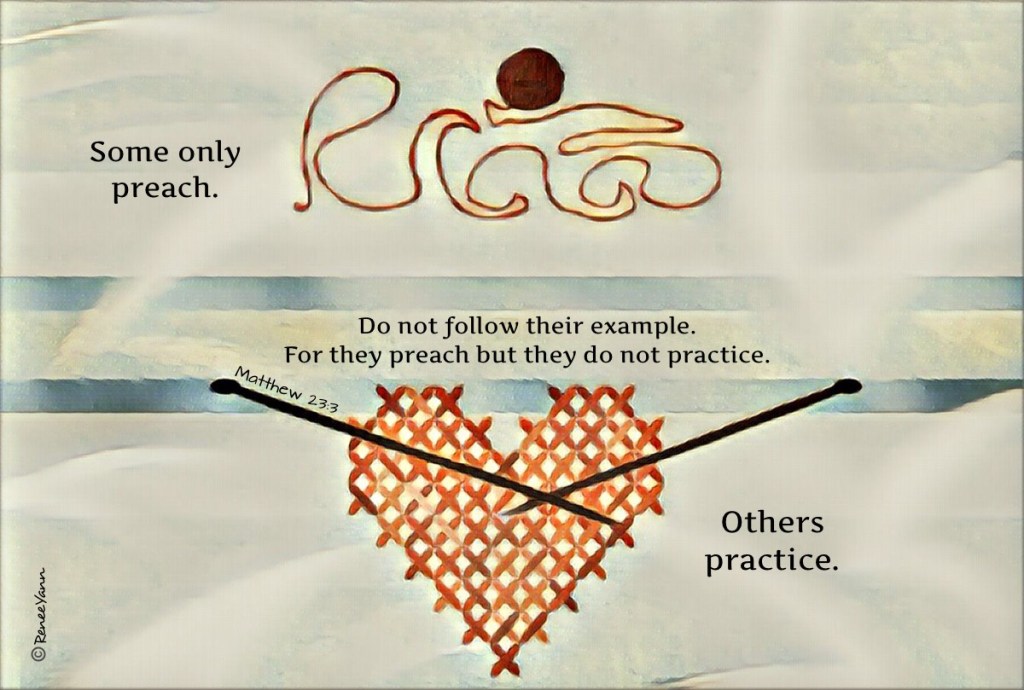
In our Gospel, Jesus tells us that we achieve such blessedness by actions, not simply by words.
Jesus spoke to the crowds and to his disciples, saying, “The scribes and the Pharisees have taken their seat on the chair of Moses. Therefore, do and observe all things whatsoever they tell you, but do not follow their example. For they preach but they do not practice.
Matthew 23: 1-3
I took that admonition to heart today. I do a lot of “preaching” on these pages. Following the example of Jesus, I need to see if those words come to life in my actions.
Are you with me?
Poetry: The Words We Speak – Hafiz
The words
We speak
Become the house we live in.
Who will want to sleep in your bed
If the roof leaks
Right above
It?
Look what happens when the tongue
Cannot say to kindness,
“I will be your slave.”
The moon
Covers her face with both hands
And can’t bear
To look.
Music: Without Words – Bethel Music
Just a pretty cool instrumental to reflect with today.
Today, in God’s Lavish Mercy, we pray with Psalm 146, chosen today to complement our first reading which is a rare lectionary passage from the Book of Ruth. In it, we meet Naomi who is, at one point, widowed and alone.
The fatherless and the widow the Lord sustains, but the way of the wicked is thwarted.
Psalm 146:9
Ruth Carries Her Gleanings – James Tissot
The Book of Ruth is familiar to many of us because some of its charming story and verses seem a lovely fit for weddings and anniversaries. But in some ways, that isolated use tends to trivialize the powerful messages embedded in this short volume.
If we have a limited view of the Book of Ruth, Psalm 146 can help us widen it. The psalm points to elements central to a hopeful and just community, to a community in right relationship with God. This too is a core message of Ruth.
It is a community strengthened by compassion, loyalty, inclusivity, trust, hope and grateful praise. Each character, at some point in the story’s unfolding, exhibits some aspect of God’s merciful nature and steadfast attachment to us. They put flesh on the psalm’s Antiphons:
Happy are they who have the God of Jacob for their help!
For their hope is in the Lord their God,
who made heaven and earth,
the seas, and all that is in them;
who keeps promises for ever;
who gives justice to those who are oppressed,
food to those who hunger
and sets the prisoners free.
The Lord opens the eyes of the blind!
The Lord lifts up those who are bowed down
and loves the righteous.
The Lord cares for the stranger
and sustains the orphan and widow,
but frustrates the way of the wicked.
The Lord shall reign for ever,
your God, O Zion, throughout all generations.
Hallelujah!
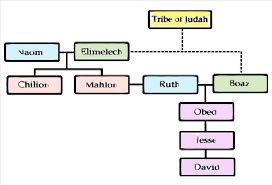
Ruth was the great-grandmother of David and blood ancestor of Jesus. Her story, and the tender mercy it declares, foretells the character of the Beloved Community Christ will establish.
The heart of that community – our community – is aptly described in today’s Gospel. When the Pharisees ask Jesus what is most important, he replies:
You shall love the Lord, your God, with all your heart, with all your soul, and with all your mind. This is the greatest and the first commandment. The second is like it: You shall love your neighbor as yourself. The whole law and the prophets depend on these two commandments.
Ruth already knew what was most important. May we learn it deeply from her story.
Poem: Ruth and Naomi by Frances Ellen Watkins Harper (1825-1911), an African American abolitionist and poet. Born free in Baltimore, Maryland, she had a long and prolific career, publishing her first book of poetry at twenty and her first novel, the widely praised Iola Leroy, at age 67.
"Turn my daughters, full of woe,
Is my heart so sad and lone?
Leave me children — I would go
To my loved and distant home.

From my bosom death has torn
Husband, children, all my stay,
Left me not a single one,
For my life's declining day

Want and woe surround my way,
Grief and famine where I tread;
In my native land they say
"God is giving Jacob bread.”

Naomi ceased, her daughters wept,
Their yearning hearts were filled;
Falling upon her withered neck,
Their grief in tears distill'd.

Like rain upon a blighted tree,
The tears of Orpah fell
Kissing the pale and quivering lip,
She breathed her sad farewell.

But Ruth stood up, on her brow
There lay a heavenly calm;
And from her lips came, soft and low
Words like a holy charm.

"I will not leave thee, on thy brow
Are lines of sorrow, age and care;
Thy form is bent, thy step is slow,
Thy bosom stricken, lone and sear.

Oh! when thy heart and home were glad,
I freely shared thy joyous lot;
And now that heart is lone and sad,
Cease to entreat — I'll leave thee not.

Oh! if a lofty palace proud
Thy future home shall be;
Where sycophants around thee crowd,
I'll share that home with thee.

And if on earth the humblest spot,
Thy future home shall prove;
I'll bring into thy lonely lot
The wealth of woman's love.

Go where thou wilt, my steps are there,
Our path in life is one;
Thou hast no lot I will not share,
'Till life itself be done.

My country and my home for thee,
I freely, willingly resign,
Thy people shall my people be,
Thy God he shall be mine.

Then, mother dear, entreat me not
To turn from following thee;
My heart is nerved to share thy lot,
Whatever that may be.”
Music: Ruth’s Song – Marty and Misha Goetz
(Verse 1) All my life, I have wondered Wondered where I might belong Feeling lost, like a stranger Wandering far all on my own (Verse 2) Without a home. Without a people Without a hope, without a prayer Without a way, that I could follow Then I turned, and you were there (Chorus) Where you go, I will go Where you stay, I will stay forever Where you lead, I will follow So I can know the one you know (Verse 3) Under his wings, you found a shelter You have no fear, you have no shame And when you call, he seems to answer He even seems to know your name (Chorus) (Bridge) Then somehow should I find his favor I won’t look back on all I’ve known Your people then will be my people And Your God my God alone (Chorus) Where you go, I will go And you know I will never leave you Not even death, will ever part us Now that I know the one you know I will go now, where you go
Today, in God’s Lavish Mercy, we pray with Psalm 66 – a psalm which, according to scripture scholar Roland Murphy, mixes two genres:
A thanksgiving song of the community:
Shout joyfully to God, all the earth; sing praise to the glory of God’s name; proclaim God’s glorious praise. Say to God: “How tremendous are your deeds!”
Psalm 66: 1-3
A thanksgiving song of an individual:
Hear now, all you who fear God, while I declare what God has done for me. When I appealed to God in words, praise was on the tip of my tongue.
Psalm 66: 16-17
Psalm 66 reminds us that we come to know, love and serve God both as individuals and within the community of faith. Our union with God is deepened at both fountains.
Today, we celebrate the feast of Clare of Assisi who praised God through a life of service shaped by a radical understanding of holy poverty.
We become what we love and who we love shapes what we become. If we love things, we become a thing. If we love nothing, we become nothing. Imitation is not a literal mimicking of Christ, rather it means becoming the image of the beloved, an image disclosed through transformation. This means we are to become vessels of God’s compassionate love for others.
Clare of Assisi
Poetry/Prayer: As we pray to live lives of love and compassion, may St. Clare’s blessing encourage us.
Go forth in peace, for you have followed the good road. Go forth without fear, for the One who created you has made you holy, has always protected you, and loves you as a mother. Blessed be you, my God, for having created me.
Music: Let the Love that Dwells in Your Heart – Poor Clare’s of Arundel
Today, in God’s Lavish Mercy, we pray with Psalm 112, particularly chosen for the Feast of St. Lawrence
Blessed the one who fears the LORD, who greatly delights in God’s commands. That one’s posterity shall be mighty upon the earth; the upright generation shall be blessed. Well for the one who is gracious and lends, who conducts all affairs with justice; That person shall never be moved; the just one shall be in everlasting remembrance.
After the martyrdom of Pope Sixtus II in 258 AD, the prefect of Rome demanded that Lawrence turn over the riches of the Church. St. Ambrose is the earliest source for the narrative that Lawrence asked for three days to gather the wealth. He worked swiftly to distribute as much Church property to the indigent as possible, so as to prevent its being seized by the prefect. On the third day, at the head of a small delegation, he presented himself to the prefect, and when ordered to deliver the treasures of the Church he presented the indigent, the crippled, the blind, and the suffering, and declared that these were the true treasures of the Church. One account records him declaring to the prefect, “The Church is truly rich, far richer than your emperor.” This act of defiance led directly to his martyrdom.
Wikipedia
There are many lessons for us in the life of St. Lawrence. The most striking for me is his gift for seeing the most vulnerable people as the Church’s greatest treasures.
Praying Psalm 112 today, we might ask God to deepen that gift of sublime generosity which imitates God’s own Mercy to us:
Lavishly they give to the poor, Their generosity shall endure forever; Their name shall be exalted in glory.
Poetry: Khalil Gibran- On Giving
You give but little when you give of your possessions.
It is when you give of yourself that you truly give.
For what are your possessions but things you keep
and guard for fear you may need them tomorrow?

And tomorrow, what shall tomorrow bring
to the over-prudent dog burying bones in the trackless sand
as he follows the pilgrims to the holy city?

And what is fear of need but need itself?
Is not dread of thirst when your well is full,
the thirst that is unquenchable?

There are those who give little of the much which they have–
and they give it for recognition and their hidden desire
makes their gifts unwholesome.

And there are those who have little and give it all.
These are the believers in life and the bounty of life,
and their coffer is never empty.

There are those who give with joy, and that joy is their reward.
And there are those who give with pain, and that pain is their baptism.
And there are those who give and know not pain in giving,
nor do they seek joy, nor give with mindfulness of virtue;
They give as in yonder valley the myrtle breathes its fragrance into space.

Through the hands of such as these God speaks,
and from behind their eyes He smiles upon the earth.
It is well to give when asked,
but it is better to give unasked, through understanding;

And to the open-handed
the search for one who shall receive is joy greater than giving.
And is there aught you would withhold?
All you have shall some day be given;
Therefore give now, that the season of giving
may be yours and not your inheritors’.

You often say, “I would give, but only to the deserving.”
The trees in your orchard say not so, nor the flocks in your pasture.
They give that they may live, for to withhold is to perish.
Surely he who is worthy to receive his days and his nights,
is worthy of all else from you.

And he who has deserved to drink from the ocean of life
deserves to fill his cup from your little stream.
And what desert greater shall there be,
than that which lies in the courage and the confidence,
nay the charity, of receiving?

And who are you that the poor should rend their bosom and unveil their pride,
that you may see their worth naked and their pride unabashed?
See first that you yourself deserve to be a giver, and an instrument of giving.

For in truth it is life that gives unto life
while you, who deem yourself a giver, are but a witness.

And you receivers… and you are all receivers…
assume no weight of gratitude,
lest you lay a yoke upon yourself and upon him who gives.
Rather rise together with the giver on his gifts as on wings;
For to be overmindful of your debt, is to doubt his generosity
who has the freehearted earth for mother, and God for father.
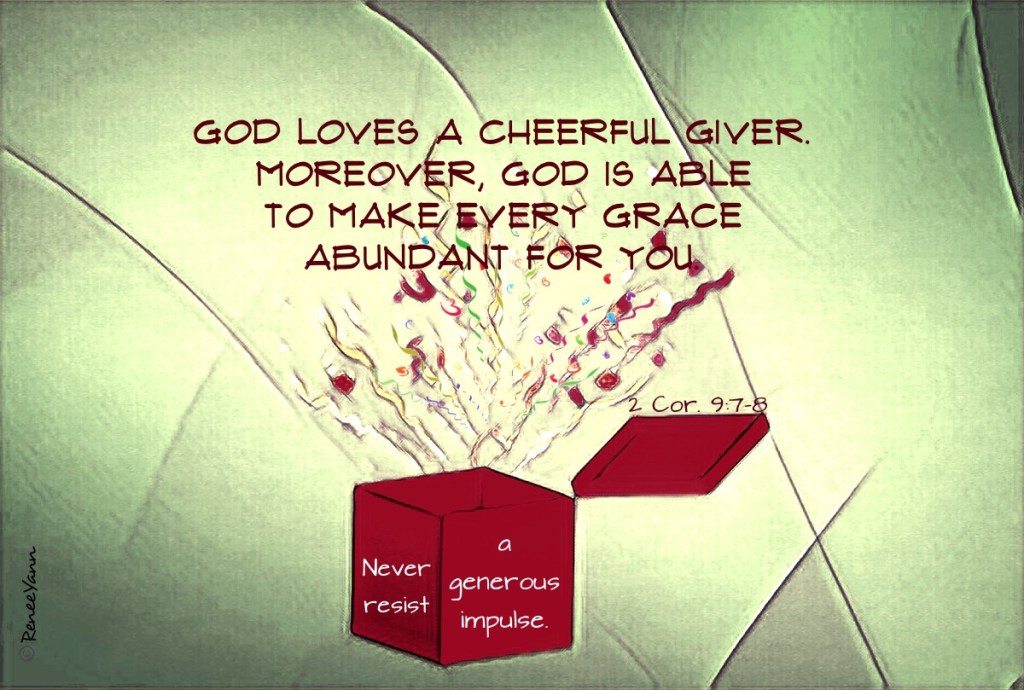
Music: God Loves a Cheerful Giver – Steve Green has fun with the kids. I hope you do too!🤗
Today, in God’s Lavish Mercy, we pray with Psalm 112, a poem about why and how to live a generous life.
Blessed the one who is in awe of the LORD, who greatly delights in God’s commands. That person’s posterity shall be mighty upon the earth; the upright generation shall be blessed. Wealth and riches shall be in their house; their generosity shall endure forever.
Psalm 112:2-4
The psalm nicely complements our readings:
Paul, nudging the Corinthians for a general collection
Jesus, preaching sincerity and humility in our giving – both to humans and to God.
Generosity is the fruit of the theological virtue of charity.
I think “charity” gets a flimsy definition in our modern culture. Many think of it only as a noble intermittent gesture toward those who are disadvantaged, like change tossed into the Salvation Army bucket.
But it’s a way bigger deal. Here are a few clips from the Catechism of the Catholic Church. They offer so much thought for our meditation. After that, we might pray to deepen in true charity and to manifest it in quiet, sustained generosity.
The theological virtues are the foundation of Christian moral activity; they animate it and give it its special character. They inform and give life to all the moral virtues. They are infused by God into the souls of the faithful to make them capable of acting as God’s children and of meriting eternal life. They are the pledge of the presence and action of the Holy Spirit in the faculties of the human being. There are three theological virtues: faith, hope, and charity.
Charity is the theological virtue by which we love God above all things for God’s own sake, and our neighbor as ourselves for the love of God.
The practice of all the virtues is animated and inspired by charity, which “binds everything together in perfect harmony”; it is the form of the virtues; it articulates and orders them among themselves; it is the source and the goal of their Christian practice. Charity upholds and purifies our human ability to love, and raises it to the supernatural perfection of divine love.
The fruits of charity are joy, peace, and mercy; charity demands beneficence and fraternal correction; it is benevolence; it fosters reciprocity and remains disinterested and generous; it is friendship and communion:.
Love is itself the fulfillment of all our works. There is the goal; that is why we run: we run toward it, and once we reach it, in it we shall find rest.
Today, in God’s Lavish Mercy, we pray with Psalm 128 which is a recounting of how blessed we are when we live in God’s Presence.
Our Gospel reveals the clear and essential key to attaining that Presence – love of God and neighbor.
The scribe in today’s Gospel is well on his way to living in God’s embrace.
We might choose to go with him to Jesus today to ask what is most important for us as we continually try to open our lives to God’s grace.
How can we increase our understanding, strength, and charity in our everyday choices? …. How can we love more like God loves?
Poetry: Love as if … by Vinita Hampton Wright
Love as if loving is the first thing on your to-do list.
Love as if you have no other plan but to love.
Love as if you are confident that love makes good things happen.
Love as if this is your first opportunity to love.
Love as if this is your last opportunity to love.
Love as if loving can heal all wounds.
Love as if loving is your first purpose on earth.
Love as if loving is your favorite choice.
Love as if you have that kind of power.
Love as if it will keep the earth spinning in vast, beautiful space.
Music: You Shall Love the Lord with All Your Heart
Today, in God’s Lavish Mercy, we pray with Psalm 149 exhorting us to praise God out loud. And we can do that. We’ve all been part of that kind of glorious praise with the help of our wonderful choirs, musicians, and praise dancers.
However, the psalm today is set between two intriguing readings that may cause us to think more deeply about our “praise”.
Sirach offers a cryptic description of who might be remembered as a godly person, ultimately saying it is the one whose virtues are unforgettable.
So the practice of virtue is presented as the most important act of praise.
Yet these also were godly persons whose virtues have not been forgotten; Their wealth remains in their families, their heritage with their descendants;
Sirach 14: 10-11
In our Gospel, we meet what at first might appear as a moody, frustrated Jesus. Hungry one morning, he curses a figless fig tree. We might be inclined to focus on the poor zapped tree, but that would be to miss the point.
The leafy yet fruitless tree is a symbol of a wordy “faith” without accompanying works. It describes people who, like the Pharisees in the Temple, shout praise without practicing charity and mercy.
Together, the readings help us see true praise in a clear light – as beautiful waving leaves on a tree full of sweet, loving fruitful actions.
Poetry: Judgement Day – R.S. Thomas
Yes, that’s how I was,
I know that face,
That bony figure
Without grace
Of flesh or limb;
In health happy,
Careless of the claim
Of the world’s sick
Or the world’s poor;
In pain craven –
Lord, breathe once more
On that sad mirror,
Let me be lost
In mist for ever
Rather than own
Such bleak reflections,
Let me go back
On my two knees
Slowly to undo
The knot of life
That was tied there.
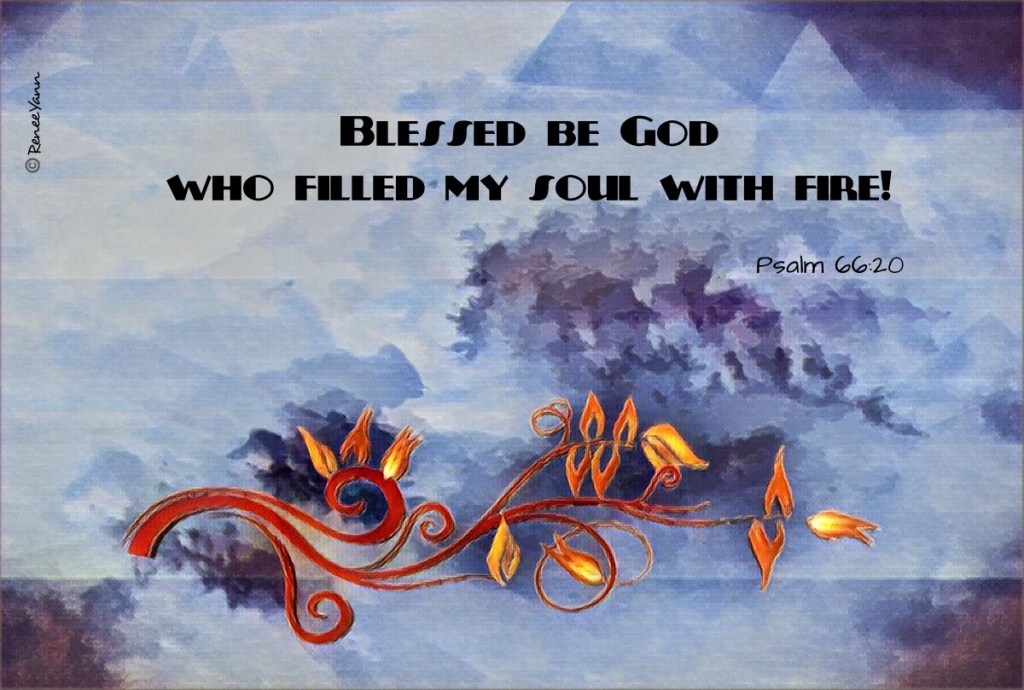
Today, in God’s Lavish Mercy, we pray with Psalm 104 – a fitting prayer for this glorious Feast of Pentecost.
Lord, send out your Spirit, and renew the face of the earth.
It is a bold prayer, an extravagant request. It asks for everything – a Fire of Love so complete that the whole earth is remade in its Divine Power.
It is a prayer based in mutual invitation as, in the Sequence, we invite the Holy Spirit to renew us:
Come, Holy Spirit, come! And from your celestial home Shed a ray of light divine!
Pentecost Sequence
And, as in any true relationship, the Spirit invites us too – to open our hearts to the infinite grace of this feast. The Book of Revelation describes this reciprocity in this profound passage:
“ I, Jesus, have sent my angel to give you this testimony for the churches. I am the Root and the Offspring of David, and the bright Morning Star.”
The Spirit and the bride say, “Come!” And let the one who hears say, “Come!” Let the one who is thirsty come; and let the one who wishes take the free gift of the water of life.
Revelation 22: 16-17
Today, on the Birthday of the Church, we pray not only for our own soul’s kindling, but for the whole People of God. May the Grace of Pentecost ignite a new fire of charity over all the earth. May that fire clear the way for the Spirit’s gifts to flower, for Her fruits to blossom, for Her power to surprise us as it bursts forth in our hearts!
Poetry: The Golden Sequence
Veni Sancte Spiritus, sometimes called the Golden Sequence, is a sequence prescribed in the Roman Liturgy for the Masses of Pentecost and its octave. It is usually attributed to either the thirteenth-century Pope Innocent III or to the Archbishop of Canterbury, Cardinal Stephen Langton, although it has been attributed to others as well.
“Veni Sancte Spiritus” is one of only four medieval Sequences which were preserved in the Roman Missal published in 1570 following the Council of Trent (1545–63).
The other three occasions when we hear these beautiful ancient hymns are Easter Sunday (“Victimae Paschali Laudes”), Corpus Christi (“Lauda Sion Salvatorem”) and Our Lady of Sorrows (“Stabat Mater Dolorosa”). On Easter Sunday and Pentecost, the sequence must be sung, whereas on Corpus Christi and Our Lady of Sorrows, the sequence is optional.
Wikipedia
Come, Holy Spirit, come!
And from your celestial home
    Shed a ray of light divine!

Come, Father of the poor!
Come, source of all our store!
    Come, within our bosoms shine.

You, of comforters the best;
You, the soul’s most welcome guest;
    Sweet refreshment here below;

In our labor, rest most sweet;
Grateful coolness in the heat;
    Solace in the midst of woe.

O most blessed Light divine,
Shine within these hearts of yours,
    And our inmost being fill!

Where you are not, we have naught,
Nothing good in deed or thought,
    Nothing free from taint of ill.

Heal our wounds, our strength renew;
On our dryness pour your dew;
    Wash the stains of guilt away:

Bend the stubborn heart and will;
Melt the frozen, warm the chill;
    Guide the steps that go astray.

On the faithful, who adore
And confess you, evermore
    In your sevenfold gift descend;

Give them virtue’s sure reward;
Give them your salvation, Lord;
    Give them joys that never end. Amen.
    Alleluia.








 Lavish Mercy