Mary, Mother of the Church

June 6, 2022

Today, in God’s Lavish Mercy, we celebrate the Memorial of the Blessed Virgin Mary, Mother of the Church.
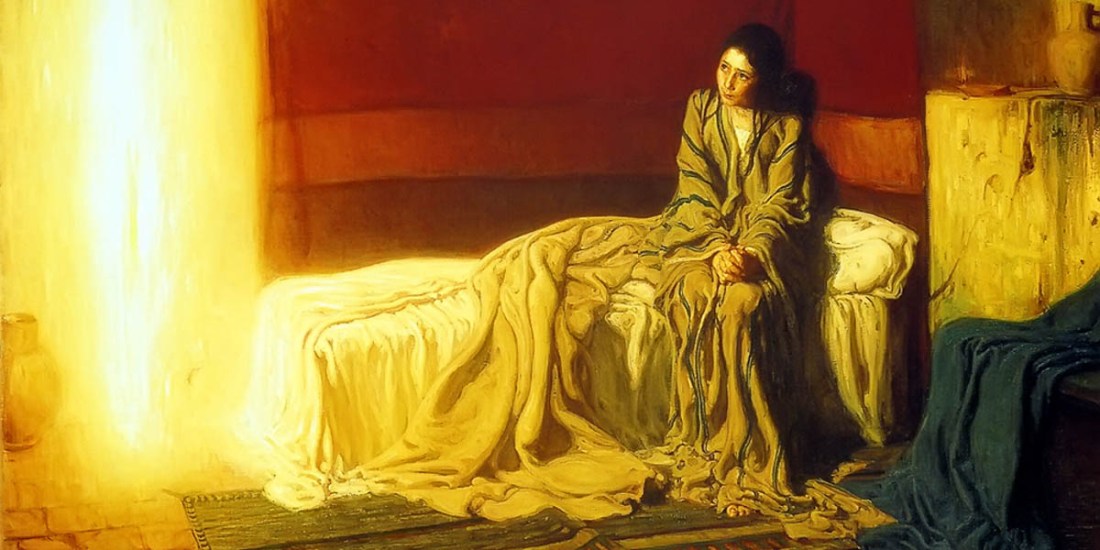

web3-the-annunciation-by-henry-ossawa-tanner
Annunciation by Henry Ossawa Tanner

It is a day to honor Mary for giving life to Jesus
for the sake of all humanity.

It is day to beg her intercession
for a world so desperately in need of
Christ’s continued revelation.
door of Mercy

Mary is the Door through which
Heaven visited earth
to heal it from sinful fragmentation.


Ave

May Mary continue to carry her beautiful grace
to broken hearts and even
to the twisted souls who broke them. 

Through her, may we all find healing.

Mary, Mother of Mercy, intercede for all Creation
that we may embrace the Love your Son taught us.


Poetry: How Do I See Her – by Judith Evans

How do I see her?
Blessed Mother, Queen of Heaven, Virgin Mary:
these are names that people have given her.
But who is she?

When I see the mother of our Savior,
I see the courage of women:

She said “yes” and stepped into the never-before,
the great unknown,
unfairly judged by neighbors,
nearly losing her betrothed at a time when “unmarried” and “pregnant” meant banishment or death by stoning.

I see the strength of women:

A pregnant teenage girl,
she rode 100 miles on a donkey,
sleeping on the ground,
surrounded by Roman oppression.

I see the wisdom of women:

It was time.
She knew that her son was ready before he knew it.
“Do as he tells you,” she told the servants at the wedding. And then there was wine,
and the greatest ministry of all time began.

I see the anguish of women:

She visualized her son’s destiny as she nursed him,
cleaned him,
baked bread for him.
Her heart nearly stopped when she couldn’t find him,
and then rejoiced when he turned up
discussing theology with scholars:
a prelude to a future loss,
that horrific afternoon at the foot of the cross.

I see women celebrating:

Beyond all human-sized hope,
her son conquered death.
She had dared to believe in hope,
and when hope’s light seemed extinguished,
she hoped one more time.

Who is she?
She is each and every one of us.
Whole, messy, wounded, blessed.

Bewildered by the mystery of it all,
yet willing to try one more time
to comprehend God’s purpose.

Learning to receive God’s mercy and grace,
realizing that we are seen and loved
beyond our understanding.


Music: Ave Maria – Michael Hoppé
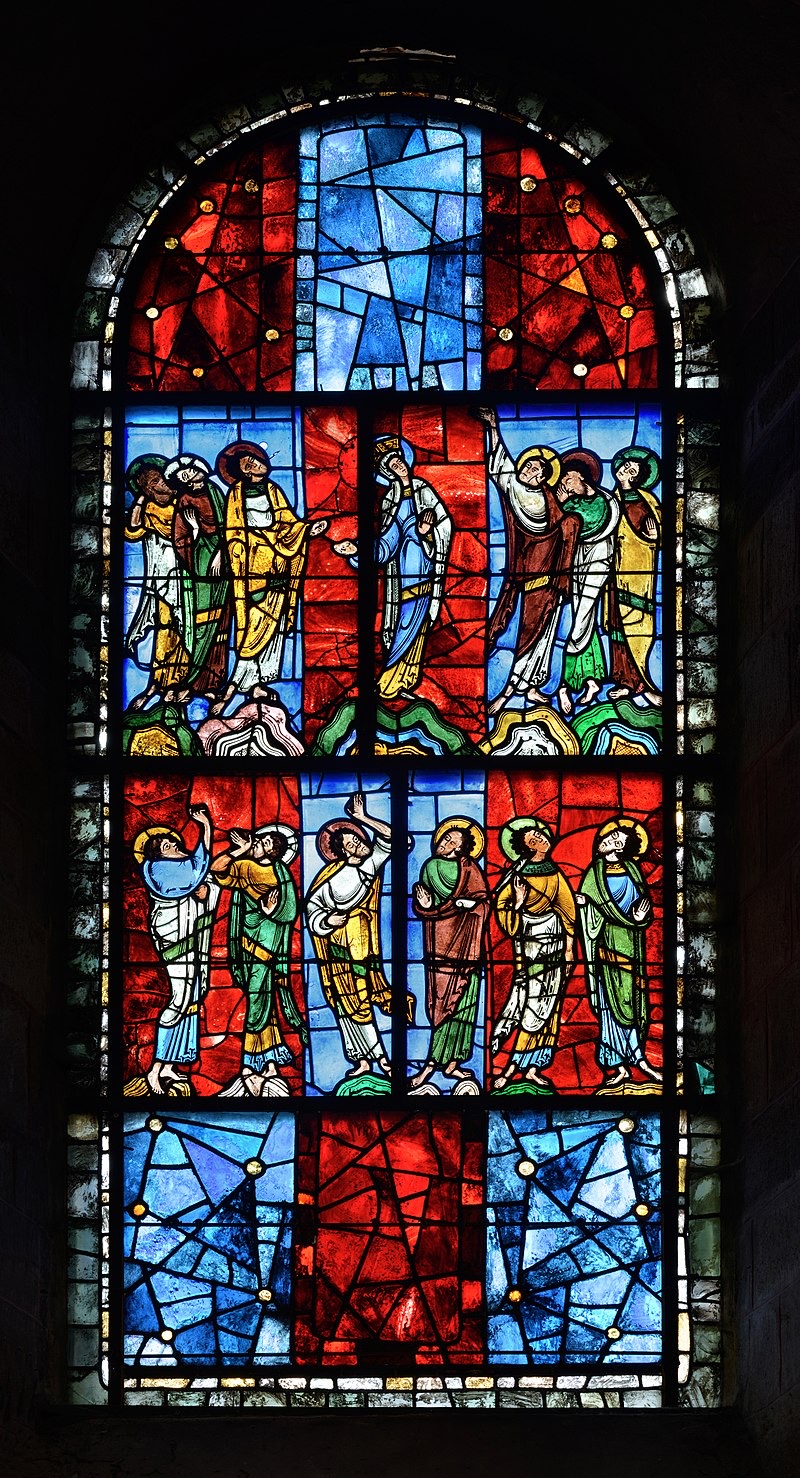
Feast of the Ascension

May 29, 2022

le mans
Le Mans Cathedral is a Catholic Church situated in Le Mans, France. Its construction dates from the 6th through the 14th century, and it features many French Gothic elements. The cathedral, which combines a Romanesque nave and a High Gothic choir is notable for its rich collection of stained glass and the spectacular bifurcating flying buttresses at its eastern end. The Ascension window, towards the western end of the south aisle of the nave, has been dated to 1120, making it one of the oldest extant stained glass windows in France.

Today, in God’s Lavish Mercy, we stand with the disciples, straining for a last look at Jesus as He ascends into heaven. Their hearts are stretched with both joy and pain at all that is happening to them. They long for the Holy Spirit to come to them even as they mourn the physical departure of Christ.

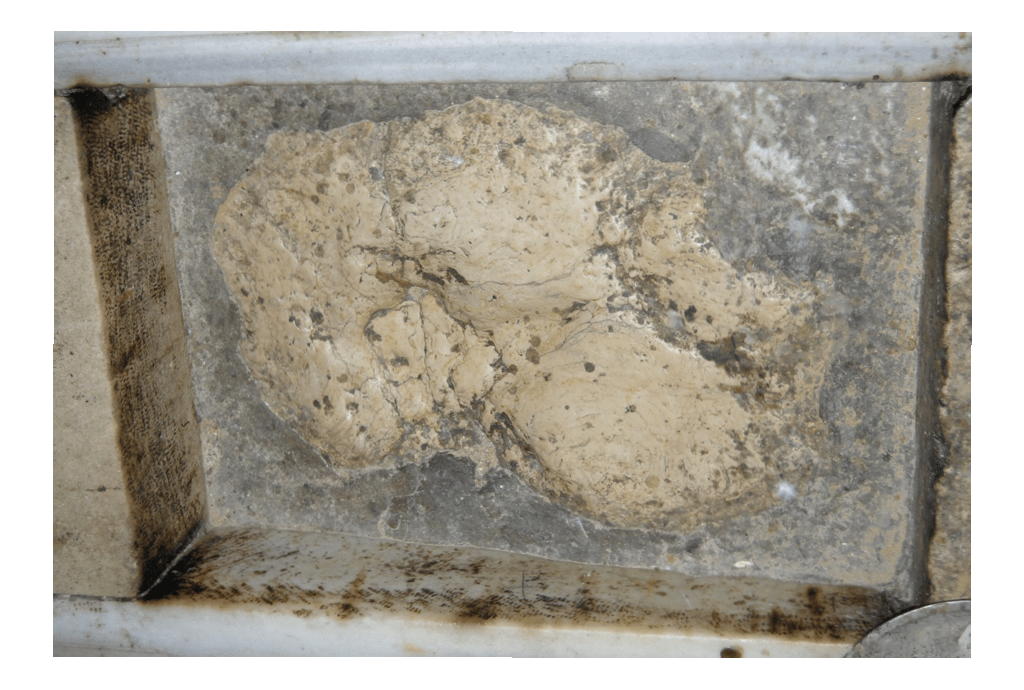
As mentioned in Thursday’s reflection, many years ago I was blessed to stand in the Chapel of the Ascension, a small shrine on the Mount of Olives in Jerusalem. Tradition holds this to be the site of Jesus’ Ascension. Inside is a well-worn rock with a slight indentation. Many venerate this as the last footprint of Christ on earth.

Ascension rock
Whether or not this devotion is valid is unimportant. In the hush of my early morning visit to this shrine, the Holy Spirit embraced me, overwhelming me with an awareness of how the disciples felt that day in the absence of Jesus.


Many reading this may feel a similar absence, a need, or a longing for God. Perhaps by touching that sense of absence, that indentation in the rock of our hearts, we may invite and welcome the Holy Spirit to fill our need.


Poetry: Ascension Day by Christina Georgina Rossetti

“When Christ went up to Heaven the Apostles stayed”
Gazing at Heaven with souls and wills on fire,
Their hearts on flight along the track He made,
Winged by desire.
Their silence spake: “Lord, why not follow Thee?
Home is not home without Thy Blessed Face,
Life is not life. Remember, Lord, and see,
Look back, embrace.
“Earth is one desert waste of banishment,
Life is one long-drawn anguish of decay.
Where Thou wert wont to go we also went:
Why not today?”
Nevertheless a cloud cut off their gaze:
They tarry to build up Jerusalem,
Watching for Him, while thro' the appointed days
He watches them.
They do His Will, and doing it rejoice,
Patiently glad to spend and to be spent:
Still He speaks to them, still they hear His Voice
And are content.
For as a cloud received Him from their sight,
So with a cloud will He return ere long:
Therefore they stand on guard by day, by night,
Strenuous and strong.
They do, they dare, they beyond seven times seven
Forgive, they cry God's mighty word aloud:
Yet sometimes haply lift tired eyes to Heaven—
“Is that His cloud?”

Music: Abide with Me – Matt Maher

My Dad’s Ascension Thursday Gift

( I’m going a little off the grid this morning because we get a double chance to celebrate the Feast of the Ascension with its recurrence this Sunday. So I will leave my scriptural reflection until then.)


For me, the celebration of Ascension will always be on a Thursday – and it will always belong especially to my Dad. Here’s why.

I was already a young nun in the early 1970s when I went home to visit my parents one beautiful May afternoon.  We had a day off from school to commemorate the Feast of the Ascension. 

That’s me in pink before nunhood

My Dad was sitting on the front steps contemplating a patch of pachysandra on our small front lawn, or so I thought.  After initial hugs and greetings, Dad said, “I’m worried about something.” Worry bells starting ringing deep in my brain. Where was Mom!?!?

“Joe Brodski just walked by a little while ago”, Dad continued. I paused a moment to consider this seeming non-sequitor.

Now Joe Brodski never walked anywhere.  He was our next-door neighbor whose only apparent activity was tumbling out of his house and into his car each morning to go to work. So I began to think that maybe the worry was about Joe Brodski, and not my Mom who had not yet appeared on the front steps.

“So what’s the worry, Dad?”, I asked. 

“Well, I asked Joe why he was out walking and he told me he was coming back from church. Ren, I completely forgot it was Thursday – the Ascension – and now all the Masses are over!”


Dad was really distressed by this oversight and it took a little theologizing on my part to allay his concern. Still, his reaction was so sincere that it has stayed with me for nearly fifty years. I never fully appreciated my Dad’s deep spirituality – nor the embedded culture of faith in our home – until I had grown up and moved away. 


Many years after that Thursday, I read David Foster Wallace’s famous graduation talk at Kenyan University. He opens the talk like this:

There are these two young fish swimming along and they happen to meet an older fish swimming the other way, who nods at them and says “Morning, boys. How’s the water?” And the two young fish swim on for a bit, and then eventually one of them looks over at the other and goes “What the hell is water?”

Wallace goes on to explain, “The point of the fish story is merely that the most obvious, important realities are often the ones that are hardest to see and talk about.”


We didn’t talk a lot about faith in my family, we just practiced it. And that practice was like fish swimming in water. We didn’t even realize that faith was the medium soaking our whole lives.

When Dad realized that he had forgotten to go to Mass that day, he felt like the proverbial “fish out of water”. The deep abiding faithfulness of his life had suffered a little fracture.


In Jerusalem, there is an ancient stone on a hillside. People venerate it as the site from which Jesus ascended into heaven. There is a deep indentation in the stone which is believed to be the last footprint of Christ on the earth as He lifted toward heaven. Whether it actually is the site isn’t important. What matters is that the life of Jesus has left an everlasting impression on our hearts and souls – a well of grace which continues to feed our spirits.

Stone as it is today.
Outline of foot

My Dad’s unassuming holiness has left the same kind of impression on me. It is a touch point which I visit many times during the year, but especially on Ascension Thursday.

I tell the story today because this Feast might be a good time for all of us to consider the “water” we swim in – that culture of faith which nourishes our life – and the life of our family and loved ones.

You may want to bless the many sources that have inspired and fed your faith over your lifetime – perhaps in your family, and perhaps in others relationships. Doing so can be a recurring source of grace even if the “inspirer” has, like Jesus and like my Dad, made their way back to heaven.

And we all might want to consider who depends on us for the nurturing water of their faith!


Music: My Father’s Faith – Janice Kapp Perry

A father’s faith can bless his little children
And help them rise above life’s daily storms.
A father works each day to keep his dear ones
Ever protected, safe and warm.

My father’s praise can send my spirit soaring
And help me see the good I may achieve.
My father’s trust can fill my soul with courage
And help my doubting heart believe.

My father’s tears can somehow say, “I love you”
When words fall silent in his tender heart.
Through daily acts of service and of caring
His deepest feelings he imparts.

My father’s prayers can call down heaven’s blessings
And keep his children walking in the light.
His constant strength is steady as a lighthouse
That brings me safely through the night.

My father’s arms can offer consolation
When I, in sorrow, turn my heart toward home.
His loving voice resounds within my being
To help me know I’m not alone.

My father’s eyes can see past faults and failings
And still imagine all I may become.
And when I fall he’s there to walk beside me
To tell me I can overcome.

My father’s love will shine through generations –
A gentle force that guides me through the years.
My father’s faith will be my inspiration
And make my path to heaven clear.

Monday of the Sixth Week of Easter

May 23, 2022

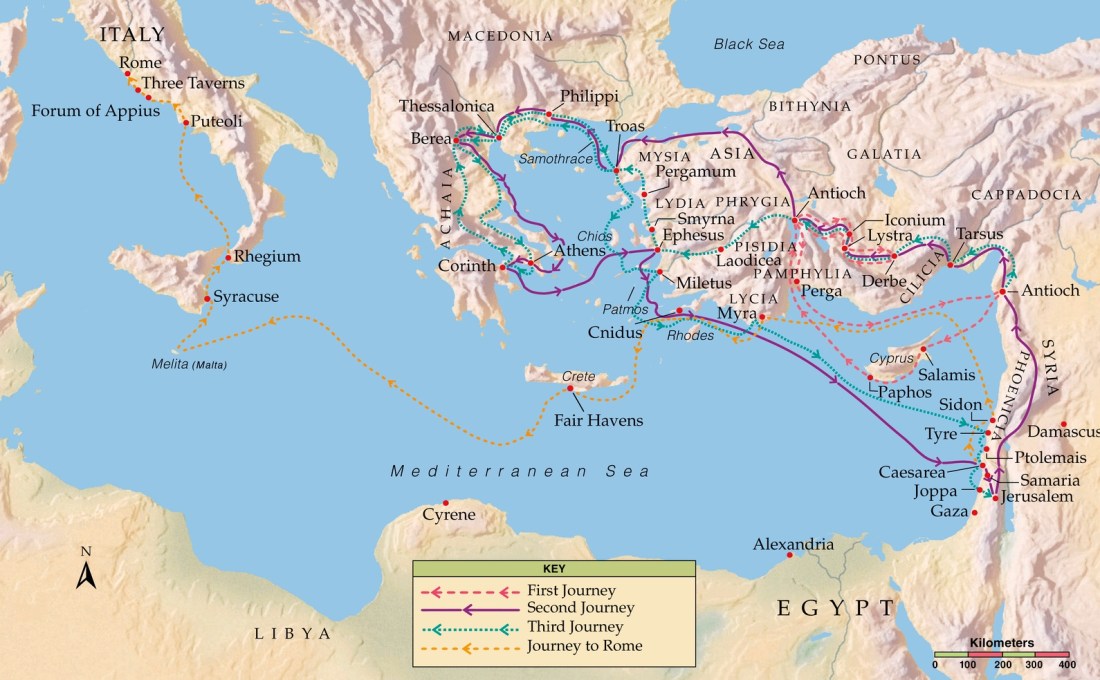
Today, in God’s Lavish Mercy, Paul ventures for the first time into the area which is now modern Europe. He settles for a while in Philippi, the city which gives its name to my favorite epistle.

Pauls journeys

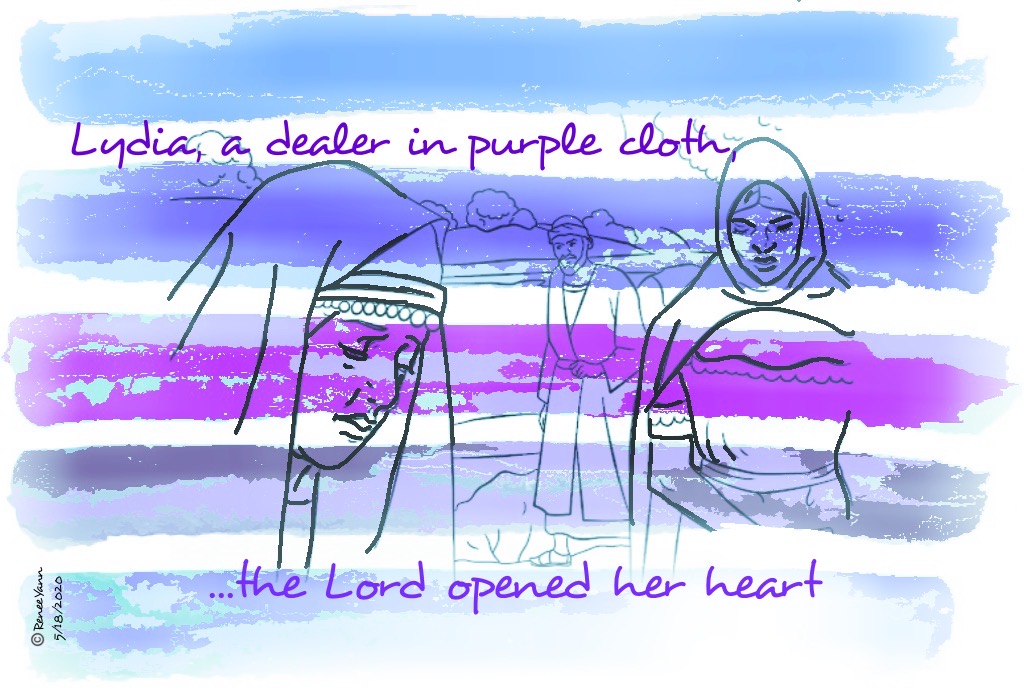
One morning, Paul, Silas and Timothy went down by the river to pray. There they met Lydia, one of the most influential yet mysterious women of the New Testament.

Lydia

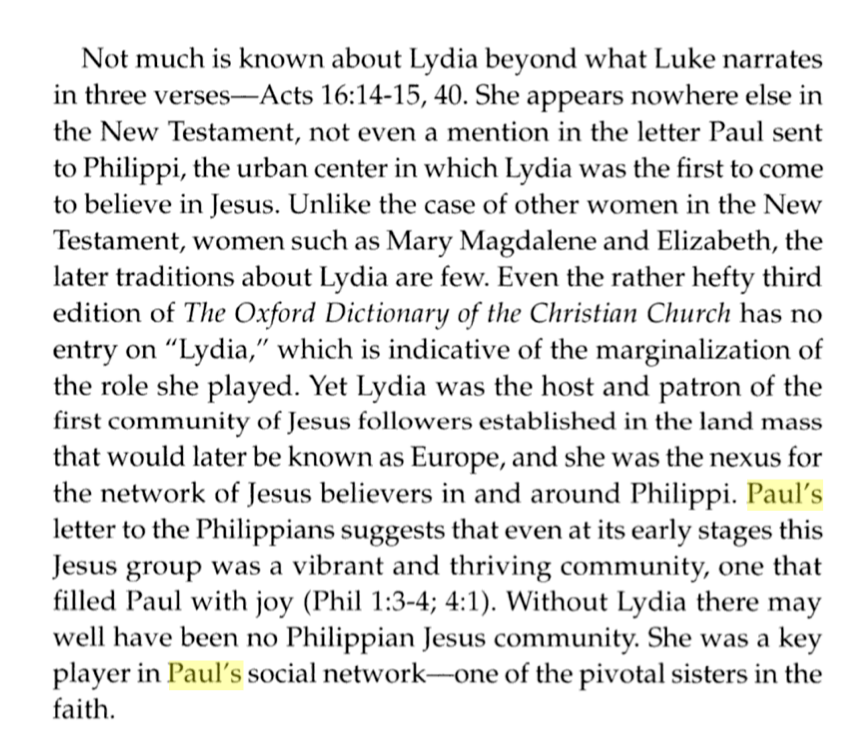
Today’s verses are the only time she is mentioned in the scriptures, and there is no historical documentation about her. Yet, by her support and hospitality, she is likely responsible for the establishment of the Church in Europe and is considered its first convert.


Despite the parcity of information about Lydia, Richard Ascough was able to write a book about her: Lydia: Paul’s Cosmopolitan Hostess

excerpt

Lydia, like many of our foremothers in faith, is hidden in the shadows of a patriarchal history. Sunlight briefly falls on Lydia in this engaging reading from Acts today.

I like to pray with this reading by imagining myself as one of Lydia’s companions, listening to her conversation with Paul, imagining her life as it unfolds into Christian leadership.

As we pray with Lydia today, let’s ask God to lead the Church to a clearer and more committed use of women’s gifts in Church life. Even Pope John Paul II made some small attempts in this direction:

“In this vast domain of service, the Church’s two-thousand-year history, for all its historical conditioning, has truly experienced the ‘genius of woman’; from the heart of the Church there have emerged women of the highest calibre who have left an impressive and beneficial mark in history.” 
John Paul II – “Letter to Women”

But our Church and its women need more than what has been. Let’s ask for women to be welcomed out of the shadows of ecclesial life into an appropriate equity in leadership ministry.


Poetry: Purple – by Kwame Dawes who is a Ghanaian poet, actor, editor, critic, musician, and former Louis Frye Scudder Professor of Liberal Arts at the University of South Carolina. He is now Professor of English at the University of Nebraska-Lincoln and editor-in-chief at Prairie Schooner magazine.

I found his beautiful poem while searching for something on the color purple (in honor of Lydia)


Walking, I drew my hand over the lumpy
bloom of a spray of purple; I stripped away
my fingers, stained purple; put it to my nose,
the minty honey, a perfume so aggressively
pleasant—I gave it to you to smell,
my daughter, and you pulled away as if
I was giving you a palm full of wasps,
deceptions: “Smell the way the air
changes because of purple and green.”
This is the promise I make to you:
I will never give you a fist full of wasps,
just the surprise of purple and the scent of rain.

Music: Patterns of Sun and Shade – Kathryn Kaye

Sixth Sunday of Easter

May 22, 2022

Today, in God’s Lavish Mercy, our readings definitely convey the sense of a young Church growing in its self-understanding.

The early Church leaders, most of whom are Jews, grapple with the question of whether new Gentile followers must first be circumcised in order to be baptized.

Over twenty centuries later, the answer seems obvious. But the question nagging the disciples shows us how they experienced their Christianity as emerging from Judaism. They had no concept of the call to Christianity coming in any other way.

It seems it was a huge shift for some of them to realize that God is not Jewish, that God is the God of all peoples – just as some of us today have trouble understanding that God is not Catholic, Protestant, Muslim, male, white, born again or any other human limitation we attach to the Divine.

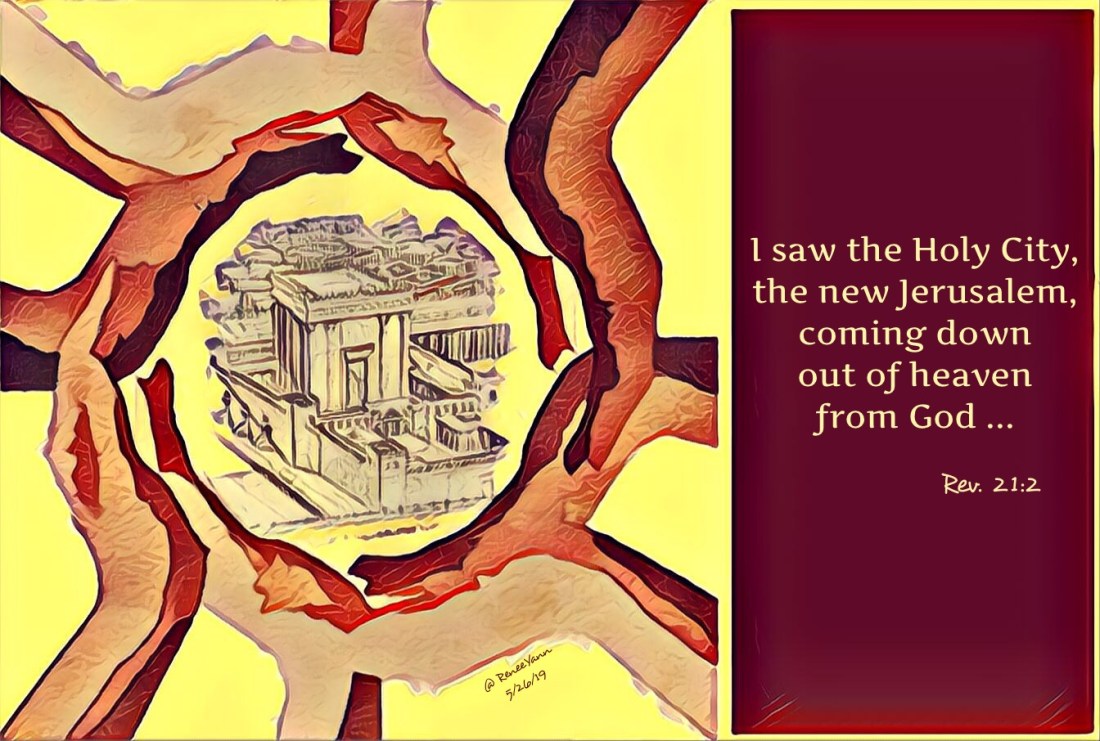
Rev21_2 Jerusalem

Our second reading reveals how John dealt with navigating this shift. Still cemented in his Jewish symbols, he sees “Jerusalem” coming down out of heaven from God. But it was a new Jerusalem – one without the central symbol of Judaism, the Temple:

I saw no temple in the city
for its temple is the Lord God almighty and the Lamb.
The city had no need of sun or moon to shine on it,
for the glory of God gave it light,
and its lamp was the Lamb.

For John, the New Creation in Christ included, but exceeded the Jewish narrative.

In our Gospel, Jesus prepares his disciples for life without his physical presence. They, too, need to learn to let go. He encourages them to open their hearts to even greater graces:

The Advocate, the Holy Spirit,
whom the Father will send in my name,
will teach you everything
and remind you of all that I told you.

Jesus is reminding his disciples, and us, that the graces and learnings of the New Creation are infinite. If we can learn when to let go of our old practices, our material symbols, our impregnable sureties, the Holy Spirit will astound us, and re-shape our understanding of God, just as She did for Mary, Peter, Paul, John and all the many enlightened saints through the ages.

As Pentecost approaches, let us pray for such Enlightenment in ourselves and especially in our Church. For the world seems to grow ever more resistant to the Holy Spirit Whose Gifts are wisdom, understanding, counsel, fortitude, knowledge, piety, and awe of God.

Let us pray for a New Jerusalem where all are one in God.


Poetry: The Props Assist the House – Emily Dickinson

Dickinson’s poem can be interpreted in many ways, but for me it speaks about spiritual openness. While the symbol of Jerusalem was central in Old Testament faith, the early Christian community is called to open itself to a “New Jerusalem” with all the amazing inspirations of the Holy Spirit. We are called to the same openness in our spiritual life.

The Props assist the House
Until the House is built
And then the Props withdraw
And adequate, erect,
The House support itself
And cease to recollect
The Auger and the Carpenter —
Just such a retrospect
Hath the perfected Life —
A past of Plank and Nail
And slowness — then the Scaffolds drop
Affirming it a Soul


Music: If you do nothing else with this reflection, please allow yourselves the thrill of listening to the celestial voice of Miss Jessye Norman. (Always gives me goosebumps!)

Thursday of the Fifth Week of Easter

May 19, 2022

Today, in God’s Lavish Mercy, Acts allows us to sit in on an early Church “convention”. The dynamics are fascinating, as well as amazingly familiar.

The community is a-bustle with concerns. Paul and Barnabas have been out gathering Gentile converts to the faith. The Jewish Christian community back in Jerusalem feels that these new converts should be required to submit to circumcision as a sign of their conversion. Peter offers an intense, lucid, yet gentle argument to convince the Jerusalem community that this is not necessary.

God, who knows the heart,
bore witness by granting them the Holy Spirit
just as he did us.
He made no distinction between us and them,
for by faith he purified their hearts.
Why, then, are you now putting God to the test
by placing on the shoulders of the disciples
a yoke that neither our ancestors nor we have been able to bear?

Acts 15:8-10

James, who appears to have influence in the Jerusalem Church, backs Peter up by referring to the prophet Amos who promised the rebuilding of the faith community:

After this I shall return
                        and rebuild the fallen hut of David;
            from its ruins I shall rebuild it
                        and raise it up again,
            so that the rest of humanity may seek out the Lord,
                        even all the Gentiles on whom my name is invoked.
            Thus says the Lord who accomplishes these things,
                        known from of old.

What a perfect reference to help convince the Jewish community that to be a Christian one did not have to also be a Jew nor follow the Old Law.

This passage helps us to be aware of our openness to new inspiration from the Holy Spirit not only in the Church but in our personal lives. God is the great “heart-reader” and knows when we are ready for growth and deepening. “Protecting” our faith with rituals and exercises that have lost meaning can be a way to avoid opening ourselves to conversion and spiritual transformation. The Holy Spirit invites us beyond such false securities:

And God, who knows the heart,
bore witness by granting them the Holy Spirit
just as he did us.

Acts 15:8

In our Gospel, Jesus reminds us of all that we need to make our faith — and our joy — complete:

Jesus said to his disciples:
“As the Father loves me, so I also love you.
Remain in my love.
If you keep my commandments, you will remain in my love,
just as I have kept my Father’s commandments
and remain in his love.

“I have told you this so that
my joy might be in you and
your joy might be complete.”

Poetry: Quench Your Heart’s Thirst – Hafiz

I know the way you can get
When you have not had a drink of Love:

Your face hardens,
Your sweet muscles cramp.
Children become concerned
About a strange look that appears in your eyes
Which even begins to worry your own mirror
And nose.

Squirrels and birds sense your sadness
And call an important conference in a tall tree.
They decide which secret code to chant
To help your mind and soul.

Even angels fear that brand of madness
That arrays itself against the world
And throws sharp stones and spears into
The innocent
And into one’s self.

O I know the way you can get
If you have not been drinking Love:

You might rip apart
Every sentence your friends and teachers say,
Looking for hidden clauses.

You might weigh every word on a scale
Like a dead fish.

You might pull out a ruler to measure
From every angle in your darkness
The beautiful dimensions of a heart you once
Trusted.

I know the way you can get
If you have not had a drink from Love’s
Hands.

That is why all the Great Ones speak of
The vital need
To keep remembering God,
So you will come to know and see Him
As being so Playful
And Wanting,
Just Wanting to help.

That is why Hafiz says:
Bring your cup near me.
For all I care about
Is quenching your thirst for freedom!

All a Sane man can ever care about
Is giving Love!”


Music: CHANGE MY HEART, O GOD

Monday of the Fifth Week of Easter

May 16, 2022

Today, in God’s Lavish Mercy, Acts recounts some of the challenges Paul and Barnabas met as they continued spreading the Gospel. With such a reading, we see the beginnings of theological arguments in the unfolding teaching of the Church.

The Apostles Barnabas and Paul tore their garments
when they heard this and rushed out into the crowd, shouting,
“Men, why are you doing this?
We are of the same nature as you, human beings.
We proclaim to you good news
that you should turn from these idols to the living God,
who made heaven and earth and sea and all that is in them.

Acts 14:14-15

One might wonder what turned yesterday’s Jewish and Gentile listeners into a stone-throwing mob. One wonders it today regarding some of the acrimonious factions within the Church.

It is one thing to receive the Gospel with one’s heart and spirit. It is another thing to receive it with one’s mind. As human beings, we resist mystery; we long for logic. We are more comfortable with a problem we can solve than with a Truth beyond our comprehension. Rather than Infinite Surprise, I think most of us prefer predictability and control.


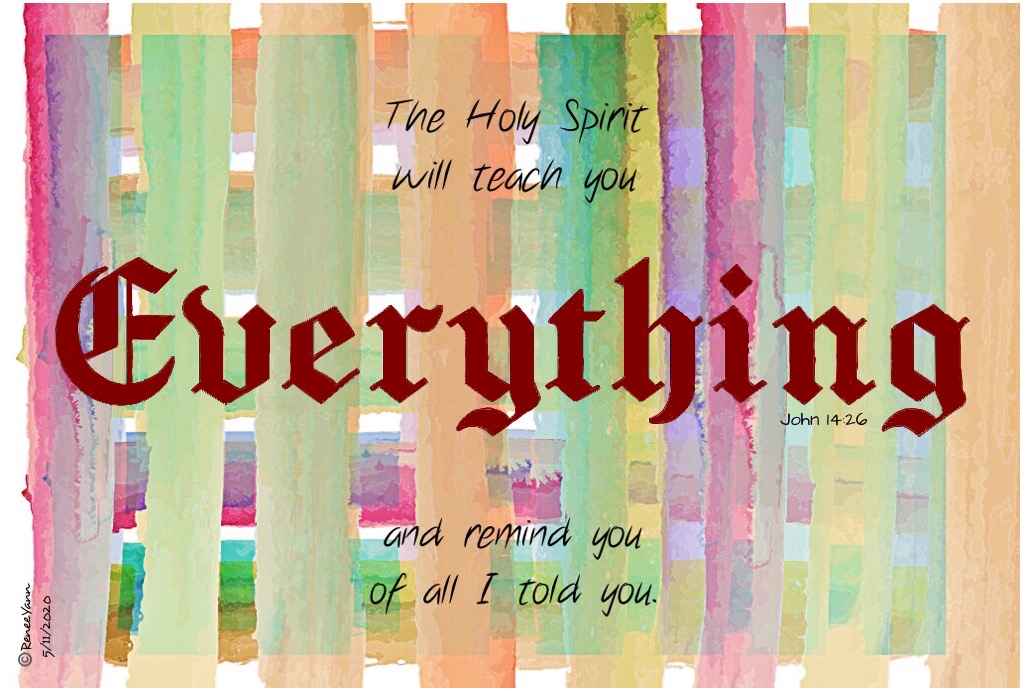
Jn14_26 Everything

The Gospel can be fearsome. It asks that we let go of our limited human “geometry”; that we entrust everything to the Inclusive Love who is Jesus Christ. It asks us to open ourselves to the Holy Spirit who, ultimately, will “teach us EVERYTHING”.


question

In our recent readings, we’ve seen Thomas, Philip, and today, Jude the Apostle trying to reach this level of spiritual trust. It’s hard because such trust is more than human. It is a trust bred of the Holy Spirit within us. It is a trust born of living fully in Peace with that Presence.

Judas, not the Iscariot, said to him,
“Master, then what happened that you will reveal yourself to us
and not to the world?”
Jesus answered and said to him,
“Whoever loves me will keep my word,
and my Father will love him,
and we will come to him and make our dwelling with him.

John 14:22-23


It is a trust described like this in tomorrow’s Gospel reading:

Peace I leave with you; my peace I give to you.
Not as the world gives do I give it to you.
Do not let your hearts be troubled or afraid.

Let us pray for trust and peace
in ourselves, our Church, and our world.

Poetry: The Peace of Wild Things – Wendell Berry

When despair for the world grows in me
and I wake in the night at the least sound
in fear of what my life and my children’s lives may be,
I go and lie down where the wood drake
rests in his beauty on the water, and the great heron feeds.
I come into the peace of wild things
who do not tax their lives with forethought
of grief. I come into the presence of still water.
And I feel above me the day-blind stars
waiting with their light. For a time
I rest in the grace of the world, and am free.

Music:  Wonderful Peace – an old Gospel song by Warren Cornell and William Cooper (1899), sung here by Don Moen 

Far away in the depths of my spirit tonight
Rolls a melody sweeter than psalm;
In celestial strains it unceasingly falls
O’er my soul like an infinite calm.

Peace, peace, wonderful peace,
Coming down from the Father above!
Sweep over my spirit forever, I pray
In fathomless billows of love!

Ah, soul! are you here without comfort and rest,
Marching down the rough pathway of time?
Make Jesus your Friend ere the shadows grow dark;
O accept of this peace so sublime!

What a treasure I have in this wonderful peace,
Buried deep in the heart of my soul,
So secure that no power can mine it away,
While the years of eternity roll!

I am resting tonight in this wonderful peace,
Resting sweetly in Jesus’ control;
For I’m kept from all danger by night and by day,
And His glory is flooding my soul!

And I think when I rise to that city of peace,
Where the Anchor of peace I shall see,
That one strain of the song which the ransomed will sing
In that heavenly kingdom will be:

Peace, peace, wonderful peace,
Coming down from the Father above!
Sweep over my spirit forever, I pray
In fathomless billows of love!

Wednesday of the Fourth Week of Easter

May 11, 2022

Today, in God’s Lavish Mercy, our readings have a global, even universal, feel to them. By the power of God, the Apostles begin to go out and preach to the whole world.

Acts tells us that:

… the Holy Spirit said,
“Set apart for me Barnabas and Saul
for the work to which I have called them.”
Then, completing their fasting and prayer,
they laid hands on them and sent them off.

Acts 13:2-3

Our Responsorial Psalm gives us this universal prayer:

May God have pity on us and bless us;
may he let his face shine upon us.
So may your way be known upon earth;
among all nations, your salvation.

Psalm 67:2-3

And Jesus assures us in the Gospel:

I came into the world as light,
so that everyone who believes in me
might not remain in darkness.

John 12:45

Jn12_46 LightJPG

For our prayer, we might want to place before God’s Radiance all those places in the world, and within ourselves, which long for Light. The whole world shares at least one dark shadow in the global pandemic. That shadow has emphasized some of the tenebrous corners in our own hearts where fear, loneliness, loss, and doubt cower and now want to creep out in our required isolation.

And, spread across our world, there are so many other darknesses famished for Light! War, gun violence, gender violence, economic oppression, a global sacrilegious inhumanity to other human beings.

Together, let us give all of these shadows to God’s power as we pray. May that power release us and all our sisters and brothers into its glorious resplendence. Like the Apostles, may a brilliant, steady energy go out from our hearts, convinced of and empowered by the Light of the Gospel.


Music: Two lovely pieces of music suggested themselves today.  I hope you enjoy them.

  1. Eric Whitaker  – Lux Aurumque (“Light and Gold”) is a choral composition in one movement. It is a Christmas piece based on a Latin poem of the same name.

Lux,
Calida gravisque pura velut aurum
Et canunt angeli molliter
modo natum.

Light,
warm and heavy as pure gold
and angels sing softly
to the new-born babe.
Edward Esch, b.1970
(Translated to Latin by Charles Anthony Silvestri)


2. Spirit Seeking Light and Beauty – Janet Erskine Stuart, RSCJ

Spirit seeking Light and Beauty,
Hearts that longeth for Thy rest,
Soul that asketh understanding, only thus can you be blest.
Through the vastness of creation though your restless heart may roam,

God is all that you may long for,
God is all His creatures’ home.
Taste and see it, feel and hear it,
Hope and grasp His unseen Hand.

Though the darkness seems to hide Him,
Faith and love can understand
God Who loveth all His creatures,
All our hearts are known to Thee.
Lead us through the Land of Shadows
To Your vast eternity

Feast of Saints Philip and James, Apostles

May 3, 2022


Today, in God’s Lavish Mercy, I am offering a slightly edited edition of last year’s reflection for the Feast. Re-reading it, I thought it had some points worth repeating.

We pray today with Psalm 19 in which the psalmist draws on nature’s beauty to praise God.

The heavens declare the glory of God;
    and the firmament proclaims his handiwork.
Day pours out the word to day;
    and night to night imparts knowledge.

Psalm 19: 2-3

Psalm 19 is used today to highlight the apostolic work of Philip and James who chose to declare the Gospel by their lives.

We note that these men are no longer called simply “disciples” or learners of the Word. They are now “apostles”, charged with spreading the Word for the benefit of all.

In our Christian vocations, we each are called to live both these aspects of our call. We are continual learners of the faith through our prayer, reading, and listening.  At the same time, we have an apostolic charge to spread the Gospel by the way we live.


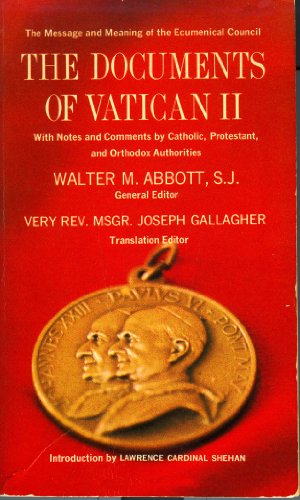
This double call was clearly proclaimed through Vatican II in the magnificent document Lumen Gentium, the Dogmatic Constitution on the Church.

I remember with great joy how this document, with its companions, released a surge of enthusiastic faith in the People of God when published in the 1960s. Many of us read and re-read our paperback copies of the Documents until they have long since fallen apart.

There is a Kindle edition available, but now when I want to be refreshed by their power, I access them for free on my iPad at the Vatican site:

https://www.vatican.va/archive/hist_councils/ii_vatican_council/index.htm


Here is a favorite passage I used today to inform my prayer on this feast of two apostles

Lumen Gentium 
(The Dogmatic Constitution on the Church)
promulgated by Pope Paul VI

The laity are gathered together in the People of God and make up the Body of Christ under one head. Whoever they are they are called upon, as living members, to expend all their energy for the growth of the Church and its continuous sanctification, since this very energy is a gift of the Creator and a blessing of the Redeemer.

The lay apostolate, however, is a participation in the salvific mission of the Church itself. Through their baptism and confirmation all are commissioned to that apostolate by the Lord. Moreover, by the sacraments, especially Holy Eucharist, that charity toward God and our brothers and sisters which is the soul of the apostolate is communicated and nourished. Now the laity are called in a special way to make the Church present and operative in those places and circumstances where only through them can it become the salt of the earth. Thus every lay person, in virtue of the very gifts bestowed upon them, is at the same time a witness and a living instrument of the mission of the Church itself “according to the measure of Christ’s bestowal”.

Besides this apostolate which certainly pertains to all Christians, the laity can also be called in various ways to a more direct form of cooperation in the apostolate of the Hierarchy. This was the way certain men and women assisted Paul the Apostle in the Gospel, laboring much in the Lord. Further, they have the capacity to assume from the Hierarchy certain ecclesiastical functions, which are to be performed for a spiritual purpose.

Upon all the laity, therefore, rests the noble duty of working to extend the divine plan of salvation to all persons of each epoch and in every land. Consequently, may every opportunity be given them so that, according to their abilities and the needs of the times, they may zealously participate in the saving work of the Church.


This morning’s question: 
how am I hearing 
and responding 
to my apostolic call?

Poetry: An Apostle’s Prayer – Edward Henry Bickersteth, Bishop of Exeter (1825-1906)

My God, my Father, let me rest
In the calm sun-glow of Thy face,
Until Thy love in me express’d
Draws others to Thy throne of grace.

O Jesu, Master, let me hold
Such secret fellowship with Thee,
That others, careless once and cold,
Won to my Lord and theirs may be.

Eternal Spirit, heavenly Dove,
The light of life to me impart,
Till fire descending from above
Burns on and on from heart to heart.

O Father, Son, and Holy Ghost,
Still, still may love to love respond;
And teach me, when I love Thee most,
Depths all unfathom’d lie beyond.

Music: The Call – from Five Mystical Songs – Vaughan Williams

Come, my Way, my Truth, my Life:
such a way as gives us breath;
such a truth as ends all strife;
such a life as killeth death.

Come, my Light, my Feast, my Strength:
such a light as shows a feast;
such a feast as mends in length;
such a strength as makes a guest.

Come, my Joy, my Love, my Heart:
such a joy as none can move:
such a love as none can part;
such a heart as joys in love.

Memorial of St. Catherine of Siena

April 29, 2022

Today, in God’s Lavish Mercy, we meet Gamaliel, the revered rabbinical teacher and early mentor of St. Paul.

Rembrandt_-_Old_Rabbi_-_WGA19186
The Old Rabbi by Rembrandt

With his patient wisdom, Gamaliel famously intervened  to save Peter and John from the Sanhedrin’s wrath.

“Fellow children of Israel,
be careful what you are about to do to these men….
…I tell you,
have nothing to do with these men, and let them go.
For if this endeavor is of human origin,
it will destroy itself.
But if it comes from God, you will not be able to destroy them;
you may even find yourselves fighting against God.”

Acts 5: 35-38

Biblical scholars have interpreted Gamaliel’s intervention in various and even contradictory ways. Some see in him a hesitancy which will believe only that which is proven and successful. Others suggest that Gamaliel was already a believer who maintained his Sanhedrin position in order to assist the early Christians. In the Catholic canon, Gamaliel is venerated as a saint whose feastday is August 30.


Thinking about Gamaliel may lead us to the question, “What do I need in order to believe?” 

  • Do I, like the Sanhedrin, need to see proven success?
  • Do I, like some of the crowd fed in today’s Gospel, need miracles?
  • Do I, like the rich young man, need answers to all of my questions?
  • Do I, like Thomas, need to see and touch the Resurrected Christ?

In other words, am I looking for a faith that is a fail-proof blueprint, or is my faith a living journey with Christ, as was Peter’s and John’s?

John4_4 bread word

The Apostles’ faith and trust were so complete that they saw even persecution as evidence of God’s plan and power:

So the Apostles left the presence of the Sanhedrin,
rejoicing that they had been found worthy
to suffer dishonor for the sake of the name.
And all day long, both at the temple and in their homes,
they did not stop teaching and proclaiming the Christ, Jesus.

Acts 5: 41-42

When we are completely given to God in faith, all our life experiences bring us closer to God. All circumstances reveal God to the deeply believing heart.

May we grow every day in that kind of faith.


Today, as we celebrate the feast of the great Saint Catherine of Siena, a reflection in place of our usual poetry.

We can learn Catherine’s spiritual wisdom. Without formal education, she grew by grace into a Doctor of the Church.

Siena

She was born Catherine Benincasa on March 25, 1347, in Siena, Italy, and was a twin, the 24th child of 25. She only lived to the age of 33, dying of a stroke in Rome in 1380. Catherine of Siena, often referred to as “great Kate,” is well known for her expressive life of prayer shared in three major sources of writings: over 400 letters, 26 prayers, and The Dialogue of Divine Providence, which she referred to as “the book,” written in the format of a conversation between herself and God. She was noted for her style of learning, not acquired from formal education and degrees, but gained from an interior wisdom that came from lived experiences and a mystical life of prayer. ( https://www.hprweb.com/2020/02/the-trinitarian-theology-of-the-eucharist-according-to-st-catherine-of-siena/)


Here are two selections from Catherine’s extensive writings which reveal her ever-deepening relationship with God through the gift of the Bread of Life.


Eternal God, Eternal Trinity, You have made the Blood of Christ so precious through His sharing in your Divine Nature. You are a mystery as deep as the sea; the more I search, the more I find, and the more I find the more I search for You. But I can never be satisfied; what I receive will ever leave me desiring more. When You fill my soul I have an ever-greater hunger, and I grow more famished for Your Light. I desire above all to see You, the true Light, as you really are.


St. Catherine of Siena, Prayer 12, V 124–157

And by the light of most holy faith
I shall contemplate myself in you.
And I shall clothe myself in your eternal will,
And by this light I shall come to know
That you, eternal Trinity,
Are table
And food
And waiter for us.

You, eternal Father,
Are the table
That offers us as food
The Lamb, your only-begotten Son.

He is the most exquisite of foods for us,
Both in his teaching,
Which nourishes us in your will,
And in the sacrament
That we receive in Holy Communion,
Which feeds and strengthens us
While we are pilgrim travelers in this life.

And the Holy Spirit
Is indeed a waiter for us,
For he serves us this teaching
By enlightening our mind’s eye with it
And inspiring us to follow it.
And he serves us charity for our neighbors
And hunger to have as food
Souls
And the salvation of the whole world
For the Father’s honor

So we see that souls enlightened in you,
True light,
Never let a moment pass
Without eating this exquisite food
For your honor.


Music:  Ave Verum Corpus – words attributed to 14th century Pope Innocent VI, melody to Mozart