A New Box of Crayons

September 7, 2025

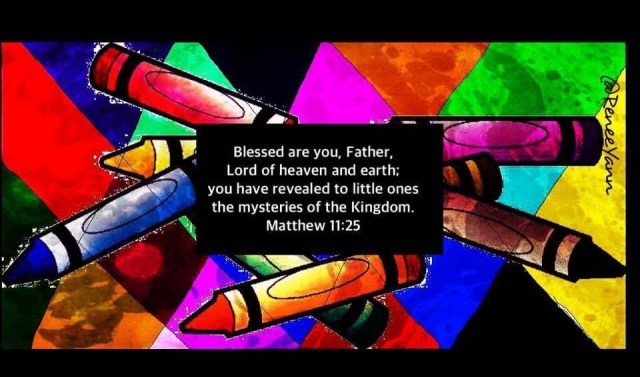
You were a kid once, right? Well when I was a kid, one of the things I really loved about September was getting a new box of crayons. It was a chance to start fresh. It was an opportunity once more to make my contribution to the design of the world with renewed sharpness and depth. It was a beginning participation in the infinite cycle of experience and revitalization we call “Life”.

Our ability with crayons, like our ability with life, develops in stages. As toddlers, our first box of crayons may have been a small three-pack of the primary colors, thick enough for little fingers to grasp, bright enough to make a mark, and (if Mom was lucky) maybe washable! Like life, each year our box of crayons grew bigger with both vibrant and subtle colors, usually indelible, a lot like life itself.

We learned not only that things are rarely black and white. They are not often really red, blue or yellow. We learned that a wild red rose begins as a shy pink bud, just like some people do. We learned that a true blue friendship doesn’t just happen but has to be proven through many green seasons. We learned that what appears to be a yellow streak may really hide the aqua depths of a courageous peacemaker. Each of our experiences brings us a greater capacity and depth to express the power of our spirit as they add the nuances of color to our understanding of life.


On September 11, 2001, our nation and our world added a bruising violet to our box of crayons. As time passes, we are learning to use that painful color to deepen our capacity for courage, compassion, hope, and resolve. Sometimes we and our leaders do this well; sometimes poorly. Our civic and moral duty is to pursue universal peace and justice for all peoples; to contribute to the well-being of Earth and all who share her riches.

As we continue to color our world with meaning, God, Who holds our hand, renews us in grace. In that grace, we are invited to begin afresh. We have a new chance every day to make our lives and our world better — just as we did in our early Septembers with that new box of crayons.

Let’s pray for and encourage one another — especially as September 11th approaches. Let’s pray for those who were most profoundly wounded by the deep purple shadow that fell over all of us that day. Let’s pray for leaders who have the magnitude of heart and spirit to create a compassionate and just world. And let’s reach out in sincerity to one another every day, like we did as children– sharing the colors of hope, faith, and love.


Music: Colors – Black Puma

This song and video present a moving contradiction. The music is upbeat, suggesting happiness. But in the video, a family struggles with losing their home and living unhoused.
The video invites us to think about the counterbalance between struggle and joy, between justice and reality. Lyrics at end of page.


For Your Reflection

  • What feelings or reactions do I have after reading this reflection?
  • Do my feelings or reactions remind me of any passage or event in scripture, especially in the life of Christ? 
  • What actions might I take today because of my response to these readings?

Suggested Scripture: Genesis 9:13


[Verse 1: Eric Burton]
I woke up to the morning sky first
Baby blue, just like we rehearsed
When I get up off this ground, I shake leaves back down
To the brown, brown, brown, brown ’til I’m clean
Then I walked where I’d be shaded by the trees
By a meadow of green
For about a mile
I’m headed to town, town, town in style

[Chorus: Eric Burton with The Soul Supporters]
With all my favorite colors, yes, sir
All my favorite colors, right on
My sisters and my brothers see ’em like no other
All my favorite colors

[Post-Chorus: Eric Burton with The Soul Supporters]
It’s a good day to be, a good day for me
A good day to see my favorite colors, colors
My sisters and my brothers, they see ’em like no other
All my favorite colors

[Verse 2: Eric Burton]
Now take me to the other side
Little bitty blues birds fly
In gray clouds, or white walls, or blue skies
We gon’ fly, feel alright
And we gon’, ooh-ooh, ooh-ooh, ooh-ooh, ooh, yeah
They sound like ooh-ooh, ooh-ooh, ooh-ooh, ooh, yeah
And the least I can say, I anticipate
A homecome parade as we renegade in the morning, right on

Photo by Susanne Jutzeler, suju-foto on Pexels.com

A Crane in the Desert

August 6, 2025

Today is the 80th anniversary of the bombings of Hiroshima and Nagasaki

Dona Nobis Pacem – Yo-Yo Ma and Illia Bondarenko

On a hot August 6th over 40 years ago, I sat quietly in the Nevada desert just outside Las Vegas. Most maps call the place the Nevada Test Site. Established as the Atomic Energy Commission’s on-continent proving ground, the Nevada Test Site has seen multiple decades of nuclear weapons testing.

But to the native peoples, the land is known as Newe Sogobia (Earth Mother), or the Western Shoshone homelands.

I had come to the place with over 200 other peace activists to pray for the end of nuclear wars, bombings and weapons proliferation. As part of our prayer, each one of us found a private spot in that massive desert where we could sit alone to meditate. I rested by a low bush to capture its small shady triangle in the dry, threatening heat even of that early morning.

At first, to the unappreciative eye, the desert seems a monochromatic place. The earth, the few stones, the sparse vegetation all appear to wear a beige garment of anonymity – almost as if they are saying, “Don’t see me. Don’t change me by noticing me.” But after many minutes of peeling away the multiple blindfolds we all carry, I became aware of muted majesty breaking from that desert like tender life from an egg.

A tiny hummingbird, the color of slate and sand, hovered inches from my hand. It drew my eyes to another small white object hidden under the lowest branches of the bush. It was a perfectly executed origami crane, no bigger than my thumb. I learned later of the Japanese activists who had preceded us into the desert, and whose custom it was to leave behind these beautiful “peace cranes” as mute reminders of the horrors of Hiroshima and of the hope for universal peace.

Later that evening, thinking about the cranes, I found myself straddling a confusing range of emotions. In the late 40’s and 50’s, I had grown up in a household that despised Japan. On my mother’s birthday in 1945, her 19 year old brother had been killed at Iwo Jima. It was a scar my mother bore the rest of her life.

But as with many scars we have earned or inherited in life, the years had taught me that there is an inner grace to every pain. Holding one of the delicate cranes, I thought about the innumerable Japanese lives – mostly innocent civilians – that had been lost or disfigured on August 6, 1945. I thought about the fact that life is never served by war – whether that war is global, local or personal. War serves only death.

The quest for peace is a complicated and endless pursuit. I ask myself – and each of you – to renew that quest today by harboring peace in our own lives. Refuse to solve conflicts by aggression. Look beyond the battle to the person. Be an agent of mutuality not of domination. Resist the normalization and glorification of violence and war, and defend their victims.

Eighty years after Hiroshima, we still see abominable inhumanity exploding in Gaza, Ukraine, Haiti, Sudan, and the immigrant communities of the Americas. We cannot be silent in the face of what we see. We are called to witness for peace and justice by our words, our attitudes, our votes, and our advocacy.

God knows our world – our streets – need this from us. If we unfold the wings of our own hearts, perhaps the crane of peace can be freed to change the world.


Music: Peace Train – Cat Stevens

For Your Reflection

  • What feelings or reactions do I have after reading this reflection?
  • Do my feelings or reactions remind me of any passage or event in scripture, especially in the life of Christ? 
  • What actions might I take today because of my response to these readings?

Suggested Scripture: John 14:23-27

The 5th of July

July 5, 2025

Photo by Rakicevic Nenad on Pexels.com
1812 Overture in E-Flat Major, Op.49: I. Largo – Allegro giusto

After all the speeches, sparklers, and spectaculars, the “Next Day” dawns. I wonder what it was like for Jefferson, Franklin, Hamilton, and Adams on the fifth of July in 1776. Did they wake up thinking, “Declaration of Independence – signed. Now, make it happen!”?

When you get right down to it, most of our days are 5th, 6th, 7th, and 8ths of July. They are the days after graduation when we need to get a job. They are the days after the honeymoon when somebody needs to cook dinner and take out the trash. They are the days after the promotion when the first deadline looms and a bunch of faces are looking to you for the plan. They are the days that follow any major life decision, when we must take stock and determine who we are now – in this new dimension.

If the 4th of July is Independence Day, the 5th is Dependability Day, a day to celebrate the people we can always count on. They are there for the parades but they are there for the clean up afterward. They light the spark for the fireworks, but they have a hose nearby just in case. They put their “John Hancock” on the brave new dream and they show up the next morning to design its daunting execution.

The 5th of July is a day to celebrate our own sense of responsibility or “Dependability” – to realize that most of us really do try to be good spouses, parents, employees, neighbors, sons, daughters and friends – that we do keep making the effort every day to be someone for others and not just for ourselves. It is a day to look around at the people in our lives and be grateful that most of them are trying to do the same thing.

Like the founding patriots, we all need to wake up the next day, consider the “dependabilities” in our lives, and put our shoulders to the task of making a better world. Each of our lives is its own small country where the future really depends on how we show up on our “5th of Julys”. The fact that you get up every day and engage that challenge is cause for its own celebration. So if you have a little sparkler left in your back yard, light it for yourself tonight – and for your spouse, your community, your friends, your boss, your kids, your co-workers – who all showed up today to do the best they could on the 5th of July.

Thanks for that and Happy Fifth!


Music: We Need Each Other – PROSKUNED

For Your Reflection:

  • What feelings or reactions do I have after reading this reflection?
  • Do my feelings or reactions remind me of any passage or event in scripture, especially in the life of Christ? 
  • What actions might I take today because of my response to these readings?

Suggested Scripture: Romans 12:3-21

Pimple Balls

June 8, 2025

David Lanz – Return to the Heart

The neighborhoods of my youth were safe playgrounds. On a summer morning, a score of sparkling kids would tumble out onto the bricks like polished marbles rolling to their sparsely equipped games. Occasionally, some kid would have a new pimple ball, prompting an hours-long boxball game, guttered corners serving as bases.

When, over the weeks, that ball grew smooth and airless, we cut it in half, grabbed a doctored broomstick, and hit the halfball up over the electric wires fringing our city street. Top one wire, a single; top two, a double. Lose it on the roof and you had to find a four-inch length of hose to replace it. This until the next kid lost a tooth, got a dime from the tooth fairy, and contributed a new ball.


On those afternoons, the surrounding porches and stoops were dotted with grandparents in folding chairs, escaping the swelter of the unairconditioned houses. They served to arbitrate any particularly sticky play, precursors of instant replay. Behind the houses, our mothers held council together over their billowing clotheslines.

By the time our dads came home, carrying their empty black lunch pails, we shiny kids were dusty with city soot. The beach-chaired elders had solved all the problems of world affairs and our moms had rendered the house ready for the daily family dinner liturgy.

These were such simple times, so simple that they may seem even naïve in today’s complex society. But their symbols assure me that, though things change, they remain the same. The shared play, the community of conversation, the neighborly support group, the evening gathering to home – these were the holy anchors that fed our spirits and honed our souls.

The outline of these sacramentals may look different today, but their substance must remain if we are ever to be happy people – people who live in the world as playmates, neighbors, friends, and family. That, dear friends, is what we were created to be.


Music: Won’t You Be My Neighbor?


For Your Reflection:

  • What feelings or reactions do I have after reading this reflection?
  • Do my feelings or reactions remind me of any passage or event in scripture, especially in the life of Christ? 
  • What actions might I take today because of my response to these readings?

Suggested Scripture: Mark 12:28-29


Happy?

June 1, 2025

There was a quote floating around the internet some time ago. It was a loose translation from the classic poem “The Rubaiyat of Omar Khayyam”. The quote, popularized through the film “Unfaithful”, goes like this:

“Be happy for this moment.
This moment is your life.”

There are so many ways to interpret this quote! We might see it as a cheap excuse to ignore the responsibilities of life and live in a fantasyland (along the lines of that famous song, “Don’t Worry. Be Happy”). We might see the quote as a failure to acknowledge the suffering and difficulty life sometimes brings us. Or we may see it as an invitation to let nothing in life destroy our joy.

How we interpret this saying has a lot to do with our personal definition of the word “happy.” If we think of happiness as freedom from any sorrow, burden, or difficulty, then the quote is unattainable. But if we view happiness as a deep, abiding peace and self-confidence, steadfast in the face of challenge, then the quote can open up a rich world of application.

With this deeper view of what it means to be happy, the quote invites us to live in our “now”. This particular moment is all that we really have. We can no longer influence the past, and the future is beyond our grasp. This moment is where we have the power to create possibility. In the action of this moment, we shape our world. Most of us won’t ever make the newspaper headlines or history books. Simple things – the things we need to pay attention to in our everyday lives – will make our mark on the world.


Each day, there seem to be so many realities asking for our attention. Certainly our families, our work, our communities are all seeking our focus. But other inanimate things call us as well: that undiagnosed knock in our car engine, the leak in the basement, the bad weather forecast, the unpaid bills on the kitchen table. All of these call on our attention, and can block us from living in the moment fully and joyously. But with discipline, it is possible.

We’ve all been around people who live in the deep moment. They pay exquisite attention to us, and to the life we share with all Creation. They seem able to peel away what is unimportant and to re-focus us on the essentials. They don’t do a lot of talking, but they do a lot of quality listening. When they speak, their words plant themselves inside us and create a sheltering shade for our decisions.


How do these “deep moment” people do that? The secret may lie in a few simple intentional choices:
• know to whom your life belongs and trust that Creator to sustain you no matter what happens.
• build some time – no matter how brief – into each day to acknowledge and connect to that Abiding Presence in your life.
• continually choose to see every person and every encounter as an opportunity for grace and possibility.

Living in such a way is simple but it is not easy. It requires the commitment of a spiritual athlete whose goal is to fully engage life. But look at it this way. Wouldn’t it be sad to come to the end of this one precious life and to realize that we had missed the whole point!


Music: Jesu, Joy of Our Desiring – J. S. Bach (New Age version by Lanfranco Perini)

For Your Reflection:

  • What feelings or reactions do I have after reading this reflection?
  • Do my feelings or reactions remind me of any passage or event in scripture, especially in the life of Christ? 
  • What actions might I take today because of my response to these readings?

Suggested Scripture: 1 Peter 1:3-9

Memorial Day

May 26, 2025

Adagio – Samuel Barber

After my mother died, it was my sad honor to sift through our home in preparation for its sale. The long years of our family’s story had accumulated in closets, cabinets, and a few storage boxes. So many half-forgotten treasures lay hidden in the corners and niches of our now-empty home.

Among these ordinary reliquaries was one unique spot, reserved for the most precious markers on our ancestral line. It was a 19th century “games table” whose leaf folded and whose top swiveled to reveal a hidden compartment. Inside this table, in a shallow space spiced with the essence of history, lay our family’s sad and joyful relics.

Each was a treasure, but as Memorial Day dawns, I remember one in particular. The telegram had been tear-stained and folded into a three-inch square, almost as if to hold the words inside and prevent them from wounding again. Its message, like so many messages down through the ages, fell like a guillotine on the heart of another “Gold Star Mother”: “We deeply regret to inform you that your son James…”

None of our currently living family ever met Uncle Jim. But his memory lives with us. The dreaded telegram resides with me. His Purple Heart and other medals are with my brother. A cousin treasures a picture of Jim’s memorial at the USS Arizona. The story of his death on the shores of Iwo Jima saddens us. Although we never knew his presence, we have espoused his legend as part of our legacy.

But beyond his legend, we need to embrace his truth: he must have been a frightened hero, as are most heroes. He was a 19-year-old boy who loved his country and was brave enough to stand for its ideal of freedom. But he was nonetheless conscripted to an untimely death because more powerful men succumbed to the moral failures of aggression, greed, rampant nationalism, and war.


Each Memorial Day offers us the challenge to balance two eternally contradictory realities: the awesome self-sacrifice of our brave warriors against the moral imperative to disavow war as a means to peace.

Sadly, every family has its fallen and broken heroes. Their relics may rest on our mantle pieces or hide folded in our cedar-scented wardrobes. They may be creased and softened with age or as painfully fresh as the rip of yesterday’s mail.

On Memorial Day, let us remember and honor these heroes for their courage, generosity, and hope. Let us treasure their willingness to stand in harm’s way for us and for their belief that war could be won.

But let us recognize in their loss that wars are never won. War’s collateral loss — fractured bodies, stunted dreams, orphaned children, victimized women, hopeless elders, and a ravaged earth — is a price too great to pay. These expenses of war break the heart of God and God’s people. War, despite its profound costs, is a cheap answer to the failed pursuit of peace.

Let us commit ourselves and commission our leaders to do the daunting work of building true peace through honest politics, globally sensitive financial policies, mutual nation-building, and respect for human life. The sacrifice of our heroes demands it of us. The unfolded memory of Uncle Jim demands it of me.


For Your Reflection

  • What feelings or reactions do I have after reading this reflection?
  • Do my feelings or reactions remind me of any passage or event in scripture, especially in the life of Christ? 

Suggested Scripture – Isaiah 2:1-5

Glimpses of Glory

May 18, 2025

Spiegel Im spiegel (Mirron in the Mirror)

Like many of our immigrant ancestors, my early family was rather poor. They and their neighbors labored to put food on the table and to keep the house warm. I remember one neighbor in particular from my very early childhood. Widowed young and unskilled, she struggled to raise three children in a two-room house. My mother saw her devastation. Financially strapped herself, Mom would “hire” Rae about four times a year to help her house clean – – this rather than embarrass her with a direct handout.

Rae quietly and gratefully acknowledged my mother’s secret strategy. We would be rewarded with a pot of Rae’s famous “Pepper Pot Soup”. This was a poor person’s soup, made from scraps the butcher might otherwise discard. But, through her generous mutuality, Rae transformed it into a gourmet meal. She grew the spices for cooking in a little plot behind her house. I savored their scent which has never been quite repeated in my life.

I haven’t tasted Rae’s soup in nearly seventy years, but I can still savor the divine dimension of my mother’s generosity and of Rae’s gratitude. These women left me a glimpse of glory – an insight into how God sees, loves, and responds – both to our unspoken needs and our deliberate generosities.

  • 1 pound honeycomb beef tripe
  • 5 slices bacon, diced
  • 3 medium leeks, chopped
  • 2 medium green bell peppers, diced
  • 1 bunch fresh parsley, chopped
  • ½ cup chopped onion
  • ½ cup chopped celery
  • 2 quarts beef stock
  • 1 teaspoon ground black pepper
  • ½ teaspoon dried marjoram
  • ½ teaspoon ground cloves (Optional)
  • ¼ teaspoon dried thyme
  • ¼ teaspoon crushed red pepper flakes
  • 1 large bay leaf
  • 2 large carrots, diced
  • 1 large potato, peeled and diced
  • 4 tablespoons butter
  • 4 tablespoons all-purpose flour

Music: A Little a This and That – Pete Seeger (Lyrics below)

My grandma, she can make a soup,
With a little a’ this ‘n’ that.
She can feed the whole sloop group,
With a little a’ this ‘n’ that.
Stone soup! You know the story.
Stone soup! Who needs the glory?
But with grandma cooking, no need to worry.
Just a little a’ this ‘n’ that.

Grandma likes to make a garden grow,
With a little a’ this ‘n’ that.
But she likes to have the ground just so,
With a little a’ this ‘n’ that.
Not too loose and not too firm.
In the spring, the ground’s all got to be turned.
In the fall, lots of compost, to feed the worms,
With a little a’ this ‘n’ that.

Grandma knows we can build a future,
With a little a’ this ‘n’ that.
And a few arguments never ever hurt ya,
With a little a’ this ‘n’ that.
True, this world’s in a helluva fix,
And some say oil and water don’t mix.
But they don’t know a salad-maker’s tricks,
With a little a’ this ‘n’ that.

The world to come may be like a song,
With a little a’ this ‘n’ that.
To make ev’rybody want to sing along,
With a little a’ this ‘n’ that.
A little dissonance ain’t no sin,
A little skylarking to give us all a grin.
Who knows but God’s got a plan for the people to win,
With a little a’ this ‘n’ that.


For Your Reflection

  • What feelings or reactions do I have after reading this reflection?
  • Do my feelings or reactions remind me of any passage or event in scripture, especially in the life of Christ? 
  • What actions might I take today because of my response to these readings?

Suggested Scripture: 1 Kings 17:8-16

Eleanor’s Daughter

May 11, 2025

Brahms’s Lullaby

I had been away – busy and incommunicado for several days. The message was the last one on my answering machine when I got home. It lay curled like a wounded kitten at the end of a long line of incidentals.

Mag had died at 101 years of age – the long faithful friend of my grandmother, my mother, and me.


My Grandmother

The manner of Mag’s faithfulness to each of our generations had been different: a companion to Grandmom, a guide and confidant to Mom, a distant but vigilant observer and encourager of my life in my mother’s stead after Mom had died.


When I called back to acknowledge the message, there was only one meaningful way to announce myself: “This is Eleanor’s daughter.” Just that said everything – it paid tribute to both Mag’s and my mother’s lives. It recognized the duty I owed in both their names. Mag’s daughter said, “We don’t expect you to come… we just wanted you to know.” My mother’s voice spoke in the silence of my heart – “Of course, you will go.”

Eleanor, my Mother

So I traveled to the place where I grew up. There will never be any place that you know more intimately than your childhood neighborhood. You ran through its alleyways and knew its secret hiding places. You explored every inch of its terrain and, to this day, can remember its textures, smells, dangers, and promises. That day, I drove into its heart, remembering.


As I approached the neighborhood, I saw that its edge had frayed like a tattered fabric. The industrial and commercial corridor that had hemmed the old neighborhood had disappeared. Abandoned lots had replaced the thriving factories and immigrant-run shops of my youth. The bustling avenues where I had once threaded my shiny Schwinn bike now echoed like empty canyons under my tires. Loss rose up in my throat like a bitter aftertaste.

But as I neared the church, the fabric began to re-weave. People still lived in the houses and gathered on the brick pavements. I saw neighbors walking to church, as my family had when I was young. I was to learn that the deep human links that had embraced our parish family remained unbroken.

It had been nearly fifty years since I last worshipped in St. Michael’s, but the church of my childhood was perfectly intact. Not only had it been physically restored to the perfection of its 200-year-old origin, but the descendants of many original families remained or had returned for the funeral. During the wake, we reconnected, weaving names and histories into a warm swaddling of belonging.

During preparation for the solemn funeral service, many people came to visit me in the silence of my heart: my parents who had taught me to pray, the sisters and priests who had nurtured my call to religious life, my neighbors and friends whose lives had found graceful regeneration each Sunday in this sanctuary. This place had been the heart of our “village”. It was where we learned and acknowledged that we live life together, not alone – and that the myriad pieces which make up who we are belong in some way to every person who has ever touched us. Every one of us attending Mag’s funeral was paying honor to that reality.


It takes a lifetime to fully learn the office of honor. As a teenager, I was uncomfortable accompanying my mother on her many dutiful journeys: not wanting to visit my old maiden aunts in their very Victorian home, to take a pot of soup to a house in mourning, not knowing what to say at a neighbor’s wake. I remember my mother’s words on such occasions: “We show up. It’s what we do – because it’s all that we can do. It’s an honor to be with someone at these moments of their lives.”

I am old enough now to cherish that role of honor guard. I have learned its beauty and character from the many – including Mag — who have kept vigil beside me and my family in the challenges and blessings of life. I went to Mag’s funeral privileged to exercise that role in my mother’s name – to assume the duty of our family to “show up”.

To stand within duty is to be like a surfer poised inside the huge curl of a powerful wave. It is to ride on an energy that does not belong to you – to open yourself to it with gratitude, awe, and trust. It is to know – in an indescribable way – the profound power of God that holds all life together beyond time and beyond burden.

At Mag’s funeral, I was – once again – proud to be Eleanor’s daughter. I know that she and Mag smiled as I rejoiced in that pride. On this Mother’s Day, I remember that day as a very intentional gift to me, and I treasure it beyond telling.

Mom and I when Pope John Paul II visited for the Eucharistic Congress

Music: Thank You

For Your Reflection

  • What feelings or reactions do I have after reading this reflection?
  • Do my feelings or reactions remind me of any passage or event in scripture, especially in the life of Christ? 
  • What actions might I take today because of my response to these readings?

Suggested Scripture: Proverbs 31 (Adaptation)

Who can find a valiant woman?
She is worth far more than rubies.
Her family has full confidence in her
and lacks nothing of value.
She brings them good, not harm,
all the days of her life.
She gets up while it is still night;
she provides food for her neighbors
and portions for the very poor.
She considers a field and buys it;
out of her earnings she plants a vineyard.
She sets about her work vigorously;
her arms are strong for her tasks.
She sees that her work is fruitful,
and her lamp does not go out at night.
In her hand she holds the distaff
and grasps the spindle with her fingers.
She opens her arms to the poor
and extends her hands to the needy.
When it snows, she has no fear for her household;
for all of them are clothed in scarlet.
She is clothed with strength and dignity;
she can laugh at the days to come.
She speaks with wisdom,
and faithful instruction is on her tongue.
She watches over the affairs of her beloveds
and does not eat the bread of idleness.
Her neighbors arise and call her blessed;
her family also praises her:
“Many women do noble things,
but you surpass them all.”
Charm is deceptive, and beauty is fleeting;
but a generous woman is to be praised.
Honor her for all that her hands have done,
and let her works bring her praise at the heavenly gate.

National Day of Prayer

May 1, 2025

God Bless America

I know that readers of this blog are people of deep prayer.  Your faith, love, and generosity have built my spirit and lifted my heart many times.

On this National Day of Prayer, I encourage us all to focus on our deepest beliefs about what sustains us in life.  Ask that Source of Love, Peace, and Wisdom – by whatever Name you give – to heal our broken world and to make us people of truth, generosity, and goodness.

As we pray, remember those who struggle with life, with faith, with hope.  Wrap your prayer around their need this day.  If you are one who struggles today with these things, let your spirit hand that struggle over to the prayers of those who lift you up and to the Source of Life Who longs to embrace you.

The Creator and Source of Life wants to heal and encourage us all.  Today, in a more conscious way, let us seek that healing and encouragement together. In particular, let us pray for our nation and for our world, that we may find healing from the terrible divisions generated among us by political aggression and despotic greed.


Prose: from C.S. Lewis

For many years after my conversion, I never used any ready-made forms except the Lord’s Prayer. In fact, I tried to pray without words at all – not to verbalize the mental acts. Even in praying for others, I believe I tended to avoid their names and substituted mental images of them. I still think that the prayer without words is the best – if one can really achieve it.


Music: The Prayer – Celine Dion, Andrea Bocelli

For Your Reflection

  • What feelings or reactions do I have after reading this reflection?
  • Do my feelings or reactions remind me of any passage or event in scripture, especially in the life of Christ? 
  • What actions might I take today because of my response to these readings?

Suggested Scripture: 1 Thessalonians 5:16-24

Languages

March 26, 2025

A Sister of Mercy, visiting from Honduras, was scheduled to dine out with my friend. One spoke only Spanish; the other only English. Thus, the dinner party was widened to include another American friend who had spent many years in Peru and spoke both languages. 

Language can both bind and divide us. So often, people speak to each other in the same language but share no true level of understanding. I think of the venomous rhetoric that has poisoned our political culture and am saddened to see the beautiful gift of language used in such hateful ways.

But at other times, even without a shared spoken language, we can communicate with clarity and respect.

I remember a chance meeting a friend and I – two unilingual North Americans– had with one of our Peruvian sisters. We connected at an airport, each preparing to return to our widely-distant homes. She spoke very little English, and I– only the stilted, useless phrases of a high school curriculum. Still, with a few gaps and miscommunications, we enjoyed lunch in one other’s company. By combining signs, gestures, guesses, and silence, we grew comfortable in each other’s hospitality and care. 

There are so many languages beyond the spoken word. The language of kindness, respect, compassion, mutuality– these are the elements of the multilingual world we all should yearn to master. No one is so distant from us that they do not understand a smile, an extended hand, or the offer to share a meal.  And in that offer, we may just learn that we are “multi-lingual” after all. 


Poetry: Silent Language – Thomas Burbidge (1860-1892)

Speak it no more—no more with words profane
What only for the language of the eye
Is fit—what only can be told thereby!
The heart has tones which words cannot contain,
And feelings which to speak is to restrain.
Like scent with scent commixed invisibly,
Or rays of neighbour planets in the sky
Inter-confused; or, as in some deep strain
Of music, heavenly passion is combined
With thought, and tone with tone in harmony,
Thus be the meeting of our hearts, dear love!
The pure communion of mind with mind,
Above poor symbols of this earth,—above
All that can baulk or cramp,—can change or die.

Music: Love in Any Language – Sandy Patty

For Your Reflection

  • What feelings or reactions do I have after reading this reflection?
  • Do my feelings or reactions remind me of any passage or event in scripture, especially in the life of Christ? 
  • What actions might I take today because of my response to these readings?

Suggested Scripture: Ephesians 4:1-7