Earth Day 2020

Wednesday of the Second Week of Easter

April 22, 2020 – Fiftieth Anniversary Earth Day

Today, in Mercy, the theme of our readings falls perfectly in step with Earth Day.

John3_16 so loved

For my prayer this morning, I re-read Pope Francis magnificent encyclical Laudato Si’ which instructs us and begs us to cherish the gift of our Common Home. – a world which God has so loved that God gave the only begotten Son that we should not perish.

This sacred document has become even more meaningful as a global pandemic exposes the fragmentations we have wrought upon the earth.

Here are two of my favorite sections from the encyclical, although I do encourage you to read the whole masterpiece if you have the time and desire.


Click here for the complete Laudato Si’


In the Judaeo-Christian tradition,
the word “creation” has a broader meaning than “nature”,
for it has to do with God’s loving plan
in which every creature
has its own value and significance.
Nature is usually seen
as a system which can be studied,
understood and controlled,
whereas Creation can only be understood
as a gift from the outstretched hand of the Father of all,
and as a reality illuminated by the love
which calls us together into universal communion.

(Laudato Si’ paragraph 76)

laudato


The ultimate destiny of the universe
is in the fullness of God,
which has already been attained by the risen Christ,
the measure of the maturity of all things.
Here we can add yet another argument
for rejecting every tyrannical and irresponsible domination
of human beings over other creatures.
The ultimate purpose of other creatures
is not to be found in us.
Rather, all creatures are moving forward with us
and through us towards a common point of arrival,
which is God,
in that transcendent fullness
where the risen Christ embraces and illumines all things.
Human beings, endowed with intelligence and love,
and drawn by the fullness of Christ,
are called to lead all creatures back to their Creator.
(Laudato Si’ paragraph 83)


May these words bless and enlighten us today to become blessings for Earth, our Common Home.

Music: God So Loved the World – sung by the Mormon Tabernacle Choir
The Seesaw of Faith

Tuesday of the Second Week of Easter

April 21, 2020

Click here for readings

Nicodemus

Today, in Mercy, we meet two towering figures of the early Christian story, Barnabas and Nicodemus.

In our first reading, Barnabas is cited as a devout member of the community of believers which …

… was of one heart and mind,
and no one claimed that any of his possessions was his own,
but they had everything in common.


Our Gospel brings us Nicodemus who “came to Jesus under cover of the night”.  Nicodemus, obviously Ph.D. material, has a long exchange with Jesus in the attempt to come to intellectual comfort with Jesus’s message.

Nicodemus wants his faith to make logical sense before committing to it,  to the point that Jesus sounds a little astounded at the effort:

You are the teacher of Israel
and you do not understand
what I am saying to you?


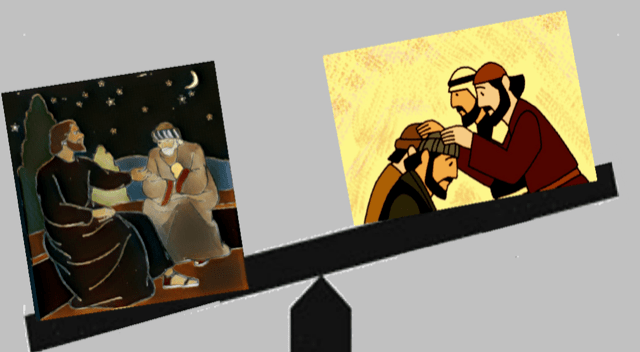
I think a little bit of both Barnabas and Nicodemus lives within each of us.

barnabas seesaw

Like Nicodemus, we do believe, but we would like to understand more. We grapple with concepts of “God’s plan”, with the problem of evil, with what seems the random mercilessness of nature, and myriad other inexplicable realities.

Still, like Barnabas, we trust and are willing to lay our lives at the feet of Christ to be his agents in the world.

That balancing of trust with anxiety is the story of faith for most of us. And it’s OK.  Both Nickie and Barnie turned out to be giants for Christ.  And so will we with God’s help.

Music: Ye Must Be Born Again – sung by The Sensational Nightingales, a beloved Black Gospel Quartet that, with several membership changes, has been popular for over seven decades.  (Lyrics below)

Ye Must Be Born Again
written by William T. Sleeper in 1877

A ruler once came to Jesus by night,
To ask Him the way of salvation and light;
The Master made answer in words true and plain,
“Ye must be born again!”
“I verily, verily say unto thee,
Ye must be born again!”

Ye children of men, attend to the word
So solemnly uttered by Jesus, the Lord,
And let not this message to you be in vain,
“Ye must be born again.”

Oh, ye who would enter that glorious rest,
And sing with the ransomed the song of the blest;
The life everlasting if ye would obtain,
“Ye must be born again.”

Shaken to Life

Monday of the Second Week of Easter

April 20, 2020

Click here for readings

Today, in Mercy, our readings are filled with the sanctifying unrest of the Holy Spirit.

In Acts we read that, despite the internal peace of the early Christian community, they faced a hostile surrounding environment. Nevertheless, they were impelled by the Spirit within them to continue to proclaim Jesus Christ.

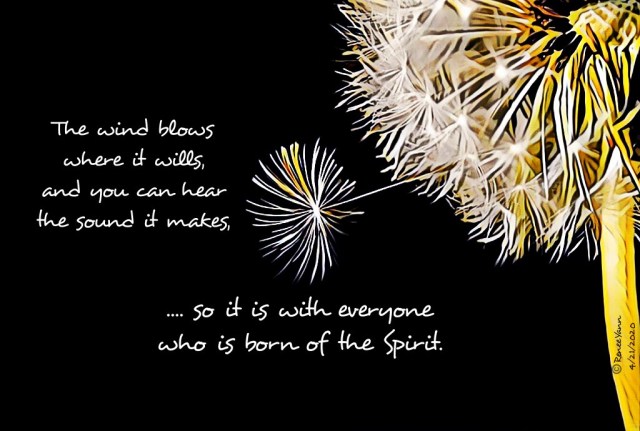
shook


Our Gospel remembers Nicodemus, a ruler of the Jews. Grace burned in him too, but it was a subtle light shaded by his early fear. He came to Jesus in the shadows of the night to test the flame in his soul.

Jesus answered and said to him,
“Amen, amen, I say to you,
unless one is born from above,
he cannot see the Kingdom of God.

balletAgain and again in salvation history, the world is “turned upside down and shaken” by God’s renewing power.  We human beings find ourselves struggling to get our feet under us again as circumstances spin to a new truth. Like graceful ballet dancers pirouetting in space, we must keep our eyes on the fixed point of God’s immovable love.
The early disciples did this. Nicodemus did this. As our world now shakes into a changed reality, it is our turn to lock our hearts on God, opening to the new dream God has for all Creation.

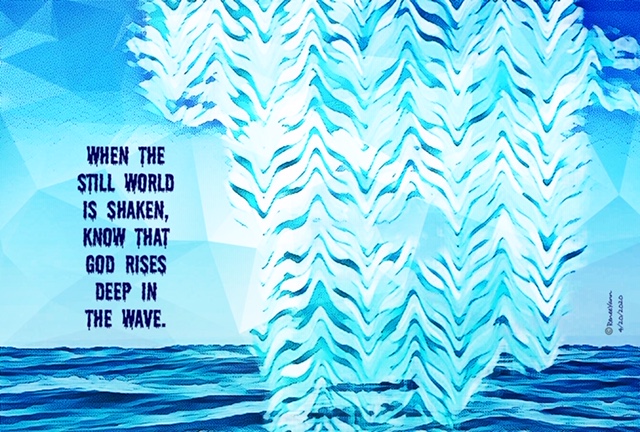
wave

Music: Shake – by Mercy Me (You been sittin’ in that chair a while? Here’s a song you can get up and dance-pray!)

Reborn in God

Second Sunday of Easter

April 19,2020

Click here for readings

Today, in Mercy, our readings offer us a snapshot of the infant Church – a joyful, loving, generous community confidently sharing the Good News of Jesus Christ.

Eucharist

Our Responsorial Psalm, written centuries before their time, prophetically captures their grateful Resurrection prayer:

R. Alleluia.
The stone which the builders rejected
has become the cornerstone.
By the LORD has this been done;
it is wonderful in our eyes.
This is the day the LORD has made;
let us be glad and rejoice in it.


Our second reading from Peter voices the community’s amazed gratitude:

Blessed be the God and Father of our Lord Jesus Christ,
who in his great mercy gave us a new birth to a living hope
through the resurrection of Jesus Christ from the dead,


Friends, how we need that living hope today, in these times that test our souls!

It is true that everyday of our lives we are reborn in God.  New grace, new challenge, new blessing comes to us daily. But the need for that newness has seldom felt so momentous as it does in these pandemic times.

We are challenged:

  • to find God in clouded realty
  • to be a channel of God’s love even in suffering
  • to build the generous community despite isolation
  • to be the touch of Mercy in a touchless world

We may feel a little like Thomas as we pray with these challenges. It must have been so hard for him to touch the wounds of Jesus! And it must have been shocking for him to feel them — these apparent talismans of suffering –  now charged with an infinite transformative power!

My Lord

What changed for Thomas to make him a devout believer? Not his circumstances. Not the reality around him.  Not the challenges before him.

The change came within him because he believed. By looking through suffering to glory, Thomas believed.

May we have that kind of faith in these times that so hunger for it! That kind of faith allows us to be reborn!

(Speaking of being reborn, I am sending a short second reflection today. Today is my 75th birthday and the Psalm is my way of celebrating with all of you.)

Music: Thomas Song – Halleal (Lyrics below)

Thomas’ Song – Hallal

Jesus you were all to me,
Why did you die on Calvary?
O Lamb of God, I fail to see
How this could be part of the plan.

They say that you’re alive again
But I saw death and every sin
Reach out to claim their darkest whim
How could this part if the plan?

If I could only
Hold your hand
And touch the scars
Where nail were driven,
I would need
To feel your side
Where holy flesh
A spear was riven,
Then I’d believe,
Only then I’d believe
Your cruel death
Was part of a heavenly plan.

Holy presence, holy face
A vision filling time and space
Your newness makes my spirit race
Could this be part of the plan?
I see the wounds that caused the cry
From heaven, ocean, earth, and sky
When people watched their savior die
Could this be part of the plan?

Reaching out
To hold your hand
And touch the scars
Where nails were driven
Coming near
I feel your side
Where holy flesh
A spear was riven
Now I believe
Jesus now I believe
Your cruel death
Was part of a heavenly plan
I proudly say
With blazen cry
You are my Lord and my God!


Recognized by Love

Saturday in the Octave of Easter

April 18, 2020

Click here for readings

Today, in Mercy, our readings are about appearances and recognitions.

Acts_recognizedJPG

We pray this morning with the pioneers of our Christian Faith: Mary Magdalen, Peter, John, and all the Eleven. The scriptures tell us the story of their post-Resurrection discipleship – a time of joyous, dynamic commitment to build the faith community, to share the wonder of the eternally living Jesus with all people.

These first Easter Christians were shining with faith…. so much so that it could be said:

Observing the boldness of Peter and John
and perceiving them to be uneducated, ordinary men,
the leaders, elders, and scribes were amazed,
and they recognized them as the companions of Jesus.

Our Gospel summarizes the fact that, for a brief time, the Risen Jesus remained with these disciples to shore up their confidence and commitment. In this passage, He appeared first to beloved Mary Magdalen, then to the unnamed two who journeyed a country road, and finally to the Eleven gathered at dinner.

He had different messages at each appearance:

  • the intimate commission of Mary to be his first announcer
  • the companionable accompaniment of the two distraught disciples from Emmaus
  • the scolding of the “hard-hearted” Eleven with the uncompromising charge

“Go into the whole world
and proclaim the Gospel
to every creature.”


Dear Friends, that charge is meant for each of us as well. For our times, we are the ones commissioned to proclaim that Christ is risen, that the Good News of God’s love is alive in us! Damn the Corona – We are a Resurrection People!

Our prayer today may lead us to consider:

  • Would we, like Mary, recognize the voice of Jesus calling us to deeper discipleship?
  • Would we, like the Emmaus travelers, listen beyond our fears to hear the Truth of Jesus in our circumstances?
  • Would we, like the hesitant Eleven, rebound through our failures to a stronger faith?
  • Would we, like Peter and John, by our faith-filled words and actions, be recognizable as companions of Jesus?

Music: They Will Know We Are Christians- This is a 60s song, reminiscent of the kind of music that flooded the Church after the breakthroughs of Vatican II.  It’s not great music — but I always love hearing it, because it reminds of the joy and enthusiasm of those times when we first realized WE were the Church Alive in the world!

The Precious Name

Wednesday in the Octave of Easter

Click here for readings

Today, in Mercy, our passage from Acts describes a sacred practice of the early Church – the invocation of the Name of Jesus as a source of spiritual power.

acts3_6 Name

Peter said, “I have neither silver nor gold,
but what I do have I give you:
in the name of Jesus Christ the Nazorean, rise and walk.”


These first Christians were so invested in the Gospel of Jesus Christ that they claimed the right to act in his Name. They also clearly believed that they had no power themselves, but only in that blessed Name.

To call someone by their given name is an act of familiarity, if not intimacy. For those closest to us, we often have nicknames or pet names, conveying a unique understanding of each other.

Calling God by name is an act of both intimacy and worship. In the book of Exodus, God takes the first step in that deeper friendship:

God also said to Moses, “I am the Lord.
I appeared to Abraham, to Isaac and to Jacob
as God Almighty,
but by my name “the Lord”
I did not make myself fully known to them.


With the Incarnation of Jesus, God took the ultimate step in loving friendship with us. To help us understand the nature of this friendship, Jesus gives himself some “nicknames” throughout the Gospel:

  • Good Shepherd
  • Lamb of God
  • the Vine
  • the Way, the Truth, the Life
  • the Bread of Life
  • the Light of the World

Each of these names helps us to enter more deeply into the infinite love God has for us.


Do you have a special name for God? Sometimes, early in the morning when First Light touches my window, I pray with that Name. I ask my Bright God to light my life and the lives of those I love this day. At night, that same window is full of Sweet Darkness, a Name I call God as I ask that we all find a peaceful, protected sleep.

We might also ask if God has a special name for us. At different moments and moods of your life, does God speak to you with a personal, loving “nickname”? If you haven’t heard it yet, why not ask God to whisper it to you in your next prayer?

Jesus, Jesus
Let all creation bend the knee to the Lord.

In Him we live, we move and have our being;
In Him the Christ, In Him the King!
Jesus the Lord.

Though Son, He did not cling to Godliness,
But emptied Himself, became a slave!
Jesus the Lord.

He lived obediently His Father’s will
Accepting His death, death on a cross!
Jesus the Lord.

Struck to the Heart

Easter Tuesday 2020

Click here for readings

Today, in Mercy, our readings present us with a picture of the nascent Church as it works toward understanding itself in the physical absence of Jesus.

Throughout the Gospels, we see a Christian community forming around a Leader they can see, hear and touch. Acts reveals how that community awakens to itself when Jesus is no longer materially present.

Acts shows us a Church like us. We have never seen Christ, nor heard him, nor touched him. And yet we believe, or want to believe.


In our reading today, Peter preaches with brutal honesty:

Let the whole house of Israel know for certain
that God has made him both Lord and Christ,
this Jesus whom you crucified.

acts2_38_heartstruck

Peter’s message gets through to the assembly, to the point that, when they hear it, they are “cut to the heart”. This phrase indicates a profound conversion in the way they believed. Peter tells them that their faith, like Jesus’ life, must now become a sign of contradiction to a “corrupt generation “.

What might this powerful passage say to us?

For one thing, the reading calls us to be honest about the sincerity of our faith. Is it the core of our lives? Or is it, at best, a Sunday hobby? Does it pervade our relationships and choices, giving witness to Christ’s commission to love? Or is it a tool to judge and vilify those who differ from us?

Now, in these pandemic times, as we are distanced from the opportunity to worship in community, we may be struck by all that we had taken for granted until now. Faith matters.  We need it to be whole human beings.

The reading doesn’t demand that we “preach our faith out loud”. It calls us to a much deeper and more courageous witness:

  • to be Truth in a world of lies
  • to be Peace in violence
  • to be Justice in the face of abuse and domination
  • to be Servant rather than be served
  • to be Love for those deemed unlovable
  • in other words, to be like Jesus

And to do it all because we have been “cut to the heart” by the witness of the Cross and Resurrection.

Music: By Faith-Keith & Kristyn Getty


Holy Thursday 2020

Holy Thursday 

April 9, 2020

Click here for readings

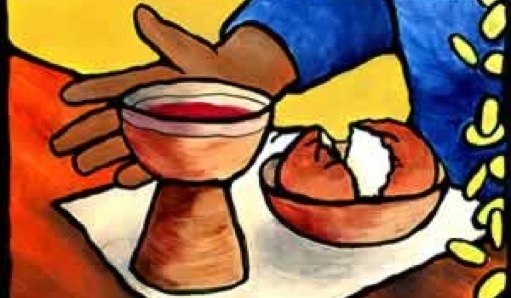
Eucharist

Today, in Mercy, we celebrate the gift of Eucharist, the real and enduring Presence of Christ in  the world.

It is both ironic and instructive that on this “Corona” Holy Thursday, we are quarantined from the sacred Bread and Wine. 

Today, as supper time falls slowly from east to west over the Earth, so will a palpable sadness that pandemic keeps us from physical communion with Christ and the believing community.

There will instead flow a great surge of virtual communion as we join an irrepressible wave of faith. The evening skies will echo with the precious words that, despite circumstances, gather us from whatever distances prevent us:

Jesus took bread, and, after he had given thanks,
broke it and said, “This is my body that is for you.
Do this in remembrance of me.”
In the same way also the cup, after supper, saying,
“This cup is the new covenant in my blood.
Do this, as often as you drink it, in remembrance of me.

Our Gospel reminds us of something which seems even more important this year – there are two equally significant dimensions to a full understanding of Eucharist:

  • the Body and Blood we share at Mass
  • the sacrificial service we live daily among the People of God
    who are the living Body of Christ for us.

In these times of stark loss and need, that second dimension sustains us.

foot

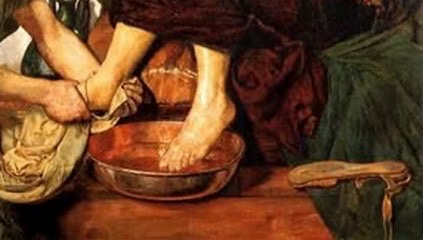
Eucharist is offered when we wash the feet of our sisters and brothers:

  • by the medical and support personnel who tend and comfort the sick, who feed them, clean for them, pray for them
  • by the sick themselves who endure in faith and hope 
  • by those who strive to keep others well
  • by those who serve our essential needs for sustenance and safety
  • by those who pray for the healing, courage and restoration of all Creation 
  • by each one of us as we turn from self toward the good of the whole

As Jesus leans to wash the feet of his disciples, so may we lean in service over our suffering world. Jesus asks us:

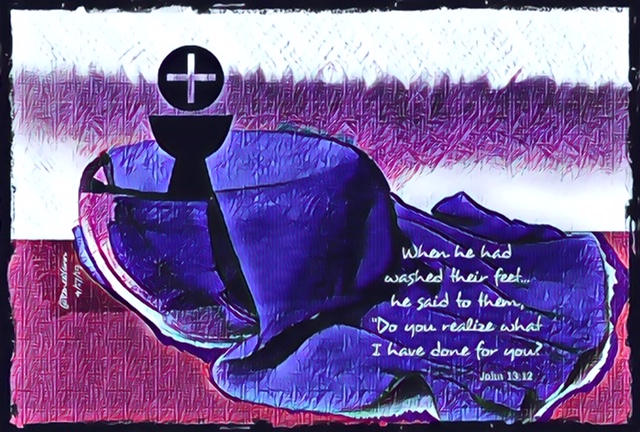
Do you realize what I, your Lord and Master, have done for you?

Not fully, Lord, but we are learning a new depth of understanding.

bowl

The realization rises like a slow dawn over the shadows of our selfishness. It is a sunrise which continues throughout our lives. Please help us to rise with You no matter how the darkness weighs on us.

Like the fragile bread and fluid wine which hide your Omnipotent Presence, may we become holy nourishment and joy for one another – a true and living memorial to your infinite act of love for us.

Music: Pange Lingua – Chant of the Mystics.
Written by St. Thomas Aquinas in the 13th century
English lyrics below


Sing, my tongue, the Saviour’s glory,
Of His Flesh, the mystery sing;
Of the Blood, all price exceeding,
Shed by our Immortal King,
Destined, for the world’s redemption,
From a noble Womb to spring.

Of a pure and spotless Virgin
Born for us on earth below,
He, as Man, with man conversing,
Stayed, the seeds of truth to sow;
Then He closed in solemn order
Wondrously His Life of woe.

On the night of that Last Supper,
Seated with His chosen band,
He, the Paschal Victim eating,
First fulfils the Law’s command;
Then as Food to all his brethren
Gives Himself with His own Hand.

Word-made-Flesh, the bread of nature
By His Word to Flesh He turns;
Wine into His Blood He changes:
What though sense no change discerns.
Only be the heart in earnest,
Faith her lesson quickly learns.

Down in adoration falling,
Lo, the sacred Host we hail,
Lo, o’er ancient forms departing
Newer rites of grace prevail:
Faith for all defects supplying,
When the feeble senses fail.

To the Everlasting Father
And the Son who comes on high
With the Holy Ghost proceeding
Forth from each eternally,
Be salvation, honor, blessing,
Might and endless majesty.
Amen.

Worlds Falling Apart

Saturday of the Fifth Week of Lent

April 4, 2020

Click here for today’s readings

Today, in Mercy, worlds are splitting apart, but the Word of God comes to heal them.

In our first reading, we share in the experience of the prophet Ezekiel.

Ezekiel and his wife lived during the Babylonian Captivity on banks of the Chenab River which is in modern day Iraq. He lived during the siege of Jerusalem in 589 BC. In Ezekiel’s day the northern kingdom had been conquered and destroyed 150 years earlier.

In other words, Ezekiel, like his contemporary Jeremiah, had his heart torn apart along with the homeland they cherished as God’s promise to them. 

dry bones
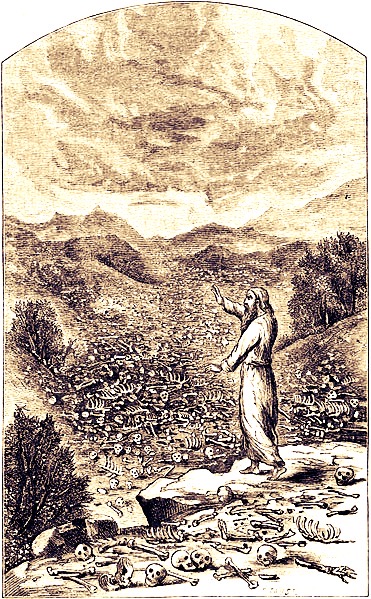
The Valley of the Dry Bones – artist unknown

In today’s reading, which comes immediately after his vision of the Dry Bones, Ezekiel prophesies a message of hope and restoration to a fragmented and devastated nation.


In our Gospel, Jesus is the new Ezekiel. He stands in the midst of the bigger “nation” of all God’s Creation which has been fragmented by the failure to love. Like Ezekiel, Jesus offers a message of hope and restoration to sinners.

In this Gospel, Jesus himself is the “Temple” about to destroyed. The prophecy of its destruction is unwittingly delivered by the high priest Caiaphas:

Caiaphas,
who was high priest that year,
said to the Pharisees and Sanhedrin,
“You know nothing,
nor do you consider that it is better for you
that one man should die instead of the people,
so that the whole nation may not perish.”
He did not say this on his own,
but since he was high priest for that year,
he prophesied that Jesus was going to die for the nation,
and not only for the nation,
but also to gather into one the dispersed children of God.

Within Christ’s new law of love, these “children of God” go far beyond the Jewish nation. They are you and me, and every other creature with whom we share this time and universe. The fragmentations which separate and alienate us are dissolved in the Passion, Death and Resurrection of Jesus Christ.


holy week

Holy Week will begin tomorrow when all believers will intensify their desire to join Christ in his final journey to Resurrection, to understand our own lives anew in the power of Paschal Grace.

This is a somber and surreal time for all of us, and we will miss our ability to join one another in our beloved Holy Week Services. But there are some helpful alternatives. I’ve listed some of my favorites below. Click on any of these three links below to explore.

Resources for observing Holy Week at home from Liturgical Press

The Holy Week services at the Vatican will also be available on line. This link explains how to join them in prayer.

EWTN television station also has a full schedule of Holy Week prayer opportunities.

Music:  Make Us One – featuring James Lorne’s. Written by Sally DeFord
(Lyrics below)

Lyrics

How shall we stand amid uncertainty?
Where is our comfort in travail?
How shall we walk amid infirmity,
When feeble limbs are worn and frail?
And as we pass through mortal sorrow,
How shall our hearts abide the day?
Where is the strength the soul may borrow?
Teach us thy way.

Chorus:
Make us one, that our burdens may be light
Make us one as we seek eternal life
Unite our hands to serve thy children well
Unite us in obedience to thy will.
Make us one! teach us, Lord, to be
Of one faith, of one heart
One in thee.
Then shall our souls be filled with charity,
Then shall all hate and anger cease
And though we strive amid adversity,
Yet shall we find thy perfect peace
So shall we stand despite our weakness,
So shall our strength be strength enough
We bring our hearts to thee in meekness;
Lord, wilt thou bind them in thy love?

(Repeat chorus)

Take from me this heart of stone,
And make it flesh even as thine own
Take from me unfeeling pride;
Teach me compassion; cast my fear aside.
Give us one heart, give us one mind
Lord, make us thine
Oh, make us thine!
(Repeat chorus)

Our Golden Calf

Thursday of the Fourth Week of Lent

March 26, 2020

Click here for today’s readings

calf

Today, in Mercy, God sends Moses down to straighten out his “depraved people” because, despite all God’s  goodness to them, they have preferred “the golden calf”.

In the deprivations of this pandemic time, when all of us are doing a lot of soul-searching, we are discovering quite a few golden calves still running around in our times.


One of them jumped out at me last night when I read this headline:

Texas’ lieutenant governor suggests grandparents
are willing to die for US economy


I woke up this morning still appalled by the statement.  But upon reflection, I realized that Mr. Patrick may have unwittingly done us a great service if we ruthlessly unpack his cavalier remarks.

How have we gotten to a world where such a statement can be uttered and even approved by some? How can we so blatantly ignore basic moral principles such as the sanctity of every life, and that the ends never justify the means? Well, let’s take a look at Moses’ “depraved” community. They seem to have reached a similar moral deprivation.

I think the key lies with the golden calf.  The idol is a symbol of the Israelite community’s economy, what they really deem most important, what they really worship when they think God isn’t looking. When they look upon its golden reflection, they see themselves mirrored back the way they want to be – rich, powerful, and dominant. Lt. Governor Patrick’s statement should make us consider how we have become hypnotized by the same idolatries.

Let’s face it.  We live in a culture that has normalized war, capital punishment, abortion, illegal detention, corporate hijacking of natural resources, unchecked pollution, and commercialization of deadly substances like tobacco. Why are we surprised that we’re ready to sacrifice the elderly to preserve the sheen on our “golden calf”?

We have created a world where we welcome information sources that tell us lies just so we can be falsely convinced and dangerously indifferent. It’s really hard to discern a moral path amidst today’s political complexities. So let’s just build that golden calf whose mesmerizing patina permits us to remain morally comatose!


I hope we allow this man’s callous commentary to continue to stab our consciences:

Somebody’s beloved can die
not only so that my beloved can live,
but can also have an undamaged economy.


What “economy”, for God’s sake? Does he mean the one where over 40 million Americans and nearly 800 million worldwide face daily hunger? Or where 80 million Americans have inadequate or no health insurance? Or does he mean the extractive economy which causes two-thirds of the world population to live on less than $10 per day?

I’m pretty sure he means instead the economy of the “ golden calf” where 

  • half of the world’s net wealth belongs to the top 1%
  • top 10% of adults hold 85%
  • while the bottom 90% eke out existence on  the remaining 15% of the world’s total wealth

I’m not willing to die to shore up that economy, are you? But I’m sure willing to fight to change it.

So, at least, thanks for inspiring me, Lt. Governor Patrick and God help you!

Music: If There’s a God in Heaven – Elton John – (a song that could reflect how the ancient Israelites struggled with their tortuous journey. (Lyrics below)

Torn from their families
Mothers go hungry
To feed their children
But children go hungry
There’s so many big men
They’re out making millions
When poverty’s profits
Just blame the children
If there’s a God in heaven
What’s he waiting for
If He can’t hear the children
Then he must see the war
But it seems to me
That he leads his lambs
To the slaughter house
And not the promised land
Dying for causes
They don’t understand
We’ve been taking their futures
Right out of their handsThey need the handouts
To hold back the tears
There’s so many crying
But so few that hear

If there’s a God in heaven

Well, what’s he waiting for

If there’s a God in heaven
What’s he waiting for