Psalm 123: Song of the Caged Bird

Memorial of Saint Charles Lwanga and Companions, Martyrs
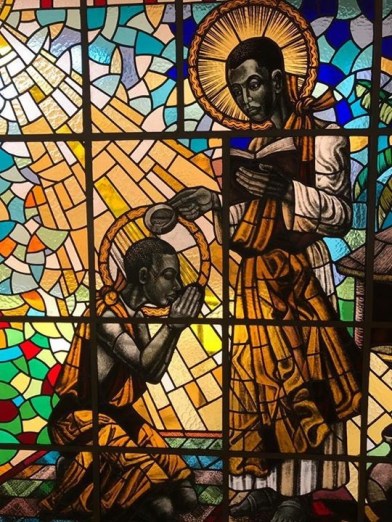
Charles Lwango
St. Kizito being baptised by St. Charles Lwanga at Munyonyo – stained glass at Munyonyo Martyrs Shrine

Charles Lwanga (1860 – 1886) was a Ugandan convert to the Catholic Church, who was martyred for his faith and is revered as a saint by both the Catholic Church and the Anglican Communion.


June 3, 2020

Click here for today’s readings

Today, in God’s Lavish Mercy, we pray with Psalm 123. How fitting that this particular prayer should bless us at this time!

Psalm 123 is one of the fifteen Psalms of Ascent (120-134). It is thought that these prayer songs were sung by pilgrims ascending to Jerusalem, expressing the joys, sorrows, needs and sufferings of the community.

Among them Psalm 123 is a lament, particularly for the scorn and contempt the Israelites felt as they tried to live lives of faith in a hostile world. Verses 3 and 4, (not included in today’s passage) plead:

Show us favor, LORD, show us favor,
for we have our fill of contempt.
Our souls are more than sated
with mockery from the insolent,
with contempt from the arrogant.

Praying with Psalm 123, we might think of today’s “pilgrims”, traveling the streets in protest of racial injustice. The integrity of their cause has been polluted by the rioters and looters infiltrating them, drawing contempt even from some who might otherwise have supported them.
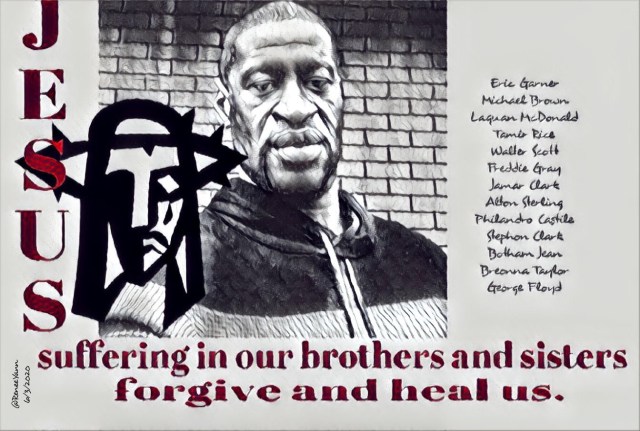
Geo_Floyd

Still, people of faith must not be distracted from the truth, nor should we hide from the reality of our own complicity in normalizing unjust systems.  We must hear the lament of all those who long for justice. We must acknowledge that our current structures have grievously failed people of color, the poor and the refugee. We must make the choices that justice and mercy demand of us.


Today’s Responsorial verses may help us. In our hearts and souls, let us stand beside one another as we pray, each of us created to serve God by serving one another:

To you I raise my eyes,
to you enthroned in heaven.
Yes, like the eyes of servants
on the hand of their masters,

Like the eyes of a maid
on the hand of her mistress,
So our eyes are on the LORD our God,
till we are shown favor.


A poem to enrich your reflection:

cage

Caged Bird
A free bird leaps
on the back of the wind
and floats downstream
till the current ends
and dips his wing
in the orange sun rays
and dares to claim the sky.

But a bird that stalks
down his narrow cage
can seldom see through
his bars of rage
his wings are clipped and
his feet are tied
so he opens his throat to sing.

The caged bird sings
with a fearful trill
of things unknown
but longed for still
and his tune is heard
on the distant hill
for the caged bird
sings of freedom.

The free bird thinks of another breeze
and the trade winds soft through the sighing trees
and the fat worms waiting on a dawn bright lawn
and he names the sky his own

But a caged bird stands on the grave of dreams
his shadow shouts on a nightmare scream
his wings are clipped and his feet are tied
so he opens his throat to sing.

The caged bird sings
with a fearful trill
of things unknown
but longed for still
and his tune is heard
on the distant hill
for the caged bird
sings of freedom.
~ Maya Angelou


Music: Giovanni Pierluigi da Palestrina: Ad te levavi oculos meos (Psalm 123)

Ad te levavi oculos meos, qui habitas in caelis.
Ecce sicut oculi servorum in manibus dominorum suorum;
sicut oculi ancillae in  manibus dominae suae:
ita oculi nostri ad Dominum Deum nostrum,
donec misereatur nostri.

Miserere nostri, Domine, miserere nostri,
quia multum repleti sumus despectione;
quia multum repleta est anima nostra
opprobrium abundantibus, et despectio superbis.

Psalm 90: Where the Bees Hum

Tuesday of the Ninth Week in Ordinary Time

June 2,2020

Click here for readings

Today, in God’s Lavish Mercy, we pray with Psalm 90. As we re-enter Ordinary Time, I was so happy to see this beautiful psalm as the first in our new reflective approach!

Psalm 90

Psalm 90 is the only psalm attributed to Moses. Reading it, one can imagine him in his older years, considering his long relationship with God. As the story of his graced life unfolds in prayer, Moses prays too for the community with whom his years have been intwined.

Some of his same sentiments may fill our hearts as we pray for our own communities in the troubled times:

Relent, O LORD! How long?
Have pity on your servants!
Fill us at daybreak with your mercy,
that all our days we may sing for joy.


Sister Beatrice Brennan, RSCJ wrote an article entitled, Praying at 93”.  Sister reminded me of Moses when she wrote:

To live this long is an amazing grace. One of its unexpected joys is how alive one can feel spiritually as the slow dismantling of other human processes goes on.
The Bible speaks of “laughing in the latter day.” Prayer, for me, is like that at times. And always, a song of gratitude and joy.

I think Psalm 90 is that kind of prayer, one marinated in a long fidelity and trust. As Sister Beatrice goes on to say:

At a deeper, quieter level of consciousness runs an undefined awareness of God’s presence, similar, I think, to that union of old married couples who may rarely or never put love into words. It has become their life. So prayer becomes a steady underlying trust bearing me along.


Two poems that I hope will enrich your reflection:

IMG_3944

Now I Become Myself
Now I become myself. It’s taken
Time, many years and places;
I have been dissolved and shaken,
Worn other people’s faces,
Run madly, as if Time were there,
Terribly old, crying a warning,
“Hurry, you will be dead before—”
(What? Before you reach the morning?
Or the end of the poem is clear?
Or love safe in the walled city?)
Now to stand still, to be here,
Feel my own weight and density!
The black shadow on the paper
Is my hand; the shadow of a word
As thought shapes the shaper
Falls heavy on the page, is heard.
All fuses now, falls into place
From wish to action, word to silence,
My work, my love, my time, my face
Gathered into one intense
Gesture of growing like a plant.
As slowly as the ripening fruit
Fertile, detached, and always spent,
Falls but does not exhaust the root,
So all the poem is, can give,
Grows in me to become the song,
Made so and rooted by love.
Now there is time and Time is young.
O, in this single hour I live
All of myself and do not move.
I, the pursued, who madly ran,
Stand still, stand still, and stop the sun!
~ May Sarton


IMG_3948

A Long Faith
This is the way of love, perhaps
near the late summer,
when the fruit is full
and the air is still and warm,
when the passion of lovers
no longer rests against
the easy trigger
of adolescent spring,
but lumbers in the drowsy silence
where the bees hum—
where it is enough
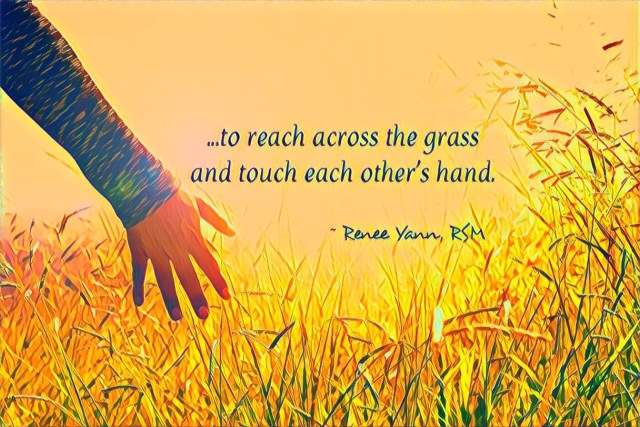
to reach across the grass
and touch each other’s hand.
~ Renee Yann, RSM


Music: Psalm 90 – Marty Goetz

Closing the Book

Saturday of the Seventh Week of Easter

May 30, 2020

Click here for readings

Today, in Mercy, on this day before Pentecost, we close the book on both Acts and John’s Gospel, companions we have been praying with since mid-April.

When I read a really great book, I hate it to end. The characters and their story linger in my mind. The places where I’ve pictured them seem real – as if I’ve visited there myself. And the core of their stories becomes part of me, a reference point for my own experience.

Hopefully, the same thing happens when we read and pray with scripture. 

bible


apostles

As we leave Acts today, we should feel like we know the early disciples better, especially Peter, Paul, Barnabas, Stephen, Lydia and others whose story might have touched us. We should better understand the ups and downs of the early Church, the passion for mission, and the evolution of faith – and how these speak to our own times.


Finishing John, we have a slightly different picture of Jesus from that of the Synoptic Gospels of Matthew, Mark, and Luke. We see a Jesus full of Light, his human existence described through the lens of his Divinity. Johannine scholar Raymond E. Brown describes the difference like this:

That Jesus is the center of John’s message is confirmed by even a hasty reading of the Gospel itself. The emphasis on the Kingdom of God, so prominent in the Synoptic Gospels, has yielded in John to an emphasis on Jesus as the embodiment of life, truth, and light. No more is the parabolic language introduced by “The kingdom of God is like,..”; rather we hear the majestic “I am ” Whereas it is the Kingdom that the Synoptic Gospels describe in terms of vineyard, wheat, shepherd and sheep, in John it is Jesus who is the vine, the bread, the shepherd, and the sheepgate.


shepherdvineeucharist


Today, in our prayer, we might want to glance back through these books, reminding ourselves of the words, phrases and stories that touched our own experience most deeply. 

John_I

Sketching such phrases – perhaps in a daily prayer journal –  is a good way to let our minds turn them over and over again in prayer, discovering new depths with each turn.


Music:  Cavalleria Rusticana: Easter Hymn – Pietro Mascagni, featuring Australian soprano Kiandra Howarth

I thought we’d close these two wonderful books, and the Easter Season, with a bang. (Lyrics and explanation below)


Click here to learn more about Cavalleria rusticana: The Easter Hymn

Lyrics:
LATIN AND ENGLISH:
CHORUS (within the church)
Regina coeli, laetare—Alleluia!
Quia, quem meruisti portare—Alleluia!
Resurrexit sicut dixit—Alleluia!

CHORUS (in the square)
We rejoice that our Saviour is living!
He all-glorious arose from the dead;
Joys of heaven the Lord to us giving,
All the sorrows of darkness are fled!
(The chorus goes out slowly)


ITALIAN:
CORO INTERNO (dalla Chiesa.)
Regina coeli, laetare—Alleluja!
Quia, quem meruisti portare—Alleluja!
Resurrexit sicut dixit—Alleluja!

CORO ESTERNO (sulla piazza.)
Inneggiamo, il Signor non è morto.
Ei fulgente ha dischiuso l’avel,
inneggiamo al Signore risorto
oggi asceso alla gloria del Ciel!
(il Coro esce lentamente)


Weepers

Wednesday of the Seventh Week of Easter

May 27, 2020

Click here for readings

Today, in Mercy, Jesus and Paul continue their heart-wrenching farewell addresses.

We’ve become accustomed to the passages and may read them without much emotional investment, but honestly they are real “weepers” – like movies where you have to bite the edge of your popcorn cup to keep from sobbing out loud.


paul-s-farewell-to-ephesian-elders-sacred-biblical-history-old-new-testament-two-hundred-forty-images-ed-st-69560609
St. Paul Bids Farewell to the Ephesians

Look at Acts, for example, and put yourself in the scene:

When Paul had finished speaking
he knelt down and prayed with them all.
They were all weeping loudly
as they threw their arms around Paul and kissed him,
for they were deeply distressed that he had said
that they would never see his face again.
Then they escorted him to the ship.


blessing


The verses from John are not quite so emotional, but picture yourself being prayed over like this. You sense that this is really a final blessing. You know these may be some of Christ’s last words you will ever hear.

Holy Father, keep them in your name
that you have given me,
so that they may be one just as we are one.


As we pray with today’s scriptures, we are reminded that goodbyes are awfully hard. We need to mourn them within a community of faith lest our hearts break from their weight. 


So many of us, in these sorrowful times, feel that deep longing. We need to tell one another the stories of our loved ones, to sing together our belief in eternal life, to prove that we can still laugh with old memories, to cry at the sight of one another’s tears.

But in an atmosphere of overwhelming loss, the pandemic has denied us this kind of faith-supported mourning.

Jn17_11 keep

Someday, we will gather as we once did. Together, we will pick up the fabric of our common life and finger the places where it has thinned with the passings of our beloveds.

Until then, let us take great hope in the core of Jesus’s message today:

Father, now I am coming to you.
I speak this in the world

so that those you have given me
may share my joy completely.

All that we love, and may seem to have lost, is preserved and transformed – complete and joyful – in the infinite love of God. 

We too can be there in our prayer. We may be shaken by loss, but we are confident in faith. We know and believe that we are all kept in God’s Name.

Music: Aaronic Benediction – Misha and Marty Goetz

Our Beloved Communities

Memorial of Saint Philip Neri, priest

May 26, 2020

Click here for readings

given me

Today, in Mercy, Paul gives the first part of his Ephesian farewell address which he will complete in tomorrow’s reading.

Paul really loved the Ephesian community. He lived with them for three years and poured his heart and soul into teaching them. He doesn’t say it outright, but like all ministers, he must have learned from them as well – from their faith, compassion, and openness to his teaching.

Now Paul begins the last journey back to Jerusalem, a passage which will mirror Christ’s own journey to that sacred city. But before he departs, Paul tells the Ephesians how much he loves and expects from them. And he blesses them.

In tomorrow’s continuation, Paul will say:

And now I commend you to God
and to that gracious word of his that can build you up
and give you the inheritance among all who are consecrated.

In our Gospel today, as Jesus commences his own final journey, he blesses his listeners as well:

Father, I pray for them.
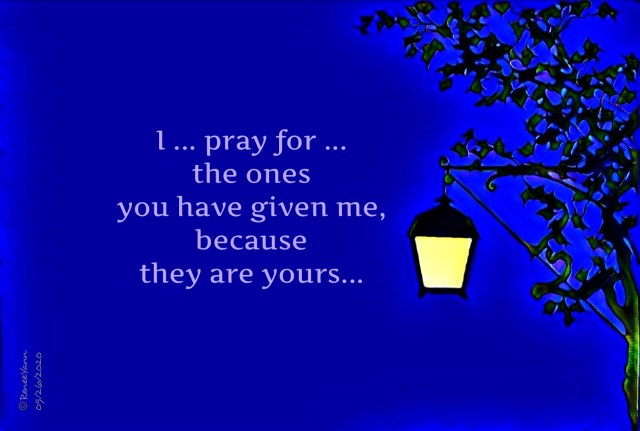
I do not pray for the world but for the ones you have given me,
because they are yours, and everything of mine is yours


Today as we pray, whether we are at the beginning or late parts of our journey, we might take time to pray for the ones God “has given” us in our lives. Like Paul who shared life with the Ephesians, and like Jesus and his beloved disciples, God has given us communities to love and form us on our journey.

These extraordinary pandemic days have reminded us all of what’s most cherished in our lives. It’s such a perfect time to show our own beloved communities how much they mean to us. It doesn’t have to be a long address or a profound speech. My young nephew and his dear wife did it yesterday with a simple and delightfully surprising phone call just before they journeyed on a small vacation.

Just little phrases between us, passed over a thousand mile telephone signal, carried a much bigger message of love and gratitude:

  • just wanted to check on you
  • are you feeling well
  • do you have what you need
  • enjoy your time away
  • travel safely
  • thanks for thinking of me
  • I love you
  • God bless you

Today, as we read the orations of Jesus and Paul, we may not see the same exact phrases, but the message is the same. Jesus and Paul knew it was important to their communities to put that loving message into words. It’s important for our communities too.

familyThanks Jimmy and Kristin. Thank you all my dear family and friends. I am so blessed to have these kinds of conversations with all of you. I don’t ever want to take that for granted.

Like Paul,
I commend each one of you to God
and to that gracious word of his that can build you up
and give you the inheritance among all who are consecrated.

On this, and all your life journeys, travel safely and know you are deeply loved.

Music: The Lord Bless You and Keep You – John Rutter

What “World” Do You Live In?

Saturday of the Fifth Week of Easter

May 16, 2020

Click here for readings

Jn15:18 world

Today, in Mercy, Jesus talks about “the world”.

That word can cause a little confusion, both as we find it in scripture and in the history of Christian thought.

Baker’s Evangelical Dictionary of Biblical Theology says five connotations for “world” may be found in scripture:

  • The physical world – the actual plant Earth
  • The human world – the land and seas we can navigate
  • The moral world – the universe of good and evil
  • The temporal world – the world that will someday end
  • The coming world – eternal existence 

In today’s Gospel, Jesus is talking about the moral world which, in the New Testament, refers to those people who are indifferent and hostile to Christ’s teaching.

If the world hates you, realize that it hated me first.
If you belonged to the world, the world would love its own;
but because you do not belong to the world…
the world hates you.


wolf-clipart-57
A Wolf in Sheep’s Clothing

We understand this use of the word. We see the evil in the world. We are saddened, angered and confounded by it when we recognize it.

But do we always recognize it?

Blatant evils like murder are readily recognized. But the most insidious evils are those that masquerade as good.

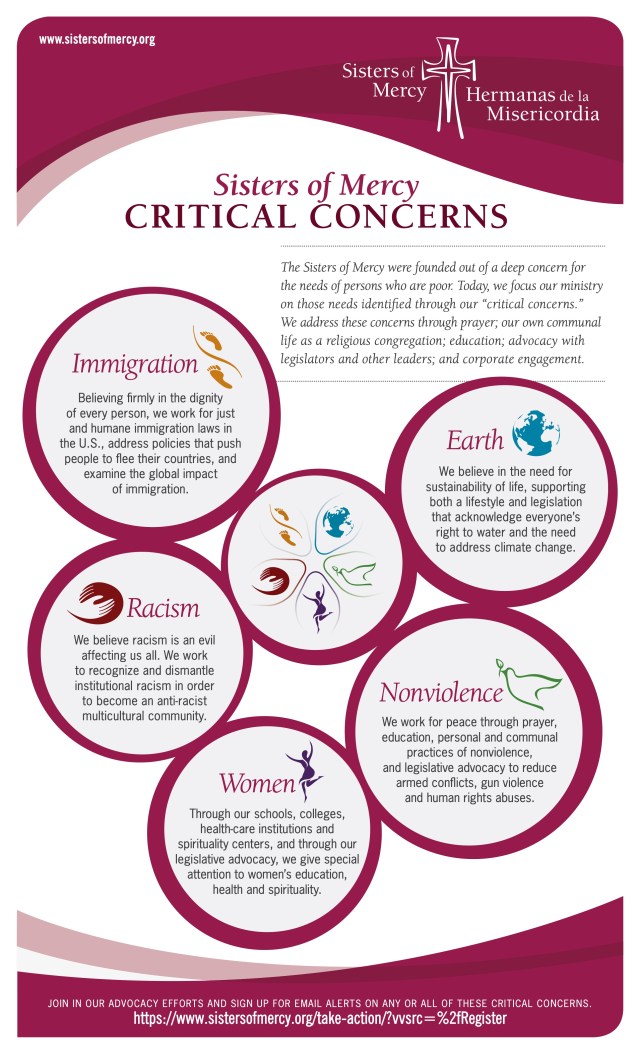
These masquerading evils often pretend to protect our rights, our security, our safety. But they usually do so at the expense of someone else’s rights – the poor, the refugee, the aged, the homeless, people of color……and all who have become “disposable” in our society.


These deceptions hide behind brave and noble words like “America First”, “Second Amendment Rights”, “Protect Life” and a rash of other slogans which fail to examine the whole impact of single-issue politics. 

It’s confusing because we love America, right? We believe in people’s constitutional rights, right? We respect life, right?

What if our slogans instead more clearly reflected Gospel values:

  • The Human Family First
  • Safety Rights for Everyone
  • Health Security for All Life – Womb to Tomb

CriticalConcerns-Poster-FINAL

How can we be spiritually discerning about what is good within such realities and what is rooted in sinful self-interest? Jesus tells us in these words:

Remember the word I spoke to you,
‘No slave is greater than his master.’
If they persecuted me, they will also persecute you.

We must look to the one who is hated and persecuted to find the Face of Christ. We must love that Face and learn its heartaches. We must become a companion in their search for wholeness. We must set aside any costume of self-righteousness and put on the garment of Mercy:

Therefore, as God’s chosen people, holy and dearly loved, clothe yourselves with mercy, kindness, humility, gentleness and patience. Bear with each other and forgive one another if any of you has a grievance against someone. Forgive as the Lord forgave you. And over all these virtues put on love, which binds them all together in perfect unity.
Colossians 3:14-16

Music: The Mercy Song – Paul Alexander

Twelve Who Loved

Feast of Saint Matthias, Apostle

May 14, 2020

Click here for readings

12

Today, in Mercy, Acts relates the story of Matthias and his inclusion as one of the Twelve. But besides Matthias, there was another man considered just as worthy of appointment, Justus. The lot did not fall on him and we never hear of him again.

So if there were two equally good men why didn’t they just widen the circle to thirteen Apostles?


This appointment of the twelfth apostle reflects the importance of the number twelve throughout Scripture. It is a number which signifies perfection, heritage, and strength.

Jacob 12
Jacob Blessing His Twelve Sons – T. Daziel (c.1893)

The Book of Genesis states there were twelve sons of Jacob and those twelve sons formed the twelve tribes of Israel. The New Testament tells us that Jesus had twelve apostles. According to the Book of Revelation, the kingdom of God has twelve gates guarded by twelve angels. 

So Matthias, the Twelfth, brought the circle of Apostles to wholeness.


JofCross
In our Gospel, Jesus tells us that he chooses us all to be his friends. It is a friendship built on imitation of him, proven by keeping his commandments. His commandments are clear:

          • Love God.
          • Love others as I have loved you.

Every day, by prayer and reflective living, we deepen in our love for God and neighbor. We learn Love within the revelation of our own lives.

joy

Jesus tells us that if we love like that our joy will be complete. May we be blessed by that holy joy.

Meditation: Instead of music today, a lovely meditation for those of us missing the celebration of Eucharist: No Longer Do I Call You Servants

Remain

Wednesday of the Fifth Week of Easter

May 13, 2020

Click here for readings

Today, in Mercy, Acts reveals the tensions in the Church between Jewish and Gentile believers. For the Jews, the ritual of circumcision was a key expression of covenantal faith. Some felt it was necessary for Gentile converts to undergo the ritual in order to become Christians.

Like all start-ups, the Church had many friction points which required decisions about what was essential and what was only customary. Those customs being thousands of years old, the decisions become even harder. Readings later this week describe more conflict points.

Nevertheless, under the guidance of the Holy Spirit, and despite the venerability of custom, the nascent Church was able embrace a new reality rooted in Christ’s inclusive love.

These kinds of philosophical and theological tugs-of-war have accompanied the Church down through history. Some of them have helped reveal deeper insights into our faith. But, as in all human communities, some of the tugs have been motivated by fear, greed, power, and other selfish interests.

Watching how the early Church handles their particular situation may give us hints about how we should handle them today.


In our Gospel, Jesus makes clear what is essential and inviolable to the faith:

I am the vine, you are the branches.
Whoever remains in me and I in him will bear much fruit,
because without me you can do nothing.

John15_4 Remain

I think “Remain” is a beautiful word. In the dictionary, it will be defined as ‘stay’. But it connotes much more to me.  Re–main asks us not just to choose to stay with Jesus, but to choose it over and over – like reenlist, renew, recommit.

Remain means to endure with the Beloved Vine through every season – winter’s cold and summer’s heat, and all that’s in between.

Remain means “Love Me, stay beside me, even when others fall away.”

May we remain.


Music: I Am the Vine – John Michael Talbot

Lean on the Cornerstone

Fifth Sunday of Easter

May 10, 2020

Click here for readings

Today, in Mercy, our readings give us the powerful description of a growing Church built on the cornerstone of Jesus Christ.

Acts shows us how that young Church organizes itself on the pattern of Christ, its Foundation.

Our reading from Peter draws on Isaiah’s dynamic metaphor:

cornerstone

Jesus, too, describes a mansion, a sturdy dwelling place with God. It is not some ephemeral dream. That “mansion” is Christ himself who, by his death and Resurrection,  brings us home to our Original Love.


Such images help us to imagine the unimaginable, that God:

  • made us in the Divine Likeness
  • sent the Beloved to redeem us 
  • remains with us forever in the Holy Spirit
  • opens the doors of eternal life to us

This unimaginable grace is a trustworthy promise which we can rest on securely, as a magnificent building rests on its cornerstone.


When the exigencies of time and circumstance assail us, we need to go lean against that Rock. It will not move, even when everything else swirls around us.

Do not let your hearts be troubled.
You have faith in God; have faith also in me.
In my Father’s house there are many dwelling places…
…I will come back again and take you to myself,
so that where I am you also may be.


motherhouse early
19th century photo of Mercy Motherhouse from Lower Merion Historical Society

The beautiful buildings on our Motherhouse grounds are constructed of sixteen inch thick stones, chiseled by a 19th century stonemason. On a clear, late afternoon, one western wall heats up like a vertical oven, capturing all the final sunbeams of the day.  I like to lean against that wall, especially in winter, praying to the God Whose power it has absorbed. I ask that I too may absorb that power; that those for whom I pray may be wrapped in it.

Maybe today, you might find a stone like that to help you pray. Even hold a small one in your hand.

Such images can yield unexpected grace.

Music: Cornerstone – Hillsong ( Lyrics below)

My hope is built on nothing less
Than Jesus’ blood and righteousness
I dare not trust the sweetest frame
But wholly trust is Jesus’ name

My hope is built on nothing less
Than Jesus’ blood and righteousness
I dare not trust the sweetest frame
But wholly trust is Jesus’ name
Christ alone, Cornerstone

Weak made strong in the Savior’s love
Through the storm
He is Lord
Lord of all

When darkness seems to hide His face
I rest on His unchanging grace
In every high and stormy gale
My anchor holds within the veil
Christ alone, Cornerstone

Weak made strong in the Savior’s love
Through the storm
He is Lord
Lord of all
He is Lord
Lord of all, Christ alone
Christ alone, Cornerstone

Weak made strong in the Savior’s love
Through the storm
He is Lord
Lord of all
Christ alone, Cornerstone

Weak made strong in the Savior’s love
Through the storm
He is Lord
Lord of all

When he shall come with trumpet sound
Oh, may I then in Him be found
Dressed in His righteousness alone
Faultless, stand before the throne
Cornerstone

Oh, yeah, in the Savior’s love
He is Lord
Lord of all

Christ alone, Cornerstone
Weak made strong in the Savior’s love
Through the storm
He is Lord
Lord of all

The Power of the Name

Saturday of the Fourth Week of Easter

May 9, 2020

Click here for readings

Today, in Mercy, Paul and Barnabas make a final grand effort to speak to the hearts of the Jews in Antioch. The outcome is both bad news and good news.

The Jewish community resists the Word. But the Gentiles receive it with an open heart and the Gospel ignites “through the whole region”. The catechesis was so successful that resisters mounted the persecution and expulsion of the disciples from the neighborhood.

Then reminiscent of Jesus’s advice in Matthew 10:14:

dust

So they shook the dust from their feet
in protest against them
and went to Iconium.
The disciples were filled with joy and the Holy Spirit.


acts3_6 Name_Original

In our Gospel, Jesus instructs his disciples that He and the Father are one:

“If you know me, then you will also know my Father.
From now on you do know him and have seen him.”


Philip
Philip, like Thomas in yesterday’s Gospel, says he needs a little more to go on than that simple statement:

“Master, show us the Father,
and that will be enough for us.”

Jesus once again patiently reminds Philip and the others that all that they have experienced in Him is a revelation of the Father. He further tells them that they themselves are to be that ongoing revelation for the world:

“Amen, amen, I say to you,
whoever believes in me will do the works that I do,
and will do greater ones than these,
because I am going to the Father.
And whatever you ask in my name, I will do,
so that the Father may be glorified in the Son.
If you ask anything of me in my name, I will do it.”


As Christians, we believe that we too are commissioned in the Name of Christ to be his Presence in the world. Jesus tells us that whatever we ask in his Name will be accomplished.

That doesn’t mean that the name of Jesus is a magic formula to get what we want.

Instead, within the Holy Name, we come to trust the mercy, love, and abiding accompaniment of God. Such trust allows us to see the slow working of God’s loving Will in all things – just as Jesus did through his faithful life, heartbreaking death, and ultimately triumphant Resurrection.

Let us gently repeat that beloved Name in our prayer, asking that its sweet grace enlighten and transform us.

Music: In the Name of the Lord – Gloria Gaithersburg, Phil McHugh, and Sandi Patti