Mission: Eternal

Thursday of the Fourth Week of Easter

May 7, 2020

Click here for readings


Southover, St John the Baptist Church
Barnabas, Paul and Mark window St. Patrick’s Church, Sussex, England

Today, in Mercy, and for much of this and next week, we travel with Paul on his first missionary journey. Acts 13 and 14 make for some interesting historical reading, revealing how the early Church took form, how leadership emerged, and how various congregations sparked the spread of the Gospel.


These passages also offer at least two important thoughts to enrich our faith and spiritual life:

  1. They recount a compact synthesis of Salvation History, the story of God’s faithfulness to Israel and, through Jesus Christ, to us. It is a truly marvelous story. Praying with it can make us amazed and grateful that we are now a living part of its continuing grace.
  1. They clearly establish the Christian life as a missionary life – one meant to receive but also to share the Good News of the Gospel.

John13_16 wash

In our Gospel, Jesus, by washing the feet of his companions, clearly demonstrates the key characteristic of a true missionary disciple — sacrificial love rendered in humble service.

Amen, amen, I say to you, no slave is greater than his master
nor any messenger greater than the one who sent him.
If you understand this, blessed are you if you do it.

Jesus commissions his disciples to imitate his love. He promises to be present with them as they minister in his name:

Amen, amen, I say to you,
whoever receives the one I send receives me,
and whoever receives me receives the one who sent me.

Jesus wasn’t just talking to a little dinner party gathered long ago. He was talking to us. For our time and place in history, we are the ones commissioned for Love. 


Our service of the Gospel may take us on exciting journeys like Paul. Or we may be missionaries of prayer and charity, like Thérèse of Lisieux who, though she never left her cloister, was declared Patroness of the Missions by Pope Pius XI.
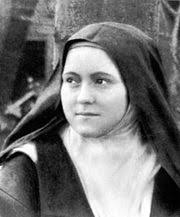

therese
O Jesus, my Love, my Life … I would like to travel over the whole earth to preach Your Name and to plant Your glorious Cross on infidel soil. But O my Beloved, one mission alone would not be sufficient for me. I would want to preach the Gospel on all five continents simultaneously and even to the most remote isles. I would be a missionary, not for a few years only but from the beginning of creation until the consummation of the ages.” (Thérèse of Lisieux – Story of a Soul) 


In our prayer today, perhaps we might ask Paul, Barnabas, Thérèse or another of our favorite saints to help us see more clearly our own call to carry the mission in our lives.

Music: Here I Am, Lord – St. Louis Jesuits

You Are Mine

Monday of the Fourth Week of Easter

May 4, 2020

Click here for readings

800px-Domenico_Fetti_-_Peter's_vision_of_a_sheet_with_animals_-_Kunsthistorisches_Museum_Wien
Peter’s Vision of the Sheet – By Domenico Fetti – Kunsthistorisches Museum Wien, Bilddatenbank., Public Domain

Today, in Mercy, we have the long story and explanation by Peter of who can be welcomed into the Community. The earliest Christians were all Jews. Their beginning Christian rituals had deep roots in Jewish tradition. Their entire expectation of a Messiah was wrapped in the garment of the Old Testament. So it was hard for them to comprehend that Gentiles might also be saved by the Blood of Christ.

We might be tempted to consider these Jewish Christians very provincial, parochial, or even prejudiced. But maybe we should just look in the mirror!

It seems to be an enduring human inclination and, rather than – like Peter – to seek a road to inclusion, we claim privilege for ourselves and exclude others on all kinds of bases:

  • She’s a woman, so she can’t…. whatever…
  • He’s gay, so he can’t …
  • She’s divorced, so she can’t…
  • He’s pro-life, or pro-choice, so he can’t…
  • She’s a Muslim, an atheist, and (irony of ironies) a Jew, so she can’t…

Maybe in your own life, you have felt the pain of some of these suggested or blatant exclusions.


Jn10_4 Mine

Jesus, in our Gospel, has a whole different approach to whom he loves. All creatures belong to him and will be brought to the Father in love.

I am the good shepherd,
and I know mine and mine know me,
just as the Father knows me and I know the Father;
and I will lay down my life for the sheep.
I have other sheep that do not belong to this fold.
These also I must lead, and they will hear my voice,
and there will be one flock, one shepherd.

Let us pray today to know and love our God ever more intensely. Let us ask to experience God’s infinite love and knowledge of us so that our unquenchable joy, humble gratitude, and limitless charity grow more evident.

Let us pray these gifts for all our sisters and brothers, no matter by what gate they come to the sheep fold.

Music: You are Mine – David Haas

Unless Someone Show Me

Thursday of the Third Week of Easter

April 30, 2020

Click here for readings

philip

Today, in Mercy, in our reading from Acts, we meet the Ethiopian eunuch who served the country’s Queen. The man was sitting in a chariot reading the prophet Isaiah. Philip asks him, “Do you understand what you are reading?”  He replied, “How can I, unless someone instructs me?” Philip’s instruction results in this faith-filled man’s Baptism.unless

It’s a bible story I’ve loved since I was a novice and read the excellent book by Alexander Jones, “Unless Some Man Show Me”.  That long-ago era in my life was a time when Vatican II opened up to the faithful the power and beauty of scriptural study and prayer.

The 1960s were a wonderful time to be committing myself to a life-long spiritual journey. Over the next few years, I devoured the published documents of Vatican II which included the one on sacred scripture, the “Dogmatic Constitution on Divine Revelation” (“Dei Verbum”).


For an excellent summary of the document, click here.


Before Vatican II, like many Catholics, I had had limited experience with scripture. Mainly, we had it read to us at Mass. We had a Bible in my childhood home, but we used it mainly to record familial births and deaths inside the front cover.

Part of the reason for this scriptural vacuum was the long-held belief that most Christians were not theologically astute enough to interpret scripture on their own. Vatican II initiated a blessed change in that perception.


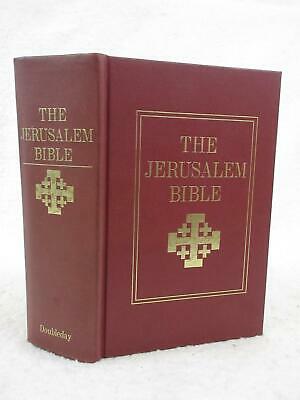
JB

In 1966, the same Alexander Jones, in the company of 27 colleagues, edited the magnificent Jerusalem Bible. My parents gave me this revered book as a gift for my Religious Profession and it has accompanied my prayer for more than a half-century. 

Reading the phrase in Acts today, “unless someone show me”, brought the whole sacred journey back to me. 

I offer this brief reminiscence to confirm how precious and important it is to build our prayer life on scripture. It is also important to educate ourselves continually by reading good commentary and spirituality. Such thinkers are like Philip in today’s passage. They are the ones who will “show” us, opening to us new understandings for our prayer.


Some of my favorite guides over the years have been:
(I’ll just list ten. There could be a whole other ten if I did this tomorrow🤗)

  1. Walter Brueggemann 
  2. Elizabeth Johnson
  3. Thelma Hall
  4. Macrina Wiederkehr 
  5. Raymond Brown
  6. Brother David Steindl-Rast 
  7. Sandra Schneiders
  8. Margaret Farley
  9. Matthew Fox
  10. Pierre Teilhard de Chardin

I would love for some of you
(even though you are a shy audience 😉 
to list some of your biblical and spiritual guides
in the comment section, if you feel so inclined.


Music:  Thy Word – Amy Grant

Divine Inheritance

Memorial of Saint Catherine of Siena, virgin and doctor of the Church

April 29, 2020

Click here for readings

Today, in Mercy, our Gospel gives us the sense of Jesus claiming his inheritance  from the Father. He makes it clear that the Father’s Will is the Redemption of all Creation. This is the divine charge given to Jesus. This is his mission.

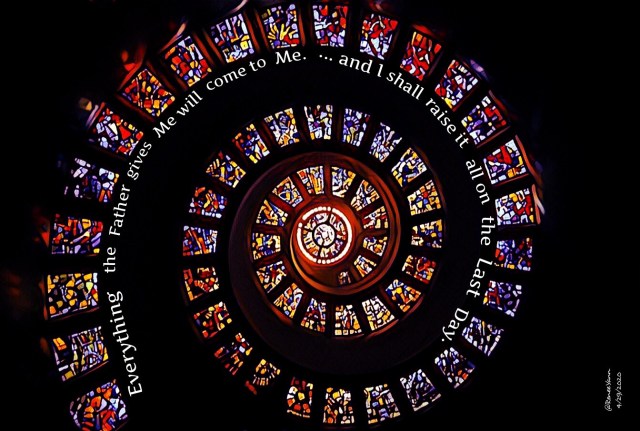
Jn6_37


Jesus continues to use the symbol of bread to teach the forming community. 

Bread sustains life.
God’s Word is eternal life.

Sharing bread is an act of community.
In the Body of Christ, we are made One with God
and with one another.

Bread can stale and disintegrate.
Within the Body of Christ, we become eternal
and will be raised up unto the Last Day.


These are such BIG thoughts, amazing teachings. I always wonder how simple shepherds, fishermen and housekeepers were supposed to understand! I wonder how we, in our human limitations, could begin to comprehend the infinitely loving design of God revealed in Jesus Christ!


Today, as we celebrate the feast of the great Saint Catherine of Siena, we can learn from her spiritual wisdom. Without formal education, she grew by grace into a Doctor of the Church.

Siena


She was born Catherine Benincasa on March 25, 1347, in Siena, Italy, and was a twin, the 24th child of 25. She only lived to the age of 33, dying of a stroke in Rome in 1380. Catherine of Siena, often referred to as “great Kate,” is well known for her expressive life of prayer shared in three major sources of writings: over 400 letters, 26 prayers, and The Dialogue of Divine Providence, which she referred to as “the book,” written in the format of a conversation between herself and God. She was noted for her style of learning, not acquired from formal education and degrees, but gained from an interior wisdom that came from lived experiences and a mystical life of prayer. ( https://www.hprweb.com/2020/02/the-trinitarian-theology-of-the-eucharist-according-to-st-catherine-of-siena/)


Here are two selections from Catherine’s extensive writings which reveal her ever-deepening relationship with God through the gift of the Bread of Life.


Eternal God, Eternal Trinity, You have made the Blood of Christ so precious through His sharing in your Divine Nature. You are a mystery as deep as the sea; the more I search, the more I find, and the more I find the more I search for You. But I can never be satisfied; what I receive will ever leave me desiring more. When You fill my soul I have an ever-greater hunger, and I grow more famished for Your Light. I desire above all to see You, the true Light, as you really are.


St. Catherine of Siena, Prayer 12, V 124–157

And by the light of most holy faith
I shall contemplate myself in you.
And I shall clothe myself in your eternal will,
And by this light I shall come to know
That you, eternal Trinity,
Are table
And food
And waiter for us.

You, eternal Father,
Are the table
That offers us as food
The Lamb, your only-begotten Son.

He is the most exquisite of foods for us,
Both in his teaching,
Which nourishes us in your will,
And in the sacrament
That we receive in Holy Communion,
Which feeds and strengthens us
While we are pilgrim travelers in this life.

And the Holy Spirit
Is indeed a waiter for us,
For he serves us this teaching
By enlightening our mind’s eye with it
And inspiring us to follow it.
And he serves us charity for our neighbors
And hunger to have as food
Souls
And the salvation of the whole world
For the Father’s honor

So we see that souls enlightened in you,
True light,
Never let a moment pass
Without eating this exquisite food
For your honor.

Music:  Ave Verum Corpus – words attributed to 14th century Pope Innocent VI, melody to Mozart, sung by King’s College Choir

Hail, true body
Ave, ave verum Corpus 

Born of the Virgin Mary;
Natum de Maria Virgine

Truly offered,
Vere passum, immolatum 

In the cross for man
In cruce pro homine

Whose side
Cujus latus perforatum 

Water and blood
Fluxit aqua et sanguine

May we taste
Esto nobis praegustatum 

Time of death
Mortis in examine 

The time of death
In mortis examine

Our Deepest Hunger

Monday of the Third Week of Easter

April 27, 2020

Click here for readings

Today, in Mercy, Acts introduces us to Stephen, so filled with the Holy Spirit that “his face was like the face of an angel”.

You may wish to refer to last year’s reading on Stephen’s introduction.

Click here to read about Stephen


For today’s reflection, though, our focus will be John 6 which is the beginning of a week-long journey into the discourse on the Bread of Life (Jn 6:22-71). These passages, going from today until Friday, are like a “faith boot camp” for Jesus’s followers. They contain the core message of who Jesus is and how we are brought into communion with him.

The reading seems so meaningful in these days when we are kept from shared communion and community in the Eucharist, when we long to be gathered again around that table of love.


John’s Gospel does not include an account of the Last Supper and institution of the Eucharist. The Bread of Life Discourse is where Jesus proclaims those teachings in John. It is a more detailed instruction and, as we pray with it over the course of the week, we may trace our own past and current awakening in faith.

painting
Limbourg Brothers, Très Riches Heures du duc de Berry, Jesus Feeding the 5,000 Source Wikimedia Commons

Today’s verses offer very basic training. Jesus has just fed 5000 people in the miracle of the loaves and fishes. The crowds, not having a global view of the miracle like we do, are confused. They know they got plenty to eat, but did everybody? They heard many people ate, but they saw only their nearby neighbors. What really happened out on the green field?

Finding Jesus the next day, they are ready for another meal. They’re more interested in matzoh than miracles. Their basic hunger for physical sustenance consumes them. Jesus begins the task of opening their hearts to their deeper hungers and his desire to meet them:

Jesus said,
“You are looking for me
not because you saw signs
but because you ate the loaves and were filled.
Do not work for food that perishes
but for the food that endures for eternal life.”

Jn6_27 food


Praying with today’s Gospel, we might ask ourselves some basic questions about our own faith.

  • When we go looking for God, as these hungry people did, what is it that we are looking for?
  • Do we talk to God only when we need something the way these folks needed another loaf or fish?
  • Jesus is inviting us to Eucharist, to Communion with him. To what degree have we opened our hearts to that invitation by our reflective prayer and acts of mercy?

Jesus’s basic message to his flock today is this:

Don’t be satisfied by a tasty roll, a fat fish,
(or a fancy car, a good job, a comfortable life.)
God made you for much more than these things.
Come to Me and feed your deepest hunger.

Maybe, as we pray, we can ask the question posed at end of today’s Gospel and listen intently to Jesus’s answer:

So they said to him,
“What can we do to accomplish the works of God?”
Jesus answered and said to them,
“This is the work of God, that you believe in the one he sent.”

Music: Hungry – Kathryn Scott

Peter’s Kiss

Feast of Saint Mark, evangelist

April 25, 2020

Click here for readings

Today, in Mercy, we celebrate Saint Mark the Evangelist.

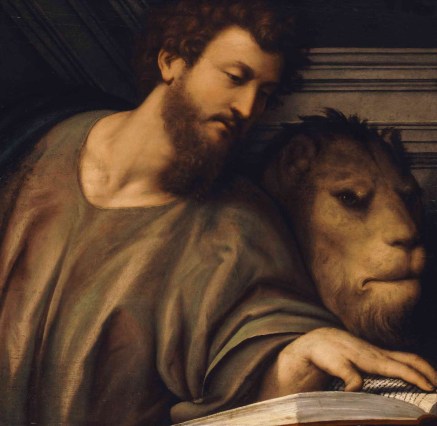
Pordenone: M‡rk evangelista
Mark the Evangelist by Il Pordenone (c. 1484-1539)

Who exactly that person was hides in the mists of early Church history. Several possible “Marks” are mentioned at various points in the New Testament. Whether they are the same or different persons and which, if any, is the author of Mark’s Gospel are questions scripture detectives have chased for centuries.


What the readings offer us today is a young man whom Peter loved and who absorbed the Good News under Peter’s own tutelage.

In today’s passage from Acts, Peter writes to Christians scattered throughout Asia Minor at the time of the persecutions. His teaching is clearly that of the universal leader of the Church helping the scattered flock to hold on to the faith.

Your opponent the Devil is prowling around like a roaring lion
looking for someone to devour.
Resist him, steadfast in faith,
knowing that your brothers and sisters throughout the world
undergo the same sufferings.

It isn’t hard to read these ancient words and imagine Pope Francis speaking them to all of us across the empty reaches of St. Peter’s Square. The suffering of the pandemic tests our faith and resolve. It too is a crucible which can either deepen or fracture our relationship with God.

Peter’s assurance can strengthen us:
The God of all grace
who called you to his eternal glory through Christ Jesus
will himself restore, confirm, strengthen, and establish you
after you have suffered a little.
To him be dominion forever.  Amen.

Mark, who sat at the feet of Peter’s strong and loving leadership, himself went on to become a devoted leader of Christ’s flock. How Mark must have cherished Peter’s brave and tender words to the young suffering Church and harkened back to them so often over the course of his life:

The chosen one (early Christian code for “the whole Church”)
sends you greeting, as does Mark, my son.

Greet one another with a loving kiss.
Peace to all of you who are in Christ.

1Peter5_14 kiss

That gracious “kiss” from Peter carried the the love and power of every Christian, just as we carry it today in our constant prayer for and encouragement of one another.

Music: He Will Make You Strong – hymn based on 1 Peter

Earth Day 2020

Wednesday of the Second Week of Easter

April 22, 2020 – Fiftieth Anniversary Earth Day

Today, in Mercy, the theme of our readings falls perfectly in step with Earth Day.

John3_16 so loved

For my prayer this morning, I re-read Pope Francis magnificent encyclical Laudato Si’ which instructs us and begs us to cherish the gift of our Common Home. – a world which God has so loved that God gave the only begotten Son that we should not perish.

This sacred document has become even more meaningful as a global pandemic exposes the fragmentations we have wrought upon the earth.

Here are two of my favorite sections from the encyclical, although I do encourage you to read the whole masterpiece if you have the time and desire.


Click here for the complete Laudato Si’


In the Judaeo-Christian tradition,
the word “creation” has a broader meaning than “nature”,
for it has to do with God’s loving plan
in which every creature
has its own value and significance.
Nature is usually seen
as a system which can be studied,
understood and controlled,
whereas Creation can only be understood
as a gift from the outstretched hand of the Father of all,
and as a reality illuminated by the love
which calls us together into universal communion.

(Laudato Si’ paragraph 76)

laudato


The ultimate destiny of the universe
is in the fullness of God,
which has already been attained by the risen Christ,
the measure of the maturity of all things.
Here we can add yet another argument
for rejecting every tyrannical and irresponsible domination
of human beings over other creatures.
The ultimate purpose of other creatures
is not to be found in us.
Rather, all creatures are moving forward with us
and through us towards a common point of arrival,
which is God,
in that transcendent fullness
where the risen Christ embraces and illumines all things.
Human beings, endowed with intelligence and love,
and drawn by the fullness of Christ,
are called to lead all creatures back to their Creator.
(Laudato Si’ paragraph 83)


May these words bless and enlighten us today to become blessings for Earth, our Common Home.

Music: God So Loved the World – sung by the Mormon Tabernacle Choir

The Seesaw of Faith

Tuesday of the Second Week of Easter

April 21, 2020

Click here for readings

Nicodemus

Today, in Mercy, we meet two towering figures of the early Christian story, Barnabas and Nicodemus.

In our first reading, Barnabas is cited as a devout member of the community of believers which …

… was of one heart and mind,
and no one claimed that any of his possessions was his own,
but they had everything in common.


Our Gospel brings us Nicodemus who “came to Jesus under cover of the night”.  Nicodemus, obviously Ph.D. material, has a long exchange with Jesus in the attempt to come to intellectual comfort with Jesus’s message.

Nicodemus wants his faith to make logical sense before committing to it,  to the point that Jesus sounds a little astounded at the effort:

You are the teacher of Israel
and you do not understand
what I am saying to you?


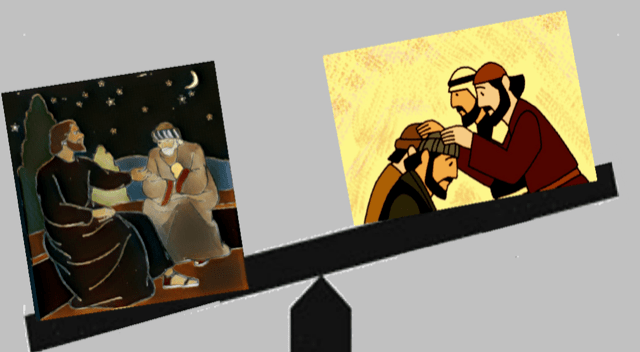
I think a little bit of both Barnabas and Nicodemus lives within each of us.

barnabas seesaw

Like Nicodemus, we do believe, but we would like to understand more. We grapple with concepts of “God’s plan”, with the problem of evil, with what seems the random mercilessness of nature, and myriad other inexplicable realities.

Still, like Barnabas, we trust and are willing to lay our lives at the feet of Christ to be his agents in the world.

That balancing of trust with anxiety is the story of faith for most of us. And it’s OK.  Both Nickie and Barnie turned out to be giants for Christ.  And so will we with God’s help.

Music: Ye Must Be Born Again – sung by The Sensational Nightingales, a beloved Black Gospel Quartet that, with several membership changes, has been popular for over seven decades.  (Lyrics below)

Ye Must Be Born Again
written by William T. Sleeper in 1877

A ruler once came to Jesus by night,
To ask Him the way of salvation and light;
The Master made answer in words true and plain,
“Ye must be born again!”
“I verily, verily say unto thee,
Ye must be born again!”

Ye children of men, attend to the word
So solemnly uttered by Jesus, the Lord,
And let not this message to you be in vain,
“Ye must be born again.”

Oh, ye who would enter that glorious rest,
And sing with the ransomed the song of the blest;
The life everlasting if ye would obtain,
“Ye must be born again.”

Shaken to Life

Monday of the Second Week of Easter

April 20, 2020

Click here for readings

Today, in Mercy, our readings are filled with the sanctifying unrest of the Holy Spirit.

In Acts we read that, despite the internal peace of the early Christian community, they faced a hostile surrounding environment. Nevertheless, they were impelled by the Spirit within them to continue to proclaim Jesus Christ.

shook


Our Gospel remembers Nicodemus, a ruler of the Jews. Grace burned in him too, but it was a subtle light shaded by his early fear. He came to Jesus in the shadows of the night to test the flame in his soul.

Jesus answered and said to him,
“Amen, amen, I say to you,
unless one is born from above,
he cannot see the Kingdom of God.

balletAgain and again in salvation history, the world is “turned upside down and shaken” by God’s renewing power.  We human beings find ourselves struggling to get our feet under us again as circumstances spin to a new truth. Like graceful ballet dancers pirouetting in space, we must keep our eyes on the fixed point of God’s immovable love.


The early disciples did this. Nicodemus did this. As our world now shakes into a changed reality, it is our turn to lock our hearts on God, opening to the new dream God has for all Creation.

wave

Music: Shake – by Mercy Me (You been sittin’ in that chair a while? Here’s a song you can get up and dance-pray!)

Reborn in God

Second Sunday of Easter

April 19,2020

Click here for readings

Today, in Mercy, our readings offer us a snapshot of the infant Church – a joyful, loving, generous community confidently sharing the Good News of Jesus Christ.

Eucharist

Our Responsorial Psalm, written centuries before their time, prophetically captures their grateful Resurrection prayer:

R. Alleluia.
The stone which the builders rejected
has become the cornerstone.
By the LORD has this been done;
it is wonderful in our eyes.
This is the day the LORD has made;
let us be glad and rejoice in it.


Our second reading from Peter voices the community’s amazed gratitude:

Blessed be the God and Father of our Lord Jesus Christ,
who in his great mercy gave us a new birth to a living hope
through the resurrection of Jesus Christ from the dead,


Friends, how we need that living hope today, in these times that test our souls!

It is true that everyday of our lives we are reborn in God.  New grace, new challenge, new blessing comes to us daily. But the need for that newness has seldom felt so momentous as it does in these pandemic times.

We are challenged:

  • to find God in clouded realty
  • to be a channel of God’s love even in suffering
  • to build the generous community despite isolation
  • to be the touch of Mercy in a touchless world

We may feel a little like Thomas as we pray with these challenges. It must have been so hard for him to touch the wounds of Jesus! And it must have been shocking for him to feel them — these apparent talismans of suffering –  now charged with an infinite transformative power!

My Lord

What changed for Thomas to make him a devout believer? Not his circumstances. Not the reality around him.  Not the challenges before him.

The change came within him because he believed. By looking through suffering to glory, Thomas believed.

May we have that kind of faith in these times that so hunger for it! That kind of faith allows us to be reborn!

(Speaking of being reborn, I am sending a short second reflection today. Today is my 75th birthday and the Psalm is my way of celebrating with all of you.)

Music: Thomas Song – Halleal (Lyrics below)

Thomas’ Song – Hallal

Jesus you were all to me,
Why did you die on Calvary?
O Lamb of God, I fail to see
How this could be part of the plan.

They say that you’re alive again
But I saw death and every sin
Reach out to claim their darkest whim
How could this part if the plan?

If I could only
Hold your hand
And touch the scars
Where nail were driven,
I would need
To feel your side
Where holy flesh
A spear was riven,
Then I’d believe,
Only then I’d believe
Your cruel death
Was part of a heavenly plan.

Holy presence, holy face
A vision filling time and space
Your newness makes my spirit race
Could this be part of the plan?
I see the wounds that caused the cry
From heaven, ocean, earth, and sky
When people watched their savior die
Could this be part of the plan?

Reaching out
To hold your hand
And touch the scars
Where nails were driven
Coming near
I feel your side
Where holy flesh
A spear was riven
Now I believe
Jesus now I believe
Your cruel death
Was part of a heavenly plan
I proudly say
With blazen cry
You are my Lord and my God!