A Legacy of Faith

Wednesday of the Third Week of Lent

March 18, 2020
Click here for readings

faith

Today, in Mercy, on this day between the feasts of St. Patrick and St. Joseph, it seems a very good day to thank God for our heritage of faith. Our readings today remind us how precious that heritage is.

Moses, after reiterating the history of God’s goodness to Israel, enjoins the People:

Take care and be earnestly on your guard
not to forget the things which your own eyes have seen,
nor let them slip from your memory as long as you live,
but teach them to your children and to your children’s children.

Jesus, too, acknowledges the importance of his religious heritage:

Do not think that I have come to abolish the law or the prophets.
I have come not to abolish but to fulfill.
Amen, I say to you, until heaven and earth pass away,
not the smallest letter or the smallest part of a letter
will pass from the law,
until all things have taken place.

This day between St. Patrick’s and St. Joseph’s always takes me back to my grade school days – a time when my “faith family” gifted me with the seeds that now sustain my life.

Autosave-File vom d-lab2/3 der AgfaPhoto GmbH
Beautiful St. Michael’s Church, 2nd and Jefferson, Philadelphia – built in 1846, now much as it look in the mid-1950s

I can still see our straight-from-Ireland pastor, old as the hills, standing in the pulpit to bless us with water from the Shrine at Knock. We school kids had waited all year for a chance to belt out the hymn “Great and Glorious Saint Patrick” to the accompaniment of a thundering organ. We held our breath at the final blessing, anxiously awaiting the word to go home. It was inevitably a school holiday but we were always innocently surprised to receive it!
Organ_and_Choir_Loft
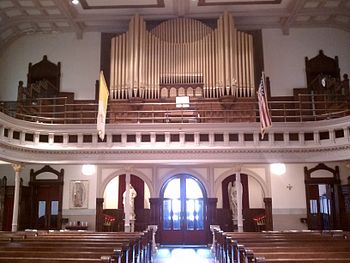
St. Michael’s magnificent organ

Then, we gathered for 8 o’clock Mass again on the 19th to celebrate St. Joseph, patron of our beloved Sisters who taught us. If we had the means to give them feastday gifts, we were asked to give canned goods. That request never struck me as a kid, but as I grew up, I realized how dependent these Sisters were on those donations – how close to poverty they lived for the sake of transmitting the faith to us.

So I count these days of mid-March as Foundation of Faith Days. Perhaps today’s reading might incline you to think about your own faith story and who planted the early seeds in your heart. Let’s give these beloveds our grateful prayers of remembrance.

Music:  Faith of Our Fathers – another oldie that we loved to sing voce piena 

The Luck of the Irish Faith

Tuesday of the Third Week of Lent

March 17, 2020

Click here for readings

Today, in Mercy, Azariah of Fiery Furnace fame meets Patrick of Ireland!☘️☘️ 🔥 🔥 – —two great champions of faith ready to bolster ours in these uncertain times.

In today’s reading from the Book of Daniel, Azariah (later Abednego) prays a moving prayer of urgency, repentance, supplication, and trust:

And now we follow you with our whole heart,
we hold you in awe and we pray to you.
Do not let us be put to shame,
but deal with us in your kindness and great mercy.
Deliver us by your wonders,
and bring glory to your name, O Lord.

This prayer rang very true for me today, as I prayed for God’s mercy and miracles all over our suffering earth.

The prayer also brought to mind St. Patrick’s own prayer:

I arise today
Through the strength of heaven;
Light of the sun,
Splendor of fire,
Speed of lightning,
Swiftness of the wind,
Depth of the sea,
Stability of the earth,
Firmness of the rock.

I arise today
Through God’s strength to pilot me;
God’s might to uphold me,
God’s wisdom to guide me,
God’s eye to look before me,
God’s ear to hear me,
God’s word to speak for me,
God’s hand to guard me,
God’s way to lie before me,
God’s shield to protect me,
God’s hosts to save me
Afar and anear,
Alone or in a mulitude.

Christ shield me today
Against wounding
Christ with me, Christ before me, Christ behind me,
Christ in me, Christ beneath me, Christ above me,
Christ on my right, Christ on my left,
Christ when I lie down, Christ when I sit down,
Christ in the heart of everyone who thinks of me,
Christ in the mouth of everyone who speaks of me,
Christ in the eye that sees me,
Christ in the ear that hears me.
I arise today
Through the mighty strength
Of the Lord of creation.

Slainte

In solidarity with Irish people everywhere, who today celebrate their amazing faith, let’s pray to our dear Blessed Mother for one another and wish all people good health and joy.

And for St. Patrick’s sake, lift your spirit, lift a glass, lift your hearts for the love of God and one another! PS: Sláinte means “To your health“.

Music: Hymn to Our Lady of Knock – Frank Patterson – Oh, the Voice! (Lyrics below)
(This song always gives me the Irish chills … nothing like it.  A lot of Italian songs do the same thing to me. LOL!)

There were people of all ages
Gathered ’round the gable wall
Poor and humble men and women,
Little children that you called
We are gathered here before you
And our hearts are just the same
Filled with joy at such a vision
As we praise your name

Golden Rose, Queen of Ireland
All my cares and troubles cease
As I kneel with love before you
Lady of Knock, our Queen of Peace

Though your message was unspoken
Still the truth in silence lies
As we gaze upon your vision,
And the truth I try to find
Here I stand with John the teacher,
And with Joseph at your side
And I see the Lamb of God
On the Altar glorified

Golden Rose, Queen of Ireland
All my cares and troubles cease
As we kneel with love before you
Lady of Knock, our Queen of Peace

And the Lamb will conquer
And the woman clothed in the sun
Will shine Her light on everyone
Yes,
The Lamb will conquer
And the woman clothed in the sun
Will shine Her light on everyone

Golden Rose, Queen of Ireland
All my cares and troubles cease
As I kneel with love before you
Lady of Knock, my Queen of Peace
Lady of Knock, my queen of peace


Rejected

Friday of the Second Week of Lent

March 13, 2020

Click here for readings

Mt21_42rejected

Today, in Mercy, there is a great sadness in our readings.

The poignant opening line from Genesis immediately strikes us:

Israel loved Joseph best of all his sons,
for he was the child of his old age

Joseph

We picture young Joseph in his beautiful rainbow coat and, under an olive tree’s shade, old Jacob(Israel) proudly, tenderly, watching him play.

As the story ensues to reveal the later betrayal of Joseph’s jealous brothers, we are left astounded. Such treachery, especially among brothers, sickens the heart.


Our Gospel picks up the sad theme because Joseph and his brothers are archetypes of Christ’s story with humankind.

800px-The_Wicked_Husbandman_(The_Parables_of_Our_Lord_and_Saviour_Jesus_Christ)_MET_DP835802
The Wicked Husbandman by John Everett Millais shows the owner’s murdered son

Jesus tells a parable in which he is actually the unnamed main character. He is the Son sent by a loving Father. He is the one rejected, beaten and killed by the treacherous tenants of his Father’s garden.

We know from our familiarity with Scripture that both these stories ultimately come to glorious conclusions. But today’s readings do not take us there. They leave us standing, mouths dropped open, at the dense meanness of the human heart, at the soul’s imperviousness to grace, at the profound sadness Jesus felt at this point in his ministry.

In our prayer today, let’s just be with Jesus, sharing his sadness for the meanness still hardening our world. Let us comfort him with our desire to be open to God’s Grace and Mercy.

Music:  Handel:Messiah – He was despised and rejected – Alfred Deller

Be Impartial, or Not?

Thursday of the Sixth Week in Ordinary Time

February 20, 2020

Click here for readings

Today, in Mercy, two Apostles of Jesus are our teachers. James advises us on what to do. Beloved Peter, as so often is the case, shows us what not to do.

James tells us to show no partiality. He makes clear that he is talking about impartiality toward those who are materially poor. It’s a maxim that Jesus gave us time and again in the Gospel.

James2_1 partiality

James reminds us that Jesus is not just impartial toward the poor, he actually has a preferential love for them. So Jesus was partial to the poor, right? Hmm!

Yes, I think that’s right. In order to balance our human inclination to the richest, best, strongest, etc., Jesus teaches us to go all out in the other direction.

It’s like this great cartoon that’s popped up on Facebook recently:

equity


Our Gospel picks up the theme.

Because of his great love for the poor and his passion for mercy, Jesus tells his followers that suffering is coming. Peter doesn’t like hearing that. Can you see Peter take Jesus aside and say, “Listen, Jesus, negative talk is going to hurt you campaign. You’re God! You can just zap suffering out of your life!


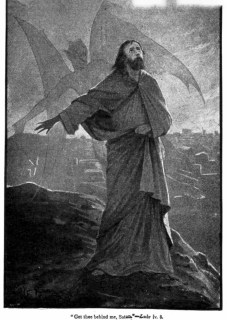
behind me satan

Jesus responds to Peter definitively: “Get thee behind me, Satan!

Wow! That must have stung! But that’s how important it was to Jesus that his followers understood his mission: to preach Mercy to the poor, sick, and broken by sharing and transforming their experience.

Jesus wants us to understand that too.


Music: Beauty for Brokenness – Graham Kendrick

A Queenly Message

Wednesday of the Fifth Week in Ordinary Time

February 12, 2020

Click here for readings

Today, in Mercy, the Queen of Sheba visits Solomon. It’s another Solomon story worthy of the big screen where, in fact, it has been loosely fictionalized and adulterated many times.

sheba

Many trusted scripture scholars question the historicity of the story. Several agree that Solomon never rose to the kind of material glory described in the passage. The two books of Kings were written 500 years after Solomon lived. In many aspects, the writings offer a reflection on the meaning of his reign in Israel’s covenanted life rather than a strict account of his life.

So what might we glean from today’s passage on the mysterious queen. The story demonstrates that Solomon is so accomplished that a revered leader will come to learn from him. Once she arrives, she is overwhelmed by his material successes and strength. Solomon has constructed a dominant, rich and subservient culture.

But wait. Is there a bit of ironic judgement and, perhaps, prophetic reminder woven into the Queen’s accolades? Shifting the focus from an increasingly arrogant Solomon back to Israel’s God, she says:

Blessed be the LORD, your God,
whom it has pleased to place you on the throne of Israel.
In his enduring love for Israel,
the LORD has made you king to carry out judgment and justice

In fact, the great wealth and power of Solomon’s kingdom was built, not on justice and judgement, but on the backs of the poor and excluded. For example, Walter Brueggemann says this:

(Solomon’s kingdom) … was an economy of extraction that regularly transferred wealth from subsistence farmers to the elite in Jerusalem, who lived off the surplus and the device and the strategy for that extraction was an exploitative tax system.

When the Biblical scribe puts the words judgment and justice into the Queen’s remarks, it may be intended to forecast the miserable end Solomon will meet because he has abandoned his responsibilities to care for all the people according the the Lord’s covenant.

This glorious, shining realm which so impressed the Queen is a kingdom built on corruption, greed, militarism, and manipulation of the poor.

The lessons for our world are obvious.


As Jesus tells us in today’s Gospel, it doesn’t matter whether we’re gilded in gold on the outside and spin our words in glorious promises. What matters are the true intentions of our hearts and the compassionate actions they inspire:

But what comes out of the person, that is what defiles him.
From within, from the heart,
come evil thoughts, unchastity, theft, murder,
adultery, greed, malice, deceit,
licentiousness, envy, blasphemy, arrogance, folly.

Ultimately, the great Solomon misses the boat on this. May his story help us not to do the same.


Also, as we pray, we may want to remember the devastated people of Yemen, the land identified as the historical Sheba. For some background on the current crisis in Yemen, see this article from Catholic Bishops


Music: La Reine de Saba – Raymond LeFevre

God Won’t Be Boxed!

Tuesday of the Fifth Week in Ordinary Time

February 11, 2020

Click here for readings

Today, in Mercy, our readings talk about how we try to “house” God.

Because God is bigger than BIG, our minds struggle. More than struggle, they actually fail, repeatedly, to define God. Yet we still try, don’t we?

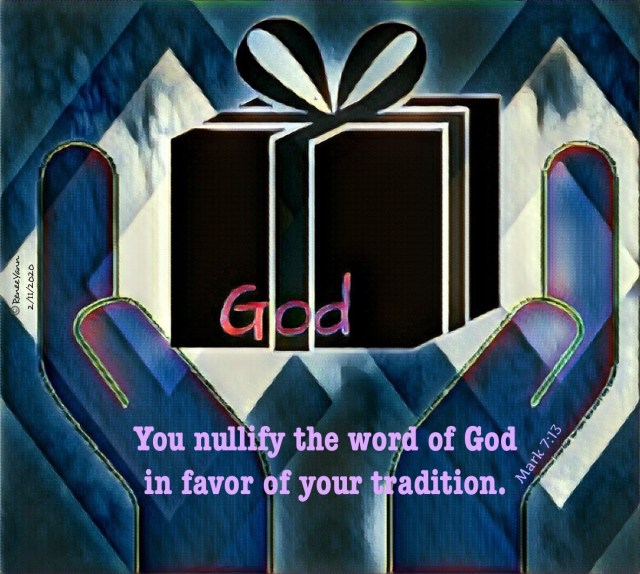
Mk7_13 box god

We try to picture, describe, paint, quote, and interpret God. We even decide what God wants and create laws to insure God gets that.

We dilute Divinity to our human dimensions. We just can’t take it straight. We mix it and bottle it in our laws, and box it in our rituals — because we can’t manage Omnipotence. 

And let’s face it, most of us like to manage things. 😉At least the Pharisees in today’s Gospel liked that kind of control. And Jesus challenges them on it.


Praying with these thoughts today, I think of my Dad. He liked an occasional jigger of really fine bourbon – savored in its unadulterated state, without water or soda – what today’s purists call “sipping whisky”.

When the doctor informed him, unfortunately in my mother’s presence, that whisky was a no-no, Dad didn’t like it. But he acquiesced. At least we thought he did. 

After Dad died, my brother and I found his bottle of Kentucky bourbon wrapped in a towel in the basement dryer. You see, only Dad did the wash. Mom never liked machines.

I think Jesus would have really enjoyed my Dad as one of his original disciples. Dad liked life “straight”. His faith was simple, direct, complete and undiluted. Sitting with Jesus that Gospel day, Dad wouldn’t have washed his hands either. He would have been too busy listening to the pure, unbottled Word pouring over him.

The message I took from today’s prayer: 

  • Be very wary of anyone who thinks they know exactly what God wants.
  • Let God out of the boxes I put Him in.
  • Invite God’s Spirit to run free through my heart.
  • Don’t bottle God up; don’t box God in.
  • Enjoy sipping God’s surprising and infinite grace.

Music:  New Pharisees – Charlie Daniels Band (Lyrics below)

New Pharisees

They go walking into church every Sunday morning
They the self-appointed sin patrol
Well they whisper and they gossip behind the back
Of anybody that they can’t control

See that girl in the choir she’s got evil desires
She must be drinking from the devil’s well
She’s a downright disgrace with that paint on her face
She looks just like a Jezebel

And they’re running around putting everybody down
What are you trying to do?
You need to pick up the Book and take another look
‘Cause brother I’ve got the news for you

You know Jesus was sent with a new covenant
And he even died for you
New pharisees like a fatal disease
Always flapping your jaws trying to live by the law

You see that boy over there with that long shaggy hair
Ought to be ashamed of his self
He wearing hip-hop clothes got a ring in his nose
Don’t he know he going straight to hell

And then yesterday morning me and sister Johnson
Were talkin’ on the party line
She said that Deacon Brown was having dinner downtown
Somebody seen him with a glass of wine

And you act so righteous and you look so pious
You always pay your tithe
But there’s a rock in your heart and a fire on your tongue
And there ain’t no love in your eyes

Bad news is begotten and the devil is smiling
You gossip and you criticize
New pharisees like a fatal disease
Always flapping your jaws trying to live by the law

Well you can’t get by the law so quit flapping your jaws
New pharisees yes, you’re a lot like me

Heart Temple

Memorial of Saint Scholastica

February 10, 2020

Click here for readings

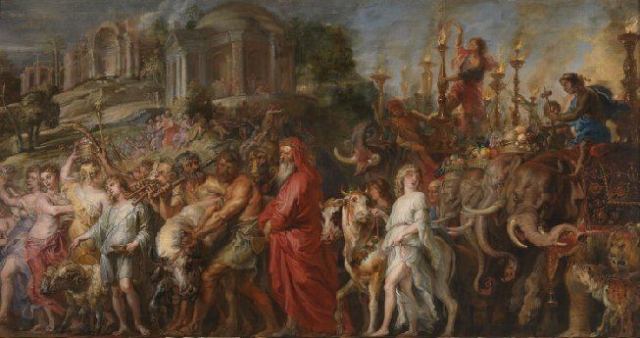
Today, in Mercy, we read about the massive celebration to dedicate Solomon’s Temple. It would have been a ceremony akin to the parades we view in movies like Ben Hur.

roman-triumph-58737a77-19e6-4606-bb0f-b3441f961b8-resize-750


This video gives us a good understanding of the magnificence of the building.


Praying with the passage today, core questions repeat themselves to me:

  • Can God be in a building?
  • Is there a legitimate spiritual purpose to the cathedrals, large or small, that we build?

For me, the answer is a fluid one. Certainly, beautiful churches inspire our faith and serve as a central symbol for the unity of believers.

But throughout history, these buildings have also symbolized individual and national power, pride and greed.

A recent initiative of Pope Francis converted a 19th century palace behind the Vatican into a homeless shelter. The Pope directed this rather than the site’s upgrade to a luxurious hotel. 

The building is described as having “carved wooden ceilings, frescoed walls and tiled floors — evidence of its aristocratic origins.” Sharing a meal with its first residents, Pope Francis said, “Beauty heals”.

Such healing is the real purpose of all such buildings – that their beauty heal hearts, communities, and nations. Where the purpose is lost, excess eviscerates the healing beauty.


At points in the Gospel, Jesus refers to himself as the Temple – instructing his disciples that God’s Presence now dwells in the world through him. Today’s Gospel shows us how this Presence manifests itself – through the power of compassion and justice for the poor:

Whatever villages or towns or countryside he entered,
they laid the sick in the marketplaces
and begged him that they might touch only the tassel on his cloak;
and as many as touched it were healed.

Where God is present there is always healing. May it be so in our churches and in our hearts.

Music: Dwelling Place – John Foley

Shine!

Fifth Sunday in Ordinary Time

February 9, 2020

Click here for readings

Today, in Mercy, our readings are threaded on a theme of light, justice, and healing.

Is58_8wound

Isaiah writes to a formerly exiled community trying to restore itself after returning to Jerusalem. Tensions, meanness, and dissatisfactions tear at the community. Focus on religious rituals becomes excessive while communitarian practices are ignored.

It is a sad and fractious time for Israel.

Isaiah tells them they are missing the whole point.  The path to healing their national soul is not through empty religious words and practices.

If you remove from your midst
oppression, false accusation and malicious speech;
if you bestow your bread on the hungry
and satisfy the afflicted;
then light shall rise for you in the darkness,
and the gloom shall become for you like midday.


In our second reading, Paul writes to the Corinthian community similarly disturbed. He reminds the Corinthians that he came to build Christian community among them humbly and open to the Holy Spirit. Like Isaiah in the first reading, Paul now reminds his community not to miss the point:

I came to you in weakness …
so that your faith might rest
not on human wisdom

but on the power of God.


Jesus tells his disciples to let that power of God shine in them by virtue of their good deeds — the very same deeds Isaiah recommends to his listeners:

Share your bread with the hungry,
shelter the oppressed and the homeless;
clothe the naked when you see them,
and do not turn your back on your own.


In sum, our readings caution us that failures in charity and mercy wound us, both as individuals and as a community. Meanness kills – not only its object, but its subject as well.

When we remove all meanness from our actions, the Light shines, healing all our wounds.

Music:  Let Your Light Shine – Mike Balhoff and Darryl Ducote

So Much More Than a Holiday!

photo-1570492886075-77b6014064ab

Some of us begin this day simply grateful for a holiday. Perhaps some of us forget, or some are too young to remember, how this “holiday” came to be.

But there are some among us who are old enough to remember his actual voice; to have listened — live – on that sweltering August day in 1963 when he inspired us with the words:

I have a dream.

gty_march_on_washington_martin_luther_king_ll_130819_16x9_992

There are some of us who saw him stand on the steps of the Lincoln Memorial on that golden day, the personification of President Lincoln’s vision of justice and equality.

 There are some of us who listened and watched every step he took, every prayer he said, every challenge he met with equanimity and courage.


 There are some of us who remember the very night he told us:

I have been to the mountaintop 
and I have seen the Promised Land.
I may not get there with you.
But I want you to know that we,
as a people,
will get to the promised land.


There was a whole world of us who cried when he was martyred the very next day.


Monday is no mere holiday. It is the commemoration of a giant soul who changed the world forever. And he did it not in the way that many have done it throughout history — through wars and conquest.

Martin Luther King changed the world by non-violent protest, by a leadership of love, by a faith that endures beyond the assassin’s gun.

Say his name in reverence on this commemorative day. He has given all of us — no matter our color — the hope of a more human existence. If you have not had the gift of living in his time, ask your elders who remember his face, his sound, his power to tell you the story of the freedom God gave each of us.

 In his memory, and to continue to realize his dream, we might consider these 12 steps to non-violence for our own lives.


12 Steps to Non-Violence

  1. Acknowledge your powerlessness — that our lives/culture are co-opted by subversive and pervasive violence
  2. Believe that a Power greater than ourselves can restore us to right relationship.
  3. Decide to turn our will and our lives over to that Power.
  4. Examine fearlessly our own violent inclinations.
  5. Admit to that Power, to ourselves and to another person the exact nature of our own violence.
  6. Be open to have that inclination removed.
  7. Ask to have all violence removed from our hearts and actions.
  8. List all persons to whom we have been violent by word or deed and be willing to make amends to them.
  9. Amend directly to these people wherever possible and prudent.
  10. Self-examine continuously; promptly admit recurring violence in ourselves.
  11. Seek through prayer and meditation to know the nature of Peace and Mercy.
  12. Carry the message of non-violence to others and practice it in all our interactions.

Music: “Abraham, Martin and John” is a 1968 song written by Dick Holler and sung here by Marvin Gaye. It is a tribute to the memory of four assassinated Americans, all icons of social change: Abraham Lincoln, Martin Luther King Jr., John F. Kennedy, and Robert F. Kennedy. It was written in response to the assassination of King and that of Robert Kennedy in April and June 1968, respectively. (Wikipedia)

The song reflects the mix of awe, hope, sorrow and disappointment the nation felt in those tumultuous times.


Be Careful What You Ask For

Memorial of Saint Anthony, abbot

January 17, 2020

Click here for readings

www-St-Takla-org--b3h-50-israel-demands-a-king
1 Samuel 8:19 – Israel demands a king. J. Winter – from “The Bible and its Story” book, authored by Charles Horne, 1909

Today, in Mercy, our first reading startles us with how foolish the Israelites are about their leaders. Oh, wait a minute, why are we so surprised? Don’t we see the same dynamics all around us?

Israel is desperate for a “strong man” who will mimic the tyrants leading their enemies. They say a king will “rule us and to lead us in warfare and fight our battles.” They begin to envision a nation of their own design, not God’s.

They believe that having an absolute leader will make them strong. They are indifferent to Samuel’s warnings that such a choice will usurp their freedom, and lead to their devastation and enslavement.

lossy-page1-441px-Olivetan_Master_-_Leaf_from_an_Antiphonary-_Historiated_Initial_P_with_the_Prophet_Samuel;_Ar_-_1999.131_-_Cleveland_Museum_of_Art.tif
This leaf is distinguished by a large initial P depicting Samuel, the last and one of the greatest of Israel’s judges. It introduces the text Preparte corda vestra domino et servite (“Prepare your hearts for the Lord and serve”). In the lower margin are the arms of the Visconti family, rulers of Milan, featuring an eagle (left) and a coiled serpent (right). At bottom center is the emblem of the Olivetan Order, a reformed branch of the Benedictines founded in 1319 known as the “white monks.” The Olivetan monastery in Milan was founded in 1400 and it appears that this leaf belonged to a set of choral books presented to the monastery by one of the Visconti, perhaps about 1439–47. The so-called Olivetan Master takes his name from a luxuriously illustrated psalter made for the order’s monastery in Milan, where he was undoubtedly a monk

God tells Samuel that, in rejecting the choice for responsible, spiritually-grounded, and mutually sustained leadership, the people are rejecting God and God’s plan for them.

In a nutshell, Israel’s problem is this: they have forgotten who and whose they are. For the sake of expected political dominance, they are willing to sacrifice their identity as a people formed and led by God.


Centuries later, in today’s Gospel, Jesus comes among these dispirited people. Their choice hasn’t worked. They are still a politically dominated nation. Their religious practice has lost its vigor, denigrating into lifeless rules and practices. A corrupt religious class manipulates them.

Jesus, ignoring their religiously manufactured limitations on the Spirit, cures a paralytic. The scribes are scandalized. But Jesus confronts their equivocation:

Jesus said, “Why are you thinking such things in your hearts?
Which is easier, to say to the paralytic,
‘Your sins are forgiven,’
or to say, ‘Rise, pick up your mat and walk’?
But that you may know
that the Son of Man has authority to forgive sins on earth”
–he said to the paralytic,
“I say to you, rise, pick up your mat, and go home.”
He rose, picked up his mat at once,
and went away in the sight of everyone.
They were all astounded
and glorified God …

What would the world be like if we left ourselves so open to grace and mercy that God could work through us for the good of all Creation? Can we even imagine such freedom and trust? Can we even imagine the marriage of our faith and politics to the point that we all live for the common good?

Ps89 name_justice

Music: Come, Holy Spirit – Bright City