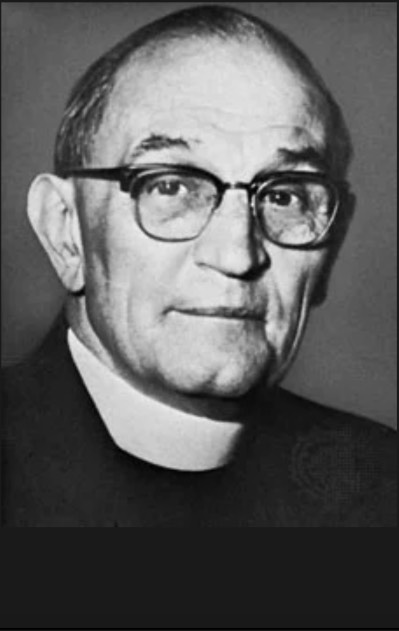
On March 6, 1984, a man named Martin Niemoeller died. He had been a German U-boat commander in WWI. After that war, he became a Lutheran pastor and initially supported Hitler. But as the years moved toward WWII, Niemoeller became more and more critical of Hitler. Arrested several times, he finally spent seven years in various concentration camps beginning in 1938. He was liberated from Dachau in 1945.
Martin Niemoeller wrote the following words:
“They came for the Communists, but I was not a Communist so I did not speak out. They came for the Socialists and trade unionists, but I was neither, so I did not speak out. They came for the Jews but I was not a Jew, so I did not speak out. Then they came for me, and there was no one to speak for me.”
As the world deals with interminable war, terrorism, racism, and cloaked fascism, we should remember that true justice and peace always include BOTH understanding and standing up.
Music: Show Me How to Stand for Justice – Martin Leckebusch
With it being nearly March, and with the weather being as it has lately, perhaps this phrase has crossed your mind: “In like a lion; out like a lamb”. I’ve had a few teachers, bosses, and colleagues who could have been described by that phrase. Maybe it could even describe some of us at times!
Beside its meteorological purposes, the phrase captures a life lesson. Life and the passage of time will probably tame us if we allow it. Reflection and patience will probably make us gentler and wiser. And there are so many situations where it might be more prudent to begin with a well-planned bleat than with a roar.
Think about it.
Music: LION/LAMB – Joshua Leventhal
Ready your heart child, ready your heart child The Lionlamb is coming, the Lionlamb is coming yeah Soften your heart bride, soften your heart bride The Wedding Day is coming, the Wedding Day is coming And when we see Him we shall be made like Him And when we see Him we shall be made like Him And when we see Him we shall be made like Him oh-oh-oh Lift up your eyes child, Lift up your eyes child The Lionlamb is coming, the Lionlamb is coming yeah He’s gonna make it right child, He’s gonna make it right child His justice, oh it’s coming, His justice, oh it’s coming And when we see Him we shall be made like Him As we see the end of death and dying And when we see Him we shall be made like Him As we see the end of death and dying oh-oh-oh He’s gonna make it right, child He’s gonna make it right, child He’s gonna make it right, child He’s gonna make it right, child (He’ll make it right) He’s gonna make it right, child (The Lionlamb is coming) He’s gonna make it right, child (Oh-oh-oh-oh) The LionLamb is coming
For Your Reflection
What feelings or reactions do I have after reading this reflection?
Do my feelings or reactions remind me of any passage or event in scripture, especially in the life of Christ?
What actions might I take today because of my response to these readings?
As we may think about love this Valentine’s Day, I offer one of my poems on a different aspect of love.
Rusalka, Op. 114: “Song to the Moon” · Antonín Dvořák
One bitter day in February
I sat inside a sunlit room,
made warm love to You in prayer,
and she passed outside my window,
the unhoused woman, dressed
uncarefully against the wind,
steadied on a cane,
though she was young.

She seemed searching for
a comfort, unavailable and undefined.
The wound of that impossibility
fell over her the way it falls
on every tender thing that cries
but is not gathered to a caring breast.
Suddenly she was a single
anguished seed of You,
fallen into all created things.

Re-entering prayer,
I wear the thought of her
like old earth wears fresh rain.
I’ve misconstrued You,
Holy One, to whom
I open my heart
like a yearning field,
Holy One, already ripe within
her barest, leanest yearning.
Music: Teach Me to Love- Steve Green (Good song, but sorry for the non-inclusive language)
For Your Reflection
What feelings or reactions do I have after reading this reflection?
Do my feelings or reactions remind me of any passage or event in scripture, especially in the life of Christ?
What actions might I take today because of my response to these readings?
Click the white arrowhead to the left above for some relaxing music while you read. You may repeat click if you wish.
One January morning, I stood with my sisters in our community cemetery. As our religious community ages, it is a ritual we practice all too often, as we honor the legacies of women with whom we have spent most of our lives. But that Saturday was unique. Let me tell you why.
That day, we celebrated our first military funeral for one of our sisters. It was a solemn and thrilling sight. The cold February sky sparkled like blue crystal. Sun reflected off the time-polished tombstones, creating an honor guard of light. As we processed to the graveside beside her flag-draped casket, three sailors awaited us at attentive salute.
Sister Bernard Mary, a farm girl from Trenton NJ, became a Navy nurse in World War II. After her service to our country, she entered the Sisters of Mercy and served in our healthcare ministries for over fifty years. She cared for the sick and poor with unrivaled perfection and compassion. Her entire life was marked by a profound sense of duty – a duty suffused with love.
As she was laid to rest, the clear notes of “Taps” rang out to the heavens, inviting her compassionate soul to “go to sleep”. Like all the others gathered there, I drew so many lessons from her dedicated life. One is this: understand your duty and execute it with sincerity and love. If you do, no matter what life throws at you — be it economic, physical, or psychological downturn –your clear spirit will endure and will ring out like singular bugle notes in the crisp morning air.
Sister Bernard Mary lived for ninety-one long years. Still, I left her grave remembering these stirring words of the first Sister of Mercy, Catherine McAuley: “Do all you can for God’s people, for time is short.”
Music: Taps
For Your Reflection
What feelings or reactions do I have after reading this reflection?
Do my feelings or reactions remind me of any passage or event in scripture, especially in the life of Christ?
What actions might I take today because of my response to these readings?
Click the white arrowhead to the left above for some relaxing music while you read. You may repeat click if you wish.
How do the great trees die and come to life again? It’s a question we can ponder every winter as the bare, black branches fill with ice. Their stark emptiness seems to be a place from which there is no return. But we know otherwise. In the encroaching cold of every December, our experience whispers that there will be another April. Still, in the frigid dark, it is sometimes hard to believe.
Like nature, each one of us has our seasons.
Our lives contain the seasons of our youth and aging.
Our daily experiences turn in both the ebb and tide of life.
Each of us has blossomed with spring’s new life: beginning a new job, relationship, adventure.
Each of us has cultivated what we love over warm summers of dedication and growth – our faith, families, friends, ministries, andcareers.
Each of us has reaped the autumn returns of our efforts, walking away from a red and golden field carrying a well-earned harvest – graduations, anniversaries, promotions, retirements.
Certainly, each of us has known our own winters, when cold has threatened and dark has isolated – and yet, like the trees – we have survived.
As we move into the depths of “Winter 2025”, it seems an opportune time to review the lessons of the season – especially the chapters on deep roots, inner quiet, and a hidden spiritual warmth that defies freezing.
In the winters of our lives, we are invited to learn what truly sustains us. We are called to delve into the power of endurance, forgiveness, honesty, loyalty, and faithfulness. These are the winter virtues that sustain life deep under the surface of any paralyzing storm. These are the salts that keep life’s highways passable, allowing us to stay connected to all that keeps us vibrant.
On any given day of the year, we can experience “winter”. Think of the times you have received (or given) the “cold shoulder”. Remember the times your explanations have been given an icy reception? Haven’t there been conversations where you were frozen out? Can’t you still see the frosty stare you got from someone who thought you were beneath them? We have all known some sub-zero responses when we were looking for a warm word. We have all received some chilly greetings when we needed not to feel like a stranger.
Hospitality is the perfect antidote to all these methods of freezing one another out. It is the human anti-freeze that reminds us that we need one another’s warmth to survive the treacheries of life. If there is someone you have exiled to the Arctic, think about reaching out in hospitality, forgiveness or honesty. This winter, let go of the glacial grudges, silences, and harbored hurts that sometimes freeze our souls and kill our hope of returning to life. Listen to the voice of the dark December night. It tells us how to move toward spring.
Music: Winter Sonata – David Lanz
For Your Reflection
What feelings or reactions do I have after reading this reflection?
Do my feelings or reactions remind me of any passage or event in scripture, especially in the life of Christ?
What actions might I take today because of my response to these readings?
The red fox lay dead in the road a little east of the mall entrance. It was a beautiful animal come to an inglorious end.
When an animal is killed trying to cross a road, it demonstrates a lesson learned in college biology – “geographic isolation”. Geographic isolation occurs when human-made structures, such as roads or canals, artificially separate animals of the same family. Over the course of decades, the animals on one side of the road assume different characteristics from the same type of animals on the other side of the road. Eventually, they may begin to behave toward each other as if they were two different species. In other words, their isolation begins to fool them into thinking they are different – even enemies.
There are all kinds of geographies in the world – not just the traditional ones that delineate nations. And there are all kinds of isolations that we can build into our multiple internal and external maps.
That little red fox might cause us to consider the breadth of our landscapes, our mindscapes, our soulscapes. How restricted are we in our ability to travel to and be comfortable in all different kinds of worlds. As we look at the circle of our friends, experiences, ideas, multi-cultural exposure – is the circle expansive or very limited and controlled? Have we allowed ourselves to live in a compressed world with fake boundaries? At the end of our one precious life, will we be sorry for all the growth opportunities we missed because our “geography” was so protected and myopic?
History boasts a few borderless explorers who have led the rest of us out of our comfort zones and into the challenges of discovery. These leaders had a sense of a universal geography. They saw borders only as the farthest points to which we can stretch – imagination, love, hope and courage. Their standard approach to life’s newness was an inclusive hospitality. They had a constant attitude that questioned isolation and was suspect of territorialism. They were the believers who knew there was more beyond the horizon – beyond the limits of a flat world or a self-centered universe.
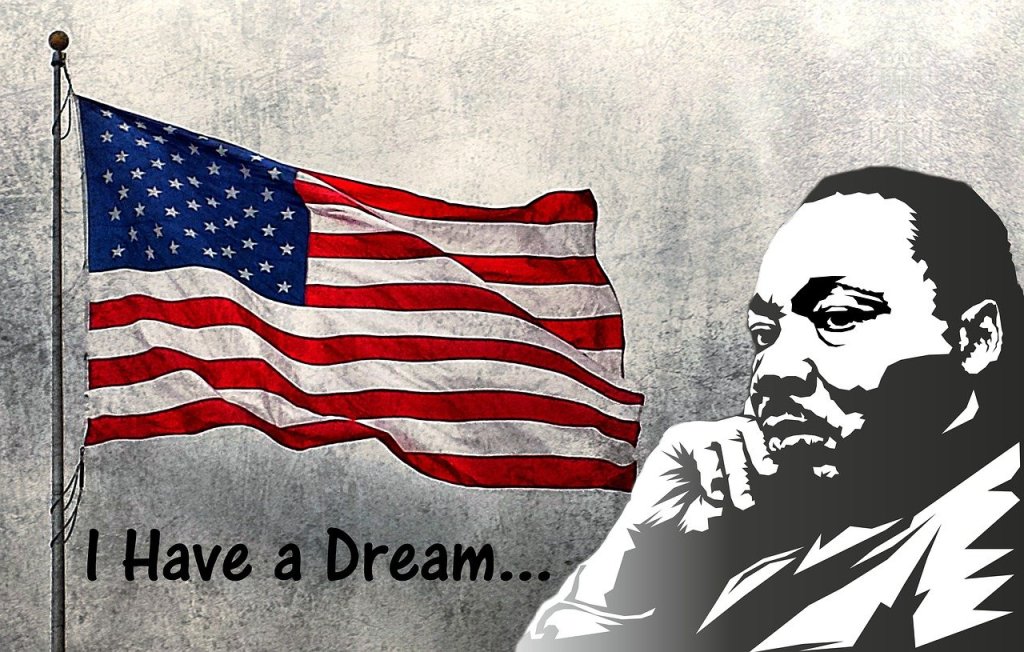
Martin Luther King was such a man. The artificial boundaries created by race and economic status were invisible to him. He challenged people who built their “privilege” on these unfounded borders. He opened the eyes and hearts of millions who had taken this moral “geographic isolation” for granted. He began the building of bridges that, if we complete them, will ultimately heal our world and our spirits.
Martin Luther King knew that we are all one people. He refused to allow the separations of prejudice and stereotyping to define the borders of his life. May his inspiration spur the rest of us to move outside our life-limiting ideas and step into a world of unity, mutuality, respect, and hope.
This year, we will celebrate MLK Day on January 20th. But today, as we mark his actual birthday, let’s take a sincere look at how much our prejudices control our choices. Let’s find someone or something that will help us continue to grow in openness and understanding.
Music: We Shall Overcome – Morehouse College
For Your Reflection
What feelings or reactions do I have after reading this reflection?
Do my feelings or reactions remind me of any passage or event in scripture, especially in the life of Christ?
What actions might I take today because of my response to these readings?
And now, bless the God of all, who has done wondrous things on earth; Who fosters people’s growth from their mother’s womb, and fashions them according to his will! May he grant you joy of heart and may peace abide among you; May God’s goodness toward us endure to deliver us in our days. Sirach 50:22-24
Jesus Christ is the faithful witness, the firstborn of the dead and ruler of the kings of the earth. To him who loves us and has freed us from our sins by his blood, who has made us into a kingdom, priests for his God and Father, to him be glory and power forever and ever. Amen. Behold, he is coming amid the clouds, and every eye will see him, even those who pierced him. All the peoples of the earth will lament him. Yes. Amen.
“I am the Alpha and the Omega, ” says the Lord God, “the one who is and who was and who is to come, the almighty.” Revelation 1:5-8
Pope Pius XI instituted the Feast of Christ the King in his 1925 encyclical Quas primas. The encyclical was written in response to growing secularism and secular ultra-nationalism. The encyclical, wedged between two World Wars, attempted to focus people’s minds and hearts on Christ whose power unites and directs us to peace rather than domination.
Today, in God’s Lavish Mercy: We pray to be agents of peace and justice in our world, sustained by our devotion to Christ who modeled his kingship by loving service, especially to the poor and marginalized.
Beloved, you are faithful in all you do for the brothers and sisters, especially for strangers; they have testified to your love before the Church. Please help them in a way worthy of God to continue their journey. For they have set out for the sake of the Name and are accepting nothing from the pagans. Therefore, we ought to support such persons, so that we may be co-workers in the truth. 3 John 5:8
Most of us have felt like strangers at some point in our lives. It’s not a nice feeling. You might have attended an event without a date or companion. You might have been the only woman in a group of men, or vice versa. You might have been the only Black person at a White funeral or the other way around. Didn’t we hope to find someone to connect to, someone who would offer us an open door?
Today, in God’s Lavish Mercy: As we think about Paul’s teaching, and our own experiences, let’s prayerfully consider our attitudes and actions regarding immigrants and refugees. Persons displaced by climate, politics, poverty, lawlessness, and a host of other causes deserve our help, as Paul describes. Let’s ask ourselves how we’re doing with that.
Poem: The Kindness of Strangers – Sally Van Dorn
Here I am with all my flaws seeking form and shelter.
I blanche at the notion of violence, but it’s coming
after us, closing in like a superstition I can’t shake.
If I acquiesce to your harsh future you must promise me
one thing. Where we go we will find our youth again. Can you
see it there under the yellow linen tablecloth? I’m depending on it.
Music: Wayfaring Stranger – published in 1858, author unknown
I'm just a poor wayfaring stranger
Traveling through this world below
There is no sickness, no toil, no danger
In that bright land to which I go
I'm going there to see my father
And all my loved ones who've gone on
I'm just going over Jordan
I'm just going over home
I know dark clouds will gather 'round me
I know my way is hard and steep
But beauteous fields arise before me
Where God's redeemed, their vigils keep
I'm going there to see my mother
She said she'd meet me when I come
So I'm just going over Jordan
I'm just going over home
I'm just going over Jordan
I'm just going over home
Do you not know that you are the temple of God, and that the Spirit of God dwells in you? If anyone destroys God’s temple, God will destroy that person; for the temple of God, which you are, is holy. Corinthians 3:16-17
How different our world would be if we believed this passage! How could we damage the precious gift of God’s Presence in ourselves or in one another!
Today, in God’s Lavish Mercy: We pray to the Spirit Who dwells in us, Whom we can never dislodge through transgression, to grant us a deep awareness and respect for the Holy in ourselves and all Creation. Today’s feast does not celebrate a building. It celebrates a symbol of who we are created to be in the power and oneness of God.
Poetry: St. John Lateran – Bessie Rayner Parkes (1829-1925)
Of temples built by mortal hands, Give honor to the Lateran first; ‘Twas here the hope of many lands– The infant Church–was nursed:
And grew unto a great estate, And waxed strong in grace and power, With Christ for Head and Faithful Mate, And Learning for her dower.
Since first this house to Him was raised, Three times five hundred years have run; For this let Constantine be praised, An English mother’s son!
He with his own imperial sword Did dig foundations broad and deep, That henceforth in His hand the Lord Rome and her hills should keep.
In after ages, one by one, Arose the altars vowed to Heaven; Each crest is sacred now, but none Like this of all the Seven!
Behold she stands! The Mother Church! A queen among her countless peers! Ah! open be that sacred porch For thrice five hundred years!
Video: A Virtual Visit to St. John Lateran Cathedral in Rome













 Lavish Mercy