They said to him, “The things that happened to Jesus the Nazarene, who was a prophet mighty in deed and word before God and all the people, how our chief priests and rulers both handed him over to a sentence of death and crucified him. But we had hoped that he would be the one to redeem Israel …
… And he said to them, “Oh, how foolish you are! How slow of heart to believe all that the prophets spoke! Was it not necessary that the Christ should suffer these things and so enter into his glory?”
Luke 24: 19-21; 25-26
The Emmaus disciples travel home confused, disappointed, walking on the thin edge of doubt, caught in the pluperfect form of hope that struggles to believe.
How special these two must have been to Jesus that he comes to them to soothe and redeem their bewilderedness!
Today, in God’s Lavish Mercy:
Each of us walks the road of faith, sometimes confident, and sometimes as befuddled as these two on the way to Emmaus. Good friends – holy friends – help us open our eyes to the presence of God in our lives. We pray in gratitude for the companions who accompany us on our life journey. We consider our openness to God’s presence in our companionship, and ask for the grace to inspire one another’s faith.
Poetry: Emmaus Journey by Irene Zimmerman, OSF – from Incarnation: New and Selected Poems for Spiritual Reflection
All was chaos when he died.
We fled our separate ways at first,
then gathered again in the upper room
to chatter blue-lipped prayers
around the table where he’d talked
of love and oneness.

On the third day Cleopas and I
left for the home we’d abandoned
in order to follow him.


We wanted no part of the babble
the women had brought from the tomb.
We vowed to get on with our grieving.

On the road we met a Stranger
whose voice grew vaguely familiar
as he spoke of signs and suffering.

By the time we reached our village,
every tree and bush was blazing
and we pressed him to stay the night.

Yet not till we sat at the table
and watched the bread being broken
did we see the Light.
Peter approached Jesus and asked him, “Lord, if my brother sins against me, how often must I forgive him? As many as seven times?” Jesus answered, “I say to you, not seven times but seventy-seven times.
Matthew 18: 21-22
Today’s parable reminds us that often our desire to be forgiven does not match our desire to forgive others. Of course, we understand our personal circumstances and see clearly how they deserve leniency. Can’t you hear yourself saying:
“I didn’t mean it!”
“I just forgot.”
“Give me another chance!”
“I won’t let it happen again.”
Many times people do hurtful things because of their own fears. Mercy calls us to receive and forgive those fears and limitations with the same generous grace as God receives us. And our merciful openness must extend endlessly .. “77 times”. That kind of sincere forgiveness takes a lot of grace. Let’s pray for it today.
Poetry: Forgiveness – George MacDonald
God gives his child upon his slate a sum –
To find eternity in hours and years;
With both sides covered, back the child doth come,
His dim eyes swollen with shed and unshed tears;
God smiles, wipes clean the upper side and nether,
And says, ‘Now, dear, we’ll do the sum together!’
Today, in God’s Lavish Mercy, our readings are connected by the topic of leprosy.
The LORD said to Moses and Aaron, “If someone has on his skin a scab or pustule or blotch which appears to be the sore of leprosy, he shall be brought to Aaron, the priest, or to one of the priests among his descendants. If the man is leprous and unclean, the priest shall declare him unclean by reason of the sore on his head.
Leviticus 13:2-3
“Leprosy” (Hebrew “tzaraat“) is first mentioned in chapters 13 and 14 of the Book of Leviticus. The term referred not only to many types of skin maladies but to ritual impurities and visually perceptible “punishments for sin”. In ancient times, someone suffering from an affliction as common as eczema might have been shunned as a leper.
Essentially, Levitical Law could base moral judgment of a person on their physical appearance. One might be seen to suffer physical deformity because of their own sins or the sins of their ancestors. The illness or deformity was then used as an excuse to condemn and isolate the suffering person.
Cleansing of the Leper by Harold Copping
Even though our scripture readings today are ostensibly about “leprosy”, they are about much more. Our readings challenge our ability or inability to see, love, and support our neighbor for who they are, not for how they appear.
Jesus sees the person who comes to him, not the disease or disfigurement which inhibits him.
A leper came to Jesus and kneeling down begged him and said, “If you wish, you can make me clean.” Moved with pity, he stretched out his hand, touched him, and said to him, “I do will it. Be made clean.”
Mark 1: 40-41
Praying with today’s Gospel reminds me of the powerful movie “Philadelphia” starring Tom Hanks who won an Academy Award for his role as Andrew Beckett, a lawyer suffering from AIDS.
“Philadelphia” is notable for being one of the first mainstream Hollywood films not only to explicitly address HIV/AIDS and homophobia, but also to portray gay people in a positive light. Andrew Beckett is a senior associate at the largest corporate law firm in Philadelphia. He conceals his homosexuality and his status as an AIDS patient from others in the office. A partner in the firm notices a lesion on Beckett’s forehead. Although Beckett attributes the lesion to a racquetball injury, it indicates Kaposi’s sarcoma, an AIDS-defining condition.
wikipedia
My own reflection today benefitted from revisiting this scene from the film. Like any parable, the story invites us to find ourselves somewhere in it.
People can be cut off from society for many conditions, be they leprosy, AIDS, or any other visible impediment. But the underlying reason they are shunned is fear — something about the person frightens us, or threatens to upset our religious, political, or economic securities.
If we want to be like Jesus, we must move beyond those fears and judgments – to see and love the person whom Mercy sees.
Music: “La Mamma Morta”, a 1950 Studio recording by Renata Tebaldi
Those who remember this movie will also remember this beautiful aria, played when Denzel Washington comes to consult with Tom Hanks in his home. The moment is a turning point for Washington who is fighting his own fears and prejudices as he takes on Hank’s case.
“La mamma morta” (They killed my mother) is a soprano aria from act 3 of the 1896 opera Andrea Chénier by Umberto Giordano. It is sung by Maddalena di Coigny to Gérard about how her mother died protecting her during the turmoils of the French Revolution.
Today, in God’s Lavish Mercy, we finish with the Book of Kings. And, as several of my readers have told me, they’ll be glad for it. There may have been points in our journey through Samuel and Kings, when you thought, “WHY am I even reading this! Who cares about Rehoboam, Jeroboam or any other “boams”!
I understand, but here are two of my “WHY”s:
The Hebrew Scriptures show us how human beings deepened, over thousands of years, in their understanding of God. Throughout that extended deepening, God remains unchangingly faithful. Even though the cultural context of some Old Testament stories may upset, befuddle, or offend us, they still express the human attempt to find God in one's experience.
The Hebrew Scriptures inform and underlie the theology of the Christian Scriptures, and the culture in which Jesus lived and taught. Like a butterfly is the fulfillment of the chrysalis, Jesus was the fulfillment of the Promise to Abraham. Without an appreciation of that Promise, and how Israel lived out its long realization, our comprehension of Christ's meaning is limited.
Our Gospel today gives us the familiar story of the feeding of the multitude. Mark describes a large crowd engaged in the search for God. They follow Jesus for three days, listening, learning, and being amazed at his miracles. They are so hungry to find something to believe in that they forget to feed their human hungers!
I love the compassionate way Jesus takes notice of their predicament:
“My heart is moved with pity for the crowd, because they have been with me now for three days and have nothing to eat. If I send them away hungry to their homes, they will collapse on the way, and some of them have come a great distance.”
In this pivotal miracle, Jesus teaches a core lesson of faith.
In Christ, we are given the gift of full and abundant life. Our hearts then must become like his, moved in mercy toward those who are still hungry, both spiritually and physically.
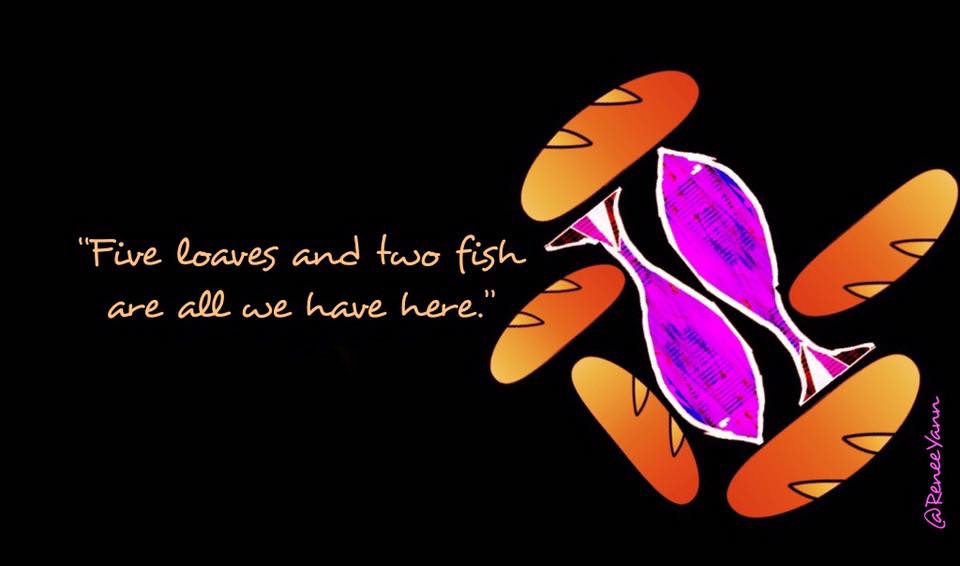
The miracle of the loaves and fishes calls the faithful community to the practice of shared abundance. It invites us to notice the hungers around us and within our world. It moves us to understand the distances people experience from love, inclusion, respect, security, and peace. It convinces us that the need to have more and more will only yield less and less for our spirits.
Our culture works to convince us that we can never work hard enough or accumulate enough. It deludes us to believe that we matter because of what we have, not because of who we are. In this miracle, Jesus models another way to live in relationship with God, ourselves and with Creation:
Trust in and respect for the abundant generosity of God’s Creation
His disciples answered him, “Where can anyone get enough bread
to satisfy them here in this deserted place?”
Still he asked them, “How many loaves do you have?”
They replied, “Seven.”
He ordered the crowd to sit down on the ground.
Deep reverence and gratitude for God’s Presence in all life
Then, taking the seven loaves he gave thanks, broke them,
and gave them to his disciples to distribute,
and they distributed them to the crowd.
They also had a few fish.
He said the blessing over them
and ordered them distributed also.
They ate and were satisfied.
Acknowledgement of our need to replenish our spirits in rest and solitude
He dismissed the crowd and got into the boat with his disciples
and came to the region of Dalmanutha.
Somewhere in each of our lives, we might find a few loaves or minnows hidden away. Or we might be the famished one with an empty basket after a long journey. Today’s Gospel tells us to invite God’s transformative grace into our needs, hungers, inhibitions, or emptiness. Like this amazed Gospel crowd, we might be wowed at what God can do with our generous hearts!
Poetry: In the Storm – Mary Oliver
Some black ducks
were shrugged up
on the shore.
It was snowing
hard, from the east,
and the sea
was in disorder.
Then some sanderlings,
five inches long
with beaks like wire,
flew in,
snowflakes on their backs,
and settled
in a row
behind the ducks --
whose backs were also
covered with snow --
so close
they were all but touching,
they were all but under
the roof of the duck's tails,
so the wind, pretty much,
blew over them.
They stayed that way, motionless,
for maybe an hour,
then the sanderlings,
each a handful of feathers,
shifted, and were blown away
out over the water
which was still raging.
But, somehow,
they came back
and again the ducks,
like a feathered hedge,
let them
crouch there, and live.
If someone you didn't know
told you this,
as I am telling you this,
would you believe it?
Belief isn't always easy.
But this much I have learned --
if not enough else --
to live with my eyes open.
I know what everyone wants
is a miracle.
This wasn't a miracle.
Unless, of course, kindness --
as now and again
some rare person has suggested --
is a miracle.
As surely it is.
Music: Krystian Zimerman – Beethoven: Piano Concerto No. 5 in E Flat Major, Op. 73: II. Adagio un poco moto
A lovely piece to accompany our reflection on faith, miracles, and abundance.
Today, in God’s Lavish Mercy, our readings offer us insights into the ministry of leadership. They are insights worth pondering for at least these two reasons:
We are all called to be leaders in some way in our lives, be it as parent, teacher, supervisor, team captain, committee lead, board chair … you name it.
We need to be able to recognize good leaders in order to follow wisely, otherwise we are following self-interested fools determined to re-create us in their likeness.
In both our readings, leadership is characterized by this key element: selflessness.
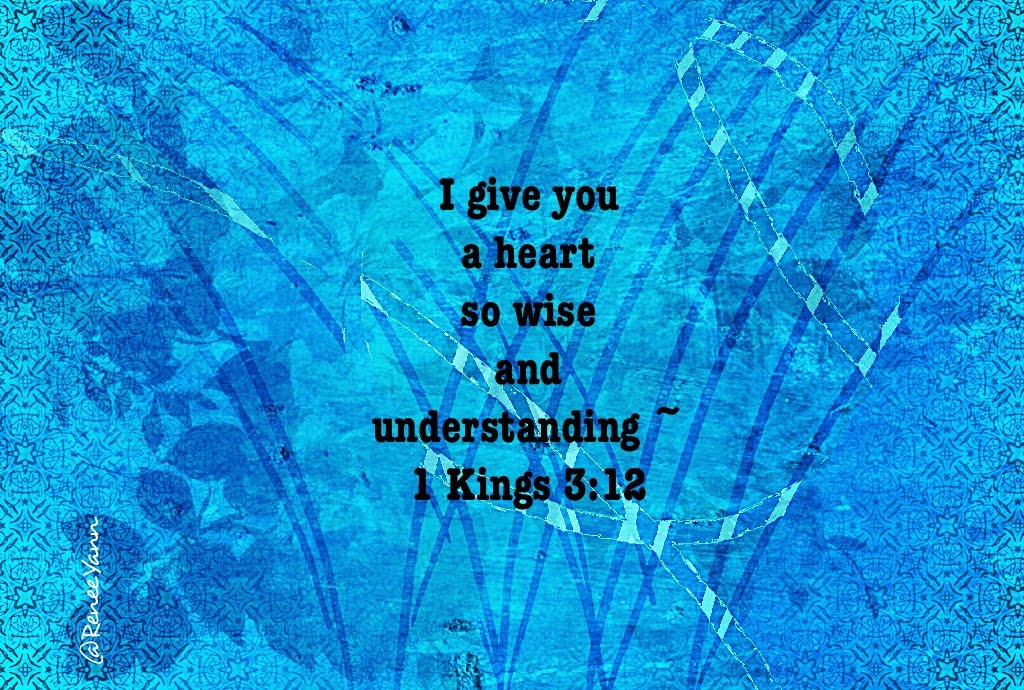
Solomon, when given the chance to ask for anything he wants, asks for a gift that will benefit the community.
Give your servant, therefore, an understanding heart to judge your people and to distinguish right from wrong.
1 Kings 4:9
Jesus and the disciples, exhausted from the press of the crowd, still respond in mercy to their relentless needs
Jesus said to the disciples, “Come away by yourselves to a deserted place and rest a while.” People were coming and going in great numbers, and they had no opportunity even to eat. So they went off in the boat by themselves to a deserted place. People saw them leaving and many came to know about it. They hastened there on foot from all the towns and arrived at the place before them.
When Jesus disembarked and saw the vast crowd, his heart was moved with pity for them, for they were like sheep without a shepherd; and he began to teach them many things.
Mark 6: 30-34
As we daily focus our lives on becoming more like Christ, the practice of selflessness can be tricky – how to live selflessly without losing one’s self; how to foster common and individual good without depleting one’s own spiritual strength. To my mind, these things are important:
Honesty: I think the grounding virtue of a good leader is honesty – with others and with self. Once a leader starts to pretend, deceive, equivocate, feign ignorance, or outright lie, (even to themselves), they are no longer fit to lead.
Spiritual Discipline: When we look at Jesus’s life, we see that he practiced a cycle of ministry and prayer. Several times in the Gospel, Jesus withdraws to commune with the Father. Although Christ was in union with the Father at all times, he exercised his ministry around a personal discipline of solitude and prayer.
Discernment: Solomon understands the importance of this gift. What Solomon actually prays for is the sensitivity to practice the “cardinal virtues” that we learned long ago in catechism class. Remember? Prudence, Justice, Fortitude, and Temperance.
Prose: Remember the Baltimore Catechism? Well, maybe some of you are too young to remember, Here’s how wikipedia defines it:
A Catechism of Christian Doctrine, Prepared and Enjoined by Order of the Third Council of Baltimore, or simply the Baltimore Catechism, was the national Catholic catechism for children in the United States, based on St. Robert Bellarmine’s 1614 Small Catechism. The first such catechism written for Catholics in North America, it was the standard Catholic school text in the country from 1885 to the late 1960s. From its publication, however, there were calls to revise it, and many other catechisms were used during this period. It was officially replaced by the United States Catholic Catechism for Adults in 2004, based on the revised universal Catechism of the Catholic Church.
Throughout my adult life, I have retained an appreciation for what I learned from the now-defunct edition of the Baltimore Catechism. While it conveyed the impression that a recipe for holiness could be compacted into a small manual, its inimitable Thomistic logic left valuable lessons with me to which I often return. Here are a few that informed my prayer today as I reflected on “selflessness”:
Besides the theological virtues of faith, hope, and charity there are other virtues, called moral virtues.
These virtues are called moral virtues because they dispose us to lead moral, or good lives, by aiding us to treat persons and things in the right way, that is, according to the will of God.
The chief moral virtues are: prudence, justice, fortitude, and temperance; these are called cardinal virtues.
These virtues are called cardinal virtues because they are like hinges on which hang all the other moral virtues and our whole moral life. The word “cardinal” is derived from the Latin word “cardo” meaning hinge.
Prudence disposes us in all circumstances to form right judgments about what we must do or not do.
Justice disposes us to give everyone what belongs to them.
Fortitude disposes us to do what is good despite any difficulty.
Temperance disposes us to control our desires and to use rightly the things which please ourselves.
Today, in God’s Lavish Mercy, our readings say something about Divine Order, about Sacred Balance – and our ability to let go and trust.
Nathan Rebukes David – by James Tissot
In our first reading, the prophet Nathan confronts David regarding his relationship with Bathsheba. The beautiful Bathsheba was the wife of Uriah, an elite soldier in David’s army. From far away one day, David spies her bathing in a pool. Full of covetousness and lust, he engineers a heartless plot to have her as his own.
The story is complex, intriguing, and extremely dramatic. You can read it for yourself in 2 Samuel. But the point I would like to draw out for today is about covetousness. What is that, really, and does it play any part in my life?
“Covet” is an intransitive verb that we learned when we were taught the Ten Commandments. Like all the other sins, my six-year-old self decided I would try hard not to commit it … but I had no idea what it even meant! I was pretty sure I didn’t have to be worried about coveting my neighbor’s wife, but I did like Jimmy Clark’s bike enough to covet it. (But, I didn’t steal it.)
Honestly, I don’t think I’ve ever used the verb “covet” in a sentence before today. So I turned to Meriam-Webster who defines covetousness like this: to desire (what belongs to another) inordinately or culpably
Do we “covet” when we wish we had some of the great things others have? Material things like money, mansions, and limousines? Or immaterial things like talent, beauty, and popularity?
I don’t think so. We may have to deal with the concupiscence of jealousy or envy, but it’s not quite the same as coveting. As Merriam-Webster indicates, coveting implies an inordinance or culpability. In other words, we act on our jealousy or envy in some way, creating an imbalance in our moral life.
We resent, judge, or ostracize the person who has what we want.
We plot to take away the other’s prized possession or status.
We create a deficit in our own responsibilities by directing essential resources to our plot.
And what may be the worst and most likely situation, we use our power to indifferently usurp what belongs to others.
When I examine my conscience I remind myself that the world belongs to me, but it also belongs to others — all others. Peace, a decent level of sustenance, the goods of Creation, the right to life — these belong to me but also to others. I may not be aware of “coveting” these things to the detriment of others, but how do my choices and actions in any way limit that right for others?
It could be as simple as this:
Do I vote for leaders who continually foster negotiation over militaristic responses?
Do I support trade agreements that establish sustainable practices for producers as well as consumers?
Do I recognize that climate deterioration and refugee intensification are inextricably connected to abusive environmental practices and that I have a role in promoting change?
Do I have a single-issue or a holistic approach to life concerns for the unborn, impoverished, incarcerated, unhoused, immigrant, and medically needy populations?
When we find ourselves entangled in greed or covetousness, it’s not necessarily that we are bad people. We might be more like the disciples described in today’s Gospel – fearful people, so insecure that we amass material protections around us.
A violent squall came up and waves were breaking over the boat, so that it was already filling up. Jesus was in the stern, asleep on a cushion. They woke him and said to him, “Teacher, do you not care that we are perishing?” He woke up, rebuked the wind, and said to the sea, “Quiet! Be still!” The wind ceased and there was great calm. Then he asked them, “Why are you terrified? Do you not yet have faith?”
Mark 4: 37-40
Jesus calls us to live a life grounded in faith not material protections. Only faith is invulnerable to life’s storms. Within its eternal securities, we become more deeply aware of our sacred relationship to all creatures and to Creation Itself.
If David had exercised such faith, the taking of Bathsheba and murder of Uriah would have been incomprehensible to him. As we deepen in our faith, what awarenesses will awaken in us?
Quote: Wisdom from Ramana Maharshi (1879 – 1950) who is considered an Indian Hindu sage and “jivanmukta” (liberated being). He is regarded by many as an outstanding enlightened being and, as a charismatic person, attracted many devotees. I particularly value this quote which leads me to consider my oneness with all beings:
Questioner:How are we to treat others? Ramana Maharshi:There are no others.
Today, in God’s Lavish Mercy Mercy, vigorous, grace-filled David dances with abandon before the Lord. It is a beautiful moment to imagine!
David went to bring up the ark of God from the house of Obed-edom into the City of David amid festivities. As soon as the bearers of the ark of the LORD had advanced six steps, he sacrificed an ox and a fatling. Then David, girt with a linen apron, came dancing before the LORD with abandon, as he and all the house of Israel were bringing up the ark of the LORD with shouts of joy and to the sound of the horn.
2 Samuel 6: 12-15
David dances with unselfconscious joy because he has brought the Presence of God home to the heart of the community. The joy comes from recognizing that God wants to be with the People. This joy, inexpressible in words, takes the form of a dance with the Spirit of God.
Let’s pause today with that dancing image, to consider all the ways God longs to dance with us throughout our lives, and we with God — dances of both:
joy and sorrow, faith and questioning, hope and shadow
… dances in which we must abandon ourselves to the moment’s sacred music and respond to God’s mysterious, leading step.
Whatever the emotion we bring to prayer, what matters is only that we carry it close to God’s heart, listening to our circumstances for the Divine Heartbeat. We may not be the “Fred Astaire” or “Ginger Rodgers” of prayer, but each one of us has a holy dance somewhere in their heart.
I think our children can teach us something about this kind of uninhibited prayer – one filled with trust, hope, joy, and innocence.
Poetry: T. S. Eliot
At the still point of the turning world. Neither flesh nor fleshless; Neither from nor towards; at the still point, there the dance is, But neither arrest nor movement. And do not call it fixity, Where past and future are gathered. Neither movement from nor towards, Neither ascent nor decline. Except for the point, the still point, There would be no dance, ~ T.S. Eliot
A second lovely poem, even though it is not Easter 🙂
Easter Exultet
Shake out your qualms. Shake up your dreams. Deepen your roots. Extend your branches.
Trust deep water and head for the open, even if your vision shipwrecks you.
Quit your addiction to sneer and complain. Open a lookout. Dance on a brink.
Run with your wildfire. You are closer to glory leaping an abyss than upholstering a rut.
Not dawdling. Not doubting. Intrepid all the way Walk toward clarity.
At every crossroad Be prepared to bump into wonder. Only love prevails.
Enroute to disaster insist on canticles. Lift your ineffable out of the mundane.
Nothing perishes; nothing survives; everything transforms! Honeymoon with Big Joy! ~ James Broughton
The motherhouse chapel is hushed in sacred quiet. We have spent these New Year’s Eve hours in prayer, thanksgiving, and hope. Now in midwinter’s purple shadows, a silent nun touches her single, small light to the majestic candelabras to prepare for this Mass which balances on the turning of the years. The tiny flames slowly saturate the darkness, transforming it to a warm, golden invitation.
Our Mercy family gathers from the places where they have been praying. Each one carries a heart filled with the past year’s blessings and challenges and with the new year’s hopes.
As each one enters the chapel, she places her thoughts in the ciborium of silence. She pours her needs into the chalice of trust.
Evening, through the stained-glass windows, breaks its dark rainbow across the sanctuary, wakening an expectant God to receive our promises. The schola rustles to life for the celebration. With them, our spirits hum the treasured Christmas harmonies learned in distant novitiates. Some who will celebrate Jubilee this year gather at the back of chapel for the entrance procession, awed that the years have carried them to this moment. The stage is set for the great liturgy of renewal, for on this night each year, we pronounce again the vows that sculpt our lives.
This is a most-hallowed ritual for year after year in Mercy, even before we were born, we have been carried by the sacrament of one another’s fidelity. As we light the slender tapers, we remember and are encouraged by our beloved sisters who now live the fulfillment of their vows in heaven.
We give thanks for the new life of our candidates and novices whose eyes and hearts open in wonder at the incredible power of call and community. And we see the inexplicable beauty of one another whose lives, woven together in joys and sorrows through the years, have carried us to the merciful heart of God.
These are the grains of bread. These are the drops of wine – these lives, taken and called by God, blessed and broken over the world, given again and again in mercy for the poor, sick and uneducated. This is the Eucharist of our vowed and covenanted lives. This is the Body and Blood of Christ.
On this night, the spice of life steeps in a mulled wine where tart experience and sweet assurance marry in faith. On this night, we offer the past; we pledge the future, but we do so in this present moment which alone holds meaning. It is in this vowed moment – this pledged renewal – that the host is lifted and the cup sanctified. It is a moment repeated infinitely in the faithful living of our call. It is the moment of transformation.
Today, in God’s Lavish Mercy, we begin a three-week immersion in John’s magnificent first letter. At the same time, our Gospels will take us on a somewhat random journey with Jesus through his very early years.
Today’s Gospel, however, differs from the expected pattern and – yes, right here in the Christmas season – gives us an account of the Resurrection!
Early in the morning, on the first day of the week, Mary Magdalene ran and went to Simon Peter and to the other disciple whom Jesus loved, and told them, “They have taken the Lord from the tomb, and we do not know where they put him.” So Peter and the other disciple went out and came to the tomb. They both ran, but the other disciple ran faster than Peter and arrived at the tomb first; he bent down and saw the burial cloths there, but did not go in. When Simon Peter arrived after him, he went into the tomb and saw the burial cloths there, and the cloth that had covered his head, not with the burial cloths but rolled up in a separate place. Then the other disciple also went in, the one who had arrived at the tomb first, and he saw and believed.
John 20: 1-8
Did somebody get mixed up? Did someone think it was the Octave of Easter, not Christmas! No, of course not. I think the choice of this Gospel, at this point in the Liturgical Year, serves at least two purposes:
From the start of Christ’s life, it establishes how his days will end. Therefore, throughout the ensuing year, we are to read and interpret all of the Gospel in the glorious light of the Resurrection.
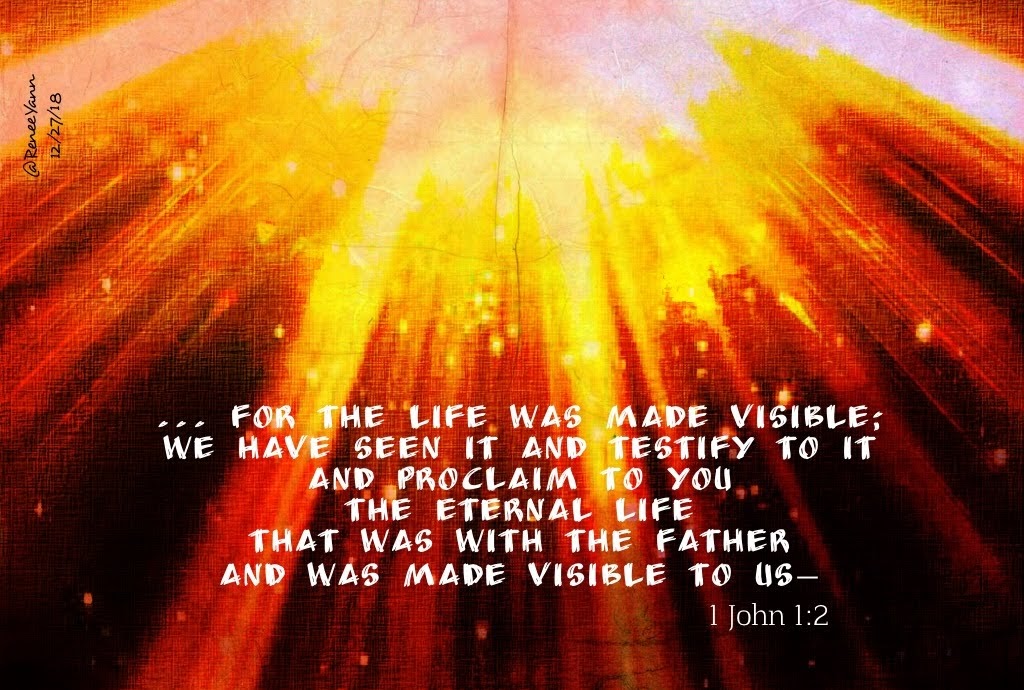
Placing this Gospel here, to accompany our first reading, clarifies exactly who John is — the one who indeed saw, heard, and touched the Word of God made visible in Jesus Christ and therefore is eminently qualified to testify to Christ.
Beloved: What was from the beginning, what we have heard, what we have seen with our eyes, what we looked upon and touched with our hands concerns the Word of life — for the life was made visible; we have seen it and testify to it and proclaim to you the eternal life that was with the Father and was made visible to us—
1 John 1:1-2
One very popular form of both fiction and non-fiction is the love letter. Some of the most wonderful books are in the genre. Three of my favorites fit the category:
84, Charing Cross Road – Helene Hanff
The Love Letters – Madeleine L’Engle
A Green Journey – John Hassler
Reading such literature evokes a reverence for the lives we touch in the gathered words. We read what is said and imagine what is unsaid. We witness the depth of another’s self-donation and we ponder our own capacity for such a gift.
In 1 John, we are granted the privilege of reading John’s love letters to his God and to his community. John’s love is profoundly deep yet simply expressed. We might tend to skip through his rich but clipped phrases. But to truly plumb them requires us to suspend time and rest with his words until they open in us like flowers in sunlight.
Poetry: The Living Word – Herman Hesse
The sun speaks to us through light. Flowers give voice to fragrance and colour. The air communes through clouds, snow, and rain. From the sacred center of the world streams forth an irrepressible desire to overcome the silence between things. Art, the ever flowing fountain, reveals the secret of life through word and gesture, colour and sound.
The world wants to be known to spirit and find expression for timeless wisdom. All life longs for a language. Deep intuitions wish to surface, find words and numbers, lines and tones, always evolving forms of understanding.
The red and blue of flowers
and the verses of the poet
point to the inner workings of creation,
always pregnant with beginning and never-ending.
When word and sound marry,
where songs soar and art unfolds
all life is brimmed again with spirit.
And every melody and book
and every painting is a revelation,
is another fresh attempt
to unfold the harmony of life.
Poetry and music invite you
to understand the splendors of creation.
A look into a mirror will confirm it.
What disturbs us often as disjointed
becomes clear and simple in a poem:
Flowers start laughing, the clouds release their rain,
the world regains its soul, and silence speaks.
Merry Christmas, dear readers! May our sweet Jesus abundantly bless you and those you love.
Below is a video beautifully edited by our Sister Mary Kay Eichman. We both thought you might like to enjoy it, whole or in parts, over this Christmastide.
Today, in God’s Lavish Mercy, let us pray within the amazing Presence of God in our life renewed in us this Christmas.
Mary is wrapped in the cold darkness of this winter night. She is vulnerable as she waits to bring forth her child. Yet she feels wrapped in tenderness by God and supported by God’s love. She longs to welcome this Holy Child in warmth And to wrap him in the same love and tenderness.
We too want to welcome Jesus with warm tenderness. In Mercy, we have tried to bring Christ into world and to warm and comfort people with God’s presence.
Is there a person in your life, Or a place in your heart today that needs warmth, comfort and love?
Be in quiet prayer for that person or place for a while as we absorb the amazing graces offered us in the Christmas miracle.
Prayer
Today the Christ Child is born We welcome Him into our hearts We wrap Him in our adoration.
Today the Christ Child is born In the refugee who longs for home In the sick who long care In the poor who long for sustenance In the uneducated who long for hope In these, we welcome Him. We wrap them in our prayer.
Today the Christ Child in born In children who long for a future In families who long for unity In elders who long for peace In all people who long for dignity and love In these, we welcome Him. We wrap them in our prayer.
Today the Christ Child is born In our Church that longs for holiness In our community that longs for grace In our world that longs for peace In our hearts that long for God In these we welcome Him. We wrap them in our prayer.












 Lavish Mercy