Earnest Expectation

Saturday of the Third Week of Advent
December 23, 2023

Today’s Readings:

https://bible.usccb.org/bible/readings/122323.cfm


(Today, the Church repeats the King O Antiphon. But I love the concept of Christ as Radiant Dawn. It also fits so clearly with the sacred purifications alluded to in today’s readings.)


Today, in God’s Lavish Mercy, we have finally reached the “delivery” stage of Advent. Just like those Amazon packages that keep showing up on doorsteps in the days preceding Christmas, other important arrivals are popping up in our readings.

Malachi announces that a prophet is coming who will purify the people, particularly concerning their worship practices which have corrupted:

Thus says the Lord GOD:
Lo, I am sending my messenger
to prepare the way before me;
And suddenly there will come to the temple
the LORD whom you seek,
And the messenger of the covenant whom you desire.
Yes, he is coming, says the LORD of hosts.


It seems that Malachi and his friends, perhaps like some of us, haven’t had the discipline and devotion to safeguard the Temple rituals. Maybe like Mal and the gang, we start to take things for granted, to become cavalier about liturgical intention, to cut corners, to program our own agendas into the sacred rituals of common prayer. — to forget that God is the center of worship, not us.

Becoming that “forgetful” hardens the heart to grace. The One Who longs to encounter us in prayer and worship is stymied by our distracted negligence.


Our Gospel, too, is reminiscent of a sanctuary scene, for it was there that Zechariah learned that a prophet was actually going to be his son! Zechariah encountered God’s Word purifying his life and directing it in a totally unexpected manner. Surely, in the ensuing nine months of silence, the essence of Zechariah’s worship was transformed.

In today’s reading, the incredulous neighbors at John’s bris question Elizabeth’s assignment of such an unfamiliar name. But Zechariah confirms Elizabeth’s declaration. Zechariah’s purification and graceful evolution are complete. His tongue is loosened to proclaim the Word God has spoken in his silent heart.

“There is no one among your relatives who has this name.”
So they made signs, asking his father what he wished him to be called.
He asked for a tablet and wrote, “John is his name,”
and all were amazed.
Immediately his mouth was opened, his tongue freed,
and he spoke blessing God.

Luke 1: 61-64

(I often wonder why the neighbors “made signs” to Zechariah.
Why didn’t they just speak to him? 
He wasn’t struck deaf, just mute.:)


Poetry: Zechariah by Andy Sabaka, Pastor of Grace Fellowship Church in Louisville, KY

Day one of his nine months of silence
Began as Zechariah entered God’s presence.
When he walked past the curtain to behold
Gabriel standing by the incense altar of gold,
Zechariah did what all who are not regularly
In the presence of such shining authority
Do: he fell to his knees, filled full with dread,
Assuming in moments he would be struck dead.
Yet Gabriel’s words were frightfully comforting,
Ringing off the walls like heavenly trumpeting.
“Zechariah, my friend, do not be afraid,
For the prayers you and Elizabeth have prayed,
Have been heard by our God, the All-powerful One,
And I tell you, soon your bride will bear a son.
His name will be John, a man set apart,
Filled with God’s Spirit, calling the hearts
Of all who will listen to make room and repent
Because the coming Messiah is soon to be sent.”
The announcement of who the promised child would be,
Never reached Zechariah’s ears, for all he could see
Was Elizabeth’s barrenness and how old they both were.
He was stung that the promise had come so long after
They had given up hope of any offspring.
The guarantee of a child brought back an old sting.
His fear of the angel faded, now replaced by disbelief,
Combined with renewed disappointment and grief.
He said to the angel, “How shall I know this is true?
Can’t you see we are old; our youth long ago flew?
So I hear your authoritative proclamation
But from the little I know about procreation…”
“Silence,” the angel said, and Zechariah obeyed the command.
“Gabriel is my name; before God in heaven I stand.
I was sent from there to give you this good news.
But since you have rejected these wonderful truths,
You will be silent until you see their fulfillment.”
And at the exit of Gabriel, Zechariah’s voice also went.
The crowd outside had been worried at Zechariah’s delay,
So when he finally emerged, they demanded right away
An explanation for all that had happened inside,
But Zechariah’s mouth could give none, no matter how he tried.
It was obvious to all that a vision had been sent
And those who heard of his muteness responded with wonderment.
Yet the response to Zechariah’s silence was nothing compared
To the way that everyone would stop and then stare
At Elizabeth’s pregnant stomach. How could it be
That a woman her age could possibly conceive?
So it was that dumbfounded silence was the reply
To Gabriel’s message that could no longer be denied.
Elizabeth named her child John the day he was born,
But everyone received the name with great scorn,
Insisting the name Zechariah was the right one,
But his father wrote clearly: “His name shall be John.”
It was in that moment of faith, when Zechariah obeyed,
When he showed he believed all the angel had said,
God reached down and touched the lips of the man,
Releasing his tongue to speak once again.
And when his voice first spoke after being dead for so long,
It rang out clearly in the words of this song:
Praise the Lord, the God of Israel, who has come to save
And redeem his people – a horn of salvation he will raise
And he will come from the house of David, his servant,
The one who the prophets said would be sent,
Bringing salvation from our enemies and great mercy
To our fathers before and to all who now see
The promise of Abraham fulfilled in our days.
We are free now to serve with no fear in the way
To walk in righteousness before the rising sun,
And in holiness from this blessed day on.
And you, John, my son, will be a prophet of the Most High,
Preparing the way for him – in the desert you will cry,
Giving the knowledge of salvation through the forgiveness of sins
That the tender mercy of God has come here to win.
He will rise like the sun from heaven and shine bright
On those living in darkness, giving them sight,
Calling them out of the shadow of death to release
Their feet to walk in the path paved with peace.”
Our first advent candle tells us to recall
The miracle of Christmas and the wonder of all
It took for our God to prepare and then send
His Son to bring sin and death to an end.
Let us silently wait in this season pregnant with meaning
Until God loosens our lips to break forth with loud singing
About the rising sun from heaven who has risen again
And brings forgiveness and life to each of us when
We repent and believe that God can do
Any miraculous thing that he wants to,
Including save doubting sinners like you and like me,
Shutting our mouths, making us able to see.

Music: Anticipation – from The Secret Garden

Rescue Us from Ourselves, O Adonai!

Monday of the Third Week of Advent
December 18, 2023

Today’s Readings:

https://bible.usccb.org/bible/readings/121823.cfm


Today, in God’s Lavish Mercy, we pray with our beautiful O Antiphon:

In our prayer, we call out to God as a Leader, a Leader we desperately crave because we cannot find the way ourselves. Oh, how badly we need that Divine Leader today!


Throughout these past few weeks, as I have prayed and written about the salvation history of Israel, interwoven with our Christian faith, I have been so painfully aware of the current situation in the Holy Land. The human carnage being executed there, as well as in Ukraine, screams against our mounting stagnation and indifference.

As the world observes and opines over the sacrilegious slaughter of human life, I know God’s heart breaks, as does the heart of anyone who loves as God loves. Where are the human leaders who will hear God’s cries to fashion a peace for these people, and for the world which is sickened by their suffering.

“We, people of God who proclaim the Gospel of the Risen One, have the duty to cry out this truth of faith: God is a God of peace, love, and hope. A God who wants us all to be brothers and sisters, as His Son Jesus Christ taught us. The horrors of war, of every war, offend the most holy name of God. And they offend Him even more if His name is abused to justify such unspeakable carnage.”

Pope Francis

War, and its reflection in proliferating smaller violences, is the extreme expression of a heart and a civilization deadened by sin. When a culture has normalized the tactics of death, it can be rescued only by the Divine.


As we pray today with Jeremiah’s promise to a beleaguered people, let us pray for mercy and justice for all people, especially women, children, and the poor who are always the most brutalized in war. And let’s do all that we can to move our government to moral leadership against the embedded sin of global violence.

Behold, the days are coming, says the LORD,
when I will raise up a righteous shoot to David;
As king he shall reign and govern wisely,
he shall do what is just and right in the land.
In his days Judah shall be saved,
Israel shall dwell in security.
This is the name they give him:
“The LORD our justice.”

Jeremiah 3:5-6

Prayer: On Peace and War – Walter Brueggemann from Prayers for a Privileged People

We are aware, acutely aware in your presence,
of the grind of tanks,
of the blast of mines hidden against human flesh,
of the rat-tat-tat of sniper fire.
We are aware of the stench of death,
bodies of our own military women and men, bodies of countless Iraqis,
and the smell makes us shiver.

Such smells and sounds are remote from us,
but not remote from us are bewilderment,
and anxiety, and double-mindedness.
We are bewildered,
whether we are liberators or invaders,
whether they are terrorists or freedom fighters, whether we should yearn for peace or savor victory.

The world has become so strange,
and our place in it so tenuous,
where gray seems clearer than the white purity of our hopes,
or the darkness of our deathly passions.
There is so little agreement among us,
perhaps so little truth among us,
so little, good Lord, that we scarcely know how to pray,
or for what to pray.

We do know, however, to whom we pray!
We pray to you, creator God, who wills the world good;
We pray to you, redeemer God, who makes all things new.
We pray to you, stirring Spirit, healer of the nations.
We pray for guidance,
And before that, we pray in repentance,
for too much wanting the world on our own terms.

We pray for your powerful mercy,
to put the world – and us – in a new way,
a way after Jesus who gave himself,
a way after Jesus who confounded the authorities and
who lived more excellently.
Whelm us by your newness, by peace on your terms
– the newness you have promised,
of which we have seen glimpses in your Son
who is our Lord.

Music: End the War. Grant Us Peace – Lord’s Loving Melody

Beyond Fear

Memorial of Saint Martin of Tours, Bishop
November 11, 2023

Today’s Readings:

https://bible.usccb.org/bible/readings/111123.cfm


Today, in God’s Lavish Mercy, there is a graceful coincidence of several themes calling me to prayer. I share them with you:

  • On November 11th, Sisters of Mercy throughout the world commemorate the death of our beloved founder Catherine McAuley.
  • This year that commemoration falls on the feast of the beautiful St. Martin of Tours.
  • Our readings for the day prompt us to consider our beloved companions on our spiritual journey who provide a harbor of blessings in a fearsome world.

Not just today, but often, I think about what Catherine would be like if she lived among us today. In her day, she was ever practical, focusing on healing the greatest unmet needs around her.

Her “un-technologized” world was smaller than ours. She encountered need simply by a walk through Dublin’s neighborhoods. Were she here today, need would pour into her awareness from every corner of the earth via technological means. How would she focus the power of her merciful heart for our times?


Our readings prompt me to think that Catherine would do the same three things she did almost two hundred years ago:

  • She would gather her companions on the journey
  • Together, they would empty their spirits of anything that was not of God
  • In that profound spiritual clarity, they would see where God called them to be Mercy for the world.

In our first reading, Paul names a number of his companions, those who strengthened and assisted him in life and ministry. Catherine too had beloved companions without whom she could not have met the challenges of her call.


In our Gospel, Jesus affirms that our hearts must be emptied of the undue love of anything that distracts us from God and God’s Way:

No servant can serve two masters.
He will either hate one and love the other,
or be devoted to one and despise the other.
You cannot serve God and mammon.”
The Pharisees, who loved money,
heard all these things and sneered at him.And he said to them,
“You justify yourselves in the sight of others,
but God knows your hearts;
for what is of human esteem is an abomination in the sight of God.”

Luke 16: 12-15

While in her times, Catherine encountered the ravages of material poverty, I think that something much less tangible, but exponentially more destructive, would capture her ministerial awareness today.

Our world suffers from an intrinsic and debilitating fear which inclines us to amass power and possessions to the impoverishment of those around us. The fear of not being or having enough drives the systemic predation of the rich upon the poor, and the powerful over the weak. It is a fear that grows in a heart emptied of God.

While Catherine would continue to address the needs of those suffering from poverty and disenfranchisement, I think she would reach out in a new way to the healing of those underlying fears. These fears fester in a culture of spiritual ignorance endemic to our modern society. The naming and healing of that ignorance is deeply congruous with Catherine’s charism and calls to us urgently today.


About St. Martin de Porres, Pope John XXIII said this:

“He loved his neighbors with the benevolence
of the heroes of the Christian faith.”

So did Catherine McAuley. So must we.


Poetry: Where the Mind is Without Fear – Rabindranath Tagore

Where the mind is without fear and the head is held high
Where knowledge is free
Where the world has not been broken up into fragments
By narrow domestic walls
Where words come out from the depth of truth
Where tireless striving stretches its arms towards perfection
Where the clear stream of reason has not lost its way
Into the dreary desert sand of dead habit
Where the mind is led forward by thee
Into ever-widening thought and action
Into that heaven of freedom, my Father, let us awake.


Music: There is No Fear in Love – The Bible Project

Magna Misericordia

Memorial of Saint Leo the Great, Pope and Doctor of the Church
Friday of the Thirty-first Week in Ordinary Time
November 10, 2023

Today’s Readings:

https://bible.usccb.org/bible/readings/111023.cfm


already paid

Today, in God’s Lavish Mercy, our readings are about spiritual wealth, stewardship, and Godly generosity.

Paul starts us off by proclaiming that the wealth/riches of salvation belong to ALL humanity. He presents himself as a unique “steward “ of those riches to the Gentiles.

But I have written to you rather boldly in some respects to remind you,
because of the grace given me by God
to be a minister of Christ Jesus to the Gentiles
in performing the priestly service of the Gospel of God,
so that the offering up of the Gentiles may be acceptable,
sanctified by the Holy Spirit.

Romans 15:15-16

Our Gospel gives us a second interpretation of “stewardship” in the parable the wily steward. This fella’ gets called on the carpet for squandering his employer’s resources. Pink slip time! 

So the steward calls in some of the debtors and reduces their debt by the amount of his own commission. By doing this, he hopes to make some friends to support him in his impending unemployment.

Talbots

Many years ago, there was a Talbot’s outlet in the Franklin Mills Mall in Northeast Philly. You could get an amazing deal on the clearance items. But you got an even better deal if you went to a certain cashier for your checkout.

He was a tall, flamboyant and loudly funny guy. If a price tag was missing on an item, you got it virtually for free. He would make outlandish comments like, “Oh, honey, this isn’t your color so let’s discount it 50%.” If you bought two of the same item, he might announce,”Two for one today”, charging for only one. He was a living example of the Biblical steward! Over time, he developed a devoted buying community – those who had learned the secret of why people waited in his long line!


In today’s parable, Jesus isn’t advocating that we cheat our employers. The parable isn’t really about that at all. It is about the way Jesus wants his disciples to be profligate in preaching the mercy of God.

Remember that this parable comes in between two blockbusters about Mercy- the Prodigal Son and Lazarus and the Rich Man. In a way, you might say Jesus is on a tear about the unbounded generosity of God in forgiveness and hope for us. He makes clear that the wealth of Divine Love is delivered to us by our unbounded Christian love for one another.


So today, maybe we can think about the Talbot’s guy. We have been abundantly blessed by God’s love for us. Let’s pay it forward over and over today… and every day. Let’s generously share the infinite discount of Mercy.


Poetry: from Day of a Stranger by Thomas Merton

I am out of bed at two-fifteen in the morning, 
when the night is darkest and most silent. . .. 
I find myself in the primordial lostness of night,
solitude, forest, peace, a mind awake in the dark,
looking for a light,
not totally reconciled to being out of bed. 
A light appears, and in the light an ikon. 
There is now in the large darkness 
a small room of radiance with psalms in it. 
The psalms grow up silently by themselves 
without effort like plants
in this light which is favorable to them.
The plants hold themselves up on stems 
that have a single consistency,
that of mercy, or rather great mercy. 
Magna misericordia. 
In the formlessness of night and silence
a word then pronounces itself: Mercy.

Music: Jesus Paid It All – Elvira M. Hall (1865)
This rendition of the hymn by Kristian Stanfill (born 1983) is so interesting. Offered here with modern instrumentation, the words date back to the era of the US Civil War. Past and present meld in the ever eternal love God has for us.

“Hate” Enough to Love Completely

Wednesday of the Thirty-first Week in Ordinary Time
November 8, 2023

Today’s Readings:

https://bible.usccb.org/bible/readings/110823.cfm


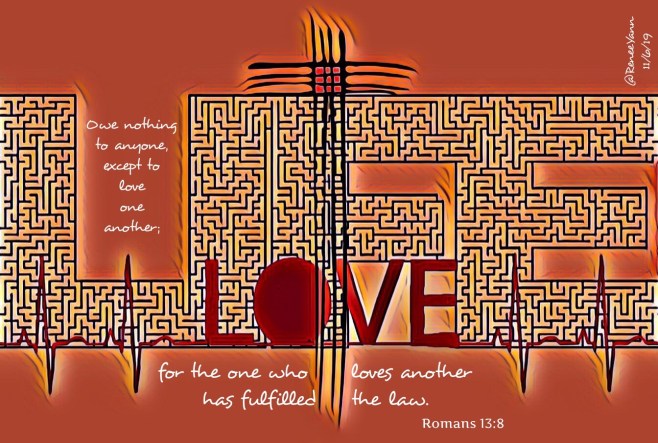
Roman13_8 owe nothing

Today, in God’s Lavish Mercy, Paul and Jesus seem to give us contradictory messages. Paul talks about love, and Jesus tells us what we must “hate” – a bit of a challenge to untangle the core message.

Here’s one way.

We don’t like Jesus telling us to “hate” anything, as in:

If anyone comes to me without hating his father and mother,
wife and children, brothers and sisters,

and even his own life,
he cannot be my disciple.

Luke 14:26

Come on, Jesus! You don’t mean that do you – my sweet mom, my precious kids???

No, the scholars say, Jesus doesn’t mean “hate” the way we interpret it in modern English. He is using the common, hyperbolic language of the ancient East which, in this circumstance, would mean “love less or without bias”.

So what is Jesus really saying? 

This.

We love many people and things in our lives. But we must love God, and God’s dream for all people, above and within all things. 


And that’s not easy! Life is a maze of relationships and situations that can get us very confused about what is most important. That’s why Jesus uses such strong language to remind us that there is only one way through the maze: to love as God loves. This is the heartbeat of our life in God!

Paul says this too, indicating as well how to negotiate the maze by keeping Love’s commandments.


We have such a critical example of this love-hate dynamic in our world just now. The terrible situation in the Holy Land has brought out radical feelings in people all over the world. People who love Israel and abhor violence are disgusted and furious over the attack against the Israeli people. People who love and pity the Palestinians, who have been suppressed into human desperation for decades, are equally disgusted and furious over the mass revenge being wrought upon innocents in Gaza and the West Bank.


I think Jesus would say this to us: You must “hate” those human relationships enough to make you not take sides in this horror. You must look past blood ties and religious ties. You must look to the human person, God’s creature like you who is the innocent victim of political forces. You must add to the voice for justice, mercy, and humane solutions.

No matter how far we may feel from the wars in Ukraine and the Middle East, each one of us is at a point of moral discernment regarding them. As massive funding is poured into weapons of war, how do we respond to the ongoing massacre of innocent people? I ask myself what is required of me as a citizen of the world to make my voice heard in this unspeakable tragedy.


If we love with God’s love, of course we will love those we cherish. But we will love them selflessly, with an infinite generosity that always chooses their eternal good. And we will try always to love all Creatures in the same way, seeking to the degree that is possible their well-being and peace. This is the kind of love Jesus taught us on the Cross. May God give us the courage to learn.


Prose: Remarks of Pope Francis at the Angelus on October 15, 2023

Dear brothers and sisters, I continue to follow with great sorrow what is happening in Israel and Palestine. I think again of the many people … in particular of the children and the elderly. I renew my appeal for the release of the hostages, and I strongly ask that children, the sick, the elderly, women, and all civilians not be made victims of the conflict. May Humanitarian Law be respected, especially in Gaza, where it is urgent and necessary to ensure humanitarian corridors and to come to the aid of the entire population. Brothers and sisters, many have already died. Please, let no more innocent blood be shed, neither in the Holy Land nor in Ukraine, nor in any other place! Enough! Wars are always a defeat, always!

Prayer is the meek and holy force to oppose the diabolical force of hatred, terrorism and war.


Music: Ubi Caritas performed by Stockholm University Choir (texts below)

Latin Text

Ubi caritas et amor, Deus ibi est.
Congregavit nos in unum Christi amor.
Exsultemus, et in ipso jucundemur.
Timeamus, et amemus Deum vivum.
Et ex corde diligamus nos sincero.
Ubi caritas et amor, Deus ibi est.
Simul ergo cum in unum congregamur:
Ne nos mente dividamur, caveamus.
Cessent iurgia maligna, cessent lites.
Et in medio nostri sit Christus Deus.
Ubi caritas et amor, Deus ibi est.
Simul quoque cum beatis videamus,
Glorianter vultum tuum, Christe Deus:
Gaudium quod est immensum, atque probum,
Saecula per infinita saeculorum. Amen.

English Translation
Where charity and love are, God is there.
Love of Christ has gathered us into one.
Let us rejoice in Him and be glad.
Let us fear, and let us love the living God.
And from a sincere heart let us love one.
Where charity and love are, God is there.
At the same time, therefore, are gathered into one:
Lest we be divided in mind, let us beware.
Let evil impulses stop, let controversy cease.
And in the midst of us be Christ our God.
Where charity and love are, God is there.
At the same time we see that with the saints also,
Thy face in glory, O Christ our God:
The joy that is immense and good,
Unto the World without end. Amen.

Preventing One Another

Tuesday of the Thirty-first Week in Ordinary Time
November 7, 2023

Today’s Readings:

https://bible.usccb.org/bible/readings/110723.cfm


Today, in God’s Lavish Mercy, Paul gives us one of his most heartfelt and beautiful passages, and Jesus offers us a puzzling parable about the kingdom.

Rms12_10 honor

Paul’s exhortation to sincere holiness is a passage that warrants frequent reading. At any given point in our lives, one or another of its encouragements will seem to ring profoundly true with our circumstances.

One of the lines that I particularly cherish goes like this in the old Douay-Rheims version, which is where I first encountered it as a young girl:

Love one another with fraternal charity:
with honor preventing one another.

The bolded phrase fascinated me. I didn’t understand what it meant. From what were we to prevent one another?

It was not until I came to the convent that I begin to discern the power of this verse. At the time (during the Dark Ages, of course), the Sisters lived under the 1952 Constitutions of the Sisters of Mercy, an adaptation of the ancient Rule of St. Augustine. As postulants, we each received a 4×6, 128 page copy of the Rule. In direct and intentional language, it set the frame for our whole lives.

I nearly memorized it, especially Chapter 14 on Union and Charity. Right in the middle of the Chapter, I found this precious line:

They (the Sisters) shall sincerely respect one another. The young shall reverence the old and all shall unceasingly try in true humility to promote constant mutual cordiality and deference, “with honor preventing one another”.

Sister Inez, our dear early instructor, explained that this meant to anticipate the needs of our beloved sisters, especially the elderly; to do for them what might be difficult for them before they had to ask. In other words, to prevent their need. She said that this anticipatory charity should mark our service toward everyone, especially the poor, sick and ignorant whom we would vow to serve.


The more all of us can live together with this mutual love and respect, the closer we come to the kingdom of God, to the banquet table described in today’s Gospel. Jesus came to gather us all around this table. Pity on those who resist his invitation because their lives are entangled in self-interested endeavors. Their places are taken by “the poor, the crippled, the blind and the lame” and all those on the margins of society.

As we join our sisters and brothers at the banquet of life, may we love and serve one another sincerely, always with honor preventing one another.


Poetry: Emily Dickinson

If I can stop one heart from breaking,
I shall not live in vain;
If I can ease one life the aching,
Or cool one pain,
Or help one fainting robin
Unto his nest again,
I shall not live in vain.

Music: a little motion mantra this morning. Maybe you might want to get up outta’ that chair and join in🤗

Let’s Meet in Heaven

The Commemoration of All the Faithful Departed
Thursday, November 2, 2023

Today’s Readings:

https://bible.usccb.org/bible/readings/110223.cfm


Today, in God’s Lavish Mercy, the whole Church joins in praying for the wholeness of the Communion of Saints. We all desire to be together again, with everyone we have loved, in eternal life.


This morning, as I prepare the reflection for All Souls Day, I consider how much religious practice can change in one’s lifetime. The Church and we are always growing in understanding and truth if we have open hearts. This graced understanding is exactly what the Church seeks in the current Synod on Synodality. Yet, as with all growth, we may tend to resist.


Today, I am taken (waaay) back to how All Souls Day was commemorated in my youth. My teachers impressed me with the idea that this special day was a time when repentant souls could be released from Purgatory if I prayed hard enough. I thought the process was similar to Amazon Prime Day where costs/penalties dropped and the early and persistent pray-er could snag a lot of souls for heaven.


(not us, but close enough)

We always had off from school on All Souls Day, so Janie McFadden and I would meet up about 5:45 AM to begin our marathon of Masses.  We had four parish priests so at three Masses a piece, Janie and I were set for the next few hours of liberating prayer. About 7:00 AM, Harry diNicolo finally showed up but he certainly didn’t get full credit like me and Janie!


The scene was somber.  The priests wore black vestments then, spoke mostly in Latin, and turned their backs to the participating congregation. There were a lot of candles and not very much real light that early in the morning. You guessed it – Janie and I took turns falling asleep. About every 10 minutes, one would punch the other in an effort to rev up purgatorial releases. Still not sure if any of that worked. Harry, by the way, went back home about 7:15 because he was hungry for breakfast.

One year, after the third Nicene Creed or so, Janie fainted. Sister Eucharistica told her not to do the All Souls Marathon again without drinking “a wee bit of milk before you come to Church”. Given our understanding of Divine Law at the time, requiring total fasting, we fourth graders were pretty sure Sr. Eucharistica would be the next soul we were praying out of Purgatory!


But as I think of her now, she was exactly the kind of person we need today for a “synodal Church”. She was a woman full of wisdom, courage, and common sense. She knew how to prioritize human needs long before the institutional Church figured it out. She knew Jesus desired communion with someone who wasn’t in a dead faint!

I think she probably knew too that we hadn’t come to Mass on that cold 1955 morning just to help “release” folks from purgatory.  We had come to remember people we loved who had gone ahead of us, to reflect on their lives, to miss them, love them, and to learn from both their lights and their shadows. 

We were young kids who, in our own small way, wanted to honor and face the meaning of death in human life. We wanted to know that God cared about our sadness over losing Grandmom or Uncle Joe. We wanted to know that God cared about us even though we too would face the same mysterious completion of our earthly lives.

Unfortunately, the Tridentine Mass didn’t provide much of that spiritual enrichment. But Sr. Eucharistica did. God bless her!


Today, in a language still very heavy with 16th-century concepts, the Catholic Encyclopedia defines purgatory as a place or condition of temporal punishment for those who, departing this life in God’s grace, are, not entirely free from venial faults, or have not fully paid the satisfaction due to their transgressions.

That language doesn’t do much for me either. I choose to think that most of us do the best we can with our lifetimes, but maybe there are a few who don’t. They don’t quite create the space in themselves to receive and eternally embrace God.  “Purgatory” is their second chance, a “time out” God gives them to get their heads together and realize how much they have been missing. Then, violà, they like all the saints are flooded with glory.


My dear friend Janie has long ago gone to the heavenly understanding.  I’m not sure what happened to Harry, even though we dated off and on well into high school.  I think he finally found somebody who liked to eat more than she liked to go to Mass. Meanwhile, my likes were going in a different direction.


Prose: from Pope Francis’s homily on November 2, 2022

Brother and sisters, let us feed our expectation for Heaven, let us exercise the desire for paradise. Today it does us good to ask ourselves if our desires have anything to do with Heaven. Because we risk continuously aspiring to passing things, of confusing desires with needs, of putting expectations of the world before expectation of God. But losing sight of what matters to follow the wind would be the greatest mistake in life.


Remembering Our Merion Mercy Family – lyrics below

We lovingly remember these dear Sisters and Associates who shared Mercy life with us and who have gone home to God in 2023.

One day in the love of Christ
we’ll meet once again
We’ll laugh as we celebrate a life with no end
Where death has been overcome by our Risen Lord

And there are no more goodbyes,
no more tears, no more loneliness,
and no more fear

Our pain turns to joy
darkness to light
in God’s heaven
there are no more goodbyes

No words tell the gratitude
we have for the gift
your life was to each of us
We’ll never forget

May angels now
lead you home
to our Risen Lord

And there are no more goodbyes,
no more tears, no more loneliness,
and no more fear

Our pain turns to joy
darkness to light, in God’s heaven
there are no more goodbyes

Though now with our heavy hearts
we go separate ways
we trust in the certain hope
there will come a day
we’ll join you in paradise
with our risen Lord

There will be no more goodbyes,
no more tears, no more loneliness,
and no more fear
Our pain turns to joy
darkness to light God’s heaven
there are no more goodbyes

The Right Thing

Friday of the Twenty-ninth Week in Ordinary Time
October 27, 2023

Today’s Readings:

https://bible.usccb.org/bible/readings/102723.cfm


Today, in God’s Mercy, Paul sounds a lot like someone approaching the microphone at “Sinners Anonymous“:

I know that good does not dwell in me, that is, in my flesh.
The willing is ready at hand, but doing the good is not.
For I do not do the good I want,
but I do the evil I do not want.

Romans 7:18-19

Paul basically attests to the fact that for human beings, even him, will and actions often don’t synch up. Sure, we want to be good people, but as Nike says, do we:

Do itJPG

Paul says no, we don’t. The only way we do the good we will to do is by the grace of Jesus Christ.

In our Gospel, Jesus affirms the slowness of the human spirit to act on the realities around us. In some translations, Jesus uses a phrase which caught on with the architects of Vatican II: the signs of the times.

You hypocrites!
You know how to interpret the appearance of the earth and the sky;
why do you not know how to interpret the present time?
“Why do you not judge for yourselves what is right?

Luke 12:56-57

Jesus is telling his listeners and us that we need to be alert to the circumstances of our world. It both weeps and rejoices. Where it weeps, we must be a source of mercy and healing. Where it rejoices, we must foster and celebrate the Presence of the Spirit.


In the Vatican II document Gaudium et Spes (The Church in the Modern World), we read:

In every age, the church carries the responsibility
of reading the signs of the times and of
interpreting them in the light of the Gospel,
if it is to carry out its task.
In language intelligible to every generation,
it should be able to answer the ever recurring questions
which people ask about the meaning
of this present life and of the life to come,
and how one is related to the other.
We must be aware of and understand the aspirations,
the yearnings, and the often dramatic features
of the world in which we live.


While we look forward hopefully to the communications that will come from the current Synod on Synodality, the Documents of Vatican II have everlasting meaning for the Church. Although written in the 1960s, these powerful words hold true today. We are the Church of which the document speaks. We are the ones whom Jesus calls to respond with authentic justice and mercy to the signs of the times. Read the newspaper in that light today. Watch the news in that light. Meet your brothers and sisters in that light today.


Poetry: The Right Thing – Theodore Roethke

Let others probe the mystery if they can.
Time-harried prisoners of Shall and Will —
The right thing happens to the happy man.

The bird flies out, the bird flies back again;
The hill becomes the valley, and is still;
Let others delve that mystery if they can.

God bless the roots! Body and soul are one!
The small become the great, the great the small;
The right thing happens to the happy man.

Child of the dark, he can outleap the sun,
His being single, and that being all:
The right thing happens to the happy man.

Or he sits still, a solid figure when
The self-destructive shake the common wall;
Takes to himself what mystery he can,

And, praising change as the slow night comes on,
Wills what he would surrendering his will
Till mystery is no more: No more he can.
The right thing happens to the happy man.


Music: The Times They Are A’changin’ – Bob Dylan whose songs in the 50s and 60sbecame anthems for the Civil Rights and anti-war movements. His lyrics during this period incorporated a wide range of political, social, philosophical, and literary influences, defied popular music conventions and appealed to the burgeoning counterculture. (Wikipedia) (Ah, it was a good time to be young!)

The Swedish Academy awarded Dylan the 2016 Nobel Prize inLiterature “for having created new poetic expressions within the great American song tradition.

Wake Up! Act Up!

Friday of the Twenty-seventh Week in Ordinary Time
October 13, 2023

Today’s Readings:

https://bible.usccb.org/bible/readings/101323.cfm


Today, in God’s Lavish Mercy, – and tomorrow – we finish up our short journey with the minor prophets with two passages from Joel.

Joel the Prophet by Michelangelo
from the Sistine Chapel ceiling

Joel and his neighbors were living through a plague of locusts. The book begins with a stark warning to wake up and see the meaning of what is happening:

Listen to this, you elders!
Pay attention, all who dwell in the land!
Has anything like this ever happened in your lifetime,
or in the lifetime of your ancestors?…
What the cutter left
the swarming locust has devoured;
What the swarming locust left,
the hopper has devoured;
What the hopper left,
the consuming locust has devoured.
Wake up, you drunkards, and weep;
wail, all you wine drinkers,
Over the new wine,
taken away from your mouths.

Joel 1:1-5

Although Joel’s agricultural disaster is part of ancient history, like other seemingly remote scriptural passages, it bears a startlingly apropos message for us today.

Joel gave voice to a ravaged earth that could not speak for itself. In his writings, earth and its people are intimately connected – each affected by and bearing the consequences of the other’s suffering. The devastation of the wheat fields and vineyards has robbed the worshippers of their most important possession – the staples to offer in praise of God:

Gird yourselves and weep, O priests!
wail, O ministers of the altar!
Come, spend the night in sackcloth,
O ministers of my God!
The house of your God is deprived
of offering and libation.
Proclaim a fast,
call an assembly;
Gather the elders,
all who dwell in the land,
Into the house of the LORD, your God,
and cry to the LORD!

Joel 1:13-14

As Joel pleaded with his people to recognize their implication in the earth’s annihilation, so Pope Francis pleads with us in Laudate Deum:

Eight years have passed since I published the Encyclical Letter Laudato Si’, when I wanted to share with all of you, my brothers and sisters of our suffering planet, my heartfelt concerns about the care of our common home. Yet, with the passage of time, I have realized that our responses have not been adequate, while the world in which we live is collapsing and may be nearing the breaking point. In addition to this possibility, it is indubitable that the impact of climate change will increasingly prejudice the lives and families of many persons. We will feel its effects in the areas of healthcare, sources of employment, access to resources, housing, forced migrations, etc. (2)
This is a global social issue and one intimately related to the dignity of human life.(3)

Pope Francis recognizes, as did the prophet Joel, that there are “deniers” – climate change deniers and deniers of the sins of complicity.

Joel warns that such sinful denial will bear consquences not only on his current generation but on their children:

Yes, it is near, a day of darkness and of gloom,
a day of clouds and somberness!
Like dawn spreading over the mountains,
a people numerous and mighty!
Their like has not been from of old,
nor will it be after them,
even to the years of distant generations.

Joel 2: 1-2

Pope Francis voices a similar warning:

Climate change is one of the principal challenges facing society and the global community. The effects of climate change are borne by the most vulnerable people, whether at home or around the world. In a few words, the Bishops assembled for the Synod for Amazonia said the same thing: “Attacks on nature have consequences for people’s lives”. And to express bluntly that this is no longer a secondary or ideological question, but a drama that harms us all, the African bishops stated that climate change makes manifest “a tragic and striking example of structural sin”. (3)


Many of us don’t want to read about climate change much less pray about it. A lot of us don’t have a clue how we can help reverse the cataclysmic tide. We may even be a “denier” ourselves! But if we are, we are in a very small minority:

Robust studies of climate change perceptions in Australia, the UK and America show that only very small numbers of people actually deny that climate change is happening. The figures range from between 5 to 8% of the population. However this small minority can be influential in casting doubt on the science, spreading misinformation and impeding progress on climate policies.

from the Australian Psychological Society

The other 92% to 95% of us must pray and act with the global community to respond effectively to the summons of Pope Francis:

I ask everyone to accompany this pilgrimage of reconciliation with the world that is our home and to help make it more beautiful, because that commitment has to do with our personal dignity and highest values. At the same time, I cannot deny that it is necessary to be honest and recognize that the most effective solutions will not come from individual efforts alone, but above all from major political decisions on the national and international level. (69)
Nonetheless, every little bit helps, and avoiding an increase of a tenth of a degree in the global temperature would already suffice to alleviate some suffering for many people. Yet what is important is something less quantitative: the need to realize that there are no lasting changes without cultural changes, without a maturing of lifestyles and convictions within societies, and there are no cultural changes without personal changes. (70)

Video: from the Vatican website introducing Laudate Deum

Neighbor

Monday of the Twenty-seventh Week in Ordinary Time
October 9, 2023

Today’s Readings:

https://bible.usccb.org/bible/readings/100923.cfm


Today, in God’s Lavish Mercy, get ready for a three-day cruise with Jonah and a radical journey down the Jericho road with the Good Samaritan.

The message of Jonah is clear: all people, even hated Ninevites, are children of God’s Mercy. Resisting that understanding can be catastrophic to our spiritual life.


Patricia Tull, Rhodes Professor Emerita of Old Testament at Louisville Seminary, summarizes the Book of Jonah like this:

A postexilic book, Jonah’s story is atypical for prophetic works. Not only is it a narrative about the prophet rather than his speeches, but it also rebuffs Jonah for his refusal to preach to foreign enemies. Jonah’s story portrays foreigners as more than ready to repent and turn to God. The book uses humor, hyperbole, and irony to make its parabolic point.

Our Gospel gives us one of the most beloved yet challenging parables of Jesus – who is our “neighbor”. The infinite dimensions within this parable continue to unfold for us as we deepen in our mercy spirituality.

God does not see anyone as a “foreigner”. Every human being lives with the breath of God. We are “neighbors” because we share that breath, that “neighborhood” of God’s boundless Love.


But, oh my God, how we have forgotten or rejected that common bond of reverence for one another! Just yesterday, one of our sisters brought up the subject of a recent hit-and-run accident in Philadelphia. It now seems to be the common practice to leave the scene of such an occurrence, abandoning the victim to his fatal circumstance. She wondered, incredulously, how anyone could be that callous.


Our Gospel parable describes that callousness. Notice that both the priest and the Levite pass the victim by “on the opposite side“. The phrase implies that if I can build a wall to make you invisible to me, I can more easily ignore your claim on my merciful neighborliness.

The Samaritan lived without those walls. He did not see a Jew, or a foreigner, or an expendable “other”. He saw a human being, like himself – a neighbor who was struggling to live.

The Good Samaritan (1880) by Aimé Morot


Jesus’ parable of the Good Samaritan is a clear example of the call of the Gospel to neighborliness. In the story, such a call is an inconvenient truth because it summons outside the comfortable community to find the neighbor among the not-well-regarded “others.” 

Walter Brueggemann, Health Progress, January – February 2010

We don’t want to be like resistant Jonah, nor like the prejudicially blinded priest and Levite of our parable. But it is hard. The world conspires to separate us into the haves and the have-nots, the deserving and the undeserving, the winners and the losers, the sinners and the saints. Mercy not only resists but dismantles such walls. Do we have the courage to examine our own prejudices and to step across from “the opposite side” for the sake of our neighbor?


Poem: Neighbor – Iain Crichton Smith

Build me a bridge over the stream
to my neighbour’s house
where he is standing in dungarees
in the fresh morning.
O ring of snowdrops
spread wherever you want
and you also blackbird
sing across the fences.
My neighbor, if the rain falls on you,
let it fall on me also
from the same black cloud
that does not recognize gates.

Music: JJ Heller – Neighbor

Sometimes it's easier to jump to conclusions
Than walk across the street
It's like I'd rather fill the blanks with illusions
Than take the time to see
You are tryna close the back door of your car
You are balancing the groceries and a baby in your arms
You are more than just a sign in your front yard
You are my neighbor
I can get so lost in the mission
Of defending what I think
I've been surfing on a sea of opinions
But just behind the screen
You are grateful that the work day's finally done
You are stuck in miles of traffic, looking at your phone
You are tryin' to feel a little less alone
You are my neighbor
When the chasm between us feels so wide
That it's hard to imagine the other side
But we don't have to see things eye to eye
For me to love you like you are my neighbor
My neighbor
Oh, to fear the unfamiliar
Is the easy way to go
But I believe we are connected more than we might ever know
There's a light that shines on both the rich and poor
Looks beyond where we came from and who we voted for
'Til I can't see a stranger anymore
I see my neighbor
May my heart be an open door to my neighbor
You are my neighbor