Let’s Meet in Heaven

The Commemoration of All the Faithful Departed
Thursday, November 2, 2023

Today’s Readings:

https://bible.usccb.org/bible/readings/110223.cfm
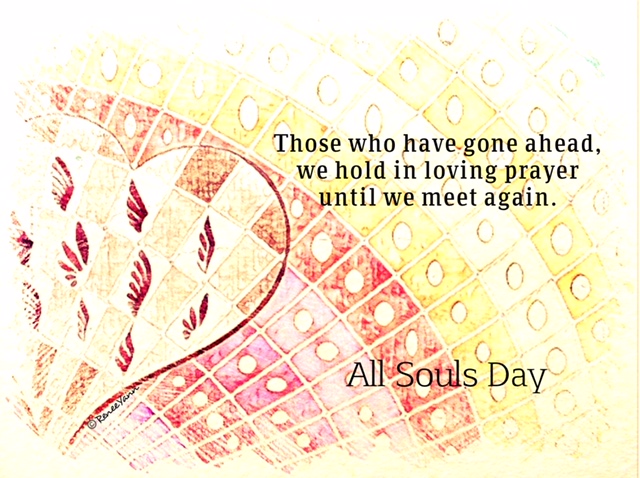

Today, in God’s Lavish Mercy, the whole Church joins in praying for the wholeness of the Communion of Saints. We all desire to be together again, with everyone we have loved, in eternal life.


This morning, as I prepare the reflection for All Souls Day, I consider how much religious practice can change in one’s lifetime. The Church and we are always growing in understanding and truth if we have open hearts. This graced understanding is exactly what the Church seeks in the current Synod on Synodality. Yet, as with all growth, we may tend to resist.


Today, I am taken (waaay) back to how All Souls Day was commemorated in my youth. My teachers impressed me with the idea that this special day was a time when repentant souls could be released from Purgatory if I prayed hard enough. I thought the process was similar to Amazon Prime Day where costs/penalties dropped and the early and persistent pray-er could snag a lot of souls for heaven.


(not us, but close enough)

We always had off from school on All Souls Day, so Janie McFadden and I would meet up about 5:45 AM to begin our marathon of Masses.  We had four parish priests so at three Masses a piece, Janie and I were set for the next few hours of liberating prayer. About 7:00 AM, Harry diNicolo finally showed up but he certainly didn’t get full credit like me and Janie!


The scene was somber.  The priests wore black vestments then, spoke mostly in Latin, and turned their backs to the participating congregation. There were a lot of candles and not very much real light that early in the morning. You guessed it – Janie and I took turns falling asleep. About every 10 minutes, one would punch the other in an effort to rev up purgatorial releases. Still not sure if any of that worked. Harry, by the way, went back home about 7:15 because he was hungry for breakfast.

One year, after the third Nicene Creed or so, Janie fainted. Sister Eucharistica told her not to do the All Souls Marathon again without drinking “a wee bit of milk before you come to Church”. Given our understanding of Divine Law at the time, requiring total fasting, we fourth graders were pretty sure Sr. Eucharistica would be the next soul we were praying out of Purgatory!


But as I think of her now, she was exactly the kind of person we need today for a “synodal Church”. She was a woman full of wisdom, courage, and common sense. She knew how to prioritize human needs long before the institutional Church figured it out. She knew Jesus desired communion with someone who wasn’t in a dead faint!

I think she probably knew too that we hadn’t come to Mass on that cold 1955 morning just to help “release” folks from purgatory.  We had come to remember people we loved who had gone ahead of us, to reflect on their lives, to miss them, love them, and to learn from both their lights and their shadows. 

We were young kids who, in our own small way, wanted to honor and face the meaning of death in human life. We wanted to know that God cared about our sadness over losing Grandmom or Uncle Joe. We wanted to know that God cared about us even though we too would face the same mysterious completion of our earthly lives.

Unfortunately, the Tridentine Mass didn’t provide much of that spiritual enrichment. But Sr. Eucharistica did. God bless her!


Today, in a language still very heavy with 16th-century concepts, the Catholic Encyclopedia defines purgatory as a place or condition of temporal punishment for those who, departing this life in God’s grace, are, not entirely free from venial faults, or have not fully paid the satisfaction due to their transgressions.

That language doesn’t do much for me either. I choose to think that most of us do the best we can with our lifetimes, but maybe there are a few who don’t. They don’t quite create the space in themselves to receive and eternally embrace God.  “Purgatory” is their second chance, a “time out” God gives them to get their heads together and realize how much they have been missing. Then, violà, they like all the saints are flooded with glory.


My dear friend Janie has long ago gone to the heavenly understanding.  I’m not sure what happened to Harry, even though we dated off and on well into high school.  I think he finally found somebody who liked to eat more than she liked to go to Mass. Meanwhile, my likes were going in a different direction.


Prose: from Pope Francis’s homily on November 2, 2022

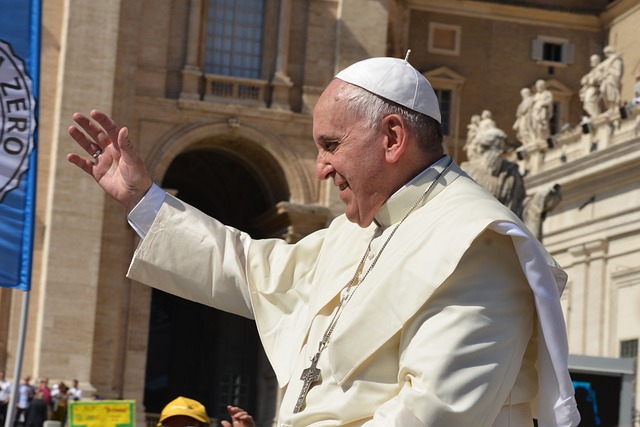
Brother and sisters, let us feed our expectation for Heaven, let us exercise the desire for paradise. Today it does us good to ask ourselves if our desires have anything to do with Heaven. Because we risk continuously aspiring to passing things, of confusing desires with needs, of putting expectations of the world before expectation of God. But losing sight of what matters to follow the wind would be the greatest mistake in life.


Remembering Our Merion Mercy Family – lyrics below

We lovingly remember these dear Sisters and Associates who shared Mercy life with us and who have gone home to God in 2023.

One day in the love of Christ
we’ll meet once again
We’ll laugh as we celebrate a life with no end
Where death has been overcome by our Risen Lord

And there are no more goodbyes,
no more tears, no more loneliness,
and no more fear

Our pain turns to joy
darkness to light
in God’s heaven
there are no more goodbyes

No words tell the gratitude
we have for the gift
your life was to each of us
We’ll never forget

May angels now
lead you home
to our Risen Lord

And there are no more goodbyes,
no more tears, no more loneliness,
and no more fear

Our pain turns to joy
darkness to light, in God’s heaven
there are no more goodbyes

Though now with our heavy hearts
we go separate ways
we trust in the certain hope
there will come a day
we’ll join you in paradise
with our risen Lord

There will be no more goodbyes,
no more tears, no more loneliness,
and no more fear
Our pain turns to joy
darkness to light God’s heaven
there are no more goodbyes

The Right Thing

Friday of the Twenty-ninth Week in Ordinary Time
October 27, 2023

Today’s Readings:

https://bible.usccb.org/bible/readings/102723.cfm


Today, in God’s Mercy, Paul sounds a lot like someone approaching the microphone at “Sinners Anonymous“:

I know that good does not dwell in me, that is, in my flesh.
The willing is ready at hand, but doing the good is not.
For I do not do the good I want,
but I do the evil I do not want.

Romans 7:18-19

Paul basically attests to the fact that for human beings, even him, will and actions often don’t synch up. Sure, we want to be good people, but as Nike says, do we:

Do itJPG

Paul says no, we don’t. The only way we do the good we will to do is by the grace of Jesus Christ.

In our Gospel, Jesus affirms the slowness of the human spirit to act on the realities around us. In some translations, Jesus uses a phrase which caught on with the architects of Vatican II: the signs of the times.

You hypocrites!
You know how to interpret the appearance of the earth and the sky;
why do you not know how to interpret the present time?
“Why do you not judge for yourselves what is right?

Luke 12:56-57

Jesus is telling his listeners and us that we need to be alert to the circumstances of our world. It both weeps and rejoices. Where it weeps, we must be a source of mercy and healing. Where it rejoices, we must foster and celebrate the Presence of the Spirit.


In the Vatican II document Gaudium et Spes (The Church in the Modern World), we read:

In every age, the church carries the responsibility
of reading the signs of the times and of
interpreting them in the light of the Gospel,
if it is to carry out its task.
In language intelligible to every generation,
it should be able to answer the ever recurring questions
which people ask about the meaning
of this present life and of the life to come,
and how one is related to the other.
We must be aware of and understand the aspirations,
the yearnings, and the often dramatic features
of the world in which we live.


While we look forward hopefully to the communications that will come from the current Synod on Synodality, the Documents of Vatican II have everlasting meaning for the Church. Although written in the 1960s, these powerful words hold true today. We are the Church of which the document speaks. We are the ones whom Jesus calls to respond with authentic justice and mercy to the signs of the times. Read the newspaper in that light today. Watch the news in that light. Meet your brothers and sisters in that light today.


Poetry: The Right Thing – Theodore Roethke

Let others probe the mystery if they can.
Time-harried prisoners of Shall and Will —
The right thing happens to the happy man.

The bird flies out, the bird flies back again;
The hill becomes the valley, and is still;
Let others delve that mystery if they can.

God bless the roots! Body and soul are one!
The small become the great, the great the small;
The right thing happens to the happy man.

Child of the dark, he can outleap the sun,
His being single, and that being all:
The right thing happens to the happy man.

Or he sits still, a solid figure when
The self-destructive shake the common wall;
Takes to himself what mystery he can,

And, praising change as the slow night comes on,
Wills what he would surrendering his will
Till mystery is no more: No more he can.
The right thing happens to the happy man.


Music: The Times They Are A’changin’ – Bob Dylan whose songs in the 50s and 60sbecame anthems for the Civil Rights and anti-war movements. His lyrics during this period incorporated a wide range of political, social, philosophical, and literary influences, defied popular music conventions and appealed to the burgeoning counterculture. (Wikipedia) (Ah, it was a good time to be young!)

The Swedish Academy awarded Dylan the 2016 Nobel Prize inLiterature “for having created new poetic expressions within the great American song tradition.

Wake Up! Act Up!

Friday of the Twenty-seventh Week in Ordinary Time
October 13, 2023

Today’s Readings:

https://bible.usccb.org/bible/readings/101323.cfm


Today, in God’s Lavish Mercy, – and tomorrow – we finish up our short journey with the minor prophets with two passages from Joel.

Joel the Prophet by Michelangelo
from the Sistine Chapel ceiling

Joel and his neighbors were living through a plague of locusts. The book begins with a stark warning to wake up and see the meaning of what is happening:

Listen to this, you elders!
Pay attention, all who dwell in the land!
Has anything like this ever happened in your lifetime,
or in the lifetime of your ancestors?…
What the cutter left
the swarming locust has devoured;
What the swarming locust left,
the hopper has devoured;
What the hopper left,
the consuming locust has devoured.
Wake up, you drunkards, and weep;
wail, all you wine drinkers,
Over the new wine,
taken away from your mouths.

Joel 1:1-5

Although Joel’s agricultural disaster is part of ancient history, like other seemingly remote scriptural passages, it bears a startlingly apropos message for us today.

Joel gave voice to a ravaged earth that could not speak for itself. In his writings, earth and its people are intimately connected – each affected by and bearing the consequences of the other’s suffering. The devastation of the wheat fields and vineyards has robbed the worshippers of their most important possession – the staples to offer in praise of God:

Gird yourselves and weep, O priests!
wail, O ministers of the altar!
Come, spend the night in sackcloth,
O ministers of my God!
The house of your God is deprived
of offering and libation.
Proclaim a fast,
call an assembly;
Gather the elders,
all who dwell in the land,
Into the house of the LORD, your God,
and cry to the LORD!

Joel 1:13-14

As Joel pleaded with his people to recognize their implication in the earth’s annihilation, so Pope Francis pleads with us in Laudate Deum:

Eight years have passed since I published the Encyclical Letter Laudato Si’, when I wanted to share with all of you, my brothers and sisters of our suffering planet, my heartfelt concerns about the care of our common home. Yet, with the passage of time, I have realized that our responses have not been adequate, while the world in which we live is collapsing and may be nearing the breaking point. In addition to this possibility, it is indubitable that the impact of climate change will increasingly prejudice the lives and families of many persons. We will feel its effects in the areas of healthcare, sources of employment, access to resources, housing, forced migrations, etc. (2)
This is a global social issue and one intimately related to the dignity of human life.(3)

Pope Francis recognizes, as did the prophet Joel, that there are “deniers” – climate change deniers and deniers of the sins of complicity.

Joel warns that such sinful denial will bear consquences not only on his current generation but on their children:

Yes, it is near, a day of darkness and of gloom,
a day of clouds and somberness!
Like dawn spreading over the mountains,
a people numerous and mighty!
Their like has not been from of old,
nor will it be after them,
even to the years of distant generations.

Joel 2: 1-2

Pope Francis voices a similar warning:

Climate change is one of the principal challenges facing society and the global community. The effects of climate change are borne by the most vulnerable people, whether at home or around the world. In a few words, the Bishops assembled for the Synod for Amazonia said the same thing: “Attacks on nature have consequences for people’s lives”. And to express bluntly that this is no longer a secondary or ideological question, but a drama that harms us all, the African bishops stated that climate change makes manifest “a tragic and striking example of structural sin”. (3)


Many of us don’t want to read about climate change much less pray about it. A lot of us don’t have a clue how we can help reverse the cataclysmic tide. We may even be a “denier” ourselves! But if we are, we are in a very small minority:

Robust studies of climate change perceptions in Australia, the UK and America show that only very small numbers of people actually deny that climate change is happening. The figures range from between 5 to 8% of the population. However this small minority can be influential in casting doubt on the science, spreading misinformation and impeding progress on climate policies.

from the Australian Psychological Society

The other 92% to 95% of us must pray and act with the global community to respond effectively to the summons of Pope Francis:

I ask everyone to accompany this pilgrimage of reconciliation with the world that is our home and to help make it more beautiful, because that commitment has to do with our personal dignity and highest values. At the same time, I cannot deny that it is necessary to be honest and recognize that the most effective solutions will not come from individual efforts alone, but above all from major political decisions on the national and international level. (69)
Nonetheless, every little bit helps, and avoiding an increase of a tenth of a degree in the global temperature would already suffice to alleviate some suffering for many people. Yet what is important is something less quantitative: the need to realize that there are no lasting changes without cultural changes, without a maturing of lifestyles and convictions within societies, and there are no cultural changes without personal changes. (70)

Video: from the Vatican website introducing Laudate Deum

Neighbor

Monday of the Twenty-seventh Week in Ordinary Time
October 9, 2023

Today’s Readings:

https://bible.usccb.org/bible/readings/100923.cfm


Today, in God’s Lavish Mercy, get ready for a three-day cruise with Jonah and a radical journey down the Jericho road with the Good Samaritan.

The message of Jonah is clear: all people, even hated Ninevites, are children of God’s Mercy. Resisting that understanding can be catastrophic to our spiritual life.


Patricia Tull, Rhodes Professor Emerita of Old Testament at Louisville Seminary, summarizes the Book of Jonah like this:

A postexilic book, Jonah’s story is atypical for prophetic works. Not only is it a narrative about the prophet rather than his speeches, but it also rebuffs Jonah for his refusal to preach to foreign enemies. Jonah’s story portrays foreigners as more than ready to repent and turn to God. The book uses humor, hyperbole, and irony to make its parabolic point.

Our Gospel gives us one of the most beloved yet challenging parables of Jesus – who is our “neighbor”. The infinite dimensions within this parable continue to unfold for us as we deepen in our mercy spirituality.

God does not see anyone as a “foreigner”. Every human being lives with the breath of God. We are “neighbors” because we share that breath, that “neighborhood” of God’s boundless Love.


But, oh my God, how we have forgotten or rejected that common bond of reverence for one another! Just yesterday, one of our sisters brought up the subject of a recent hit-and-run accident in Philadelphia. It now seems to be the common practice to leave the scene of such an occurrence, abandoning the victim to his fatal circumstance. She wondered, incredulously, how anyone could be that callous.


Our Gospel parable describes that callousness. Notice that both the priest and the Levite pass the victim by “on the opposite side“. The phrase implies that if I can build a wall to make you invisible to me, I can more easily ignore your claim on my merciful neighborliness.

The Samaritan lived without those walls. He did not see a Jew, or a foreigner, or an expendable “other”. He saw a human being, like himself – a neighbor who was struggling to live.

The Good Samaritan (1880) by Aimé Morot


Jesus’ parable of the Good Samaritan is a clear example of the call of the Gospel to neighborliness. In the story, such a call is an inconvenient truth because it summons outside the comfortable community to find the neighbor among the not-well-regarded “others.” 

Walter Brueggemann, Health Progress, January – February 2010

We don’t want to be like resistant Jonah, nor like the prejudicially blinded priest and Levite of our parable. But it is hard. The world conspires to separate us into the haves and the have-nots, the deserving and the undeserving, the winners and the losers, the sinners and the saints. Mercy not only resists but dismantles such walls. Do we have the courage to examine our own prejudices and to step across from “the opposite side” for the sake of our neighbor?


Poem: Neighbor – Iain Crichton Smith

Build me a bridge over the stream
to my neighbour’s house
where he is standing in dungarees
in the fresh morning.
O ring of snowdrops
spread wherever you want
and you also blackbird
sing across the fences.
My neighbor, if the rain falls on you,
let it fall on me also
from the same black cloud
that does not recognize gates.

Music: JJ Heller – Neighbor

Sometimes it's easier to jump to conclusions
Than walk across the street
It's like I'd rather fill the blanks with illusions
Than take the time to see
You are tryna close the back door of your car
You are balancing the groceries and a baby in your arms
You are more than just a sign in your front yard
You are my neighbor
I can get so lost in the mission
Of defending what I think
I've been surfing on a sea of opinions
But just behind the screen
You are grateful that the work day's finally done
You are stuck in miles of traffic, looking at your phone
You are tryin' to feel a little less alone
You are my neighbor
When the chasm between us feels so wide
That it's hard to imagine the other side
But we don't have to see things eye to eye
For me to love you like you are my neighbor
My neighbor
Oh, to fear the unfamiliar
Is the easy way to go
But I believe we are connected more than we might ever know
There's a light that shines on both the rich and poor
Looks beyond where we came from and who we voted for
'Til I can't see a stranger anymore
I see my neighbor
May my heart be an open door to my neighbor
You are my neighbor

Pray for One Another

Friday of the Twenty-sixth Week in Ordinary Time
October 6, 2023

Today’s Readings:

https://bible.usccb.org/bible/readings/100623.cfm


Baruch Writing Jeremiah’s Prophecies – Gustave Doré


Today, in God’s Lavish Mercy (and tomorrow) we have a few words from Baruch – and he is not a happy camper. Baruch, the scribe for the prophet Jeremiah, did his own little bit of writing reflecting on the situation of the Jews exiled in Babylon.

The Book of Baruch takes the form of a letter from the captives to the high priest who remained in Jerusalem after the exile. The writer asks for prayers for the exiled community and sends money to support that request. He voices the people’s acknowledgment that their suffering is a result of their own sin. He even composes the prayers that he wishes to be said in Jerusalem:

Justice is with the Lord, our God;
and we today are flushed with shame,
we men of Judah and citizens of Jerusalem,
that we, with our kings and rulers
and priests and prophets, and with our ancestors,
have sinned in the Lord’s sight and disobeyed him.

Baruch 1:15-18

When I was growing up, we had a practice in my family very similar to that described in Baruch. When confusing troubles arose for the family, Mom would appeal to either of two sources for supportive prayer: The Shrine of Sainte-Anne-de-Beaupré in Canada or the “Pink Sisters” (The Holy Spirit Adoration Sisters) on Green Street in Philadelphia. I have written to the Pink Sisters myself on a few spiritually catastrophic occasions. A Sister always writes back with sustaining wisdom and the affirmation of prayer.

Remembering all this reminds me that it is so important to pray for one another! Doing so creates an invisible, almost magnetic connection that helps sustain us in times of doubt, suffering, loss, and sadness. It also helps the pray-er to affirm membership in a company of believers – all of us “just walking each other home.”(Ram Dass)


This is exactly what Baruch was doing for the Babylonian exiles:

  • reminding them of their true home in God
  • reconnecting them to a community from which they had been severed
  • voicing their suffering
  • showing them a path to repentance, hope, and restoration.

At those “exile times” in our lives, when we are somewhere on the fragile edge of faith and endurance, as our Psalm today reminds us, prayer refocuses us on God rather than ourselves. Trusting the glorious name of God, we slowly open to a Light we may not have seen because our own shadow was in the way.

Help us, O God our savior,
because of the glory of your name;
Deliver us and pardon our sins
for your name’s sake.

Psalm 79:9

Poetry: A Prayer – May Sarton

Help us to be the always hopeful
gardeners of the spirit
who know that without darkness
nothing comes to birth
as without light
nothing flowers.

Music: Anthem – Leonard Cohen

God’s Firewall

Memorial of Saint Jerome, Priest and Doctor of the Church
September 30, 2023

Today’s Readings:

https://bible.usccb.org/bible/readings/093023.cfm


Today, in God’s Lavish Mercy, we begin the first of three passages from the prophet Zechariah to be read over the next few days. These are the only times we meet Zechariah in our cycle of readings, other than December 12th, the Feast of Our Lady of Guadalupe.

For that reason, we could easily overlook Zechariah, a minor prophet whose visions, so specifically directed to the post-exilic Israelite community, may seem alien and extraneous to our own spirituality.


But we should not overlook Zechariah. Here’s why.

These two prophets (Zechariah and Haggai) seek to rally the identity and vocation of Jews in a time when faith is hard and prospects are lean. Such a time, they assert, is a time for vigorous action. The rebuilding of the temple is thus an act of faith, confident in the reality of God, and an act of defiance against the established imperial order of the world, even the imperial order that funded the project. We might well read these prophets in our own time of “small things” when the church seems to lack energy, courage, and imagination. In just such a time it is urgent to enact visible faithful gestures (like the temple building) that defy business as usual. Thus the prophetic imagination given here outruns historical possibility. That is the quality and depth of faith held here to which we are invited.

Walter Brueggeman: From Judgement to Hope

Zechariah invites the people to imagine a world vastly beyond their present perceptions. It is a world where the Temple is rebuilt as a symbol of God’s Presence, central to their identity. That Divine Presence provides any protection needed, thus removing the need for “walls” of isolation, fear, oppression, defensiveness, and exclusion.

People will live in Jerusalem as though in open country,
because of the multitude of men and beasts in her midst.
But I will be for her an encircling wall of fire, says the LORD,
and I will be the glory in her midst.

Zechariah 2:8-9

Surely we could use such holy imagination in our times! And surely this is the sacred energy Pope Francis seeks as he leads the Church in synodality.

As our shared geopolitical world seems daily to become more fragmented and hostile, the power of our communal, Resurrection faith is crucial to its graceful restoration.


Zechariah calls the people to sing, even in the midst of their disheartening exile, and to dream of a world without vicious walls. We are called to the same hope even in a world that conspires to feed cynicism and indifference rather than justice and mercy.

Sing and rejoice, O daughter Zion!
See, I am coming to dwell among you, says the LORD.
Many nations shall join themselves to the LORD on that day,
and they shall be his people and he will dwell among you.

Zechariah 2:14

Prose: The Monk Manifesto – Christine Valtners Paintner

Monk Manifesto is a public expression of one’s commitment to live a compassionate, contemplative, and creative life. When I read it, I find encouragement to act for a more integrated world, one without dissociative walls.

  • I commit to finding moments each day for silence and solitude, to make space for another voice to be heard, and to resist a culture of noise and constant stimulation.
  • I commit to radical acts of hospitality by welcoming the stranger both without and within. I recognize that when I make space inside my heart for the unclaimed parts of myself, I cultivate compassion and the ability to accept those places in others.
  • I commit to cultivating community by finding kindred spirits along the path, soul friends with whom I can share my deepest longings, and mentors who can offer guidance and wisdom for the journey.
  • I commit to cultivating awareness of my kinship with creation and a healthy asceticism by discerning my use of energy and things, letting go of what does not help nature to flourish.
  • I commit to bringing myself fully present to the work I do, whether paid or unpaid, holding a heart of gratitude for the ability to express my gifts in the world in meaningful ways.
  • I commit to rhythms of rest and renewal through the regular practice of Sabbath and resist a culture of busyness that measures my worth by what I do.
  • I commit to a lifetime of ongoing conversion and transformation, recognizing that I am always on a journey with both gifts and limitations.

Music: One World – Toby Mac

I’m not a big fan of rap, but I think this song is pretty good for today’s reflection.

Turn to Tenderness, Turn to God

Thursday of the Twenty-fifth Week in Ordinary Time
September 28, 2023

Today’s Readings:

https://bible.usccb.org/bible/readings/092823.cfm


Today, in God’s Lavish Mercy – and tomorrow – we will hear from Haggai, one of the twelve minor prophets of the Hebrew Scriptures. These dozen writers are referred to as “minor” because of the length of their writings, not their value.

So Haggai, even though many of us have never heard of him, has something important to say for Judeo-Christian tradition and for each of us who read him. Let’s see what that might be.

Hag1_9JPG

Haggai is prophesying during the Persian period of Jewish history, around the middle of the 6th century, BC. The Jewish people had been back home from the Babylonian captivity for almost 20 years. When they first returned they were passionate about rebuilding the Temple. But as the decades passed, and opposition from their non-Jewish neighbors increased, their commitment waned.


The building of worship places has always been an activity with fans on both sides of the aisle. Some argue that God needs a spot where the Divine Presence can be recognized and revered. Others believe that the effort and resources expended in such building could better be used in human services for God’s poor and needy people. Haggai’s community had people in both camps. (Sound familiar?)

Haggai offers a turning point for their arguments. He tells the people they are a mess. The absence of a central symbol for their faith has weakened and scattered them to their own selfish pursuits. He tells them to look at themselves:

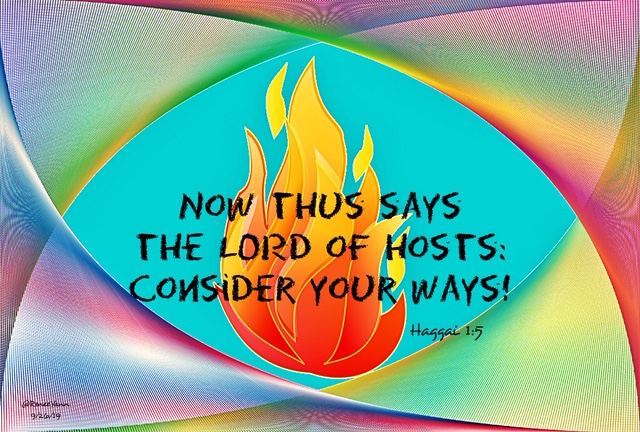
Consider your ways!
You have sown much, but have brought in little;
you have eaten, but have not been satisfied;
You have drunk, but have not been exhilarated;
have clothed yourselves, but not been warmed;
And whoever earned wages
earned them for a bag with holes in it.


The Temple, while it is important, isn’t the most important part of Haggai’s prophecy. He tells the people they have lost their souls. The lack of a central, shared faith has caused them to forget who they are. They will remember only when they remember God’s centrality in their lives.

Haggai appeals to the people to restore a public life which gives honor to God. For their time and circumstance, such a return is symbolized by the rebuilding of the Temple which had been destroyed at the time of their enslavement by Babylon.


We humans often forget what’s important. We chip away at, and ultimately destroy, what makes us who we are by little acts of faithlessness, deceit, covetousness, and envy. These small treacheries grow into big ones redeemable only by an impeachment of the soul and the renewal of a common moral purpose. Haggai offered that conversion to Israel. Pope Francis is offering it to us today.


Video: TED Talk by Pope Francis given at the Annual TED Conference in 2017 and pleading for a “Revolution of Tenderness”. (Yes, it’s long, but it is profound. When he delivered this talk, the Pope was given a standing ovation by some of the most prestigious business people of our time.)

https://www.npr.org/sections/thetwo-way/2017/04/26/525699847/in-surprise-ted-talk-pope-francis-asks-the-powerful-for-revolution-of-tenderness


Music: Come Back to Me – by Gregory Norbet, sung by John Michael Talbot

Money is Not Enough

Friday of the Twenty-fourth Week in Ordinary Time
September 22, 2023

Today’s Readings:

https://bible.usccb.org/bible/readings/092223.cfm


Today, in God’s Lavish Mercy, we pray with Psalm 49, the point of which according to Walter Brueggemann is this:

The point is that death is the great equalizer, 
and those who are genuinely wise 
should not be impressed by or committed to 
that which the world over-values.

Walter Brueggemann: From Whom No Secrets Are Hid

We may have heard the sentiment stated more succinctly by an anonymous scholar:

You can’t take it with you.


This is the core message Paul imparts to Timothy in our first reading:

For the love of money is the root of all evils,
and some people in their desire for it have strayed from the faith
and have pierced themselves with many pains.

1 Timothy 6:10

The advice is about more than money, or “dollar-bucks” as my 7-year-old grandnephew calls them.


The instruction is about our priorities – 
whom, why and what 
we love, value, and sacrifice for.

Walter Brueggemann

The opposite of this “love of money” is an unselfish, sacrificial love for others. This is the love Jesus hopes for in his disciples as he blesses them in today’s Gospel.

It takes courage to live such discipleship. As human beings, we tend to fear any kind of deprivation. We crave security, and sometimes we think money and possessions can give us that. Our readings today redirect that all too common misperception.

The world can be a very dark place, and of course, we will have fears and worries. Paul and our psalmist direct us to the right place to calm these concerns. Jesus calls us to believe in and live in the Light which is our true security.

Our psalm reminds us to keep our eyes on the eternal promise we have all been given.

But God will redeem my life,
will take me from the hand of Darkness.

Psalm 49:16

Poetry: Accepting This – Mark Nepo

Yes, it is true. I confess,
I have thought great thoughts,
and sung great songs—all of it
rehearsal for the majesty
of being held.
The dream is awakened
when thinking I love you
and life begins
when saying I love you
and joy moves like blood
when embracing others with love.
My efforts now turn
from trying to outrun suffering
to accepting love wherever
I can find it.
Stripped of causes and plans
and things to strive for,
I have discovered everything
I could need or ask for
is right here—
in flawed abundance.
We cannot eliminate hunger,
but we can feed each other.
We cannot eliminate loneliness,
but we can hold each other.
We cannot eliminate pain,
but we can live a life
of compassion.
Ultimately,
we are small living things
awakened in the stream,
not gods who carve out rivers.
Like human fish,
we are asked to experience
meaning in the life that moves
through the gill of our heart.
There is nothing to do
and nowhere to go.
Accepting this,
we can do everything
and go anywhere.

Music: His Eye is on the Sparrow (You might recall this version from the movie “Sister Act II”)

Responsible Membership

Memorial of Saints Andrew Kim Tae-gŏn, Priest,
and Paul Chŏng Ha-sang, and Companions, Martyrs
September 20, 2023

Today’s Readings:

https://bible.usccb.org/bible/readings/092023.cfm


Today, in God’s Lavish Mercy, our readings lead us in prayer to the concept of responsible membership in community, specifically the Church.

Paul counsels Timothy in this regard, reminding the Ephesian community, whom Timothy shepherded, how profoundly graced they are in their Church membership :

… you should know how to behave in the household of God,
which is the Church of the living God,
the pillar and foundation of truth.
Undeniably great is the mystery of devotion,
Who was manifested in the flesh,
vindicated in the spirit,
seen by angels,
proclaimed to the Gentiles,
believed in throughout the world,
taken up in glory.


In today’s Gospel, Jesus assesses the “membership potential” of the surrounding crowd and finds it wanting. He compares them to a gaggle of immature children taunting and gossiping in the streets:

Jesus said to the crowds:
“To what shall I compare the people of this generation?
What are they like?
They are like children who sit in the marketplace and call to one another,

‘We played the flute for you, but you did not dance.
We sang a dirge, but you did not weep.’


Membership in any community is a serious commitment. It requires our sincere and charitable investment in the daily give-and-take of life.

As a creature of God, Who exists in the Trinitarian Community, every human being – even a hermit in the desert – subsists in some dimension of sustaining community. We live, and exchange life, in our families, neighborhoods, countries, world, and universe. We choose communities of faith, ministry, political belief, philosophical understanding, and social interaction. We have a bearing on the lives of those with whom we share the gifts of time and space.


These commitments, to be life-giving, demand our sincere, honest, and reverent participation. Community is never a perfect circle, but more like an interlaced wreath requiring courage to navigate, as David Whyte describes here:

Courage is the measure of our heartfelt participation with life, with another, with a community, a work; a future. To be courageous is not necessarily to go anywhere or do anything except to make conscious those things we already feel deeply and then to live through the unending vulnerabilities of those consequences.


Pope Francis has called all of us to a “culture of encounter”, a way of living together in compassionate community:

An invitation to work for “the culture of encounter”, in a simple way, “as Jesus did”: not just seeing, but looking; not just hearing, but listening; not just passing people by, but stopping with them; not just saying “what a shame, poor people!”, but allowing yourself to be moved with compassion; “and then to draw near, to touch and to say: ‘Do not weep’ and to give at least a drop of life”.

Pope Francis, in a 2016 homily on the Gospel of the Widow of Nain

Pope Francis has also said that the most common and insidious way to kill this culture of encounter is the evil of gossip:

Gossip is a weapon and it threatens the human community every day; it sows envy, jealousy and power struggles. It has even caused murder. Therefore, discussing peace must take into account the evil that can be done with one’s tongue.

Sometimes we become so used to gossip that we don’t even recognize it in ourselves and others. Sometimes our motivations, unexamined, seem innocent enough. However, consider this:

Some bad motivations are more wicked than others. Backstabbing gossip bent on revenge is birthed in malice and threatens to sink whole fellowships (2 Corinthians 12:19–13:2; 3 John 9–10). That kind of gossip is worse than being a busybody who is too interested in other peoples’ business (2 Thessalonians 3:11; 1 Peter 4:15). Yet Jesus said that we will give an account for every careless word we have spoken (Matthew 12:36), not just for the malicious ones.

Matt Mitchell, author – Resisting Gossip: Winning the War on the Wagging Tongue

We don’t want to be like the thoughtless children mocking and teasing in the streets. I know that, for me, it warrants taking a good look at myself, my investment in my many communities, and the reverence of my conversations about them.


Poetry: A Word by Emily Dickinson

A word is dead
When it is said,
Some say.
I say it just
Begins to live
That day.

Music: Neighbor, Neighbor – Jimmy Hughes

While this song presents a rather isolationist interpretation of relationships, it still has its valid points — and definitely a great beat to wake up your morning. 😉

Neighbor, neighbor, don’t wonder what goes on in my home
You’re always lookin’ for somethin’ to gossip about
You’re goin’ around from door to door
Runnin’ your mouth about things you don’t know
Neighbor, neighbor, don’t wonder what goes on in my home

[Verse 2]
Neighbor, neighbor, don’t worry how I make my bread
‘Cause my success is drivin’ you out of your head
You got in those troubles, my trouble, too
Something bad’s gonna happen to you
Neighbor, neighbor, don’t worry what goes on in my home

[Guitar Solo]

[Verse 3]
Neighbor, neighbor, don’t worry how I treat my wife
Quit tellin’ ev’rybody we fuss and fight ev’ry night
You’re sweepin’, peepin’ through the hall
Keepin’ your big ears glued to my wall
Neighbor, neighbor, don’t worry what goes on in my home

[Verse 4]
Neighbor, neighbor, don’t worry who knocks on my front door
You’re walkin’, a-talkin’, a-pacin’ all over the floor
You’re sweepin’, peepin’ through the hall
Keepin’ your big ears glued to my wall
Neighbor, neighbor, don’t worry who goes in and out of my door

Simplicity Yields Freedom

Memorial of Saint John Chrysostom, Bishop and Doctor of the Church
September 13, 2023

Today’s Readings:

https://bible.usccb.org/bible/readings/091323.cfm


Today, in God’s Lavish Mercy, our Gospel gives us a quick and intense course in the upside-down, inside-out world of Jesus Christ. The course is known by various names:

  • the Blessings and Woes
  • the Sermon on the Plain
  • the “other” Beatitudes

But the passage might just as well be called, “The Loving Slap in the Face Wake-up Call”.


Picture it. The Twelve have just been commissioned by Jesus as his Apostles (refer to yesterday’s Gospel). I mean this is a big deal! They’ve passed the toughest job interview ever … to stand in for God in the world! They probably want to go home and tell their families, “Guess what! I have a new, fabulous job!”


But then Jesus gives them the orientation manual – the Blessings and Woes – and it’s shocking!

“Blessed are you who are poor,
for the Kingdom of God is yours.
Blessed are you who are now hungry,
for you will be satisfied.
Blessed are you who are now weeping,
for you will laugh.
Blessed are you when people hate you,
and when they exclude and insult you,
and denounce your name as evil
on account of the Son of Man.”


Really? This is what will make me successful in this new gig?

I am called to honor and accompany those who are poor, hungry, heartbroken, hated, excluded and insulted? THEY are the blessed, the “successful” in God’s estimation?


Like many of us, the Apostles may have thought success looked just the opposite – a lot of money, extravagant possessions, careless jocularity, universal adulation, and unquestioned consumption of common resources. You know. – a big boat, a lot of fish, an unconscious immunity from worrying about the poor, hungry guy outside the boatyard.


Jesus turns all of this upside-down and inside-out. He warns that excessive satisfaction with the world’s goods distracts us from true life in God. It hardens us against a loving compassion for one another. It weakens our capacity to receive the immense joy and freedom of life in the Spirit. Jesus calls us to a simplicity of heart that frees us to see and love God in ourselves and others.


As we proceed through Luke’s Gospel, Jesus continues to teach his apostles its contradictory truth. Eleven of the aspirants absorbed his words, transforming their life in a holy “inversion”. Only one, in the long run, proved resistant.

Where might we find ourselves if we stood among them?


Poetry: by C. Austin Miles

A little more kindness, a little less creed
A little more giving, a little less greed
A little more smile, a little less frown
A little less kicking, A man when he's down
A little more "we" a little less "I",
A little more laugh, a little less cry,
A little more flowers on the pathway of life
And fewer on graves at the end of the strife.

Music: A Simple Man – by Lynyrd Skynyrd