A Good Heart, an “Easter-ed Heart”

Thursday of the Second Week of Easter
April 20, 2023

Today’s Readings:

https://bible.usccb.org/bible/readings/042023.cfm

Today, in God’s Lavish Mercy, the post-Resurrection Apostles continue their unstoppable testimony to Jesus Christ. Their persistence “infuriates” the Sanhedrin who fear the blood of Christ being called down upon them!

“We gave you strict orders did we not,
to stop teaching in that name.
Yet you have filled Jerusalem with your teaching
and want to bring this man’s blood upon us.”
But Peter and the Apostles said in reply,
“We must obey God rather than men. 
The God of our ancestors raised Jesus,
though you had him killed by hanging him on a tree.
God exalted him at his right hand as leader and savior
to grant Israel repentance and forgiveness of sins.
We are witnesses of these things,
as is the Holy Spirit whom God has given to those who obey him.”

Acts 5: 28-33

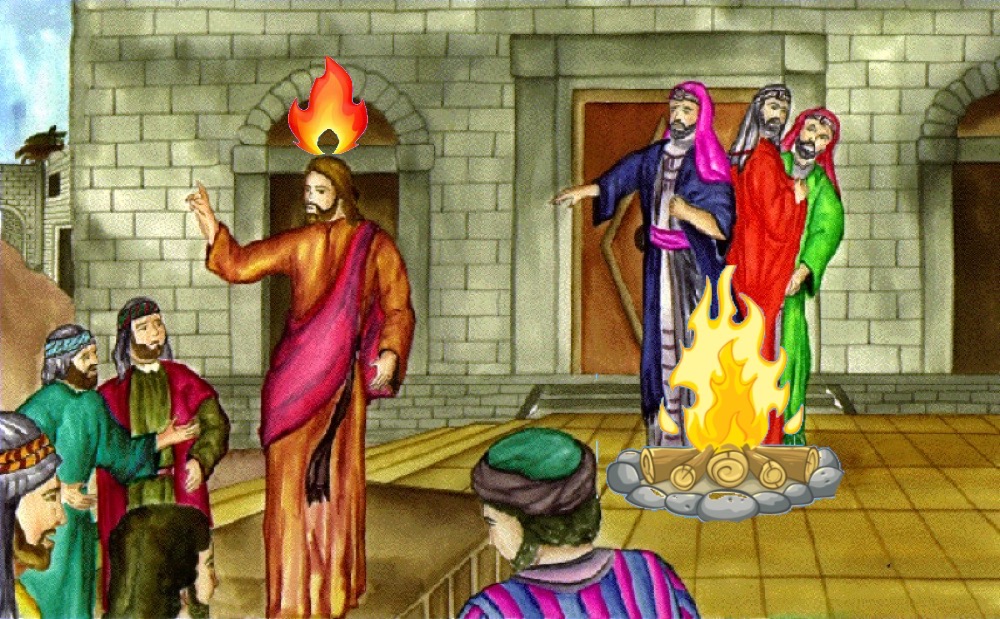
There is an interesting play in the words and concepts of this reading from Acts.

  • While the Sanhedrin are infuriated, or filled with the fire of denial and sin, the Apostles are inflamed with the unquenchable Fire of the Holy Spirit.
  • While the Sanhedrin fear the blood of Christ called down upon them, the disciples hearts are transformed by its power.

The contrast in their responses to God’s Word is stunning.

In our Gospel, John captures this contrast in a nutshell:

The one who comes from above is above all.
The one who is of the earth is earthly
and speaks of earthly things.

John 3:31

In other words, those transformed in the power of the Resurrection see the world with God’s eyes — “from above”. Those unconverted by that Power still see the world in godlessness.


Our Gospel calls us to be like the disciples not like the Sanhedrin.  It calls us to open our hearts:

  • to see the Truth Who is Jesus Christ
  • to believe that the Truth of his Resurrection lives in us
  • to become that Truth through the witness of our lives.

The Gospel calls us to live a whole-hearted faith which allows the Holy Spirit to be expressed in every aspect of our lives. Jesus does not ration the gift of the Spirit, nor should we:

Whoever does accept Christ’s testimony certifies that God is trustworthy.
For the one whom God sent speaks the words of God.
He does not ration his gift of the Spirit.

John 3:33-34

How do we live such a life of Christian witness? Do we have to shout the witness out loud with every action of our lives?  I don’t think so.

Brother David Steindl-Rast describes believers like this:

People who have faith in life are like swimmers who entrust themselves to a rushing river. They neither abandon themselves to its current nor try to resist it. Rather, they adjust their every movement to the watercourse, use it with purpose and skill, and enjoy the adventure.


And the great St. Teresa of Avila blesses believers with this prayer:

May today there be peace within.
May you trust God that you are exactly where you are meant to be.
May you not forget the infinite possibilities that are born of faith.
May you use those gifts that you have received,
and pass on the love that has been given to you.
May you be content knowing you are a child of God.
Let this presence settle into your bones,
and allow your soul the freedom to sing, dance, praise and love.
It is there for each and every one of us.


Poetry: Little Summer Poem Touching The Subject Of Faith by Mary Oliver

Every summer
I listen and look 
under the sun’s brass and even
into the moonlight, but I can’t hear

anything, I can’t see anything — 
not the pale roots digging down, nor the green 
stalks muscling up,
nor the leaves
deepening their damp pleats,

nor the tassels making,
nor the shucks, nor the cobs.
And still,
every day,

the leafy fields
grow taller and thicker — 
green gowns lofting up in the night,
showered with silk. 

And so, every summer,
I fail as a witness, seeing nothing — 
I am deaf too
to the tick of the leaves, 

the tapping of downwardness from the banyan feet — 
all of it
happening
beyond any seeable proof, or hearable hum. 

And, therefore, let the immeasurable come.
Let the unknowable touch the buckle of my spine.
Let the wind turn in the trees,
and the mystery hidden in the dirt

swing through the air.
How could I look at anything in this world
and tremble, and grip my hands over my heart?
What should I fear? 

One morning
in the leafy green ocean
the honeycomb of the corn’s beautiful body
is sure to be there.


Music: A Good Heart – Marc Enfroy

Not So Easy to Be Born Again!

Tuesday of the Second Week of Easter
April 18, 2023

Today’s Readings:

https://bible.usccb.org/bible/readings/041823.cfm

The words in today’s readings are little explosives camouflaged in familiarity.

We are used to reading how the earliest Christians formed a loving and mutual community. We might admire how they held everything in common. We might think how nice and comforting that must have been for everyone.

The community of believers was of one heart and mind,
and no one claimed that any of his possessions was his own,
but they had everything in common.
With great power the Apostles bore witness
to the resurrection of the Lord Jesus,
and great favor was accorded them all.

Acts 4:32

But, friends, I don’t think it was all that comforting! I think it was hard! People who had worked tirelessly to build secure lives had to rethink that security. Whether in material goods or established reputations, they had to give up houses, businesses, rabbi-ships, and political offices to truly be part of this radical new “community”.

They had to split the last two matzah balls with some dude who never worked a day in his life. It’s not easy!


Picture the heated conversations between someone choosing this “community” and a spouse who preferred to keep their big boat and villa by the seaside.

Imagine the rumbling synagogue crowd when the beloved old rabbi told them just to call him “brother”! Hear the distressed uproar when he announced that the Holy Law he had confidently taught them now must be rethought in Gospel light!

I’m pretty sure it wasn’t as smooth as Acts seems to imply. There is a small acknowledgment of that in the notoriety given to astoundingly generous Joseph. He stood out for buying in completely to this new community. ( We’ll hear more about him later under his new name “Barnabas”).

Thus Joseph, also named by the Apostles Barnabas
(which is translated “”son of encouragement””),
a Levite, a Cypriot by birth,
sold a piece of property that he owned,
then brought the money and put it at the feet of the Apostles.

Acts 4:36-37

By Henry Ossawa Tanner

The Gospel story of Nicodemus confirms the struggle to really become a Gospel person. It should be profoundly unsettling to those of us  -and I think that is ALL of us – who sometimes thrive on security, status, and control.

Nicodemus had “made it” in Jewish society. He was considered a good, learned, influential and wealthy man. But Jesus challenges him on every level of his success to test what he values and builds his life on.

  • Is Nicodemus really “good” in light of the Beatitudes?
  • Is he really “learned” in living the law of radical love?
  • Is he really “rich” in holy grace?

  • Or is his “goodness” tinged with judgement?
  • His “learning” mired in self-righteousness?
  • His “wealth” rooted in complacency with systemic injustice?

Jesus tells Nicodemus that the Spirit of God will not be tamed or controlled by these supposed “successes” of his life. Rather, Nicodemus must start all over again to be transformed in God:

Jesus said to Nicodemus:
“‘You must be born from above.’
The wind blows where it wills, and you can hear the sound it makes,
but you do not know where it comes from or where it goes;
so it is with everyone who is born of the Spirit.”

John 3:7-8

And here’s the really hard thing. We must make the “Nicodemus Choice” every day of our lives. Every circumstance invites us either to be “born again” or to choose the old securities we are so falsely comfortable with. Those securities can blind us with the complacency of one who has forgotten how to see.

Jesus answered and said to him,
“You are the teacher of Israel and you do not understand this?
Amen, amen, I say to you,
we speak of what we know and we testify to what we have seen,
but you people do not accept our testimony.
If I tell you about earthly things and you do not believe,
how will you believe if I tell you about heavenly things?

John 3:10-12

Poetry: Nicodemus – Mary Elizabeth Coleridge (1861-1907) 

With slow and stealthy steps he trod 
— The darkening and deserted streets; 
— And no one in the market greets 
The man upon his way to God. 

By night he left the splendid home 
— That sheltered many a sleeping guest. 
— One and another lay at rest — 
The master of the house would roam. 

Was there a single soul that knew? 
— No! For he feared the eye of scorn, 
— The crooked laugh of anger born. 
Only the bats about him flew. 

The broidered borders of his gown 
— He covered o’er, that none might see. 
— Shall good come out of Galilee? 
This were the mock of all the town. 

But in the City named for Peace 
— No peace his weary heart had known, 
— And ever in the crowd alone 
He waged a war that would not cease. 

He came by night — and yet he came. 
— And He that was Himself the Way 
— Shall own him in the Judgment Day, 
And to the world confess his name.


Music: Nicodemus – Graham Kendrick

Don’t Be Afraid

Monday in the Octave of Easter
April 10, 2023

Today’s Readings:

https://bible.usccb.org/bible/readings/041023.cfm

Today, in God’s Lavish Mercy, we begin to read and relish the post-Resurrection stories.

As I begin my prayer with these stories, I am reminded of a sweet cartoon I recently saw on Facebook. The illustration showed an elderly couple relaxing outside a simple home. The woman is shelling peas; the man whittling some wood. The comment below the picture reads, “If only I could visit my grandparents one more time!”. 

Haven’t we all felt that way about someone dear who has died.  If only we could be with them one more time!


Well, that’s exactly what happens in these post-Resurrection stories. The disciples, and we, get to be with Jesus one more time:

  • to re-hear his Truth more clearly in the light of the Resurrection 
  • to get right the Gospel imperatives we might have missed in our distractions 
  • to heal the doubts which his suffering, and ours, may have caused us
  • to have our faith irrevocably affirmed by his real and transformed Presence

The Three Marys at the Tomb – WILLIAM-ADOLPHE BOUGUEREAU


Mary Magdalene and the other Mary went away quickly from the tomb,
fearful yet overjoyed,
and ran to announce the news to his disciples.
And behold, Jesus met them on their way and greeted them.
They approached, embraced his feet, and did him homage.
Then Jesus said to them, “Do not be afraid.
Go tell my brothers to go to Galilee, 
and there they will see me.”

Mark 28:8-10

Like Mary Magdalen and the “other Mary”, we too might be “fearful but overjoyed” at moments in our faith life – those moments when we are confronted with our own small Calvaries. 

But Jesus, filled with the glory of Resurrection, greets us on our way. He tells us too, “Do not be afraid” —— you will see me, risen in your life. And you will understand.


Prose: from Paula D’Arcy

Who would I be,
and what power

would be expressed in my life,
if I were not dominated by fear.


Music: Don’t Be Afraid – Mac Lynch

God is Outside the Box!

Friday of the First Week in Ordinary Time
January 13, 2023

Today’s Readings:

https://bible.usccb.org/bible/readings/011323.cfm

Today, in God’s Lavish Mercy, our Gospel tells of a memorable event – so memorable that it is described in detail.

Jesus preaches from a neighborhood living room. Every access point to the house is blocked with excited listeners and miracle-seekers. Jesus has been corralled by the enthusiastic faithful.

roof

Then some latecomers arrive carrying their paralyzed friend. It is easy to imagine that these are young guys, because Jesus later calls the paralytic “Child”. Perhaps their friend was injured in a soccer game or diving accident in which they all had participated. Perhaps, as well as carrying him, they are carrying the burden of “survivor guilt”.

Whatever the situation, these friends are determined that the young man shall see Jesus. Confronted with the barricading crowd, they climb up on the roof, opening the turf plates to make an entry point. Jesus had to laugh as he saw to rooftop disappearing above him!


Would that we had such a wild desire to be in God’s Presence
– to know God face to face, and heart to heart!

Can we peel away the many barricades to such relationship? We have only our limited human images of God. While these can help us pray, they can also box God.

Faulty theology and exaggerated ritual can, believe or not, put a lid on God’s power!

It is important to read, listen, and grow within good theology. One measure of that value is the degree of limitation any “theology” puts on God. A theology that limits God to male, white, Catholic, Evangelical, Republican or Democrat (or whatever religion) – that kind of false theology limits us as well. 

A theology that is used as validation for political, economic, or moral domination distorts God, making God an idol of our own greed and selfishness. Such ”theologies” have, for centuries, made excuses for slavery, apartheid, pogroms, wars and holocausts. 

Let’s try to “take the roof off” our theology today. Let’s be sure our tightly held perceptions and beliefs are really leading us to the absolute freedom of a God Who cherishes all Beings, all Creation.


Poetry: God’s Grandeur – Gerard Manley Hopkins

The world is charged with the grandeur of God.
It will flame out, like shining from shook foil;
It gathers to a greatness, like the ooze of oil
Crushed. Why do men then now not reck his rod?
Generations have trod, have trod, have trod;
And all is seared with trade; bleared, smeared with toil;
And wears man's smudge and shares man's smell: the soil
Is bare now, nor can foot feel, being shod.
And for all this, nature is never spent;
There lives the dearest freshness deep down things;
And though the last lights off the black West went
Oh, morning, at the brown brink eastward, springs —
Because the Holy Ghost over the bent
World broods with warm breast and with ah! bright wings.

Music: God Beyond All Names ~ Bernadette Farrell 

Heart-Softening

Thursday of the First Week in Ordinary Time
January 12, 2023

Today’s Readings:

https://bible.usccb.org/bible/readings/011223.cfm

psalm 95 copy

Today, in Mercy, our first reading quotes at length from Psalm 95, and the message is reprised in the Responsorial Psalm.

Harden not your hearts.

We all know what it feels like to harden our hearts. We do it out of anger, fear, exhaustion, frustration and so many other reasons. We feel like the only way to protect ourselves and our space is to build a wall! Put up those bricks made out of our stony faces, curt words, numbing silence, distancing indifference – our hardened hearts.


Today’s reading tells us that this is never God’s way.

The way to freedom, peace, self-respect, joy and fullness of life is always found in relationship – as God is in relationship with all Creation.

Jesus demonstrates that relationship in today’s Gospel by connecting with the leper. This leper has been walled off from society by illness and disfigurement. Most people’s hearts are hardened against him, but Jesus is “moved by pity” at the leper’s isolation.

The leper, too, has built a bridge by reaching through his own hardened heart in faith and trust. Surely all the years of mistreatment had made him wary of trust, had immobilized him in self-protection. But he allows himself a courageous plea to Jesus, and he is heard.

Jesus Cures a Leper – Rembrandt


It is no easy challenge to soften a hardened heart. Some of our walls are very high, some of our bricks very heavy. But, one by one, we can choose opportunities for forgiveness, kindness, understanding, patience, encouragement, listening and companionship – even, and especially, toward those estranged in any way from us or from themselves. And we can do this even toward ourselves when we have become hardened to our own beauty and goodness.

To begin might take only a smile, a prayer, a phone call, a small kindness, an invitation, a moment of ordinary conversation…. just these might start to crumble a wall, to soften a heart.

Let’s ask God’s grace today to do this heart-softening wherever we might need it. Let’s ask this grace for others in need as well.


Poetry: The Altar by George Herbert – Herbert wrote this poem in the shape of an altar. He describes the spiritual process of allowing his “hard heart” to be built into an altar for God’s praise.

A broken ALTAR, Lord, thy servant rears,

 Made of a heart and cemented with tears:

  Whose parts are as thy hand did frame;

No workman’s tool hath touch’d the same.

                   A HEART alone

                   Is such a stone,

                  As nothing but

                  Thy pow’r doth cut.

                  Wherefore each part

                  Of my hard heart

                  Meets in this frame,

                  To praise thy name:

       That if I chance to hold my peace,

 These stones to praise thee may not cease.

   Oh, let thy blessed SACRIFICE be mine,

     And sanctify this ALTAR to be thine.


Music: Soften My Heart, Lord (and adding a second song, just because I think you’ll like it.)

Seeing What We Look At

The Epiphany of the Lord
Sunday, January 8, 2023

Today’s Readings:

https://bible.usccb.org/bible/readings/010823.cfm

Today, in God’s Lavish Mercy, we celebrate the great feast of the Epiphany of Our Lord, a day which commemorates Christ’s manifestation to the Gentiles.

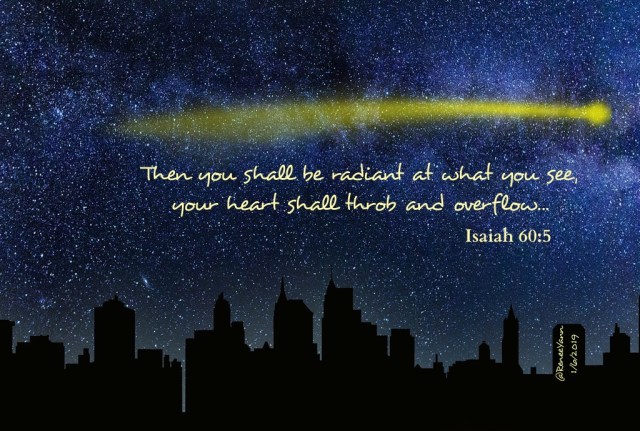
is60_5 epiphanyjpg

Perhaps on this day, as little children, some of us placed the Three Kings in the crèche, fascinated by their journey and their majesty (and of course by the camels.). These figures represented all nations bringing their gifts to the newborn Savior. In their humble generosity, the journeyers eyes were opened and they recognized Divinity in the most unlikely of places.

An epiphany is a special kind of vision.
It is an insight to see something amazingly deeper
in what we thought we had already perceived.

We might walk by a tree, a house, a person day after day taking them completely for granted. We see them – but don’t really see them. Then, one day, a certain turn of sun on leaves might let us see that tree differently. An open window with its curtains billowing might transform that house into a home. A caring exchange might change that person into a friend.

And we say things like, “Gosh, why had I never noticed that before…”


The Three Kings were given the grace of Epiphany to see God where others saw only a poor newborn. They were given the wisdom to see Herod’s treachery where he pretended to offer only homage.


This feast reminds us that a sacred dimension exists beneath the surface of all appearances. Every reality contains the capacity for holiness, for goodness, for wisdom, for love. The more we are attuned to Grace, the more we recognize the presence (or the absence, as with Herod) of this capacity. The more we begin to live in deeper relationship with the seemingly ordinary in our lives.

Because actually, nothing is ordinary! Everything that comes to us is fraught with grace and divine possibility. We just need to live intentionally – to ask for and respond to the gift of Epiphany as it is given in our particular circumstances.


Poetry: I think the sentiments of today’s feast thread through a beautiful poem by William Wordsworth, Ode: Intimations of Immortality from Recollections of Early Childhood – particularly in these lines:

Our birth is but a sleep and a forgetting:
The Soul that rises with us, our life’s Star,
Hath had elsewhere its setting,
And cometh from afar:
Not in entire forgetfulness,
And not in utter nakedness,
But trailing clouds of glory do we come
From God, who is our home:
Heaven lies about us in our infancy!

Poetry lovers might like to read the entire poem here: 

Click here for full poem


Music: Walking through Clouds – Bernward Koch
Please enjoy this gentle music as you pray your Epiphanies:

Fig Trees and Ladders

Memorial of Saint John Neumann, Bishop
January 5, 2023

Today’s Readings:

https://bible.usccb.org/bible/readings/010523.cfm

Today, in God’s Lavish Mercy,  we celebrate the Memorial of Saint John Neumann. 

John Neumann was born in Bohemia on March 20, 1811. Since he had a great desire to dedicate himself to the American missions, he came to the United States as a cleric and was ordained in New York in 1836 by Bishop Dubois.

In 1840, John Neumann entered the Congregation of the Most Holy Redeemer (Redemptorists). He labored in Ohio, Pennsylvania and Maryland. In 1852, he was consecrated bishop of Philadelphia. There he worked hard for the establishment of parish schools and for the erection of many parishes for the numerous immigrants. Bishop Neumann died on January 5, 1860; he was beatified in 1963.
(catholicculture.org)


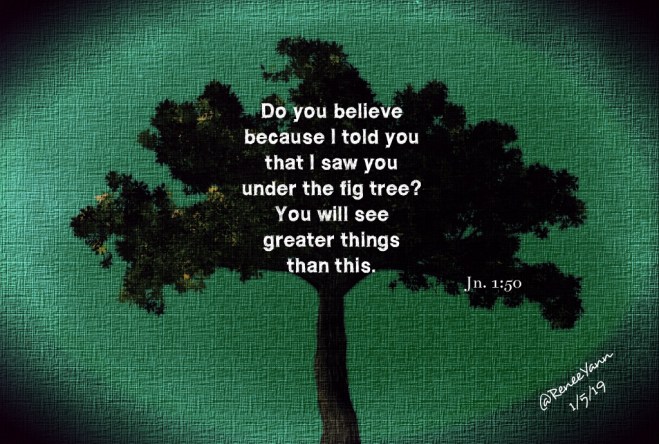
jn1_50 figjpg

In our first reading today, John tells us bluntly:

Whoever does not love remains in death.

1 John 3:14

This kind of statement is what one might both love and hate about John. We love it because it’s clear, unequivocal – tells us exactly what we need to do.

And we hate it because it’s clear and unequivocal – there’s no evading it, no back door. We must love – everybody- or we are as good as dead. Wow!


Was this the kind of either-or that Nathaniel struggled with under the fig tree? He sat there pondering some deep challenge or decision and Jesus saw him – and understood – from afar.

The miracle of that moment caused Nathaniel to believe. But Jesus says something like this to Nathaniel:

Hold up, you ain’t seen nothin’ yet! Your little wrestling under the fig tree was all about your own small world and vision. I invite you now to see the world with God’s eyes.


We all spend worrying time under the shadow our own little fig trees – most of the time worrying about ourselves – who hurt us, doesn’t like us, gets in our way, misunderstands or annoys us.

Today’s Gospel invites us to stop licking our wounds. It beckons us out of the shadows of our self-absorption to see what God might see today – the beauty, the needs, the challenges and possibilities of the world around us. We are invited to become lovers and healers like Jesus.

As John has said, we are invited to leave any shadow of death and to live in love:

The way we came to know love
was that he laid down his life for us;
so we ought to lay down our lives for our brothers.
If someone who has worldly means
sees a brother in need and refuses him compassion,
how can the love of God remain in him? 
Children, let us love not in word or speech
but in deed and truth.

1 John 3:16-18

Poem: In the following poem, Malcolm Guite compares the spiritual transformations of Jacob and Nathaniel.

Jesus called Nathaniel “a true Israelite” and tells him: “… you will see the sky opened and the angels of God ascending and descending on the Son of Man.” This is a clear reference to the story of Jacob’s Ladder from Genesis, where in a dream God transforms Jacob’s life to become the Patriarch of Israel.

Jacob left Beersheba and set out for Harran. When he reached a certain place, he stopped for the night because the sun had set. Taking one of the stones there, he put it under his head and lay down to sleep. He had a dream in which he saw a stairway resting on the earth, with its top reaching to heaven, and the angels of God were ascending and descending on it. There above it stood the Lord, and he said: “I am the Lord, the God of your father Abraham and the God of Isaac. I will give you and your descendants the land on which you are lying. Your descendants will be like the dust of the earth, and you will spread out to the west and to the east, to the north and to the south. All peoples on earth will be blessed through you and your offspring.

Genesis 28:10-15

Nathaniel’s Awakening – Malcolm Guite

A fugitive and exile, Jacob slept,
A man of clay, his head upon a stone
And even in his sleep his spirit wept
He lay down lonely and would wake alone.
But in the night he dreamt the Heavens parted
And glimpsed, in glory, as from Heaven’s core,
A ladder set for all the broken-hearted
And earth herself becoming Heaven’s door.
And when the nameless Angel named him Israel
He kept this gift, whose depth he never knew;
The promise of an end to all our exile,
For now a child of Israel finds it true,
And sees the One who heals the deep heart’s aching
As Jacob’s dream becomes Nathanael’s waking.

Music: Maybe Nathaniel sang a song like this in his heart as he came out from under his fig tree.

Love Like Jesus – Rhett Walker

The Invitation

Memorial of Saint Elizabeth Ann Seton, Religious
January 4, 2023

Today’s Readings:

https://bible.usccb.org/bible/readings/010423.cfm

Today, in God’s Lavish Mercy, we celebrate the Feast of St. Elizabeth Anne Seton, the first American born saint.

Elizabeth Seton was born on August 28, 1774, of a wealthy and distinguished Episcopalian family. She was baptized in the Episcopal faith and was a faithful adherent of the Episcopal Church until her conversion to Catholicism.

She established her first Catholic school in Baltimore in 1808; in 1809, she established a religious community in Emmitsburg, Maryland. After seeing the expansion of her small community of teaching sisters to New York and as far as St. Loius, she died on January 4, 1821, and was declared a saint by Pope Paul VI on September 14, 1975. She is the first native born American to be canonized a saint.

(from CatholicCulture.org)


Jn 1_39

In our Gospel, we find the first disciples encountering Jesus. They are curious about him because the Baptist has just described him as “the Lamb of God”.

The two disciples heard what he said and followed Jesus.
Jesus turned and saw them following him and said to them,
“What are you looking for?”
They said to him, “Rabbi” (which translated means Teacher),
“where are you staying?”
He said to them, “Come, and you will see.”
So they went and saw where he was staying,
and they stayed with him that day.
It was about four in the afternoon.
Andrew, the brother of Simon Peter,
was one of the two who heard John and followed Jesus.

John 1: 37-40

We can picture Andrew and his unnamed buddy trailing behind Jesus, watching him, listening to him. Finally they hazard a question, “Rabbi, where do you live?”

It’s kind of a loaded question. What it might really mean are things like these:

  • Where did you come from all of sudden?
  • How could you possibly be the Messiah if you’re walking around looking just like us?
  • Do you go back to heaven at night or are you really one of us?
  • Can we just hang out and find out more about you?

Their faith is tentative, hopeful and maybe just a little bit suspicious. Does your faith ever feel like that? 


When we pray, are we convinced that God hears us? When we suffer, do we believe God abides with us? When we choose, act or respond, do we trust that God cares about our actions? Do we believe, in these and all circumstances, that the power of God is present in our lives?

To have that kind of faith, we have to “learn” Christ, to become as close and comfortable with him as with an intimate friend. In our Gospel, Jesus tells us how to do that: “Come and see.” 

In other words:

Spend time with me.
Talk with me about ordinary things.
Watch sunsets and sunrises with me.
Tell me your secrets.
Let me tell you mine.
Laugh with me.
Be silent with me.
Trust that you are never separate from me.

If we do these things, even slowly and steadily as the first disciples, we will eventually say with Andrew, “l have found the Messiah” – and he is living right within my life!


Poetry: the calling of the disciples – Lucille Clifton

some Jesus
has come on me

i throw down my nets
into the water he walks

i loose the fish
he feeds to cities

and everyone calls me
an old name

as i follow out
laughing like God’s fool
behind this Jesus

Music: Come and See – Bob Bennett

Life’s Curriculum of Faith

Memorial of Saints Basil the Great and Gregory Nazianzen,
Bishops and Doctors of the Church
January 2, 2023

Today’s Readings:

https://bible.usccb.org/bible/readings/memorial-saints-basil-great-and-gregory-nazianzen-bishops-and-doctors-church

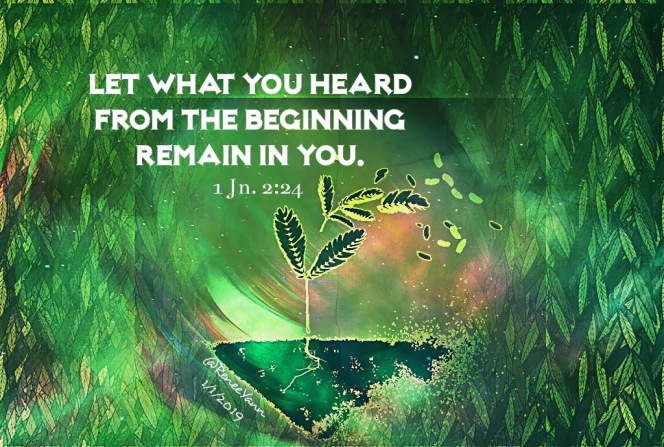
1Jn2_24 beginning

Today, in God’s Lavish Mercy, we continue to relish John’s eloquent first letter in which he heartily instructs us in the life of Christian love and fidelity.

Let what you heard from the beginning remain in you. 
If what you heard from the beginning remains in you,
then you will remain in the Son and in the Father. 
And this is the promise that he made us: eternal life. 

1 John 2:24-26

John has written this letter out of concern about false teachings that are cropping up in the early Church. Misguided “prophets” are placing distorted interpretations on the pure, original message of the Gospel.

Human beings have never stopped doing that, have we? Down through the centuries, how many heresies and misinterpretations have tried to weave their confusion into the Gospel’s central, inviolable thread? How many charlatans, purposefully or ignorantly, have confused people with their bogus religious interpretations.

Has it happened to our own faith? Have we lost the crisp, clear power of our foundational belief? Have we been hijacked into a “faith” or religious practice that ultimately contradicts the Gospel?

It can happen easily in a society where truth is manipulated for purposes of politics, power, and economics. How can we work to avoid it?


John tells us to hold fast to the core teaching of the Gospel.

As for you,
the anointing that you received from him remains in you,
so that you do not need anyone to teach you. 
But his anointing teaches you about everything and is true and not false; 
just as it taught you, remain in him.

1 John 2: 27

This is the faith that many of us learned as children from devout parents and teachers. It is a faith that continues to evolve through scriptural prayer and meditation, through openness to theological wisdom, through the holy dialogue of the beloved community.

It is a living faith, stretched and tested by our daily choices for true Christian love for all people, especially the poor, sick and marginalized.

Ultimately, it is a faith rooted in the Cross and transformed by the Resurrection.

Over these next few weeks, let us listen carefully to John as he guides us to the depth of this faith.


Poetry: A Thanksgiving – St. John Henry Newman

The faith-journey of John Henry Newman has always inspired me. Born in 1801, he was an English theologian, academic, intellectual, philosopher, polymath, historian, writer, scholar and poet, first as an Anglican priest and later as a Catholic priest and cardinal. He was an important and controversial figure in the religious history of England in the 19th century. St. John Henry Newman was canonized as a saint in the Catholic Church in 2019.

As a young nun, when I thought faith was largely an intellectual pursuit, I was caught up in his Apologia Pro Vita Sua (Latin: A defense of one’s own life). The essay is a defense of his religious opinions, published in 1864 in response to Charles Kingsley of the Church of England after Newman quit his position as the Anglican vicar of St. Mary’s, Oxford.

Newman also wrote poetry. “A Thanksgiving” traces the unfolding gift and struggle of Newman’s faith journey.

Lord, in this dust Thy sovereign voice
First quicken’d love divine;
I am all Thine, Thy care and choice,
My very praise is Thine.

I praise Thee, while Thy providence
In childhood frail I trace,
For blessings given, ere dawning sense
Could seek or scan Thy grace;

Blessings in boyhood’s marvelling hour,
Bright dreams, and fancyings strange;
Blessings, when reason’s awful power
Gave thought a bolder range;

Blessings of friends, which to my door
Unask’d, unhoped, have come;
And, choicer still, a countless store
Of eager smiles at home.

Yet, Lord, in memory’s fondest place
I shrine those seasons sad,
When, looking up, I saw Thy face
In kind austereness clad.

I would not miss one sigh or tear,
Heart-pang, or throbbing brow;
Sweet was the chastisement severe,
And sweet its memory now.

Yes! let the fragrant scars abide,
Love-tokens in Thy stead,
Faint shadows of the spear-pierced side
And thorn-encompass’d head.

And such Thy tender force be still,
When self would swerve or stray,
Shaping to truth the froward will
Along Thy narrow way.

Deny me wealth; far, far remove
The lure of power or name;
Hope thrives in straits, in weakness love,
And faith in this world’s shame.

Music: some gentle meditation music for your prayer with John:

Herb Ernst – Song of the Inner Child

Sweet Child, forgive us …

Feast of the Holy Innocents, martyrs
December 28, 2022

Today’s Readings:

https://bible.usccb.org/bible/readings/122822.cfm

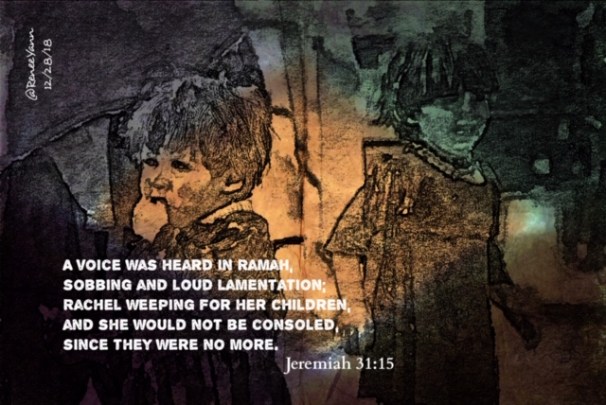
Jer 31_15 Ramah

Today, in God’s Lavish Mercy, we are lifted to Light by John’s sacred words in our first reading:

Beloved:
This is the message that we have heard from Jesus Christ
and proclaim to you:
God is light, and in God there is no darkness at all.

1 John 1:5

Simply hearing it, we long to abide in that whole and healing Light.


But then we read our Gospel, among the saddest accounts in all of Scripture – the slaughter of the Holy Innocents. Their needless deaths come at the hands of a power-crazed and fearful man.  So hungry for his own aggrandizement, he tries to assure it by killing a generation of children.

It sounds impossible, doesn’t it, that anyone could be so hardened by evil? It sounds impossible that good people would execute this order of a mad man! It sounds impossible that human beings could be so blind to the sanctity of another’s life!

When Herod realized that he had been deceived by the magi,
he became furious.
He ordered the massacre of all the boys in Bethlehem and its vicinity
two years old and under,
in accordance with the time he had ascertained from the magi.
Then was fulfilled what had been said through Jeremiah the prophet:
A voice was heard in Ramah,
    sobbing and loud lamentation;
Rachel weeping for her children,
    and she would not be consoled,
    since they were no more.

Dear friends, we must confront our own blindness. We must look into the eyes of our 21st century children – the border children, the children of Ukraine, Russia, Sudan, Haiti, … the children of war, violence, drugs and poverty. We must hear the last cries of the children we fail to protect by adequate gun laws – the children of Columbine, Uvalde, Sandy Hook and on and on….

We must hear the cry of God, their Mother, and choose legislators and leaders who will honor life; who will shape global policies and relationships recognizing the common life we share in God – who will make true pro-life choices regarding gun control, arms sales, and an economy of endless war.

Our attitudes, our advocacy and our votes will either condemn or exonerate us when that Great Light ultimately reveals our hearts. When a society’s children become the victims of its indefensible corruption, we must say “Enough!”


Poetry: Holy Innocents – Christina Rossetti

Sleep, little Baby, sleep;
The holy Angels love thee,
And guard thy bed, and keep
A blessed watch above thee.
No spirit can come near
Nor evil beast to harm thee:
Sleep, Sweet, devoid of fear
Where nothing need alarm thee.

The Love which doth not sleep,
The eternal Arms surround thee:
The Shepherd of the sheep
In perfect love hath found thee.
Sleep through the holy night,
Christ-kept from snare and sorrow,
Until thou wake to light
And love and warmth to-morrow.

Music: A Coventry Carol – sung by Anúna

The “Coventry Carol” is an English Christmas carol dating from the 16th century. The carol was traditionally performed in Coventry in England as part of a mystery play called The Pageant of the Shearmen and Tailors. The play depicts the Christmas story from chapter two in the Gospel of Matthew: the carol itself refers to the Massacre of the Innocents, in which Herod ordered all male infants under the age of two in Bethlehem to be killed, and takes the form of a lullaby sung by mothers of the doomed children. (Lyrics below)

Lullay, thou little tiny child
Sleep well, lully, lullay
And smile in dreaming, little one
Sleep well, lully, lullay
Oh sisters two, what may we do
To preserve on this day
This poor youngling for whom we sing
Sleep well, lully, lullay
Farewell, lully, lullay
Herod the king in his raging
Set forth upon this day
By his decree, no life spare thee
All children young to slay
Then woe is me, poor child, for thee
And ever mourn and say
For thy parting, neither say nor sing
Farewell, lully, lullay
And when the stars fill darkened skies
In their far venture, stay
And smile as dreaming, little one
Farewell, lully, lullay
Dream now, lully, lullay