Lent: Stop Pretending

April 2, 2022
Saturday of the Fourth Week of Lent

Today, in God’s Lavish Mercy, danger continues to escalate for Jesus.

Our first reading from Jeremiah foreshadows Jesus’s situation. Some powerful people didn’t want to hear what Jeremiah preached. And we can understand why: Jeremiah prophesied the destruction of Jerusalem because of Israel’s unfaithfulness. It’s a message that was hard to swallow.

jeremiah

The core of Jeremiah’s teaching was this:
You people have to change. This is not the way God created the world to be.

But the people couldn’t listen. They had let the skewed reality of their lives become normal and needed. They couldn’t accept the world of mutual love and justice that God imagined for them.


Jesus meets the same kind of stonewalling.

In today’s passage, the hard-hearted rationalize their resistance:

“The Christ will not come from Galilee, will he?
Does not Scripture say that the Christ will be of David’s family
and come from Bethlehem, the village where David lived?”

But their antagonism isn’t really about geography and lineage. It’s about blind comfort in a world balanced toward their advantage. It’s about the fear of grace-inspired change.

Lk8_generous heart


Isn’t it the truth that we’ll use almost any argument to resist what demands our conversion? I understand why these guys “each went to his own house”, as the Gospel says in closing. They took refuge from grace in the little roofed pretense of their own control.

They didn’t have the courage to open their hearts to Jesus. Do we?


Poetry: LOVE IS THE MASTER – RUMI

Love is the One who masters all things;
I am mastered totally by Love.
By my passion of love for Love
I have ground sweet as sugar.
O furious Wind, I am only a straw before you;
How could I know where I will be blown next?
Whoever claims to have made a pact with Destiny
Reveals himself a liar and a fool;
What is any of us but a straw in a storm?
How could anyone make a pact with a hurricane?
God is working everywhere his massive Resurrection;
How can we pretend to act on our own?
In the hand of Love I am like a cat in a sack;
Sometimes Love hoists me into the air,
Sometimes Love flings me into the air,
Love swings me round and round His head;
I have no peace, in this world or any other.
The lovers of God have fallen in a furious river;
They have surrendered themselves to Love’s commands.
Like mill wheels they turn, day and night, day and night,
Constantly turning and turning, and crying out.

Music:  Spirit, Open My Heart –  Alfred V. Fedak

Lent: The Deep Dive

March 29, 2022
Tuesday of the Fourth Week of Lent

Today, in God’s Mercy, our readings describe a deep and hidden stream revealed by God –

first to Ezechiel …

Raffael-vision-ezechiel
The Vision of Ezechiel by Rafael

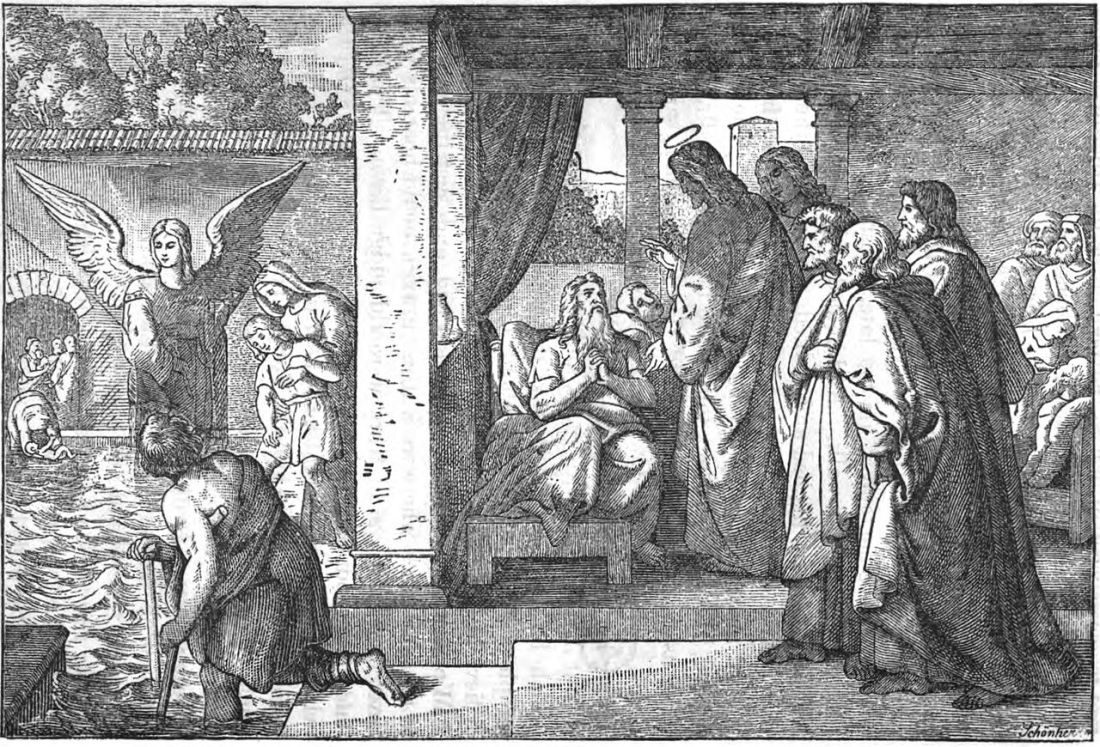
then to a long-paralyzed man …

Schönherr_The_pool_of_Bethesda
The pool of Bethesda, by Schönherr.

So many stories in Scripture are laced with the same theme: there is a infinite mystery hidden under the surface of life:

  • Keep searching. Keep searching. 
  • The precious pearl that awaits discovery. 
  • The lost coin that must be found. 
  • The mustard seed buried in circumstance. 
  • The stream running deep under appearances.

We might be tempted to dismiss our first reading from Ezechiel as over-described allegory. But its rendition of the slow, steady deepening, through which God leads the prophet, offers us an apt image to reflect on our own graced journey. 

Ez47_9 stream

Hasn’t God led us gently to the faith we have today? Like young children learning to ride the ocean breakers, we have been taught by a patient God Who returns in every tide to take us deeper into our next capacity for grace.


For thirty-eight years, the man in today’s Gospel has been paralyzed by the water’s edge. Maybe we know how he feels.

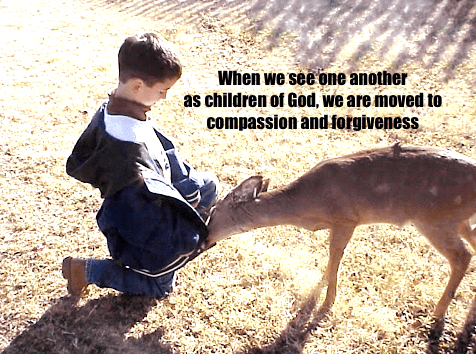
duck

He believes that his life is beyond transformation. He cannot dive under the surface of his circumstances to find the quickening waters.


Jesus gives him the key to unlock his paralysis. In a short phrase, Jesus offers the man a multilayered question:

  • What do you really want in your deepest heart?
  • When you find the answer, break through all that has kept you from that deepest desire. 
  • Step with Me through the next wave, and the next until, finally, we swim together in the great ocean of covenanted trust.

As our Responsorial Psalm-poem promises:

God is our refuge and our strength,
an ever-present help in distress.
Therefore we fear not, though the earth be shaken
and mountains plunge into the depths of the sea.

There is a stream whose runlets gladden the city of God,
the holy dwelling of the Most High.
God is in its midst; it shall not be disturbed;
God will help it at the break of dawn.

Music: I Am – Marty Goetz (Lyrics below)

Come, behold the works of the Lord
How He has wrought the desolation
How He has brought His early help
The Lord of Hosts is with us
The God of Jacob is our refuge
When the nations rage and all the kingdoms fall
He says I Am, I Am, I Am all

And there’s a river whose streams make glad the city of God
They flow to His Holy habitation
They flow to the home of the Most High
The Lord of Hosts is with us
The God of Jacob is our refuge
He breaks the bow, he shatters the spear
And says I Am, I Am, I Am here!

So we will not fear
Though the worlds should change
Though the waters roar
Though the mountains shake and tremble
For He’s a present help in trouble, in trouble

Be still and know that I am God
I Am exalted in the nations
I Am exalted in the earth
The Lord of Hosts is with us
The God of Jacob is our refuge
To the ends of the earth He causes wars to cease and says
I Am, I Am, I Am peace
He says I Am, I Am, I Am peace

Lent: Pray for the Enemy

March 24, 2022
Thursday of the Third Week of Lent

Today in God’s Lavish Mercy, Jeremiah begins our readings by describing the evil heart:

… they obeyed not, nor did they pay heed.
They walked in the hardness of their evil hearts
and turned their backs, not their faces, to Me.

Jeremiah :24

It is a terrible thing to encounter a truly evil-hearted person – someone who exudes a twisted energy which is the polar opposite of God’s Love.

I believe we are seeing such a individual now in the person of Vladimir Putin. His actions leave us astounded at their arrogance and cruelty. How can such a person face himself, and certainly, how can he face God?


But our Psalm and Gospel Verse, lead me to ask myself the question:

What if we prayed FOR Vladimir Putin?

Come, let us bow down in worship;
let us kneel before the LORD who made us.
For he is our God,
and we are the people he shepherds, the flock he guides.
R. If today you hear his voice, harden not your hearts.

What if we took pity on the wretched soul he has become and asked God to heal his mind and give him a new heart? He has become sick with evil, and that is a tragic thing to see in a leader responsible for millions of lives!


All of us feel tremendous sorrow and compassion toward the Ukrainian people. But in the end, no matter what, they will triumph through their sincerity, courage and faithfulness.

Putin, on the other hand, is otherwise lost for all eternity.


Will you consider praying today for Putin and those who share his evil culpabilities that they may yet hear the voice of goodness, justice, peace, and reverence for human life?

As we witness the power of God revealed in our Gospel story, let us ask that the evil of war be driven out of the hearts of all those responsible for the outrageous suffering and inhumanity being perpetrated again the people of Ukraine and in all war-infested parts of our world.


Music: Shchedryk by Mykola Leontovich

One of the world’s most famous Christmas songs – The Carol of the Bells – was based on the Ukrainian song Shchedryk, written in 1916 by composer Mykola Leontovich, which was in turn based on the melody and lyrics of a pre-Christian folk song.

This is Gimnazija Kranj Symphony Orchestra and Choir’s dedication to brave Ukrainian people who suffer under the brutal Russian invasion. Our musicians performed this beautiful love song a couple of years ago. Tine Bec did an amazing arrangement. It was composed by Mykola Leontovych: Shchedryk (Carol the Bells) with a splendid arrangement, made by composer Slovenian Tine Bec.

This arrangement is magical. It starts like deep sad mourning and continues to strengthen, unitarian voice, which is stronger than any steel, any armoury and any Russian bullet, rocket or trank grande. Music is a winner. It gives hope, unites us in a way, that no aggression will ever win.

Arrangement: Tine Bec
Piano: Monika Podlogar; Cello: Katarina Minatti

Lent: Forgive As Forgiven

March 22, 2022
Tuesday of the Third Week of Lent

Today, in God’s Lavish Mercy, we meet Azariah of Fiery Furnace – a great champion of faith ready to bolster ours in our own uncertain times.

In our reading from the Book of Daniel, Azariah (later Abednego) prays a moving prayer of urgency, repentance, supplication, and trust:

And now we follow you with our whole heart,
we hold you in awe and we pray to you.
Do not let us be put to shame,
but deal with us in your kindness and great mercy.
Deliver us by your wonders,
and bring glory to your name, O Lord.

This prayer rang very true for me today, as I prayed for God’s mercy and miracles all over our suffering earth, especially in Ukraine.


And then we move to our Gospel, which brings before us the always thorny issue of forgiveness. Forgiveness is easy when it is something we seek for ourselves. Yes, we may have done something wrong. But we see the issue from inside our own heart. We know we didn’t mean it, made a mistake, or didn’t fully understand the harm we caused. We know we deserve forgiveness.

But what about the other guys — the ones who hurt us or someone we love? They meant it, didn’t they!!!! Their treachery was no mistake. They understood all along the harm they would cause! How could we ever forgive them?

Isn’t that the way the tapes sometimes run in our heads when we are hurt by another, or when we witness such hurt?

In our Gospel, Jesus offers us the character of the forgiving master who represents our Creator. The parable teaches that God accepts and heals our weakness – God forgives. But once forgiven, we are called to be like God – forgiving others and desiring their healing.

Does this mean we ignore or forget the pain forced on others or ourselves? I don’t think so. It means that we use it as a catalyst to remember how in need of grace we and all our sisters and brothers are as we learn to live in love.


Poetry: As we pray with such awareness, how appropriate today’s psalm-poem is:

Your ways, O LORD, make known to me;
            teach me your paths,
Guide me in your truth and teach me,
            for you are God my savior.
Remember that your compassion, O LORD,
            and your kindness are from of old.
In your kindness remember me,
            because of your goodness, O LORD.
Good and upright is the LORD;
            thus showing sinners the way.
God guides the humble to justice,
            and teaches the humble God’s way.

Psalm 25:4-9

Music: Forgiveness – Matthew West

Lent: The Miracle of Transformation

March 21, 2022
Monday of the Third Week of Lent

Today, in God’s Lavish Mercy, our readings are about prophets and miracles, brought to us by Elisha and Jesus.

The core of the readings is this: some of us want the prophets’ miracles, but we don’t want their challenge to live in God’s freedom. We want their cures, only to return to lifestyles that make us spiritually sick or imprisoned.

Wanting to write about these themes, I decided to check with my favorite Old Testament scholar, Walter Brueggemann to see if he had any wisdom on the story of Naaman.

Naaman
Naaman brings his retinue and gifts… from The Pictorial History of Palestine and the Holy Land (1844) by John Kitto

Well, Walter certainly did…. something so good and wise that I won’t water it down with my own words. The link is below. It’s a little long, but so worth your reading and meditation. I hope you’ll take the time.

Click here for Walter Brueggemann’s article


Music: some instrumental music to listen to while you’re reading

Lent: To Drink from the Cup

March 16, 2022
Wednesday of the Second Week of Lent

Today, in God’s Lavish Mercy, we learn a lesson in humble leadership, thanks once again to “Mrs. Zebedee”.

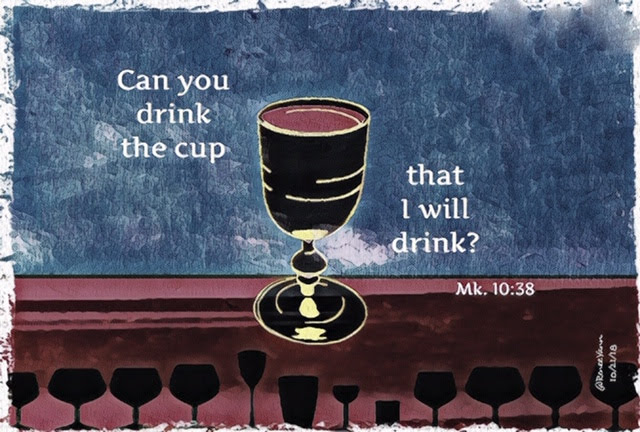
Mk 10_38 cup

Our Gospel recounts the story of the mother of James and John interceding for her sons with Jesus. Like many overprotective mothers, she intervenes even into their adult lives. She wants to make sure they get the best deal for their investment with Jesus.


Listen, I understand and love her! I would be the same way with my kids if I had any. I often say it’s best I had none because “Overprotective Me” would have had to shadow them to school, dances, playgrounds etc. until they were about 35 years old!

But the point of this Gospel story isn’t Mrs. Zebedee’s overprotectiveness.  It has little to do with Mrs. Zebedee at all.


The point is that “Mrs. Zebedee” (like many of us) has missed the whole POINT. The Gospel story is about US and the integrity of our choice to live a life in the pattern of Jesus.

Christ’s disciples have decided to follow a man who says things like this:

  • The last shall be first and the first, last.
  • Unless you lay down your life, you cannot follow me.
  • Whoever takes the lowly position of a child is the greatest in the Kingdom of Heaven.

The seats at Christ’s right and left, which Mrs. Zebedee requests for her sons, will bring them rewards only through humility and sacrificial service.


Here’s the way a 14th century artist imagined the Zebedee family. (Dad looks happy!)

sons of zebedee
Mary Salome and Zebedee with their Sons James the Greater and John the Evangelist
(c.1511) by Hans von Kulmbach, Saint Louis Art Museum

Jesus is gentle with “Mrs. Zebedee”. He understands how hard it is for any of us to comprehend the hidden glory of a deeply Christian life. We are surrounded by a world that screams the opposite to us:

  • Me first!
  • Stand your ground!
  • Good guys finish last!

So Jesus turns to James and John (and to us). One can imagine the bemused look on Christ’s face. He knows the hearts of his disciples. He knows they have already given themselves to him. So he asks them for a confession of faith, “Can you drink the cup that I will drink?”

veronese-le-christ-rencontrant-la-femme-et-les-fils-de-zebedee_-_grenoble
The meeting of Christ with Zebedee’s wife and sons by Paolo Veronese

Their humble, faith-filled answer no doubt stuns their mother. She is left in wonder at the holy men her sons have become. Perhaps it is the beginning of her own deep conversion to Christ.

As we pray with this passage,
where do we find ourselves in this scene?
How immediate, sincere, and complete
is our response to Jesus’ question:
“Can you drink the cup….?”

Prose: by Henri J.M. Nouwen, Can You Drink the Cup?

Drinking the cup that Jesus drank
is living a life in and with the spirit of Jesus,
which is the spirit of unconditional love.
The intimacy between Jesus and Abba, his Father,
is an intimacy of complete trust,
in which there are no power games,
no mutually agreed upon promises,
no advance guarantees.
It is only love
—pure, unrestrained, and unlimited love.
Completely open, completely free.
That intimacy gave Jesus the strength to drink his cup.
That same intimacy Jesus wants to give us
so that we can drink ours.


Music: The More I Seek You – Kari Jobe

Lent: Untie the Knots

March 15, 2022
Tuesday of the Second week of Lent

Today, in God’s Lavish Mercy, in Isaiah’s prophecy, God addresses some of the most famous sinners in the Bible — the residents of Sodom and Gomorrah. And the Divine manner of that address is both gentle and direct…

Come now … let us set things right!

Come now, let us set things right,
says the LORD:
Though your sins be like scarlet,
they may become white as snow;
Though they be crimson red,
they may become white as wool.
If you are willing, and obey,
you shall eat the good things of the land;
But if you refuse and resist,
the sword shall consume you:
for the mouth of the LORD has spoken!

Isaiah 1:18-20

Setting things right! Aren’t there times in our lives when we long for that? Not in the sense of vengeance or some vigilante justice, but rather in the sense of balance, equity, peace, and understanding in our lives.


Some things go wrong in our lives – that’s just the way it is. And sometimes we struggle endlessly and futilely to realign them.

Even in the most tranquil and “together” lives, there are places of irresolution – little knots in our life story of “why” and “why not”; of “if” and “if only”.

These may be places where we can’t really “forget” and so have not really forgiven. They may be nagging questions left unanswered because we hadn’t the courage to ask. They may be reasons we wanted to explain but no one wanted to listen. They may be excuses or pretenses we have made for so long that we have begun to believe them ourselves.

In almost all such instances, a scarlet concupiscence is at the root of our suffering or pain – sin, not only in the other, but in ourselves that longs to be made white as snow.


In many such cases, the time passes when we might reach out to the other for mutual healing. Death, distance, stubborn resistance and other walls may block us from worldly reconciliation.

But in God’s realm, healing is still possible, as is the power of our desire for the other to be healed with us.

in Isaiah’s beautiful passage, God invites us to full and eternal wholeness. That wholeness is achieved through our willingness to be open before God and to practice obedient listening in our prayer.

If you are willing, and obey,
you shall eat the good things of the land.

Isaiah 1:19

Let’s listen to and trust the awesome invitation in Isaiah:
“Come now, let us set things right”
… come to Me where I will allow you to forgive yourself as I forgive you.
Let us begin to untie any grace-resistant knot in your heart.
Untied, it also frees the other to seek their own healing.


Poetry: Forgiveness – George MacDonald

God gives his child upon his slate a sum –
To find eternity in hours and years;
With both sides covered, back the child doth come,
His dim eyes swollen with shed and unshed tears;
God smiles, wipes clean the upper side and nether,
And says, ‘Now, dear, we’ll do the sum together!’

Music: White As Snow – Maranatha Singers

Lent: The Way Home

March 13, 2022
Second Sunday of Lent

Today, in God’s Lavish Mercy, our readings are about types of citizenship, that condition of knowing we are fully and irrevocably home.


In Genesis, Abraham is given a land for himself and his descendants as a sign of God’s abiding Presence.

“I am the LORD who brought you from Ur of the Chaldeans
to give you this land as a possession.”

Genesis 15:5

In Philippians, Paul tells us that, truly, “our citizenship is in heaven”.

But our citizenship is in heaven,
and from it we also await a savior, the Lord Jesus Christ.

Philippians 3:20

In Luke, the transfigured Jesus shows us what that heavenly reality will be like. It is a kind of glorious belonging that Peter wants to hold on to … to capture in a tent.

Jesus took Peter, John, and James
and went up the mountain to pray.
While he was praying his face changed in appearance
and his clothing became dazzling white.

Luke 9:28

But the Creator makes it clear this dwelling and citizenship exists only in the heart of Christ where we are called to listen and live our lives.

While Peter was still speaking,
a cloud came and cast a shadow over them,
and they became frightened when they entered the cloud.
Then from the cloud came a voice that said,
“This is my chosen Son; listen to him.”

Luke 9:34-35

These readings confirm that, in God, we are a people not bound by borders, ethnicities, religious cult, or any other human categorization.

Every human being belongs to God and is called to live in the fullness of that Creation. This is our shared Divine citizenship demanding a reverent mutuality for one another’s lives.


Think about that in contrast to the incomprehensible outrage of Putin’s unprovoked war against the Ukrainian people. Think about it relative to the many armed conflicts in Africa, Asia and Latin and South America.

Think of our Oneness in God compared to talk of border walls, ethnic and religious bans, white supremacy, anti-semitism, islamophobia and all the other manufactured ways we try to isolate people from this Divine citizenship which makes us brothers and sisters in God.

On this Sunday when our readings remind us of where and to whom each of our hearts belongs, let us pray for our world – for those suffering from war and isolation, and for the unfortunate lost souls executing that suffering. In differing ways, each of them, and we, need continuing redemption.


Poetry: The Man He Killed – Thomas Hardy

Had he and I but met
By some old ancient inn,
We should have sat us down to wet
Right many a nipperkin!

But ranged as infantry,
And staring face to face,
I shot at him as he at me,
And killed him in his place.

I shot him dead because –
Because he was my for,
Just so: my foe of course he was;
That’s clear enough; although

He thought he’d ‘list, perhaps,
Off-hand like – just as I –
Was out of work — had sold his traps —
No other reason why.

Yes; quaint and curious war is!
You shoot a fellow down
You’d treat if met where any bar is,
Or help to half-a-crown.


Music: The Sins of War – Timothy Shortell

Lent: Persevering Prayer

March 9, 2022
Thursday of the First Week of Lent

Today, in Mercy, our readings could be so reassuring about the power of our prayer, except …..

How often have you prayed
for something that you didn’t get?


In our reading from the Book of Esther, Esther certainly puts everything she has into her prayer for deliverance:

Queen Esther – By Jean-François Portaels

She lay prostrate upon the ground, together with her handmaids,
from morning until evening, and said:
“God of Abraham, God of Isaac, and God of Jacob, blessed are you.
Help me, who am alone and have no help but you,
for I am taking my life in my hand.

The passage, in isolation from the rest of the Book, might lead us to conclude that Esther’s prayer is simply about her asking for, and receiving, what she wants from God. It’s about much more.


Esther, like Christ, is in a position to save her people. She must risk her life to do so. She is praying for the courage to do God’s will, to look past her own comfort and become an agent of grace in her circumstances.

Now that’s some kind of prayer!


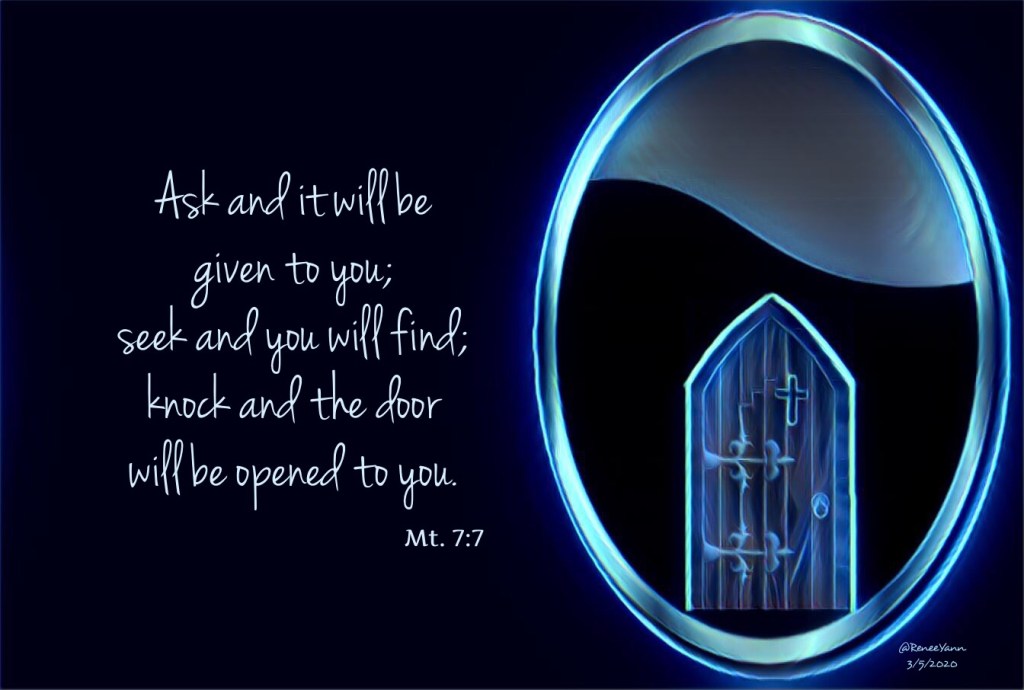
Prayer can be like looking in a mirror. All we see reflected back is our own need and desire. We don’t pray honestly and openly enough to let God open a door in the mirror – a door into God’s own will and hope for us.

That’s the door Jesus is talking about in today’s Gospel.

  • What we ASK is not just for something we want, but rather to know God’s heart.
  • What we SEEK is not our own satisfaction, but the grace to embrace God’s mysterious energy in our lives no matter how it comes to us.
  • What we KNOCK for and desire to be opened to us is deeper love and fuller relationship with our loving God.

Sometimes, the problem with prayer is that we think it’s like asking our rich uncle for a permanent loan. It’s only when we comprehend that prayer is a relationship that the RECEIVE, FIND, and OPENED parts become real for us.


Poetry: Morning Prayer – Renee Yann, RSM

Photo by WARREN BLAKE on Pexels.com

I walk the earth, soft
from yesterday’s long rain.
Mists ascend like incense
under my indulgent footfalls.
Birdsongs thin themselves
between the early light;
chanting, contrapuntal, in
the well-laved trees.

Nothing grey is left now
in the wide sky.
Rinsed in light
it spreads to dry
in sere, blue wind.

Momentarily, earth
is wholly God’s;
deep, true colors fall to it,
rich, unshadowed.
Your Word, Creator,
WaterGod, has penetrated.
It returns to You in crystal images
from a finally uncomplicated world.

As if within a lucent globe
I hold You still,
in perfect, silent love,
clear, inexplicable
like sunlit rain.


Music: two offerings today. One is old-time revival. The other is classic beauty. Enjoy.

Prayer Is the Key to Heaven – Alan Brewster

Music: Overture from Esther – George Frideric Handel

Lent: Second Chances

March 9, 2022
Wednesday of the Third Week of Lent

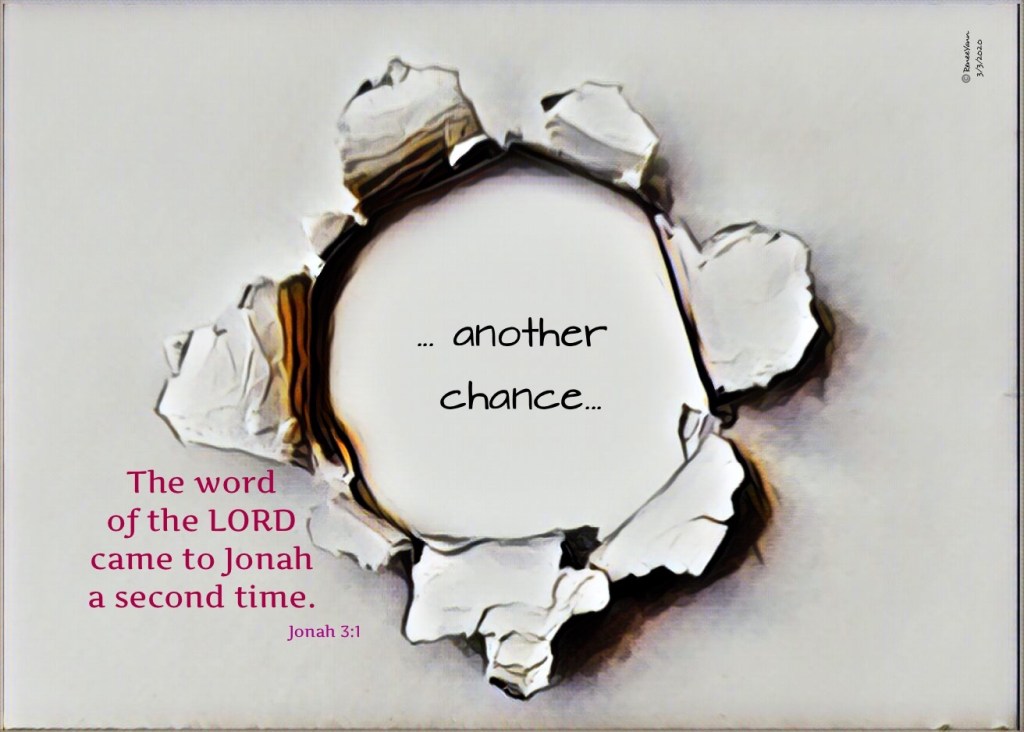
Today, in God’s Lavish Mercy, one line from our readings hit me like a lightening bolt:

The word of the LORD
came to Jonah
a second time.

Jonah 3:1

Yes, it’s the truth! God will keep coming back again and again to encourage us to hear the true message for our lives.

Our Gospel gives us a hint about how resistant we sometimes are to do this deep listening:

This generation is an evil generation;
it seeks a sign, but no sign will be given it,
except the sign of Jonah.

Luke 11:29

What is the sign of Jonah anyway?

To put it simply, it is the witness of the Resurrection – that overarching event that changed everything for believers. For just as Jonah was able to return from certain death in the whale’s belly, so Christ conquered death and rose to new life, promising us the same power.

This is the central, life-changing belief for Christians. It should make a difference in how we live.


By our Lenten repentance, we can be like Jonah, grasping the second chance God always gives us to respond to our life circumstances with faith, hope, and love.

I would bet there is something in your life right now that is calling you to such a response. Someplace in your life, you may be caught in a bit of a “whale’s belly 🐳” about some issue, am I right?

God makes us ask ourselves questions most often when He intends to resolve them. He gives us needs that He alone can satisfy, and awakens capacities that He means to fulfill. Any perplexity is liable to be a spiritual gestation, leading to a new birth and a mystical regeneration.

Thomas Merton, The Sign of Jonas

Today’s readings remind us that we already have the glorious sign of the Resurrection to inspire us to leap from that dark “belly” into God’s hope for us!


Poetry: WE ARE JONAH – Rabbi Rachel Barenblat

In Rabbi Eliezer’s vision
Jonah entered the whale’s mouth
as we enter a synagogue.
Light streamed in through its eyes.
Jonah approached the bimah, the whale’s head.
Show me wonders, he said, as though
his own life weren’t a miracle.

The whale obliged, swimming down
to the foundation stone,
the navel of creation
fixed deep beneath the land.
Tsk tsk, chided the fish:
you’re beneath God’s temple —
you should pray.

Prayer requires stillness.
Running away had always been
so easy. Sitting silent
in self-judgement — forget it!
But waves only churn the surface.
In the deep beneath the deep
Jonah was wholly present.

We all flee
from uncomfortable conversations
the drip of a hospital IV
the truths we don’t want to own
the work we don’t want to do.
Now we’re in the belly of the whale,
someplace deep and strange.

God calls us to awareness:
to stand our ground
in the place where we are,
to do the work which needs doing.
To bring kindness and mercy
even to those who are unlike us.
Are we listening?


Music: a fun song “In the Belly of Whale” – The Newsboys