Tuesday of the Fifteenth Week in Ordinary Time

Tuesday, July 13, 2021

Today, in God’s Lavish Mercy, we pray with Psalm 69 whose speaker, not to make a pun, is in bad straits!

I am sunk in the abysmal swamp
    where there is no foothold;
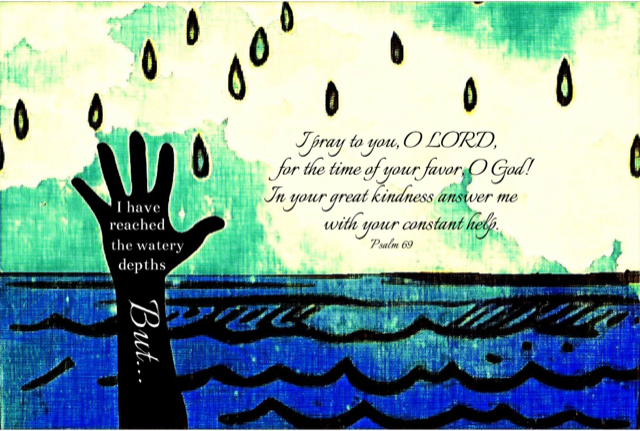
I have reached the watery depths;
    the flood overwhelms me.

Psalm 69:3

This is painful stuff – the kind of desperate pain we find threaded throughout the psalms in the prayers of lament.

These laments follow a pattern:

  • a petition for God’s help
  • multiple repetitions of this plea
  • detailed descriptions of the suffering being endured
  • proclamations of the sufferer’s innocence
  • assurances of the sufferer’s goodness
  • and often, a list of suggestions about how God should solve the problem

So the prayer, at least mine, would go something like this:

  • Dear God, please help me get out of this mess!
  • Do something, please. I know you can do something!
  • I am being harassed and destroyed. Let me tell you all about it.!
  • And it’s not my fault- (well, not completely anyway)
  • I try to be a good person and look what happens anyway!
  • I still believe in you and pray that you take care of my persecutors
  • (By the way, here are some tips on how you might do that, God.)

All in all, such a lament is a really healthy prayer. If we pray it completely, we get to the “BUT” of the pictured verse – that place where we allow God to teach and change us.

When we pray like this, we do these things in God’s Presence:

  • recognize our pain and name it
  • admit that we need help
  • analyze what’s really at the root of our pain
  • acknowledge our part in causing the suffering
  • rehearse our vengeance until we have exhausted it
  • reclaim our faith as a way to healing
  • THEN allow God to convert us to the Love of which we are made

The psalmist has given us a gift by laying out such vulnerability for us. It is healing to humbly and honestly pray this psalm when we are “overwhelmed” by hurt, confusion, anger, fear or any form of desperation.

The psalm is a script for
unburdening negation in God’s presence.
It is a script for rehabilitation to
the community of praise and thanks.

Walter Brueggemann

We may have to pray Psalm 69 many times before we let God through to teach us the real meaning of our suffering. It is only then that we might pray the psalm’s final verses:

See, you humble ones, and be glad;
you who seek God, take heart!
For the LORD hears us,
and does not turn away from our pain.
Let the heaven and the earth praise God,
the seas and whatever moves in them!
For God will rescue usand rebuild us
so that we can be at home with ourselves
as the dwelling place of God.

Psalm 69: 33-36

Poetry: Psalm 69 – Christine Robinson

Save me, O God,
I have gotten myself in deep waters.
and find no firm ground under my feet.

I am tired of crying.
I feel at war with myself and with others;
I’m unable to do what is expected of me.

O God, you know my foolishness and my faults—
Do you love me anyway?
I really am sinking.

These rushing, dark waters are going to swallow me up.
Answer me, God!
Your loving kindness would save me.

If I could see your face, it would be enough
to ease my distress and help me relax in the flood.
I will remember that you are here,
even in the torrent, even in the war.

I will give thanks for the small beauties
and kindnesses of the day.
And for the love that is in my heart.

Music: Deep Water – American Authors 

Monday of the Fifteenth Week in Ordinary Time

Monday, July 12, 2021

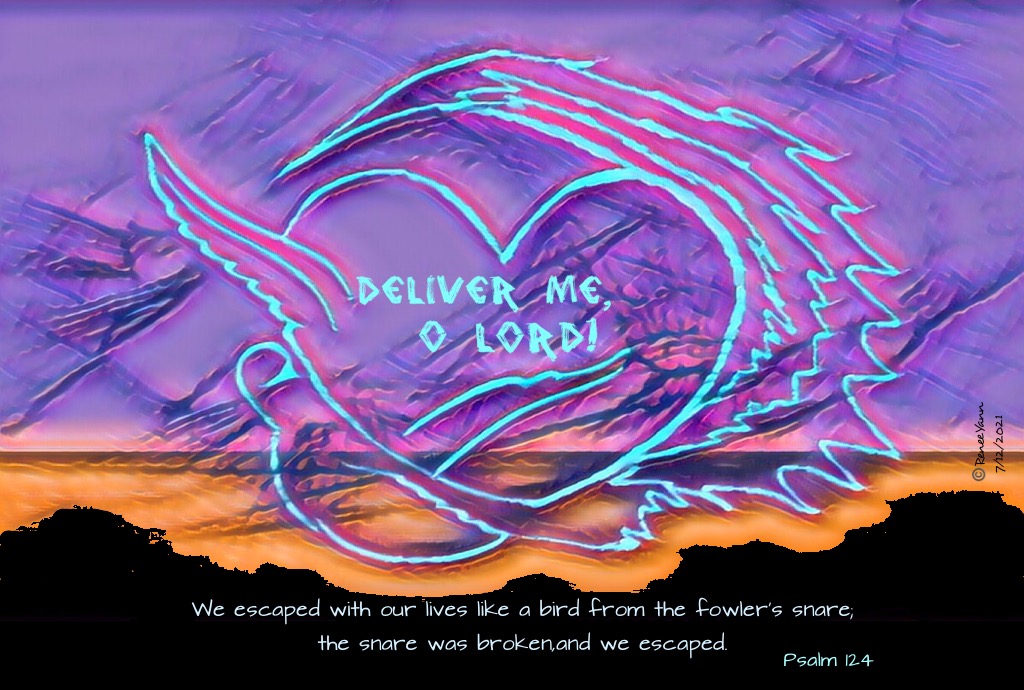
Today, in God’s Lavish Mercy, we pray with Psalm 124 which is a raw remembering of how bad things could have been without God’s help.

The psalm opens with these lines:

Had not the LORD been with us,
let Israel say,
Had not the LORD been with us,
when all rose against us,
Then we would have been swallowed alive,
for fury blazed against us.

Psalm 124: 1-3

Have you been there? What flares up to swallow your life, your hope, can wear many disguises: 


or the many forms of hunger and dying.


The psalm calls us to remember these things for two reasons:

  1. so that we don’t get caught again
  2. and that if – sadly – we do, we remember who freed us

We were rescued like a bird 
    from the fowlers’ snare;
Broken was the snare, 
    and we were freed.
Our help is in the name of the LORD,
    who made heaven and earth.

Psalm 124: 7-8

The release from such snares
does not return us to the way things were.
There will be
wounds and wisdom
to change us.
It depends on us which we choose to cherish.

“Re-membering” ourselves, pulling our new selves together in God, releases us to fuller, deeper life.

Our help is in the name of the LORD,
the maker of heaven and earth.

… so surely that Omnipotent God can heal and remake us.

Remember, this and a few other of my images have been set beautifully into cards by Sister Judy Ward, RSM.
You can contact her at

Poetry: The Fowler by Wilfrid Wilson Gibson (1868-1962)

A wild bird filled the morning air 
With dewy-hearted song; 
I took it in a golden snare 
Of meshes close and strong. 
But where is now the song I heard? 
For all my cunning art, 
I who would house a singing bird 
Have caged a broken heart.

Music: Peter Kater – Wings

Thursday of the Thirteenth Week in Ordinary Time

July 1, 2021

Today, in God’s Lavish Mercy, we pray with Psalm 115, bringing a welcome comfort after the always disturbing story of Isaac’s aborted sacrifice.

This story fascinated Rembrandt. Notice the differences between the 1635 and 1655 interpretations. The old man in the 1655 image has darkened eyes, covers his son’s eyes – not his mouth, and embraces the boy in his lap not laid out on an altar. Old age has gentled what Rembrandt found in the story.


But here’s what I think. It was never about a human sacrifice. God was never going to let that happen.

It was about whether Abraham’s trust would allow him to really see God – God who is never a God of death, but always of life.

As Abraham looked about,
he spied a ram caught by its horns in the thicket.
So he went and took the ram
and offered it up as a burnt offering in place of his son.
Abraham named the site Yahweh-yireh;
hence people now say, “On the mountain the LORD will see.”


We live in a world full of choices that run the gamut from death-dealing to life-giving. They may be small, personal choices like what we eat, or how we drive. Or they may be more consequential choices such as the political views we foster or the global ideologies we embrace.

Psalm 115 helps us to solve any confusion we might have about our choices. Always make the choices that lead ourselves and others to the land of the living.

Abraham must have been thrown into the dark by what he believed was God’s expectation of him. But it was really Abraham’s own expectation that had to be broken through. He did this by staying with his pain while trusting that God was bigger than it.

Christine Robinson’s interpretation of Psalm 115 fits well here:

O Great Mystery
   We must love and praise you without understanding.
You are not a little tin god
   with eyes that do not see and ears that do not hear
   and a mouth that does not speak.
You can not be described or boxed up or tamed
   You are beyond our understanding.
Still, we yearn to hear you, know you,
   feel your love, and in mystery, we do.
We know awe at the intricate majesty of the heavens,
We cherish the work of caring for each other 
and the Earth.
We praise you, Great Mystery
   all the days of our lives.

Poetry: Silence – Rabbi Rachel Barenblat

Abraham failed the test.
For Sodom and Gomorrah he argued
but when it came to his son
no protest crossed his lips.
God was mute with horror.
Abraham, smasher of idols
and digger of wells
was meant to talk back.
Sarah would have been wiser
but Abraham avoided her tent,
didn’t lay his head in her lap
to unburden his secret heart.
In stricken silence God watched
as Abraham saddled his ass
and took Isaac on their final hike
to the place God would show him.
The angel had to call him twice.
Abraham’s eyes were red, his voice hoarse
he wept like a man pardoned
but God never spoke to him again.

(It is true that, in Genesis, this is the last recorded exchange between God and Abraham!)


Music: Story of Isaac – Leonard Cohen

(If there’s no picture below, just click on the underlined phrase “Watch on Youtube

The door, it opened slowly
My father, he came in
I was nine years old
And he stood so tall above me
Blue eyes, they were shining
And his voice was very cold
Said, "I've had a vision
And you know I'm strong and holy
I must do what I've been told"
So we started up the mountain
I was running, he was walking
And his axe was made of gold

Well, the trees, they got much smaller
The lake, a lady's mirror
When we stopped to drink some wine
Then he threw the bottle over
Broke a minute later
And he put his hand on mine
Thought I saw an eagle
But it might have been a vulture
I never could decide
Then my father built an altar
He looked once behind his shoulder
He knew I would not hide

You who build these altars now
To sacrifice these children
You must not do it anymore
A scheme is not a vision
And you never have been tempted
By a demon or a god
You, who stand above them now
Your hatchets blunt and bloody
You were not there before
When I lay upon a mountain
And my father's hand was trembling
With the beauty of the word

And if you call me brother now
Forgive me if I inquire
Just according to whose plan?
When it all comes down to dust
I will kill you if I must
I will help you if I can
When it all comes down to dust
I will help you if I must
I will kill you if I can
And mercy on our uniform
Man of peace or man of war
The peacock spreads his fan

Saturday of the Eleventh Week in Ordinary Time

Saturday, June 19, 2021

Today, in God’s Lavish Mercy, we pray with Psalm 34 once again. With its two accompanying readings, the psalm hits me right between the eyes with this awareness:

Those of us trying to live in God’s presence, the world isn’t going to help us. We will be in contradiction to many, if not most, popular values. Our choices may be questioned, if not ridiculed. Our values may be explained away. Our integrity may be challenged. 

What’s it like to live a faith-based life in today’s culture? The image that comes to my mind is that of trying to play soccer with a square ball! 

Paul felt the dissonance:

But the Lord said to me, “My grace is sufficient for you,
for power is made perfect in weakness.”
So I will rather boast most gladly of my weaknesses,
in order that the power of Christ may dwell with me.
Therefore, I am content with weaknesses, insults,
hardships, persecutions, and constraints,
for the sake of Christ …


Jesus put the contradiction in a nutshell for us:

No one can serve two masters.
You will either hate one and love the other,
or be devoted to one and despise the other.
You cannot serve God and mammon.


So we need to figure out our “mammon” and vanquish it. We need to make the choice that Paul, the psalmist, and Jesus made. Let’s pray on it today.


Poetry: Contraband – Denise Levertov

The tree of knowledge was the tree of reason.
That’s why the taste of it
drove us from Eden. That fruit
was meant to be dried and milled to a fine powder
for use a pinch at a time, a condiment.
God had probably planned to tell us later
about this new pleasure.
                                   We stuffed our mouths full of it,
gorged on but and if and how and again
but, knowing no better.
It’s toxic in large quantities; fumes
swirled in our heads and around us
to form a dense cloud that hardened to steel,
a wall between us and God, Who was Paradise.
Not that God is unreasonable – but reason
in such excess was tyranny
and locked us into its own limits, a polished cell
reflecting our own faces. God lives
on the other side of that mirror,
but through the slit where the barrier doesn’t
quite touch ground, manages still
to squeeze in – as filtered light,
splinters of fire, a strain of music heard
then lost, then heard again.


Music: I Choose You Now – Rend Collective

Monday of the Tenth Week in Ordinary Time

Monday, June 7, 2021

Today, in God’s Lavish Mercy, we pray with Psalm 34, filled with lovely images assuring us of God’s abiding mercy. This mercy moves the psalmist to promise perpetual praise – that means “no matter what”!

I will bless the LORD at all times;
    praise shall be ever in my mouth.
Let my soul glory in the LORD;
    the lowly will hear me and be glad.

Psalm 34:2-3

By telling about God’s loving intervention in our lives, the psalmist invites everyone to join in praise:

Glorify the LORD with me,
    let us together extol God’s name.
I sought the LORD who answered me
    and delivered me from all my fears.

Psalm 34:4-5

I’m not so sure it’s an easy thing to rejoice in another’s blessing when we ourselves are feeling overlooked by God. But that’s the whole point of the psalm. It is WE who feel overlooked, not God who is overlooking. 

It is as if we have turned our back to a brilliant sun and complained how cloudy it is. The psalmist says, “Stop that … turn your self around.

Look to God that you may be radiant with joy,
    and your faces may not blush with shame.
When the suffering one called out, the LORD heard,
    and from all distress was saved. 

Psalm 34:6-7

Notice that they were not saved from suffering but from distress. Such salvation rests in the confidence that, even in suffering, we are never alone; that when we take refuge in God, palpable blessing ensues.

The angel of the LORD encamps
    around those who reverence God, and delivers them.
Taste and see how good the LORD is;
    blessed the one who takes refuge in God’s embrace.

Psalm 34:8-9

Surely Psalm 34 calls us
to live in the spirit of the Beatitudes
which we can savor in today’s Gospel.

Poetry: Safe Harbor by Robert B. Shaw


Music: Two songs suggested themselves today. Here are both🤗 Enjoy!

Multiplied by needtobreathe
(notice the radiant diamonds)

Psalm 34 – Brooklyn Tabernacle Choir

I sought the Lord
And He answered me
And delivered me
From every fear
Those who look on Him
Are radiant
They'll never be ashamed

This poor man cried
And the Lord heard me
And saved me from
My enemies
The Son of God
Surrounds His saints
He will deliver them

Magnify the Lord with me
Come exalt His name together
Glorify the Lord with me
Come exalt His name forever
Oh taste and see
That the Lord is good
Oh blessed is he
Who hides in Him
Oh fear the Lord
Oh all you saints
He'll give you everything

Magnify the Lord with me
Come exalt His name together
Glorify the Lord with me
Come exalt His name forever
Magnify the Lord with me
Come exalt His name together
Glorify the Lord with me
Come exalt His name forever

Let us bless the Lord
Every day and night
Never ending praise
May our incense rise

Let us bless the Lord
Every day and night
Never ending praise
May our incense rise

Let us bless the Lord
Every day and night
Never ending praise
May our incense rise
Every day and night
Never ending praise
May our incense rise

Magnify the Lord with me
Come exalt His name together
Glorify the Lord with me
Come exalt His name forever
Magnify the Lord with me
Come exalt His name together
Glorify the Lord with me
Come exalt His name forever
Oh taste and see
That the Lord is good
He'll give you everything

Friday of the Ninth Week in Ordinary Time

June 4, 2021

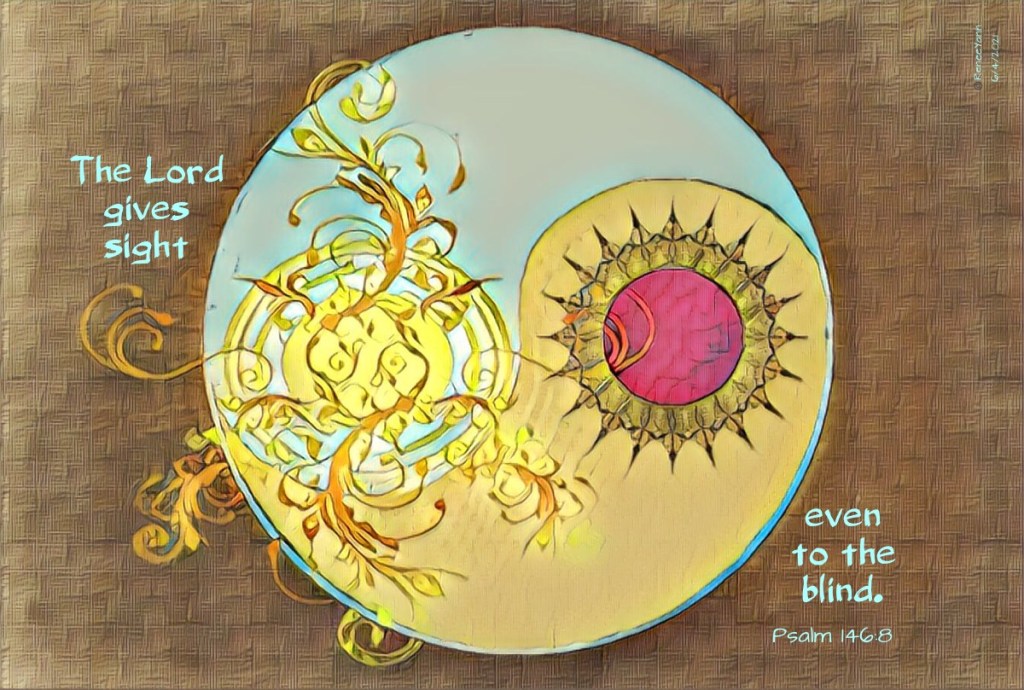
Today, in God’s Lavish Mercy, we pray with Psalm 146, a song of uninhibited delight and thanksgiving to God.

Coming after our reading from Tobit, we see just what such utter delight looks like.

That “angelic fish gall” re-lit the world for Tobit in a way he had never imagined before!


Sometimes we too have to experience a profound blindness before we really begin to see rightly. Let’s be honest: haven’t we all been blind a few times in our lives.

  • Blessings unrecognized
  • Friendships taken for granted
  • Kindnesses overlooked
  • People misjudged 
  • Needs ignored
  • Expectations unsurrendered 
  • Biases unexamined
  • Opportunities bypassed
  • Perhaps even responsibilities shirked

Praying with Psalm 146, we might take note of those whom the Lord favors:

the oppressed, the hungry. captives, those who are bowed down; 
the just, strangers, orphans and widows

These favored of God share a common trait – a vulnerability learned through suffering.


None of us seeks suffering in our lives. But we all will encounter it personally at least to some degree. Further, all in the community of faith are called to share the sufferings of others by our works of mercy.

In both instances, can we allow suffering to let us see the world differently, to lift the scales of any blindness in our hearts? Because here is the beautiful mystery: the God of Mercy is with us in our lights and shadows — and is always Light.

Praise the LORD, O my soul;
    I will praise the LORD all my life;
    I will sing praise to my God while I live. 

Psalm 146:1

Poetry: God Pours Light – Hafiz

God
pours light
into every cup,
quenching darkness.
The proudly pious
stuff their cups with parchment
and critique the taste of ink
while God pours light
and the trees lift their limbs
without worry of redemption,
every blossom a chalice.
May I seduce those withered souls
with words that wet their parched lips
as light
pours like rain
into every empty cup
set adrift on the Infinite Ocean.


Music: Amazing Grace – Leo Rojas

Thursday of the Eighth Week in Ordinary Time

May 27, 2021

Today, in God’s Lavish Mercy, we pray with Psalm 33. It is a song of extravagant praise to the Creator of a universe which extends infinitely both within and without us.


Our readings call us to be aware – to see – this infinite power and generosity of God, and to order our life upon the abundance of that vision.

Our lyrical passage from Sirach includes this:

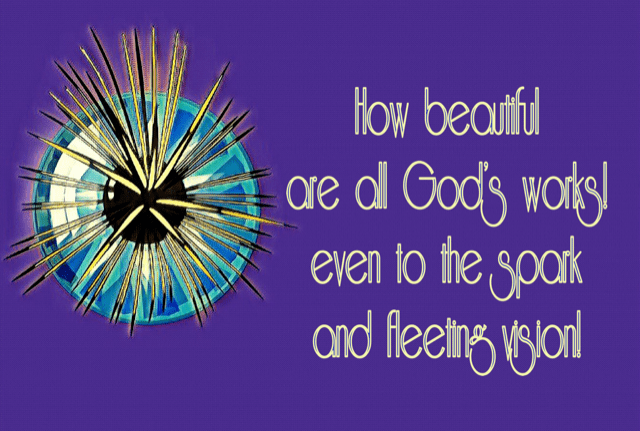
How beautiful are all God’s works!
    even to the spark and fleeting vision!
The universe lives and abides forever;
    to meet each need, each creature is preserved.
All of them differ, one from another,
    yet none of them has God made in vain,
For each in turn, as it comes, is good;
    can one ever see enough of their splendor?

Sirach 15:22-25

In Mark’s Gospel, a blind man – one who longs to see – cries out for Jesus:

Jesus stopped and said, “Call him.”
So they called the blind man, saying to him,
“Take courage; get up, Jesus is calling you.”
He threw aside his cloak, sprang up, and came to Jesus.
Jesus said to him in reply, “What do you want me to do for you?”
The blind man replied to him, “Master, I want to see.
Jesus told him, ‘Go your way; your faith has saved you.”
Immediately he received his sight and followed him on the way.

Mark 10:49-52

God is calling us too, as we pray Psalm 33, to be grateful, to trust, to SEE the wonders around and within us:

Give thanks to the LORD on the harp;
on the ten-stringed lyre offer praise.
Sing to God a new song;
skillfully play with joyful chant.
For the LORD’s word is upright,
and works are trustworthy.
God loves justice and right.
The earth is full of the mercy of the LORD.

Psalm 33:2-5

This kind of seeing is more than just looking.
It is letting go of prefabricated expectation.
It is waiting in trust for the Invisible
to capture our hearts.

Prose: from de Chardin

Seeing. One could say that the whole of life lies in seeing — if not ultimately, at least essentially. To be more is to be more united — and this sums up and is the very conclusion of the work to follow. But unity grows, and we will affirm this again, only if it is supported by an increase of consciousness, of vision. That is probably why the history of the living world can be reduced to the elaboration of ever more perfect eyes at the heart of a cosmos where it is always possible to discern more. Are not the perfection of an animal and the supremacy of the thinking being measured by the penetration and power of synthesis of their glance? To try to see more and to see better is not, therefore, just a fantasy, curiosity, or a luxury. See or perish. This is the situation imposed on every element of the universe by the mysterious gift of existence. And thus, to a higher degree, this is the human condition.”
(Pierre Teilhard de Chardin: The Human Phenomenon, trans. Sarah Appleton-Weber, p. 3)

Music: Vision of Change by Back to Earth

Third Sunday of Easter

April 18, 2021

Today, in God’s Lavish Mercy, we pray with Psalm 4 which describes the spiritual contentment of one who tries to respond faithfully to an ever-faithful God:

The psalmist’s faithful response is driven by a deep repentance – a conversion, a turning toward the Light.

Let your heart be awestruck by God’s steadfast love.
Sin no more;
Turn to God in the depth of your spirit.
Examine your heart in silence 
as you offer your evening prayer.

Psalm 4: 4-5

I think that, even in the most brilliant souls, there are still corners yearning for Light. Until we are transfigured by death, such is the human condition. This is the case with the people Peter addresses in our first reading, John in our second. Even the faithful disciples are called to greater Light in today’s Gospel.

Jesus said to them:
Thus it is written that the Christ would suffer
and rise from the dead on the third day
and that repentance, for the forgiveness of sins,
would be preached in his name
to all the nations, beginning from Jerusalem.
You are witnesses of these things.

Luke 24:46-48

Today, as we pray, might there be a shadowed corner we would like to turn toward Grace? What places in our sometimes darkened world shall we plead before the Merciful Light?

Poetry: Light – Today’s poem by George Macdonald is long, but oh so worth the time and focus. I encourage you to revisit often, taking small excerpts to cherish.

George Macdonald (10 December 1824 – 18 September 1905) was a Scottish author, poet and Christian minister. He was a pioneering figure in the field of fantasy literature and the mentor of fellow writer Lewis Carroll. In addition to his fairy tales, MacDonald wrote several works on Christian apologetics.

His writings have been cited as a major literary influence by many notable authors including W. H. Auden, J. M. Barrie, Lord Dunsany, Hope Mirrlees, Robert E. Howard, L. Frank Baum, T.H. White, Lloyd Alexander, C. S. Lewis, J. R. R. Tolkien, Walter de la Mare, E. Nesbit, Peter S. Beagle, Neil Gaiman and Madeleine L’Engle. 

C. S. Lewis wrote that he regarded MacDonald as his “master”: “Picking up a copy of Phantastes one day at a train-station bookstall, I began to read. A few hours later”, said Lewis, “I knew that I had crossed a great frontier.” G. K. Chesterton cited The Princess and the Goblin as a book that had “made a difference to my whole existence”.


Light 

First-born of the creating Voice!
Minister of God’s Spirit, who wast sent
Waiting upon him first, what time he went
Moving about mid the tumultuous noise
Of each unpiloted element
Upon the face of the void formless deep!
Thou who didst come unbodied and alone
Ere yet the sun was set his rule to keep,
Or ever the moon shone,
Or e’er the wandering star-flocks forth were driven!
Thou garment of the Invisible, whose skirt
Sweeps, glory-giving, over earth and heaven!
Thou comforter, be with me as thou wert
When first I longed for words, to be
A radiant garment for my thought, like thee!

We lay us down in sorrow,
Wrapt in the old mantle of our mother Night;
In vexing dreams we strive until the morrow;
Grief lifts our eyelids up-and Lo, the light!
The sunlight on the wall! And visions rise
Of shining leaves that make sweet melodies;
Of wind-borne waves with thee upon their crests;
Of rippled sands on which thou rainest down;
Of quiet lakes that smooth for thee their breasts;
Of clouds that show thy glory as their own;
O joy! O joy! the visions are gone by!
Light, gladness, motion, are reality!

Thou art the god of earth. The skylark springs
Far up to catch thy glory on his wings;
And thou dost bless him first that highest soars.
The bee comes forth to see thee; and the flowers
Worship thee all day long, and through the skies
Follow thy journey with their earnest eyes.
River of life, thou pourest on the woods,
And on thy waves float out the wakening buds;
The trees lean toward thee, and, in loving pain,
Keep turning still to see thee yet again;
South sides of pines, haunted all day by thee,
Bear violins that tremble humanly.
And nothing in thine eyes is mean or low:
Where’er thou art, on every side,
All things are glorified;
And where thou canst not come, there thou dost throw
Beautiful shadows, made out of the dark,
That else were shapeless; now it bears thy mark.

And men have worshipped thee.
The Persian, on his mountain-top,
Waits kneeling till thy sun go up,
God-like in his serenity.
All-giving, and none-gifted, he draws near,
And the wide earth waits till his face appear-
Longs patient. And the herald glory leaps
Along the ridges of the outlying clouds,
Climbing the heights of all their towering steeps.
Sudden, still multitudinous laughter crowds
The universal face: Lo, silently,
Up cometh he, the never-closing eye!
Symbol of Deity, men could not be
Farthest from truth when they were
kneeling unto thee!

Thou plaything of the child,
When from the water’s surface thou dost spring,
Thyself upon his chamber ceiling fling,
And there, in mazy dance and motion wild,
Disport thyself-etherial, undefiled.
Capricious, like the thinkings of the child!
I am a child again, to think of thee
In thy consummate glee.
How I would play with thee, athirst to climb
On sloping ladders of thy moted beams,
When through the gray dust darting in long streams!
How marvel at the dusky glimmering red,
With which my closed fingers thou hadst made
Like rainy clouds that curtain the sun’s bed!
And how I loved thee always in the moon!
But most about the harvest-time,
When corn and moonlight made a mellow tune,
And thou wast grave and tender as a cooing dove!
And then the stars that flashed cold, deathless love!
And the ghost-stars that shimmered in the tide!
And more mysterious earthly stars,
That shone from windows of the hill and glen-
Thee prisoned in with lattice-bars,
Mingling with household love and rest of weary men!
And still I am a child, thank God!-to spy
Thee starry stream from bit of broken glass
Upon the brown earth undescried,
Is a found thing to me, a gladness high,
A spark that lights joy’s altar-fire within,
A thought of hope to prophecy akin,
That from my spirit fruitless will not pass.

Thou art the joy of age:
Thy sun is dear when long the shadow falls.
Forth to its friendliness the old man crawls,
And, like the bird hung out in his poor cage
To gather song from radiance, in his chair
Sits by the door; and sitteth there
His soul within him, like a child that lies
Half dreaming, with half-open eyes,
At close of a long afternoon in summer-
High ruins round him, ancient ruins, where
The raven is almost the only comer-
Half dreams, half broods, in wonderment
At thy celestial ascent
Through rifted loop to light upon the gold
That waves its bloom in some high airy rent:
So dreams the old man’s soul, that is not old,
But sleepy mid the ruins that infold.

What soul-like changes, evanescent moods,
Upon the face of the still passive earth,
Its hills, and fields, and woods,
Thou with thy seasons and thy hours art ever calling forth!
Even like a lord of music bent
Over his instrument,
Giving to carol, now to tempest birth!
When, clear as holiness, the morning ray
Casts the rock’s dewy darkness at its feet,
Mottling with shadows all the mountain gray;
When, at the hour of sovereign noon,
Infinite silent cataracts sheet
Shadowless through the air of thunder-breeding June;
When now a yellower glory slanting passes
‘Twixt longer shadows o’er the meadow grasses;
And now the moon lifts up her shining shield,
High on the peak of a cloud-hill revealed;
Now crescent, low, wandering sun-dazed away,
Unconscious of her own star-mingled ray,
Her still face seeming more to think than see,
Makes the pale world lie dreaming dreams of thee!
No mood, eternal or ephemeral,
But wakes obedient at thy silent call!

Of operative single power,
And simple unity the one emblem,
Yet all the colours that our passionate eyes devour,
In rainbow, moonbow, or in opal gem,
Are the melodious descant of divided thee.
Lo thee in yellow sands! Lo thee
In the blue air and sea!
In the green corn, with scarlet poppies lit,
Thy half-souls parted, patient thou dost sit.
Lo thee in dying triumphs of the west!
Lo thee in dew-drop’s tiny breast!
Thee on the vast white cloud that floats away,
Bearing upon its skirt a brown moon-ray!
Gold-regent, thou dost spendthrift throw
Thy hoardless wealth of gleam and glow!
The thousand hues and shades upon the flowers
Are all the pastime of thy leisure hours;
The jewelled ores in mines that hidden be,
Are dead till touched by thee.

Everywhere,
Thou art lancing through the air!
Every atom from another
Takes thee, gives thee to his brother;
Continually,
Thou art wetting the wet sea,
Bathing its sluggish woods below,
Making the salt flowers bud and blow;
Silently,
Workest thou, and ardently,
Waking from the night of nought
Into being and to thought;

Influences
Every beam of thine dispenses,
Potent, subtle, reaching far,
Shooting different from each star.
Not an iron rod can lie
In circle of thy beamy eye,
But its look doth change it so
That it cannot choose but show
Thou, the worker, hast been there;
Yea, sometimes, on substance rare,
Thou dost leave thy ghostly mark
Even in what men call the dark.
Ever doing, ever showing,
Thou dost set our hearts a glowing-
Universal something sent
To shadow forth the Excellent!

When the firstborn affections-
Those winged seekers of the world within,
That search about in all directions,
Some bright thing for themselves to win-
Through pathless woods, through home-bred fogs,
Through stony plains, through treacherous bogs,
Long, long, have followed faces fair,
Fair soul-less faces, vanished into air,
And darkness is around them and above,
Desolate of aught to love,
And through the gloom on every side,
Strange dismal forms are dim descried,
And the air is as the breath
From the lips of void-eyed Death,
And the knees are bowed in prayer
To the Stronger than despair-
Then the ever-lifted cry,
Give us light, or we shall die,
Cometh to the Father’s ears,
And he hearkens, and he hears:-

As some slow sun would glimmer forth
From sunless winter of the north,
We, hardly trusting hopeful eyes,
Discern and doubt the opening skies.
From a misty gray that lies on
Our dim future’s far horizon,
It grows a fresh aurora, sent
Up the spirit’s firmament,
Telling, through the vapours dun,
Of the coming, coming sun!
Tis Truth awaking in the soul!
His Righteousness to make us whole!
And what shall we, this Truth receiving,
Though with but a faint believing,
Call it but eternal Light?
‘Tis the morning, ’twas the night!

All things most excellent
Are likened unto thee, excellent thing!
Yea, he who from the Father forth was sent,
Came like a lamp, to bring,
Across the winds and wastes of night,
The everlasting light.
Hail, Word of God, the telling of his thought!
Hail, Light of God, the making-visible!
Hail, far-transcending glory brought
In human form with man to dwell-
Thy dazzling gone; thy power not less
To show, irradiate, and bless;
The gathering of the primal rays divine
Informing chaos, to a pure sunshine!

Dull horrid pools no motion making!
No bubble on the surface breaking!
The dead air lies, without a sound,
Heavy and moveless on the marshy ground.

Rushing winds and snow-like drift,
Forceful, formless, fierce, and swift!
Hair-like vapours madly riven!
Waters smitten into dust!
Lightning through the turmoil driven,
Aimless, useless, yet it must!

Gentle winds through forests calling!
Bright birds through the thick leaves glancing!
Solemn waves on sea-shores falling!
White sails on blue waters dancing!
Mountain streams glad music giving!
Children in the clear pool laving!
Yellow corn and green grass waving!
Long-haired, bright-eyed maidens living!
Light, O radiant, it is thou!
Light!-we know our Father now!

Forming ever without form;
Showing, but thyself unseen;
Pouring stillness on the storm;
Breathing life where death had been!
If thy light thou didst draw in,
Death and Chaos soon were out,
Weltering o’er the slimy sea,
Riding on the whirlwind’s rout,
In wild unmaking energy!
God, be round us and within,
Fighting darkness, slaying sin.

Father of Lights, high-lost, unspeakable,
On whom no changing shadow ever fell!
Thy light we know not, are content to see;
Thee we know not, and are content to be!-
Nay, nay! until we know thee, not content are we!
But, when thy wisdom cannot be expressed,
Shall we imagine darkness in thy breast?
Our hearts awake and witness loud for thee!
The very shadows on our souls that lie,
Good witness to the light supernal bear;
The something ‘twixt us and the sky
Could cast no shadow if light were not there!
If children tremble in the night,
It is because their God is light!
The shining of the common day
Is mystery still, howe’er it ebb and flow-
Behind the seeing orb, the secret lies:
Thy living light’s eternal play,
Its motions, whence or whither, who shall know?-
Behind the life itself, its fountains rise!
In thee, the Light, the darkness hath no place;
And we have seen thee in the Saviour’s face.

Enlighten me, O Light!-why art thou such?
Why art thou awful to our eyes, and sweet?
Cherished as love, and slaying with a touch?
Why in thee do the known and unknown meet?
Why swift and tender, strong and delicate?
Simple as truth, yet manifold in might?
Why does one love thee, and another hate?
Why cleave my words to the portals of my speech
When I a goodly matter would indite?
Why mounts my thought of thee beyond my reach?
-In vain to follow thee, I thee beseech,
For God is light.

Music: Heaven’s Window – Peter Kater

Friday of the Second Week of Easter

April 16, 2021


Today, in God’s Lavish Mercy, we pray with Psalm 27, the prayer of one confident in God’s loving protection, no matter any surrounding threat. The psalmist exudes the equanimity of one who has given everything over to Love, who seeks only one fulfillment:

One thing I ask of the LORD;
this I seek:
To dwell in the LORD’s house
all the days of my life,
To gaze on the LORD’s beauty,
to visit his temple.

Psalm 27:4

I remember praying this psalm so intently as a young novice! I so wanted to understand and deepen in the spiritual life. I so wanted to be completely in love with God.


Gamaliel, from our first reading, has grown into such a love. It has freed him to respond to the Spirit even when the Spirit astounds, contradicts, and demands change.

Gamaliel said to the Sanhedrin…“So now I tell you,
have nothing to do with these men, and let them go.
For if this endeavor or this activity is of human origin,
it will destroy itself.

But if it comes from God, you will not be able to destroy them; you may even find yourselves fighting against God.”

Acts 5: 38-39

It seems that Gamaliel is speaking from experience. He likely had his big or little tussles with the Spirit along the now long road of his life. He has one even today as Jesus’s pesky disciples challenge Gamaliel’s long-held religious practice.


But it is likely that a prayer like Psalm 27 rose up in the heart of this longtime friend of God:

The LORD is my light and my salvation;
whom should I fear?
The LORD is my life’s refuge;
of whom should I be afraid?

For I am protected in the Lord’s shelter
when troubles threaten,
wrapped in the folds of the Lord’s tent,
set high upon the rock’s safety.

Psalm 27: 1,5

As we pray beautiful Psalm 27 today, may we remember our early, enthusiastic love. May we give thanks for the accumulated blessings of the years that have enriched and matured us in wisdom and faith. May we seek the courage to journey ever deeper into God’s heart.

I believe that I shall see the bounty of the LORD
    in the land of the living.
Wait for the LORD with courage;
    be stouthearted, and wait for the LORD.

Psalm 27: 13-14

Poetry: Old Age by Edmund Waller

The seas are quiet when the winds give o’er; 
So calm are we when passions are no more. 
For then we know how vain it was to boast 
Of fleeting things, so certain to be lost. 
Clouds of affection from our younger eyes 
Conceal that emptiness which age descries. 
The soul’s dark cottage, batter’d and decay’d, 
Lets in new light through chinks that Time hath made: 
Stronger by weakness, wiser men become 
As they draw near to their eternal home. 
Leaving the old, both worlds at once they view 
That stand upon the threshold of the new.

Music: Depths – Hillsong

Wednesday of the Second Week of Easter

April 14, 2021

Today, in God’s Lavish Mercy, we pray with Psalm 34, an exultation in our God who protects and delivers us from harm:

The angel of the LORD encamps
    around those who fear him, and delivers them.
Taste and see how good the LORD is;
    blessed the man who takes refuge in him.

Psalm 34:8-9

Why is it that the Sadducees and Pharisees, as told in our first reading, so strongly resisted the gift of spiritual freedom and life?

We get used to our ways, don’t we? We get stuck in our compensations. We can even reach a point of comfort with things that sap and lessen us – that keep us from being our best selves – as long as we can maintain even a false sense of security and control.

This is what happened to the Pharisees and Sadducees. If they now accepted Jesus, their whole pretend world of domination and abusive power, a world in which they were very comfortable, would be turned upside down!

So they chose not to believe in Love. 

They tried to lock up the call to mercy and justice. They tried to chain Grace in a dungeon. They tried to stifle the cry of the poor so that the Lord wouldn’t hear! 


But, despite their blind efforts, the truth of Psalm 34 endures:

Come, children,listen to me;
I will teach you fear of the LORD.
Who is the man who delights in life,
who loves to see the good days?
Keep your tongue from evil,
your lips from speaking lies.
Turn from evil and do good;
seek peace and pursue it.
The eyes of the LORD are directed toward the righteous
and his ears toward their cry.

Psalm 34: 12-16

In our Gospel, Jesus gently but firmly teaches Nicodemus that our choice to believe matters:

God so loved the world that he gave his only-begotten Son,
so that everyone who believes in him might not perish
but might have eternal life.
For God did not send his Son into the world to condemn the world,
but that the world might be saved through him.
Whoever believes in him will not be condemned,
but whoever does not believe has already been condemned,
because he has not believed in the name of the only-begotten Son of God.

John 3:16-20

Prose Poetry: from an interview with Ilia Dileo Ilia Delio, a Franciscan Sister of Washington, DC. She holds the Josephine C Connelly Endowed Chair in Theology at Villanova University, and is he author of seventeen books, several of which have won awards.

You know, love is always a little tipsy.
If you’re really ecstatically in love, 
you are always a little bit falling over yourself 
and God is that.
God is the absolute being in love 
and always a little tipsy, 
falling over God’s self to share that love with an other. 
That dynamic engagement of God 
in the personal beingness of life, 
in the person of Jesus Christ -
if we bring in Jesus as that fullest manifestation of God’s love
in our own lives.
This is right from Pseudo-Dionysius, the 5th century writer 
who spoke of God as being superly drunk, drunk with love. 
That’s the kind of God we are dealing with here. 
Not some kind of the philosopher God, 
not the mechanical God, not a self-thinking, thought God…
This is a God who is drunk with love. 
Spilling over in love for us. 
And that’s what we are called to be. 
As image of God we are to be drunk with love, 
spilling over in our lives to be love in relation to another.
Every thing that exists, 
every person, every being, every creature 
every star, every lepton, every little cell
is a little word of the word of God...
God speaking that divine word of love 
throughout the rich variety of creation.

Music: God So Loved the World

God so loved the world

So loved the world

So loved the world

That He gave His only son

That He gave His only son

God so loved the world

That everyone who would believe

Who believed in His only son

Shall have everlasting life

For God sent not his son into the world

To condemn the world

But God so loved the world

That through His son the world might be saved

The world might be saved (the world might be saved)

The world might be saved

God so loved the world (so loved)

So loved the world (so loved)

So loved the world (that He)

That He gave His only son (only son)

That He gave His only son (only son)

That everyone who would believe (believe)

Believe in Him

Who would believe in Him

Would have everlasting life

Would have everlasting

Life (everlasting life)