Today, in God’s Lavish Mercy, we pray with Psalm 85, a prayer celebrating what God will accomplish through a listening heart:
I will listen to what you, Lord God, are saying, for you are speaking peace to your faithful people and to those who turn their hearts to you. Truly, your salvation is very near to those who fear you, that your glory may dwell in our land.
Psalm 85: 8-9
Our psalm flows naturally from our first reading in which Gideon listens to God’s messenger who has a nice visit with him under a terebinth tree. In scripture, many great revelations and conversions happen under trees and bushes – for example, consider the stories of Moses, Jacob, and Ezekiel.
Gideon and the Angel of the Lord by Julius Schnorr Von Carolsfeld
Gideon’s Angel is patient, lingering in the shade while Gideon lets the lamb (and the angel’s suggestion) stew a while in the quiet. It’s like that sometimes when we are trying to listen to God. We need a little time to hear through our circumstances to the real Word God is whispering to us.
It helps sometimes to go among the trees where angels always seem to nestle. It helps sometimes to mull over grace as we simmer a fragrant stew. It helps sometimes to quietly work a knitting needle or finger a rosary’s cool beads.
It helps to take a little time, a little silence and let God speak to us.
The range of Divine sound may be as gentle as a soft kiss, so that we must listen with a delicate heart. Or it may be as loud as an exploding volcano, so that we must resist the temptation to hold our ears:
Kindness and truth shall meet; justice and peace shall kiss. Truth shall erupt from the earth, and justice shall look down from heaven.
Psalm 85: 11-12
However God wants to speak in our lives today, let’s invite that transforming Word. And let’s not only hear, but listen.
Poetry: God’s Word – Hildegard of Bingin
The Word is living,
being,
spirit,
all verdant greening,
all creativity.
This Word
manifests itself
in every creature.
Today, in God’s Lavish Mercy, we meet the rich young man of Mark 19. Since the first reading and psalm would be challenging to pray with, I would like to offer this homily I wrote some years ago on our Gospel for today
Christ and the Rich Young Man by Heinrich Hoffmann
Most had come to the rolling hills beyond the Jordan because of the miracles: the crippled walking, the dead raised, the demons cast out. Who wouldn’t take an afternoon hike to witness such amazing things? They came with their blankets and lunch baskets. They came to see.
But today, Jesus is not about miracles. He is about teaching. And it is hard to listen to him. The words are gentle but incisive. Like small scalpels, they deftly strip away the listeners’ harbored illusions. He says things like this:
Become humble like a child.
The last will be first and the first last.
If your hand or foot causes you to sin, cut it off.
Forgive seventy times seven.
His words challenge everything they had learned, believed, based their lives on! Nobody got anywhere in life by behaving the way he described! Jesus can see their consternation. What they had relied on – all that had justified their self-satisfied successes – lay now at his feet like a sculptor’s remnants.
Jesus pauses to allow a long silence to envelop their startled hearts. Quietly, he retires to a shaded grove to let his own heart settle. On the hillside, it is lunchtime. The large crowd bundles into small neighborly bands. They open their baskets and uncork their water-skins while the curative words begin the hard transformation of their souls.
But one man is not hungry – at least not for earthly food. He slowly approaches Jesus in his solitude, perhaps with a shy glance that asks, “May I come closer?” Jesus nods for the young man to join him. Settling beside Jesus, he asks, “Master, what must I do to gain eternal life?”
There is no lack of directness in this man. He comes bluntly to the point. But there is, nonetheless, a blindness in him. Jesus has already taken its measure even as the young man approached. His garments distinguish him from the rest of the crowd. His robe is fine linen not rude camel hair. He is not unshod, but rather wears sandals of expertly tooled leather. He carries no basket; it is held by a servant standing off at a modest but ready distance. He is so accustomed to his privilege that he is unaware of his difference from all those who surround him. He no longer sees his wealth, just as he no longer sees their poverty.
Commemorative Cross for the 150th Anniversary of the Philadelphia Sisters of Mercy, featuring the Works of Mercy. Designed by the late Robert McGovern
Jesus at once pities his obliviousness yet loves his sincerity. He tests the young man even though he already reads his heart. The questions are not intended to derail the man. Instead, Jesus leads him by a rabbinical path through the levels of spiritual commitment.
Do you understand true goodness?
Do you then keep the commandments?
Do you then seek perfection?
Will you then give everything you have to embrace it?
At this final question, the young man goes away sad, “for he had many possessions”.
Here Jesus defines for us the ultimate sticking point for a nearly committed person: “All you possess”. In other words, can we give everything in Christlike love?
The Christian ethic teaches us that this kind of self-donation is the only path to joy and salvation. Yet, it is a perfection few achieve. This failure in achievement leads to broken marriages, fractured families, rescinded vows and unfulfilled hopes. What is the secret to meeting its challenge?
Jesus may have given an answer two chapters earlier in Matthew’s Gospel. A desperate father has brought his possessed son to the disciples, but they are unable to cast out the demon. Jesus is frustrated with their impotence, saying, “How long must I be with you (before you learn)?” What is it that these disciples have yet to learn? Jesus goes on to tell them that if their faith were even the size of a tiny mustard seed, they would have the power, not only to cast out this demon, but to move mountains.
To live fully by faith is to live in the understanding that we possess nothing. Everything we think we have, including life itself, is a pure gift of God’s mercy to us. Abandonment to such understanding makes us truly rich and renders us divinely powerful. This is the continuing lesson Jesus is teaching his beloved disciples. This is the secret of eternal life to which Jesus tries to lead the rich young man. This is the daily invitation God places before us within the circumstances of our lives. Will we embrace it or will we go away sad?
Psalm 95 is a summons to rejoice, but laced within it are stern reminders to remember and repent.
Oh, that today you would hear his voice: “Harden not your hearts as at Meribah, as in the day of Massah in the desert, Where your forebearers tested me; they tested me though they had seen my works.”
Psalm 95: 8-9
The rock referred to in the psalm is the one Moses struck to release the waters. It is a contentious episode where the Israelites test God and Moses wavers in his faith.
These are the waters of Meribah, where the children of Israel contended against the Lord, and where the LORD’s sanctity was revealed among them.
Numbers 20:13
On the other hand, the rock in our Gospel passage refers to the strength and stability Peter receives and which will endure through the ages.
And so I say to you, you are Peter, and upon this rock I will build my Church, and the gates of the netherworld shall not prevail against it.
Matthew 16:18
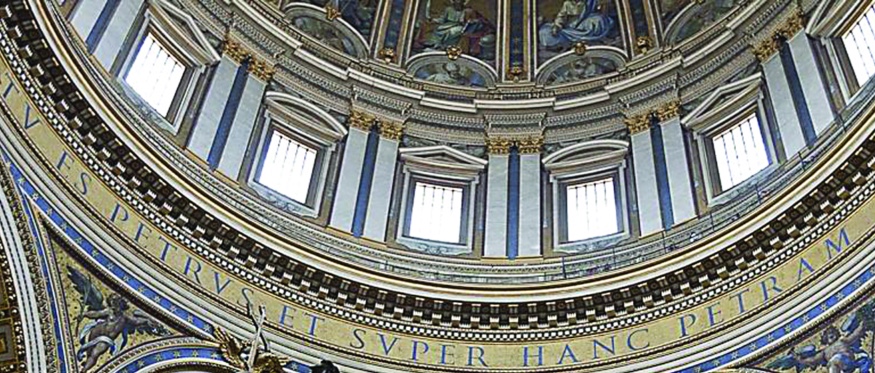
Latin inscription on dome of St. Peter’s Basilica in Rome – ” Tu es Petrus — You are Peter and upon this rock…”
So the “rock”, like any symbol, takes its meaning and relevance from the circumstances which surround it.
This is true as well for the “rocks” we meet in our own lives. Some are sources of strength, some nearly insurmountable obstacles. Some are a test, some a consolation.
Praying with today’s psalm and other readings, we might take the time to reflect on our current or past “rocks”.
May we realize and gratefully remember how God gives life-giving water even from these seemingly unyielding sources.
Poetry: Sorrow – Renee Yann, RSM
You must be alone
    with sorrow
    before you can leave it,
    or it will crush you
    like a black, heavy rock.

    You must drive into
    the hollow of its face,
    under the ledges
    it projects against you.
    Feel its cold granite
    pressed to your grain.

    In time,
    it will allow your turning
    to rest your back
    within its curve.

    Only then,
    you will be free to leave it,
    walking lightly once again
    on yielding earth.

    When you return, it will be freely,
    on a pilgrimage,
    to touch the name you carved once
    with the anguish of your heart.
Music: Rock of Ages
“Rock of Ages” is a popular Christian hymn written by the Reformed Anglican minister, the Reverend Augustus Toplady, in 1763 and first published in The Gospel Magazine in 1775.
Traditionally, it is held that Toplady drew his inspiration from an incident in the gorge of Burrington Combe in the Mendip Hills in England. Toplady, a preacher in the nearby village of Blagdon, was traveling along the gorge when he was caught in a storm. Finding shelter in a gap in the gorge, he was struck by the title and scribbled down the initial lyrics. The fissure that is believed to have sheltered Toplady (51.3254°N 2.7532°W) is now marked as the “Rock of Ages”, both on the rock itself and on some maps.
Today in God’s Lavish Mercy, we pray with our Sunday readings, so full of wisdom for our lives.
“Don’t we have anything decent to eat around here?” “There’s nothing to eat in this house !”
How many times do parents hear these complaints from their growing teenagers! The problem? They’re not looking for the apples, or eggs, or yogurt, or avocados which actually are in the fridge. They’re looking for junk!
Today’s first reading reflects a similar situation with the Jews in the desert. They are hungry, but not for the spiritual food Yahweh is offering them. They complain continuously. So God relents, feeding them manna and quail. But God is clear. He says, “I have done this so that you may know I am the Lord, your God.”
In the Gospel, Jesus admonishes his listeners, “Do not work for food that perishes but for the food that endures for eternal life.” Jesus doesn’t mean we should stop eating. He knows that we need food and other things in order to live. What He wants us to understand is that these things have only secondary importance to the food for our soul, a sustenance which we often relegate to inferior status, to “when we have time”.
In his advice to the Ephesians, Paul says that to live without spiritual awareness is “to live in the futility of our minds”. It’s a powerful phrase, generating an image of us running around in our heads after all sorts of vain worries and goals — junk.
Paul’s advice? Get over that running around! Put on a New Self!
At our essence, we are hungry for the Bread of Life. Nothing else will fill that emptiness.
we are such a mix of thorns and thread; why do You insist on living in the midst, even among the broken bowls and spilled strengths? I’ve seen You sift among the crumbs and find (I don’t know how) a loaf; what we tear, touch to make us mend; and show again to sift and share and be again the bread.
Music: Bread of Life ~ Bernadette Farrell
Bread of life, hope of the world,
Jesus Christ, our brother:
feed us now, give us life,
lead us to one another.

As we proclaim your death,
as we recall your life,
we remember your promise
to return again.

Bread of life, hope of the world,
Jesus Christ, our brother:
feed us now, give us life,
lead us to one another.

The bread we break and share
was scattered once as grain:
just as now it is gathered,
make your people one.

Bread of life, hope of the world,
Jesus Christ, our brother:
feed us now, give us life,
lead us to one another.

We eat this living bread,
we drink this saving cup:
sign of hope in our broken world,
source of lasting love.

Hold us in unity,
in love for all to see;
that the world may believe in you,
God of all who live.

You are the bread of peace,
you are the wine of joy,
broken now for your people,
poured in endless love.
Today, in God’s Lavish Mercy, we pray with Psalm 69 whose speaker, not to make a pun, is in bad straits!
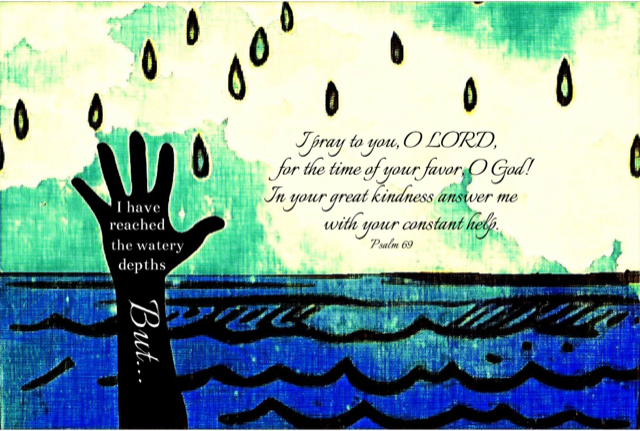
I am sunk in the abysmal swamp where there is no foothold; I have reached the watery depths; the flood overwhelms me.
Psalm 69:3
This is painful stuff – the kind of desperate pain we find threaded throughout the psalms in the prayers of lament.
These laments follow a pattern:
a petition for God’s help
multiple repetitions of this plea
detailed descriptions of the suffering being endured
proclamations of the sufferer’s innocence
assurances of the sufferer’s goodness
and often, a list of suggestions about how God should solve the problem
So the prayer, at least mine, would go something like this:
Dear God, please help me get out of this mess!
Do something, please. I know you can do something!
I am being harassed and destroyed. Let me tell you all about it.!
And it’s not my fault- (well, not completely anyway)
I try to be a good person and look what happens anyway!
I still believe in you and pray that you take care of my persecutors
(By the way, here are some tips on how you might do that, God.)
All in all, such a lament is a really healthy prayer. If we pray it completely, we get to the “BUT” of the pictured verse – that place where we allow God to teach and change us.
When we pray like this, we do these things in God’s Presence:
recognize our pain and name it
admit that we need help
analyze what’s really at the root of our pain
acknowledge our part in causing the suffering
rehearse our vengeance until we have exhausted it
reclaim our faith as a way to healing
THEN allow God to convert us to the Love of which we are made
The psalmist has given us a gift by laying out such vulnerability for us. It is healing to humbly and honestly pray this psalm when we are “overwhelmed” by hurt, confusion, anger, fear or any form of desperation.
The psalm is a script for unburdening negation in God’s presence. It is a script for rehabilitation to the community of praise and thanks.
Walter Brueggemann
We may have to pray Psalm 69 many times before we let God through to teach us the real meaning of our suffering. It is only then that we might pray the psalm’s final verses:
See, you humble ones, and be glad; you who seek God, take heart! For the LORD hears us, and does not turn away from our pain. Let the heaven and the earth praise God, the seas and whatever moves in them! For God will rescue usand rebuild us so that we can be at home with ourselves as the dwelling place of God.
Psalm 69: 33-36
Poetry: Psalm 69 – Christine Robinson
Save me, O God,
I have gotten myself in deep waters.
and find no firm ground under my feet.

I am tired of crying.
I feel at war with myself and with others;
I’m unable to do what is expected of me.

O God, you know my foolishness and my faults—
Do you love me anyway?
I really am sinking.

These rushing, dark waters are going to swallow me up.
Answer me, God!
Your loving kindness would save me.

If I could see your face, it would be enough
to ease my distress and help me relax in the flood.
I will remember that you are here,
even in the torrent, even in the war.

I will give thanks for the small beauties
and kindnesses of the day.
And for the love that is in my heart.
Today, in God’s Lavish Mercy, we pray with Psalm 124 which is a raw remembering of how bad things could have been without God’s help.
The psalm opens with these lines:
Had not the LORD been with us, let Israel say, Had not the LORD been with us, when all rose against us, Then we would have been swallowed alive, for fury blazed against us.
Psalm 124: 1-3
Have you been there? What flares up to swallow your life, your hope, can wear many disguises:
or the many forms of hunger and dying.
The psalm calls us to remember these things for two reasons:
so that we don’t get caught again
and that if – sadly – we do, we remember who freed us
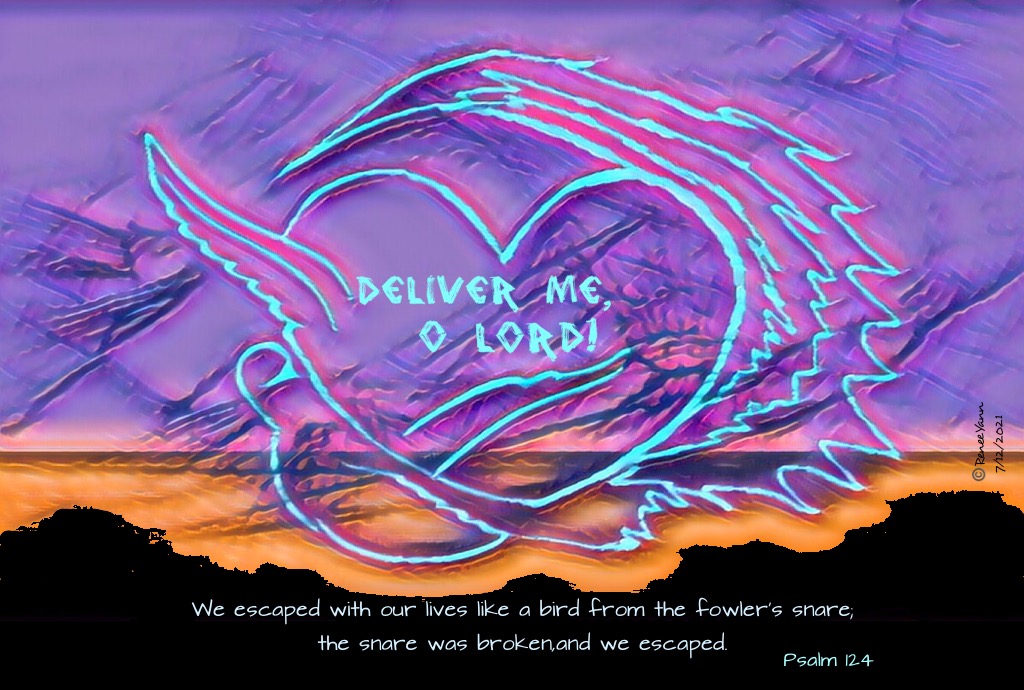
We were rescued like a bird from the fowlers’ snare; Broken was the snare, and we were freed. Our help is in the name of the LORD, who made heaven and earth.
Psalm 124: 7-8
The release from such snares does not return us to the way things were. There will be wounds and wisdom to change us. It depends on us which we choose to cherish.
“Re-membering” ourselves, pulling our new selves together in God, releases us to fuller, deeper life.
Our help is in the name of the LORD, the maker of heaven and earth.
… so surely that Omnipotent God can heal and remake us.
Remember, this and a few other of my images have been set beautifully into cards by Sister Judy Ward, RSM. You can contact her at
Poetry: The Fowler by Wilfrid Wilson Gibson (1868-1962)
A wild bird filled the morning air
With dewy-hearted song;
I took it in a golden snare
Of meshes close and strong.
But where is now the song I heard?
For all my cunning art,
I who would house a singing bird
Have caged a broken heart.
Today, in God’s Lavish Mercy, we pray with Psalm 115, bringing a welcome comfort after the always disturbing story of Isaac’s aborted sacrifice.
This story fascinated Rembrandt. Notice the differences between the 1635 and 1655 interpretations. The old man in the 1655 image has darkened eyes, covers his son’s eyes – not his mouth, and embraces the boy in his lap not laid out on an altar. Old age has gentled what Rembrandt found in the story.
On the left, 1635. On the right, 1655
But here’s what I think. It was never about a human sacrifice. God was never going to let that happen.
It was about whether Abraham’s trust would allow him to really see God – God who is never a God of death, but always of life.
As Abraham looked about, he spied a ram caught by its horns in the thicket. So he went and took the ram and offered it up as a burnt offering in place of his son. Abraham named the site Yahweh-yireh; hence people now say, “On the mountain the LORD will see.”
We live in a world full of choices that run the gamut from death-dealing to life-giving. They may be small, personal choices like what we eat, or how we drive. Or they may be more consequential choices such as the political views we foster or the global ideologies we embrace.
Psalm 115 helps us to solve any confusion we might have about our choices. Always make the choices that lead ourselves and others to the land of the living.
Abraham must have been thrown into the dark by what he believed was God’s expectation of him. But it was really Abraham’s own expectation that had to be broken through. He did this by staying with his pain while trusting that God was bigger than it.
Christine Robinson’s interpretation of Psalm 115 fits well here:
O Great Mystery
   We must love and praise you without understanding.
You are not a little tin god
   with eyes that do not see and ears that do not hear
   and a mouth that does not speak.
You can not be described or boxed up or tamed
   You are beyond our understanding.
Still, we yearn to hear you, know you,
   feel your love, and in mystery, we do.
We know awe at the intricate majesty of the heavens,
We cherish the work of caring for each other
and the Earth.
We praise you, Great Mystery
   all the days of our lives.
Poetry: Silence – Rabbi Rachel Barenblat
Abraham failed the test.
For Sodom and Gomorrah he argued
but when it came to his son
no protest crossed his lips.
God was mute with horror.
Abraham, smasher of idols
and digger of wells
was meant to talk back.
Sarah would have been wiser
but Abraham avoided her tent,
didn’t lay his head in her lap
to unburden his secret heart.
In stricken silence God watched
as Abraham saddled his ass
and took Isaac on their final hike
to the place God would show him.
The angel had to call him twice.
Abraham’s eyes were red, his voice hoarse
he wept like a man pardoned
but God never spoke to him again.
(It is true that, in Genesis, this is the last recorded exchange between God and Abraham!)
Music: Story of Isaac – Leonard Cohen
(If there’s no picture below, just click on the underlined phrase “Watch on Youtube“
The door, it opened slowly
My father, he came in
I was nine years old
And he stood so tall above me
Blue eyes, they were shining
And his voice was very cold
Said, "I've had a vision
And you know I'm strong and holy
I must do what I've been told"
So we started up the mountain
I was running, he was walking
And his axe was made of gold

Well, the trees, they got much smaller
The lake, a lady's mirror
When we stopped to drink some wine
Then he threw the bottle over
Broke a minute later
And he put his hand on mine
Thought I saw an eagle
But it might have been a vulture
I never could decide
Then my father built an altar
He looked once behind his shoulder
He knew I would not hide

You who build these altars now
To sacrifice these children
You must not do it anymore
A scheme is not a vision
And you never have been tempted
By a demon or a god
You, who stand above them now
Your hatchets blunt and bloody
You were not there before
When I lay upon a mountain
And my father's hand was trembling
With the beauty of the word

And if you call me brother now
Forgive me if I inquire
Just according to whose plan?
When it all comes down to dust
I will kill you if I must
I will help you if I can
When it all comes down to dust
I will help you if I must
I will kill you if I can
And mercy on our uniform
Man of peace or man of war
The peacock spreads his fan
Today, in God’s Lavish Mercy, we pray with Psalm 34 once again. With its two accompanying readings, the psalm hits me right between the eyes with this awareness:
Those of us trying to live in God’s presence, the world isn’t going to help us. We will be in contradiction to many, if not most, popular values. Our choices may be questioned, if not ridiculed. Our values may be explained away. Our integrity may be challenged.
What’s it like to live a faith-based life in today’s culture? The image that comes to my mind is that of trying to play soccer with a square ball!
Paul felt the dissonance:
But the Lord said to me, “My grace is sufficient for you, for power is made perfect in weakness.” So I will rather boast most gladly of my weaknesses, in order that the power of Christ may dwell with me. Therefore, I am content with weaknesses, insults, hardships, persecutions, and constraints, for the sake of Christ …
Jesus put the contradiction in a nutshell for us:
No one can serve two masters. You will either hate one and love the other, or be devoted to one and despise the other. You cannot serve God and mammon.
So we need to figure out our “mammon” and vanquish it. We need to make the choice that Paul, the psalmist, and Jesus made. Let’s pray on it today.
Poetry: Contraband – Denise Levertov
The tree of knowledge was the tree of reason. That’s why the taste of it drove us from Eden. That fruit was meant to be dried and milled to a fine powder for use a pinch at a time, a condiment. God had probably planned to tell us later about this new pleasure. We stuffed our mouths full of it, gorged on but and if and how and again but, knowing no better. It’s toxic in large quantities; fumes swirled in our heads and around us to form a dense cloud that hardened to steel, a wall between us and God, Who was Paradise. Not that God is unreasonable – but reason in such excess was tyranny and locked us into its own limits, a polished cell reflecting our own faces. God lives on the other side of that mirror, but through the slit where the barrier doesn’t quite touch ground, manages still to squeeze in – as filtered light, splinters of fire, a strain of music heard then lost, then heard again.
Today, in God’s Lavish Mercy, we pray with Psalm 34, filled with lovely images assuring us of God’s abiding mercy. This mercy moves the psalmist to promise perpetual praise – that means “no matter what”!
I will bless the LORD at all times; praise shall be ever in my mouth. Let my soul glory in the LORD; the lowly will hear me and be glad.
Psalm 34:2-3
By telling about God’s loving intervention in our lives, the psalmist invites everyone to join in praise:
Glorify the LORD with me, let us together extol God’s name. I sought the LORD who answered me and delivered me from all my fears.
Psalm 34:4-5
I’m not so sure it’s an easy thing to rejoice in another’s blessing when we ourselves are feeling overlooked by God. But that’s the whole point of the psalm. It is WE who feel overlooked, not God who is overlooking.
It is as if we have turned our back to a brilliant sun and complained how cloudy it is. The psalmist says, “Stop that … turn your self around.”
Look to God that you may be radiant with joy, and your faces may not blush with shame. When the suffering one called out, the LORD heard, and from all distress was saved.
Psalm 34:6-7
Notice that they were not saved from suffering but from distress. Such salvation rests in the confidence that, even in suffering, we are never alone; that when we take refuge in God, palpable blessing ensues.
The angel of the LORD encamps around those who reverence God, and delivers them. Taste and see how good the LORD is; blessed the one who takes refuge in God’s embrace.
Psalm 34:8-9
Surely Psalm 34 calls us to live in the spirit of the Beatitudes which we can savor in today’s Gospel.
Poetry: Safe Harbor by Robert B. Shaw
Music: Two songs suggested themselves today. Here are both🤗 Enjoy!
Multiplied by needtobreathe (notice the radiant diamonds)
Psalm 34 – Brooklyn Tabernacle Choir
I sought the Lord
And He answered me
And delivered me
From every fear
Those who look on Him
Are radiant
They'll never be ashamed
They'll never be ashamed

This poor man cried
And the Lord heard me
And saved me from
My enemies
The Son of God
Surrounds His saints
He will deliver them
He will deliver them

Magnify the Lord with me
Come exalt His name together
Glorify the Lord with me
Come exalt His name forever
Oh taste and see
That the Lord is good
Oh blessed is he
Who hides in Him
Oh fear the Lord
Oh all you saints
He'll give you everything
He'll give you everything

Magnify the Lord with me
Come exalt His name together
Glorify the Lord with me
Come exalt His name forever
Magnify the Lord with me
Come exalt His name together
Glorify the Lord with me
Come exalt His name forever

Let us bless the Lord
Every day and night
Never ending praise
May our incense rise

Let us bless the Lord
Every day and night
Never ending praise
May our incense rise

Let us bless the Lord
Every day and night
Never ending praise
May our incense rise
Every day and night
Never ending praise
May our incense rise

Magnify the Lord with me
Come exalt His name together
Glorify the Lord with me
Come exalt His name forever
Magnify the Lord with me
Come exalt His name together
Glorify the Lord with me
Come exalt His name forever
Oh taste and see
That the Lord is good
He'll give you everything
He'll give you everything
Today, in God’s Lavish Mercy, we pray with Psalm 146, a song of uninhibited delight and thanksgiving to God.
Coming after our reading from Tobit, we see just what such utter delight looks like.
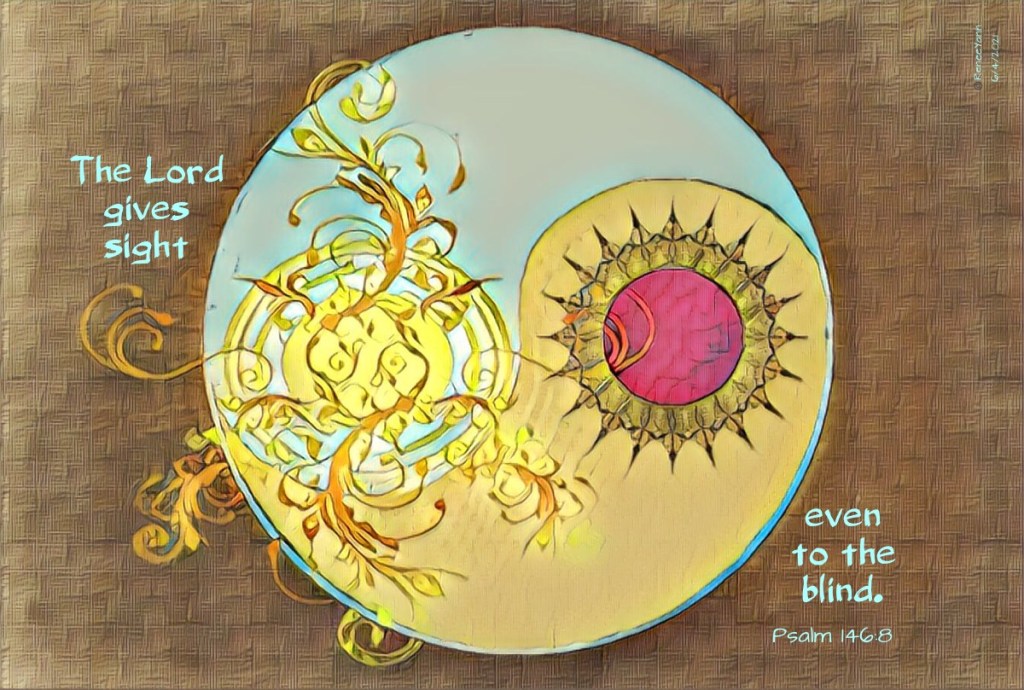
That “angelic fish gall” re-lit the world for Tobit in a way he had never imagined before!
Sometimes we too have to experience a profound blindness before we really begin to see rightly. Let’s be honest: haven’t we all been blind a few times in our lives.
Blessings unrecognized
Friendships taken for granted
Kindnesses overlooked
People misjudged
Needs ignored
Expectations unsurrendered
Biases unexamined
Opportunities bypassed
Perhaps even responsibilities shirked
Praying with Psalm 146, we might take note of those whom the Lord favors:
the oppressed, the hungry. captives, those who are bowed down; the just, strangers, orphans and widows
These favored of God share a common trait – a vulnerability learned through suffering.
None of us seeks suffering in our lives. But we all will encounter it personally at least to some degree. Further, all in the community of faith are called to share the sufferings of others by our works of mercy.
In both instances, can we allow suffering to let us see the world differently, to lift the scales of any blindness in our hearts? Because here is the beautiful mystery: the God of Mercy is with us in our lights and shadows — and is always Light.
Praise the LORD, O my soul; I will praise the LORD all my life; I will sing praise to my God while I live.
Psalm 146:1
Poetry: God Pours Light – Hafiz
God pours light into every cup, quenching darkness. The proudly pious stuff their cups with parchment and critique the taste of ink while God pours light and the trees lift their limbs without worry of redemption, every blossom a chalice. May I seduce those withered souls with words that wet their parched lips as light pours like rain into every empty cup set adrift on the Infinite Ocean.












 Lavish Mercy