A Prodigal Love

Twenty-fourth Sunday in Ordinary Time

September 15, 2019

Click here for readings

Today, in Mercy, Numbers tells a story of Moses’ intervention to save the people from God’s wrath. It is a story of God’s relenting … a theme which repeats itself endlessly in the Hebrew Scriptures.

This is the way we sometimes characterize the astonishment of Grace – God’s overwhelming passion to love and forgive us over and over. We just can’t imagine such mercy, such infinite generative love!

And so we imagine instead that Moses made God do it!😉 Yeah, I don’t think so.

We imagine that God cannot tolerate our sinful pursuits because we cannot tolerate them in ourselves or in others. But God is mercy, forgiveness, reconciliation, wholeness, love. God can’t help loving us!

Of course, we shouldn’t be stupid and take advantage of the divine largesse… not because it would hurt God, but because it so damages us and limits our capacity for wholeness. But nevertheless, whether we’re stupid or not, God will always welcome us home.

A few days ago, we prayed with the word splancha – that “gut love” that so describes God’s passion for us. We find the word again today in the heart-wrenching parable of the Prodigal Son.

prodigal son

You know the story. Near the end, as the devastated son returns seeking mercy…

While he was still a long way off,
his father caught sight of him,
and was filled with compassion — with splancha – esplanchnisthē
Luke 15:20

Our God is a Love that is filled, overflowing – with no room for retribution or condemnation.

Indeed, our God, like the Prodigal Father, is soft-hearted, an easy mark, a pushover for our sincere repentance, trust, and hope. Our God would bleed for us!

This short but powerful scene from George Balanchine’s ballet, Prodigal Son, may inspire our prayer today. The father is steadfast, a monolith of strength and love. The son is broken, naked in his desperation. Let their magnetic reunion take you to God’s heart. Let God wrap you too in the mantle of Love for any hurt or emptiness that is within you.

George Balanchine “Prodigal Son” – Final Scene (Son- Barishnikov)


Claude Debussy also wrote a beautiful piece on this parable. If you have a contemplative space sometime this week, you may want to listen to Debussy’s moving opera (with my all-time fav Ms. Jessye Norman.)

Click here for full opera

If you have only a little time, do try this – short, and oh so beautiful!

Music: Debussy The Prodigal Son – Prelude

A Plank in the Eye

Memorial of Saint John Chrysostom, Bishop and Doctor of the Church

Friday, September 13, 2010

Click here for readings

Today, in Mercy, Paul, seeing himself as he really is, gives thanks and praise for his unmerited salvation.

Paul says this:

I was once a blasphemer and a persecutor and an arrogant man,
but I have been mercifully treated
because I acted out of ignorance in my unbelief.
Indeed, the grace of our Lord has been abundant,
along with the faith and love that are in Christ Jesus.

God has also granted me the gift of unmerited salvation. You too, my friends. But everybody’s story is a little different. So I thought a bit today about what I might fill in for those bolded words above. (And you can be sure I’m not going to tell you!😂) You might want to do the same in your prayer today.

In our Gospel, Jesus confronts those who think they are, not beneath, but above redemption and salvation. It’s beautiful: he nails the nitpickers who see the flaws in everyone but themselves.

How can you say to your brother,
‘Brother, let me remove that splinter in your eye,’
when you do not even notice the wooden beam in your own eye?
You hypocrite!  Remove the wooden beam from your eye first;
then you will see clearly
to remove the splinter in your brother’s eye.

IMG_0799Luke6_41 beam

It’s always been one of my favorite passages. But do you know why? It’s because the beam in my own eye probably has prevented me from seeing that the passage is about me!🥺

Music: Only Takes a Moment – Cory Asbury

All That Is Withered

Memorial of Saint Peter Claver, Priest

September 9, 2019

Click here for readings

Today, in Mercy, Paul and Jesus share a similar situation.

Paul is imprisoned in Rome. Visited by Epaphras, a citizen of Colossae, Paul seizes the chance to write to these Christians whom he has never seen in person. Paul tells the Colossians that his singular intention is to preach the truth of the Gospel so that they, and all the world, may be transformed in Christ.

to bring to completion for you the word of God,
the mystery hidden from ages and from generations past.

That “mystery” is the nature of God as Love, only fleetingly accessible before its full revelation in the Person of Jesus Christ.

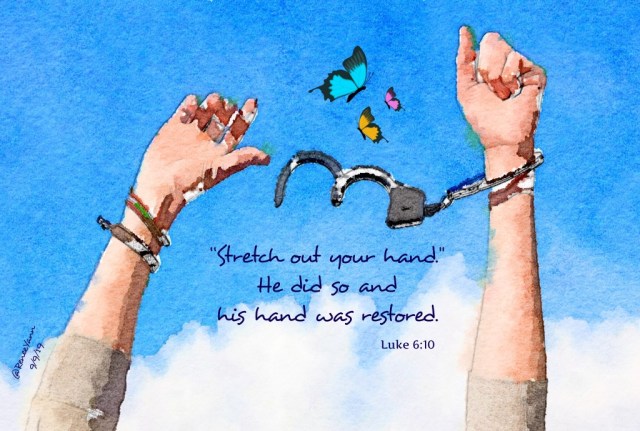
Luke6_10 withered hand

Jesus too, in today’s Gospel, is in a sort of prison. The prison consists of the entrenched resistance of people like the Pharisees. They are so entangled in the deceitful and self- serving interpretation of Law that they are blind to the revelation before them. They wait to pounce on Jesus if, contrary to the laws of the Sabbath, he heals a man’s withered hand.

Jesus tries logic in today’s account:

Then Jesus said to them,
“I ask you, is it lawful to do good on the sabbath
rather than to do evil,
to save life rather than to destroy it?”

Unable to resist the logic, the Pharisees retreat to anger. They begin to plot the removal of this Truth they cannot counter. The saddest part of these resistances is that they estrange the resisters from their own good, from their own freedom, from their own salvation.

In our world, we see so many places closed off to the Mystery of Love.  We see people imprisoning themselves in their own resistance and hate while they plot to build barriers against others. We see it in our geo-political world, in our Church, in our workplaces, in ourselves.

It takes courage to recognize and turn from such self-destructive fixations. We must be alert and brave to cooperate with our own transformation in grace.

This is why Paul writes of …

the great struggle I am having for you
and for those in Laodicea
and all who have not seen me face to face,
that their hearts may be encouraged
as they are brought together in love,
to have all the richness of assured understanding,
for the knowledge of the mystery of God, Christ,
in whom are hidden all the treasures of wisdom and knowledge.

This is why God continues to offer grace in the gift of Jesus Christ, healing all that is “withered” in us when we lift it up in faith.

Music: God Will Make a Way – Dan Moen

The Wisdom of God

Twenty-third Sunday in Ordinary Time

September 8, 2019

Click here for readings

Today, in Mercy, the Church links three readings which, at first glance, seem unrelated.

  • Our first reading from Wisdom reminds us of God’s infinite wisdom, incomprehensible to our human minds.
  • Paul, in his letter to Philemon, begs for the loving inclusion of Onesimus, an enslaved person, into the Colossian community.
  • In today’s Gospel, Jesus  makes the harsh pronouncement:

If anyone comes to me without hating his father and mother,
wife and children, brothers and sisters,
and even his own life,
he cannot be my disciple.

How might we interpret these disparate passages to find a message of wholeness for our prayer?

Wis9_13 gods mind

Let’s start with Jesus. In no uncertain terms, he challenges his disciples to move out of their small worlds into God’s big world. That Godly world is not defined by family, nor by any condition other than our common Creaturehood in God … not by:

word gram

Jesus says the sacred community is defined only by shared and irrevocable commitment to the Gospel of love and mercy.

Paul knows and loves Onesimus, the slave, as a brother in this community. In his letter, Paul encourages Philemon to do the same.

Sometimes as human beings, filled with all kinds of insecurities, we tend to build enclaves that make us feel safe. We like to be with “our kind”. We invent borders to filter out those whose differences we don’t understand. We allow fear to grow out of that lack of understanding. Within the enclosure of our self-protectionism, we eventually forget that we are all one, equal, precious, beautiful and beloved by God.

Such toxic attitudes are the soil for slavery, war, ethnic cleansing, racial supremacy,   human trafficking, destructive nationalism, and all the other sacrileges committed by humans against the human family.

Wisdom reminds us that only God can open the tight circle of our fears, judgments and isolations – only God whose infinite love encompasses all. Jesus tells us that we find that love only by lifting up the cross and following him.

Wisdom tells us to put it in God’s hands, and to respond to God’s challenge in the preaching of Jesus Christ.

Who can know your way of thinking, O God
… except you give us wisdom

 and send your Holy Spirit from on high
 thus stretching the hearts of those on earth

Today I pray, may God do this for me, and for all our tight, convoluted and troubled world.

Music: Who Has Known (an Advent hymn, but perfect I think for today’s readings)

All Things Hold Together

Friday of the Twenty-second Week in Ordinary Time

September 6, 2019

Click here for readings

Today, in Mercy, our readings challenge us to see things differently- to see with God’s eyes.

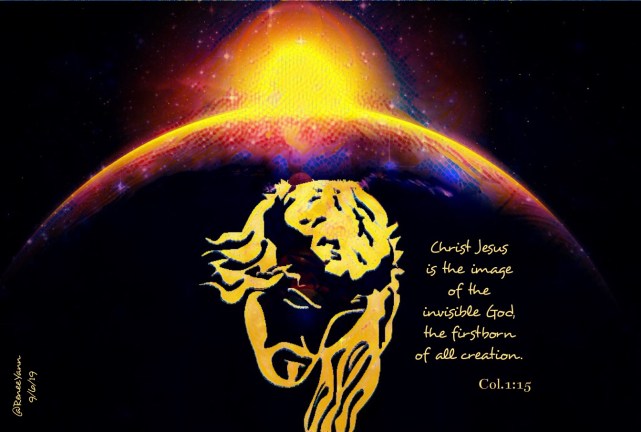
Col1_15 image of God

Paul invites us first with the glorious Colossians Hymn. No words can enhance it. Let us savor it in itself:

Christ Jesus is the image of the invisible God,
the firstborn of all creation.
For in him were created all things in heaven and on earth,
the visible and the invisible,
whether thrones or dominions or principalities or powers;
all things were created through him and for him.
He is before all things,
and in him all things hold together.
He is the head of the Body, the Church.
He is the beginning, the firstborn from the dead,
that in all things he himself might be preeminent.
For in him all the fullness was pleased to dwell,
and through him to reconcile all things for him,
making peace by the Blood of his cross
through him, whether those on earth or those in heaven.


wineskin
Ancient wineskins were not like the fancy botas we see today. They were formed from the entire skin of the animal. As the new wine fermented inside, the skin expanded with the fermentation. It ultimately stretched beyond further use. – thus the necessity for new skins for new wine.


Jesus, in our Gospel, tells us we must become new wineskins in order to hold the vibrant gift of new life in Christ. He says the old ways, stiffened by pharisaical pretensions, have lost the elasticity of grace. He warns us to avoid the accretions of showy religious practice which may bury and inhibit sincere faith.


Jesus is the new wine of love and mercy, and our hearts must become his new wineskins.

As we pray, this poetic musical piece may inspire us. … in Him, all things hold together …

Music: The Christ Hymn – Alana Levandoski

God Invests in Us

Saturday of the Twenty-first Week in Ordinary Time

August 31, 2019

Click here for readings

Today, in Mercy, Paul again shows his great admiration for the commitment of the Thessalonians:

You have no need for anyone to write you about fraternal charity…
( in other words, you already live it.)

Don’t we all wish that line could be written, without reservation, to us?

In our Gospel, Jesus tells us the familiar parable of the talents which shows what God would look for in order to say as much to us.

Mt25_25

On the surface this story looks like one about material goods or personal capabilities – about how we use our individual gifts to further God’s reign. Certainly that is one valuable interpretation.

But think about the talents in the story. They did not belong to the servants. They belonged to the master.

This parable is about God’s talents, God’s nature, and how we either frustrate or facilitate their effectiveness in God’s Creation.

We are the means by which God is present in the world.

God invests God’s own heart  in us – Unconditional Love, Lavish Mercy, Infinite Hope, the Perfection of Compassion, Sacred Accompaniment, Abiding Fidelity.

If we tender these divine “talents” to others with care and generosity, we become good and faithful reflections of God’s own presence.

What about the poor soul who buried the talents under his own fear and small-mindedness? Sad, right? But that self-protective, parsimonious little burier hides in all of us.

We know the blockades we put up against God’s Grace. Let us look sincerely at them today, asking to be worthy of the trust invested in us to multiply God’s grace in the world.

Music: Psalm 131 – written by Marty Goetz

Heart-Light

Friday of the Twenty-first Week in Ordinary Time

Friday, August 30, 2019

Click here for readings

Today, in Mercy, Paul describes for the Thessalonians how precious they are to God.

It is in a beautiful line of thought in today’s passage, but the thought is hidden in a thread through Paul’s sermon about marriage practices. It seems that some Thessalonians were playing a sort of “Bachelor/Bachelorette” game, devoid of the reverence marriage deserves.

But within Paul’s spousal instructions is this tender verse:

This is the will of God, your holiness.

1Thes4_3

God wants us to be blessed and completed with holiness. What is holiness? 

Merriam-Webster has a few definitions, the most helpful of which is this:

devoted entirely to the deity or the work of the deity


But maybe we could think of holiness this way:

  • Seeing deeply through circumstances to the heart of God
  • Learning to beat with that Heart in a mutual rhythm of grace and trust
  • Singing that rhythm into a longing world by a life of mercy and love

Some of the world’s longing will always remain in us too. But Jesus tells us, in today’s Gospel, that our longing will be filled when the Bridegroom comes. Still, he cautions us to be ready – to have an abundance of oil to light our heart-lamps for God.

So today, let’s squeeze that precious oil out of every moment – every opportunity to find, love, and serve God in the people and circumstances of our lives.

Music: a little bit of a stretch today.  But if you listen inside the lyrics, I think you’ll find connections to today’s reflection. (Besides, who can’t be uplifted by Neil Diamond? 🙂


Beautiful God Within

Memorial of Saint Augustine, Bishop and Doctor of the Church

August 28, 2019

Click here for readings

Today, in Mercy, celebrate the Feast of St. Augustine who gave us such beautiful quotes as these:

late have i loved

These quotes reflect a clarity of soul Augustine pursued all his life. He was a brilliant philosopher, intellectual, and poet. His early spiritual practice struggled for years to break through the shell of philosophy into the heart of true faith.

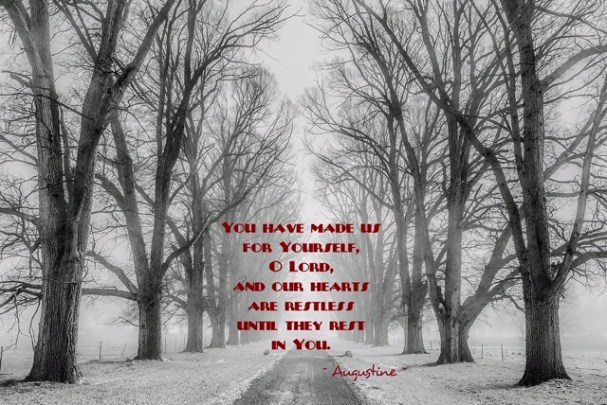
made us for yourself

Eventually, through the prayers of his mother Monica and the gentle guidance of St. Ambrose, Augustine’s searching soul found God as reflected in today’s choice for a Responsorial Psalm:

Lord, you have searched me and known me;
you understand everything I do;
you are closer to me than my thoughts.
You see through my selfishness and weakness,
into my inmost self. 

There is not one corner of my mind
that you do not know completely.
You are present before me, behind me,
and you hold me in the palm of your hand. 

Such knowledge is too awesome to grasp:
so deep that I cannot fathom it.
Where can I go from your spirit?
Where can I flee from your presence? 

If I take the wings of the morning and fly to the ends of the sea,
even there your hand will guide me
and your spirit will give me strength.

~  A Book of Psalms by Stephen Mitchell

Some of us , no matter how hard we try, have a tortuous path to spiritual peace. Augustine is a saint because he never abandoned that path.

Paul’s Thessalonians seemed to have had an easier way:

And for this reason we too give thanks to God unceasingly,
that, in receiving the word of God from hearing us,
you received it not as the word of men, but as it truly is, the word of God,
which is now at work in you who believe.

Jesus, in Matthew’s Gospel continues his tirade against those who only appear to seek that path to spiritual sincerity and whole-heartedness:

Woe to you, scribes and Pharisees, you hypocrites.
You are like whitewashed tombs, which appear beautiful on the outside,
but inside are full of dead men’s bones and every kind of filth.
Even so, on the outside you appear righteous,
but inside you are filled with hypocrisy and evildoing.

The etymological root of the word “hypocrisy” is to “under decide” – a kind of half-heartedness, a falsely comfortable pretense, a neither “here nor there” attitude that safeguards our worldly advantage but paralyzes us on the path to holiness.

Augustine lived in that limbo for a long time. He came late to true Beauty, Love and Clarity. Oh, but what a transformation!

What does he want to teach us today?

Music: Late Have I Loved You – Len Sroka

Faithful Monica

Memorial of Saint Monica

Tuesday, August 27, 2019

Click here for readings

Today, in Mercy, we celebrate St. Monica, mother of St. Augustine of Hippo.

Monica
Santa Monica e Sant’Agostino by Giuseppe Riva (This work is in the public domain n its country of origin and other countries and areas where the copyright is the author’s life plus 100 years or less.)

Monica had a difficult life, burdened by an autocratic pagan husband. She was forbidden to have her children baptized. Augustine worried her deeply because he developed into a wayward and lazy young man. Eventually he was wooed by the Manichaean heresy which denied Christ as God. This was too much for Monica. She asked him to leave her house.

But Monica continued for seventeen years to pray for and encourage Augustine to return to a faithful, moral life. Finally through the influence of St. Ambrose, Augustine was converted.

How many mothers and fathers, friends and spouses have prayed like this for someone they love? How many of us have had a “lost sheep” right in the center of our family but beyond its touch?

Monica’s great love and faithful devotion to her son are reminiscent of Paul’s love for his Thessalonian flock:

… we were gentle among you,
as a nursing mother cares for her children.
With such affection for you, we were determined to share with you
not only the Gospel of God, but our very selves as well,
so dearly beloved had you become to us.

This is the way God loves us and draws us to himself. It is the way that we, who carry God’s love in the world, must be with one another.

Our Gospel gives us another example of how disgusted Jesus is with those who pretend the “exteriors” of faith but on the inside are “blind hypocrites… full of plunder and self-indulgence”.

Instead, we need a faith like Monica’s, humble and generous but at the same time tenacious and persevering in seeking good.

Music: Give Me the Faith Which Can Remove – written by Charles Wesley, younger brother of John Wesley, founder of Methodism

Walk in Mercy and Hope

Twenty-first Sunday in Ordinary Time

August 25, 2019

Click here for readings

Is66_18 great lightJPG

Today, in Mercy, our first reading gives us the conclusion of the magnificent Book of Isaiah. Most biblical scholars today attribute this book to at least three different authors writing over the period of two centuries. The book is thus divided into three sections: First, Second, and Third Isaiah – each reflecting a particular time and circumstance in the history of the Jewish people.

Despite its multi-authorship, the Book holds an essential integrity throughout. As a whole, it is the story of the displacement and restoration of Israel. That dynamic is poetically articulated through the themes of loss, grief, hope, and responsiveness to hope. These themes are so fundamentally human and universal that Isaiah stands as one of the most influential scriptures, both spiritually and culturally.

Today’s passage from Isaiah, combined with the Lukan symbol of the narrow gate, strike a powerful message for us – as individuals, as Church, as global citizens. 

There is one Kingdom in God and we ALL are invited to it.

I come to gather nations of every language;
they shall come and see my glory.

But we will find our way to this Kingdom by the twists of suffering and compassion, living on one side or the other of that reciprocal throughout our lives. 

faith reciprocal

How we support, include, love and minister with one another in our “displacement” determines our “restoration”:

And people will come from the east and the west
and from the north and the south
and will recline at table in the kingdom of God.
For behold, some are last who will be first,
and some are first who will be last

We know the works of mercy and our call to live them. Let’s pray for the strength to do so fully and joyfully.

Let’s pray for all nations, especially our own, to respond in mercy and hope to the displaced people of our time, knowing that it is only with them that we shall find the narrow gate.

Music: The People That Walked in Darkness (Is. 9:2) from Handel’s Messiah

Sung by James Milligan with Royal Liverpool Philharmonic Orchestra