How Does God Think We Are Doing?

Tuesday, July 31, 2018

Readings: http://www.usccb.org/bible/readings/073118.cfm

Today, in Mercy, the readings from Jeremiah and Matthew squarely place the reality of sin in our sight. Nobody likes to talk about sin, at least if they’re normal. We like to talk about fun, success, winning, freedom, prosperity. But when the distortion of these things get in the way of our relationship with God and neighbor, then we’re talking about sin.

Ps79 Deliver usJPG

How do you feel about our world today? The small area of my world is abundantly blessed and happy, as I hope yours is. The inhabitants of Jeremiah’s world felt the same way — until the devastation touched them! Then they realized that their “comfortable “ world was woefully out of line with God’s hope.

They had been blind to the sin around them, and their –  perhaps –  unwitting part in it. Ultimately, they were visited with destruction. We might read their plight and say, “Oh well, they worshipped false idols.  No wonder God was displeased with them.”

A better read might be:

  • Are there any false gods in my life? Who or what do I really worship above all things?
  • Are there false gods in our world? How do I respond to them- in the political arena, in the workplace, in my social sets?

The world is so much bigger than our  living rooms or offices. And we are called to be faithful witnesses to God in that bigger world. How are we doing? Today, Jeremiah and Jesus offer us an examination of conscience.

Today is also the feast of St. Ignatius Loyola. This is a version of the five-step Daily Examen that St. Ignatius practiced.

  1. Become aware of God’s presence.
  2. Review the day with gratitude. 
  3. Pay attention to your emotions.
  4. Choose one feature of the day and pray from it.
  5. Look toward tomorrow.

For more on Ignatian spirituality see:

Click here to go to Ignatian Spirituality website

Music: Take, Lord, Receive – The Prayer of St. Ignatius by John Foley
Would God Divorce Us?

Saturday, July 28, 2018

Readings:  http://www.usccb.org/bible/readings/072818.cfm

Today, in Mercy, we hear from Jeremiah, a “sock-it-to-‘em” prophet. He lived in a disastrous time for Judah, and had to deliver some difficult challenges to the people. Today’s passage is called the Temple Sermon. It confronts his listeners with the fact that there is a big difference between their professed faith and their daily practice. In other words, they are living a lie.

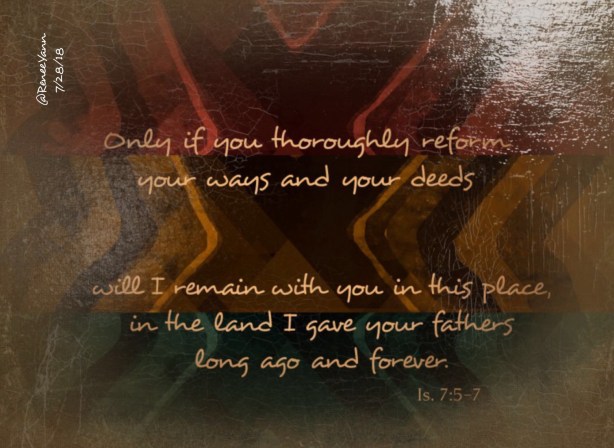
Jeremiah7_5

The people seem to think that no matter how idolatrous or immoral their choices are, the Temple building will protect them from God’s anger. It’s a mentality that might remind us of the film “The Godfather”, where the mafioso kill and cheat all week but always fulfill their sacramental obligations.

God tells Jeremiah to go stand at the Temple gate and tell the people that their fake piety won’t work. Instead they are to:

  • thoroughly reform their ways and deeds
  • deal justly with their neighbor
  • no longer oppress the resident alien, the orphan, and the widow
  • no longer shed innocent blood in this place (cease human sacrifice)
  • or follow strange gods to their own harm

Otherwise, Jeremiah says, they risk losing God because God will not live in a desecrated Temple.

The message to us that comes wrapped in the ancient words of Jeremiah?

  • Examine your life.
  • Is our faith sincere, proven by our practices?
  • Do we give others not only the benefit of the doubt, but also the benefit of our kindness?
  • Do we support and foster immigrants, orphans, widows … in other words the vulnerable?
  • Do we stand against the suffering of innocents caused by war and unjust policy?
  • Do we resist the “gods” competing for our souls — all the destructive isms and addictions of our time?

Otherwise, Jeremiah says, we risk losing God because God will not live in a heart-temple that is desecrated.

Music: Fill This Temple – Don Moen

https://m.youtube.com/watch?v=r1CIpLFywdc

Can You Drink the Cup?

July 25, 2018 – Feast of St. James, Apostle

Readings: http://www.usccb.org/bible/readings/072518.cfm

Today, in Mercy, we learn a lesson in humble leadership, thanks to “Mrs. Zebedee”. Our Gospel recounts the story of the mother of James and John interceding for her sons with Jesus. Like many overprotective mothers, she intervenes in their adult lives. She wants to make sure they get the best deal for their investment with Jesus.

Mt20_22 cup

Unfortunately, “Mrs. Zebedee” has missed the whole point of Christian discipleship. Her boys have decided to follow a man who says things like this:

  • The last shall be first and the first, last.
  • Unless you lay down your life, you cannot follow me.
  • Whoever takes the lowly position of a child is the greatest in the Kingdom of Heaven.

The seats at Christ’s right and left, which she requests for her sons, will bring them only the rewards of humility and sacrificial service.

Jesus is gentle with “Mrs. Zebedee”. He understands how hard it is for any of us to comprehend the hidden glory of a deeply Christian life. We are surrounded by a world that screams the opposite to us:

  • Me first!
  • Stand your ground!
  • Good guys finish last!

So Jesus turns to James and John. One can imagine the bemused look on his face. He knows the hearts of these two men. He knows they have already given themselves to him. So he asks them for a confession of faith, “Can you drink the cup that I will drink?”

Their humble, faith-filled answer no doubt stuns their mother. She is left in wonder at the holy men her fishermen sons have become. Perhaps it is the beginning of her own deep conversion to Christ.

As we pray with this passage on the feast of St. James the Apostle, where do find ourselves in this scene? How immediate, sincere, and complete is our response to Jesus’ question: “Can you drink the cup….?”

Music: Can You Drink the Cup? ( Be patient. The song has a slightly delayed start😀)

Can You Drink The Cup?

Lyrics by Pamela Martin, Music by Craig Courtney
Copyright 2001, Beckenhorst Press, Inc.

Can you dring the cup,
embrace it in your hands?
Can you look inside
and face what it demands?

In the wine you see
reflections of your soul.
No one else can drink
this cup that you must hold.

Can you drink the cup?
Then you must lift it high
though this cup of joy
holds pain and sacrifice.

When you lift your cup,
raise it unafraid.
Lift it up, this cup
of life, and celebrate.

Can you drink the cup
until there is no more?
When the wine is gone,
Christ Himself will pour.

Though you drink it all
the cup is never dry,
God keeps filling it
with everlasting life.

The Times They Are A-Changin’

July 24, 2018

Readings: http://www.usccb.org/bible/readings/072418.cfm

Today, in Mercy, we pray with a passage from the prophet Micah, the last of three over the past few days of readings. Micah, who composed about 700 years before Christ, is considered a “minor prophet”. We hear from him only these three times in our liturgical readings. Yet, some of the loveliest and most moving lines come from the pen of this country poet.

Micah

Micah gave us this gem:

He has shown you, O mortal, what is good.
   And what does the Lord require of you?
To act justly and to love mercy
   and to walk humbly[a] with your God.
~ Micah 6:8

He also foretold the birth of Jesus in Bethlehem.

But you, Bethlehem Ephrathah,
   though you are small among the clans of Judah,
out of you will come for me
   one who will be ruler over Israel,
whose origins are from of old,
   from ancient times.~ Micah 5:2

Micah was a poor farmer with a rich gift of poetry and grace. In powerful images, he confronted the corporate sinfulness of his times – economic and social injustices institutionalized in the Jerusalem political power structure. He was like a folk singer whose simple words cut to the truth, mourned the sad state of current affairs, and offered lyrical hope to his listeners. Micah teaches us that God’s justice will always prevail. Still, he assures us that this divine justice will be delivered with Mercy.

One can profit from reading Micah prayerfully while considering our current political reality. Like all good poetry, his words still have meaning for us. Our “Jerusalem” may be Washington or Moscow or Beijing. Our “Babylon” maybe economic, environmental, or moral destruction. 

Micah calls us to recognize injustice, especially toward the poor, orphans, and refugees. He enjoins us to mourn the sad reality that surrounds us. And then he encourages us to hope – and act – because God is with us in our vulnerability and will bring us Mercy.

Music: The Times They Are A-Changin’- written by Nobel Laureate Bob Dylan, sung here by Bruce Springsteen when Dylan received the Kennedy Honors.( Lyrics below.)

https://m.youtube.com/watch?v=Dhuf_OvH8B8

Come gather ’round people
Wherever you roam
And admit that the waters
Around you have grown
And accept it that soon
You’ll be drenched to the bone.
If your time to you
Is worth savin’
Then you better start swimmin’
Or you’ll sink like a stone
For the times they are a-changin’.

Come writers and critics
Who prophesize with your pen
And keep your eyes wide
The chance won’t come again
And don’t speak too soon
For the wheel’s still in spin
And there’s no tellin’ who
That it’s namin’.
For the loser now
Will be later to win
For the times they are a-changin’.

Come senators, congressmen
Please heed the call
Don’t stand in the doorway
Don’t block up the hall
For he that gets hurt
Will be he who has stalled
There’s a battle outside
And it is ragin’.
It’ll soon shake your windows
And rattle your walls
For the times they are a-changin’.

Come mothers and fathers
Throughout the land
And don’t criticize
What you can’t understand
Your sons and your daughters
Are beyond your command
Your old road is
Rapidly agin’.
Please get out of the new one
If you can’t lend your hand
For the times they are a-changin’.

The line it is drawn
The curse it is cast
The slow one now
Will later be fast
As the present now
Will later be past
The order is
Rapidly fadin’.
And the first one now
Will later be last
For the times they are a-changin’

Rest

Thursday, July 19, 2018

Readings: http://www.usccb.org/bible/readings/071918.cfm

Today, in Mercy, Jesus stretches out his arms to all the suffering, troubled, lonely, upset people of the world. He opens his arms to us when we are feeling exhausted, confused or lost.

Mt 11_29 Rest

“Come to Me”, Jesus says. I am waiting for you. I see your burdens and distress. It doesn’t even matter if you are the cause of your own problems. I love you and I will comfort you.

Today, let’s just give ourselves, without reservation, into his loving invitation.

I Fall into Your Arms – Sean Clive

From the Depths of Woe

Tuesday, July 17, 2018

Readings: http://www.usccb.org/bible/readings/071718.cfm

Today, in Mercy, we read one of the saddest Gospel passages, the woes to Chorazain, Bethsaida and Capernaum.  These little villages were precious to Jesus, like little children to a loving teacher. Jesus had preached and performed amazing miracles in these towns. Still they had not demonstrated that basic change of heart which proclaims, “I believe”. They had not become places of mercy, justice and mutual love.

Woe Mt11_20_24JPG

Notice that Jesus does not deliver these woes to individuals. He doesn’t say, “Harry, you messed up!” or “Gert, you better get it together”. What Jesus is talking about here is corporate guilt, that kind of hard-hearted sinfulness that affects whole institutions, clubs, societies, cities, nations. 

This kind of sin manifests itself in a dehumanization of people, and a blindness to mercy and love. In Jesus’ day, such sin had infected the Pharisees, Sadducees, Romans, and probably a host of smaller religious, political and social networks.

In our day, we might recognize it in our churches, governments, or social associations. Its dead giveaway is the act of marking any person as “other”: not white like us, not men like us, not American like us, not Gentiles like us, not straight like us, smart, rich, educated and privileged like us — not fully human like us.

Corporate sin confuses justice with law, power with control, importance with success, wealth with possession, strength with domination. It is the kind of sin wherein a weaker group must suffer in order for the stronger group to thrive. We see its effects in war, economic suppression, racism and nationalism, misogyny and homophobia, and in the devastation of the Earth.

To the degree that we espouse and benefit from such corporate sin – or to the degree that we remain silent in its presence – woe to us as well.

Music: De Profundis – Gregorian Chant

From the depths of woe I cry to You,
Lord, hear my voice!
Let Your ears be attentive
to my voice in supplication: 

If You, O Lord, mark iniquities,
Lord, who can stand?
But with You is forgiveness,
that You may be revered. 

I trust in the Lord;
my soul trusts in His word.
My soul waits for the Lord
more than sentinels wait for the dawn. 

More than sentinels wait for the dawn,
let Israel wait for the Lord.
For with the Lord is kindness,
and with Him is plenteous redemption;
And He will redeem Israel
from all their iniquities.

Truth on Friday 13th

Friday, July 13, 2018

Readings: http://www.usccb.org/bible/readings/071318.cfm

Today, in Mercy, we pray with the word “Truth”. The word appears 137 times in the Bible. God clearly has something to tell us about it!

Jn16_13

A truth theme runs through today’s readings like a magnetic thread, drawing us to deeper self-understanding. Friday the 13th is a good day for that, don’t you think – a day fraught with superstitions and falsehoods?

When I was a teenager, my parents decided to wallpaper our living room. Dad, a master craftsman at just about any DIY project, had been physically incapacitated by several heart attacks. So, while he was the architect, I was the contractor for this home project.

Dad was an exact yet patient teacher. I learned how to cut, paste and match seams. I absorbed the craftsperson’s essential mantra: measure twice, cut once. Even the mysteries and miracles of Dad’s old, treasured toolbox were opened to me.

One morning, Dad said we had to “true up” a wall and that we were going to “drop a plumb line”. It was Greek to me. But he explained that no building is perfectly level. If we didn’t begin our papering from a leveled line, we would end up feeling like our living room was a tilted funhouse. 

Don’t you sometimes feel like our world is that funhouse? But it isn’t really very much fun, is it? We live in a time when information and communication are at our fingertips. Yet, we are confused by half-truths and distorted facts. We are assailed with propaganda and cyber-manipulation. We are fed a diet of constant cabled lies AND we consume them to satisfy our biases. Even in our personal lives, we may be undercut by false friends and masquerading enemies. Like Pontius Pilate, we are left with the question, “Truth! What is “Truth”?

Today’s readings drop a plumb line into that skewed world. 

  • Hosea tells us, “Straight are the paths of the Lord; in them the just walk.” 
  • Our Psalm implores God to create in us a true heart. 
  • Our Gospel tells us that, even in the midst of deceit, that true heart will be guided by the Holy Spirit.

On this Friday the 13th, we can start by truing up our own spirits. Let’s pray for the grace today to be true friends – not fair weather; true patriots – not nationalists; true believers – not Pharisees. 

Behold, you are pleased with sincerity of heart,
and in my inmost being you teach me wisdom.
Cleanse me of sin with hyssop, that I may be purified;
wash me, and I shall be whiter than snow.
(from today’s Psalm)

Music: Change My Heart, O God! – Maranatha Music

Demons

Tuesday, July 10, 2018

Readings:  http://www.usccb.org/bible/readings/071018.cfm

Today, in Mercy, Jesus cures a demoniac who is mute. 

In Jesus’ time, the connection between ordinary disease and demonical possession was quickly drawn – perhaps too quickly. As we read some of the Gospel cures, our modern understanding recognizes epilepsy, glaucoma, cataracts and mental illness in the people Jesus touched and healed. But two thousand years ago, these conditions were assigned to demons.

Demons

This doesn’t mean demons don’t exist. Remember the Gerasene miracle where Jesus cast demons into pigs who then threw themselves into the sea? Dramatic evidence that demons are real!

Demons are real in our world too, embodiments of the evil that is always competing for control of Creation, that is always resisting the supremacy of Goodness and Love.

These demons masquerade in various costumes of power, prestige and pleasure. But they are all eventually exposed as addictive, self-consuming and destructive.

How dangerous and deceptive these demons are! The word itself comes from the same Greek root as the word “genius”. And they do have a genius for rendering us:

  • blind to narcissistic motivations
  • crazed with exaggerated self-importance
  • crippled by deceptive rhetoric
  • mute in the face of systemic evil
  • deaf to the cries of the suffering
  • dead to the power of transforming Mercy in our own souls

Even as you read this list, faces and moments of history and current events are flashing before your eyes.  Circumstances in your own life, family and work suggest themselves. Bring these to your transforming prayer today. The touch of Jesus can deliver us from such demons. We pray for that touch in our own hearts and in our world.

Music: Our Father – Leontyne Price


Wine, Anyone?

Saturday, July 7, 2018

Click here for Readings

Today, in Mercy, in our Gospel passage, some of the Baptist’s disciples come to question Jesus. They are confused that they have been encouraged to fast and repent while Jesus’ disciples are feasting and rejoicing. They put the question to Jesus very directly.

But, typical of Jesus, He doesn’t answer directly. He answers with metaphors. He could simply have said, “They don’t fast because I’m God, and they feel fulfilled in my presence.” But that kind of direct answer is a conversation-ender.

Jesus, like most great teachers, enjoyed metaphors. They’re conversation starters. They open up a whole world of consideration far beyond the initial question.

Mt9_17 wineskin

So Jesus, perhaps fingering the tattered sleeve of someone’s tunic, suggests to  these questioners,  – You know, your faith is like an old piece of cloth. It resists new possibilities. Then, maybe pouring them a cup of wine, He indicates that they need to stretch and freshen their ideas about God. “Old wine skins can’t hold new wine.

Most people resist the stretching that life brings us. Most times, we prefer things the way they are. We’d rather be comfortable, fasting with a well-defined god than to be stretched and re-woven by the spiritual opportunities of our lives.

But God is always making new wine, always offering a challenging, deeper invitation to holiness. These invitations come in many forms:

  • to shift our inner focus point from self to others
  • to open our minds and hearts to people who differ from us 
  • to change the way we interact with the earth’s resources
  • to deepen our political consciousness with moral understanding
  • to confront toxic habits and policies in ourselves and others
  • to endure difficulty, loss and pain with an Easter confidence

Living with that kind of holy openness to God makes our life a feast, not a fast. What invitation is pouring out of your life today?

Music: New Wine – Hillsong Worship

Tenderhearted Mercy

Friday, July 6, 2018

Readings: http://www.usccb.org/bible/readings/070618.cfm

mercy quilt

Today, in Mercy, our Gospel reading introduces Matthew, a Jewish tax collector. The setting is a dusty Galilean square, crowds bustling by after midday marketing. These are Matthew’s neighbors, and he knows them by name. He calls any tax delinquent passer-by to his customs post, bent on collecting the levies due to the Roman occupiers.

Matthew is not a popular guy. He may have gotten his government job through the influence of his father Alpheus, a man a little better off than his acquaintances. His fellow Jews may have resented Matthew’s education, economic status, and certainly his apparent complicity with a tyrannical government.

Matthew was probably treated like Sarah Huckabee Sanders at the Red Hen Restaurant.  Maybe that’s why Jesus noticed him that day.

But buried deep in Matthew was an unlit wick of messianic hope that only Jesus could discern. With the small spark of two words, “Follow me”, Jesus lit that hidden wick. And all the ensuing ages have been blessed by Matthew’s telling of the divine story!

When Jesus dined with Matthew’s other tax collector friends, the “righteous” Pharisees, entwined in their own sinful complicities, criticized Jesus for his choice of friends. Jesus makes his position clear: I did not come to call the righteous but sinners. His words imply that “the righteous” are irredeemable.

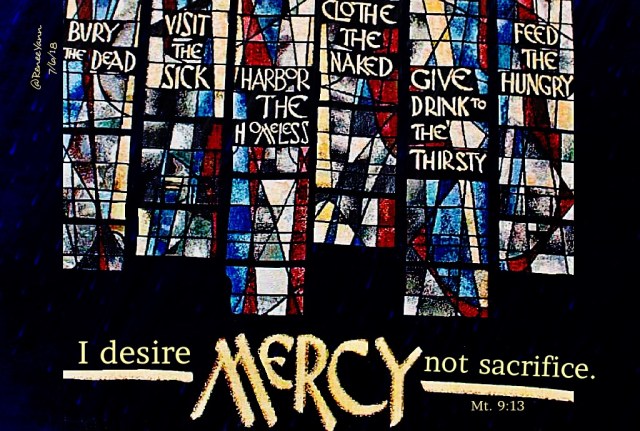
Jesus reminds us that God desires Mercy not sacrifice. Our holy words, laws, and rituals are empty if our actions impede God’s merciful love for all Creation.

We might want to sit at Matthew’s table ourselves today, and ask him to teach us more about that tender-hearted, transformative Mercy.

Music: Tender Hearted – Jeanne Cotter