Stay with the Journey

Friday of the Thirty-fourth Week in Ordinary Time
November 25, 2022

Today’s Readings:

https://bible.usccb.org/bible/readings/112522.cfm


Today, in God’s Lavish Mercy, we pray with Psalm 84, a praise and pilgrimage hymn. 

It is a perfect prayer for us if we have any small sense of alienation, loss, or confusion in our own pilgrimage.

And, honestly, who doesn’t!?

Even in the best of times, life can be a twist! And in “pandemic” times, politically charged times, economically shaky times??? Never a better time to say, “God help us!”


But Psalm 84 orients us. It announces what the journey is really about … the desire to find a resting place in God. Once we realize that, the road slowly straightens with the power of faith.

In Psalm 84, the pilgrim’s heart, hungry for God, sets out on the spiritual journey.

My soul yearns and pines 
for the courts of the LORD.
My heart and my flesh
cry out for the living God.

There can be a deep trust in our journeying heart because “even the sparrow” finds a home in God’s tender care.

Even the sparrow finds a home,
and the swallow a nest
in which she puts her young–
Your altars, O LORD of hosts,
my king and my God!


The secret, though, is constancy.:

  • We pilgrims must stay with the essence of our journey – the deep desire for God. 
  • We must listen to scripture’s “directions” about where God dwells – with the poor, humble, and merciful. 
  • We must not let the flashy road signs of the “Me Culture” distract us.


“The Narcissism Epidemic,” 
by psychologists Jean M. Twenge and W. Keith Campbell 
studies the increase of narcissism or “me-ism” in our culture. 
Here’s an excerpt:

Although these seem like a random collection of current trends, all are rooted in a single underlying shift in the American psychology: the relentless rise of narcissism in our culture. Not only are there more narcissists than ever, but non-narcissistic people are seduced by the increasing emphasis on material wealth, physical appearance, celebrity worship, and attention seeking. Standards have shifted, sucking otherwise humble people into the vortex of granite countertops, tricked-out MySpace pages, and plastic surgery. A popular dance track repeats the words “money, success, fame, glamour” over and over, declaring that all other values have “either been discredited or destroyed.”


Let’s pray today for “staying power”. We have been given the grace to seek God in our lives. Let’s dwell in that seeking, moving from strength to strength in any twists life tosses in front of us.

Blessed they who dwell in your house!
continually they praise you.
Blessed are we whose strength you are!
They go from strength to strength.


Poetry: The Journey – Tagore

The morning sea of silence broke into ripples of bird songs; 
and the flowers were all merry by the roadside;
and the wealth of gold was scattered through the rift of the clouds
while we busily went on our way and paid no heed.

We sang no glad songs nor played;
we went not to the village for barter;
we spoke not a word nor smiled;
we lingered not on the way.

We quickened our pace more and more as the time sped by.
The sun rose to the mid sky and doves cooed in the shade. 
Withered leaves danced and whirled in the hot air of noon.

The shepherd boy drowsed and dreamed in the shadow of the banyan tree, 
and I laid myself down by the water
and stretched my tired limbs on the grass.

My companions laughed at me in scorn;
they held their heads high and hurried on;
they never looked back nor rested;
they vanished in the distant blue haze.
They crossed many meadows and hills,
and passed through strange, far-away countries.

All honor to you, heroic host of the interminable path!
Mockery and reproach pricked me to rise, 
but found no response in me.

I gave myself up for lost
in the depth of a glad humiliation
—in the shadow of a dim delight.

The repose of the sun-embroidered green gloom 
slowly spread over my heart.
I forgot for what I had traveled,
and I surrendered my mind without struggle 
to the maze of shadows and songs.

At last, when I woke from my slumber and opened my eyes, 
I saw thee standing by me, flooding my sleep with thy smile. 
How I had feared that the path was long and wearisome, 
and the struggle to reach thee was hard!


Music: How Lovely Is Your Dwelling Place – Jesuit Music

The Times of Our Lives

Saturday of the Thirty-third Week in Ordinary Time
November 19, 2022

Today’s Readings:

https://bible.usccb.org/bible/readings/111922.cfm

Today, in God’s Lavish Mercy, our readings are challenging. 

Revelation, a very complex book of the Bible, uses symbols, prophecies and allegorical references to make its point. There are huge bodies of scholarship written in the attempt to interpret these passages.

Our Gospel has Jesus describing what it will be like in heaven – when our human perceptions will be erased and we will finally be absorbed into God’s understanding.

These are BIG thoughts and my mind, at least, needs some more manageable inspirations for my morning prayer.  So here’s how I prayed with these readings today.

Lit yr flowerJPG

What both passages share are continual references to time – past, present and future. They reference then-time, now-time, and to-be-time. These passages, and others in Scripture like them, talk about time like this:

  • “in the days before” (then time)
  • “in the days after” (to -be time)
  • “in the day of” (now time)

So what is this day, November 19th, for me?
How is God revealing Love to me in this, my time? 

Today is among “the days after” the last memorable thing that happened in my life – maybe a good thing, maybe not so much. In “the days after”, we spend time with a completed event – learning, savoring, or perhaps regretting and recovering. The “days after” are a time to pray for grace and blessing over what cannot be changed.

Today is also among “the days before” the next big events of my life. So my prayer includes a petition for new and continued courage, hope and enthusiasm for life.

And, most importantly, today is “a day of”. I ask God to help me see and receive the graces of this present moment – not to miss them because I am looking only back or forward. Let me look God square in the eye on this day, which is the only place that I can really find the God Who is always Now.


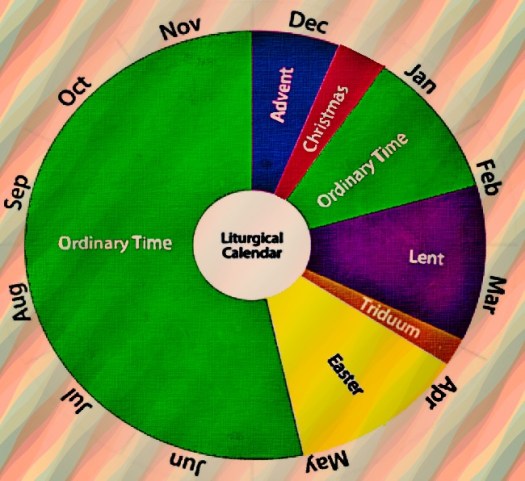
The entire liturgical year is built on this understanding of time. 

  • Advent and Lent are “the days before”, the days of preparation, anticipation, imagining, creating, hoping.
  • The feasts like Christmas, Easter and Pentecost are “the days of”, days of celebrating, loving, being with.
  • The various Octaves are “the days after”, days of remembering, thanking, appreciating, understanding, mourning, forgiving and savoring
lit yr

Where are you today in the times of your life? It may be in a very different place from what is printed on the calendar. The events of our lives create their own personal liturgies.

No matter where that happens to be, let us meet God there with full and open hearts.


Poetry: from Burnt Norton by T.S. Eliot

Time present and time past
Are both perhaps present in time future,
And time future contained in time past.
If all time is eternally present
All time is unredeemable.
What might have been is an abstraction
Remaining a perpetual possibility
Only in a world of speculation.
What might have been and what has been
Point to one end, which is always present.
Footfalls echo in the memory
Down the passage which we did not take
Towards the door we never opened
Into the rose-garden. My words echo
Thus, in your mind.
But to what purpose
Disturbing the dust on a bowl of rose-leaves
I do not know.
Other echoes
Inhabit the garden. Shall we follow?


Music: God of All My Days – Casting Crowns

The End Times

Thirty-third Sunday in Ordinary Time
November 13, 2022

Today’s Readings:

https://bible.usccb.org/bible/readings/111322.cfm

Today, in God’s Lavish Mercy, our readings carry the full flavor of the “end times” warnings, those repeated annually as we move closer to Advent (which is only two weeks away!) When I was a kid, these readings scared me. And now, even as an elder, I’m not particularly in love with them!

But, nevertheless, you gotta’ love Malachi! What a powerful poet! His message of impending judgement and necessary repentance definitely hits the mark.

Lo, the day is coming, blazing like an oven,
 when all the proud and all evildoers will be stubble…

Malachi 3:19

Wow! Really? Depending on where we stand in our moral life, our reaction to this announcement might range from:

Good! Go get ‘em, God!” 

to

Oh, dear God, I hope it’s not me!!!”.


Nobody wants to be “stubble” when the final fires blaze. So how can we avoid that? Paul resets us on the right track, from both “cheer” and “fear” to commitment. He instructs his readers to do their job, living and honest simple lives. He says something like this:

Listen! You must imitate your teachers in Christ.
Live with integrity, justice and generous mercy.
Navigate the world with these as your compass.
Then you will welcome the end times.


Lk21_19 perseverance

In Luke’s Gospel, Jesus offers an equally dire prediction of the end times. When we read the list of disasters and betrayals Jesus describes, we must admit that every one of them occurs somewhere in our world everyday. In essence, we already live in the “end times”, trying to welcome and foster Divine Grace in our piece of the universe.


Photo by Stas Knop on Pexels.com

Today’s readings are an alarm clock. They call us to recognize the geopolitical world we live in as the emerging Realm of God, and to do our part to bring that realm to full realization.

It is likely impossible to communicate God’s vision for the world in the language of politics.  Scripture offers us the transcendent gift of the eloquent prophets Malachi and Jesus describing not only their own times but ours as well.


Walter Brueggemann says this:

The prophet’s task is to imagine the world as though Yahweh, the God of Israel and the creator of heaven and earth, were a real character and a lively agent in the life of the world.  I believe that such a claim, then and now, has to be articulated poetically in order not to be co-opted by political absolutism or theological orthodoxy.

Our readings today give us this poetic vision and challenge. Read them with great longing to hear God’s voice for our times. The world so sorely needs the answer that will blossom by the perseverance of our lives.


Poetry: A Song on the End of the WorldCzeslaw Milosz

Czeslaw Milosz ranks among the most respected figures in 20th-century Polish literature, as well as one of the most respected contemporary poets in the world: he was awarded the Nobel Prize for Literature in 1980. 

On the day the world ends
A bee circles a clover,
A fisherman mends a glimmering net.
Happy porpoises jump in the sea,
By the rainspout young sparrows are playing
And the snake is gold-skinned as it should always be.

On the day the world ends
Women walk through the fields under their umbrellas,
A drunkard grows sleepy at the edge of a lawn,
Vegetable peddlers shout in the street
And a yellow-sailed boat comes nearer the island,
The voice of a violin lasts in the air
And leads into a starry night.

And those who expected lightning and thunder
Are disappointed.
And those who expected signs and archangels’ trumps
Do not believe it is happening now.
As long as the sun and the moon are above,
As long as the bumblebee visits a rose,
As long as rosy infants are born
No one believes it is happening now.

Only a white-haired old man, who would be a prophet
Yet is not a prophet, for he’s much too busy,
Repeats while he binds his tomatoes:
There will be no other end of the world,
There will be no other end of the world.

Warsaw, 1944


Music:  Let Justice Roll – video of the Salvation Army

Released from Hate

Monday of the Thirty-first Week in Ordinary Time
October 31, 2022

Today’s Readings:

https://bible.usccb.org/bible/readings/103122.cfm

Today, in God’s Lavish Mercy, what a beautiful prayer Paul spreads over his listeners. It is a prayer that calls all believers to live in love, peace, and reverence for one another:

Brothers and sisters:
If there is any encouragement in Christ,
any solace in love,
any participation in the Spirit,
any compassion and mercy,
complete my joy by being of the same mind, with the same love,
united in heart, thinking one thing.

Philippians 2:1-2

Reading this passage, I was immediately struck by the awareness of how much opposite messaging we receive in today’s world.

In the arenas of entertainment, politics, civic life, and – sad to say – even religion, we often hear a message contradictory to Paul’s. We hear civic and supposedly “religious” leaders tell their followers to attack, shun, fight, and even “hang” the other. Night after night on our TVs, we watch fictional characters act out the hate and crime that has become normalized in our culture. Our video games, music and movies are drowning in blood, hate and anger.

Sometimes, I am just astounded that we entertain ourselves with murder, war, rape and other outrages against human beings!

With the vicious attack on Paul Pelosi this week, as in so many other horrendous incidents of unbridled hate, we see a perpetrator sickened and abetted by the violent rhetoric our society has allowed. And perhaps even worse than the crime itself, we see political leaders not only minimizing the atrocity, but mocking the victim!


If St. Paul were here, what would he say?

  • where is the encouragement in Christ?
  • where is the solace in love?
  • where is the participation in the Spirit?
  • where is the compassion and mercy?

As a matter of fact, if St. Paul were here, I think he would wail in sadness!


In Luke’s Gospel, Jesus tells us what a society should look like when it respects God and God’s Creation. It should be impelled by the deepest respect and tenderness toward the self and the other:

When you hold a lunch or a dinner,
do not invite your friends or your brothers or sisters
or your relatives or your wealthy neighbors,
in case they may invite you back and you have repayment.
Rather, when you hold a banquet,
invite the poor, the crippled, the lame, the blind; 
blessed indeed will you be because of their inability to repay you.
For you will be repaid at the resurrection of the righteous.

Luke 14:12-14

Bottom line is this: a lot of people just don’t buy Paul’s or Jesus’s message. A lot of people would rather live for themselves to the expense of others.

But we’re not just “a lot of people”. We are Christ’s, and we must examine our speech, attitudes, choices and behaviors for anything that contradicts his message of love, mercy, inclusion, and mutual reverence.

The contradictions are subtle. Discovering and uprooting them takes honest and humble prayer. It requires a good look at how we entertain ourselves, how we confront those we disagree with, who we criticize and how we do it.


Several years ago, I was shocked when someone close to me announced, “I hate Obama!” I asked her why and she said, “I just do. I don’t need a reason!”

Where does all the hate in our culture come from? And, oh, how much more does it tell us about the haters than the ones hated! And of course, the essential question, “What can we do about it?”

Jesus made it simple. He told us to look around the “table” of our attitudes, behaviors and choices.

Who is welcome? Who is shunned? Who is embraced as a human being? Who is objectified and dispensed with as unimportant.

As in all solutions, we can begin with ourselves. Ridding ourselves of these contradictions requires that we listen to ourselves to see if, how, and why we ever use the word “hate”. Only then might we cleanse our hearts of its subtle poisons.


Prose: Two thoughts today

The enemy is fear.
We think it is hate,
but it is really fear.

Mahatma Gandhi

Who would I be,
and what power would be expressed in my life,
if I were not dominated by fear?

Paula D’Arcy

Music: At My Table – JJ Heller – a kinda fun video to watch!

Holy Civility

Friday of the Twenty-ninth Week in Ordinary Time
October 21, 2022

Today, in God’s Lavish Mercy, having blessed and reassured the Ephesian community of the power of their Baptism, Paul instructs them in how to live a Christian life. He says that their Baptism demands a life worthy of their call.

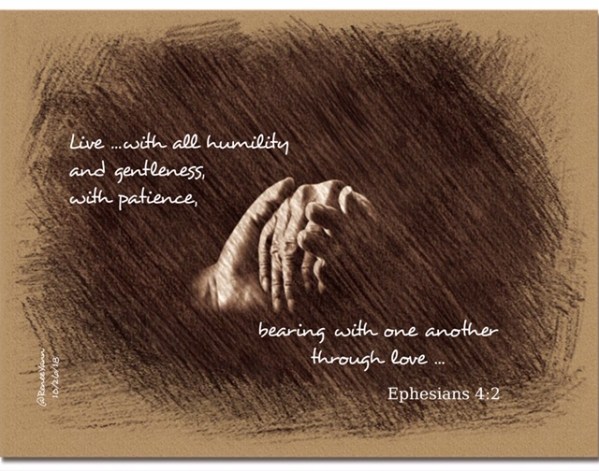
Eph 4_2 bear with

Do you feel called? In your daily life, do you recognize the demand to witness to a graced life in the face of a sometimes ungracious world?

Paul says that’s what it’s all about:

  • the humble, gentle, patient exercise of Christian love
  • the building of inclusive community through acts of peace
  • the embrace of one God Who claims all humanity as one people

Therefore, anything that suggests hate, aggression, pride or exclusion is not worthy of our Baptismal call.


I watched – or tried not to watch – a few political ads last night. I heard the vitriolic rhetoric before I could tap the mute button. I’m probably a bit of a political pollyanna, but I can’t help thinking back to election days when I was a kid. Election Day was fun back then. OK, maybe it was in the dark ages, but you could go to the polls with an ” I Like Ike” button and not be afraid of being shot.

  •  
  •  John J Mellon

My grandfather, known to the neighbors as “The Duke”, was the Republican committee man. He always dressed like a million dollars, but on that Tuesday he was a GQ prototype. Around at the local barbershop, where the voting machines sat unwatched, Grandpop offered coffee and doughnuts to everyone, no matter what button they wore or pushed. That night, if the Republicans lost, he didn’t go out and firebomb the neighbors houses. I really liked that world. Now though my heart keeps saying, “What has happened to us?”


And then I read Paul’s admonitions on Christian responsibility.

I urge you to live in a manner worthy of the call you have received,
with all humility and gentleness, with patience,
bearing with one another through love,
striving to preserve the unity of the spirit
through the bond of peace

Even if our culture’s rampant hostility makes us sad and angry, we must respond to it with Christian courage and peace-building action. We must not become like those who stun us with their indifference to life, humanity, morality and truth. And we must never make an appeal to religion as an excuse for loveless behavior.

In our Gospel, Jesus challenges his listeners in a similar way:

Why do you not know how to interpret the present time?
Why do you not judge for yourselves what is right?

Our times will challenge our Christian character. Will we pass the test?


Prose: from “The Art of Courage” by Dorothy Day

Love and ever more love is the only solution to every problem that comes up.
If we love each other enough, we will bear with each other’s faults and burdens.
If we love enough, we are going to light that fire in the hearts of others.
And it is love that will burn out the sins and hatreds that sadden us.
It is love that will make us want to do great things for each other.
No sacrifice and no suffering will then seem too much.
My prayer from day to day is that God will so enlarge my heart
that I will see you all, and live with you all, in his love.

Plough Magazine, February 21, 2017

Music: one Bread, One Body – John Foley, SJ

Power in Fragility

Memorial of Saints John de Brébeuf and Isaac Jogues, Priests, and Companions, Martyrs
October 19, 2022

Today’s Readings:

https://bible.usccb.org/bible/readings/101922.cfm

Today, in God’s Lavish Mercy,  Paul proclaims his mission to the Gentiles, announcing that through the Gospel, salvation is offered to all people. He says that, by grace, he became a minister of this Gospel – called to preach “the inscrutable riches of Christ”.

Lk12_48 much given

And Paul certainly did an extraordinary job. He had been given much by God, and he gave it back wholeheartedly.

In the Gospel, Jesus talks about that same kind of investment. In answer to Peter’s confusion about the call to be ready for God, Jesus tells the story of wily steward.

This servant had been given much: trust, responsibility, power and probably higher pay. But when the master is away, the trusted servant fails him, acting cruelly and greedily in his own interest.

Jesus ends the story with a pronouncement that has always shaken me a little: 

For unto whomever much is given,
much will be required. 

I know I’ve been given a stunning abundance by God: faith, family, friends and a thousand other graces.  But my will and ability to give back sometimes feels as fragile as a decaying leaf. Ever feel like that?

It turns out that even Paul, great Apostle to the Gentiles, felt that way too. He says so in his letter to the Corinthians. Paul asks God to remove his fragility.

But He said to me,
“My grace is sufficient for you, 
for my power is made perfect in weakness.” 

Let’s pray today to be good stewards of the amazing riches God has given us – in Creation, Faith, Grace and Community. Let us invite God’s power to perfect our weakness, all for the sake of God’s glory.

Even a lacy leaf can be beautiful when it is filled with Light.


Poetry: To Autumn – John Keats

Season of mists and mellow fruitfulness,
  Close bosom-friend of the maturing sun;
Conspiring with him how to load and bless
  With fruit the vines that round the thatch-eves run;
To bend with apples the moss'd cottage-trees,
  And fill all fruit with ripeness to the core;
    To swell the gourd, and plump the hazel shells
  With a sweet kernel; to set budding more,
And still more, later flowers for the bees,
Until they think warm days will never cease,
    For summer has o'er-brimm'd their clammy cells.
Who hath not seen thee oft amid thy store?
  Sometimes whoever seeks abroad may find
Thee sitting careless on a granary floor,
  Thy hair soft-lifted by the winnowing wind;
Or on a half-reap'd furrow sound asleep,
  Drowsed with the fume of poppies, while thy hook
    Spares the next swath and all its twined flowers:
And sometimes like a gleaner thou dost keep 
  Steady thy laden head across a brook;
  Or by a cider-press, with patient look,
    Thou watchest the last oozings, hours by hours.
Where are the songs of Spring? Ay, where are they?
  Think not of them, thou hast thy music too,--
While barred clouds bloom the soft-dying day,
  And touch the stubble-plains with rosy hue;
Then in a wailful choir the small gnats mourn
  Among the river sallows, borne aloft
    Or sinking as the light wind lives or dies;
And full-grown lambs loud bleat from hilly bourn;
  Hedge-crickets sing; and now with treble soft
  The redbreast whistles from a garden-croft,
    And gathering swallows twitter in the skies.

Music: My Grace is Sufficient for You – Keith and Amy Amano 

Hypocrisy! Oh, no!

Tuesday of the Twenty-eighth Week in Ordinary Time
October 11, 2022

Today’s Readings:

https://bible.usccb.org/bible/readings/101122.cfm

Today, in God’s Lavish Mercy, our readings challenge religious and moral hypocrisy.

Lk.11_39 dirty cup

Paul, in his continuing letter to the Galatians, counsels them about the practice of circumcision. But his counseling is really about freedom in Christ. 

In Paul’s time, circumcision had religious significance as a sign of inclusion in the Jewish nation. Some Jewish Christians mistakenly taught that a Gentile must first become a Jew, through the law of circumcision, in order to become a Christian.

Paul condemns this error, reminding the Galatians that the grace given to us in Christ is beyond the Law.

For in Christ Jesus,
neither circumcision nor uncircumcision counts for anything,
but only faith working through love.

In the Gospel, Jesus condemns any religious practice that is empty and just for show.  He compares such rituals to cups, whose clean exterior hides a corrupt interior. Jesus says that the remedy to this hidden nastiness is to give alms, to be merciful.

We are all aware of pharisaical behavior within our religious institutions. We have seen disgusting evidence of it in sexual predation among clergy. We see it when exaggerated religious rituals are substituted for sincere, communal worship. We see it when the small, visible mistakes of others are used to hide the gaping faithlessness of the condemner. Sometimes, we are even caught in the judgmental nets these pretenses spin.

When we are confused by such situations, look to the words of Jesus and Paul today:

Look for faith working through love.
Look for a generous heart that sees and comforts the poor.

If our “religious” observance results in any form of exclusion, prejudice, condemnation or unforgiveness, we can be sure it is not of God.

Poetry: by Omar Khayyam

If you will listen to me, 
I will give you some advice:
[Here it is] 
For the love of God 
put not on the mantle
of hypocrisy. 
Eternity is for all time, 
and this world
is but an instant. 
Then sell not for an instant 
the empire
of eternity.

Music: Purify My Heart ~ Brian Doerksen

Your Life Spells It Out!

Twenty-seventh Sunday in Ordinary Time
October 2, 2022

Today’s Readings:

https://bible.usccb.org/bible/readings/100222.cfm

Today, in God’s Lavish Mercy,  our readings combine to offer us a powerful message: we are the translators of God’s Word for our time. Our choices and actions for justice and mercy make the vision “readable” – visible for our sisters and brothers.

Hab2_2 vision

Habakkuk starts our challenge. He is in a bit of a struggle with God, asking repeatedly how long God is going to allow the people to suffer. ( I have had similar conversations with God, especially during these charged political times).

In so many words, God tells Habakkuk to look to his faith – his vision through God’s eyes. God sees that “the just one, because of his faith, shall live.” God tells him to “write the vision down”, to make it apparent in his own choices and actions for justice and mercy. In other words, Habakkuk, I’ve done what I am going to do. The rest is up to you, Buddy!


In a similar way, Paul reminds Timothy to “stir up the flame” – the gift of God given at his profession of faith. Paul reminds Timothy that, by grace, he knows what is right and just. He must not be chicken about living and speaking that Truth – to write the vision down by his choices and actions for justice and mercy.


In our Gospel, the disciples seem to want their faith increased because the commitment to witness is scary. They think they might feel a little better about it all if their faith consoled them more. But “writing the vision with our lives” takes guts, and the disciples seem a little lacking in today’s reading.

Jesus tells them to buck up. They are blessed to serve the Word of God by the witness of their lives. It won’t always feel good, safe or successful. Still they, and we, must unfailingly write the vision down by our choices and actions for justice and mercy, because even …

When you have done all you have been commanded,
say, ‘We are unprofitable servants;
we have done what we were obliged to do.

Jesus calls it like it is today. We are blessed to be God’s translators. We have an undeniable call to live God’s just and merciful vision. No excuses. Get it together. Keep the pencil sharp. No asking God when He’s going to make things better. The legible (just and merciful) translation depends on us!

Poetry: Abou Ben Adhem – Leigh Hunt

Abou Ben Adhem (may his tribe increase!) 
And saw, within the moonlight in his room, 
Making it rich, and like a lily in bloom, 
An angel writing in a book of gold:— 
Exceeding peace had made Ben Adhem bold, 
And to the presence in the room he said, 
“What writest thou?”—The vision raised its head, 
And with a look made of all sweet accord, 
Answered, “The names of those who love the Lord.” 
“And is mine one?” said Abou. “Nay, not so,” 
Replied the angel. Abou spoke more low, 
But cheerly still; and said, “I pray thee, then, 
Write me as one that loves his fellow men.” 

The angel wrote, and vanished. The next night 
It came again with a great wakening light, 
And showed the names whom love of God had blest, 
And lo! Ben Adhem’s name led all the rest.

Music: The Vision – Patrick Love

Job’s Storms

Monday of the Twenty-sixth Week in Ordinary Time
September 26, 2022

Today’s Readings:

https://bible.usccb.org/bible/readings/092622.cfm

Job on the Dunghill – Gonzalo Carrasco

Today, in God’s Lavish Mercy, we have the first of six readings from the wonderful Book of Job, that magnificent ancient poem which explores the human relationship with God.

“The book of Job in its three parts of narrative-poetry-narrative is a daring, majestic fugue that renders theological trouble and submissiveness in all of its immense complexity. The whole of the drama is to be fully appreciated in its inexhaustible artistry, and not interpreted so that it is made to conform to any of our ready-made theological packages.” 

Walter Brueggemann, An Introduction to the Old Testament: The Canon and Christian Imagination, 2003

The story opens with Satan annoying God with a plot against Job by suggesting that Job loves God only because God blesses Job:

And the LORD said to Satan, “Have you noticed my servant Job,
and that there is no one on earth like him,
blameless and upright, fearing God and avoiding evil?”
But Satan answered the LORD and said,
“Is it for nothing that Job is God-fearing?
Have you not surrounded him and his family
and all that he has with your protection?

To test out his thesis, Satan strikes a deal with God to go vex the heck out of poor Job:

And the LORD said to Satan,
“Behold, all that he has is in your power;
only do not lay a hand upon his person.”
So Satan went forth from the presence of the LORD.


Hopefully, we will learn something about ourselves and our relationship with God as we pray with Job over the next six readings. It is a simple book to read but a challenging one to understand. The poem seems to center on humankind’s recurring question to God: Why do good people have to suffer? But it is really about much more than that.

Job is a soul of unshakeable faith. Never once does he deny or abandon God. But he stands up to a God he doesn’t yet understand. He rails, he argues, he quiets, he listens. The book is really about that growing understanding and faith. Job’s questions are our questions. Job’s storms are our storms. Job’s journey into grace is our journey:

  • How do we relate to the inscrutable mystery of God’s Love when the circumstances of our life seem bereft of it?
  • How do we remain faithful when God seems to be silent to our pleading?
  • How do we continue to choose good when the choice seems foolish and unrewarding?

Like Job, is my faith strong enough to choose God even in the midst of all these “how’s”? Will I allow my heart to remain open to the intense truth of that Love as my life reveals it to me?


Poetry: Reversed Thunder – Malcolm Guite

This light is muffled, muted, murky, dense.
Thick with a threat of thunder unreleased.
The clouds are darkening, the air grows tense,
The coming storm is lowering in the east
Something within me trembles too, and pales,
Though no one sees the brooding darkness there,
Or feels the tension building between poles
Of faith and doubt, of vision and despair.
Everything deepens, gathers to a head:
Anguish and anger at my absent God
Until the charge of all that’s left unsaid
Leaps out at last to find its lightening rod.

But even as the skies are rent and riven
I find that lightening rod is earthed in heaven.

Music: Across the View – Richard Burmer

Trust Your Life

Thursday of the Twenty-fifth Week in Ordinary Time
September 22, 2022

Today’s Readings:

https://bible.usccb.org/bible/readings/092222.cfm

Today, in God’s Lavish Mercy, we meet the first of a few readings from Ecclesiastes, written by an author who calls himself Qoheleth – Teacher. The book contains many loved and oft-repeated phrases that we might recognize:

  • There is a time for everything, and a season for every activity under heaven
  • He has made everything beautiful in its time.

And today’s kick-off thought:

  • Vanity of vanities ….  All is vanity.

Reading Ecclesiastes places us in the presence of a writer who is a realist at best, and a cynic at worst. Parts of the book can be downright depressing; other parts, elegant in their spare beauty.


We can finish a passage like today’s and hear echoes around us of Star Trek’s Borg mantra: 

Resistance is futile. 

Qoheleth says as much:

What has been will be again,
what has been done will be done again;
there is nothing new under the sun.

The phrase carries at least a little tinge of hopelessness. But I think a lot depends on the way we read it.


Realizing that “things are the way they are” can give us a sense of stability and trust. It can release us from struggling needlessly against realities that will not be moved. It can encourage us to find within these “immovables” the hidden path to a new grace. It can remind us that others have endured; so can we.

What is is

One of our Wisdom Sisters taught us that by naming and accepting our reality, we can move from fighting it into growing from it. She always said, “What is, is” – implying “now deal with it”.

It sounds spartan, but it actually can be very freeing. We can’t change so many things – the weather, the tides, the hearts of others. The years will pass, friendships blossom and fade. We will get old, if we are blessed with that gift. We’ll lose our jump shot and probably some of our hair – maybe a few others things too.

But God will always love us, abide with us and cherish us for eternity. We’re gonna’ make it, one way or the other – because ‘God Who is, is!”


Poetry: Prayer – Galway Kinnell

Whatever happens. Whatever
what is is is what
I want. Only that. But that.

Music: In Every Age – Janét Sullivan Whitaker