Who Would I Be?

January 5, 2022
Wednesday after the Epiphany
Memorial of Saint John Neumann, Bishop

Today, in God’s Lavish Mercy, we have a few references to fear — and to its perfect antidote, Love.

John continues to instruct us in prose that stuns us with its sacred clarity:

There is no fear in love,
but perfect love drives out fear
because fear has to do with punishment,
and so one who fears is not yet perfect in love.

1 John 4:18

In our Gospel, we meet some pretty fearful disciples. First of all, they are still spinning from the avalanche of loaves and fishes gushing forth from the perfect faith of Jesus.

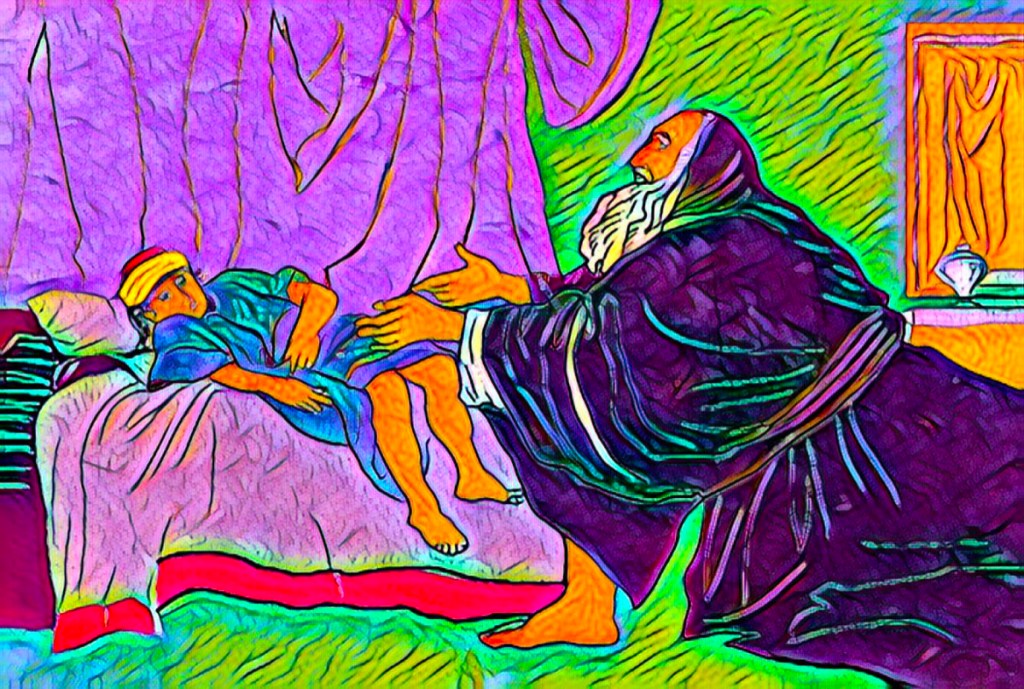
Jesus Walks on Water- William Brassey Hole

Today, they are rowing a storm-tossed lake in the pitch of night. Enough to strike fear into even a crusty fisherman’s heart! But wait a minute! As if all these scary things are not enough, here comes a ghost across the threatening waves!

And how about Jesus in this passage? A little nonchalant, or what? 

About the fourth watch of the night,
he came toward them walking on the sea.
He meant to pass by them.
But when they saw him walking on the sea,

they thought it was a ghost and cried out.

Jesus wasn’t worried about the waves.
Jesus, full of Love, and eternally perfected in the Creator’s Presence, has no need or place for fear. He lives in the accomplished wholeness of God where, as Julian of Norwich says, “All manner of things shall be well.”


Like me, you may not think about your fears very often. But when I read this line from Paula D’Arcy, I consider that there are all kinds of unrecognized fears inhibiting us:

Who would I be, 
and what power
would be expressed in my life, 

if I were not dominated by fear?

Paula D’Arcy

Fears. What are some that we may not recognize:

  • Fear of feeling unimportant, overlooked, naive.
  • Fear of failure, loss, death, loneliness, dependence.
  • Fear of looking foolish, of making a mistake
  • Fear of getting old, being sick, losing my comfort zone.
  • Fear of meaninglessness, unusefulness, of being held responsible?

Could we go on and on?

But what about the biggest fear – of being unloved, and maybe even unlovable.

Dear God, as we pray today, 
help us to grow into your amazing love for us. 
Help us to recognize the fears that limit our love,
to cast them out upon the choppy waters of our life
and to live in your perfect freedom and joy.

Music:  All Shall Be Well – Michelle Sherliza
The Epiphany Star

January 2, 2022
The Epiphany of the Lord 

Today, in God’s Lavish Mercy, we discover a star!

Rise up in splendor, Jerusalem!  Your light has come,
the glory of the Lord shines upon you.
See, darkness covers the earth,
and thick clouds cover the peoples;
but upon you the LORD shines,
and over you appears his glory.

Isaiah 60:1-2

The journey to the Epiphany is repeated in each our lives – many times over. As we – like young Jesus – grow in age and grace, God continually calls us to new Lights, ever deeper into Love’s Divine Universe.

And we, like the determined Wise Ones, move closer – by whatever means we can – to the Promised Revelation. We have our own trusted “camels” which carry us toward Truth: meditation, spiritual reading, sacred song, prayerful journaling, holy silence, merciful service, Gospel love.

Faithful commitment to our soul’s journey leads us to God’s beautiful promise. It is a difficult and sometimes challenging journey, as our poem will attest. But it is not a hopeless, pointless, or endless one:

Then you shall be radiant at what you see,
your heart shall throb and overflow,
for the riches of the sea shall be emptied out before you,
the wealth of nations shall be brought to you.

Isaiah 60

In our second reading, Paul describes that “wealth” in these words:

“that we are heirs and partners 
in God’s promise in Christ 
through the Gospel.”

Ephesians 3:6

Poetry: Nativity Poem – Joseph Brodsky

Imagine striking a match that night in the cave:
Imagine crockery, try to make use of its glaze
To feel cold cracks in the floor, the blankness of hunger.
Imagine the desert – but the desert is everywhere.

Imagine striking a match in that midnight cave,
The fire, the farm beasts in outline, the farm tools and stuff;
And imagine, as you towel your face in the enveloping folds,
Mary, Joseph, and the Infant in swaddling clothes.

Imagine the kings, the caravans’ stilted procession
As they make for the cave, or, rather, three beams closing in
And in on the star, the creaking of loads, the clink of a cowbell;
(No thronging of Heaven as yet, no peal of the bell

That will ring in the end for the infant once he has earned it).
Imagine the Lord, for the first time, from darkness, and stranded
Immensely in distance, recognizing Himself in the Son
Of Man: His homelessness plain to him now in a homeless one.


Music: Magi Veniunt – Sistine Choir

Magi veniunt ab oriente Ierosolimam
quaerentes et dicentes:
Ubi est qui natus est [Rex Judaeorum]
cujus stellam vídimus?
Vidimus stellam eius in oriente,
et venimus [cum muneribus] adorare Dominum.
Interrogabit magos Herodes quod signum vidissent
super natum regem? Stellam magnam fulgentem
cuius splendor illuminat mundum et nos cognovimus.
Vidimus et venimus adorare Dominum

The wise men came from the East to Jerusalem
asking questions and saying:
Where is he that is born [King of the Jews],
whose star we have seen?
We have seen that star in the East,
and we have come [with gifts] to worship the Lord.
Herod questioned the magi what sign they had seen
above the new-born king? We recognized that brightly shining star
whose lustre lights the world and us.
We have seen, and have come to worship the Lord

Inexhaustible Anna

Those who have followed Lavish Mercy for a while will recognize this beautiful piece. I never tire of discovering new insights when I pray with it.

Now, in this moment I close my outer eyes 
and look within with my inner eyes.
I see a vision of wonder,
for I am the daughter of the vision of God,
of the tribe of the blessed ones,
a soul under grace.
I judge not by appearances.
I believe in God’s promises.
I fast from shadows and I live on light.

From my youth, I have served at the temple,
a vessel to a holy purpose.
Prayer is the temple where I dwell
Here I behold the image of the Lord.
I close my eyes and behold that image,
the eyes of the Infinite beholding me
all through the ages,
so tenderly gazing with love and compassion,
enfolding me.

Prayer is the temple where I dwell.
Here, I behold the image of the Lord.
The thoughts held in mind 
are mirrored in kind all around me,
reflecting through all that I see.
Now, I behold with inner vision
the wonders that will be in the fullness of time.

The dreams of all my days and nights
are incensed in the inner sanctum.
My thoughts of truth are flowers on the altar of light.
In the presence of the Holy of Holies,
I keep the high watch.
Gifted with the inner sight,
I see beyond the present.

I am an old, old soul, yet ageless in eternity.
Though outer eyes may seem to dim with time,
the inner eyes are crystal clear.
Though outer vision may seem obscured by time and place,

or clouded by the sorrows and the slavery of sense,
another world’s revealed so clear.
And what I see will be.
My thoughts are giving form,
And held in mind, shall reproduce in kind.

O Lord, I take a long loving look at the real.
I prophesy.
Christ is here.
I have seen the Lord, Thine image, 
and held that image to my own heart.
I am the Spirit of Imagination.
I am Anna, the prophetess, woman of power.

Faithful Waiting

December 30, 2021
Sixth Day in the Octave of Christmas

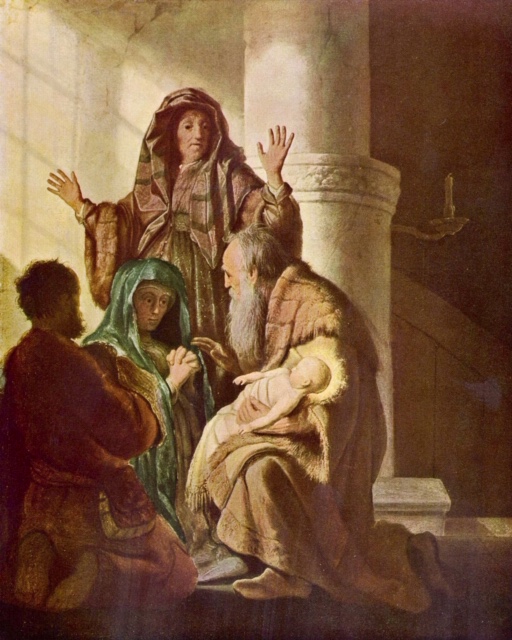
Presentation in the Temple – Rembrandt van Rijn

Today, in God’s Lavish Mercy, we meet the venerable prophetess Anna. Oh, what she has to teach us!

  • Perseverance: she had waited eight decades for the revelation
  • Unconditional Faith: throughout those decades, she prayed always believing
  • Pure Spirit: she believed that, like the pure in spirit, she would see God
  • Unquestioning Receptivity to the Holy: when the Savior appeared, not in glory nor a fiery chariot, she received his vulnerability without hesitation
  • Adoration: “She never left the temple,but worshiped night and day with fasting and prayer.”
  • Sacred Satisfaction: “And coming forward at that very time, she gave thanks to God” because her faith and hope had been affirmed.

There is so much in this reading for each one of us. Find yourself somewhere within it today as you pray. Perhaps:

  • Am I expecting God in every moment of my life?
  • If I have received the gift of “old age”, how has the long wait blessed and/or challenged me to keep hold of God’s hand?
  • If I am still “young”, how do I invite God into my unfolding journey?
  • Am I asking God to continually reveal Divinity in my daily life?
  • Am I purifying my heart of self-interest so that I can better perceive God’s Presence?
  • Can I welcome God no matter how the Divine Presence clothes itself?
  • Do I stay with my prayer, creating a deep temple in my spirit?
  • Can I find contentment and peace with how God chooses to be with me – even in suffering?

(In a second post, I will share a powerful reflective poem by Leddy Hammock & Sue Kelly – Prayer of Imagination for Anna, the Prophetess. I hope you love this piece as much as do.)


Music: While I Wait – Lincoln Brewster

Holy Innocents

December 28, 2021

Today, in Mercy, we are lifted to Light by John’s sacred words in our first reading:

Beloved:
This is the message that we have heard from Jesus Christ
and proclaim to you:
God is light, and in God there is no darkness at all.

1 John 1:5

Simply hearing it, we long to abide in that whole and healing Light.


But then we read our Gospel, among the saddest accounts in all of Scripture – the slaughter of the Holy Innocents. Their needless deaths come at the hands of a power-crazed and fearful man.  So hungry for his own aggrandizement, he tries to assure it by killing a generation of children.

It sounds impossible, doesn’t it, that anyone could be so hardened by evil? It sounds impossible that good people would execute this order of a mad man! It sounds impossible that human beings could be so blind to the sanctity of another’s life!


Dear friends, we must confront our own blindness. We must look into the eyes of our 21st century children – the border children, the victims of school shootings, the children of Yemen, Syria, Afghanistan … the children of war, violence, drugs and poverty.

We must hear the cry of God, their Mother, and choose legislators and leaders who will honor life; who will shape global policies and relationships recognizing the common life we share in God – who will make true pro-life choices regarding gun control, arms sales, and an economy of endless war.

Our attitudes, our advocacy and our votes will either condemn or exonerate us when that Great Light ultimately reveals our hearts. When a society’s children become the victims of its indefensible corruption, we must say “Enough!” and act on our word.


Poetry: Holy Innocents by Christina Rossetti – 1830-1894
We might offer this wish and prayer for all the world’s children.


Sleep, little Baby, sleep;
The holy Angels love thee,
And guard thy bed, and keep
A blessed watch above thee.
No spirit can come near
Nor evil beast to harm thee:
Sleep, Sweet, devoid of fear
Where nothing need alarm thee.

The Love which doth not sleep,
The eternal Arms surround thee:
The Shepherd of the sheep
In perfect love hath found thee.
Sleep through the holy night,
Christ-kept from snare and sorrow,
Until thou wake to light
And love and warmth to-morrow.


Music: The Mediaeval Baebes – Coventry Carol

The “Coventry Carol” is an English Christmas Carol dating from the 16th century. The carol was traditionally performed in Coventry, England as part of a mystery play called “The Pageant of the Shearmen and Tailors”. The play depicts the Christmas story from chapter two in the Matthew’s Gospel. The carol itself refers to the massacre of the Holy Innocents in which Herod ordered all male infants under the age of two in Bethlehem to be killed, and takes the form of a lullaby sung by mothers of the doomed children.
(Information from Wikipedia)

Lullay, Thou little tiny child
By, by, lully, lullay.
Lullay, Thou little tiny Child.
By, by, lully, lullay.
O sisters, too, how may we do,
For to preserve this day;
This poor Youngling for whom we sing,
By, by, lully, lullay.
Herod the King, in his raging,
Charged he hath this day;
His men of might, in his own sight,
All children young, to slay.
Then woe is me, poor Child, for Thee,
And ever mourn and say;
For Thy parting, nor say nor sing,
By, by, lully, lullay.

No More Tears

December 4, 2021
Saturday of the First Week of Advent

Today, in Mercy, Isaiah – in glorious prophecy – promises God’s People better times.

Thus says the Lord GOD,
    the Holy One of Israel:
O people of Zion, who dwell in Jerusalem,
    no more will you weep;
GOD will be gracious to you when you cry out,
    answering as soon as you are heard.
The Lord will give you the bread you need
    and the water for which you thirst.
No longer will your Teacher be hidden,
    but with your own eyes you shall see your Teacher,
While from behind, a voice shall sound in your ears:
    “This is the way; walk in it,”
    when you would turn to the right or to the left.

Isaiah 30: 19-21

Oh my, don’t we all long for the fulfillment of that promise! So much in both our larger and smaller worlds longs for healing!


Perhaps we can use our prayer within these readings today to call on God for the promised healing.

It is a healing that requires our cooperation. Isaiah says that we must name our pain to God – for ourselves and for all who suffer in our world:

The Lord will be gracious to you when you cry out,
answering as soon as you are heard.


The prophet says that this crying out will change us. We will see the Lord with us in our suffering. God will lead us through that suffering by our acts of faith, hope, love, justice and mercy:

No longer will your Teacher be hidden,
but with your own eyes you shall see your Teacher,
While from behind, a voice shall sound in your ears:
“This is the way; walk in it,”
when you would turn to the right or to the left.


Our Gospel tells us that we are called to be Christ’s disciples, and that disciples are healers. By letting our lives become sources of healing in the world, Isaiah’s prophecy is fulfilled for our time.

Jesus sent out these twelve after instructing them thus,
“Go to the lost sheep of the house of Israel.
As you go, make this proclamation: ‘The Kingdom of heaven is at hand.’
Heal the sick, raise the dead, cleanse lepers, drive out demons.

Without cost you have received; without cost you are to give.”

Matthew 10:5-8

How we do these wondrous deeds in the world is an ongoing revelation. When I was very young, I took the proclamation quite literally. But I soon lost the expectation that I would ever help “cure” anyone of anything!

Life has blessed me with the realization that there is a difference between “curing” and “healing” – and that there are many degrees of healing.

  • There are many ways in which living people are caught in deadly lives.
  • There are all kinds of “lepers” in our society, rendered so by the prejudices of others.
  • Certainly, many of us carry all sorts of crippling demons.

All these situations, and others like them, invite us to offer the gift of sacred healing implanted in us at our Baptism.

Acknowledging the pain in ourselves and others,
and trusting that God wants us to be healed and whole,
is the work of true discipleship.

Let’s draw strength from Isaiah’s promise in order to find a generous, merciful courage for our call to be “healed healers”.


Poetry: The Cure of Souls – Denise Levertov

The pastor
of grief and dreams

guides his flock towards
the next field

with all his care.
He has heard

the bell tolling
but the sheep

are hungry and need
the grass, today and

every day. Beautiful
his patience, his long

shadow, the rippling
sound of the flocks moving

along the valley.


Music: Your Healing Touch – Joe Bongiorno

In a very little while …

December 3, 2021
Friday of the First Week of Advent
Memorial of St. Francis Xavier

Today, in God’s Lavish Mercy, we stand with Isaiah on the rim of hope. We wait, trusting that “in a very little while”, the Lord will make Creation whole.

It’s a precipitous place, this cliff called “Hope”. It requires that we risk ourselves solely on the promises of a God we cannot see. It invites us to leap into a mist we cannot control.

Or can we?


In today’s Gospel, Jesus invites the blind men to the cliff’s edge by asking them:

Do you believe that I can do this?

Well, that’s everything, isn’t it? If our answer is “No”, “Maybe”, or “Kinda’”, we might as well just lie down on this side of the Promise.

But if our answer is brave, like the Gospel blind ones, we too may have our vision cleared to see that there is no leap required. We already stand beside God.

When his children see
the work of my hands in his midst,
They shall keep my name holy;
they shall reverence the Holy One of Jacob,
and be in awe of the God of Israel.
Isaiah 29:23


Poetry:Hope – Lisel Mueller

It hovers in dark corners
before the lights are turned on,
it shakes sleep from its eyes
and drops from mushroom gills,
it explodes in the starry heads
of dandelions turned sages,
it sticks to the wings of green angels
that sail from the tops of maples.

It sprouts in each occluded eye
of the many-eyed potato,
it lives in each earthworm segment
surviving cruelty,
it is the motion that runs
from the eyes to the tail of a dog,
it is the mouth that inflates the lungs
of the child that has just been born.

It is the singular gift
we cannot destroy in ourselves,
the argument that refutes death,
the genius that invents the future,
all we know of God.

It is the serum which makes us swear
not to betray one another;
it is in this poem, trying to speak.


Music: Amazing Grace sung by Il Divo

Beyond Measure

Wednesday of the Thirty-third Week in Ordinary Time
Memorial of St. Elizabeth of Hungary
November 17, 2021

Today, in God’s Lavish Mercy, we pray a lovely verse of Psalm 17:

The psalm is a gentle plea which might serve to soften our two dramatically intense readings.

Who can read the story of the Maccabean Martyrs without a mix of horror, empathy, and astonishment?

And don’t we all feel a pang of pity for the poor, fearful servant who hid his talent in a handkerchief much to the King’s displeasure?

The two stories, (one based in fact, the other a parable), paint a contrasting picture of courageous faith against fearful subservience. The difference between the actors lies in their capacity, or lack there of, to look beyond themselves toward eternal life.

Mother Maccabee bolsters her sons with her faith in a life beyond their current circumstances:

… the Creator of the universe
who shapes each man’s beginning,
as he brings about the origin of everything,
he, in his mercy,
will give you back both breath and life,
because you now disregard yourselves
for the sake of his law.

2 Mc 7:23

The poor soul in Jesus’s parable doesn’t have that faith and vision. His perception of God, represented by the King, is one of only harsh judgement. His fear causes him to bury not only his talent, but also his openness to the possibilities of grace and transformed relationship with God.

Jesus told his parable because indeed the Kingdom was at hand. He and his disciples were near Jerusalem where the Passion, Death and Resurrection events would begin.

He wants his followers to realize the challenging gift they have been given in their call to be his disciples. He wants them to see that it is now on them to magnify his message courageously and generously until he returns to perfect the Kingdom.

Jesus wants us to understand that too.


Poetry: Sonnet 19: When I consider how my light is spent – John Milton
Milton became blind in later life. The poem reflects his concerns about all that he has left undone in his life. Ultimately, Milton expresses the confidence that God has no need of his “talent”, only his steadfast faith.

When I consider how my light is spent, 

   Ere half my days, in this dark world and wide, 

   And that one Talent which is death to hide 

   Lodged with me useless, though my Soul more bent 

To serve therewith my Maker, and present 

   My true account, lest he returning chide; 

   “Doth God exact day-labour, light denied?” 

   I fondly ask. But patience, to prevent 

That murmur, soon replies, “God doth not need 

   Either man’s work or his own gifts; who best 

   Bear his mild yoke, they serve him best. His state 

Is Kingly. Thousands at his bidding speed 

   And post o’er Land and Ocean without rest: 

   They also serve who only stand and wait.”


Music:   Be Not Afraid – written by Bob Dufford, SJ, sung here by Cat Jahnke

Stretching to See God

November 16, 2021
Tuesday of the Thirty-third Week in Ordinary Time

Today, in God’s Lavish Mercy, we pray with Psalm 3 which well might reflect the prayer of noble Eleazar from our first reading:

You, O LORD, are my shield;
    my glory, you lift up my head!
When I call out to the LORD,
    he answers me from his holy mountain.
R.    The Lord upholds me.
When I lie down in sleep,
    I wake again, for the LORD sustains me.
I fear not the myriads of people
    arrayed against me on every side.

Psalm 3: 4-7

Eleazar’s faithful character is so strong that he can look beyond his present circumstance to:

… leave in his death a model of courage
and an unforgettable example of virtue
not only for the young but for the whole nation.

2 Mc 6:31

Both Eleazar’s story and Zaccheus’s are about living in the big picture of God’s vision for us. These stories invite us to stretch beyond ourselves to see God in our circumstances.

Eleazar was a giant in the virtues necessary to “see beyond the trees” of his current circumstances. A more spiritually short-sighted person might have succumbed to the temptation to save himself at the cost of his faith and witness.

But Eleazar’s faith was long, both in years and in depth. He kept the eyes of his heart focused on that faith and was delivered beyond any short-sighted choices.


In our Gospel, we meet Zaccheus who, due to his short stature, was unable to get a glimpse of Jesus walking nearby. He wasn’t getting the whole picture – but he desperately wanted to!


Sometimes we miss Christ in our midst, don’t we? It may be because we’re “short” on time, patience, faith, attention, courage, peace, desire … you name it.

Zaccheus may have been physically short, but he was tall in will and intention to see Jesus. The trees became his tools not his obstacles.


It’s hard sometimes to see the forest beyond the trees – to direct our choices, attitudes and actions by a vision we glimpse only on the tippy toes of faith and prayer.

Perhaps these two God-seekers can inspire us today, by their courage, steadfastness and faith, to always live within God’s long eternal vision for us.


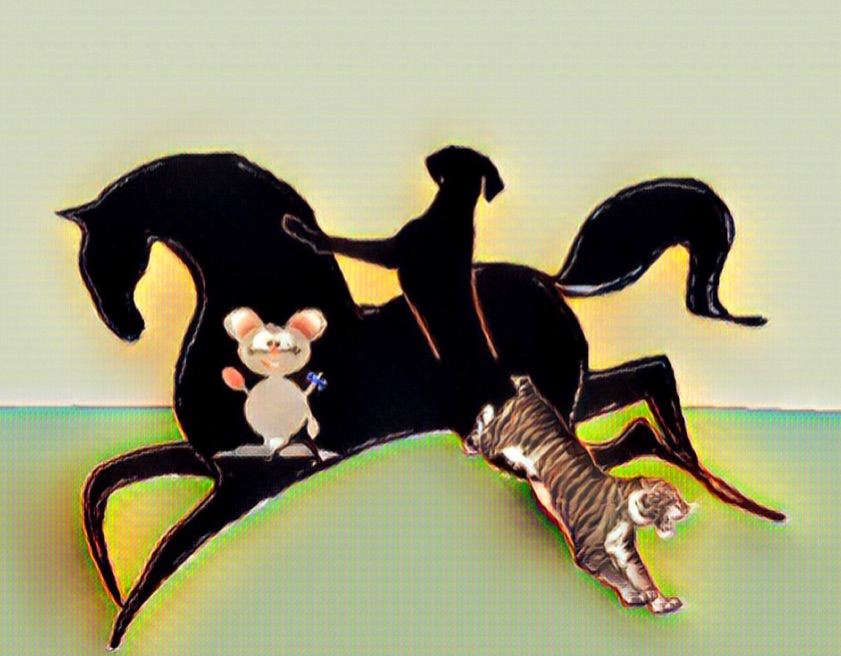
Poetry: Walking on Tiptoe by Ted Kooser

Long ago we quit lifting our heels
like the others—horse, dog, and tiger—
though we thrill to their speed
as they flee. Even the mouse
bearing the great weight of a nugget
of dog food is enviably graceful.
There is little spring to our walk,
we are so burdened with responsibility,
all of the disciplinary actions
that have fallen to us, the punishments,
the killings, and all with our feet
bound stiff in the skins of the conquered.
But sometimes, in the early hours,
we can feel what it must have been like
to be one of them, up on our toes,
stealing past doors where others are sleeping,
and suddenly able to see in the dark.

Turn Your Eyes Upon Jesus – written in 1922 by Helen Lemmel, sung here by Michael W. Smith

O soul are you weary and troubled
No light in the darkness you see
There's light for a look at the Savior
And life more abundant and free

Turn your eyes upon Jesus
Look full in his wonderful face
And the things of earth will grow strangely dim
In the light of his glory and grace

His word shall not fail you he promised
Believe him and all will be well
Then go to a world that is dying
His perfect salvation to tell

Turn your eyes upon Jesus
Look full in his wonderful face
And the things of earth will grow strangely dim
In the light of his glory and grace

O soul are you weary and troubled
No light in the darkness you see
There's light for a look at the Savior
And life more abundant and free

Turn your eyes upon Jesus
Look full in his wonderful face
And the things of earth will grow strangely dim
In the light of his glory and grace

Fear Not

Today, in God’s Lavish Mercy, we pray with Psalm 146 which tells us just how very much God loves those whom no-one else appears to love.

Hallelujah!
Praise the Lord, O my soul!
I will praise the Lord as long as I live;
I will sing praise to my God while I have my being.
Put not your trust in rulers, nor in any child of earth,
for there is no help in them.
When they breathe their last, they return to earth,
and in that day their thoughts perish.
Happy are they who have the God of Jacob for their help!
For their hope is in the Lord their God,
who made heaven and earth, the seas,
and all that is in them;
who keeps promises for ever;
who gives justice to those who are oppressed,
food to those who hunger
and sets the prisoners free.
The Lord opens the eyes of the blind!
The Lord lifts up those who are bowed down
and loves the righteous.
The Lord cares for the stranger
and sustains the orphan and widow,
but frustrates the way of the wicked.
The Lord shall reign for ever,
your God, O Zion, throughout all generations.
Hallelujah!


In our readings this Sunday, we learn lessons from widows – those whose place in biblical times was uncertain and frightening. Without a husband, a woman experienced diminished standing in the legal, financial and political life of the community. 

She was often dependent on charity, and was deemed fortunate to capture a bit of good will from those in better circumstances. 

There are several examples of widows being blessed by miracles, because they were among those most in need of them.

In today’s first reading and in the Gospel, we meet two widows displaying amazing charity and character strength.  The widow of Zarephath steadfastly prepares for death because she has nothing left to live on. When Elijah asks to share in her last few cornmeal cakes, she does not hesitate to feed him.

In our Gospel, it is significant that, just across the road from the well-stocked treasury, a nearly penniless widow gives her last coins to the poor.


Elijah and the Widow’s Boy

In Elijah’s account, we learn the outcome of the widow’s generosity.  She reaps an abundant reward in perpetual flour and oil to sustain her and her son.

We never learn what happens to Jesus’s widow. We are left to imagine that, in some way, her selflessness is rewarded.


It is so hard to give it all to God, especially if we feel we have little left for ourselves.  It is hard to give our love when we feel empty-hearted.  It is hard to give care when we feel unappreciated.  It is hard to assist others when we ourselves are exhausted. It is hard to do good if no one, not even God, seems to notice.

But God does notice.  Like Jesus on that long-ago afternoon, God is watching as we empty our coffers in service and care for the poor, sick, troubled and lost.

What we have to give may be small — a single corn cake or two little coins. It is the act of giving it that is large — and will make our hearts large by the choice.


Poetry: The Widow of Zarephath by Sister Lou Ella Hickman, I.W.B.S, a member of the Sisters of the Incarnate Word and Blessed Sacrament of Corpus Christi, Texas. Her most recent collection of poetry is titled “she: robed and wordless“, available through press53

https://www.press53.com/lou-ella-hickman

i was like a small bird
            pecking near a gate
            when i went in search of twigs—
            a bit of wood for a fire

so after one last meal
my son and i could die…
then a man asked for water—

                        a bit of bread
                        now i, a small bird,
                        found more than twigs
                       because i too, like ravens, fed him


Music with Visuals: The Widow of Zarephath