Anointed

Saturday of the First Week in Ordinary Time

January 18, 2020

Click here for readings

Today, in Mercy, Samuel anoints Saul King of Israel.

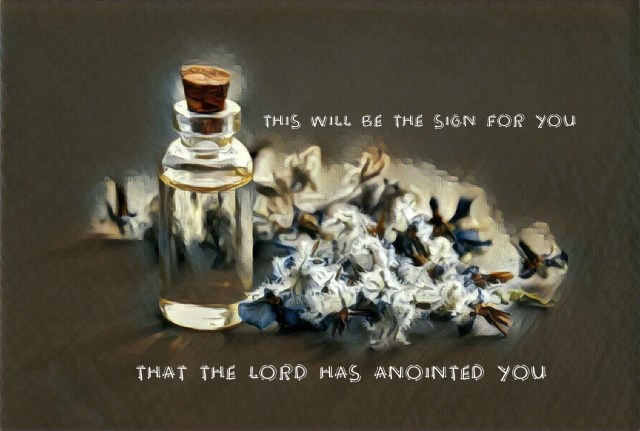
Then, from a flask he had with him, Samuel poured oil on Saul’s head;
he also kissed him, saying:
“The LORD anoints you commander over his heritage.
You are to govern the LORD’s people Israel,
and to save them from the grasp of their enemies.

1Sam10_1

Throughout Scripture, the act of anointing signifies being blessed, commissioned by grace. The sacred oil heals and strengthens the anointed to do the work of God.

We share in the grace of anointing through the sacraments – Baptism, Confirmation and Anointing of the Sick. We may not think about the power these rituals give us to live our lives in the pattern of Christ. But it is an amazing power which creates saints out of ordinary human beings like you and me!


Caritas_Bruegel
Caritas, The Seven Acts of Mercy, pen and ink drawing by Pieter Bruegel the Elder, 1559. Counter-clockwise from lower right: feed the hungry, give drink to the thirsty, ransom the captive, bury the dead, shelter the stranger, comfort the sick, and clothe the naked

In a less formal way, we can anoint one another by our acts of generosity, honesty, justice and love. Think of the woman who anointed Jesus with nard from her alabaster jar. How that act strengthened him for the suffering he had to face!

There are so many chaffed and sore places in our world awaiting the oil of mercy!

works of Mercy

We can also “anoint” our own life by gratefully remembering God’s presence in our lives:  the blessings we have received, the challenges we have gracefully met, the love we have both given and received – all that strengthened us to do the work of God over our lifetime.

Music:  Holy, Anointed One – Vineyard Worship

Can You Hear Me Now?

Wednesday of the First Week in Ordinary Time

January 15, 2020

Click here for readings

Today, in Mercy, we read about God’s call of Samuel, Hannah’s son.

New things are about to happen in Israel. The People have lived under the questionable leadership of a series of Judges. But now, threats from inside and outside loom. So God chooses to move in a new way among the community.

1Sam speak Lord

Samuel is going to be God’s bridge to that new way. In today’s reading and subsequent verses, he hears God’s call, listens, receives a vision, and prophesies to Eli.


In our reading from Mark, Jesus is the Divine Bridge to a new reality. Early now in his ministry, his call is blossoming in his heart, as he realizes that he must go all over Israel preaching and healing.

When Simon told Jesus the local villagers were looking for him, Jesus told them,

“Let us go on to the nearby villages
that I may preach there also.
For this purpose have I come.”
So he went into their synagogues,
preaching and driving out demons

throughout the whole of Galilee.”

Jesus continues his healing and enlightening mission through all who call themselves Christian. He calls each of us in different ways to be a “Bridge” with him to the Reign of God.

How are you hearing and listening to your particular call every day? Maybe, like Samuel, by the time God calls us three times, we may understand!😉

Music: Since I mentioned “bridge”, I can’t help including one of my favorite songs, Bridge Over Troubled Water by Simon and Garfunkel. It’s not really a religious song, but their popular song actually was inspired by a great Gospel song,  Oh Mary, Don’t You Weep and its one freely interpreted verse very near the end: “I’ll be your bridge over deep water/If you trust in my name.’ 

Bridge Over Troubled Waters


Oh, Mary Don’t You Weep (Lyrics below, but they are VERY liberally interpreted by these wonderful Gospel singers.)

Lord, I’m singing . . . (solo)
Oh, Mary, don’t you weep. (group)
Tell Martha not to mourn. (solo)
Tell Martha not to mourn. (group)
Listen, Mary, (solo)
Oh, Mary, don’t you weep. (group)
Tell Martha not to mourn. (solo)
Tell Martha not to mourn. (group)
Pharaoh’s army, (solo)
Oh, Mary, don’t you weep. (group)
They got drownded in the sea, (solo)
Drowned in the Red Sea. (group)
Jesus said, Mary, (solo)
Oh, Mary, don’t you weep. (group)
Tell Martha not to mourn. (solo)
Tell Martha not to mourn. (group)
Can’t you hear me singing, Mary? (solo)
Oh, Mary don’t you weep. (group)
I want you to know, Martha don’t have to mourn. (solo)
Tell Martha not to mourn. (group)
Oh, listen, Mary, (solo)
Oh, Mary don’t you weep. (group)
Tell Martha not to mourn. (solo)
Tell Martha not to mourn. (group)
Pharaoh’s army, (solo)
Oh, Mary, don’t you weep, (group)
They got drownded in the sea, (solo)
Drowned in the Red Sea. (group)
Jesus said, Mary, (solo)
Oh, Mary don’t you weep, (group)
Tell Martha not to mourn, (solo)
Tell Martha not to mourn, (group)
Lord, and if I could tonight, (solo)
If I could, (group)
I want to tell you I surely would right now. (solo)
Surely would, (group)
I would stand on the rock. (solo)
Stand on the rock, (group)
Right on the rock where Moses stood. (solo)
Moses stood, (group)
Pharaoh’s army, (solo)
Oh, Mary don’t you weep (group)
They got drownded in the sea, (solo)
Drowned in the Red Sea. (group)
Jesus say, Mary, (solo)
Oh, Mary don’t you weep. group)
He said Mary . . . (solo)
Oh, Mary don’t you weep .(group)
Oh, Mary . . . (solo)
Oh, Mary, don’t you weep. group)
Tell Martha not to mourn. (solo)
Tell Martha not to mourn. group)

Follow Me

Monday of the First Week in Ordinary Time

January 13, 2020

Click here for readings

Today, in Mercy, we re-enter Ordinary Time. (I’ll be posting a second reflection today on the topic of “ordinary time”.)

Today we begin a journey with Mark the Evangelist which carries us all the way to Lent. This journey will allow us to walk right beside Jesus as he preaches, cures, and calls people to full life in God.

Somewhere on Peter’s missionary journeys after Christ’s Ascension, he encountered Mark and took him as travel companion and interpreter. Mark then wrote down Peter’s sermons, thus composing the Gospel according to Mark (According to the historian Eusebius: Eccl. Hist. 15–16). So, in a very real sense, when we pray with Mark, we are also praying with Peter and with Peter’s memories of life with Jesus.

Today’s Gospel is a great example of that first-hand experience — the call of the first disciples.

As he passed by the Sea of Galilee,
he saw Simon and his brother Andrew casting their nets into the sea;
they were fishermen.
esus said to them, “Come after me, and I will make you fishers of men.”
Then they left their nets and followed him.


I like to think of Peter talking to young Mark about this moment in his life.  He states it so simply. One can almost hear Peter say, ”It started so ordinarily.  We were just cleaning our nets, when He came out of nowhere and picked us!”

What Peter doesn’t say, but what might be inferred from the story, is that he and his brother Andrew were READY for the call. It didn’t take them a moment to drop those nets and follow. 

And, oh my, what a journey Peter made from that first moment to where he sat telling Mark the story decades later somewhere in Asia Minor.

Maybe other fishermen along that coastline might have scoffed or been bewildered at an invitation to become “Fishers of Men”. But Jesus knew the right ones to call.  He knew the hearts that would respond to the extraordinary clothed in the ordinary.

Mk1_17 follow

As we follow Mark’s Gospel over these next weeks, let’s look for the call it carries to us in our “ordinary time”.  Let’s be ready when Jesus asks us to tag along with him. We might, like Peter, be surprised at the graces waiting for us when we drop the “nets” entwining us and just follow!

Music: Follow Me – Casting Crowns

In this song, we hear Jesus invite several people to follow him: the disciples, the woman caught in adultery, the Good Thief … even us.

Holy Victory

Friday after Epiphany

January 10, 2020

Click here for readings

Today, in Mercy, our readings both challenge and affirm our faith:

John tells us:

Beloved:
Who indeed is the victor over the world
but the one who believes that Jesus is the Son of God?

What does John mean by saying our faith makes us “victor over the world”? 

1Jn5_5

Certain scripture passages, and many theologians throughout history, use the term “the world” to refer to a secularized human system which denies or devalues God and spirituality. They set this concept of “the world” in opposition to a life lived from deep faith.

“Pope Francis, in a recent homily, spoke of the spirit of the world, which is contrary to the Holy Spirit. “Jesus, at the Last Supper,” he recalled, “does not ask the Father to remove the disciples from the world,” because Christian life is in the world, “but to protect them from the spirit of the world, which is the opposite. He emphasized, that it is, “even worse than committing a sin. It is an atmosphere that renders you unconscious, leads you to a point that you do not know how to recognize good from evil”.
(Alessandro Di Bussolo, Vatican News)

For some, though, a simplistic definition of “world” and “spirit” has led to a dichotomy in which these realities are isolated from, and do not inform each other. Such thinking may lead us to identify “world” with the “evil” generated by sin or spiritual emptiness.

Evolving theology has confronted this dichotomous perception to help us understand that we come to know God through the sacred reality of the created world we live in.

Thomas Berry says this:
“… we will recover our sense of wonder and our sense of the sacred only if we appreciate the universe beyond ourselves as a revelatory experience of that numinous presence whence all things came into being. Indeed, the universe is the primary sacred reality. We become sacred by our participation in this more sublime dimension of the world about us.”
(Thomas Berry, “The Wild and the Sacred,” in The Great Work)

Such Creation-based spirituality allows us to acknowledge and respond to God’s invitation to transform “the world” by our oneness with Christ, who is the Fullness of Creation.

“Once one understands that the evolving community of life on Earth is God’s beloved creation and its ruination an unspeakable sin, then deep affection shown in action on behalf of ecojustice becomes an indivisible part of one’s life.”
(Elizabeth A. Johnson – Ask the Beasts: Darwin and the God of Love)

Pope Francis, in paragraph 11 of Laudato Si’ writes:

If we approach nature and the environment without this openness to awe and wonder, if we no longer speak the language of fraternity and beauty in our relationship with the world, our attitude will be that of masters, consumers, ruthless exploiters, unable to set limits on their immediate needs. By contrast, if we feel intimately united with all that exists, then sobriety and care will well up spontaneously. The poverty and austerity of Saint Francis were no mere veneer of asceticism, but something much more radical: a refusal to turn reality into an object simply to be used and controlled.

As we consider all these aspects today in our prayer, let us ask for an understanding of God based in deep love and hope for our cosmic truth.

Music: Adoro Te Devote

Pants on Fire?

Thursday after Epiphany

January 9, 2020

Click here for readings


Today, in Mercy, John talks about liars. He made me really think.

nose
Liar! Liar! Pants on Fire!

When I was a kid going to weekly Saturday night confession (yes, remember a lot of us did that😇), I really had to scrape to get a decent pile of sins. I mean, honestly, how much evil can one eight-year-old generate in a week?

But lying was always a good fallback to report on. You know the deal: I told my teacher that I forgot my homework when I really hadn’t done it. I told Petey Nicolo I could beat him up when I knew I couldn’t. I told Chickie Schmidt I could ride a big bike like hers when I had actually just fallen on my face off a smaller one. I told Sister I wasn’t smoking in the girls’ room when my very own cousin Joanie threw me under the bus!

As you can see, I was your normal childhood compulsive liar – pretending to be and do lots of things I only wished I could be or do. But that’s just part of growing up. Like most people, I got over it when I began to realize the power and necessity of growing confidently into one’s true self.

People depend on us to be who we really are, to be the real deal. The value of our work and contributions to the world hinges on this. The depth and endurance of our relationships rest on such transparency and authenticity. Even our ability to love ourselves is rooted in honest self-awareness.


1Jn4_15
So how do we deepen in that kind of truthfulness, especially in this culture that so abuses it? John tells us that love is the way:

Beloved, we love God because
God first loved us.
If anyone says, “I love God,”
but hates his brother, he is a liar;
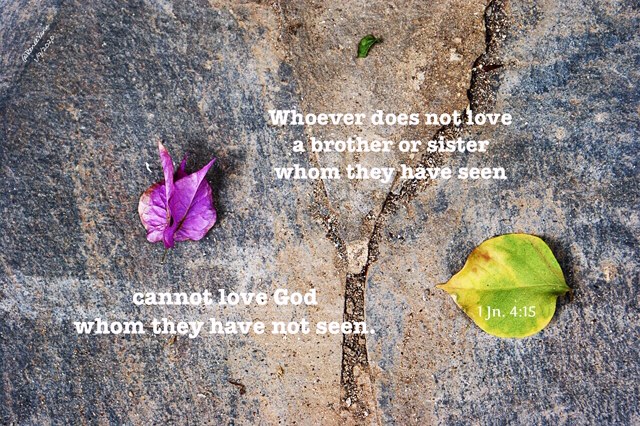
for whoever does not love a brother whom he has seen
cannot love God whom he has not seen.
This is the commandment we have from him:
Whoever loves God must also love his brother.

Friends, we live in a culture drowning in lies. Some have come to believe that unless one lies, one cannot compete. Businesses lie to sell untested or worthless commodities. Manufacturers veil the danger of their drugs, tobacco and vaping products. Politicians lie to condemn their opponents. Leaders lie to justify war. And criminals lie to excuse their crimes.

tangled netJPG

These liars may never even consider that their tangled lives are related to the scriptures. But every one of these deceptions is fueled by a failure in reverence and love for our sisters and brothers, by a failure in courage to be responsible for one another.

We lie because we think our truth is not enough. John tells us differently. Our awesome Truth is that we all are God’s children!

Our reading closes today with these words, so critical to the rebuilding of a truthful world:

In this way we know that we love the children of God
when we love God and obey his commandments.
For the love of God is this,
that we keep his commandments.
And his commandments are not burdensome,
for whoever is begotten by God conquers the world.
And the victory that conquers the world is our faith.

Let’s pray for one another’s courage, dear Friends, to be and demand the Truth that Love requires.

Music: True Heart – Oak Ridge Boys

Often, I use a popular song for prayer, allowing its words to speak to God for me.
You might like to try it with this song. No doubt intended as a human love song, it can be a divine love song too – and it’s sure a good wake up prayer😉

Afraid? Who Me?

Wednesday after Epiphany

January 8, 2020

Click here for readings

Today, in Mercy, we have a few references to fear — and to its perfect antidote, Love.

1Jn4 fear

John continues to instruct us in prose that stuns us with its sacred clarity:

There is no fear in love,
but perfect love drives out fear
because fear has to do with punishment,
and so one who fears is not yet perfect in love.


In our Gospel, we meet some pretty fearful disciples. First of all, they are still spinning from the avalanche of loaves and fishes gushing forth from the perfect faith of Jesus. 

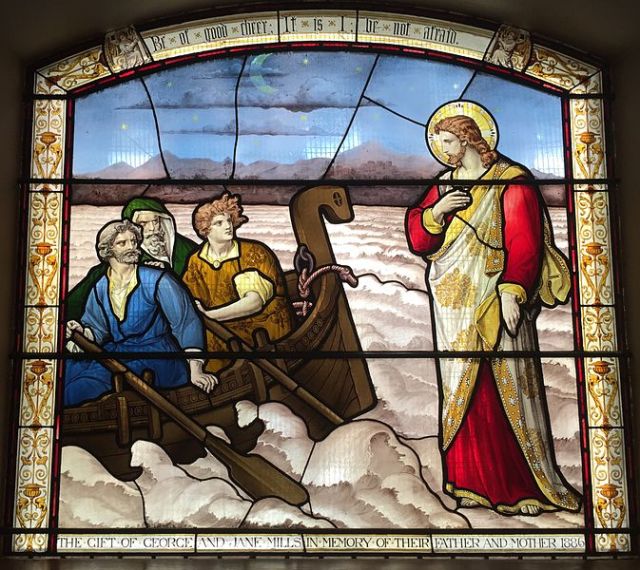
Jesus_walks_on_Water,_St_Botolph_without_Aldersgate
Jesus walks on Water, St Botolph without Aldersgate: Photo by Andrew R. Abbott Andrewrabbott [CC BY-SA (https://creativecommons.org/licenses/by-sa/4.0)%5D

Today, they are rowing a storm-tossed lake in the pitch of night. Enough to strike fear into even a crusty fisherman’s heart! But wait a minute! As if all these scary things are not enough, here comes a ghost across the threatening waves!

And how about Jesus in this passage? A little nonchalant, or what? 

About the fourth watch of the night,
he came toward them walking on the sea.
He meant to pass by them.
But when they saw him walking on the sea,

they thought it was a ghost and cried out.

Jesus wasn’t worried about the waves.

Jesus, full of Love, and perfected in the Creator’s Presence, has no need or place for fear. He lives in the accomplished wholeness of God where, as Julian of Norwich says, “All manner of things shall be well.”


cocoon

I never really thought much about fearfulness in my life. I exist in great security. But when I read this line from Paula D’Arcy, I saw that there are all kinds of unrecognized fears inhibiting us:

Who would I be,
and what power
would be expressed in my life,

if I were not dominated by fear?

Fears. What are some of yours that, like me, you may not have recognized:

  • Fear of failure, loss, death, dependence.
  • Fear of looking foolish, getting old, being sick, losing my comfort zone.
  • Fear of meaninglessness, unusefulness, of being held responsible?

Could we go on and on?

But what about the biggest fear – of being unloved, and maybe even unlovable.

Dear God, as we pray today,
help us to grow into your amazing love for us.
Help us there to cast out our fears
and to live in your perfect freedom and joy.

Music:  All Shall Be Well – Michelle Sherliza

Be the “Possible” That God Imagines!

Tuesday after Epiphany

January 7, 2020

Click here for readings

Today, in Mercy, our readings empower us for unbounded possibility!

John’s letter tells us why:

In this is love:
not that we have loved God,
but that God loved us…

God has loved me!

There is nothing more I need to be whole — if I will only believe it, absorb it, and live from it!

There is nothing more I need to become a force for love in the world.


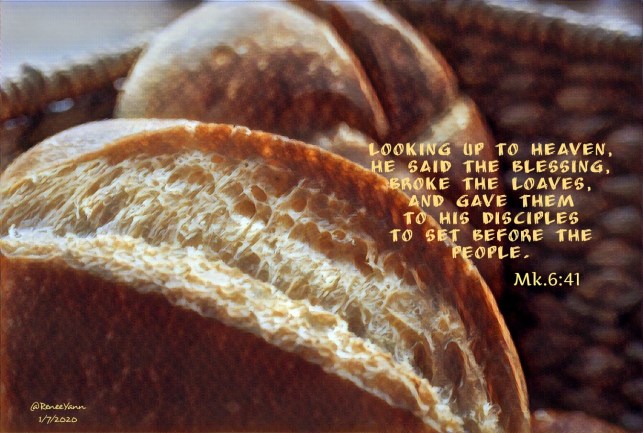
Mk6_4 loaves

Jesus demonstrates this powerful love in our Gospel reading.

It has been a long day of teaching, and the disciples see that the crowds are hungry and tired. They know the solution, which Jesus has apparently overlooked : let them go home and get something to eat!

But Jesus very simply responds, “Feed them yourselves!

He invites his disciples to realize the power released within them by God’s supernatural love. He challenges them to envision a way to respond to their challenges other than the tired, limited solutions we anxiously depend on.

Jesus calls them to imagine the world as God imagines it – transformed by an Unconditional Love which refuses the measurements of fear, control, and self- preservation.


loaves and fishes

Can you just visualize the scene that afternoon as the five loaves and two fish miraculously multiplied over the crowd of five thousand!

Can you see the expressions on the disciples’ faces as they allowed themselves to believe that, because of God’s Love, they were the vehicle of miracles!

We are too! There is no good we are incapable of if we will just believe in the power of Divine Love within us. Our miracles may not be as dramatic as the multiplication of the loaves. But they will be no less important.

They will be the miracles God planned for us to work in God’s name – for our circumstances, our challenges. They will be the way we carry God’s unimaginable grace to the tired hungers of our times.

Picture yourself starting out today, carrying that basket with just two fish and five loaves into the famished world. Imagine what happens when you open your heart to God grasping the basket with you!

Music: Imagine – John Lennon – I love this song in which Lennon imagines a world free of all the human constructs by which we limit it – a world as God might see it.

The Righteous Kingdom

Monday After Epiphany

January 6, 2020

Click here for readings

Today, in Mercy, John instructs us in the meaning of true righteousness. 

We human beings can get very confused about this term. Some have used it to imply that observable religious practice makes one superior, holier than others. We can all visualize the “righteous” preacher pouring fire and brimstone over the lowly congregation. The beautiful term “righteousness” has been disserved by this image.

In his first letter, John describes the root of true righteousness, that state of graceful balance within a Gospel-powered life:

Beloved:
We receive from him whatever we ask,
because we keep his commandments and do what pleases him.
And his commandment is this:
we should believe in the name of his Son, Jesus Christ,
and love one another just as he commanded us.

In today’s Gospel, Jesus is in the early stages of his public ministry. He is slowly teaching the people how different his “power” and “righteousness” will be from the worldly power they might have expected.

Mt4_23 kingdom

Jesus’s “Kingdom” stands in stark contrast to the Roman Empire and the principles of domination, aggression and disregard for life which fed it. Jesus’s is a Kingdom built by uniting our differences, especially those of the poor and sick, into the oneness of God’s love.

Jesus went around all of Galilee,
teaching in their synagogues,
proclaiming the Gospel of the Kingdom,

curing every disease and illness among the people.
His fame spread to all of Syria,

and they brought to him
all who were sick with various diseases

and racked with pain,
those who were possessed, lunatics, and paralytics,
and he cured them.


Praying with these readings today brings me face to face “the elephant in the room”. In this Lavish Mercy community, we hope together for the growth of the Gospel Kingdom in a global community. But now that yet unrealized community stands at the brink of war because nations have so badly blurred the lines between the righteous Gospel Kingdom and the self-righteous Empire.

RSM statement
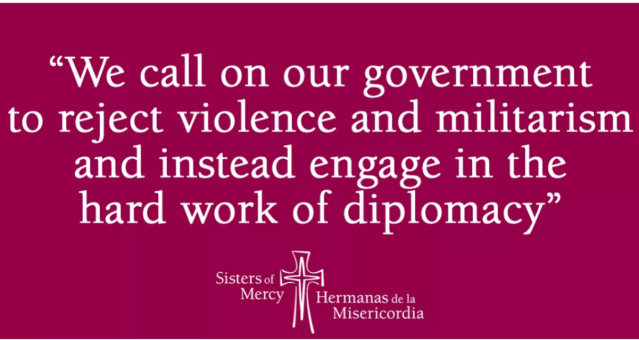
Sisters of Mercy of the Americas join with people across the world in condemning the Trump Administration’s drone strike assassination of Qassem Soleimani, leader of Iran’s Quds force, outside of Baghdad. Far from fostering peace in a troubled part of the world, this reckless decision will only escalate violence and increase suffering for millions of people. We call on our government to reject violence and militarism and instead to engage in the hard work of diplomacy. –Sister Patricia McDermott, RSM, president, Sisters of Mercy of the Americas

It is difficult to look at the “elephant” without getting political, but I am trying hard to refrain from political opinion here. What I can say with confidence is that we as faith-impelled people cannot stay silent in the face of the world’s current situation. When our voice is heard – at the ballot box and through direct advocacy – may it reflect the fundamental Gospel imperatives for which Jesus lived and died.


These clippings from Pope Francis’s visit to Hiroshima helped me in my prayer today:

“How can we propose peace if we constantly invoke the threat of catastrophic war as a legitimate recourse for the resolution of conflicts?”

“May the abyss of pain endured here in Hiroshima remind us of boundaries that must never be crossed. A true peace can only be an unarmed peace.”

“In a single plea to God and to all men and women of good will, on behalf of all the victims of atomic bombings and experiments, and of all conflicts, let us together cry out: Never again war, never again the clash of arms, never again so much suffering,” 

“Indeed, if we really want to build a more just and secure society, we must let the weapons fall from our hands.”

Pope Francis quoted Gaudium et Spes, which states that “peace is not merely the absence of war … but must be built of ceaselessly.” He added that the lessons of history show that peace is the fruit of justice, development, solidarity, care for our common home, and promotion of the common good.

“I am convinced that peace is no more than an empty word unless it is founded on truth, built up in justice, animated and perfected by charity, and attained in freedom.”

Music: Adagio for Strings – Samuel Barber

As the Shadows Lengthen…

Memorial of Saint Elizabeth Ann Seton, Religious

January 4, 2020

Click here for readings

CoverImage_Behold_the_Lamb_of_God

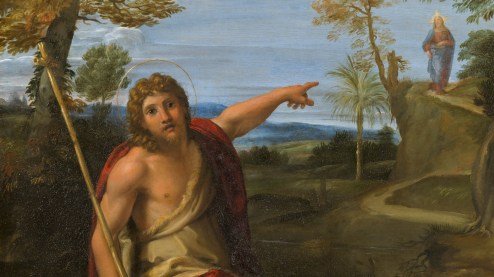
Today, in Mercy, our Gospel invites us to stand chatting with John the Baptist and a couple of his disciples. Jesus passes by us, on his way home for the day. John points to him and says to his two friends, “He’s the Guy…don’t miss this chance to learn from him.”


When I picture myself in this passage, it is the late afternoon. The shadows, even my own, have begun to lengthen across the landscape. There is a sense that time, and with it opportunity, may be passing by. 

It is a time of day like that described by Emily Dickinson:

There’s a certain Slant of light,
Winter Afternoons –
That oppresses, like the Heft
Of Cathedral Tunes –

Heavenly Hurt, it gives us –
We can find no scar,
But internal difference –
Where the Meanings, are –

None may teach it – Any –
‘Tis the seal Despair –
An imperial affliction
Sent us of the Air –

When it comes, the Landscape listens –
Shadows – hold their breath –
When it goes, ’tis like the Distance
On the look of Death –


We, like these disciples, are not neophytes. We have our lives; we’ve made our choices. Is it possible a New Call could come so far into the day? Is it imaginable that God could walk fresh right across the shadows falling around us, just as he did for the brave Elizabeth Seton?

Blog-Say-Yes-to-Splits-300x200

Our Gospel says Yes! Yes! Yes! Every single day – Yes!

Let’s go and stay with Jesus a while in prayer to see, like Peter, what new name he might call us today, even as the shadows lengthen.

Prayers and love to you, dear Friends!

Music: Shadowlands Suite – George Fenton

This glorious music video contains slides of the great movies for which Fenton has written scores. I fear they may be a bit of a distraction from prayer, but I couldn’t resist. You may want to watch some in the New Year. (Highly recommend Shadowlands with a box of tissues.)

Rachel Still Weeps

Feast of the Holy Innocents, martyrs

December 28, 2019

Click here for readings

Today, in Mercy, John tells us a hard truth:

If we say, “We are without sin,”
we deceive ourselves, and the truth is not in us.

Rachel

As I read the Gospel account of the slaughter of the Holy Innocents, John’s words pummel me, as do the images we view routinely on the evening news:

  • toddlers caged on the US-Mexico border
  • infants lying dead on Syrian and Kurdish hillsides
  • kindergarteners bulleted by AK47s
  • youngsters trafficked to the rich and powerful
  • children of color victimized by prejudice
  • acolytes defiled by their priests
  • students lunch-shamed for their poverty
  • kids bullied for their differences
  • hungry babies cut from assistance to fund military excess

In today’s world, so bereft of social justice and moral policy, we don’t have to read the Gospel to find the Holy Innocents. They are staring us, teary-eyed, right in our faces!

This morning’s is an uncomfortable prayer! What can I do to be sinless in the face of such injustice? What is morally required of me to shed complicity in these outrages?

Like many of you, I feel helpless and overwhelmed at times, just as Herod’s populace must have felt.

But then I remember that I do not live under a “Herod”, unless I passively allow myself to. I can advocate, protest, contribute and most of all VOTE. I can do everything in my power to assure that a moral and rational leadership holds the right to stand for me and for my responsibilities to my sisters and brothers.

Yes, today in our prayer, we may weep like Rachel. But then, let us finish weeping. Let us seek the ways that we can repent any complicit sinfulness. Let us acknowledge and repudiate the normalized culture of war and domination which we have accepted. Let us inform ourselves and act clearly and consistently for merciful justice – for innocent life in all its stages!

Music: Save the Children – Marvin Gaye