Witness for Christ

Feast of Saint Stephen, Protomartyr

December 26, 2019
Click here for readings

stephenJPG

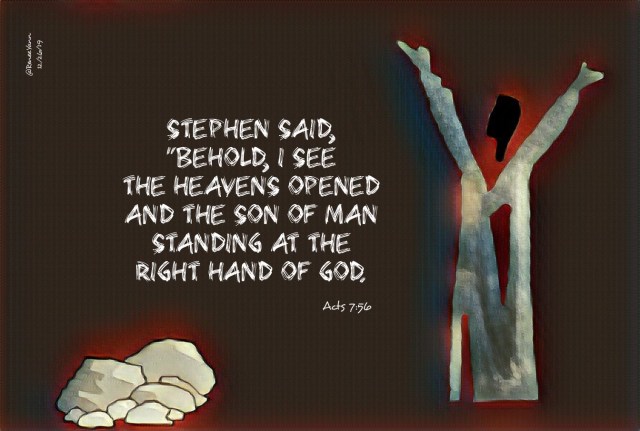
Today, in Mercy, we celebrate St. Stephen, the first martyr for the Christian Faith. Martyrdom is a somber distance from the comforting angels and kindly stars of Christmas. But I think there’s a reason our liturgy places its hard reality here.

 The story surrounding Stephen’s death reveals his beautiful soul. These are some of words describing Stephen:

  • filled with grace and power
  • working great wonders and signs
  • speaking with wisdom and spirit
  • filled with the Holy Spirit

Why would anyone want to kill such a man!

It is a question which resounds down the centuries following Stephen.

Why is innocence persecuted?
Why is faith opposed?
Why is goodness crushed?
Why is freedom strangled?
Why is love for neighbor so frightening?

Our reading from Acts exposes an “infuriated” crowd, burning with anger at Stephen. Why? How had he injured them?


lock web


The human heart can become so fixed in its securities, can’t it? Sometimes we build walled worlds where we are always right, first, best, strongest, and smartest. Smarter than anybody!

These oppressive little worlds are places where for me to be right, you must be wrong. For me to be first, you must be at least second, if not last. For me to be strong, you must be weak. If we live in such a crippling world, a challenge to listen and change is earth-shattering to our fearful, manufactured security.


Christ came to free us all from needing such worlds. Omnipotent Mercy chose to be born in utter vulnerability and poverty. Christmas was our first lesson on how to live in a world secured only by Grace. Stephen’s story, following so close upon Christmas, drives home the consequences of such a faith-filled life.

Rather than right, first, best, strongest and smartest, the invitation of Christ is to be open, humble, generous, courageous, wise. Stephen’s debaters didn’t like that invitation. His faithful conviction was so true that they could offer no argument against it to defend their walled-in lives. So they killed him.


broken doll

All over our planet, we see innocent life crushed by war, trafficking, economic subjugation, prejudice, divisiveness, irrational hatred, and soulless indifference. We see both small and large tyrannies enacted on the global political stage, in business, in the Church, in schools and in families.

The witness of Stephen, first martyr, inspires us to live a life so open to the Holy Spirit that we may stand up strong and, like him, “see the glory of God and Jesus” even through the shadows of a sinful world.

Music: I Will Stand As a Witness for Christ – Sally DeFord
Prophecies and Dreams

Fourth Sunday of Advent

December 22, 2019

Click here for readings

Today, in Mercy, our scripture readings lay down before our prayer the long line of salvation history. It is a line that we can walk in wonder, winding from Isaiah’s prophecy, through the House of David, down to Joseph dreaming in the Nazarene night.

line

It is a story filled with words we love because, ever since our childhood, they have carried to us the fragrant scent of Christmas. These readings are the thrilling stuff of prophecies and dreams, all the more wonderful because we know them now fulfilled.

Therefore the Lord himself will give you this sign:
the virgin shall conceive, and bear a son,
and shall name him Emmanuel.
Isaiah 7:14


Joseph, son of David,
do not be afraid to take Mary your wife into your home.

For it is through the Holy Spirit
that this child has been conceived in her.

She will bear a son and you are to name him Jesus,
because he will save his people from their sins.
Matthew 1:20


O Emmanuel

This long wick of Promise, burning slowly through the biblical years, bursts into light with the birth of Jesus Christ, the Fire of God.

Through our faith, that Divine Light kindles us – we who now, through our Baptism, carry the sacred DNA of Jesus into our times.

On this final Sunday of Advent, when the world’s “crazy Xmas” tries to hijack our  souls, let us be very intentional about the true meaning of these days. Let us take the time to “go into our heart cave” and prepare for Jesus. (Heart Cave poem to follow in a second post)

Music: Emmanuel – Tim Manion (Lyrics below)

Baby born in a stall.
Long ago now and hard to recall
Cold wind, darkness and sin,
your welcoming from us all.

 How can it be true?
A world grown so old now, how can it be new?
Sorrow’s end, God send,
born now for me and you

Emanuel, Emanuel
What are we that You have loved us so well?
A song on high, a Savior’s high, angel hosts rejoice
Thy glory to tell

 Lord, lead us to know.
You lay like a beggar, so humble, so low;
no place for Your head and straw for a bed,
the glory of God to show.

 Babe on mother’s knee,
child so soon to be nailed to a tree;
all praise, till the end of our days;
O Lord, You have set us free

Gaudete! Rejoice!

Third Sunday of Advent

December 15, 2019

Click here for readings

Gaudete 2019

Today, in Mercy, we celebrate Gaudete Sunday, a name which comes from the first word of the Introit of today’s Mass:

Gaudete in Domino semper: iterum dico, gaudete.
Rejoice in the Lord always; again I say, rejoice.

Our readings, too, counsel us to rejoice, and to do so with patience and honesty before God.


REJOICE:
Those whom the LORD has ransomed
…. will meet with joy and gladness (Isaiah 35:10)


BE PATIENT:
You too must be patient.
Make your hearts firm,
because the coming of the Lord is at hand. (James 5:8)


SPEAK HONESTLY WITH GOD:
When John the Baptist heard in prison of the works of the Christ,
he sent his disciples to Jesus with this question,
“Are you the one who is to come,
or should we look for another?” (Matthew 11:2)


As we pray with these verses, we might ask, similarly to John the Baptist:

  • Is the coming of the Lord really at hand?
  • Is our long wait to be complete in God really over?
  • Hasn’t this gone on for 2000 years with no Second Coming? 

Well, it all depends on how we look at it.

time


With our feet and our experiences firmly planted in a time-bound world, it is hard for us to enter God’s timeless view of our salvation.


With God there is no waiting. We already live in the fullness of God’s eternal life.

Our time-bound life is our chance to open ourselves to that Fullness by allowing our experiences to fashion us in the image of Christ.

Every moment, every encounter, every experience carries the invitation to this Complete Love. Continually answering this invitation brings us into an ever deeper transparency with God.

transparent


When we see and live our lives this way, joy captures us. Circumstances may not always leave us happy or satisfied (I mean, look at John, he was imprisoned). But they cannot claim our joy, because we see patiently through time’s veil to the eternity already within us.

This sacred insight is the gift of our Baptism in Christ.

Today, we draw closer to the celebration of his presence with us in history by his birth on Christmas. But the deeper celebration is Christ’s continual rebirth in our lives of joy, patience and honest relationship with God.

Music: Patience People – John Foley, SJ (Lyrics below)

Patience, people, till the Lord is come.
See the farmer await the yield of the soil.
He watches it in winter and in spring rain.

Patience, people,
for the Lord is coming. Patience, people, till the Lord is come.
You have seen the purpose of the Lord.
You know of His compassion and His mercy.

Patience, people,
for the Lord is coming. Patience, people, till the Lord is come.
Steady your hearts for the Lord is close at hand.
And do not grumble, one against the other.
Patience, people, for the Lord is coming.

Days of Elijah

Memorial of Saint John of the Cross, Priest and Doctor of the Church

December 14, 2019

Click here for readings

Today, in Mercy, we think about John the Baptist. For several days in this middle part of Advent, our Gospel makes reference to John, the Precursor of the Messiah.

411px-Saint_John_The_Baptist_Preaching_In_The_Wilderness_by_Anton_Raphael
John the Baptist by Anton Raphael Mengs – looking a lot better than he probably really looked!!!!

Faithful Jews had an expectation that there would be a Messiah, and that a fiery Precursor would announce him. They identified this forerunner with the prophet Elijah, based on writings like today’s from Sirach:

How awesome are you, Elijah, in your wondrous deeds!
Whose glory is equal to yours?
You were taken aloft in a whirlwind of fire,
in a chariot with fiery horses.
You were destined, it is written, in time to come
to put an end to wrath before the day of the LORD…

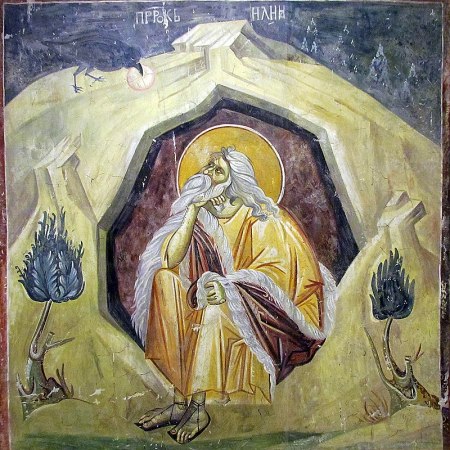
800px-Elijah,_a_prophet_and_a_miracle_worker
Elijah, a prophet and a miracle worker, Gračanica monastery


In our Gospel, Jesus indicates that John the Baptist is the new Elijah, preparing the way for Jesus’s ministry.

Scripture scholars can get pretty bundled up in trying to explicate the meanings around Elijah and his return. For the purpose of our prayer, I find it helpful to take another approach.

  • What is it in my life that prepares me to receive God in my heart?
  • What inspires me “prepare the way of the Lord” in the worlds that I touch?
  • Do I pay attention to God’s “announcements”, those quiet inklings that tell me God is trying to make something new in my life?

Jesus says that Elijah “has already come” but has been rejected by the people.

  • Are there habits and choices in my life that make it hard for God to get through to me?
  • Maybe God is sending an “Elijah”or “Baptist” my way today. Will I recognize that Precursor? Will I be open to the message?

Music: Days of Elijah – Robin Mark. 

The commentary in the Worship & Song Leader’s Edition contains a good summary of this hymn’s text: “This is a song of victory and of hope, of God’s triumph forever over death and of Christ’s eternal reign. It also calls believers to stand fast, even in the face of troubles, and to witness to the promised coming of Christ.”


Even in Darkness, TRUST!

Wednesday of the Second Week of Advent

December 11, 2019

Click here for readings

Today, in Mercy, folks in Isaiah’s reading are exhausted! He’s written a plethora of words to convey that God’s People are just about done in! He uses the words “faint”, “weary”, and “burden” at least a dozen times! We get it! The image would be something like this:

burden

But Isaiah encourages the people to look up from the weight of their burdens:

Do you not know
or have you not heard?
The LORD is the eternal God,
Creator of the ends of the earth.
He does not faint nor grow weary,
and his knowledge is beyond scrutiny.
He gives strength to the fainting;
for the weak he makes vigor abound.
Though young men faint and grow weary,
and youths stagger and fall but …

wings

Some of you, dear readers, carry heavy burdens just now, in yourselves and in your dear ones: illness, aging, sorrow, disappointment, the confusions of life, the passing of beloveds, unfulfilled dreams, an unmerciful world. 

Know this:
God is with us in any darkness,
and God’s light will prevail.

This is the whole meaning of our faith-filled journey through Advent. Trust the Promise of our Incarnate God to be with us, given in today’s tender Gospel:

Come to me, all you who labor and are burdened,
and I will give you rest.
Take my yoke upon you and learn from me,

for I am meek and humble of heart;
and you will find rest for yourselves.
For my yoke is easy, and my burden light.

Music: On Eagles’ Wings – Michael Joncas

Comfort the Lost

Tuesday of the Second Week of Advent

December 10, 2019

Click here for readings

Today, in Mercy, we have the exquisite “Comfort” passage from Isaiah. Our Gospel gives us Jesus tenderly seeking the single lost lamb.

Isaiah40_1_11

The first and last words of these two readings – COMFORT, LOST – capture the whole intent of God’s message:
Life is a maze whose walls are heightened by our incivility to one another. Isaiah calls to be a leveler of walls, a straightener of twists, a bridge over deadly valleys; Jesus calls us to seek and carry the lost sheep. They call us to be Mercy.

The US southern border is one of the many places in our world crying out for these acts of mercy. Please listen to our Sister Anne Connolly describe the cry:


Music: Comfort Ye from Handel’s Messiah – sung by Jerry Hadley

As we pray this glorious music today, let us ask for the strength and courage to be Mercy for the world, to find the ways to comfort God’s people, close by and at life’s borders.

Pride of Place

At our weekly Miraculous Medal Novena, the loudest and most impressive singer of the Novena song was Mamie Ounan. I used to hold on to my kindergarten beanie for fear Mamie’s contralto would blow it off! I wrote a little reflection about her a few years ago and thought you might enjoy it today.


Mamie


“Pride of Place”.  That’s what my Dad called it.  I asked him one Sunday when I was about six years old, “How come Mamie Ounan always sits all alone up in that front pew?” Mamie was an elegant old woman, a little like Madame Belvedere in the old movie, “Mrs. Miniver”.  Each Sunday, Mamie Ounan processed up the aisle to commandeer the entire front pew in our parish church.

Gold_Star_Banner_wikimedida_commons.svg_
Flag of a Gold Star Family who lost a member in service to the USA. Such a flag hung in my family home when I was child. It changed all of us!

““Pride of Place””, Dad said.  When I looked up at him clueless, he explained.  “Mamie’s been sitting there every Sunday for forty years. She sat there the Sunday after her husband died in a shop accident.  She sat there every Sunday through the Depression when she struggled to keep her corner grocery open. She sat there the day her son was killed at Pearl Harbor.   All the while, no homeless person ever went away hungry from Mamie’s back steps.  She earned that pew and the rest of us are proud for her to have it.”

““Pride of Place”” isn’t always something physical like a pew in church.  More often it’s a moral or spiritual position that’s granted to us by others after we pay certain dues.  These dues include trustworthiness, sacrifice, contribution and wisdom.

kids table

All of us experience at least some ““Pride of Place”” passages in our lives.  Remember when you moved up from the kids’ table at Thanksgiving dinner?  Remember being a sophomore on freshman day? Throughout our lives, we advance through grade levels, job levels, armed services levels, even golf and bridge levels.

But earning real ““Pride of Place”” is very different from making it to the top of the heap.  We receive the first from others who recognize and respect us.  We take the second from others who may begrudge it to us. Mamie was given “Pride of Place”. She didn’t take it.  Otherwise, someone else would have beaten her to that pew each Sunday.

“Pride of Place” doesn’t come automatically with power or position.  Not every parent, boss, teacher, pastor, elder or champion deserves it.  It has to be earned and kept as a trust.  Even in hard times, its owner has to honor it and use it for others.  Jimmy Carter has “Pride of Place”.  Richard Nixon never did. I have my own feelings about Mr. Trump. I’m sure you do too!

trump

We all have the potential for “Pride of Place” in our lives. We can discover that potential by looking at the things we have responsibility for.  We have kids, elders, employees, co-workers, customers and friends.  We have homes, neighborhoods and futures.  We can impact all these things for better or worse.

Do we dispense those responsibilities with love, courage and honesty?  Do we use the power we have for others, not over or against them?  Mamie Ounan, that little old lady in a tiny city neighborhood, had tremendous power.  She gave people hope and example by the way she endured, by the way she cared and by the way she lived.

If we haven’t begun to exercise that kind of responsible adult power in our lives, maybe it’s time to stand up from the kids’ table and walk toward our own “Pride of Place”.

The Promise of Wholeness

Memorial of Saint Ambrose, Bishop and Doctor of the Church

Saturday, December 7, 2019

Click here for readings

Today, in Mercy, Isaiah – in glorious prophecy – promises God’s People better times.

hope

Oh my, don’t we all long for the fulfillment of that promise! Sometimes, I can’t even watch the news anymore because the world is in such seemingly irreversible pain!


Perhaps we can use our prayer within these readings today to call on God for the healing they promise.

It is a healing that requires our cooperation. Isaiah says that we must name our pain to God – for ourselves and for all who suffer in our world:

The Lord will be gracious to you when you cry out,
as soon as he hears he will answer you.

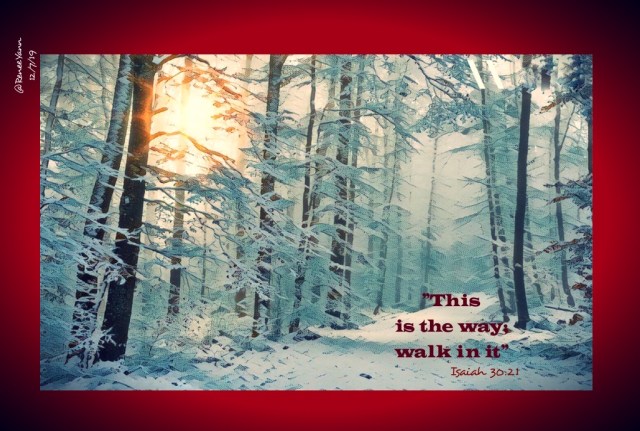
Is30_21 Walk

The prophet says that this crying out will change us. We will see the Lord with us in our suffering. God will lead us through that suffering by our acts of faith, hope, love, justice and mercy:

No longer will your Teacher hide himself,
but with your own eyes you shall see your Teacher,
While from behind, a voice shall sound in your ears:
“This is the way; walk in it,”
when you would turn to the right or to the left.


Christ_Healing_the_Mother_of_Simon_Peter’s_Wife_by_John_Bridges
Healing Peter’s mother-in-law by John Bridges, 19th century

Our Gospel tells us that we are called to be Christ’s disciples, and that disciples are healers. By letting our lives become sources of healing in the world, Isaiah’s prophecy is fulfilled for our time.

Jesus sent out these twelve after instructing them thus,
“Go to the lost sheep of the house of Israel.
As you go, make this proclamation: ‘The Kingdom of heaven is at hand.’
Heal the sick, raise the dead, cleanse lepers, drive out demons.

Without cost you have received; without cost you are to give.”

How we do these wondrous deeds in the world is an ongoing revelation. When I was very young, I took the proclamation quite literally. I soon lost confidence that I would ever really “cure” someone of anything!

Life has blessed me with the realization that there are many degrees of healing. There  many ways in which living people are caught in deadly lives. There are all kinds of “lepers ” in our society, rendered so by the prejudices of others. Certainly, many of us carry all sorts of crippling demons.

Acknowledging the pain in ourselves and others, and trusting that God wants us to be healed and whole, is the work of true discipleship. Let’s keep our eyes on Isaiah’s promise to give us a generous, merciful courage for our call! Let’s keep our eyes on Jesus as he shows us the way.

Music: (Can you take a little hint of “country” this morning?)

Turn Your Eyes upon Jesus – written by Helen Howarth Lemmel (1863-1961) and sung here by Alan Jackson, one of the best-selling music artists of all time, having sold over 75 million records.

A Transformed Heart

Memorial of Saint Cecilia, Virgin and Martyr

November 22, 2019

Click here for readings

Saint_Cecilia
Poster of fresco after John Dryden’s poem “A Song for Saint Cecilia’s Day

(Following in a second post will be John Dryden’s A Song for St. Cecilia’s Day, 1687)

Today, in Mercy, we celebrate the feast of St. Cecilia who is the patron of musicians. A Christian martyr of the 2nd century, she is one of seven women in addition to the Blessed Virgin mentioned by name in the Canon of the Mass. Her deep spirituality led to a sacred intimacy with God which gave her the faith and courage to endure martyrdom.

Both readings today speak about the Temple. After the victory of Judas Maccabeus, the Jewish people restore their Temple with exuberant celebration, recognizing it as a symbol of God’s Presence with them.

In today’s Gospel. Jesus also “restores” the Temple by driving out the merchants who have diverted the Temple’s purpose as representative of God’s Presence.

Our bodies too are temples of the Holy Spirit.

Paul, in his letter to the Corinthians tells us:

Do you not know
that your bodies are temples of the Holy Spirit,
who is in you, whom you have received from God?
You are not your own; you were bought at a price.

Through our Baptism into the Passion, Death and Resurrection of Christ, the Holy Spirit dwells in us. We are called to be transformed by this Indwelling. As in any relationship, this transformation is accomplished through transparency, communication, listening and acting on behalf of the Beloved.

Geoffrey Brown, a deeply spiritual poet, offers us this imaginative image of waiting for and welcoming, as Cecilia did, the transformative Presence of God in our lives:

I must remember to go down to the heart cave
And sweep it clean, make it warm, with fire on the hearth
And candles in their niches
The pictures on the walls glowing with quiet lights

I must remember to go down to the heart cave
And make the bed with the quilt from home
Strew rushes on the floor
And hang lavender and sage from the corners

I must remember to go down to the heart cave
And be there when you come.

Music:  Marc-Antoine Charpentier – Caecilia Virgo et Martyr


For more on Charpentier’s magnificent works, click here

Charpentier’s Histoires Sacrées, or sacred histories, are in reality, dramatic religious scenes taken from the bible or the lives of the saints and set to music.

Cæcilia, virgo et martyr octo vocibus dates from around 1677. This tells the story of St Cecilia, the patron saint of music and musicians, and an early Christian martyr. Cecilia’s husband and brother are executed for converting to Christianity, with Cecilia following shortly afterwards. Perhaps the highpoint of this piece is the final Guay – Nolite flere fideles where firstly the angels claim that Cecilia has been ‘crowned by them’, before the rest of the chorus sing ‘Come, then, let us sing and exult in Cecilia’s victory.’ Quite wonderful in the way it incorporates Cecilia’s position among musicians. (Stuart Sillitoe)

Jesus Wept

Memorial of the Presentation of the Blessed Virgin Mary

November 21, 2019

Click here for readings

Today, in Mercy, the Book of Maccabees introduces us to Mattathias, revered leader of the Jews in the city of Modein. He violently refuses the Greek Seleucid command to worship their gods, thus initiating the Maccabean Revolt. The wars lasted nearly a decade. Final victory is commemorated in the Feast of Hanukkah:

The Jewish festival of Hanukkah celebrates the re-dedication of the Temple following Judah Maccabee’s (Mattathias’s son)victory over the Seleucids. According to tradition, victorious Maccabees could find only a small jug of oil that had remained pure and uncontaminated by virtue of a seal, and although it contained only enough oil to sustain the Menorah for one day, it miraculously lasted for eight days, by which time further oil could be procured. (Wikipedia)

Our first reading is really describing the beginning of civil and intercultural wars by which dedicated Jews sought to establish both their religion and their nation. Core to their motivation was the desire to freely be in relationship with their one God according to their own custom and law.

In our Gospel, Jesus has come as the full manifestation of that One God. He has invited the Jewish people to a new and complete relationship with God, but they have resisted.

Lk19_41 weptJPG

Now, as he nears his final fate in Jerusalem, Jesus realizes that his dream for the People will not be fully realized. They will experience a destruction like the one once feared by Mattathias. The reality causes Jesus to weep.

Are the passages only  about the Jews, their religion and their history? Yes, and no.

For us, they are about choosing a faithful, evolving relationship with God – a relationship that will demand truth, action and at times suffering as we pursue deeper and deeper understanding of God’s Presence in our lives.

Our world and its culture place many godless choices before us, choices that could make Jesus weep because of the suffering they cause others. These choices are not as easy to identify as they were in the time of Mattathias. They don’t come dressed as a pagan soldier ready to kill our resistance.

They come in the large subtleties of politics, economics, human rights, global relationships. These choices show themselves in the small exercise of our respect, care, and reverence for all Creation. But they do come to us in every moment and they demand our witness.

Jesus wants the new Kingdom to rise in us when we open our hearts to his Word. It is an ongoing and daily Resurrection. Let’s pray for to courage for it!

Music:  When Jesus Wept – William Billings

One of the most well-known of the early American canons, originally appeared in the New England Psalm Singer. It was written in 1770 by William Billings, a self-taught singing-school teacher and composer who served as choir leader at Old South Church in Boston.

(Lyrics below)

When Jesus wept, the falling tear
In Mercy flowed beyond all bound;
When Jesus groaned at rambling fear
Seized all the guilty world around.

Per a valued friend:

There is a statue in Oklahoma City called “Jesus Wept.”  It is on the grounds of St. Joseph Church in the city – which is right across from where the Oklahoma City Federal Building had been located.  The people of the parish wanted to erect the statue on their grounds because the memorial on the federal property couldn’t be religious.  It is a very moving statue.