Crossing the Line

Wednesday of the Eighteenth Week in Ordinary Time

August 7, 2019

Click here for readings

Today, in Mercy, our reading from Numbers is about trust versus fear.  The Israelites have finally made it to the front door of the Promised Land. But they hesitate to go in. They get Moses to bargain with God to allow scouts to go ahead of them, checking out the lay of the land. These scouts return with a mixed report: arable land, but ferocious current residents! The community freezes in fear, refusing to go farther.
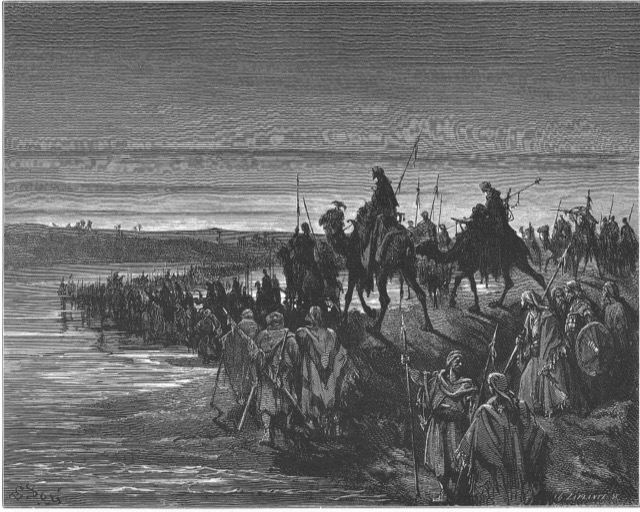
Israelites into Canaan
The Israelites Cross the Jordan River by Gustave Doré 1832-1883

So what’s this all about for us? Is it wrong for us to be deliberate about our decisions, reversing them when the situation becomes threatening? No, of course not. So what’s the difference here in our Numbers community?

At this moment in Israel’s history, God has made clear what is expected of them. They are in covenant with God – “all in” to follow God’s plan for their lives. God has demonstrated his commitment to them in numerous ways, and forgiven earlier disloyalties. 

The question before them now is have they given God their whole hearts.

Or will this be a sham covenant in which they pick and choose when they will be for God and when they will be just for themselves?

The life of deep spiritual commitment to God is not always smooth. We get really mixed up sometimes in our self-concerns and fears. Many years ago, one of my eighth grade students asked me this: what if there really is no God and you’ve wasted your life believing there was?

It was quite a question, and I’ll bet you want to know my answer.

I said that I wouldn’t change a thing about how I have chosen to live my life. Trusting God and giving my life to him has given me a freedom beyond the limits of this world. Even if, at the end, her doubt proved true, I would have had a blessed and joyous life.
Psalm 106

The fact is that we, just like those Israelites standing on the edge of Canaan, don’t know what will happen to us if we trust God. Life and the future is an intimidating open border that challenges our faith and resolve.

But if we constantly hedge our self-gift to God, we will never be capable of receiving the fullness of God’s gift in return.

Today, let’s pray for the trust to step over into God’s country by our acts of faith, hope, love, mercy, generosity, truthfulness, hospitality and courage.

This beautiful reinterpretation of today’s Responsorial Psalm may inspire you as it did me. It is from the website of Christine Robinson, a Unitarian Universalist minister: Click here for Psalm renderings

Psalm 106: Returning
“Give thanks to God, who is good
whose mercy endures forever.”

We stand in awe of an infinity
which we cannot begin to comprehend
We set ourselves to live in tune with the universe—
that we may be glad with the gladness of people of faith.
Yes, time and time again we have gone astray,

We have despoiled this beautiful, wonderful world
dealt unjustly with our compadres
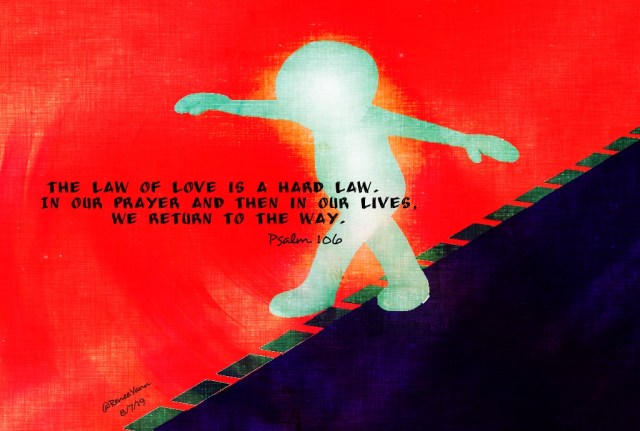
The law of love is a hard law.
In our prayer and then in our lives,
we return to the Way.

Music: Trust God – Rick Muchow 
Transfigured!

Feast of the Transfiguration of the Lord

August 6, 2019

Click here for readings

Today, in Mercy, we celebrate the Feast of the Transfiguration, that moment when the Godly glory of Jesus shone in all its splendor before a few very blessed disciples.

Lk9_32 transfiguration

On that blessed day, Peter, James and John went with Jesus to a “very high mountain”. Many scholars identify the site as Mt. Tabor, where the Franciscan Church of theTransfiguration is today. 


Aside:

church


It was interesting to me that, just the other day as I thought about this reflection, I noticed a news alert that a huge fire had broken out on this mountain.

fire


The Franciscans were evacuated and, fortunately, there were no human injuries.


Some theologians suggest that these three disciples were afforded this magnificent gift so that their faith would be sufficiently strengthened to endure the coming sufferings.

“Transfiguration” is a word without a true synonym. It is a unique experience for a being to be completely infused with the glory of God. When this happened to Jesus, something equally unique happened to Peter, James and John as well. They too became new beings, never the same after that glorious and -yes- shocking moment.

Once they descended that mountain, everything changed. In a sense, they too had been “transfigured”. They had seen Jesus clearly in the beauty of his Godliness, and they would now see everything else in that Light.

Sometimes in our lives, God gives us “mini-transfigurations”. Something we had seen only in ordinary terms suddenly becomes an insight into the sacred. It may be a person, a situation, a natural phenomenon. We see through the external trappings and find the glorious Face of God.

Jesus invites us to experience this kind of soul-change by loving God in the poor, sick, uneducated, displaced, suffering, stigmatized people of this world. He asks us to be with them, in word and deed, and to allow God’s light in them to change our hearts and souls.

Music: Transfiguration/We Behold the Splendor of God – Carey Landry (Lyrics below)

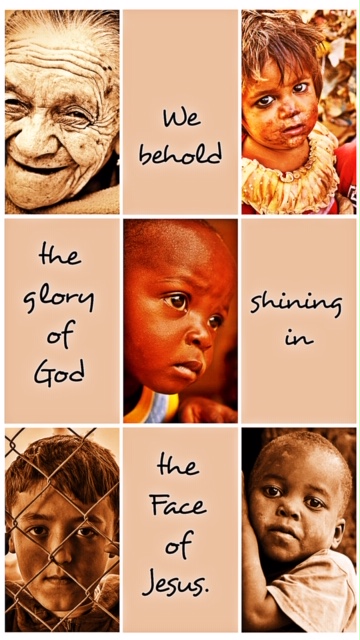
“Transfiguration”faces
[Chorus]
We behold the splendor of God shining on the face of Jesus.
We behold the splendor of God shining on the face of the Son.

[Verse1]
And oh, how his beauty transforms us, the wonder of presence abiding.
Transparent hearts give reflection of Tabor’s light within, of Tabor’s light within.

[Verse 2]
Jesus, Lord of Glory, Jesus, Beloved Son, oh, how good to be with you;
how good to share your light; how good to share your light

Enduring Journey

Monday of the Eighteenth Week in Ordinary Time

August 5, 2019

Click here for readings

Today, in Mercy, we have the first of a few readings from the Book of Numbers. Numbers is basically about two themes: journeying and maturing as a community of faith.

roots


Numbers is the fourth book of the Bible, part of the five which comprise the Pentateuch, or Hebrew Torah. We can think of these books as a kind of Jewish “Roots”, for those who are familiar with the Alex Haley classic.


In the Pentateuch, both Jews and Christian find the foundational bedrock of their faith story. Today’s chapter focuses on two realities of faith and community: leadership and fidelity.

The People are having trouble staying committed to the journey. They are tired, hungry and walking around in circles. They are hungry for something besides manna, the way we become hungry for more than our dailyness.

Numbers11_4 complain

Like most frustrated groups, they start busting on their leader – Moses. Moses, unwilling to carry their burdens alone, starts busting on God. Watch any TV drama for a similar plot/theme. As a matter of fact, let’s examine our lives for it.

Enduring commitment is hard, especially when it is tested. When our commitment seems meaningless, or ignored, or misinterpreted, or otherwise futile, what do we do? How do we re-examine and re-define the fundamental relationship of faith which informs that commitment.

This re-examination and deeper re-commitment is what the Israelites experience through their desert journey, until they are ready to pass into the Promised Land as God’s People.

It is what we experience as a person of faith and as a faith community. Commitment is never static. In life’s test chamber, it either grows or diminishes. Praying with these passages from the Sacred Scripture may help us to grow deeper in our faith and trust. They may help us find the center if we feel a little hungry and lost in the desert too.

Music: Guide Me, Thou, O Great Redeemer

This hymn is the English version of a melody written by the Welshman John Hughes in 1909. The text was composed in 1745 by William Williams, considered Wales’ most famous hymnist. As a writer of poetry and prose,he is also considered today as one of the great literary figures of Wales. For an interesting history of the hymn, click here.

Who Do You See in the Mirror?

Eighteenth Sunday in Ordinary Time

August 4, 2019

Click here for reading

Today, in Mercy, our readings focus on “vanity” – its threats and remedies.

Often, we think of vanity as a physical emotion – that Narcissistic self-absorption that keeps us in front of a mirror for inordinate amounts of time. Our culture promotes this kind of vanity by working endlessly to convince us that without certain products we are “not enough” on our own. 

mirror statue

Historically, this kind of rhetoric was directed primarily toward women, spawning a nearly $500 billion global cosmetic market! But men are catching up! The men’s market is forecasted to reach nearly $30 billion by 2023.

Several years ago, while flying home from a business trip, I was seated across from two young women. As we approached home, the one nearest me, began to prepare for landing. She initiated an elaborate cosmetic ritual that involved no fewer than ten brushes plus an array of tubes and compacts. At first, it struck me really funny. Then I realized how very sad it was.

This maturing child was no more than eighteen. She was naturally beautiful with the vigor of youth. But she had obviously spent a lot of money and time not believing in her natural beauty.

Society considers vanity as a kind of pride and pomposity. I think just the opposite. I think vanity is really fear, self-dissatisfaction, anxiety and pain because something has convinced us that we are inadequate.

Vanity damages souls as well as bodies. It makes us behave in greedy, self-absorbed and careless ways toward our neighbors. It makes us pretend we are more than we think we are. It saps us of the strength to be generous, trusting and hopeful.

Paul, in his letter to the Colossians, tells us to get over this kind of vanity:

Put to death, then, the parts of you that are earthly:
immorality, impurity, passion, evil desire,
and the greed that is idolatry.
Stop lying to one another,

since you have taken off the old self with its practices
and have put on the new self,
which is being renewed, for knowledge,
in the image of its creator. 

Col3_10 new image

What if that sweet girl on Flight 419 had been able to look in her mirror and see the image of her Creator? What if we could all do that? How might we spend our time and money differently if we were convinced of how beautiful we are to God?

Music: How Could Anyone Ever Tell You – Shaina Nell

I have added two versions of this beautiful song. Let God sing it to you in your prayer today.


Mrs. Zebedee, Again

Feast of Saint James, Apostle

July 25, 2019

Click here for readings

( I am republishing last year’s post for this feast. I think it is worth another read. But to make up for my little bit of laziness, I will send another post today with a few profound quotes from Henri Nouwen’s book Can You Drink the Cup? – Ave Maria Press; 10th Anniversary edition (October 1, 2012))


Today, in Mercy, we learn a lesson in humble leadership, thanks to “Mrs. Zebedee”. Our Gospel recounts the story of the mother of James and John interceding for her sons with Jesus. Like many overprotective mothers, she intervenes in their adult lives. She wants to make sure they get the best deal for their investment with Jesus.

Veronese-Le-Christ-rencontrant-la-femme-et-les-fils-de-zebedee_-_Grenoble
Veronese-Le-Christ-Rencontrant La Femme Et Les Fils de Zebedee By Paolo Veronese

Unfortunately, “Mrs. Zebedee” has missed the whole point of Christian discipleship. Her boys have decided to follow a man who says things like this:

  • The last shall be first and the first, last.
  • Unless you lay down your life, you cannot follow me.
  • Whoever takes the lowly position of a child is the greatest in the Kingdom of Heaven.

The seats at Christ’s right and left, which she requests for her sons, will bring them rewards only through humility and sacrificial service.

Jesus is gentle with “Mrs. Zebedee”. He understands how hard it is for any of us to comprehend the hidden glory of a deeply Christian life. We are surrounded by a world that screams the opposite to us:

  • Me first!
  • Stand your ground!
  • Good guys finish last!

Mk 10_38 cup

So Jesus turns to James and John. One can imagine the bemused look on his face. He knows the hearts of these two men. He knows they have already given themselves to him. So he asks them for a confession of faith, “Can you drink the cup that I will drink?”

Their humble, faith-filled answer no doubt stuns their mother. She is left in wonder at the holy men her sons have become. Perhaps it is the beginning of her own deep conversion to Christ.

As we pray with this passage on the feast of St. James the Apostle, where do find ourselves in this scene? How immediate, sincere, and complete is our response to Jesus’ question: “Can you drink the cup….?”

Music: Can You Drink the Cup? (Be patient. The song has a slightly delayed start. You may have to click the white arrowhead in the orange circle- upper left. Lyrics below.😀)

Can You Drink The Cup?

Lyrics by Pamela Martin, Music by Craig Courtney
Copyright 2001, Beckenhorst Press, Inc.

Can you dring the cup,
embrace it in your hands?
Can you look inside
and face what it demands?
In the wine you see
reflections of your soul.
No one else can drink
this cup that you must hold.

Can you drink the cup?
Then you must lift it high
though this cup of joy
holds pain and sacrifice.
When you lift your cup,
raise it unafraid.
Lift it up, this cup
of life, and celebrate.

Can you drink the cup
until there is no more?
When the wine is gone,
Christ Himself will pour.
Though you drink it all
the cup is never dry,
God keeps filling it
with everlasting life.

It’s Raining Bread!

Wednesday of the Sixteenth Week in Ordinary Time

July 24, 2019

Click here for readings

Today, in Mercy, our readings are all about food in the many forms and senses of that word.

Exodus16_4

The Israelites have been in the desert for a while.  The burden of travel is beginning to weigh upon them.  Food is short, tempers even shorter.  Things seem so bad that, in a fit of stupendous forgetfulness, they tell Moses they were better off as slaves in Egypt.

Moses asks God to intervene, which God does with the gifts of manna and quail.

The folks in today’s reading remind me a lot of people I know — even myself.  Haven’t we all heard, and maybe uttered, the complaint that things were so much better in “the old days”.  Haven’t we critiqued a challenging situation with the unhelpful assessment, “Well, it’s not like it used to be!”

But the God of Exodus is so patient, as is Moses.  God doesn’t become angry with the complainers. Instead God promises to take care of them and to stay with them forever on their journey. God makes good on this word by initiating the naturally occurring phenomena of morning manna and migrating quail so that the community is fed.

Some areas to focus on as we pray with this passage:

God does not deliver the Israelites immediately to their destination. Life is a journey, not an arrival.

God intervenes to meet their needs, but through ordinary occurrences rather than miracles. God uses manna and quail, surprising but nonetheless naturally occurring events in the Sinai desert.

God expects the Israelites to interact with grace, to recognize that God is about the continuing work of Creation and Covenant, even within the natural circumstances of our lives.

For us, the profound reminder that God accompanies us in drought and abundance, in joy and sorrow, in wilderness and stability; that God is listening under our hungers; that God is sustaining us in graces we may be slow to recognize.

Music: Panis Angelicus – Luciano Pavarotti

Panis angelicus
fit panis hominum;
Dat panis caelicus
figuris terminum:
O res mirabilis!
manducat Dominum
Pauper, servus, et humilis. 

Te trina Deitas
unaque poscimus:
Sic nos tu visita,
sicut te colimus;
Per tuas semitas
duc nos quo tendimus,
Ad lucem quam inhabitas.
Amen.

Bread of Angels,
made the bread of men;
The Bread of heaven
puts an end to all symbols:
A thing wonderful!
The Lord becomes our food:
poor, a servant, and humble.

We beseech Thee,
Godhead One in Three
That Thou wilt visit us,
as we worship Thee,
lead us through Thy ways,
We who wish to reach the light
in which Thou dwellest.
Amen.

Promise


Sixteenth Sunday in Ordinary Time

July 21, 2019

Click here for readings

Today, in Mercy, our readings are all about making and keeping promises.

Our first reading refers to Genesis and God’s promise to Abraham of land and posterity. Through his hospitality to three disguised angels, Abraham secures God’s promise to bless Sara and him with a child.

Luke8_15 promise

In today’s second reading from Colossians, Paul assures us that God has brought that promise to its full completion in the gift of Jesus Christ living in us.

…the mystery hidden from ages and from generations past
has now been manifested to his holy ones,
to whom God chose to make known the riches of the glory
of this mystery among the Gentiles;
it is Christ in you, the hope for glory. 

In our Gospel, Jesus encourages Martha to give her attention to the presence of this promise revealed in her life. Mary sees the promise fulfilled in Jesus, the living presence of God. She gives her full heart to it. Martha, maybe like us sometimes, is preoccupied by other distractions.


Our readings invite us to rejoice in God’s promise to us
of “land” and “posterity”.

In Jesus, we are brought home to God.
In Jesus, the fruitfulness of our life is eternally secured.


We make promises to God too.

vowsAs I think about my vows today, I am so aware of the recent deaths of two of our Sisters. At all of our funerals, our vows rest near us for our wakes – a profound symbol of promises given and promises fulfilled. God bless you, Margaret and Mary Ellen! Thank you for your witness among us!
Today, as we pray about God’s faithful promises to us, we might want to reflect on and deepen the commitments of our Baptism, our religious profession, our marriage, our covenants to communities of faith and service.

Like Martha, we might hear Jesus encourage us to give our fullest heart to that which is most important.

Music: God’s Promise – Brooklyn Tabernacle Choir  (Lyrics below)

God’s Promise

Chorus:
Everything He said
In His word
He will do it for you.
Every prophecy He gave
Every promise he made

He will do it for you.
If you only trust Him
And let Him have his way
He’ll work things out for you.

If you only believe and
You will see
That He will do it
For you.

(Repeated several times)

He’ll do it
He will do it/
My God is a faithful God
He will do it

And He’s always there
To answer every payer
He will do it.
He’ll do it.

No matter what you’re going through.
He’ll do it.
Remember His word is true.
He’ll do it.

Cause He understands
He’ll do it.
You can always trust and lean on Him
My God will do it
For you….

Vigil

Saturday of the Fifteenth Week in Ordinary Time

July 20, 2019

Click here for readings

Today, in Mercy, we keep vigil with the “Children of Israel” as they begin the great Exodus.

Ex12_42 Vigil

Even the youngest of us understands what it means to “keep vigil”. Toddlers, on Christmas Eve, keep vigil for the sound of Santa’s footsteps on the roof.

Throughout our lives, the kinds of vigils we keep deepen in meaning. Any given night holds an array of vigil-keepers:

  • A nervous student pulls an all-nighter before a big exam.
  • An anxious parent watches over a feverish child.
  • A faith-filled soul sits in pre-dawn prayer.
  • A vigilant elder prays quietly at the death bed of a long-beloved.

As families and communities, we wait together for each other’s lives.

  • Together, we expect the births of each generation’s babies.
  • We wait and hope for college acceptances and new jobs.
  • We wait for test results of all kinds.
  • We wait to listen to one another’s stories of success or disappointment.
  • We wait and prepare for the dawning of great feasts like Christmas and Easter

When we keep vigil, we live in expectation of something or someone coming to us. But there is another important aspect to every vigil.

As we wait, something is also happening within us.
In the deep quiet of our waiting, we are transformed.

Thomas Merton, monk of Gethsemane, was assigned to keep a particular type of vigil at the abbey. It was called “fire watch”, a night-long lookout to ensure that no fire erupted in the old wooden buildings as the other monks slept.  Merton writes about that watch at the end of his book The Sign of Jonas:

The fire watch is an examination of conscience in which your task as watchman suddenly appears in its true light:  a pretext devised by God to isolate you, and to search your soul with lamps and questions, in the heart of darkness.
“Fire Watch, July 4, 1952”

Today, as we pray with Israel’s Passover vigil, let us consider our own vigils – current or past. Beyond their apparent meaning, to what secret transformation might God be inviting us? What is happening deep in our soul as we watch far out to the horizon of our hope?

Music: Firewatch – Chris Remo

The Bloody Lintel

Friday of the Fifteenth Week in Ordinary Time

July 19, 2019

Click here for readings

Today, in Mercy, we begin a series of texts about the Passover. These readings are so richly symbolic, not only for our personal prayer, but also for our sacramental understanding. Today’s passage addresses the acquisition and sacrifice of the Passover lamb.

plague
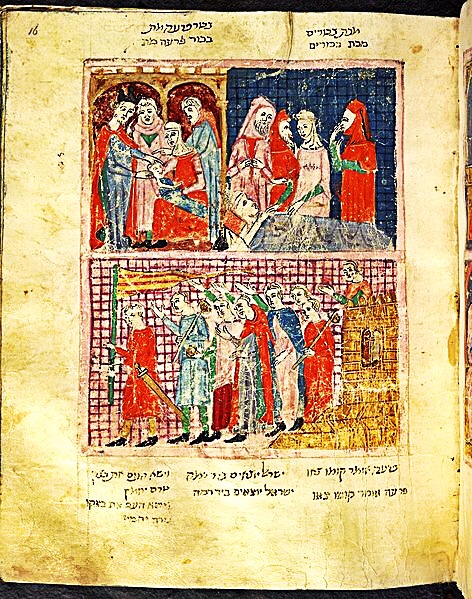
Scenes from Exodus. Full-page miniature, upper register: the tenth plague: the death of the first-born including Pharaoh’s son, lower register: the Israelites leaving Egypt. From the Haggadah for Passover (14thC.)

Maybe for you, as for me, this is one of first Bible stories you recall from childhood. I remember how the drama built as my teacher read this story – all these wide-eyed kindergarteners hanging on her every word.

God was done with Pharaoh who had already ignored nine – yes NINE – plagues! Now the Egyptians’ first-born would be taken from them in a heavenly massacre! It was terrible to imagine. But even worse to consider was how the innocent Israelites would be spared from the dreaded visitation!

Even as a little pre-schooler, I already knew that we sometimes get in situations that only God can get us out of.  What I have begun to learn in my maturity is that – rather than get us out of such circumstances –  God chooses to pass through these life experiences WITH us.

An image we might consider in our prayer today:  these lintels were marked in BLOOD. The visiting angel could have as easily read a charcoal mark on the door, or a colored slab of paint. But the deliverance was secured by blood.

lintel

When devastating loss, sorrow or confusion comes to our door, how does our faith deliver us to the Promise of joy and peace? 

It cannot be by some hastily obtained symbol or sign, or borrowed prayer. Our faith must already be rooted deep down in our veins, our arteries, our heart, our blood. That rooting shall not be moved, no matter the circumstance. That rooting ties us to the God of Life. That rooting allows us to discover God even in our chaos.

As we pray today, under the lintel post of our faith, let us be mindful that these magnificent passages prefigure the Holy Lamb of God, Jesus, who saves us from every kind of death. May we ask for the grace to deepen our Eucharistic and Paschal faith so that we may fully trust God in our own Passovers.

Music: Agnis Dei – Michael Hoppé

The Name

Thursday of the Fifteenth Week in Ordinary Time

July 18, 2010

Click here for readings

Today, in Mercy, God reveals God’s Name to Moses.

Ex3_14

Names are so important, aren’t they? Parents among you will remember how you labored over a name for each of your unborn children. Names carry roots to our history and hopes for our future. They suggest a shape for us to grow into and a way for us to be in the world.

In relationships, the giving of our name is a gift and an invitation. It is the first step in a mutual journey that may stop at the end of the encounter, or grow and blossom for years to come.

When God gives God’s name to Moses, it is all these things plus a Promise to abide forever in relationship. God hands Moses the key to call on God’s faithfulness forever. And God risks the hope that Moses will respond with fidelity and courage.

In prayer, and in our acts of mercy over a lifetime, God ever more deeply reveals the Holy Name to us. God promises to abide through our life with us and asks us to abide with Him. God risks that we will love, reverence, and respond to that amazing invitation with each successive moment and into eternity.

Today, in prayer, let us just rest in the Names we love to call God. Let us listen to the Love with which God names us.

Music:  Names of God – Laurell Hubick