Vigil

Saturday of the Fifteenth Week in Ordinary Time

July 20, 2019

Click here for readings

Today, in Mercy, we keep vigil with the “Children of Israel” as they begin the great Exodus.

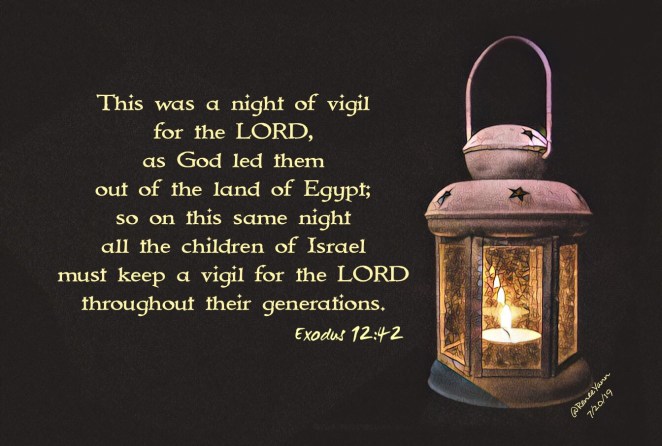
Ex12_42 Vigil

Even the youngest of us understands what it means to “keep vigil”. Toddlers, on Christmas Eve, keep vigil for the sound of Santa’s footsteps on the roof.

Throughout our lives, the kinds of vigils we keep deepen in meaning. Any given night holds an array of vigil-keepers:

  • A nervous student pulls an all-nighter before a big exam.
  • An anxious parent watches over a feverish child.
  • A faith-filled soul sits in pre-dawn prayer.
  • A vigilant elder prays quietly at the death bed of a long-beloved.

As families and communities, we wait together for each other’s lives.

  • Together, we expect the births of each generation’s babies.
  • We wait and hope for college acceptances and new jobs.
  • We wait for test results of all kinds.
  • We wait to listen to one another’s stories of success or disappointment.
  • We wait and prepare for the dawning of great feasts like Christmas and Easter

When we keep vigil, we live in expectation of something or someone coming to us. But there is another important aspect to every vigil.

As we wait, something is also happening within us.
In the deep quiet of our waiting, we are transformed.

Thomas Merton, monk of Gethsemane, was assigned to keep a particular type of vigil at the abbey. It was called “fire watch”, a night-long lookout to ensure that no fire erupted in the old wooden buildings as the other monks slept.  Merton writes about that watch at the end of his book The Sign of Jonas:

The fire watch is an examination of conscience in which your task as watchman suddenly appears in its true light:  a pretext devised by God to isolate you, and to search your soul with lamps and questions, in the heart of darkness.
“Fire Watch, July 4, 1952”

Today, as we pray with Israel’s Passover vigil, let us consider our own vigils – current or past. Beyond their apparent meaning, to what secret transformation might God be inviting us? What is happening deep in our soul as we watch far out to the horizon of our hope?

Music: Firewatch – Chris Remo

The Bloody Lintel

Friday of the Fifteenth Week in Ordinary Time

July 19, 2019

Click here for readings

Today, in Mercy, we begin a series of texts about the Passover. These readings are so richly symbolic, not only for our personal prayer, but also for our sacramental understanding. Today’s passage addresses the acquisition and sacrifice of the Passover lamb.

plague
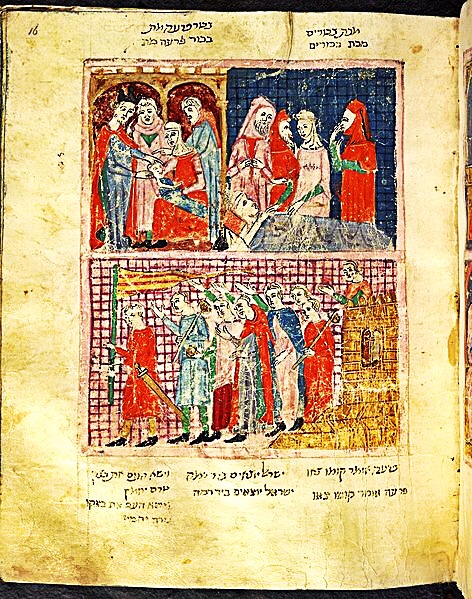
Scenes from Exodus. Full-page miniature, upper register: the tenth plague: the death of the first-born including Pharaoh’s son, lower register: the Israelites leaving Egypt. From the Haggadah for Passover (14thC.)

Maybe for you, as for me, this is one of first Bible stories you recall from childhood. I remember how the drama built as my teacher read this story – all these wide-eyed kindergarteners hanging on her every word.

God was done with Pharaoh who had already ignored nine – yes NINE – plagues! Now the Egyptians’ first-born would be taken from them in a heavenly massacre! It was terrible to imagine. But even worse to consider was how the innocent Israelites would be spared from the dreaded visitation!

Even as a little pre-schooler, I already knew that we sometimes get in situations that only God can get us out of.  What I have begun to learn in my maturity is that – rather than get us out of such circumstances –  God chooses to pass through these life experiences WITH us.

An image we might consider in our prayer today:  these lintels were marked in BLOOD. The visiting angel could have as easily read a charcoal mark on the door, or a colored slab of paint. But the deliverance was secured by blood.

lintel

When devastating loss, sorrow or confusion comes to our door, how does our faith deliver us to the Promise of joy and peace? 

It cannot be by some hastily obtained symbol or sign, or borrowed prayer. Our faith must already be rooted deep down in our veins, our arteries, our heart, our blood. That rooting shall not be moved, no matter the circumstance. That rooting ties us to the God of Life. That rooting allows us to discover God even in our chaos.

As we pray today, under the lintel post of our faith, let us be mindful that these magnificent passages prefigure the Holy Lamb of God, Jesus, who saves us from every kind of death. May we ask for the grace to deepen our Eucharistic and Paschal faith so that we may fully trust God in our own Passovers.

Music: Agnis Dei – Michael Hoppé

The Name

Thursday of the Fifteenth Week in Ordinary Time

July 18, 2010

Click here for readings

Today, in Mercy, God reveals God’s Name to Moses.

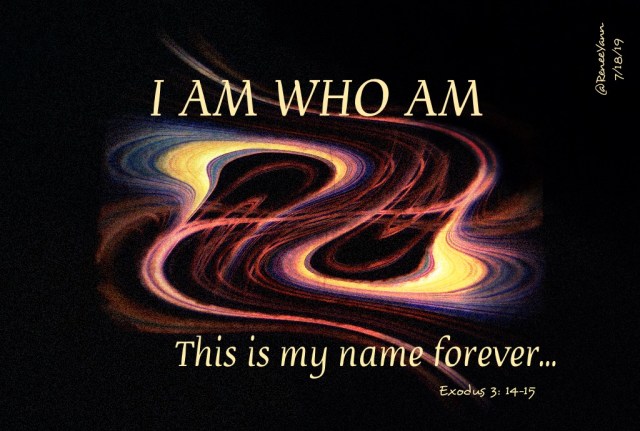
Ex3_14

Names are so important, aren’t they? Parents among you will remember how you labored over a name for each of your unborn children. Names carry roots to our history and hopes for our future. They suggest a shape for us to grow into and a way for us to be in the world.

In relationships, the giving of our name is a gift and an invitation. It is the first step in a mutual journey that may stop at the end of the encounter, or grow and blossom for years to come.

When God gives God’s name to Moses, it is all these things plus a Promise to abide forever in relationship. God hands Moses the key to call on God’s faithfulness forever. And God risks the hope that Moses will respond with fidelity and courage.

In prayer, and in our acts of mercy over a lifetime, God ever more deeply reveals the Holy Name to us. God promises to abide through our life with us and asks us to abide with Him. God risks that we will love, reverence, and respond to that amazing invitation with each successive moment and into eternity.

Today, in prayer, let us just rest in the Names we love to call God. Let us listen to the Love with which God names us.

Music:  Names of God – Laurell Hubick

The Basket … The Women

Tuesday of the Fifteenth Week in Ordinary Time

July 15, 2019

Click here for readings

Today, in Mercy, little Moses is saved from the Pharaoh’s wrath against the Israelites. It is a theme we are familiar with, notably repeated in the New Testament when Herod orders the slaughter of the Holy Innocents. In that event Jesus, like Moses, is spared by clandestine human intervention.

Exodus2_3 basket

The interveners in Exodus are all women – Moses’ mother, sister, Pharaoh’s daughter, and maid. Each of them decides to practice what we, today, call “civil disobedience“ – to stand and act against an immoral government order. Each woman becomes an agent through whom God actualizes the promise of life and freedom. And their choices are interdependent. They need to be a community of holy resistance in order to succeed.

An apt symbol for this agency is the papyrus basket, fortified with bitumen and pitch, and set afloat in the very river where Pharaoh had ordered the babies to be drowned. The basket is reminiscent of Noah’s ark, that vessel which preserved the diversity of life for future generations.

Sadly, history often has repeated the drama in which soulless leaders set a policy to extinguish the innocent. Many perish in that savagery. But many also rise up to bravely weave a “basket” of solidarity and compassion for the persecuted. Even in our own time, we see this story unfolding on the borders of xenophobic nations, whose leaders are indifferent to shaping just and moral policies.

But God is always at work in the world to accomplish the Promise of Life for God’s Creatures. Often, as in the story of infant Moses, God is not named – but rather is  evident as a relentless, compassionate force in the courageous choices of caring human beings.

As we pray today, might we find ourselves somewhere in this story? How might this finding inspire us to be God’s agents for life in our own time?

Video Clip from “The Prince of Egypt” (Lyrics below)

Hush now, my baby. Be still love, don’t cry
Sleep as you’re rocked by the stream
Sleep and remember my last lullaby
So I’ll be with you when you dream
Drift on a river
That flows through my arms
Drift as I’m singing to you

I see you smiling
So peaceful and calm
And holding you, I’m smiling, too
Here in my arms
Safe from all harm
Holding you, I’m smiling, too

Hush now, my baby
Be still, love, don’t cry
Sleep like you’re rocked by the stream
Sleep and remember this river lullaby
So I’ll be with you when you dream
Here in my arms
Safe from all harm
Holding you, I’m smiling, too

Sleep and remember this river lullaby
And I’ll be with you when you dream
Sleep and remember this river lullaby
And I’ll be with you when you dream

Journey through Exodus

Memorial of Saint Bonaventure, Bishop and Doctor of the Church

July 15, 2019

Click here for readings

Today, in Mercy, we begin a three-week journey through the Book of Exodus. The word “journey” is used purposefully because the Book not only narrates a journey in history, it invites us to move with it into a deeper spiritual freedom within ourselves.

It also impresses me that these weeks of reading come to us during a time when the world witnesses oppressed peoples exiting their ravished homelands in search of a sustainable life. Our prayerful reading of these Exodus passages may bring us deeper understanding, compassion, and advocacy courage for these struggling sisters and brothers.

In today’s introduction to Exodus, the narrator provides a transition from the closing of Genesis to the new situation in Egypt. Many years have passed. Favored Joseph is long dead. A “new king”, never named perhaps from contempt of his evilness, “knows nothing” of Joseph. If we don’t care enough to “know” another, we can never care enough to respect and foster their life.

Ex1_10_oppress

This Pharaoh’s sole preoccupation is to preserve Egyptian dominance . He was a man driven by irrational fears. To allay those fears, he was willing to suppress the life of a people who had lived peacefully in Egypt for hundreds of years. 

The Pharaoh begins by objectifying the Israelites as potential enemies and terrorists.

He orders their containment and oppression, moving them to encampments. Ironically, these encampment cities had originally been built, at Joseph’s direction, to contain surplus grain before the famine so that Egypt would not starve!

Still, the Israelites thrive and grow. They are the children of God’s Promise. This growth further threatens Pharaoh, spinning him into more desperate and ineffective attempts to retain domination. His systemic oppression doesn’t work. His fears – and his projection of them on to the Egyptian populace – consume both him and his people.


As the oppressors dehumanize others and violate their rights, they themselves also become dehumanized. … Once a situation of violence and oppression has been established, it engenders an entire way of life and behavior for those caught up in it—oppressor and oppressed alike. Both are submerged in the situation, and both bear the marks of oppression.
PAULO FREIRE, Pedagogy of the Oppressed, pp. 43-44)


Today’s readings offer us so much to consider in terms of a culture of domination versus one of right relationship. These balances and imbalances occur in exchanges as small as a word between two people, or as large as a policy between two nations. The parallels to our current world are painfully obvious. There may be parallels in our personal relationships as well that we might place into the power of prayer.

May we have eyes to see, a heart to care, and the courage to act – both personally and globally.

Music:  Hymn to Our Alien God – Maryknoll Father’s and Brothers

(Background music is the hymn “Eternal Father, Strong to Save” by William Whiting

Be the Neighbor!

Fifteenth Sunday in Ordinary Time

July 14, 2019

Click here for readings

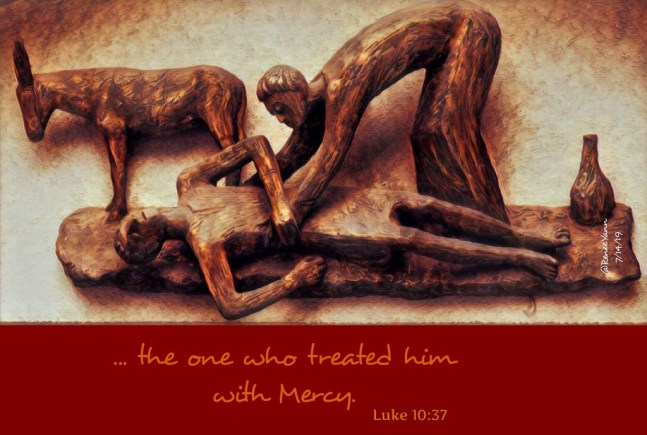
Today, in Mercy, dear friends, we have heard this Gospel from our youth. Even those without faith know the story.

Lk10_37 Samaritan

Let us deeply examine our daily lives today as we pray.

What more is there to say? This is what I hear in my prayer today:

Always be the neighbor.
Just do it.
This is Mercy.

do it1JPG

Music: I Will Love You, Lord! – Dale Sechrest

This wonderful mantra! Let yourself sing it!

Trust and Fears

Saturday of the Fourteenth Week in Ordinary Time

July 13, 2019

Click here for readings

Today, in Mercy, our readings are an interplay of trust and fear, just like most of our lives are.

Related image

The TV character Adrian Monk is the exaggerated personification of our human fears. You name it, he’s afraid of it. Most of us aren’t that bad off, thank God. But we all have fears at times, and maybe life-long ones.

We might entertain conquerable anxieties like fear of water, or public speaking, or heights. These limits to our courage can be stretched by lessons and practice. 

But the deeper fears, like those central to today’s readings, are radically existential and perhaps never fully conquerable. These might include fear of meaninglessness, loneliness, diminishment, and death.

Joseph’s brothers handle their doubts by straight-talking with him. They trust his assurances. Joseph addresses his concerns about burial by pressing a promise from these same brothers.

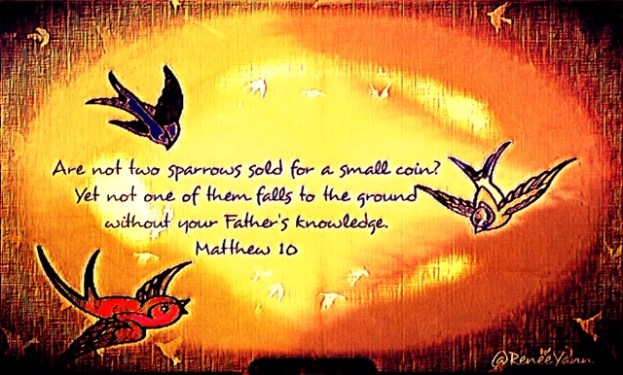
Mt10_sparrow

In our Gospel, Jesus tells us how to deal with our deepest worries and fears. He assures us that no one or nothing can break the insoluble bond of love God has for us. He promises that we will endure eternally within this love. He reminds us that, ultimately, this is the only thing that matters.

The image of the free and unfettered sparrow shows us how God wants us to live and enjoy our creaturehood. The image of a loving God, brushing our hair and counting every one of them, may inspire us to deeper trust as we pray today.

You may be familiar with the trusting phrase attributed to Julian of Norwich:

“All shall be well,
and all manner of thing shall be well.”


Actually, it was Jesus who spoke the word to her in a vision:

“But Jesus, who in this vision informed me of all that is needed by me, answered with these words and said: ‘It is true that sin is cause of all this pain, but all shall be well, and all shall be well, and all manner of thing shall be well.’

“These words were said most tenderly, showing no manner of blame to me nor to any who shall be saved.”


Indeed, we will meet the results of sin and darkness in the world and in ourselves. Julian grew to understand that, in God’s love, we are saved from that darkness:


And from the time that [the vision] was shown, I desired often to know what our Lord’s meaning was. And fifteen years and more afterward I was answered in my spiritual understanding, thus: ‘Would you know your Lord’s meaning in this thing? Know it well, love was his meaning. Who showed it to you? Love. What did he show you? Love. Why did he show it? For love. Keep yourself therein and you shall know and understand more in the same. But you shall never know nor understand any other thing, forever.’  

    Thus I was taught that love was our Lord’s meaning. And I saw quite clearly in this and in all, that before God made us, he loved us, which love was never slaked nor ever shall be. And in this love he has done all his work, and in this love he has made all things profitable to us. And in this love our life is everlasting. In our creation we had a beginning. But the love wherein he made us was in him with no beginning. And all this shall be seen in God without end … 


Music: All Shall Be Well – Kathleen Deignan (Lyrics below)

All shall be well and all manner of thing shall be well.

Receive the gift of healing
from the well of tears;
be washed anew
by grief and sorrowing.

Receive the gift of healing
from our mother Earth,
her deep and dark
and secret verdancy.

Receive the gift of healing
from the shaman’s touch:
the wounded healer’s power
to revive.

Receive the gift of healing
in the arms of love,
embraced in passion
and compassioning.

That Family Reunion!

Friday of the Fourteenth Week in Ordinary Time

July 12, 2019

Click here for readings

Today, in Mercy, we read about a family reunion of biblical proportions!  After many years, Joseph – long-thought dead- is reunited with his grieving father, deceitful half-siblings, and beloved younger brother. Wow!

For better or worse, “Family” is a powerful force in every one of our lives. It both nurtures and siphons us; both exalts and critiques us; frees us and binds us.

Genesis46_30 family reunion

In many ways, family makes us who we are – by blood and genes – but more importantly by the hope and promise it places in us.  This was the case with Joseph, the great hope of his father Jacob and the misunderstood threat to his jealous brothers.

Today’s reading shows us a family who has made it through their devastating conflicts, not by their own effort, but by the abiding promise of God.

So many fractured families wish they could tell the same story of redeeming wholeness! What were the openings in this family’s brokenness that allowed God to enter and heal?

As so often in our human story, God comes dressed in ordinary clothes.  God wears the garments of our grief, repentance, forgiveness, hope and longing. He is disguised in our memories, cherished or painful. He peeks through our unresolved regrets, and dances in our acts of kindness, patience, and understanding.

We reach through to touch this God of Hope by our smallest mercy, our offered reconciling word, our tendered apology for a slight grown bigger with the years. And sometimes, we must simply let go of that which is unreconcilable, of those human hurts that can’t be healed because of time’s passage or unreachable hearts.

We let this God of Promise live in our families by honestly loving one another, supporting one another, thanking one another, and anticipating one another’s needs.

Being a strong family takes courage and sacrifice – something Joseph’s brothers were lucky to learn, however late. Let us pray in hope and thanksgiving for our own families – and for all families —  that God may give us that kind of self-sacrificing courage. Let us pray especially for young families, in today’s very inhospitable world, that they may grow strong in God’s and each other’s love.

Music: Family Prayer Song – The Promise Keepers

Broken Dreams

Memorial of Saint Benedict, Abbot

Thursday, July 11, 2019

Click here for readings

Today, in Mercy, Joseph reveals himself to his brothers. The story is rich in emotional layers, leading us to reflect on the unfolding chapters of our own lives.

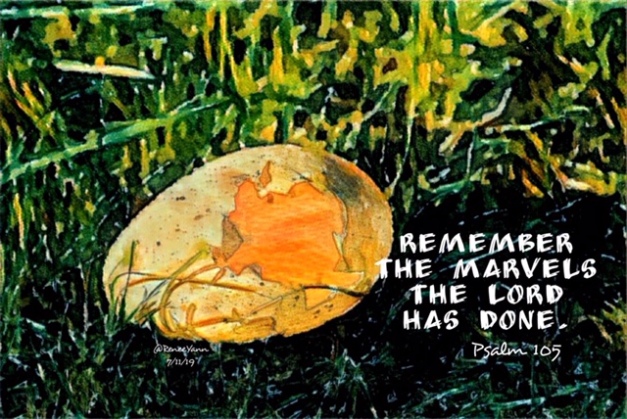
Ps105

Have you ever looked back to a personal circumstance which, when it occurred, seemed shattering, even unbearable? That same circumstance, when viewed through the long lens of time, may have -amazingly- turned out to be a blessing.

The event may have been a job we didn’t land, a loss we almost couldn’t bear, a failure we tried to avoid. Nevertheless, by the grace of God, we endured and even thrived. We learned new things about God’s power in our hearts, about the resilience of hope, and the effable dynamism of trust.

We learned how to forgive ourselves and others, how to be nourished by community, how to start over – perhaps with better intentions and greater wisdom.

Such was the atmosphere for Joseph and his brothers in today’s reading. Praying with this reading, let us give thanks for God’s Presence, even through the dreams that once seemed broken.

Music: Even If by MercyMe

Wounded by Mercy

Tuesday of the Fourteenth Week in Ordinary Time

July 9, 2019

Click here for readings

Today, in Mercy, we continue to learn from the amazing saga of Jacob.

This passage tells a story we may have heard: 

Jacob, after years in isolation, is returning to seek reconciliation with his aggrieved brother Esau. Jacob is stressed, penitent, and maybe a good bit nervous about the first encounter.

He tries to get a decent night’s sleep before the highly anticipated meeting. But that was not to be.

Jacob and AngelJPG
Jacob Wrestling with the Angel by Eugène Delacroix

Jacob wrestles through night with an unnamed stranger. The stranger – perhaps an angel, perhaps God – wounds him, renames him, and ultimately blesses him.

The passage is so worth a reflective read! In that reflection, we may see glimpses of our own relationship with God. God comes to us too, unexpectedly, in both our lights and our darknesses. God wrestles us to look him in the face, in the heart – to turn our attention from all the luring distractions and shallowness that keep us from him.

At best we, like Jacob, might come to a sort of truce with God: we do not fully know God’s Name but we, nevertheless, receive God’s blessing. That blessing changes us, renames us. And, in a visible way, it marks us – just as Jacob was marked by a “limp”. We become vulnerable to the things of God, to God’s hope for the world, to the Mercy of God for all Creation. We become marked by a Love which, though it seems to weaken, is our ultimate and indefatigable strength.

Today’s final thought: Will we let ourselves be changed by the grace offered us in life’s struggles? Will we let ourselves be renamed and marked as God’s own?

Frederick Buechner, in his sermon The Magnificent Defeat talks about such surrender:

Power, success, happiness, as the world knows them, are his who will fight for them hard enough; but peace, love, joy, are only from God. And God is the enemy whom Jacob fought there by the river, of course, and whom in one way or another we all of us fight-God, the beloved enemy. Our enemy because, before giving us everything, he demands of us everything; before giving us life, he demands our lives – our selves, our wills, our treasure.

Will we give them, you and I? I do not know. Only remember the last glimpse that we have of Jacob, limping home against the great conflagration of the dawn. Remember Jesus of Nazareth, staggering on broken feet out of the tomb toward the Resurrection, bearing on his body the proud insignia of the defeat which is victory, the magnificent defeat of the human soul at the hands of God.

Music: Jacob Wrestles with the Angel – Leo Kraft