Precious to God

Saturday, July 14, 2018

Readings: http://www.usccb.org/bible/readings/071418.cfm

Today, in Mercy, our readings tell us something we already know – living a good, holy life is hard, especially when we are caught in suffering.

Isaiah gets so upset about his unworthiness for it that he cries out, “Woe is me! I am doomed!” But then, after a little angelic intervention, he nevertheless opens his heart to God’s call.

In our Gospel, Jesus says we’re going to run into a lot of darkness as we try to speak Light. He says the darkness could even be life-threatening. That thought is pretty woeful, too, don’t you think?

But then Jesus says somethings so stark, yet reassuring:

  • Do not be afraid of those who can kill the body, but not the soul.
  • Not a single sparrow falls without God’s awareness, and you are worth more than many sparrows.
  • God even numbers the hairs on your head, like a Mother brushing the locks of her beloved child.

In other words, you are beyond precious to God. God will accompany and sustain you as you navigate any darkness.

Mt10_31 sparrow

This morning, I think of those young Thai boys and coach, delivered from the isolating, life-threatening darkness of a twisted, flooded cave. Praise God! 

Their situation may remind us of times we have been overwhelmed by sorrow, loneliness, fear, isolation, or any other kind of pain. God is with us in that darkness. We are never lost to God. Our faith assures us that, like a sparrow held gently in God’s hand, we will be delivered to Light.

Music: His Eye Is on the Sparrow – a vintage selection by George Beverly Shea 

(George Beverly Shea (February 1, 1909 – April 16, 2013) was a Canadian-born American gospel singer and hymn composer. Shea was often described as “America’s beloved gospel singer” and was considered “the first international singing ‘star’ of the gospel world,” as a consequence of his solos at Billy Graham Crusades.)


God’s Mercies Are Renewed Each Morning

Saturday, June 30, 2018

Readings: http://www.usccb.org/bible/readings/063018.cfm

Today, in Mercy, we encounter a rare -in fact, singular- reading from the Book of Lamentations. While passages from the book are used in the Lenten Tenebrae service, today is the only time we will meet Lamentations during the Mass readings.

So, let’s give it special attention.

This tenderly written and grief-filled Old Testament poem laments the Babylonian destruction of Jerusalem nearly 600 years before Christ’s birth. The disaster is seen as God’s punishment against a faithless people, who have listened to false prophets. These prophets, rather than confronting the people with their sinful blindness, enabled their guilt in order to be popular and accepted.

Lament 2_13

What does Lamentations have to say to us?  What, in particular, can it teach our religious leaders about their political voice?

Many of us recognize that we live in a toxic world. Terrorism, perpetual war and militarism, rampant consumerism, political isolationism, environmental destructionism are just some of our global “Babylons”. There are numerous local and personal ones as well.

We all play some role in the fostering or impeding of these systems in our culture. A sincere and active faith helps us see our role and responsibility more clearly. We need faith leaders who are not afraid to call us to insight, lamentation, and prayerful action. We, and the political leaders we choose, need to build a world where we live in balanced relationship with God. This is a world where all God’s people live in peace, sustainability, mutuality, and freedom.

While the Book of Lamentations is filled with sadness and regret, it also contains one of the most beautiful and hopeful verses in Scripture:

Because of the Lord’s great love
we are not consumed,
for his mercies never fail.
They are renewed each morning;
So great is God’s faithfulness.
`~ Lamentations 3:22-23

Some of us may feel that our our current socio-political world is irredeemable, but Lamentations says we are wrong. Vibrant faith, active hope, and limitless courage will prove it.

Music: Great Is Thy Faithfulness

Abide With Me

Wednesday, June 27, 2018

Readings: http://www.usccb.org/bible/readings/062718.cfm

Today, in Mercy, Jesus continues his closing instructions on living a good life. Our responsorial psalm captures the whole gist of these several admonitions.

Jn 15_4 Abide

What Jesus is saying is, “Stick with Me, and I will show you the way.” It is the Divine Mother’s invitation to her child. “Come, cradle in my arms. I will protect and guide you.”

As wonderful as Christ’s invitation is, it is hard to accept. Most of us think we can do everything ourselves. Many of us find it tiresome to plumb the Gospel to find its truth. We think we already know the way to happiness: money, prestige, and power.

It often takes a lifetime to teach us how wrong we are. But a test comes into most lives which casts us back into the arms of God. We may eventually learn that joy comes from living Gospel truths, loving as God loves, and abiding faithfully with Him.

It takes courage and spiritual insight to accept Christ’s invitation to abide in Him, especially when we feel invincible. May we grow in that courage, early and late in our lives – in good times and bad.

Music: Abide With Me

Peaceful Defiance

Monday, June 18, 2018

Readings: http://www.usccb.org/bible/readings/061818.cfm

Today, in Mercy, we encounter one of the most difficult passages of the Gospel – the admonitions to turn the other cheek, and go the extra mile. 

Wow, these go against every natural instinct (at least mine! 👿) If someone slaps me, I’m slapping back! If someone grabs my goods, forces my labor, or has the guts to borrow my necessities, I’m gonna’ resist! What about you? Even the Book of Exodus supports “an eye for an eye” kind of justice, right? Well, Jesus says, “No, not right!”. 

In this passage, Jesus shatters our natural inclinations for retribution, retaliation and even self-preservation. 

He says that when we are struck or insulted, we should not respond in kind. Rather we should continue to stand our ground without being diverted into the violence of the attacker.  

He says that when laws are used unjustly against us, we should not respond in kind. Rather, we should stand our ground and expose the unjust law by our willingness to engage it in the public forum.

He says that when unrecompensateded work is demanded of us, we should give it and more, thus doubly exposing the demander’s offense.

He says that to turn our back on a borrower, no matter how inopportune, is a form of violence against the borrower.

What Jesus is asking of us is a non-violent response to the insults and outrages thrown at us. But He is not asking us to be victims or doormats. Each of the admonitions instructs us not to ignore evil, but to respond to it with positive, peaceful strength.

defiant

Jesus himself is the quintessential example of this prophetic, non-violent lifestyle. He condemned evil for what it was, but he did not adopt its methods to do so.

Eileen Campbell

Sister of Mercy Eileen Campbell, arrested at the White House
for peaceful protest of inhumane immigration policies.

Recent history offers us stellar examples of individuals who have understood and practiced this Gospel passage: Mahatma Gandhi, Martin Luther King, Dorothy Day, Oscar Romero, Berta Cáceres, and other modern peace activists – ordinary Christians like you and me.

They have heard and responded to today’s Gospel. Can we?

On This Father’s Day

Sunday, June 17, 2018

Readings: http://www.usccb.org/bible/readings/061718.cfm

2 Cor 5_7 faith

Today, in Mercy, our Sunday readings are filled with the hope of new life, spoken out of the abyss of suffering.

Both Ezekiel’s and Paul’s communities were suffering under exile or persecution. In both cases, a powerful state has dehumanized and enslaved them – rendering them as “other”, unworthy of fraternal compassion.

These suffering communities hunger for the encouragement of their prophets, Ezekiel and Paul.

They long for Ezekiel’s majestic cedar, born from a single, hopeful branch – a life-giving tree where all can dwell in fullness and joy. It is a precursor of heaven, where they will be free and restored to honor.

They draw hope from Paul’s example of courage, believing with him that there is a new day coming where they will be known as precious and worthy in God’s sight.

What might these readings suggest to us, as we celebrate Father’s Day today?

As we contemplate the gift of fatherhood from the perspective of our own experience, let us be mindful of fathers and families experiencing exile and persecution similar to Ezekiel’s and Paul’s communities.

migrant fathers

The Bible tells us stories of our ancestors in faith, but it is also a living Word – speaking to our current experiences. Just this week, we have heard some in power positions use the Bible to justify the infliction of pain and hardship on other human beings. God must weep at such sinful arrogance!

Let us, instead, be inspired by these Scriptures to open our hearts in mercy. Let us pray for suffering migrant communities throughout the world, forced from their homes by war, crime, and greed. Let us pray for children torn from their families by blind, inhumane policies. 

Today, let us pray especially for these refugee fathers as their hopes are crushed and their families broken. And, where we can, let us do more than pray. Let us act for justice and mercy. Let us, at the very least, not rally behind a power that subverts the preciousness of human life and family.

Music: One Day When We All Get To Heaven written by Eliza Hewitt (1851-1920).

Live from Your Abundance

Tuesday, June 12, 2018

Readings: http://www.usccb.org/bible/readings/061218.cfm

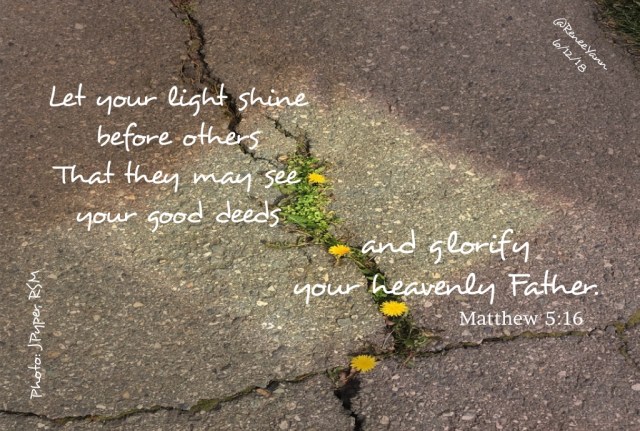
Today, in Mercy, we read the wonderful story of Elijah and the Widow. Both were in “drought and darkness” situations, but they did not lose hope. Trusting in the Lord, they chose to live out of their abundance rather than their scarcity. And their small, shared abundance sustained them.

In Matthew’s Gospel, Jesus encourages us to live from and to share our abundance, whatever that might be. Sometimes we may feel that we don’t have much to offer to the world. Our personal difficulties may thwart our spiritual energy. But we are children of God, filled with Divine potential. Life will always break through if we live with faith, hope and love. It just may look different from what we had planned or expected.

Light 6_12_18

There is a modern school of “abundance vs. scarcity” thinking, a self-improvement practice presented by the late Steven Covey, author of The 7 Habits of Highly Effective People. Whether or not he intended it, Mr. Covey delivers scriptural truths in secular language:

“ An abundance mentality springs from internal security, not from external rankings, comparisons, opinions, possessions, or associations.”

“ People with a scarcity mentality tend to see everything in terms of win-lose. There is only so much; and if someone else has it, that means there will be less for me. The more principle-centered we become, the more we develop an abundance mentality, the more we are genuinely happy for the successes, well-being, achievements, recognition, and good fortune of other people. We believe their success adds to…rather than detracts from…our lives.”

Bottom line from 1 Kings, Matthew 5, Covey? Trust, and live generously. Be light. Be salt. Doing so will open the space for God’s abundance.

Music: A New Age piece that may be helpful if some negativity is blocking our Light.

I Am Light ~ India Arie


An Eternal Weight of Glory

Sunday, June 10, 2018

Readings: http://www.usccb.org/bible/readings/061018.cfm

Today, in Mercy,  is a powerful Sunday!

woke 6_10_18

In our readings, we encounter one of the more perplexing Gospel passages. Jesus, in the thick of controversy with the scribes and Pharisees, goes home to seek some respite. But the crowds follow, harassing him with questions and demands for signs. His friends and family are increasingly concerned for him, as the animosity to his challenging message rises. Some even think he is unhinged to jeopardize himself by confronting the evils and blindnesses of his society. His mother and brothers arrive, concerned for him. When Jesus learns this, he delivers what may seem a hard-hearted comment, “Who are my mother and my brothers?” — they are the ones who do the will of God.

With this question, Jesus is not disowning his family and those who love him. He is stating clearly that, rather than deter him from his redemptive work, they need to open their minds to the deeper purpose of his life. To use a contemporary phrase rooted in the socially conscious African-American community – they need to be “woke” people. 

How hard it must have been for them! How hard to love a prophet, to fear for their safety in times when truth and justice are assailed!

Walter Brueggemann, in my all-time favorite book Prophetic Imagination, says this:

“In both his teaching and his very presence, Jesus of Nazareth presented the ultimate criticism of the royal consciousness (or self-serving power of the dominant state). He has, in fact, dismantled the dominant culture and nullified its claims. The way of his ultimate criticism is his decisive solidarity with marginal people and the accompanying vulnerability required by that solidarity. The only solidarity worth affirming is solidarity characterized by the same helplessness they know and experience.” 

In today’s second reading, Paul is experiencing the same kind of vulnerability as Jesus. Paul says that he is not discouraged for:

“ … although our outer self is wasting away,
our inner self is being renewed day by day.
For this momentary light affliction
is producing for us an eternal weight of glory
beyond all comparison,
as we look not to what is seen but to what is unseen;
for what is seen is transitory, but what is unseen is eternal.”

As Christians, we are called to live prophetic lives in imitation of Jesus. We are called to foster that kind of witness in others, to work together for that “eternal weight of glory”.

The prophet Dorothy Day puts it this way:

“As we come to know the seriousness of the situation, the war, the racism, the poverty in our world, we come to realize that things will not be changed simply by words or demonstrations. Rather, it’s a question of living one’s life in a drastically different way.”

On this powerful Sunday, the message is this: we need to be “woke” people!

Music: Wake Up My Heart ~ The Afters

When Darkness Looms

Friday, June 1, 2018

Readings: http://www.usccb.org/bible/readings/060118.cfm

temple Mark 11

Today, in Mercy, Mark’s Gospel paints a picture of Jesus in a whirlwind of emotions. He has come to Jerusalem well aware of the pharisaical negativity stalking him. Yet, recently – on Palm Sunday – the crowds had gathered around Him in what later would prove to be a fickle adulation.

After an overnight in Bethany, He returns to Jerusalem disgruntled, cursing a fig tree for its barrenness. He casts the money-changers from the Temple, tossing the tables over in an angry display. This side of Jesus must have made the disciples uneasy and afraid. They too begin to realize that the forces of evil and death are closing in on Jesus.

What lesson can we learn for our lives when dark times begin to overwhelm us? Jesus gives us the answer late in the reading:

~ Have faith in God. 

~ Whatever you ask for in prayer, believe that you will receive it.

~ Forgive, so that you may be forgiven.

It is a formula we will see Jesus practice in His own Passion and Death. Like all true leaders, He practices what He preaches. He is teaching his followers – us – how to live in our dark times.

Music: The Lord is Near ~ The Dameans

In Memory

Monday, May 28, 2018

Memorial

Memorial Day

Today, in Mercy, we pray for all who have died as a result of war, especially our deceased servicemen and women.

May we, as a human family, realize the awful sinfulness of war. May we do all we can to help all people live in peace.

Music:  Below is a link to Michael Hoppé’s moving album Requiem.  I hope you are moved by listening to some or all of it, as we pray for world peace and justice.

Clash

Tuesday, May 22, 2018

Readings: http://www.usccb.org/bible/readings/052218.cfm

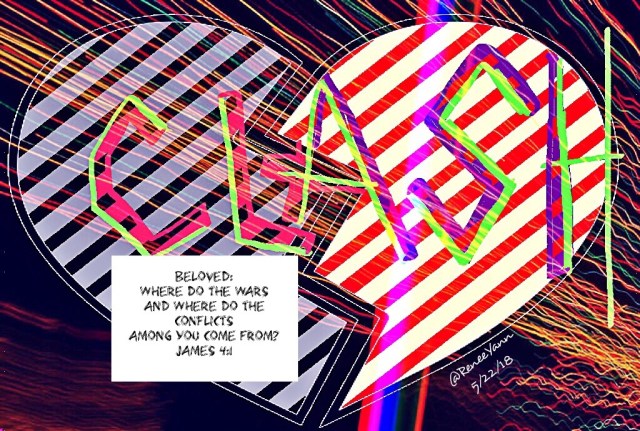
Today, in Mercy, we officially re-enter the Church’s Ordinary Time, those large time frames in the liturgical year which fall outside the major seasons. We have just left the glorious cycle of Lent, Passion and Eastertide. And now we get to show how all those special graces will impact our ordinary lives. It’s rather like coming back from free-floating outer space and landing in the gravity-laden ocean where we have to be rescued.

In our readings today, James and Mark are our rescuers. And they’re tough on us! Both point out that the clash of good and evil in our lives is rooted in our pride and unruly passions. In other words, we tend to focus on protecting and promoting our own interests in this life, sometimes to the point of stepping on others.

Our readings challenge us to place our well-being in the hands of God; to humbly turn our attention outward; to find our wealth and security in service to God’s most needy ones – because that is where God dwells.

It may be called Ordinary Time, but it is by no means ordinary. It is the glorious and dangerous daily journey into the heart of God. Travel in grace, my friends!

Music: Strength for the Journey ~ Michael John Poirier