Psalm 23: Ever Comforting

Memorial of Saint Paul Miki and Companions, Martyrs

Saturday, February 6, 2021


Today, in God’s Lavish Mercy, we pray with Psalm 23, that lovingly familiar song which, over the ages, has comforted so many.

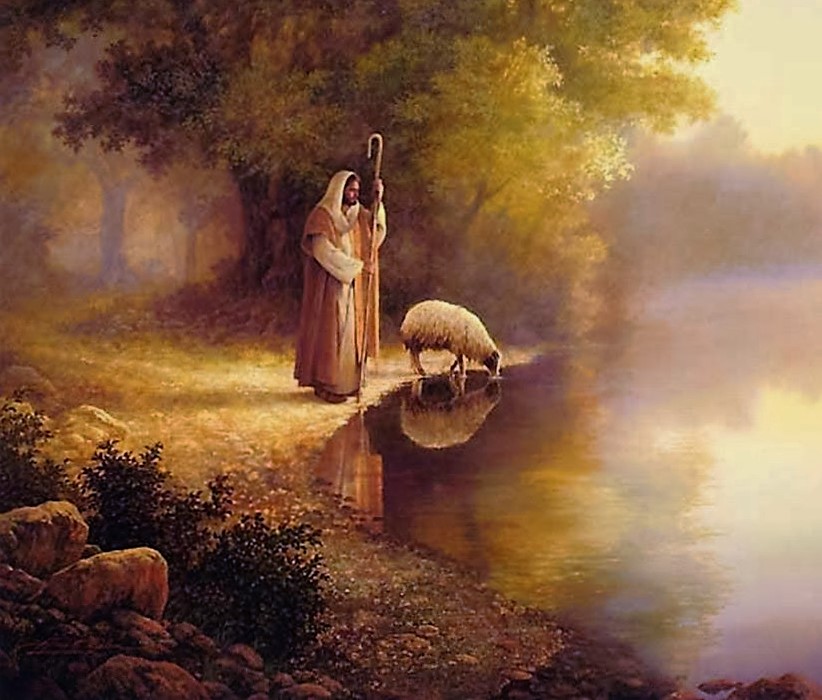
Beside Still Waters by Greg Olsen

We may wish to simply pray this psalm gently and slowly, remembering the many times it has comforted us.

(Below is the inclusive language translation from the Inclusive Language Liturgical Psalter of the Canadian Anglican Synod. Other inclusion collections include Evangelical Lutheran Worship, the Psalter for the Christian People, The Saint Helena Psalter and the Canadian publication, Songs for the Holy One.)

Psalm 23 (Dominus regit me)
The Lord is my shepherd; I shall not be in want.
You make me lie down in green pastures 
and lead me beside still waters.
You revive my soul 
and guide me along right pathways 
for your name’s sake.
Though I walk through the valley of the shadow of death, 
I shall fear no evil;
for you are with me;
your rod and your staff, they comfort me.
You spread a table before me
in the presence of those who trouble me;
you have anointed my head with oil, 
and my cup is running over.
Surely goodness and mercy shall follow me 
all the days of my life, 
and I will dwell in the house of the Lord for ever.


Music: Shepherd Me, O God – Marty Haugen

Psalm 103: Praise List

Wednesday of the Fourth Week in Ordinary Time

February 3, 2021

Today, in God’s Lavish Mercy, we pray with Psalm 103, an extended exhortation to bless and praise the Lord.

Bless the LORD, O my soul;
    and all my being, bless his holy name.
Bless the LORD, O my soul,
    and forget not all his benefits.

Psalm 103: 1-2

Running through all of Psalm 103, the psalmist creates a list of reasons to bless God.

For me, it was a good morning to create my own list and simply pray with that opening phrase:

I bless you, Lord and thank you…for …

The beauty outside my window was a good place to start.

Where would you start your “praise list” today?


Poetry: Stopping by Woods on a Snowy Evening – Robert Frost
Appreciating God’s beauty and blessings may lead us to act on our prayer, as it seems to for the poet:

Whose woods these are I think I know.   
His house is in the village though;   
He will not see me stopping here   
To watch his woods fill up with snow.
   
My little horse must think it queer   
To stop without a farmhouse near   
Between the woods and frozen lake   
The darkest evening of the year.
  
He gives his harness bells a shake   
To ask if there is some mistake.   
The only other sound’s the sweep   
Of easy wind and downy flake.
  
The woods are lovely, dark and deep,   
But I have promises to keep,   
And miles to go before I sleep,   
And miles to go before I sleep.

Music: Winter Snow – Chris Tomlin

Psalm 31: An Inextinguishable Light

Monday of the Fourth Week in Ordinary Time

February 1, 2021


Today, in God’s Lavish Mercy, we pray with Psalm 31 which assures us that we can rest in God’s love if we will just hope.

Let your hearts take comfort,
all who hope in the Lord.

Psalm 31: 25

Hope can be a complex virtue to understand.
The Catholic Catechism describes Hope in this way:
Hope is the theological virtue
by which we desire the kingdom of heaven
and eternal life as our happiness,
placing our trust in Christ’s promises
and relying not on our own strength,
but on the help of the grace of the Holy Spirit.
(CCC 1817)


This definition offers an important key. The kind of hope we are praying about in our psalm is a “virtue”, not a feeling. And in particular, hope is one of the three theological virtues which, according to the brilliant Thomas Aquinas means this:

… these virtues are called theological virtues
“because they have God for their object,
both in so far as by them we are properly directed to Him,
and because they are infused into our souls by God alone,
as also, finally, because we come to know of them
only by Divine revelation in the Sacred Scriptures”.


Now, you know, Thomas wasn’t probably that fun to talk with, given all that theological Latin. But, wow, he nailed this one.

What I think he meant, in other words, is that we are not talking about the feeling of hope, as when we put a soufflé in the oven and hope it doesn’t collapse. Or when we study like crazy and hope the right questions are on the exam. Or even when, more importantly, we make a life choice like marriage or religious life and hope it will bring us a fulfilling, lasting joy.

These kinds of “hopes” might be better defined as optimistic expectations. If they fail to be fulfilled, we might give up on them, perhaps even stop trying to achieve the kind of joy they promised. (That’s a whole other reflection! 🙂 )

Instead, the Hope we are praying about today is not a feeling. It is a gift, given by God and nurtured by our faithful practice of scriptural prayer.

Just like “Life” which is breathed into us by God without any cooperation of our own, the virtue of Hope – along with Faith and Love – is infused into our souls in God’s loving act of creation.

And just like the principle of life,
Faith, Hope, and Love
reside in us forever.


These theological realities can be hard to grasp. To make it easier, I turn them into images for my prayer. I picture Faith, Hope and Love as three small but inextinguishable candle flames deep in my spirit. God is the One who fires their light and warmth.

The circumstances of my life, chosen or imposed, can affect my ability to see and feel the power of these gifts. But circumstances cannot extinguish them because they belong to God not to me.

Once I said in my anguish,
    “I am cut off from your sight”;
Yet you heard the sound of my pleading
    when I cried out to you.

Psalm 31: 23

By prayer, and the faithful effort to be open to God’s Presence in my life, these virtues deepen in me. I can rest assured in their divine constancy. Their power and energy fuel my life both in the favorable and unfavorable “winds” of my circumstances.

Love the LORD, all you his faithful ones!
    The LORD keeps those who are constant,
    but more than requites those who act proudly.

Psalm 31: 24

I found this tender transliteration of Psalm 31 by Christine Robison helpful for my prayer:

I have come to you, O God, please, take me in.
Hear my prayers, be my rock, my stronghold, my castle.
Help me untangle myself from the web of confusions 
and self-deceptions that I’m stuck in.

I put my trust in you—I give you my life.
I have turned
from the temptation to trust the ten thousand things.
I have turned
from the temptation to despair of your love and help.

I have learned
to see you in my sorrows and afflictions
A lot of my life went by before I managed this,
which makes me sad.

Now, I practice trust and open-hearted acceptance
of my life as it is.
Now I practice trust and open-hearted acceptance
of You as You are.

Poetry: Hope – Lisel Mueller

It hovers in dark corners
before the lights are turned on,
it shakes sleep from its eyes
and drops from mushroom gills,
it explodes in the starry heads
of dandelions turned sages,
it sticks to the wings of green angels
that sail from the tops of maples.

It sprouts in each occluded eye
of the many-eyed potato,
it lives in each earthworm segment
surviving cruelty,
it is the motion that runs
from the eyes to the tail of a dog,
it is the mouth that inflates the lungs
of the child that has just been born.

It is the singular gift
we cannot destroy in ourselves,
the argument that refutes death,
the genius that invents the future,
all we know of God.
It is the serum which makes us swear
not to betray one another;
it is in this poem, trying to speak.

Music: Lavender Shadows – Michael Hoppé

Psalm 85: Be A Neighbor

Day of Prayer for the Legal Protection of Unborn Children

“A great prayer for life is urgently needed, a prayer which will rise up throughout the world. Through special initiatives and in daily prayer, may an impassioned plea rise to God, the Creator and lover of life, from every Christian community, from every group and association, from every family and from the heart of every believer.”

Evangelium vitae, 100

January 22, 2021

Today, in God’s Lavish Mercy, we pray with Psalm 85, a Psalm we have prayed with seven times in the past six months. Have we wrung it dry, do you think?😉

Never! That’s the beauty of scripture and particularly of the Psalms. They speak to us in a new voice with each new day’s blessings and challenges.

The verse that grasps my heart this morning is this:

Near indeed is salvation to those who fear God
glory dwelling in our land.

Psalm 85: 10

What will “glory”, or well-being,
look like when it dwells in our land,
throughout our earth?


Walter Brueggemann, in his many writings about the Old Testament and the Psalms, stresses the concept of “neighborliness” as integral to communal well-being.

The well-being of the neighborhood, inspired by the biblical texts, makes possibleand even insists uponan alternative to the ideology of individualism that governs our society’s practice and policy. This kind of community life returns us to the arc of God’s giftsmercy, justice, and law. The covenant of God in the witness of biblical faith speaks now and demands that its interpreting community resist individualism, overcome commoditization, and thwart the rule of empire through a life of radical neighbor love.
(Description of Brueggemann’s book, God, Neighbor, Empire: The Excess of Divine Fidelity and the Command of Common Good)

Praying with Psalm 85, we might hear echos of President Biden’s Inaugural Address which called on our capacity for “neighborliness”:

History, faith, and reason show the way, the way of unity.
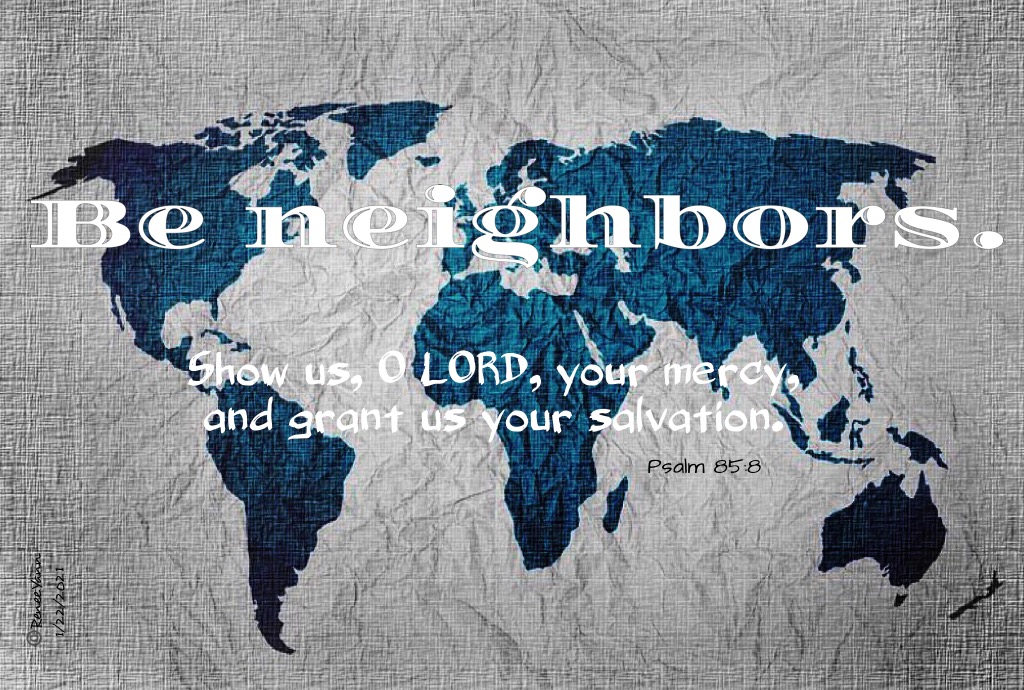
We can see each other not as adversaries but as neighbors.
We can treat each other with dignity and respect.
We can join forces, stop the shouting, and lower the temperature.
For without unity, there is no peace, only bitterness and fury.
No progress, only exhausting outrage.
No nation, only a state of chaos.


The President also said this:

Many centuries ago, Saint Augustine, the saint of my church, wrote that a people was a multitude defined by the common objects of their love.
What are the common objects we love that define us as Americans?
I think I know.
Opportunity.
Security.
Liberty.
Dignity.
Respect.
Honor.
And, yes, the truth.


Thousands of years ago, the psalmist clearly described the glorious community which God promises to those who live in mercy, truth, justice and peace:

Mercy and truth shall meet;
justice and peace shall kiss.
Truth shall spring out of the earth,
and justice shall look down from heaven.

The LORD  will give benefits;
our land shall yield its increase.
Justice shall walk before the Lord,
and salvation, along the way of God’s pattern.

Psalm 85

Prose: Here is the quote from St. Augustine referenced by President Biden, as well as the passage from Cicero which inspired Augustine

If one should say, ‘a people is the association of a multitude of rational beings united by a common agreement on the objects of their love,’ then it follows that to observe the character of a people we must examine the objects of its love.”

St. Augustine, City of God 19.24

A republic is a numerous gathering brought together by legal consent and community of interest. The primary reason for this coming together is not so much weakness as a sort of innate desire on the part of human beings to form communities. For our species is not made up of solitary individuals.

Cicero, Republic, 1.39-40 

Music: After Cicero and Augustine, a little music from our own modern philosopher, Mr. Rogers❤️

Psalm 8: What Are We?

Tuesday of the First Week in Ordinary Time

January 12, 2021

Today, in God’s Lavish Mercy, we pray with Psalm 8, a brief, beautiful, and highly personal hymn to an awesome Creator.

Charles Spurgeon, celebrated 19th century Baptist preacher, calls this psalm “the song of the Astronomer”, as gazing at the heavens inspires the psalmist to meditate on God’s creation and the human person’s place in it. 

The core of Psalm 8 asks a question:
What are we that you are mindful of us,
we humans that you care for us?

Psalm 8:5-6

Indeed, what are we, who are we? It is a question which each of us spends a lifetime answering.

If you were asked to introduce yourself to a total stranger, how would you begin?

  • With your name, expressing your unique identity?
  • Any group to which you belong?
  • Or where you’re from?
  • What you life work is?
  • Where you fit in society, to whom you are related?
  • How you have been defined by your accomplishments?

For example, might the self-introduction sound something like this:

Any similarity to persons living or dead is purely unintentional 🙂

Hi, I’m Mary Smith.
I’m a dentist, born and raised in Schenectady.
I wrote the book, “How Gumdrops Ruin Kid’s Teeth”.
You may have heard of my great-grandfather and his brother,
the cough drop magnates.


Psalm 8 suggests a whole other way of self-definition:

Hi, I’m Mary, a child of God, 
part of an infinite universe 
that spills from God’s creative love.
 
I am in awe of our Creator
who loves and cares for me,
who has ennobled me in grace.
I try to let all my actions give God praise.

I take seriously my role
in cherishing all Creation.
As I do this,
my own divinely-given nature is revealed
and made available to God 
for the transformation of the world.

I will sing of your majesty above the heavens
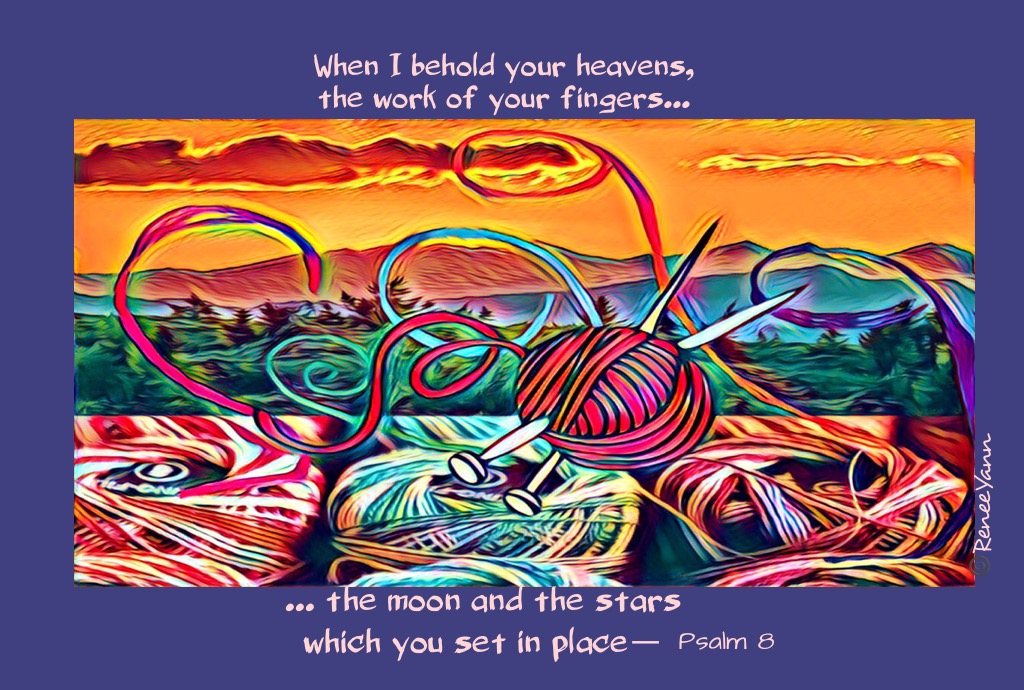
When I see your heavens, the work of your fingers, the moon and stars that you set in plac
e.

What are we that you are mindful of us,
that you care for us?
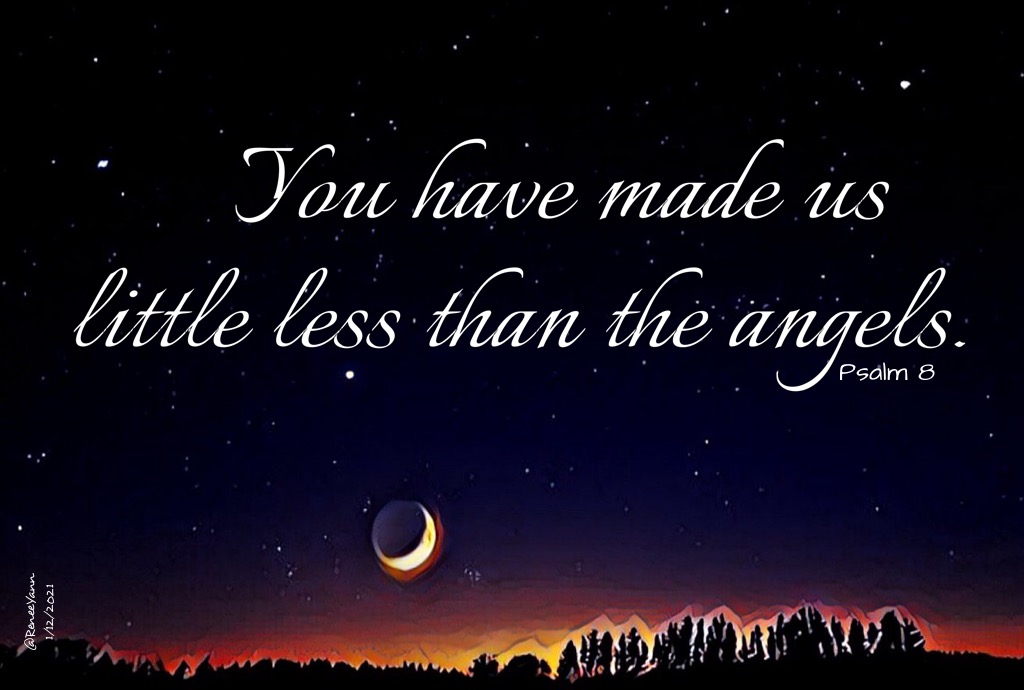
Yet you have made us little less than angels
crowned us with glory and honor.


You have given us rule over the works of your hands, put all things at our feet:
O LORD, our Lord,
how awesome is your name through all the earth!


Poetry (well really prose): from Hamlet by William Shakespeare 

Shakespeare uses Psalm 8 as his reference point for Hamlet’s monologue.
Hamlet is saying that although humans may appear to think and act “nobly” they are essentially “dust”. Hamlet is expressing his melancholy to his old friends over the difference between the best that men aspire to be, and how they actually behave; the great divide that depresses him. (Spark Notes)

I offer the passage to say that Hamlet has become disillusioned, lost his awareness of his own awesome identity in God. Don’t be like Hamlet.

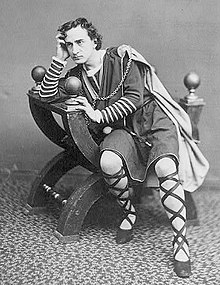
Hamlet, played by Edwin Booth – c.1870 (source: wikipedia)
I have of late—but wherefore I know not—lost all my mirth, 
forgone all custom of exercises, 
and indeed it goes so heavily with my disposition 
that this goodly frame, the earth, seems to me a sterile promontory; 
this most excellent canopy, the air—look you, 
this brave o'erhanging firmament, 
this majestical roof fretted with golden fire—
why, it appears no other thing to me 
than a foul and pestilent congregation of vapors. 
What a piece of work is a man! 
How noble in reason, how infinite in faculty! 
In form and moving how express and admirable! 
In action how like an angel, 
in apprehension how like a god! 
The beauty of the world. 
The paragon of animals. 
And yet, to me, what is this quintessence of dust? 
Man delights not me. 
No, nor woman neither, 
though by your smiling you seem to say so.

Music: Domine, Deus Noster (Psalm 8) by Marc-Antoine Charpentier 

Psalm 147: Lightning Strike

Friday after Epiphany

January 8, 2021

Today, in God’s Lavish Mercy, we pray with Psalm 147.

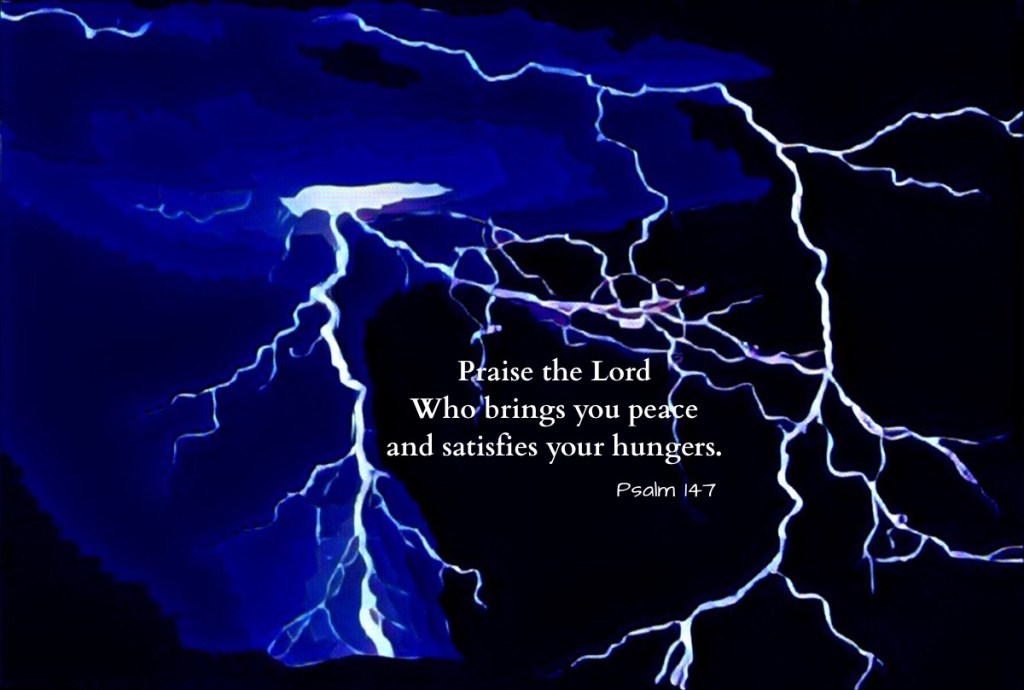
I began my prayer this morning still unsettled by the events at the U.S. Capitol building. Then I considered that it was still the Octave of the Epiphany, and realized that some epiphanies come by stormy lightning and not by starlight.


My first attempts at prayer seemed to bounce off the psalm’s formulaic words like sleet off a tin roof. The psalm did not yield to my need for naming and healing my anger and pain – the lightning’s wounds.

Asking to find God’s voice in the psalm, I finally came to see it as Israel’s prayer once it had been healed – just like I needed to be healed, just like our country needed to be.


The psalm revealed the steps to such healing …
the steps I, and we as a nation, might take to wholeness.
We heal:

by acknowledging God in humility and praise:
Glorify the LORD, O Jerusalem;
    praise your God, O Zion.


by strengthening an inclusive community:
For God has strengthened the bars of your gates;


by reverencing every family and neighbor:
God has blessed your children within you.


by building an infrastructure of peace:
God has granted peace in your borders


by assuring life’s basic needs for all:
With the best of wheat God fills you


by cherishing the Earth we share:
God sends forth the command to the earth;
    swiftly runs God’s word!

We heal, ultimately,
by acknowledging the unique gift
of God’s loving relationship
with us and every other creature.

If we truly live within that acknowledgment,
we become people of truth and mercy –
People of God.


Poetry: from A Book of Psalms – Stephen Mitchell closes Psalm 147 with this transliteration:

You rejoice in a pure heart 
and in those who let you shine through them...
You send your wisdom to their minds; 
your light runs faster than a thought.
Above all others they are blessed, 
because they can hear you speak
(though your love speaks in all people, 
in the silence of every heart).

Music: Heal Our Nation – Heartbeat

Psalm 2: A Political World

Memorial of Saint Elizabeth Ann Seton, religious

January 4, 2021

Today, in God’s Lavish Mercy, we pray with Psalm 2. The prayer seems a fitting reminder to all of us, and especially US citizens, as our new political season opens.

And now, O rulers, give heed;
take warning, you rulers of the earth.
Serve the LORD with fear, and rejoice before God;
with trembling rejoice…
Blessed are all who take refuge in God!


Although I was relieved to lessen my political attention after the November election, I realize that we always have a moral imperative both to pray for our leaders and to measure their efforts, and our own, against the standards of social justice. 

Click right triangle above to hear how Handel felt about it as he uses Psalm 2 in his Messiah.
Why do the nations so furiously rage together,
and who do the people imagine a vain thing?
The kings of the earth rise up,
and the rulers take counsel together against the Lord,
and against His Anointed.
George Frederic Handel: Messiah 
Psalm 2: 1-2

The interplay of politics and morality is on-going, and its energy rises once again with this month’s seating of the new Congress and inauguration of President Biden.

The U.S. and the world has been given stark lessons under the tenure of the exiting president. Some have learned from these experiences. Some have allowed their ignorances to be confirmed.

It has not been easy. We live in an age when truth and morality have been rendered elastic – seemingly malleable to multiple alternative narratives.


Another verse of Psalm 2 from Handel’s Messiah
Let us break their bonds asunder, and cast away their yokes from us.
(Psalm 2:3)

Psalm 2 reminds us of the one true narrative:
we are all creatures of God
charged to live in harmony
with one another and with the Creator.

Seen in a political light, we are a long way from achieving that charge. 

Our elected leaders have an almost impossible job to guide this fractured nation closer to our moral hope. But our prayer, and our sincere contribution to the effort, can make a huge difference in the result.

Despite any partisan leanings, can we pledge that contribution?


Poetry: The Paths of Love and Justice – Christine Robinson

Why are the nations in an uproar?
Why do the peoples mutter and threaten?
Why do the rich plot with the powerful?
They are rebelling against the demands of Love and Justice.
God laughs, cries, and says with anger:
I have set my Love in your hearts and my Justice in your minds.
You are my children and I have given you the universe
your lives, and the tasks of your days.
Be wise
Be warned
Stick to the paths of Love and Justice.
Your restless hearts will find me there.


Music: Justice and Mercy – Matt Redman

The Word

The Seventh Day in the Octave of Christmas

December 31, 2020

Today, in God’s Lavish Mercy, we pray with Psalm 96, which set the tone for us to more deeply appreciate our beautiful Gospel today on this New Year’s Eve.

The LORD comes,
comes to align the earth in Grace.
The LORD shall tender the world
with merciful justice
and the peoples with divine constancy.

Psalm 96: 13

Who is this Lord Who comes,
comes to each of us and all of us?

I think no one describes this mysterious, yet enfleshed, God more beautifully that the writer of John’s Gospel and Epistles.

For our prayer, let’s savor that beauty from today’s Gospel.

Click the little white triangle in the grey bar above to hear some lovely accompanying music
as you slowly move through the slides below by pressing the right arrow on the slide.

Poetry: a prayer from Hildegard of Bingen (1098–1179 – O Eternal Lord 

Dear Friends, perhaps we might pray Hildegard’s prayer for one another as we leave this painful year and move toward New Hope.

O eternal Lord,
it is pleasing to you
to burn in that same fire of love,
like that from which our bodies are born,
and from which you begot your Son
in the first dawn before all of Creation.
So consider this need which falls upon us,
and relieve us of it for the sake of your Son,
and lead us in joyous prosperity.

Psalm 25: Praying with John of the Cross

Memorial of Saint John of the Cross, priest and doctor of the Church

December 14, 2020


Today, in God’s Lavish Mercy, we pray with Psalm 25, the prayer of someone who is in love with God – as was John of the Cross:

Your ways, O LORD, make known to me;
teach me your paths,
Guide me in your truth and teach me,
for you are God my savior.

Psalm 25: 4-5
St. John of the Cross

When we truly love someone, we see God’s face in them. Who doesn’t love that beautiful line from Les Miserables:

Take my hand
I'll lead you to salvation
Take my love
For love is everlasting
And remember
The truth that once was spoken
To love another person
Is to see the face of God

( Just in case you’re longing to listen to it now🤗)


John of the Cross saw God’s Face in all Creation, and found God deep within his own contemplative soul:

What more do you want, O soul!
And what else do you search for outside, when
within yourself you possess your riches, delights,
satisfactions, fullness, and kingdom
– your Beloved whom you desire and seek?

Be joyful and gladdened
in your interior recollection with Him,
for you have Him so close to you.
Desire Him there, adore Him there.

Do not go in pursuit of Him outside yourself.
You will only become distracted and wearied thereby,
and you shall not find Him,
nor enjoy Him more securely,
nor sooner,
nor more intimately
than by seeking him within you.

Spiritual Canticle 1.8

John was in love with God in a way described by the blessed Jesuit Pedro Arrupe:

Nothing is more practical than
finding God, than
falling in Love
in a quite absolute, final way.
What you are in love with,
what seizes your imagination, will affect everything.
It will decide
what will get you out of bed in the morning,
what you do with your evenings,
how you spend your weekends,
what you read, whom you know,
what breaks your heart,
and what amazes you with joy and gratitude.
Fall in Love, stay in love,
and it will decide everything.

As we pray today with St. John of the Cross, we ask our God to deepen us in love. We thank God for the promise and gift of Unconditional Love:

Remember that your compassion, O LORD,
and your kindness are from of old.
In your kindness remember me,
because of your goodness, O LORD.

Music: One Dark Night – John Michael Talbot

Psalm 72: Justice Shall Flower

Tuesday of the First Week of Advent

December 1, 2020


Today, in God’s Lavish Mercy, we pray with Psalm 72 which sings with Advent expectation and hope. How beautiful to hear its tones once again and to realize that God has carried us through another year.

With Psalm 72, God tells us it is time to begin again – and this time, because of all the past year has taught us, to more fully abandon our hearts to the fidelity God promises. 

Our God and King comes eternally to us
in new waves of revelation.
God’s faithful promise continues
for whatever the coming year unfolds.

O God, with your judgment endow the king,
and with your justice, the king’s son;
He shall govern your people with justice
and your afflicted ones with judgment.

Psalm 72: 1-2

Our psalm invites us to see Creation as God sees it, an eternal relationship which endures in peace even beyond the moon’s final setting. That eternal promise brings profound peace. God, who is Infinite Mercy, loves us beyond boundaries, beyond circumstance, beyond time.

Justice shall flower in his days,
and profound peace, till the moon be no more.
May he rule from sea to sea,
and from the River to the ends of the earth.

Psalm 72: 7-8

Jesus is the Promise Fulfilled. In him, Infinite Mercy enfleshes justice for the humble and poor.

He shall rescue the poor one who cries out,
and the afflicted when there is no one to help.
He shall have pity for the lowly and the poor;
the lives of the poor he shall save.

Psalm 72: 12-13

Advent patiently teaches us to recognize such salvation and peace. It is not revealed in miracles, but rather in the enduring power of hope, trust and gratitude. Jesus is our salvation and peace. The cyclic retelling of his life, death and resurrection invites us to deepen our own journey once again this Advent.

May his name be blessed forever;
as long as the sun his name shall remain.
In him shall all the tribes of the earth be blessed;
all the nations shall proclaim his happiness.

Psalm 72: 17

Poetry: Advent Calendar by Rowan Williams, a Welsh Anglican bishop, theologian and poet. He was the 104th Archbishop of Canterbury, a position he held from December 2002 to December 2012.

He will come like last leaf’s fall.
One night when the November wind
has flayed the trees to bone, and earth
wakes choking on the mould,
the soft shroud’s folding.
He will come like frost.
One morning when the shrinking earth
opens on mist, to find itself
arrested in the net
of alien, sword-set beauty.
He will come like dark.
One evening when the bursting red
December sun draws up the sheet
and penny-masks its eye to yield
the star-snowed fields of sky.
He will come, will come,
will come like crying in the night,
like blood, like breaking,
as the earth writhes to toss him free.
He will come like child.

Music: O Come, Divine Messiah
Words: Abbé Simon J. Pellegrin, 1663-1745
English Translation of French Carol “Venez Divin Messie”
Translator: Sister Mary of St. Philip, SND
Melody: 16th Century French Carol

The English translation of “Venez, divin Messie” beginning “O come, divine Messiah” is by Sister Mary of St. Philip, SND, the name in religion of Mary Frances Lescher (1825-1904). She was one of the first English members of the Sisters of Notre Dame de Namur when they established their training college at Mount Pleasant in Liverpool, England, in about 1850. She and at least one other SND sister wrote both translations and original hymns and songs over the course of their long professional lives.

from John Uhrig’s letter to Douglas D. Anderson, Founder of the website “The Hymns and Carols of Christmas”