The LORD then said to Elijah: “Leave here, go east and hide in the Wadi Cherith, east of the Jordan. You shall drink of the stream, and I have commanded ravens to feed you there.” So he left and did as the LORD had commanded. He went and remained by the Wadi Cherith, east of the Jordan. Ravens brought him bread and meat in the morning, and bread and meat in the evening, and he drank from the stream. 1 Kings 17:2-6
Ravens are highly intelligent animals. In 1 Kings, God uses them to nourish Elijah for the completion of his mission.
To bolster our faith and courage, we too receive nourishment from the wonders of Creation. Praying beside an ancient stream or resting under an infinite sky can remind us how small we are but how great is the God Who sustains us.
Today, in God’s Lavish Mercy:
Let’s focus our hearts on the many ways God feeds us through the witness of Creation. As we think of the ravens in this Bible passage, we recognize our own Divine messengers in the gifts of the Universe, Mother Earth, and the animals and humans with whom we share life.
Who are the “ravens” in your life today?
Poetry: Sabbaths – Wendell Berry
No, no, there is no going back.
Less and less you are
that possibility you were.
More and more you have become
those lives and deaths
that have belonged to you.
You have become a sort of grave
containing much that was
and is no more in time, beloved
then, now, and always.
And you have become a sort of tree
standing over a grave.
Now more than ever you can be
generous toward each day
that comes, young, to disappear
forever, and yet remain
unaging in the mind.
Every day you have less reason
not to give yourself away.
Music: All Creatures of Our God and King – Tim Janis
After the man, Adam, had eaten of the tree, the LORD God called to the man and asked him, “Where are you?” He answered, “I heard you in the garden; but I was afraid, because I was naked, so I hid myself.” Then he asked, “Who told you that you were naked? You have eaten, then, from the tree of which I had forbidden you to eat!” The man replied, “The woman whom you put here with me— she gave me fruit from the tree, and so I ate it.” The LORD God then asked the woman, “Why did you do such a thing?” The woman answered, “The serpent tricked me into it, so I ate it.” Genesis 3: 9-12
In the Creation story, we are invited to find ourselves in the excuses of Adam and Eve. They choose, but do not immediately accept responsibility for their choices. They hide in their personal reinterpretations of what happened.
But God wants to find them, release them, from hiding in their “coverups” by asking, “Where are you?” —
the you I created
the you I love
the you I invite to eternal relationship
Today, in God’s Lavish Mercy:
We listen to God’s question, “Where are you?”. We open to Mercy any place where we may be hiding from God’s invitation to fullness of life.
Poetry: from Paradise Lost by John Milton
In this small snippet from the very long poem, the poet invokes the “Heavenly Muse” to instruct him about the Fall of Adam and Eve.
Say first, for Heav'n hides nothing from thy view
Nor the deep Tract of Hell, say first what cause
Mov'd our Grand Parents in that happy State,
Favour'd of Heav'n so highly, to fall off
From thir Creator, and transgress his Will
For one restraint, Lords of the World besides?
Who first seduc'd them to that foul revolt?
Th' infernal Serpent; he it was, whose guile
Stird up with Envy and Revenge, deceiv'd
The Mother of Mankind, what time his Pride
Had cast him out from Heav'n, with all his Host
Of Rebel Angels, by whose aid aspiring
To set himself in Glory above his Peers,
He trusted to have equal'd the most High,
If he oppos'd; and with ambitious aim
Against the Throne and Monarchy of God
Rais'd impious War in Heav'n and Battel proud
With vain attempt. Him the Almighty Power
Hurld headlong flaming from th' Ethereal Skie
With hideous ruine and combustion down
To bottomless perdition, there to dwell
In Adamantine Chains and penal Fire,
Who durst defie th' Omnipotent to Arms.
Music: Adam and Eve Duet from The Creation by Joseph Haydn
This Adagio tells of the couple’s early bliss before their fall and attempt to hide from the Creator.
By thee with bliss, O bounteous Lord,
the heav’n and earth are stor’d.
This world, so great, so wonderful,
thy mighty hand has fram’d.
I will send to you the Spirit of truth Who will guide you to all truth.
John 16: 7, 13
Today, in God’s Lavish Mercy:
This Saturday morning, we stand at the threshold of the great Feast of Pentecost. Let us simply take quiet time to prepare our hearts for the Gift of the Holy Spirit. We each know the places where we, and our suffering world, most need the awakening touch of God’s Life. Let’s ask for it!
(Over the next few days, you are invited to pray with lovely videos shared with me by my dear and creative friend, Sister Mary Kay Eichman. Here is one for the Vigil of Pentecost.)
God’s blessings to all of you, my readers, in this beautiful month of May! These days bring the full blossoming of Spring in the Northern Hemisphere, the grape harvest in Australia, and the close of the rainy season in Peru. May all these gifts, and the special love of Mary, brighten these days.
Please enjoy this beautiful and elegant music, reminiscent of May:
When they climbed out on shore, they saw a charcoal fire with fish on it and bread. Jesus said to them, “Bring some of the fish you just caught.” So Simon Peter went over and dragged the net ashore full of one hundred fifty-three large fish. Even though there were so many, the net was not torn. Jesus said to them, “Come, have breakfast.” And none of the disciples dared to ask him, “Who are you?” because they realized it was the Lord.
Have you ever eaten breakfast on a quiet morning beach?
When each of my nieces and nephew was about three years old, I would take her or him to the beach with me in the early morning. It was like an initiation. We would sit quietly at water’s edge as I taught them to hum or sing a morning hymn. After a little while, my dear sister-in-law, their mother, would arrive with a full pot of coffee and two cups. The praying child would be released to play while Mare and I took up the morning silence, stringing it with occasional words.
It was a time of wonderful love and ease among us, a time of unforgettable blessing. This is the gift Jesus gives his disciples in today’s reading. He offers us the same blessing too, if we can find a little space for him in our morning. Just a minute or two will do. Remember, Jesus can do a lot with just a word — just think about those 153 fish!
Poetry: Jesus Makes Breakfast: A Poem about John 21:1-14 – by Carol Penner, Mennonite pastor currently teaching theology at Conrad Grebel University College in Waterloo, Ontario.
I could smell that charcoal fire a long way off
while we were still rowing far from shore.
As we got closer I could smell the fish cooking,
I imagined I could hear it sizzling.
When you’re hungry, your mind works that way.
When the man by the fire called out asking us about our catch,
we held up the empty nets.
And his advice to throw the nets in once more
is something we might have ignored,
except for the smell of cooking fish…
this guy must know something about catching fish!
The catch took our breath away;
never in my life have we pulled so many in one heave.
I was concentrating on the catch,
but John wasn’t even paying attention,
he was staring at the shore
as if his life depended on it.
Then he clutched my shoulder, crying,
“It is the Lord!”
Suddenly, everything came into focus,
the man, the catch, the voice,
and nothing could stop me,
I had to be with the Master.
There were no words at breakfast,
beyond, “Pass the fish,”
or “I’ll have a bit more bread.”
We sat there, eating our fill,
basking in the sunrise.
We didn’t have to say anything.
Jesus just smiled and served.
There is a stream whose runlets gladden the city of God, the holy dwelling of the Most High. God is in its midst; it shall not be disturbed; God will help it at the break of dawn.
Psalm 46:5-6
Our Psalm today connects two readings centered around life-giving water.
Ezekiel’s watery vision offers a symbolic interpretation of the life-force flowing from God’s heart (symbolized by the Temple) to all Creation.
In our Gospel, a man waits for decades beside the waters of an inaccessible pool until Jesus cures him – until Jesus himself becomes the “Water of Life”.
Today, in God’s Lavish Mercy:
Imagine yourself being blessed by life-giving water – maybe a cool swim on a blistering day, or a warm bath on a frosty one.
Imagine walking in a gentle summer rain, no umbrella, no puddle prohibitions.
If you love the ocean, imagine diving under soft waves at flood tide, belly-riding them back, again and again, to a warm, quiet beach.
Now imagine that all that water is God’s Love for you, because it is. And let your heart pray with a joy similar to today’s psalmist!
Poetry: The Waterfall – Henry Vaughan (1621-1695)
With what deep murmurs through time’s silent stealth Doth thy transparent, cool, and wat’ry wealth Here flowing fall, And chide, and call, As if his liquid, loose retinue stay’d Ling’ring, and were of this steep place afraid; The common pass Where, clear as glass, All must descend Not to an end, But quicken’d by this deep and rocky grave, Rise to a longer course more bright and brave.
Dear stream! dear bank, where often I Have sate and pleas’d my pensive eye, Why, since each drop of thy quick store Runs thither whence it flow’d before, Should poor souls fear a shade or night, Who came, sure, from a sea of light? Or since those drops are all sent back So sure to thee, that none doth lack, Why should frail flesh doubt any more That what God takes, he’ll not restore?
O useful element and clear!
My sacred wash and cleanser here,
My first consigner unto those
Fountains of life where the Lamb goes!
What sublime truths and wholesome themes
Lodge in thy mystical deep streams!
Such as dull man can never find
Unless that Spirit lead his mind
Which first upon thy face did move,
And hatch’d all with his quick’ning love.
As this loud brook’s incessant fall
In streaming rings restagnates all,
Which reach by course the bank, and then
Are no more seen, just so pass men.
O my invisible estate,
My glorious liberty, still late!
Thou art the channel my soul seeks,
Not this with cataracts and creeks.
Music: How Deep Is the Ocean As you listen to the smooth jazz of Diana Krall, let yourself be in love with God who raises you from beside whatever pool where you’ve been lingering.
Thus says the LORD: Lo, I am about to create new heavens and a new earth; The things of the past shall not be remembered or come to mind. Instead, there shall always be rejoicing and happiness in what I create; For I create Jerusalem to be a joy and its people to be a delight; I will rejoice in Jerusalem and exult in my people.
Isaiah 65: 17-19a
To create – not just “to make”, the way we make a cake, or a snowball, or a campfire which always depends on our ideation for existence.
But rather to generate something new, fully enlivened and freed by our faith, hope, and love – to be no longer what was made, but to become itself.
This is how God dreamed Creation to Life, around us and in us. This is how we and all Creation are re-created in the Paschal Mystery and in the Eucharist.
Today, in God’s Lavish Mercy, let’s pray with this powerful act of praise over a New Creation:
from The Mass on the World – Pierre Teilhard De Chardin
“Since once again, Lord - though this time not in the forests of the Aisne but in the steppes of Asia - I have neither bread, nor wine, nor altar, I will raise myself beyond these symbols, up to the pure majesty of the Real itself; I, your priest, will make the whole earth my altar and on it will offer you all the labours and sufferings of the world.
Over there, on the horizon, the sun has just touched with light the outermost fringe of the eastern sky. Once again, beneath this moving sheet of fire, the living surface of the earth wakes and trembles, and once again begins its fearful travail. I will place on my paten, O God, the harvest to be won by this renewal of labour. Into my chalice I shall pour all the sap which is to be pressed out this day from the earth’s fruits.

My paten and my chalice are the depths of a soul laid widely open to all the forces which in a moment will rise up from every corner of the earth and converge upon the Spirit. Grant me the remembrance and the mystic presence of all those whom the light is now awakening to the new day . . .

Over every living thing which is to spring up, to grow, to flower, to ripen during this day say again the words: ‘This is my Body’. And over every death-force which waits in readiness to corrode, to wither, to cut down, speak again your commanding words which express the supreme mystery of faith: ‘This is my Blood’.”
Moses spoke to the people and said: “Now, Israel, hear the statutes and decrees which I am teaching you to observe, that you may live, and may enter in and take possession of the land which the LORD, the God of your ancestors, is giving you.”
Deuteronomy 4:1
The word “observe” carries several meanings. We may, for example,
observe by giving full attention
observe by stating our assessment of something
observe a holiday or birthday by sending a card
observe an order from a superior
observe the sacred by a ritual of practice, silence, or waiting
Today, in God’s Lavish Mercy:
Let’s take the final sense of sacred observing, placing our lives before God in faith, hope, and love. Each day that we live is a ritual of praise to the One Who created us. By living God’s Law of Love, we offer the praise for which God made us.
Poetry: from First Love by Denise Levertov
In the excerpt, Levertov “observes” by giving, and receiving, full attention.
`Convolvulus,' said my mother.
Pale shell-pink, a chalice
no wider across than a silver sixpence.
It looked at me, I looked
back, delight
filled me as if
I, not the flower,
were a flower and were brimful of rain.
And there was endlesness.
Perhaps through a lifetime what I've desired
has always been to return
to that endless giving and receiving, the wholeness
of that attention,
that once-in-a-lifetime
secret communion.
Today, in God’s Lavish Mercy, we finish with the Book of Kings. And, as several of my readers have told me, they’ll be glad for it. There may have been points in our journey through Samuel and Kings, when you thought, “WHY am I even reading this! Who cares about Rehoboam, Jeroboam or any other “boams”!
I understand, but here are two of my “WHY”s:
The Hebrew Scriptures show us how human beings deepened, over thousands of years, in their understanding of God. Throughout that extended deepening, God remains unchangingly faithful. Even though the cultural context of some Old Testament stories may upset, befuddle, or offend us, they still express the human attempt to find God in one's experience.
The Hebrew Scriptures inform and underlie the theology of the Christian Scriptures, and the culture in which Jesus lived and taught. Like a butterfly is the fulfillment of the chrysalis, Jesus was the fulfillment of the Promise to Abraham. Without an appreciation of that Promise, and how Israel lived out its long realization, our comprehension of Christ's meaning is limited.
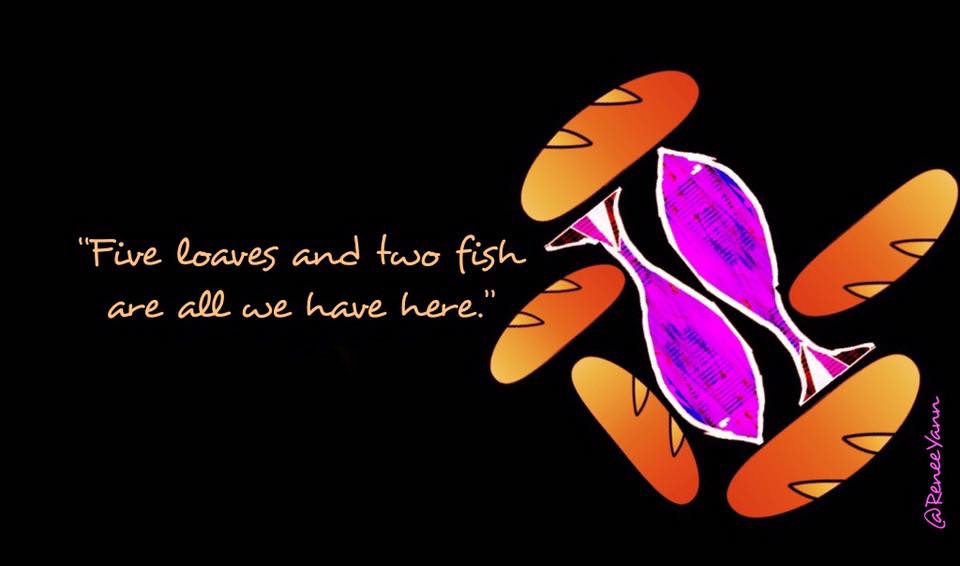
Our Gospel today gives us the familiar story of the feeding of the multitude. Mark describes a large crowd engaged in the search for God. They follow Jesus for three days, listening, learning, and being amazed at his miracles. They are so hungry to find something to believe in that they forget to feed their human hungers!
I love the compassionate way Jesus takes notice of their predicament:
“My heart is moved with pity for the crowd, because they have been with me now for three days and have nothing to eat. If I send them away hungry to their homes, they will collapse on the way, and some of them have come a great distance.”
In this pivotal miracle, Jesus teaches a core lesson of faith.
In Christ, we are given the gift of full and abundant life. Our hearts then must become like his, moved in mercy toward those who are still hungry, both spiritually and physically.
The miracle of the loaves and fishes calls the faithful community to the practice of shared abundance. It invites us to notice the hungers around us and within our world. It moves us to understand the distances people experience from love, inclusion, respect, security, and peace. It convinces us that the need to have more and more will only yield less and less for our spirits.
Our culture works to convince us that we can never work hard enough or accumulate enough. It deludes us to believe that we matter because of what we have, not because of who we are. In this miracle, Jesus models another way to live in relationship with God, ourselves and with Creation:
Trust in and respect for the abundant generosity of God’s Creation
His disciples answered him, “Where can anyone get enough bread
to satisfy them here in this deserted place?”
Still he asked them, “How many loaves do you have?”
They replied, “Seven.”
He ordered the crowd to sit down on the ground.
Deep reverence and gratitude for God’s Presence in all life
Then, taking the seven loaves he gave thanks, broke them,
and gave them to his disciples to distribute,
and they distributed them to the crowd.
They also had a few fish.
He said the blessing over them
and ordered them distributed also.
They ate and were satisfied.
Acknowledgement of our need to replenish our spirits in rest and solitude
He dismissed the crowd and got into the boat with his disciples
and came to the region of Dalmanutha.
Somewhere in each of our lives, we might find a few loaves or minnows hidden away. Or we might be the famished one with an empty basket after a long journey. Today’s Gospel tells us to invite God’s transformative grace into our needs, hungers, inhibitions, or emptiness. Like this amazed Gospel crowd, we might be wowed at what God can do with our generous hearts!
Poetry: In the Storm – Mary Oliver
Some black ducks
were shrugged up
on the shore.
It was snowing
hard, from the east,
and the sea
was in disorder.
Then some sanderlings,
five inches long
with beaks like wire,
flew in,
snowflakes on their backs,
and settled
in a row
behind the ducks --
whose backs were also
covered with snow --
so close
they were all but touching,
they were all but under
the roof of the duck's tails,
so the wind, pretty much,
blew over them.
They stayed that way, motionless,
for maybe an hour,
then the sanderlings,
each a handful of feathers,
shifted, and were blown away
out over the water
which was still raging.
But, somehow,
they came back
and again the ducks,
like a feathered hedge,
let them
crouch there, and live.
If someone you didn't know
told you this,
as I am telling you this,
would you believe it?
Belief isn't always easy.
But this much I have learned --
if not enough else --
to live with my eyes open.
I know what everyone wants
is a miracle.
This wasn't a miracle.
Unless, of course, kindness --
as now and again
some rare person has suggested --
is a miracle.
As surely it is.
Music: Krystian Zimerman – Beethoven: Piano Concerto No. 5 in E Flat Major, Op. 73: II. Adagio un poco moto
A lovely piece to accompany our reflection on faith, miracles, and abundance.








 Lavish Mercy