Remain

Wednesday of the Fifth Week of Lent
March 20, 2024

Today’s Readings:

https://bible.usccb.org/bible/readings/032024.cfm


Jesus said to those Jews who believed in him,
“If you remain in my word, you will truly be my disciples,
and you will know the truth, and the truth will set you free.”

John 8:31

In our first reading, Shadrach, Meshach, and Abednego are examples of absolute trust in God. Their story is intended to assure the Jews in Babylonian captivity that God would deliver them.

In our Gospel, Jesus assures his followers that they too will be delivered from life’s tests if they trust fully in His Word.

Today, in God’s Lavish Mercy:

Let’s pray to deepen in our trust that God is with us always. Let’s sink the anchor of our faith, hope, and love into Christ’s promise. The more we can do this, the more we will be freed to love God, ourselves, and others with the fullness of Gospel love.


Poetry: Avowal – Denise Levertov

As swimmers dare
to lie face to the sky
and water bears them,
as hawks rest upon air
and air sustains them,
so would I learn to attain
freefall, and float
into Creator Spirit’s deep embrace,
knowing no effort earns
that all-surrounding grace.

Music: How Beautiful Is Your Love – The Commons/Josh Blakesley

oh how beautiful is your love for me.
oh what joy is mine in this mystery.
i will not fear the dark
here in the presence of your heart.
oh how beautiful is your love.

oh how wonderful is your offering.
lamb laid down for me on compassion’s tree.
how could i turn away
from the mercy of your face?
oh how wonderful is your love.

Jesus, Jesus,
oh how beautiful is your love.
Jesus, Jesus,
oh how beautiful is your love.

so miraculous is your sacrifice.
body broken here that i might have life.
take everything i own,
let me be yours alone.
so miraculous is your love.

Jesus, Jesus,
oh how beautiful is your love.
Jesus, Jesus,
oh how beautiful is your love.

Recompense

Friday of the Fourth Week of Lent
March 15, 2024

Today’s readings:

https://bible.usccb.org/bible/readings/031524.cfm


The wicked said among themselves…
“Let us condemn him to a shameful death;
for according to his own words, God will take care of him.”
These were their thoughts, but they erred;
for their wickedness blinded them,
and they knew not the hidden counsels of God;
neither did they count on a recompense of holiness
nor discern the innocent souls’ reward.

Wisdom 2: 20-22

In our readings, the Holy One meets the opposition of those who plot against him. They rationalize their persecutions, proclaiming them as acts of justice. They expect their victim to crumble under the pressure of their judgments. What they do not expect is a return of goodness, gentleness, and forgiveness – a recompense of holiness. They do not expect the great contradiction of the Cross, and they are incapable of comprehending it.

Today, in God’s Lavish Mercy:

As Lent deepens, and we come closer to the shadows of Calvary, we are summoned into the sufferings of Jesus to test our own understanding of this Great Contradiction.

What does Christ teach us about payback, unforgiveness, revenge, violence, and war – the popular “recompenses” of our culture to any resistance or injury we encounter?

What might a “recompense of holiness” look like in my life when I meet gracelessness in another person or situation?

How might it transform our belligerent culture if we modeled our behaviors on the holiness of Jesus?


Poetry: Peace-making Is Hard …. – Daniel Berrigan, SJ

hard almost as war. 
the difference being 
one we can stake life upon 
and limb and thought and love.
I stake this poem out 
dead man to a dead stick 
to tempt an Easter chance— 
if faith may be 
truth, our evil chance 
penultimate at last, 
not last. We are not lost. 
When these lines gathered 
of no resource at all 
serenity and strength, 
it dawned on me 
a man stood on his nails, 
an ash like dew, a sweat 
smelling of death and life. 
Our evil Friday fled, 
the blind face gently turned 
another way. Toward Life. 
A man walks in his shroud. 

Music: He Trusted in God – from Handel’s Messiah

Piety

Saturday of the Third Week of Lent
March 9, 2024

Today’s Readings:

https://bible.usccb.org/bible/readings/030924.cfm


Your piety is like a morning cloud,
like the dew that early passes away.

Hosea 6:4

_______

… the tax collector stood off at a distance
and would not even raise his eyes to heaven
but beat his breast and prayed,
‘O God, be merciful to me a sinner.’
I tell you, the latter went home justified, not the former;
for everyone who exalts himself will be humbled,
and the one who humbles himself will be exalted.”

Luke 18: 13-14

I think the word “Piety” has taken on a rather saccharine connotation because we mistake it for an overly sentimental, and sometimes insincere, devotion. However, the word piety comes from the Latin word pietas, the noun form of the adjective pius (which means “devout” or “dutiful”).

Today, in God’s Lavish Mercy:

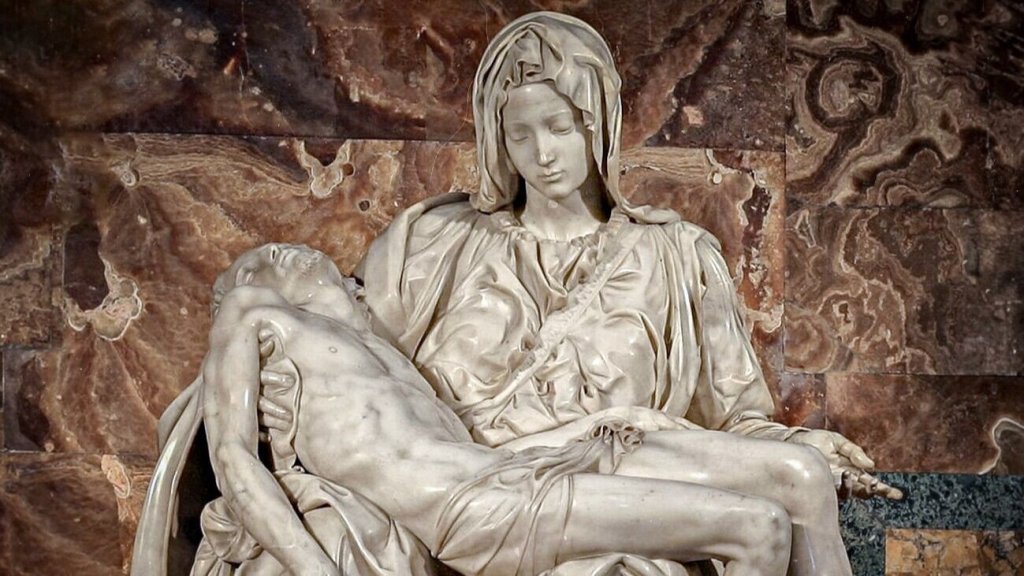
Picture Michelangelo’s Pieta. Let yourself feel the emotion captured in the heart of that sculpture. That is pietas/piety – a deep, penetrating presence and love that cannot fully be put into words. A humble, sincere prayer like that of the tax collector is the fruit of such piety.

Most of us are not great sinners. We just make some mean – and perhaps continual – choices that can block the flow of grace into our hearts. God stands beside us as we make such choices, ready to hear us when we turn and ask for the Mercy that will free and deepen us.


Prose: from Point Counterpoint by Aldous Huxley

Aldous Huxley (1894 – 1963) was an English writer and philosopher. His bibliography spans nearly 50 books, including novels and non-fiction works, essays, narratives, and poems.
By the end of his life, Huxley was widely acknowledged as one of the foremost intellectuals of his time. He was nominated for the Nobel Prize in Literature nine times.

From the quote below, Huxley obviously had strong opinions about religion but especially about false piety. Although Jesus would never have put it this way, the sentiments echo those in today’s readings.


“In the abstract you know that music exists and is beautiful. But don’t therefore pretend, when you hear Mozart, to go into raptures which you don’t feel. If you do, you become one of those idiotic music-snobs … unable to distinguish Bach from Wagner, but mooing with ecstasy as soon as the fiddles strike up. 

It’s exactly the same with God. The world’s full of ridiculous God-snobs. People who aren’t really alive, who’ve never done any vital act, who aren’t in any living relation with anything; people who haven’t the slightest personal or practical knowledge of what God is. But they moo away in churches, they coo over their prayers, they pervert and destroy their whole dismal existences by acting in accordance with the will of an arbitrarily imagined abstraction which they choose to call God.

Just a pack of God-snobs. They’re as grotesque and contemptible as the music-snobs … but nobody has the sense to say so. The God-snobs are admired for being so good and pious and Christian. When they’re merely dead and ought to be having their bottoms kicked and their noses tweaked to make them sit up and come to life.” 

Division

Thursday of the Third Week of Lent
March 7, 2024

Today’s Readings:

https://bible.usccb.org/bible/readings/030724.cfm


Jesus was driving out a demon that was mute,
and when the demon had gone out,
the mute man spoke and the crowds were amazed.
Some of them said, “By the power of Beelzebul, the prince of demons,
he drives out demons.”
Others, to test him, asked him for a sign from heaven.
But he knew their thoughts and said to them,
“Every kingdom divided against itself will be laid waste
and house will fall against house.

Luke 11: 14-17

Today’s readings point us to the virtue of spiritual integrity. Several times in the Gospel, Jesus proclaims that we can’t give our allegiance to two contradictory worlds. (Remember, “One can’t serve God and mammon.”?)

Today, in God’s Lavish Mercy:
As our Verse before the Gospel advises, God wants our whole heart. We can’t be “with” God sometimes. We’re either with God or we’re not – always. Our challenge in life is to make sure we recognize those elements pretending to be gods, so that we don’t give our hearts foolishly.


Poetry: My Kingdom – Louisa May Alcott whom you will recognize as the author of Little Women. Alcott was the daughter of strong transcendentalists. Her father’s opinions on education, severe views on child-rearing, and moments of mental instability shaped young Louisa’s mind with a desire to achieve perfection, a goal of the transcendentalists. (cf: wikipedia) Those sensibilities are reflected in the pious 19th-century style of this poem. Still the poem captures the struggles and awarenesses many have in understanding the Kingdom of Heaven within us.

A little kingdom I possess
Where thoughts and feelings dwell,
And very hard I find the task
Of governing it well;
For passion tempts and troubles me,
A wayward will misleads,
And selfishness its shadow casts
On all my words and deeds.
How can I learn to rule myself,
To be the child I should,
Honest and brave, nor ever tire
Of trying to be good?
How can I keep a sunny soul
To shine along life's way?
How can I tune my little heart
To sweetly sing all day?
Dear Father, help me with the love
That casteth out my fear;
Teach me to lean on thee, and feel
That thou art very near,
That no temptation is unseen
No childish grief too small,
Since thou, with patience infinite,
Doth soothe and comfort all.
I do not ask for any crown
But that which all may win
Nor seek to conquer any world
Except the one within.
Be thou my guide until I find,
Led by a tender hand,
Thy happy kingdom in myself
And dare to take command.

Music: Monastery of La Rabida – Vangelis

Foolishness

Third Sunday of Lent
March 3, 2024

Today’s Readings:

https://bible.usccb.org/bible/readings/030324-YearB.cfm


… We proclaim Christ crucified, …
… Christ the power of God and the wisdom of God.
For the foolishness of God is wiser than human wisdom,
and the weakness of God is stronger than human strength.

1 Corinthians 1: 22-25

This is a great mystery of our faith: that the all-powerful One chose to redeem us by assuming our human weakness, suffering torment, and dying an ignominious death.

When my three-year-old grand-niece visited our convent, she enjoyed walking through the huge motherhouse pointing out every statue of Our Lady of Mercy.

With each discovery she would pronounce the title: “Jeezie and his Mommy”. At the end of a very long corridor, we came to a life-size wooden carving of Jesus Crucified. Little Claire studied it, looked up at me and asked, “Who is that?”.

I simply said, “I don’t know” because her sweet little heart could not bear to learn, or to possibly understand, what happened to her “Jeezie”.

Today, in God’s Lavish Mercy:

Lent is the time to deepen our understanding of what happened to Jesus because of the “foolishness of God”. That Omnipotent Love suffered, died, and rose for us so that we would understand and embrace the meaning of Love in our own lives.

Let’s pray today for a fuller awareness that our lives are a continuing participation in the Great Love. Let us use these Lenten days to find the pattern of the Cross in our world, and to look within it for the Light of the Resurrection.


Poetry: The Foolishness of God – Luci Shaw

Perform impossibilities
or perish. Thrust out now
the unseasonal ripe figs
among your leaves. Expect
the mountain to be moved.
Hate parents, friends, and all
materiality. Love every enemy.
Forgive more times than seventy-
seven. Camel-like, squeeze by
into the kingdom through
the needle’s eye. All fear quell.
Hack off your hand, or else,
unbloodied, go to hell.
Thus the divine unreason.
Despairing now, you cry
with earthy logic – How?
And I, your God, reply:
Leap from your weedy shallows.
Dive into the moving water.
Eyeless, learn to see
truly. Find in my folly your
true sanity. Then Spirit-driven,
run on my narrow way, sure
as a child. Probe, hold
my unhealed hand, and
bloody, enter heaven.

Music: The Cross is Foolishness – John Michael Talbot (lyrics below)

CHORUS:
The Cross is foolishness to those who perish
But for us it has become the wisdom of God
The Cross is foolishness to those who perish
But for us it is salvation and power from God

Some look for miracles, some look for wisdom
But we preach only Jesus crucified
It seems absurdity, it seems so foolish
But to us it is the wisdom of God

(CHORUS)

(CHORUS)

Eye has never seen, ear has never heard
Nor has it dawned on the limits of the mind
What God has surely prepared
For those who love Him
He reveals this wisdom through the Spirit of God

Cup

Wednesday of the Second Week of Lent
February 28, 2024

Today’s Readings:

https://bible.usccb.org/bible/readings/022824.cfm


Then the mother of the sons of Zebedee approached Jesus with her sons
and asked …
“Command that these two sons of mine sit,
one at your right and the other at your left, in your kingdom.”
Jesus said in reply,
“You do not know what you are asking.
Can you drink the chalice that I am going to drink?”
They said to him, “We can.”
He replied,
“My chalice you will indeed drink,
but to sit at my right and at my left,
this is not mine to give
but is for those for whom it has been prepared by my Father.”

Mark 10:20-23

In our Gospel, Jesus makes it clear that the path to heavenly glory is bound by a spiritual discipline that, in this contrary world, will cause us suffering. The cup is that chasm in life where we must choose peace over violence, generosity over selfishness, mercy over judgment, truth over deception, love over indifference. There will be resistance, both within us and around us, when we make such choices.

Today, in God’s Lavish Mercy:

Let’s be honest with ourselves as we answer Jesus’s question:
“Can you drink the cup that I will drink?”
Let’s pray for the grace to drink that cup as it comes to us in the particularities of our own lives.
Let’s ask for the spiritual confidence and understanding that the cup – our cup – leads to eternal life.


Poetry: Can You Drink the Cup? – by Scott Surrency, O.F.M. Cap. (2015)

I found this poem on the website https://thejesuitpost.org/2015/10/can-you-drink-the-cup/

Can you drink the cup?
Drink, not survey or analyze,
ponder or scrutinize –
from a distance.
But drink – imbibe, ingest,
take into you so that it becomes a piece of your inmost self.
And not with cautious sips
that barely moisten your lips,
but with audacious drafts
that spill down your chin and onto your chest.
(Forget decorum – reserve would give offense.)
Can you drink the cup?
The cup of rejection and opposition,
betrayal and regret.
Like vinegar and gall,
pungent and tart,
making you wince and recoil.
But not only that – for the cup is deceptively deep –
there are hopes and joys in there, too,
like thrilling champagne with bubbles
that tickle your nose on New Year’s Eve,
and fleeting moments of almost – almost – sheer ecstasy
that last as long as an eye-blink, or a champagne bubble,
but mysteriously satisfy and sustain.
Can you drink the cup?
Yes, you — with your insecurities,
visible and invisible.
You with the doubts that nibble around the edges
and the ones that devour in one great big gulp.
You with your impetuous starts and youth-like bursts of love and devotion.
You with your giving up too soon – or too late – and being tyrannically hard on yourself.
You with your Yes, but’s and I’m sorry’s – again.
Yes, you – but with my grace.
Can you drink the cup?
Can I drink the cup?
Yes.

Music: We Will Drink the Cup

We will drink the cup.
We will win the fight.
We will stand against the darkness of the night.
We will run the race
And see God’s face,
And build the Kingdom of love.

Do not fear for I am with you.
Be still and know that I am God.

You will run and not grow weary,
For I your God will be your strength.
Refrain

We are the Church, we are the Body.
We are God’s great work of art.

And build the Kingdom of love.

Be!

Saturday of the First Week of Lent
February 24, 2024

Today’s Readings:

https://bible.usccb.org/bible/readings/022424.cfm

Moses spoke to the people, saying:
“This day the LORD, your God,
commands you to observe these statutes and decrees.
Be careful, then,
to observe them with all your heart and with all your soul.

Deuteronomy 26:16

… you are to be a people peculiarly God’s own, as promised you;
and provided you keep all his commandments,

Deuteronomy 26:18

… and you will be a people sacred to the LORD, your God,
as he promised.”

Deuteronomy 26:19

Be perfect, just as your heavenly Father is perfect.

Matthew 5:48

In our readings today, God calls us to BE in the fullness of grace. For the people of the Old Testament, that path was found in the Law and Commandments. For Christians, that fullness is found in patterning our lives on Jesus. He showed us that God’s perfection is beyond Law. It is absolute Love and Mercy.

Today, in God’s Lavish Mercy:

In our prayer, we might ask for a deeper understanding of the “perfection” God asks of us – not a measurable, demonstrable alignment with subjective guidelines, but an unlimited openness to grace. God’s perfection is a Love without boundaries. Jesus is that Love made Flesh. In God, we are called to live in their example.


Poetry: Easy to Love a Perfect God – Shams-i of Tabrizi

Shams-i Tabrīzī (1185–1248) was a Persian poet who is credited as the spiritual instructor of Rumi and is referenced with great reverence in Rumi’s poetic collection. The tomb of Shams-i Tabrīzī was recently nominated to be a UNESCO World Heritage Site.

It’s easy to love a perfect God, 
unblemished and infallible that God is.
What is far more difficult
is to love fellow human beings
with all their imperfections and defects.
Remember, only you can know
what you are capable of loving.
There is no wisdom without love.
Unless we learn to love God’s creation,
we can neither truly love
nor truly know God.

Music: Perfectly Loved – Rachael Lampa

Tend

Feast of the Chair of Saint Peter, Apostle
February 22, 2024

Today’s Readings:

https://bible.usccb.org/bible/readings/022224.cfm


Tend the flock of God in your midst,
overseeing not by constraint but willingly,
as God would have it, not for shameful profit but eagerly.
Do not lord it over those assigned to you,
but be examples to the flock.

1 Peter 5:2-3

The image of Jesus the Good Shepherd has blessed believers throughout the ages. As our weakness is lifted in the tender Divine Embrace, we find peace, hope, release of sorrow, and strength to go on.

Today, in God’s Lavish Mercy:

Our reading from Peter calls us to be like the Good Shepherd. Christ called Peter to this ministry, and he calls us as well. As we accompany and support one another on faith’s journey, let us do so with tender mercy in imitation of Christ.


Poetry: The Good Shepherd – William Denser Littlewood (1831-1886)

Into a desolate land
White with the drifted snow,
Into a weary land
Our truant footsteps go:
Yet doth Thy care, O Father,
Ever Thy wanderers keep;
Still doth Thy love, O Shepherd,
Follow Thy sheep.
Over the pathless wild
Do I not see Him come?
Him who shall bear me back,
Him who shall lead me home?
Listen! between the storm-gusts
Unto the straining ear,
Comes not the cheering whisper,—
"Jesus is near."
Over me He is bending!
Now I can safely rest,
Found at the last, and clinging
Close to the Shepherd's breast:
So let me lie till the fold-bells
Sound on the homeward track,
And the rejoicing angels
Welcome us back!

Music: Jesus, Tender Shepherd – The Gettys

Test!!!

First Sunday of Lent
February 18, 2024

Today’s Readings:

https://bible.usccb.org/bible/readings/021824.cfm


The Spirit drove Jesus out into the desert,
and he remained in the desert for forty days,
tempted by Satan.
He was among wild beasts,
and the angels ministered to him.

Mark 1:12-13

Isn’t it shocking that even our Godly Jesus experienced temptation?

There is a devotional tradition that considers temptation an act of God to test us. You have probably heard the tired old adage, “God will never test us beyond our endurance.”

I think that this is a limited and skewed image of God! God is not our Tester, our Tormentor, or our Tease. God is our Creator and Lover.

It is LIFE that tests us, and God abides with us in every aspect of that testing, just as the Father did with Jesus in the desert.

Today, in God’s Lavish Mercy:

Let us go with Jesus to the desert in our prayer today, asking his enlightenment over any dark corners of our faith, hope, and love. Life can tempt us to choose less than God desires for us. Let us ask for the strength to always choose God Who is Love.


Poetry: THE TESTING (A TRIPTYCH) – Irene Zimmerman, OSF
This is part 2 of a three-part poem by Irene Zimmerman. I highly recommend her beautiful spiritual poetry which illuminates the sacred scriptures.

Higher and yet higher he was led
till all the kingdoms of the world lay spread
before his eyes, more splendid still
than he had ever dreamed.
“Worship me and these are yours,”
the Tempter said.
Mountains boomed and echoed
a thundering “No!” The Son of Man would choose instead to go
where he was sent, to have no place
to lay his head, to be content
to spread himself cross-beamed
above a common hill.

Music: Jesus Tempted in the Desert – text by Herman G. Stuempfle (1923 – 2007); tune by Thomas J. Williams (1890)

Fasting

Friday after Ash Wednesday
February 16, 2024

Today’s Readings:

https://bible.usccb.org/bible/readings/021624.cfm


This, rather, is the fasting that I wish:
releasing those bound unjustly,
untying the thongs of the yoke;
Setting free the oppressed,
breaking every yoke;
Sharing your bread with the hungry,
sheltering the oppressed and the homeless;
Clothing the naked when you see them,
and not turning your back on your own.
Then your light shall break forth like the dawn,
and your wound shall quickly be healed;
Your vindication shall go before you,
and the glory of the LORD shall be your rear guard.
Then you shall call, and the LORD will answer,
you shall cry for help, and he will say: Here I am!

Isaiah 58:6-9

In today’s passage from Isaiah, we are given clear instructions about fasting – some forms of this practice matter more than others.

Depriving oneself of physical comforts is an ancient practice of penance. It is intended to make us more prayerfully aware of the dynamic of sin and grace in our lives. But obviously, it is a self-centered spiritual practice.

Our reading tells us that God desires an other-centered fasting – the practice of mercy toward our sisters and brothers. And Isaiah is clear about who those needy brethren are.

Today, in God’s Lavish Mercy

In order to practice this mercy-centered fasting, there must be touch-points in our lives where we meet those in need. Today, we might examine our lives for our degree of insulation or isolation from society’s needy ones. We may isolate them by our attitudes, by our prejudices, by our physical distance, or perhaps just by our indifference.

Let’s ask ourselves today, “How might I reach out in prayer, service, and tenderness toward those who are in need of mercy?”


Poetry: Fasting – translated from Rumi

There's hidden sweetness in the stomach's emptiness.
We are lutes, no more, no less. If the soundbox
is stuffed full of anything, no music.
If the brain and belly are burning clean
with fasting, every moment a new song comes out of the fire.
The fog clears, and new energy makes you
run up the steps in front of you.

Be emptier and cry like reed instruments cry.
Emptier, write secrets with the reed pen.
When you're full of food and drink, Satan sits
where your spirit should, an ugly metal statue
in place of the Spirit. When you fast,
good habits gather like friends who want to help.

Fasting is Solomon's ring. Don't give it
to some illusion and lose your power,
but even if you have, if you've lost all will and control,
they come back when you fast, like soldiers appearing
out of the ground, pennants flying above them.
A table descends to your tents,
Jesus' table.

Expect to see it, when you fast, this table
spread with other food, better than the broth of cabbages.

Music: Forty Days and Forty Nights

Forty days and forty nights
You were fasting in the wild;
Forty days and forty nights
Tempted, and yet undefiled.

Shall not we your sorrow share
And from worldly joys abstain,
Fasting with unceasing prayer,
Strong with you to suffer pain?

Then if Satan on us press,
Flesh or spirit to assail,
Victor in the wilderness,
Grant we may not faint nor fail!


So shall we have peace divine;
Holier gladness ours shall be;
Round us, too, shall angels shine,
Such as served You faithfully.


Keep, O keep us, Savior dear,
Ever constant by your side,
That with you we may appear
At th’eternal Eastertide