Cradled in Mercy’s Arms

The Solemnity of Our Lord Jesus Christ, King of the Universe
November 26, 2023

Today’s Readings:

https://bible.usccb.org/bible/readings/112623.cfm


Today, in God’s Lavish Mercy, on this feast of Christ the King, we might expect our readings to be filled with triumphal metaphors for God – conquerer, ruler, omnipotent and, yes, distant from us.

Instead, today’s passages offer us images of God as a devoted, simple, and caring shepherd – the tenderest of roles in our natural world.

Thus says the Lord GOD:
I myself will look after and tend my sheep.
As a shepherd tends his flock
when he finds himself among his scattered sheep,
so will I tend my sheep.
I will rescue them from every place where they were scattered
when it was cloudy and dark.


What an unexpected “King” this is! Rather than groveling before his majesty, we are lifted shivering to his warm shoulders. We are rescued from our cloudy shadows and raised into his light.


In Corinthians, Paul instructs us that Christ is King for one reason: he has conquered death. Death is the darkest of shadows from which we long to be rescued – both the small deaths of loss, bereavement, failure, addiction, illness, depression – and the inevitable ending of the life we cherish in ourselves and others. Christ, the kingly shepherd, finds us even when we are lost and confused in fears such as these.


In our Gospel, Jesus says that he will easily find us in our shadows because we are already marked by a certain light – our acts of mercy toward his least ones:

‘Lord, when did we see you hungry and feed you,
or thirsty and give you drink? 
When did we see you a stranger and welcome you,
or naked and clothe you? 
When did we see you ill or in prison, and visit you?’
And the king will say to them in reply,
‘Amen, I say to you, whatever you did
for one of the least brothers of mine, you did for me.’


For our prayer today, we might just ask the kingly shepherd to lift us close to the Divine Heart, to hum Mercy over us in a healing lullaby, so that we might return it freely to our wounded world.


Prayer: Our beautiful Responsorial Psalm will be our poetry for today.

The LORD is my shepherd; I shall not want.
In verdant pastures I rest.
Beside restful waters God leads me;
refreshing my soul.
guiding me in right paths
in the safety of God's Name.
You spread the table before me
in the sight of my foes;
you anoint my head with oil;
my cup overflows.
Only goodness and kindness follow me
all the days of my life;
and I shall dwell in the house of the LORD
for years to come.

Music: Shepherd Me, O God – Marty Haugen
Trust not Fear

Memorial of Saint Cecilia, Virgin and Martyr
Wednesday of the Thirty-third Week in Ordinary Time
November 22, 2023

Today’s Readings:

https://bible.usccb.org/bible/readings/112223.cfm


Today, in God’s Lavish Mercy, our two readings are dramatically intense. 

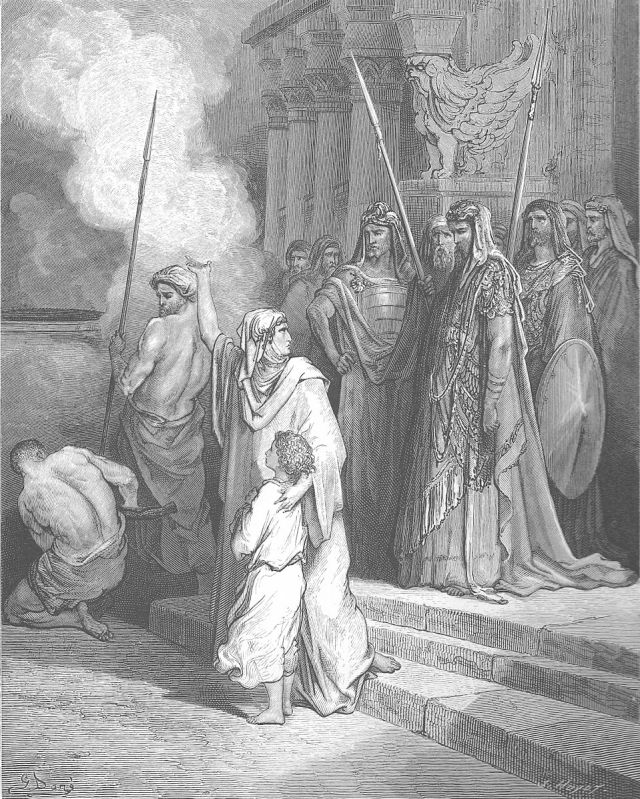
Who can read the story of the Maccabean Martyrs without a mix of horror, empathy, and astonishment?

It happened that seven brothers with their mother were arrested
and tortured with whips and scourges by the king,
to force them to eat pork in violation of God’s law.
Most admirable and worthy of everlasting remembrance was the mother,
who saw her seven sons perish in a single day,
yet bore it courageously because of her hope in the Lord.

2 Maccabees 7: 1;20

And don’t we all feel a pang of pity for the poor, fearful servant who hid his talent in a handkerchief much to the King’s displeasure?

‘Sir, here is your gold coin;
I kept it stored away in a handkerchief,
for I was afraid of you, because you are a demanding man;
you take up what you did not lay down
and you harvest what you did not plant.’
He said to him,
‘With your own words I shall condemn you,
you wicked servant.
You knew I was a demanding man,
taking up what I did not lay down
and harvesting what I did not plant;
why did you not put my money in a bank?

Luke 19:20-23

The two stories paint a contrasting picture of courageous faith against fearful subservience. The difference between the actors lies in their capacity, or lack thereof, to look beyond themselves toward eternal life.

The Courage of a Mother – Gustave Doré

Mother Maccabee bolsters her sons with her faith in a life beyond their current circumstances:

… the Creator of the universe
who shapes each man’s beginning,
as he brings about the origin of everything,
he, in his mercy,
will give you back both breath and life,
because you now disregard yourselves
for the sake of his law.


The poor soul in Jesus’s parable doesn’t have that faith and vision. His perception of God, represented by the King, is one of only harsh judgment. His fear causes him to bury not only his talent, but also his openness to the possibilities of grace and transformed relationship with God.


Jesus told his parable because indeed the Kingdom was at hand. He and his disciples were near Jerusalem where the Passion, Death and Resurrection events would begin.

He wants his followers to realize the challenging gift they have been given in their call to be his disciples. He wants them to see that it is now on them to magnify his message courageously and generously until he returns to perfect the Kingdom.

He wants us to understand that too.


Poetry – John Milton, Sonnet 19

Milton (1608- 1674) is widely considered one of the preeminent writers of the English language. By 1652, Milton had become totally blind and had to dictate his verse. He appears to wonder, in this sonnet, how his God-given talent for writing will be enhanced now that he is “light denied”. He looks to another parable for his answer – the Parable of the Workers. Even those who only stood and waited were rewarded.

When I consider how my light is spent,
Ere half my days, in this dark world and wide,
And that one Talent which is death to hide
Lodged with me useless, though my Soul more bent
To serve therewith my Maker, and present
My true account, lest he returning chide;
“Doth God exact day-labor, light denied?”
I fondly ask. But patience, to prevent
That murmur, soon replies, “God doth not need
Either man’s work or his own gifts; who best
Bear his mild yoke, they serve him best. His state
Is Kingly. Thousands at his bidding speed
And post o’er Land and Ocean without rest:
They also serve who only stand and wait.”

Music:   Be Not Afraid – written by Bob Dufford, SJ, sung here by Cat Jahnke

Outrageous Faith

Memorial of Saint Frances Xavier Cabrini
Monday of the Thirty-second Week in Ordinary Time
November 13, 2023

Today’s Readings:

https://bible.usccb.org/bible/readings/111323.cfm


Today, in God’s Lavish Mercy, we have only three weeks left in Ordinary Time before Advent. Today, we begin a week of first readings from the beautifully written Book of Wisdom.

These will be counterpointed by readings from Luke 17, filled with familiar images like millstones, mustard seeds, ungrateful lepers, a grateful one, and the one plowman taken from a field while the shocked other is left.


While our Gospel readings call us to be alert to the end of time and the coming of the Reign of God, our Wisdom readings – while cautionary – stretch us beyond time to the awareness of an Eternal Love rooted in our own hearts:

For wisdom is a kindly spirit,
yet she acquits not the blasphemer of their guilty lips;
Because God is the witness of the inmost self
and the sure observer of the heart
and the listener to the tongue.
For the Spirit of the Lord fills the world,
is all-embracing, and knows what the human heart says.

Wisdom 1: 6-7

In our Gospel, Jesus calls us to model goodness, practice forgiveness, and exercise an outrageous faith.

And the Apostles said to the Lord, “Increase our faith.”
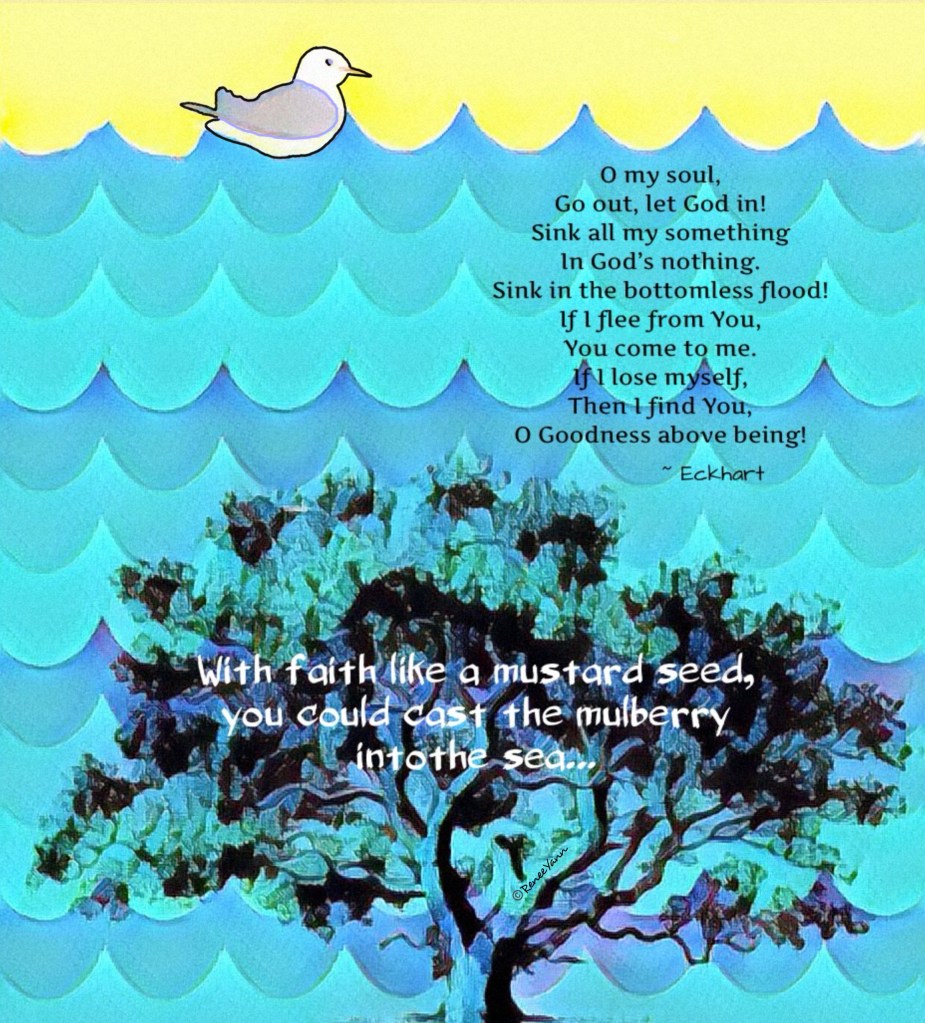
The Lord replied, “If you have faith the size of a mustard seed,
you would say to this mulberry tree,
‘Be uprooted and planted in the sea,’ and it would obey you.”

Luke 17: 5-6

Perhaps we’re not really too interested in throwing a mulberry tree into the sea, but let’s desire to live our faith so fully that the world considers us outrageously foolish for the sake of Christ.

Thinking about that this morning, I remember dear Mr. Stein, the owner of the delicatessen where I worked throughout my high school years. The Stein family loved me and all were so kind to me. But when I told them I would be leaving to enter the convent, they were shocked and terribly upset. You would have thought I was leaving for a life sentence in Sing Sing! Mr. Stein took me aside and said, “Renee, please don’t be so foolish and waste your life! I’ll buy you a new car if you don’t go!”

Besides the fact that I didn’t drive at the time, Mr. Stein’s offer didn’t sway me. I knew the treasure I had found. I just hoped that, watching my life unfold over the coming years, Mr. Stein (and quite a few other skeptics!) might recognize the treasure too.
(P.S. I didn’t learn to drive for almost another twenty years!)


Poetry: The Mustard Seed – Meister Eckhart

I.

In the Beginning
High above understanding
Is ever the Word.
O rich treasure,
There the Beginning always bore the Beginning.
O Father’s Breast,
From thy delight
The Word ever flows!
Yet the bosom
Retains the Word, truly.

II.

From the two as one source,
The fire of love.
The bond of both,
Known to both,
Flows the All-Sweet Spirit
Co-equal,
Undivided
The Three are One.
Do you understand why? No.
It best understands itself.

III.

The bond of three
Causes deep fear.
Of this circle
There is no understanding.
Here is a depth without ground.
Check and mate
To time, forms, place!
The wondrous circle
Is the Principle,
Its point never moves.

IV.

The mountain of this point
Ascend without activity.
O intellect!
The road leads you
Into a marvelous desert,
So broad, so wide,
It stretches out immeasurably.
The desert has,
Neither time nor place,
Its mode of being is singular.

V.

The good desert
No foot disturbs it,
Created being
Never enters there:
It is, and no one knows why.
It is here, it is there,
It is far, it is near,
It is deep, it is high,
It is in such a way
That it is neither this nor that.

VI.

It is light, it is clear,
It is totally dark,
It is unnamed,
It is unknown,
Free of beginning or end.
It stands still,
Pure, unclothed.
Who knows its dwelling?
Let him come forth
And tells us what sort it is.

VII.

Become like a child,
Become deaf, become blind.
Your own something
Must become nothing;
Drive away all something, all nothing!
Leave place, leave time,
Avoid even image!
Go without a way
On the narrow path,
Then you will find the desert’s track.

VIII.

O my soul,
Go out, let God in!
Sink all my something
In God’s nothing.
Sink in the bottomless flood!
If I flee from You,
You come to me.
If I lose myself,
Then I find You,
O Goodness above being!

Music: This Ancient Love – Carolyn McDade

Preventing One Another

Tuesday of the Thirty-first Week in Ordinary Time
November 7, 2023

Today’s Readings:

https://bible.usccb.org/bible/readings/110723.cfm


Today, in God’s Lavish Mercy, Paul gives us one of his most heartfelt and beautiful passages, and Jesus offers us a puzzling parable about the kingdom.

Rms12_10 honor

Paul’s exhortation to sincere holiness is a passage that warrants frequent reading. At any given point in our lives, one or another of its encouragements will seem to ring profoundly true with our circumstances.

One of the lines that I particularly cherish goes like this in the old Douay-Rheims version, which is where I first encountered it as a young girl:

Love one another with fraternal charity:
with honor preventing one another.

The bolded phrase fascinated me. I didn’t understand what it meant. From what were we to prevent one another?

It was not until I came to the convent that I begin to discern the power of this verse. At the time (during the Dark Ages, of course), the Sisters lived under the 1952 Constitutions of the Sisters of Mercy, an adaptation of the ancient Rule of St. Augustine. As postulants, we each received a 4×6, 128 page copy of the Rule. In direct and intentional language, it set the frame for our whole lives.

I nearly memorized it, especially Chapter 14 on Union and Charity. Right in the middle of the Chapter, I found this precious line:

They (the Sisters) shall sincerely respect one another. The young shall reverence the old and all shall unceasingly try in true humility to promote constant mutual cordiality and deference, “with honor preventing one another”.

Sister Inez, our dear early instructor, explained that this meant to anticipate the needs of our beloved sisters, especially the elderly; to do for them what might be difficult for them before they had to ask. In other words, to prevent their need. She said that this anticipatory charity should mark our service toward everyone, especially the poor, sick and ignorant whom we would vow to serve.


The more all of us can live together with this mutual love and respect, the closer we come to the kingdom of God, to the banquet table described in today’s Gospel. Jesus came to gather us all around this table. Pity on those who resist his invitation because their lives are entangled in self-interested endeavors. Their places are taken by “the poor, the crippled, the blind and the lame” and all those on the margins of society.

As we join our sisters and brothers at the banquet of life, may we love and serve one another sincerely, always with honor preventing one another.


Poetry: Emily Dickinson

If I can stop one heart from breaking,
I shall not live in vain;
If I can ease one life the aching,
Or cool one pain,
Or help one fainting robin
Unto his nest again,
I shall not live in vain.

Music: a little motion mantra this morning. Maybe you might want to get up outta’ that chair and join in🤗

Phat Phylacteries!

Thirty-first Sunday in Ordinary Time
November 5, 2023


Today’s Readings:

https://bible.usccb.org/bible/readings/110523.cfm


Today, in God’s Lavish Mercy, our readings perfectly complement one another delivering a clear message: all leadership, including spiritual leadership, requires the disciplines of humility, honesty, justice, mercy, and love.

These disciplines are so easy to lose in the euphoria of power and the delusions of superiority. Malachi, prophet of the 5th century before Christ, vehemently points this out. Speaking for God, the prophet states:

O priests, … I will send a curse upon you
and of your blessing I will make a curse.
You have turned aside from the way,
and have caused many to falter by your instruction;
you have made void the covenant of Levi,
says the LORD of hosts.
I, therefore, have made you contemptible
and base before all the people,
since you do not keep my ways,
but show partiality in your decisions.

Malachi 2:2

Five hundred years later, Jesus echoes the rebuke to his own generation:

Do not follow the example of the scribes and Pharisees.
For they preach but they do not practice.
They tie up heavy burdens hard to carry
and lay them on people’s shoulders,
but they will not lift a finger to move them.
All their works are performed to be seen.
They widen their phylacteries and lengthen their tassels.
They love places of honor at banquets, seats of honor in synagogues,
greetings in marketplaces, and the salutation ‘Rabbi.’

Matthew 23: 3-7

What are phylacteries anyway, and what is Jesus talking about when he describes them as widened?


The wearing of phylacteries in Jewish practice is similar to Christians wearing crosses or being signed with ashes on Ash Wednesday, All of these devotional acts are intended to demonstrate one’s faith and invite others to faithful practice. But when exaggerated, such practices draw attention to oneself rather than to the faith. It is often an attempt to proclaim the superiority of one’s faith perhaps because, in our hearts, we are unsure of it.


Jesus says that such exaggerated devotion is unnecessary when our lives speak for themselves, demonstrating faith through our works of mercy.

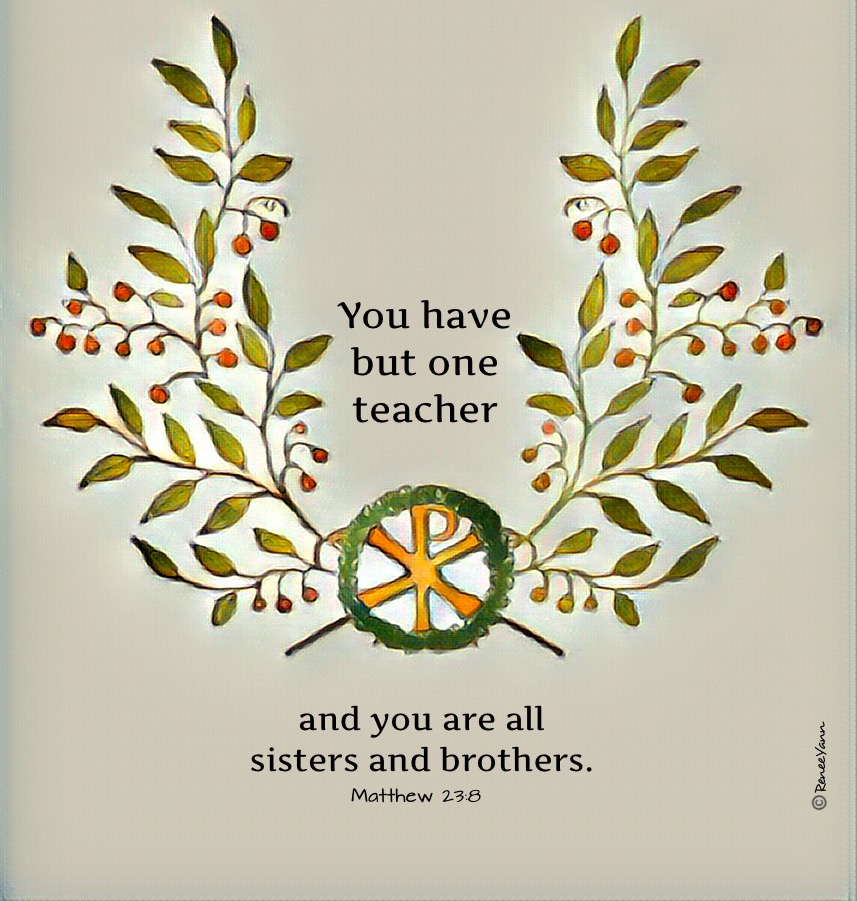
You have but one teacher, and you are all brothers.
Call no one on earth your father;
you have but one Father in heaven.
Do not be called ‘Master’;
you have but one master, the Christ.
The greatest among you must be your servant.
Whoever exalts himself will be humbled;
but whoever humbles himself will be exalted.

Matthew 23: 8-12

We are all leaders at some level in our lives — parents, teachers, supervisors, politicians, clinicians, and everyone who has influence over another’s life. In each of these roles, our soul’s lens can be turned toward ourselves, or it can be turned in merciful care toward the other. The way we effectively turn the lens is to continually deepen ourselves in the greatest commandment: Love God above all things and your neighbor as yourself.


Poetry: Some keep the Sabbath going to Church – Emily Dickinson

Some keep the Sabbath going to Church –
I keep it, staying at Home –
With a Bobolink for a Chorister –
And an Orchard, for a Dome –
Some keep the Sabbath in Surplice –
I, just wear my Wings –
And instead of tolling the Bell, for Church,
Our little Sexton – sings.
God preaches, a noted Clergyman –
And the sermon is never long,
So instead of getting to Heaven, at last –
I’m going, all along.

Music: Where I Find God – Larry Fleet

The night I hit rock bottom, sittin’ on an old barstool
He paid my tab and put me in a cab, but he didn’t have to
But he could see I was hurtin’, oh, I wish I’d got his name
‘Cause I didn’t feel worth savin’, but he saved me just the same

That day out on the water, when the fish just wouldn’t bite
I put my pole down, I floated around, was just so quiet
And I could hear my old man sayin’ “Son, just be still
‘Cause you can’t find peace like this in a bottle or a pill”

From a bar stool to that Evinrude
Sunday mornin’ in a church pew
In a deer stand or a hay field
An interstate back to Nashville
A Chevrolet with the windows down
Me and him just ridin’ around
Sometimes, whether I’m lookin’ for Him or not
That’s where I find God

Sometimes late at night, I lie there and listen
To the sound of her heart beatin’
And the song the crickets are singin’
And I don’t know what they’re sayin’
But it sounds like a hymn to me
Naw, I ain’t too good at prayin’
But thanks for everything

From a bar stool, to that Evinrude
Sunday mornin’ in a church pew
In a deer stand or a hay field
An interstate back to Nashville
A Chevrolet with the windows down
Me and him just ridin’ around
Sometimes, whether I’m lookin’ for Him or not
That’s where I find God

From a bar stool, to that Evinrude
Sunday mornin’ in a church pew
In a deer stand or a hay field
An interstate back to Nashville
A Chevrolet with the windows down
Me and him just ridin’ around
Talkin’, well I do that a lot
Well, I do that a lot
That’s where I find God

Humble Desire

Memorial of Saint Charles Borromeo, Bishop
Saturday of the Thirtieth Week in Ordinary Time
November 4, 2023

Today’s Readings:

https://bible.usccb.org/bible/readings/110423.cfm


Today, in God’s Lavish Mercy, the message of the readings seems to be that we can miss out on grace if we don’t humbly pay attention to its call.


It’s tough to miss out on something when you really want it. I’ve told the story here before of the elderly gentleman at the supermarket ice cream freezer. He was having trouble locating his favorite pineapple ice cream among the oceans of mint chocolate chip and moosetracks. Reaching into the freezer to help him, I found the last pineapple carton. He was delighted but instead of taking it, he said, “Won’t you please try it, I think you will love it. It would make me happy if you did.” In a sense, he missed out on something he really wanted, but he gained something immensely more important.


Paul wants his fellow Israelites to do something similar. He tells them that because they hesitated to embrace Christ’s message, they missed out for a while. In their place, the Gentiles have received the Gospel. But now Paul is asking his fellow Israelites to complete the Gospel community by joining and welcoming the larger Church.

But through their transgression
salvation has come to the Gentiles,
so as to make them jealous.
Now if their transgression is enrichment for the world,
and if their diminished number is enrichment for the Gentiles,
how much more their full number.

Romans 11: 11-12

Our Gospel offers a slightly different approach. Yes, it’s tough to miss out on something you really want. But it’s even worse to miss out because you’re too dense, dumb, or distracted to know what’s good for you.

The invitees to the wedding banquet are so self-absorbed that they don’t even consider the comfort of their fellow guests. Their pride merits them the lowest seat at the table while the humble guests are brought up closer to the host.


“When you are invited by someone to a wedding banquet,
do not recline at table in the place of honor.
A more distinguished guest than you may have been invited by him,
and the host who invited both of you may approach you and say,
‘Give your place to this man,’
and then you would proceed with embarrassment
to take the lowest place.
Rather, when you are invited,
go and take the lowest place
so that when the host comes to you he may say,
‘My friend, move up to a higher position.’
Then you will enjoy the esteem of your companions at the table.
For everyone who exalts himself will be humbled,
but the one who humbles himself will be exalted.”

Luke 14: 8-11

The proud guests in the Gospel really wanted the prestigious seats. But these were seats that only the host (God) could give. Grappling to land the best chair, they got in their own way and missed the sacred invitation which only the humble can hear.


Song Poem: I Don’t Want to be a Pharisee – for your fine listening pleasure and sophisticated spiritual enrichment: 😉

I don’t want to be a pharisee
Or anyone like that.
It’s stupid swallowing camels
Whilst straining out a gnat.
To keep the letter of the law,
They forgot the people it was for.
So I don’t want to be a Pharisee,
I don’t want to be a Pharisee,
I don’t want to be a Pharisee
Or anyone like that.

But They Kept Silent

Friday of the Thirtieth Week in Ordinary Time
November 3, 2023

Today’s Readings:

https://bible.usccb.org/bible/readings/110323.cfm


Today, in God’s Lavish Mercy, as we read our scriptures for the day, we sense that both Jesus and Paul suffer heartbreak for those who resist the Gospel.

Brothers and sisters:
I speak the truth in Christ, I do not lie;
my conscience joins with the Holy Spirit in bearing me witness
that I have great sorrow and constant anguish in my heart.
For I could wish that I myself were accursed and cut off from Christ
for the sake of my own people,
my kindred according to the flesh.

Romans 9:1-3

Paul expresses his deep regret that his own people, the Israelites, resist the Messiah who is God’s final gift to them in a long line of unique blessings:

They are children of Israel;
theirs the adoption, the glory, the covenants,
the giving of the law, the worship, and the promises;
theirs the patriarchs, and from them,
according to the flesh, is the Christ,
who is over all, God blessed forever. Amen.

Romans 9:4-5

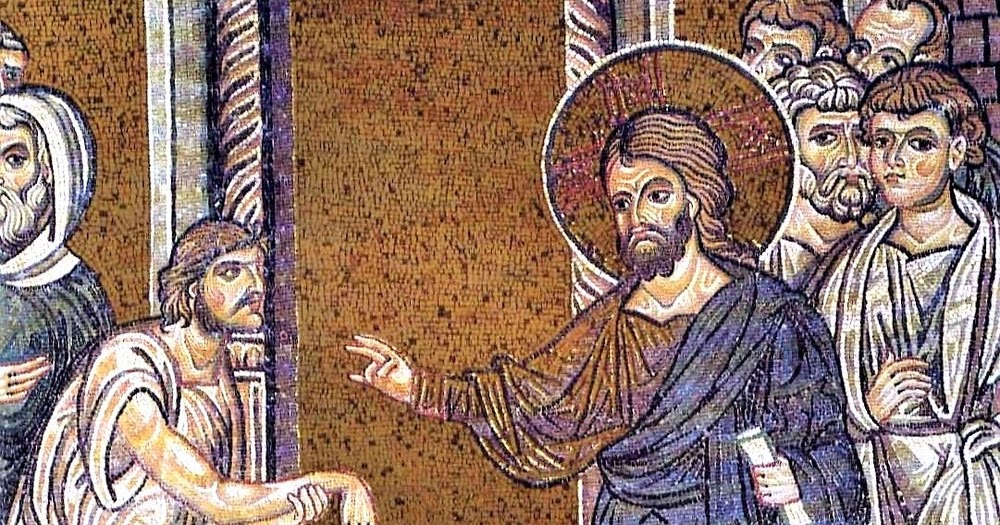
In our Gospel, Jesus encounters a man with a withered hand. From the get-go, Jesus plans to heal the suffering man, but he decides to use the occasion to teach the Pharisees a lesson.

Jesus invites the scholars and Pharisees to move beyond the written Law and into the true practice of its spirit:

Jesus spoke to the scholars of the law and Pharisees in reply, asking,
“Is it lawful to cure on the sabbath or not?”
But they kept silent; so he took the man and,
after he had healed him, dismissed him.
Then he said to them
“Who among you, if your son or ox falls into a cistern,
would not immediately pull him out on the sabbath day?”
But they were unable to answer his question.

Luke 14: 5-6

What Jesus asked was apparently too much for them. They were so encrusted in the worldly benefits the Law had brought them that they couldn’t challenge themselves to hear Jesus’s message. So they were silent – they gave no response to the divine invitation to life-giving change.

And to be fair to the Pharisees, Jesus’s invitation was a huge challenge. Their lives had become entirely dependent on a system that had lost its true meaning. The Law no longer led them to God but to themselves. They had lost the way through the woods, as you will see in Kipling’s poem below.


There are many levels on which we can pray with this passage. We are surely aware of the same kind of resistant silences in ourselves and in our world.

We may be caught in a sort of personal woods where we can’t make our way through to a life-giving choice or, like the Pharisees, to an inclusive, merciful understanding.

Or we may see this kind of entrapment happening in a beloved’s life.

Or we may see the atrophic effects of dead, unreviewed laws in our country, world, and Church. Failing to adapt laws that have lost their true spirit allows us to normalize outrageous behaviors based on manufactured”legality”. The image of a 16-year-old carrying an AK-47 down a neighborhood street, “legally” shooting unarmed protesters, comes to my mind!

All of these situations arise when we are entwined in a system that no longer gives life. The spirit and energy of the Gospel is the key to our un-entwining. Let’s pray for it in ourselves and in our very knotted world.


Poetry: The Way Through the Woods – Rudyard Kipling

They shut the road through the woods
Seventy years ago.
Weather and rain have undone it again,
And now you would never know
There was once a road through the woods
Before they planted the trees.
It is underneath the coppice and heath,
And the thin anemones.
Only the keeper sees
That, where the ring-dove broods,
And the badgers roll at ease,
There was once a road through the woods.

Yet, if you enter the woods
Of a summer evening late,
When the night-air cools on the trout-ringed pools
Where the otter whistles his mate,
(They fear not men in the woods,
Because they see so few.)
You will hear the beat of a horse’s feet,
And the swish of a skirt in the dew,
Steadily cantering through
The misty solitudes,
As though they perfectly knew
The old lost road through the woods.
But there is no road through the woods.

Music: Dave Eggar – Fallen Leaves

The Glory Yet to Come

Tuesday of the Thirtieth Week in Ordinary Time
October 31, 2023

Today’s Readings:

https://bible.usccb.org/bible/readings/103123.cfm


Today, in God’s Lavish Mercy, we pray with Psalm 126, a song of hope fulfilled:

When the LORD brought back the captives of Zion,
    we were like men dreaming.
Then our mouth was filled with laughter,
    and our tongue with rejoicing.

Then they said among the nations,
    “The LORD has done great things for them.”
The LORD has done great things for us;
    we are glad indeed.

Psalm 126: 1-3

In our readings, we are called to be people of hope – to live in gratitude for hopes fulfilled, and to live in confidence of future blessing.


Paul blesses us with some of his most powerful words:

I consider that the sufferings of this present time are as nothing
compared with the glory to be revealed for us.

Romans 8:18

How often, over the ensuing centuries, have these words uplifted and bravened a struggling heart! Paul reminds us of what he so passionately believed – that we are not here for this world alone; that we, with all Creation, are being transformed for eternal life in God.


Jesus too reminds us that our life in faith is so much bigger than we perceive. We see a tiny mustard seed, but God sees the whole tree of eternal life blossoming in us.  We see a fingertip of yeast, but God sees the whole Bread of Life rising in us.

Paul tells us to be People of Hope who do not yet expect to see the object of their hope but who, nonetheless, believe and love with all their hearts.

May we pray this today for ourselves, and for anyone burdened by suffering or hopelessness at this time in their lives.


Poetry: Hope – Czeslaw Milosz – poet, prose writer, translator, and diplomat. He primarily wrote his poetry in Polish. Regarded as one of the great poets of the 20th century, he won the 1980 Nobel Prize in Literature. In its citation, the Swedish Academy called Miłosz a writer who “voices our exposed condition in a world of severe conflicts”.

Hope is with you when you believe
The earth is not a dream but living flesh,
that sight, touch, and hearing do not lie,
That all thing you have ever seen here
Are like a garden looked at from a gate.
You cannot enter. But you're sure it's there.
Could we but look more clearly and wisely
We might discover somewhere in the garden
A strange new flower and an unnamed star.
Some people say that we should not trust our eyes,
That there is nothing, just a seeming,
There are the ones who have no hope.
They think the moment we turn away,
The world, behind our backs, ceases to exist,
As if snatched up by the hand of thieves.

Music:  Living Hope – Phil Wickham

Raised Up!

Monday of the Thirtieth Week in Ordinary Time
October 30, 2023

Today’s Readings:

https://bible.usccb.org/bible/readings/103023.cfm


Today, in God’s Lavish Mercy, we pray with Psalm 68 which pictures a triumphant God, rising like the sun over the darkness of evil.

Arise, O God, and let your enemies be scattered;
let those who hate you flee.
Let them vanish like smoke when the wind drives it away; 
as the wax melts at the fire,
so let the wicked perish at your presence.

Psalm 68:1-3

This psalm comforts us with a tender picture of God:

Protector of orphans, defender of widows,
the One who dwells in holiness,
who gives the solitary a home
and brings forth prisoners into freedom;
but the rebels shall live in dry places.

Psalm 68: 5-6

It is the same tenderness Paul presents in our first reading:

For those who are led by the Spirit of God are children of God.
For you did not receive a spirit of slavery to fall back into fear,
but you received a spirit of adoption,
through which we cry, “Abba, Father!”
The Spirit bears witness with our spirit
that we are children of God,
and if children, then heirs,
heirs of God and joint heirs with Christ…
if only we suffer with him
so that we may also be glorified with him.

Romans 8:8-9

And there we have the key line: 
we are to live a life aligned with 
the Passion, Death, and Resurrection of Christ.


And what will that kind of life look like? It will look like our merciful Jesus of today’s Gospel – who stepped out to see, comfort, and heal the suffering around him.

Jesus recognized the crippled woman as “an heir of God, and joint heir with him” to the fullness of life in God. We are called to recognize ourselves and all of our sisters and brothers in the same way.


Poetry: WOMAN UN-BENT (LUKE 13:10–17) – by Irene Zimmerman, OSF

That Sabbath day as always 
she went to the synagogue 
and took the place assigned her 
right behind the grill where, 
the elders had concurred, 
she would block no one’s view, 
she could lean her heavy head, 
and (though this was not said) 
she’d give a good example to 
the ones who stood behind her. 
 
That day, intent as always 
on the Word (for eighteen years 
she’d listened thus), she heard 
Authority when Jesus spoke. 
 
Though long stripped 
of forwardness, she came forward, nonetheless, 
when Jesus summoned her. 
“Woman, you are free of your infirmity,” he said. 

The leader of the synagogue 
worked himself into a sweat 
as he tried to bend the Sabbath 
and the woman back in place. 

But she stood up straight and let 
God’s glory touch her face.

Video: Jesus Heals the Bent-over Woman

If you’d still like a little music, this one seems to fit: Spirit Touch by Joseph Akins

It’s That Simple

Thirtieth Sunday in Ordinary Time
October 29, 2023

Today’s Readings:

https://bible.usccb.org/bible/readings/102923.cfm


Today, in God’s Lavish Mercy, our readings instruct us on how to love God. Now maybe you think you don’t need any help on that topic, and maybe you’re right. But — just maybeeeeee – you and I are a little bit like the folks in our passage from Exodus who sometimes forgot that the way to love God is to love neighbor.

“You shall not molest or oppress an alien,
for you were once aliens yourselves in the land of Egypt. 
You shall not wrong any widow or orphan. 
If ever you wrong them and they cry out to me,
I will surely hear their cry. 

Exodus 22;21-22

It seems that these Exodus folks suffer from spiritual obtusity. They are a little forgetful of who they really are. They forget their roots – that they were once aliens themselves. They forget that widows and orphans matter as much as they do. They forget that their neighbor needs a cloak (or a home) to be able to sleep at night.

So God tells them, “Hey, I love these people you have conveniently “forgotten”. So don’t pretend you love me if you don’t love them.” It’s that simple.


In our Gospel, Jesus basically says the same thing. When the brilliant Pharisee tries to trap Jesus in an obtuse intellectual argument, Jesus disarms him with a clear and simple response:

Jesus said to him,
“You shall love the Lord, your God,
with all your heart,
with all your soul,
and with all your mind.
This is the greatest and the first commandment.
The second is like it:
You shall love your neighbor as yourself.
The whole law and the prophets depend on these two commandments.”

Matthew 22:37-40

The whole enterprise of the spiritual life is to actualize Jesus’s response in one’s life. In the process of doing that by our response to God’s grace, we might sometimes get caught in spiritual forgetfulness, intellectual excuses, or the blare of a dissonant culture.


In our second reading, Paul commends the Thessalonians for having done well in this spiritual endeavor. They did it by replacing what was idolatrous in their lives with the living and true God:

You turned to God from idols
to serve the living and true God
and to await his Son from heaven,
whom he raised from the dead,
Jesus, who delivers us from the coming wrath.

1 Thessalonians 1:9-10

I don’t like to think of myself as particularly idolatrous, but I do have little false gods pop up in my life at times. They tend to wear the deceptive costumes of the seven deadly sins convincing me that I have a right, or at least an excuse, to ignore my neighbor for the sake of my egotism, possessiveness, or spiritual laziness.


May today’s readings wake us up to anything we need to hear within them so that we may freely sing with today’s psalmist:

I love you, my true God, my strength,
my neighbor God, present in my life,
my balance, safety, comforter.
My God, my dear steady God,
my protection, well of my salvation,
my trustworthy Friend!
I praise You because, with You,
I am safe from any false god
and anointed by your grace
for the journey.

Psalm 18: my prayerful adaptation

Poetry: You, Neighbor God – Rainer Maria Rilkë

You, neighbor god, if sometimes in the night
I rouse you with loud knocking, I do so
only because I seldom hear you breathe
and know: you are alone.
And should you need a drink, no one is there
to reach it to you, groping in the dark.
Always I hearken. Give but a small sign.
I am quite near.
Between us there is but a narrow wall,
and by sheer chance; for it would take
merely a call from your lips or from mine
to break it down,
and that without a sound.
The wall is builded of your images.
They stand before you hiding you like names.
And when the light within me blazes high
that in my inmost soul I know you by,
the radiance is squandered on their frames.
And then my senses, which too soon grow lame,
exiled from you, must go their homeless ways.

Music: Overcome – Psalm 18 – James Block

This song renders the Psalm in a beautiful melody. The Psalm, however, retains the militant images so prevalent in the culture of ancient Israel (and sadly in our own). Our task, as we listen and pray these Psalms, is to hear those images as metaphors for our own spiritual challenges and blessings, rather than as an approbation of war and domination.