“Keeping” the Word

Memorial of Saints Cornelius, Pope, and Cyprian, Bishop, Martyrs
Saturday of the Twenty-third Week in Ordinary Time
September 16, 2023

Today’s Readings:

https://bible.usccb.org/bible/readings/091623.cfm


Today, in God’s Lavish Mercy, in his letter to Timothy, we see that Paul thought he had been the foremost of bad dudes.

This saying is trustworthy and deserves full acceptance:
Christ Jesus came into the world to save sinners.
Of these I am the foremost.

1 Timothy 1:15

Well, maybe – maybe not! It’s hard to imagine that a really bad guy could end up with the sacred portfolio Paul compiled before he met his maker. Jesus says as much in today’s Gospel:

A good tree does not bear rotten fruit,
nor does a rotten tree bear good fruit.
For every tree is known by its own fruit.

Luke 6:43-44

So let’s say Paul wasn’t really a “bad guy” before he got knocked off his Damascus-bound horse. Then what was he? The key word in Paul’s self-description is this: SINNER. Paul was a sinner.

Sinners are otherwise “good guys” who make bad choices for their spiritual lives. When those bad choices multiply and begin to feed on one another, the soul deteriorates like the rotten tree in Jesus’s image.


Jesus uses an additional metaphor to describe the process of continual spiritual conversion:

“Why do you call me, ‘Lord, Lord,’ but not do what I command?
I will show you what someone is like who comes to me,
listens to my words, and acts on them.
That one is like a man building a house,
who dug deeply and laid the foundation on rock;
when the flood came, the river burst against that house
but could not shake it because it had been well built.

Luke 6:46-48

We open our hearts to Mercy by these commitments to God’s Word in our daily spiritual life:

  • listening
  • acting
  • deepening

Integrity in these three spiritual practices requires dedicated prayer and reflection, a faithful “keeping” with the Word of God. As our Alleluia Verse assures us:

Alleluia, alleluia.
Whoever loves me will keep my Word,
and my Father will love them,
and we will come to them.

John 14:23

Poetry: [i carry your heart with me(i carry it in] – e.e.cummings

i carry your heart with me(i carry it in
my heart)i am never without it(anywhere
i go you go,my dear;and whatever is done
by only me is your doing,my darling)
i fear
no fate(for you are my fate,my sweet)i want
no world(for beautiful you are my world,my true)
and it’s you are whatever a moon has always meant
and whatever a sun will always sing is you
here is the deepest secret nobody knows
(here is the root of the root and the bud of the bud
and the sky of the sky of a tree called life;which grows
higher than soul can hope or mind can hide)
and this is the wonder that's keeping the stars apart

i carry your heart(i carry it in my heart)


Music: Remain in Me – Steve Angrisano
Her Joys and Her Sorrows

Memorial of Our Lady of Sorrows
September 15, 2023

Today’s Readings:

https://bible.usccb.org/bible/readings/091523.cfm


Today, in God’s Lavish Mercy, as we pray with Our Mother of Sorrows, we follow the liturgical cycle and return to Paul’s letter to Timothy for our first reading. However, we break from the cycle to honor Mary, Mother of Sorrows for our Gospel and Sequence.

What a solemn title this is for Mary! It is so much more comforting to think of her as the young, lively mother of Jesus, or the exuberant girl who happily visited her cousin Elizabeth.

But today, the Church remembers Mary’s suffering by which she intimately shared in Jesus’s redemption of the world.

At the cross her station keeping,
Stood the mournful Mother weeping,
Close to Jesus to the last.
Through her heart, his sorrow sharing,
All his bitter anguish bearing,
Now at length the sword had passed.

Mary’s life was full of both mind-blowing and heart-wrenching experiences!

  • Just imagine what it felt like to find an angel in one’s living room with an invitation to star in salvation history.
  • Imagine Mary’s pride, and perhaps frightened astonishment, at Cana when she tasted that “wine-formerly-known-as-water.”
  • Imagine how she fought the urge to slow Jesus down, to call him back to the comfort, safety and anonymity of their Nazareth home.
  • Imagine the utter bereavement of mind, heart, and spirit Mary suffered at the foot of the Cross.

Mary’s life was so full of joys and sorrows that there could be little in our lives she would not fully understand. Let’s be with her in prayer today, turning over our own blessings and difficulties with her – and those of our world – asking for her counsel and care.


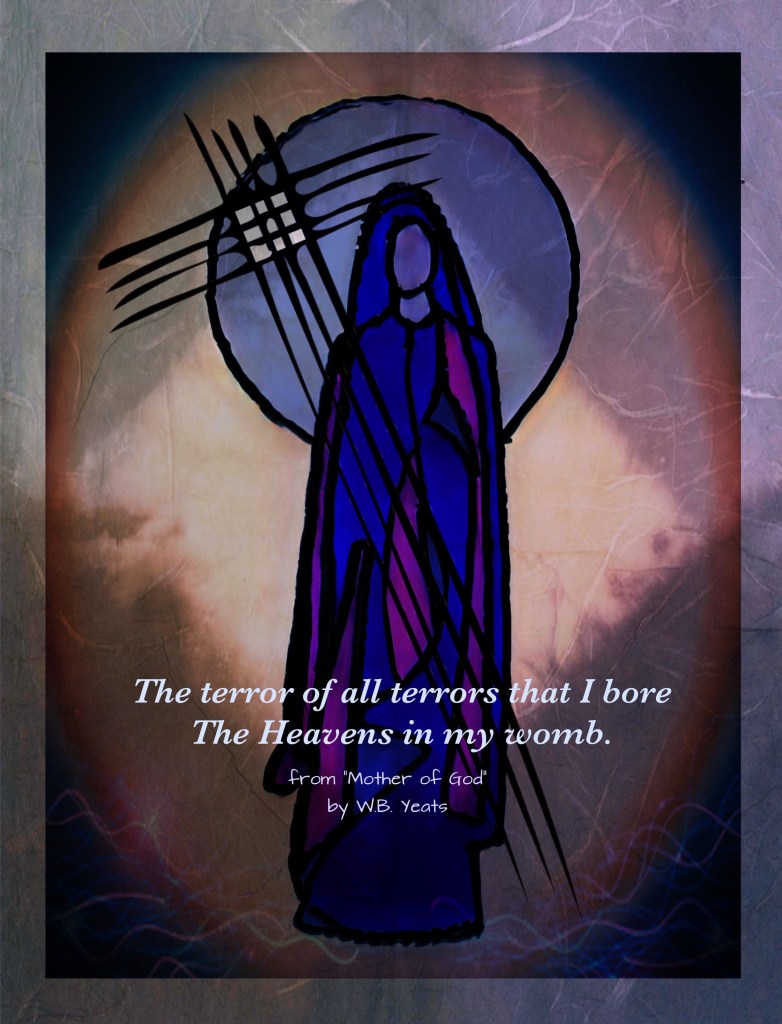
Poetry: Mother of God – W. B. Yeats

The threefold terror of love; a fallen flare
Through the hollow of an ear;
Wings beating about the room;
The terror of all terrors that I bore
The Heavens in my womb.
Had I not found content among the shows
Every common woman knows,
Chimney corner, garden walk,
Or rocky cistern where we tread the clothes
And gather all the talk?
What is this flesh I purchased with my pains,
This fallen star my milk sustains,
This love that makes my heart’s blood stop
Or strikes a Sudden chill into my bones
And bids my hair stand up?

Music: Mary’s Heart – Danielle Rose

Oh Mary
Mother of Jesus
Give me your heart
That I might receive Jesus
Give me your heart
So beautiful, so pure
So immaculate, so full
Of love and humanity

Oh Mary
Mother of Jesus
Give me your heart
That I might receive Jesus
Give me your heart
To love him as you loved him
And serve him as you served him
In the distressing disguise of the poorest of the poor

Oh Mary
Mother of Jesus
Give me your heart
That I might receive Jesus
In the bread of life
In the poorest of the poor
In distressing disguise
In Christ our Lord
In the bread of life
In the poorest of the poor
In distressing disguise
In Christ our Lord

Oh Mary
Mother of Jesus
Give me your heart
That I might receive Jesus
Jesus

Simplicity Yields Freedom

Memorial of Saint John Chrysostom, Bishop and Doctor of the Church
September 13, 2023

Today’s Readings:

https://bible.usccb.org/bible/readings/091323.cfm


Today, in God’s Lavish Mercy, our Gospel gives us a quick and intense course in the upside-down, inside-out world of Jesus Christ. The course is known by various names:

  • the Blessings and Woes
  • the Sermon on the Plain
  • the “other” Beatitudes

But the passage might just as well be called, “The Loving Slap in the Face Wake-up Call”.


Picture it. The Twelve have just been commissioned by Jesus as his Apostles (refer to yesterday’s Gospel). I mean this is a big deal! They’ve passed the toughest job interview ever … to stand in for God in the world! They probably want to go home and tell their families, “Guess what! I have a new, fabulous job!”


But then Jesus gives them the orientation manual – the Blessings and Woes – and it’s shocking!

“Blessed are you who are poor,
for the Kingdom of God is yours.
Blessed are you who are now hungry,
for you will be satisfied.
Blessed are you who are now weeping,
for you will laugh.
Blessed are you when people hate you,
and when they exclude and insult you,
and denounce your name as evil
on account of the Son of Man.”


Really? This is what will make me successful in this new gig?

I am called to honor and accompany those who are poor, hungry, heartbroken, hated, excluded and insulted? THEY are the blessed, the “successful” in God’s estimation?


Like many of us, the Apostles may have thought success looked just the opposite – a lot of money, extravagant possessions, careless jocularity, universal adulation, and unquestioned consumption of common resources. You know. – a big boat, a lot of fish, an unconscious immunity from worrying about the poor, hungry guy outside the boatyard.


Jesus turns all of this upside-down and inside-out. He warns that excessive satisfaction with the world’s goods distracts us from true life in God. It hardens us against a loving compassion for one another. It weakens our capacity to receive the immense joy and freedom of life in the Spirit. Jesus calls us to a simplicity of heart that frees us to see and love God in ourselves and others.


As we proceed through Luke’s Gospel, Jesus continues to teach his apostles its contradictory truth. Eleven of the aspirants absorbed his words, transforming their life in a holy “inversion”. Only one, in the long run, proved resistant.

Where might we find ourselves if we stood among them?


Poetry: by C. Austin Miles

A little more kindness, a little less creed
A little more giving, a little less greed
A little more smile, a little less frown
A little less kicking, A man when he's down
A little more "we" a little less "I",
A little more laugh, a little less cry,
A little more flowers on the pathway of life
And fewer on graves at the end of the strife.

Music: A Simple Man – by Lynyrd Skynyrd

Uncompromising Faith

Memorial of the Passion of Saint John the Baptist
August 29, 2023

Today’s Readings:

https://bible.usccb.org/bible/readings/082923.cfm


John the Baptist – Titian (1540)

Today, in God’s Lavish Mercy, we honor John the Baptist under the title of his “Passion”. The memorial used to be called “the Beheading of John the Baptist”, a title that more referenced the act of the criminal rather than the perseverance of the martyr.

The Gospel narrative is gripping, as is much of the history of John the Baptist. He was no smoldering wick. Rather, John was on fire with the Truth of the Messiah and he never compromised.

Herod was the one who had John the Baptist arrested and bound in prison
on account of Herodias,
the wife of his brother Philip, whom he had married.
John had said to Herod,
“It is not lawful for you to have your brother’s wife.”
Herodias harbored a grudge against him
and wanted to kill him but was unable to do so.

Mark 6: 17-19

In a commentary on this Gospel, Pope Francis described the central players like this: There are four characters:

  • King Herod “corrupt and indecisive”
  • Herodias, the wife of the king’s brother who “knew only how to hate”
  • Salome, “the vain ballerina”,
  • the “prophet, decapitated and alone in his cell”.

Pope Francis continued:

John had pointed Jesus out to His first disciples, indicating that He was the Light of the world. He, instead, gave his life little by little, to the point of being extinguished in the darkness of a prison cell.
Life has value only when we give it; when it is given in love, in truth; when we give it to others, in daily life, in our families. It should always be given. If someone grasps his or her life in order to keep it, like the king by his corruption, or the woman with her hatred, or the child, the young girl with her vanity that was that of an adolescent, naive, life dies, life ends up withered, it is useless”

Homily of Pope Francis, Santa Marta, 8 February 2019

Pope Benedict XVI also offered some compelling thoughts on the Passion of John the Baptist:
 “Celebrating the martyrdom of St. John the Baptist also reminds us – Christians in our own times – that we cannot give into compromise when it comes to our love for Christ, for his Word, for his Truth. The Truth is the Truth; there is no compromise. The Christian life requires, as it were, the ‘martyrdom’ of daily fidelity to the Gospel; the courage, that is, to allow Christ to increase in us and to direct our thoughts and actions.”


Francis and Benedict give us plenty to think about as we celebrate this solemn feast. Let us pray for the courage to live our faith wholeheartedly, inspired by the unswerving fidelity of St. John the Baptist.


Poetry: from “Saint John the Baptist” by Thomas Merton

St. John, strong Baptist,
Angel before the face of the Messiah
Desert-dweller, knowing the solitudes that lie
Beyond anxiety and doubt,
Eagle whose flight is higher than our atmosphere
Of hesitation and surmise,
You are the first Cistercian and the greatest Trappist:
Never abandon us, your few but faithful children,
For we remember your amazing life,
Where you laid down for us the form and pattern of
Our love for Christ,
Being so close to Him you were His twin.
Oh buy us, by your intercession, in your mighty heaven,
Not your great name, St. John, or ministry,
But oh, your solitude and death:
And most of all, gain us your great command of graces,
Making our poor hands also fountains full of life and wonder
Spending, in endless rivers, to the universe,
Christ, in secret, and His Father, and His sanctifying Spirit.

Music: Jesu, Joy of Man’s Desiring – J.S. Bach – This beautiful hymn befits John’s great love and devotion to Jesus.

Keys to Wisdom

Twenty-first Sunday in Ordinary Time
August 27, 2023

Today’s Readings:

https://bible.usccb.org/bible/readings/082723.cfm


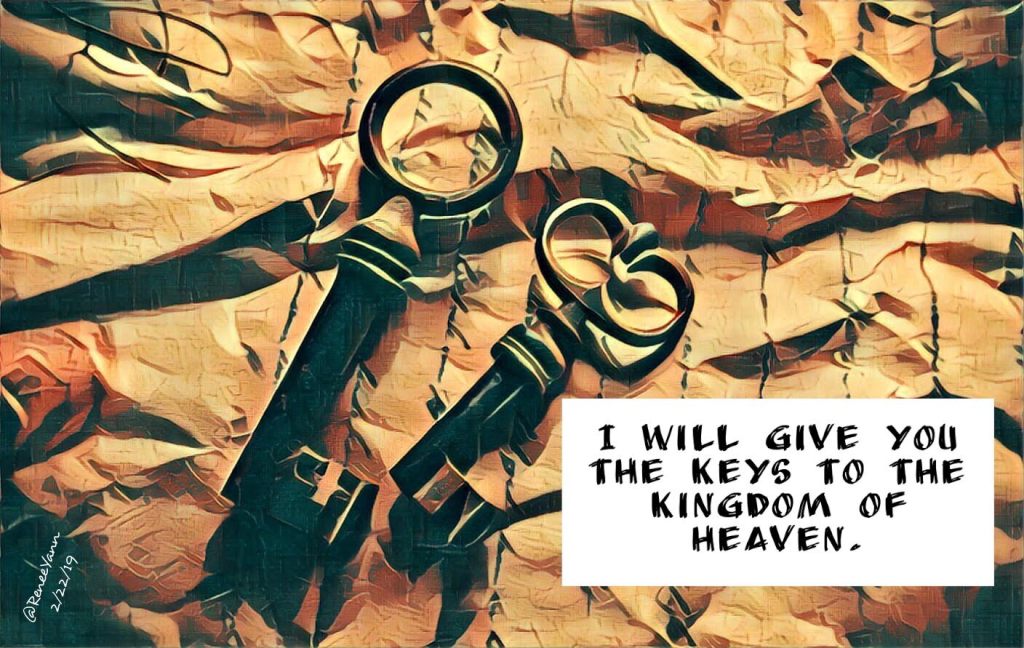
Today, in God’s Lavish Mercy, our readings revolve around the symbol of keys and the authority attached to them.

Chapter 22 of Isaiah tells the story of Eliakim whose name means “one whom God establishes”. Eliakim takes over as King Hezekiah’s prime minister. Shebna, his predecessor, has kind of wimped out as a fitting leader. Expecting an invasion by the Assyrian armies, Shebna has abandoned hope and instead built himself a nice tomb just in case. So, according to Isaiah, God is unhappy with Shebna and gives the authority and keys to Eliakim:

Thus says the LORD to Shebna, master of the palace:
“I will thrust you from your office
and pull you down from your station.
On that day I will summon my servant
Eliakim, son of Hilkiah;
I will clothe him with your robe,
and gird him with your sash,
and give over to him your authority.
He shall be a father to the inhabitants of Jerusalem,
and to the house of Judah.
I will place the key of the House of David on Eliakim’s shoulder;
when he opens, no one shall shut,
when he shuts, no one shall open.

Isaiah 22:19-22

The bestowal of “keys” is the key concept here (not to make a pun.) Keys, both in the passage from Isaiah and from Matthew, symbolize the commissioning of Eliakim and Peter as immediate subordinates to the “king”. They are to act in the king’s place as necessary and appropriate. They have “the keys to the kingdom”.


Our second reading leads us to understand that the symbolic keys given to Peter unlock mysteries far exceeding those described in Isaiah. The entire exchequer of the Faith is placed in Peter’s hands, a treasury for which Christ makes Peter and his successors forever responsible.

Oh, the depth of the riches and wisdom and knowledge of God! 
How inscrutable are his judgments and how unsearchable his ways!
For who has known the mind of the Lord
or who has been his counselor?
Or who has given the Lord anything
that he may be repaid?

For from him and through him and for him are all things. 
To him be glory forever. Amen.

Romans 11:33-36

While the Catholic Church interprets these passages as evidence for the primacy of Peter and the Popes, these scriptures also call all Christ’s disciples to plumb the depths of God’s infinite wisdom as it speaks within their own lives. In the community of learning and living we call “Church”, each of us has a role in illuminating the Gospel for our world.

Our daily prayer with the scriptures and our pursuit of reliable sources of sacred learning will deepen our ability to live the Gospel in our time. Peter did his job in his time. Now it’s our turn and Pope Francis’s turn. Let’s pray for him in a special way today.


Prayer for Pope Francis:

The ancient prayer for the Pope, sung regularly in the Vatican in Latin and found in prayer books and hymnals everywhere, is paraphrased from Psalm 41:3: 

May the Lord preserve him, give him a long life, 
make him blessed upon the earth,
and not hand him over to the power of his enemies.
O God, Shepherd and Ruler of all the faithful, 
look down in your mercy upon your servant, Francis,
whom you have appointed to preside over your Church,
and grant, we beseech you, that both by word and example,
he may edify all those under his charge so that,
with the flock entrusted to him,
he may arrive at length unto life everlasting.

Music: Who Has Known – John Foley, SJ

Oh, the depth of the riches of God
And the breadth of the wisdom and knowledge of God
For who has known the mind of God
To Him be glory forever

A virgin will carry a child and give birth
And His name shall be called Emmanuel
For who has known the mind of God
To Him be glory forever

The people in darkness have seen a great light
For a child has been born, His dominion is wide
For who has known the mind of God
To Him be glory forever

Leadership: Service not Status

Saturday of the Twentieth Week in Ordinary Time
August 26, 2023

Today’s Readings:

https://bible.usccb.org/bible/readings/082623.cfm


Today, in God’s Lavish Mercy, we continue with the story of Ruth, prototype of the Servant Christ. And we pray our first reading in the light of today’s Gospel in which Jesus teaches his disciples a key lesson in servant leadership:

Jesus spoke to the crowds and to his disciples, saying,
“The scribes and the Pharisees
have taken their seat on the chair of Moses.
Therefore, do and observe all things whatsoever they tell you,
but do not follow their example.
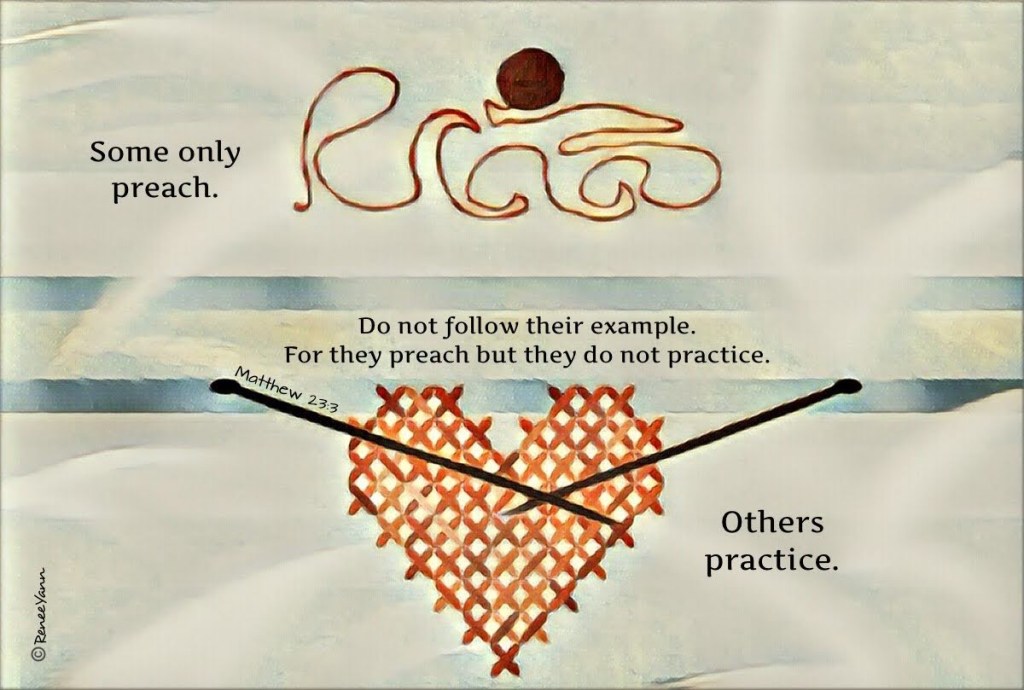
For they preach but they do not practice.
They tie up heavy burdens hard to carry
and lay them on people’s shoulders,
but they will not lift a finger to move them.
All their works are performed to be seen.
They widen their phylacteries and lengthen their tassels.
They love places of honor at banquets, seats of honor in synagogues,
greetings in marketplaces, and the salutation ‘Rabbi.’

Matthew 23: 1-7

Jesus is so clear in this teaching. How is it that, even after 2000 years, we still don’t get it!

Stop and think about our culture – how we worship glitz, and bling, and “blow-em-up”! Listen to some of our political rhetoric filled with narcissistic “me-ism” and violent braggadocio. Look at some of the people in leadership positions around the world! They are tangled in their “phylacteries and tassels” and tripping us up with them.

Yes, even in our churches, we sometimes encounter supposed leaders who delight in places of honor and who lay burdens on the faithful rather than lift them.


Our first reading offers us humble Ruth who led and healed by selfless love.

Our Gospel reminds us that the Christian life is one of servant leadership fueled in a God-centered community to which all belong as sisters and brothers.

As for you, do not be called ‘Rabbi.’
You have but one teacher, and you are all brothers.
Call no one on earth your father;
you have but one Father in heaven.
Do not be called ‘Master’;
you have but one master, the Christ.
The greatest among you must be your servant.
Whoever exalts himself will be humbled;
but whoever humbles himself will be exalted.

Matthew 23:8-12

History is the story of our struggle to find that balance of leadership and community that will foster the life of all people. It is the great struggle between sin and goodness, between a life lived only for self and a life lived generously with others.

As we deepen our spiritual understanding with today’s readings, we may see ways that we want to act and choose more intentionally around the ministry of leadership – as it is exercised by ourselves and by others.


Prayer: from Jesuit Resources at Xavier University.org

A Leader’s Prayer

Leadership is hard to define.
Lord, let us be the ones to define it with justice.
Leadership is like a handful of water.
Lord, let us be the people to share it with those who thirst.
Leadership is not about watching and correcting.
Lord, let us remember it is about listening and connecting.
Leadership is not about telling people what to do.
Lord, let us find out what people want.
Leadership is less about the love of power,
and more about the power of love.

Lord, as we continue to undertake the role of leader let us be
affirmed by the servant leadership we witness in your son Jesus.
Let us walk in the path He has set and let those who will, follow.

Let our greatest passion be compassion.
Our greatest strength love.
Our greatest victory the reward of peace.

In leading let us never fail to follow.
In loving let us never fail.


Hymn: Prayer of St. Francis

Blessings without Reservation

Feast of Saint Bartholomew, Apostle
August 24, 2023

Today’s Readings:

https://bible.usccb.org/bible/readings/082423.cfm


Today, in God’s Lavish Mercy, we pray with Psalm 145, a luxuriant song of praise to a God who overwhelms us with generosity.

I will extol you, my God and king;
I will bless your name forever and ever.

Every day I will bless you;
I will praise your name forever and ever.

Great is the LORD and worthy of much praise,
whose grandeur is beyond understanding.

Psalm 145: 1-3

Citing verses 13-20 which are structured around the word “all”, Walter Brueggemann says:

The image is an overflow of limitless blessing 
given without reservation 
to all who are in need 
and turn to the Creator.

… Which brings us to Nathaniel and how this prayer might have sung in his heart.


I got to be friends with Nathaniel sixty years ago when, at my reception into our community, Mother Bernard decided to give me his name. And after an initial shock, I came to love it.

Nathaniel and I have spent countless hours under his fig tree sharing both our lives. I’ve asked him many times what he was thinking about when Philip came to invite him to meet Jesus. Nathaniel always has a different answer… one amazingly similar to whatever happens to be preoccupying me at the time.😇

a favorite old book that started some of my conversations with Nathaniel

One element remains constant in every circumstance: in his quiet moments, Nathaniel sought God’s Light. As our Gospel shows, that Luminous Word came to him and he responded.


I think that in our “fig tree moments”, we have finally sifted through all that we are capable of in order to find Grace in our lives. Now we wait, in the shade and quiet of prayer, for the True Answer to invite us into Its Mystery.

When that answering Word comes, it shatters our doubts and pretenses like eggshells. And through the shattered shells, the Word releases new life in us. We move deeper into the unbreakable Wholeness and Infinity. Like Nathaniel, even in our ordinary lives, we begin to “see greater things” than we had ever imagined.


Nathanael said to him, “How do you know me?” 
Jesus answered and said to him,
“Before Philip called you, I saw you under the fig tree.”
Nathanael answered him,
“Rabbi, you are the Son of God; you are the King of Israel.”
Jesus answered and said to him,
“Do you believe
because I told you that I saw you under the fig tree?
You will see greater things than this.”
And he said to him, “Amen, amen, I say to you,
you will see heaven opened and the angels of God
ascending and descending on the Son of Man.”

John 1:48-51

After that momentous afternoon when he was drawn from his figgy shade into the Light, Nathaniel’s life became a hymn of praise and thanksgiving.

Let all your works give you thanks, O LORD,
    and let your faithful ones bless you.
Let them discourse of the glory of your Kingdom
    and speak of your might.

Psalm 145:10-11

Poem-Prayer from Christine Robinson

Psalm 145 – Opening Heart

I exalt you, Holy One, and open my heart to you
by remembering your great love.
Your expansiveness made this beautiful world
in a universe too marvelous to understand.
Your desire created life, and you nurtured
that life with your spirit.
You cherish us all—and your prayer
in us is for our own flourishing.
You are gracious to us
slow to anger and full of kindness
You touch us with your love—speak to us
with your still, small voice, hold us when we fall.
You lift up those who are oppressed
by systems and circumstances.
You open your hand
and satisfy us.
You ask us to call on you—
and even when you seem far away, our
longings call us back to you.
Hear my cry, O God, for some days, it is all I have.

Music: I Will Praise Your Name – Bob Fitts

Lord I will praise your name
I will praise your name
I will praise your name and extol You

I will praise Your name (I will praise Your name)
I will praise Your name
As I behold You

I will magnify, I will glorify
I will lift on high Your name, Lord Jesus
I will magnify, I will glorify
I will lift on high Your name, Lord Jesus

For Your love is never ending
And Your mercy ever true
I will bless Your name Lord Jesus
For my heart belongs to You

I will praise Your name
I will praise Your name and extol you

I will magnify, I will glorify
I will lift on high Your name, Lord Jesus
For Your love is never ending
And Your mercy ever true

I will bless Your name Lord Jesus
For my heart belongs to You
I will praise Your name
I will praise Your name and extol you
I will magnify, I will glorify
I will lift on high Your name, Lord Jesus

Parable of the Trees

Wednesday of the Twentieth Week in Ordinary Time
August 23, 2023

Today’s Readings:

https://bible.usccb.org/bible/readings/082323.cfm


Today, in God’s Lavish Mercy, our first reading delivers a powerful message if we can decipher it. The passage, sometimes known as “Jotham’s Fable”, depicts the rise of Jotham’s felonious brother Abimelech as leader of Israel.

Abimelech was a bad guy, and the story of his tenure is so full of treacherous violence that it would be an “X” movie if shown in theaters today. Jotham, the only surviving brother of Abimelech’s fratricide, preaches his fable to warn the people against his murderous brother.

Jotham went to the top of Mount Gerizim and, standing there,
cried out to them in a loud voice:
“Hear me, citizens of Shechem, that God may then hear you!
Once the trees went to anoint a king over themselves.

Judges 9:7-8

Let’s take a look at the fable. What significance might it have for us today?

The fable describes humanized trees who seek a strong leader from among the most revered trees in Israel: the olive, the fig, and the grapevine. Each of the three trees is asked to assume leadership because each has proven honest and true in sustaining the people. However each, when asked, refuses because they are committed to the current success of their own chosen work. As a result, a vacuum of leadership is left. This vacuum allows the “bramble”, a self-absorbed, non-productive weed to slip in and grasp control over the people. It doesn’t turn out well.


Walter Bruggemann interprets the parable in this way:

The point of the parable is not obscure. The parable is simply a clever way to assert that if good people with positive political potential default on governing responsibility, then rule will be exercised by less desirable, more dangerous alternatives. The point is clear; nonetheless there is merit in lining out the parable. Not only is it entertaining in its imagery, but the repetition of patterned speech reinforces the danger and the possibility concerning governance. In the case of this narrative, the parable implies that Abimelech came to power because better candidates refused to have their productive lives interrupted by public responsibility.

It takes no great imagination for us to see the contemporaneity of the parable for us. If responsible people eschew public responsibility, the way is open for those who would misuse power in a governing space.

Walter Brueggemann: “Refusing the Bramble” from churchanew.org

It takes both generous courage and insightful self-examination to answer a call to true leadership which is a ministry of God’s merciful love. Every one of us will hear that call in some way in our lives – not necessarily to be President, Queen, or Pope – but as parent, teacher, coach, counselor, minister, board member, supervisor, or simply a true friend … and all the other ways we have the power to influence another’s life.


On the flip side, it takes reflective awareness to choose and support good leaders. In our complex society, we must be intentional not to be caught in the “brambles” of a self-absorbed wannabe who, like Jotham’s combustible weed, cannot nourish the community. Achieving that awareness is not as easy as it might seem. Potential leaders, at any level, can fool us by subtly appealing to our own unexamined “brambles” – those flashpoints which exploit our fears and prejudices rather than leading to a communally successful way through them.


In our Gospel, Jesus tells us what God’s “leadership” is like. God is like the selfless landowner who meets his people’s need with unmeasured generosity. Whether we come early or late to God’s vineyard, we are fully embraced and rewarded. Jesus’s parable suggests that we should be wary of “leaders” who divide communities into “them” and “us” in order to ration God’s Mercy.

Instead, the Gospel-inspired community is amazingly able to embrace each member at the place where they can best be led to wholeness. A sound, selfless leader is essential to building that kind of community whether it be civic or religious.

In reply, the landowner said to one of the complainers,
‘My friend, I am not cheating you.
Did you not agree with me for the usual daily wage?
Take what is yours and go.
What if I wish to give this last one the same as you?
Or am I not free to do as I wish with my own money?
Are you envious because I am generous?’
Thus, the last will be first, and the first will be last.”

Matthew 20:13-16

Praying with these passages, we might ask for “justice-eyes” and a “mercy-heart” as we navigate our world as both leaders and as those who discern leaders.


Poetry: Nobility by Alice Cary (1820-1871)

True worth is in being, not seeming,-
In doing, each day that goes by,
Some little good, not in the dreaming
Of great things to do by and by.
For whatever men say in their blindness,
And spite of the fancies of youth,
There’s nothing so kingly as kindness,
And nothing so royal as truth.


Music: Song for the Journey – not the greatest music ever written, but still the song captures the message of servant leadership.

Idolatry

Memorial of Saint Pius X, Pope
Monday of the Twentieth Week in Ordinary Time
August 21, 2023

Today’s Readings:

https://bible.usccb.org/bible/readings/082123.cfm


Today, in God’s Lavish Mercy, our two readings connect to remind us of an essential truth: stay faithful to God’s Word in order to live in peace, justice, and joy.


The passage from Judges recounts the topsy-turvy history of Israel around 800 years before Christ. It was a time when various Judges served as leaders before the eventual establishment of the kingdom under Samuel.

The Twelve Judges of Israel (in technicolor!)

These were tough times for Israel. One after another, hostile forces rose against them. During each threat, someone would emerge as a deliverer and, with their heroic success, endure for a while as the Judge.


The writer equates Israel’s ups and downs with God’s pleasure or displeasure with the people. When the people broke faith, God punished them with political turmoil. When the people were repentant, God provided a deliverer.

Of course, this is an overly simplified interpretation of events. By infusing God with the human qualities of anger and appeasement, the writer explains complex history as a simple quid pro quo: You’re bad, you get zapped. You’re good, you get rewarded.


We know that our God does not vacillate between angry punishment and satisfied recompense. God is always loving, forgiving, and nurturing. So what can this passage teach us about our own faith life and the spiritual culture of our times?

I found a key reflection point in the passage’s initial phrase: The children of Israel offended the LORD by serving the Baals.

The “Baals” are false gods erected by those who manipulate “faith” to advance their self-absorbed agendas. In the time of the Judges, these Baals might have been represented by carved idols, or natural phenomena such as the moon or stars. In the end, this idolatry – like all idolatries – rewarded some hidden promoter with money, power, or influence.


But what are the “Baals” of our culture? What is our modern idolatry?

Britannica Dictionary offers this definition of idolatry: “A person becomes guilty of a more subtle idolatry, however, when, although overt acts of adoration are avoided, he attaches to a creature the confidence, loyalty and devotion that properly belong only to the Creator.”

As we pray with this passage, we might look to our own society with its infectious materialism, nationalism, consumerism, racism, sexism. These and other imposed societal shackles serve to bind some in order to exalt others to idol status. As it is with any communicable disease, some of these systems – acknowledged or not – may be lurking within us.


Worship of these “isms” falsly legitimizes:

  • the usurpation of the poor in a credit-bound economic system
    (e.g. how many times have you been offered “revolving credit” which makes money on ever-increasing interest rates)
  • the armed control of the defenseless
    (e.g. the insurmountable influence of the gun lobby to produce weapons of mass destruction despite the repeated massacres of our children)
  • the supersession of the haves over the have-nots
    (e.g. college placement of moneyed descendants over academically superior disadvantaged applicants)
  • the veiled acquiescence to white-advantage
    (e.g. entrenched indifference to colorless board rooms, executive suites, and other decision-making forums)
  • the subtle second-classism toward and objectification of women
    (e.g. the range of systemic oppressions suffered by women, from Taliban terrors and sex trafficking to indefensible Church exclusions)

Our Gospel clearly states the antidote to such idolatry:

Jesus answered the young man:

There is only One who is good.
If you wish to enter into life,

keep the commandments:
(Love God above all things,
and your neighbor as yourself.)

Jesus tells him further that if he wishes to be perfect, he will:

  • dispossess himself of anything that distracts him from God
  • follow Jesus and the Gospel with all his heart

I never read that Gospel without realizing that, just like that young man, I have a lot of work to do on my own often idolatrous soul.


Poetry: Sell All You Have – Malcolm Guite

To whom, exactly, are you speaking Lord?
I take it you’re not saying this to me,
But just to this rich man, or to some saint
Like Francis, or to some community,
The Benedictines maybe, their restraint
Sustains so much. But I can’t bear this word!
I bought the deal, the whole consumer thing,
Signed up and filled my life with all this stuff,
And now you come, when I’ve got everything,
And tell me everything is not enough!
But that one thing I lack, I cannot get.
Sell everything I have? That’s far too hard
I can’t just sell it all… at least not yet,
To whom exactly, are you speaking Lord?

Music: Simple Living (A Rich Young Man) – Keith & Kristyn Getty, Stuart Townend

Remember and Love Generously

Memorial of Saint Clare, Virgin
August 11, 2023
Friday of the Eighteenth Week in Ordinary Time

Today’s Readings:

https://bible.usccb.org/bible/readings/081123.cfm


Today, in God’s Lavish Mercy, our readings continue to take us through Deuteronomy, and for the next two weeks, through Joshua, Judges, and Ruth.

The word “Deuteronomy” means “second law” because the book is a reiteration and refinement of the Law given in Exodus. The Book of Deuteronomy is basically three big speeches by Moses, the commissioning of Joshua as Israel’s next leader, and a recounting of the death of Moses.


Today’s speech is powerful and beautiful. Moses calls on the people to remember and give thanks for the immense blessings they have received at the hand of God.

Ask now of the days of old, before your time,
ever since God created man upon the earth;
ask from one end of the sky to the other:
Did anything so great ever happen before?
Was it ever heard of? 
Did a people ever hear the voice of God
speaking from the midst of fire, as you did, and live?

Deuteronomy 4:32-33

At length, Moses recounts the sacred history of the people and tells them that, because of it, they are called to respond in covenanted fidelity.

This is why you must now know, and fix in your heart,
that the LORD is God in the heavens above and on earth below,
and that there is no other.
You must keep his statutes and commandments which I enjoin on you today,
that you and your children after you may prosper,
and that you may have long life on the land
which the LORD, your God, is giving you forever.”

Deuteronomy 4: 39-40

Moses offered these encouraging and directive speeches because he sensed he was near the end of his life and that Israel was moving into a new phase of its life.

In our Gospel, Jesus feels the same way. In the section immediately preceding today’s reading, Matthew says this:

From that time on, Jesus began to show his disciples that he must go to Jerusalem and suffer greatly from the elders, the chief priests, and the scribes, and be killed and on the third day be raised


In today’s passage, Jesus calls his disciples to live in covenanted fidelity by imitating his life.

Whoever wishes to come after me must deny himself,
take up his cross, and follow me.
For whoever wishes to save his life will lose it,
but whoever loses his life for my sake will find it.
What profit would there be for one to gain the whole world
and forfeit his life?
Or what can one give in exchange for his life?

Matthew 16: 25-26

I’ve read this Gospel passage a thousand times in the past sixty or seventy years. And I ask myself each time, “Do you really take this seriously? Do you really understand that your life is not for yourself but for God and all of God’s beloved creatures?”

It takes radical courage to live that kind of understanding. But continually remembering God’s Presence and Promises throughout our own lives strengthens us. That’s what Moses was trying to tell his people. That’s what Jesus is encouraging his disciples to recognize.

Jesus promises that, at the end of time, each will be repaid according to the level of their generosity. But the repayment doesn’t wait for the end times. Remembering our lives in grateful prayer will convince us of this: there is no true happiness, no deep joy, unless we learn to live beyond our own self-interests.


Poetry: Unless a Grain of Wheat Falls into the Ground and Dies – Malcolm Guite

Oh let me fall as grain to the good earth
And die away from all dry separation,
Die to my sole self, and find new birth
Within that very death, a dark fruition,
Deep in this crowded underground, to learn
The earthy otherness of every other,
To know that nothing is achieved alone
But only where these other fallen gather.

If I bear fruit and break through to bright air,
Then fall upon me with your freeing flail
To shuck this husk and leave me sheer and clear
As heaven-handled Hopkins, that my fall
May be more fruitful and my autumn still
A golden evening where your barns are full.

Music: Unless a Grain of Wheat – Bernadette Farrell


Unless a grain of wheat shall fall upon the ground and die,
it remains but a single grain with no life.

If we have died with him then we shall live with him;
if we hold firm, we shall reign with him.
Unless a grain of wheat shall fall upon the ground and die,
it remains but a single grain with no life.

If anyone serves me then they must follow me;
wherever I am my servants will be.
Unless a grain of wheat shall fall upon the ground and die,
it remains but a single grain with no life.

Make your home in me as I make mine in you;
those who remain in me bear much fruit.
Unless a grain of wheat shall fall upon the ground and die,
it remains but a single grain with no life.

If you remain in me and my word lives in you,
then you will be my disciples.
Unless a grain of wheat shall fall upon the ground and die,
it remains but a single grain with no life.

Those who love me are loved by my Father;
we shall be with them and dwell in them.
Unless a grain of wheat shall fall upon the ground and die,
it remains but a single grain with no life.

Peace I leave with you, my peace I give to you;
peace which the world cannot give is my gift.
Unless a grain of wheat shall fall upon the ground and die,
it remains but a single grain with no life.